


Reliability vs. Features in Aged Care Warewashing
When a meal trolley is due out, the dishwasher isn't just another appliance in the back room. In aged care, a delay in clean, sanitised crockery and utensils can ripple straight into meal timing, staff pressure, and resident care routines. That's why reliability vs features in aged care warewashing isn't really a spec-sheet debate. It's a risk management decision.
Many buyers start by comparing cycle options, control panels, or added convenience functions. In aged care, that approach usually points in the wrong direction. The better question is whether the machine can deliver dependable sanitisation, straightforward operation, and stable daily performance in an environment where hygiene standards are higher and disruption carries real operational consequences.
A common issue seen across institutional kitchens is applying standard hospitality buying logic to a healthcare-adjacent setting. Aged care warewashing needs to be assessed through the lens of compliance, infection control, staff usability, and long-term uptime. That changes what matters.
| Buying focus | Standard hospitality view | Aged care view |
|---|---|---|
| Main priority | Throughput and flexibility | Dependable sanitisation and operational continuity |
| Feature value | More programmes can be useful | Extra complexity often adds little value |
| Downtime impact | Service disruption with workarounds | Care disruption with higher compliance risk |
| Ease of use | Helpful for efficiency | Essential where staffing can vary |
| Best-fit machine | General commercial warewasher | Healthcare or aged care appropriate solution |
The Aged Care Kitchen A Different Standard
Aged care kitchens run on repetition. Breakfast, lunch, dinner, texture-modified meals, cups, trays, service utensils, and resident dining schedules all need to keep moving without friction. If warewashing falls behind, the problem doesn't stay in the scullery.
In this setting, clean dishware supports more than presentation. It supports routine, dignity, and hygiene. Many aged care operators find that the machine with the longest feature list isn't automatically the safest choice. The machine that staff can trust every shift usually has more value.
The operational difference between aged care and mainstream hospitality is easy to miss until something stops working. In aged care facilities, reliability is prioritised over features because operations depend on repetition, with meals required to be served on time and laundry turnaround being critical, making equipment downtime a high-risk operational failure rather than a minor inconvenience, as noted in Simply Hospitality's guidance on aged care equipment priorities.
Why hospitality logic doesn't fully apply
A restaurant can sometimes slow service, switch menus, or hand-wash through a short-term problem. Aged care has far less room to improvise. Meal timing often sits alongside medication rounds, personal care schedules, and staffing constraints. That changes the threshold for acceptable risk.
One consideration regularly discussed with customers is that warewashing in aged care has to be judged as part of the care environment, not just the kitchen environment. That's why it helps to look at how equipment requirements differ between hospitality and aged care before comparing machines side by side.
Practical rule: If a feature makes a machine harder to train, harder to maintain, or harder to trust, it needs to justify its place.
What tends to work better
The most suitable aged care warewashing setups usually have a few things in common:
- Clear operation: Staff shouldn't need to deal with complex options to run the correct cycle.
- Repeatable results: The wash outcome needs to be consistent from one operator to the next.
- Application fit: Machines should suit hygiene-critical use, not just general foodservice use.
- Serviceability: Routine cleaning and maintenance should be simple enough to support uptime.
The right solution depends on the facility, the volume, and whether the warewasher is supporting dining only or broader hygiene-sensitive tasks. But the overall pattern is consistent. In aged care, reliability isn't a preference. It's part of safe daily operation.
Understanding Validated Sanitisation and Compliance
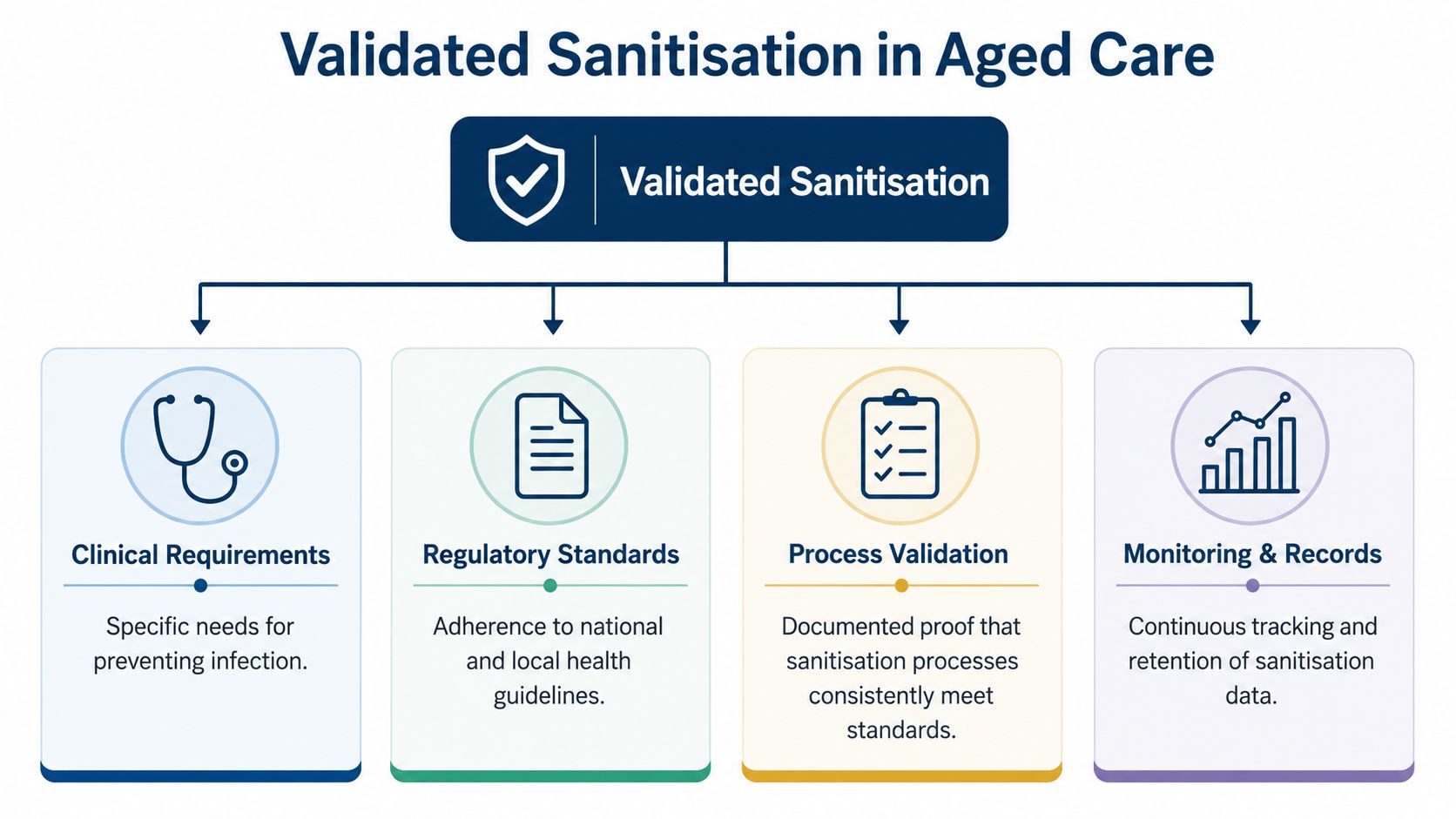
A standard commercial dishwasher can wash visibly clean items. That alone doesn't make it the right choice for aged care. The higher bar is validated sanitisation, meaning the process is documented, repeatable, and suitable for environments where hygiene assurance matters more than convenience features.
What validated sanitisation means in practice
For aged care operators, the key issue isn't whether a machine has lots of wash programmes. It's whether the sanitisation outcome can be relied on day after day, by different staff, under real operating conditions.
That usually pushes the conversation toward:
- Documented wash performance
- Stable cycle delivery
- Simple controls that reduce operator error
- Monitoring and record-keeping capability where required
Machines such as the Rhima Med Sparkle and DVS Washer Disinfector are relevant here because they're designed specifically for healthcare and aged care environments where hygiene requirements are higher than in a typical commercial kitchen. A common consideration is that these applications value sanitisation assurance and consistency ahead of novelty.
Why compliance changes the buying criteria
New Zealand's regulatory context makes reliability and process control more important. A regulatory audit conducted by the Ministry of Health requires every aged care provider to undergo a full audit at the end of each certification period, which can range from six months to five years depending on performance scores against eight high-risk areas, seven general factors, and three other matters. This matrix-based certification system scores providers on a 0–5 scale, according to the Treasury New Zealand aged care regulation case study.
That doesn't mean every warewasher decision is made by audit criteria alone. It does mean equipment should be chosen with compliance resilience in mind. If a machine is difficult to operate properly, sensitive to site conditions, or inconsistent in daily use, it creates avoidable risk.
Reliable sanitisation is more valuable than a long menu of specialist cycles that staff rarely use.
Site conditions still matter
Even the right machine can struggle if water quality, chemicals, or setup aren't aligned. Hard water is a good example. It can affect rinse results, internal scale build-up, and long-term performance. For operators reviewing installation risks, Purecowater hard water test insights are a useful reference point when assessing whether site water conditions need attention.
Chemical choice matters too. The machine, detergent, rinse aid, and sanitising process need to work together as a system, which is why many operators also review their commercial cleaning chemicals for New Zealand kitchens and care environments at the same time as the warewasher itself.
For some applications, a heavy-duty general commercial unit may still have a place for oversized items or specific back-of-house tasks. For example, the Rhima RP-4 Pot & Utensil Washer is described as a powerful, highly durable, simple-to-use and easy-to-maintain front loaded warewasher with a large wash chamber, a counterbalanced split door, and a heat recovery unit. That type of durability and straightforward operation can be useful. The critical question is whether the application calls for a general warewasher or a healthcare-specific sanitisation solution.
The True Cost of Unreliability
The purchase price of a warewasher is visible. The cost of unreliability usually isn't. That cost shows up later in disrupted meal service, rushed manual handling, staff frustration, emergency callouts, and avoidable compliance pressure.
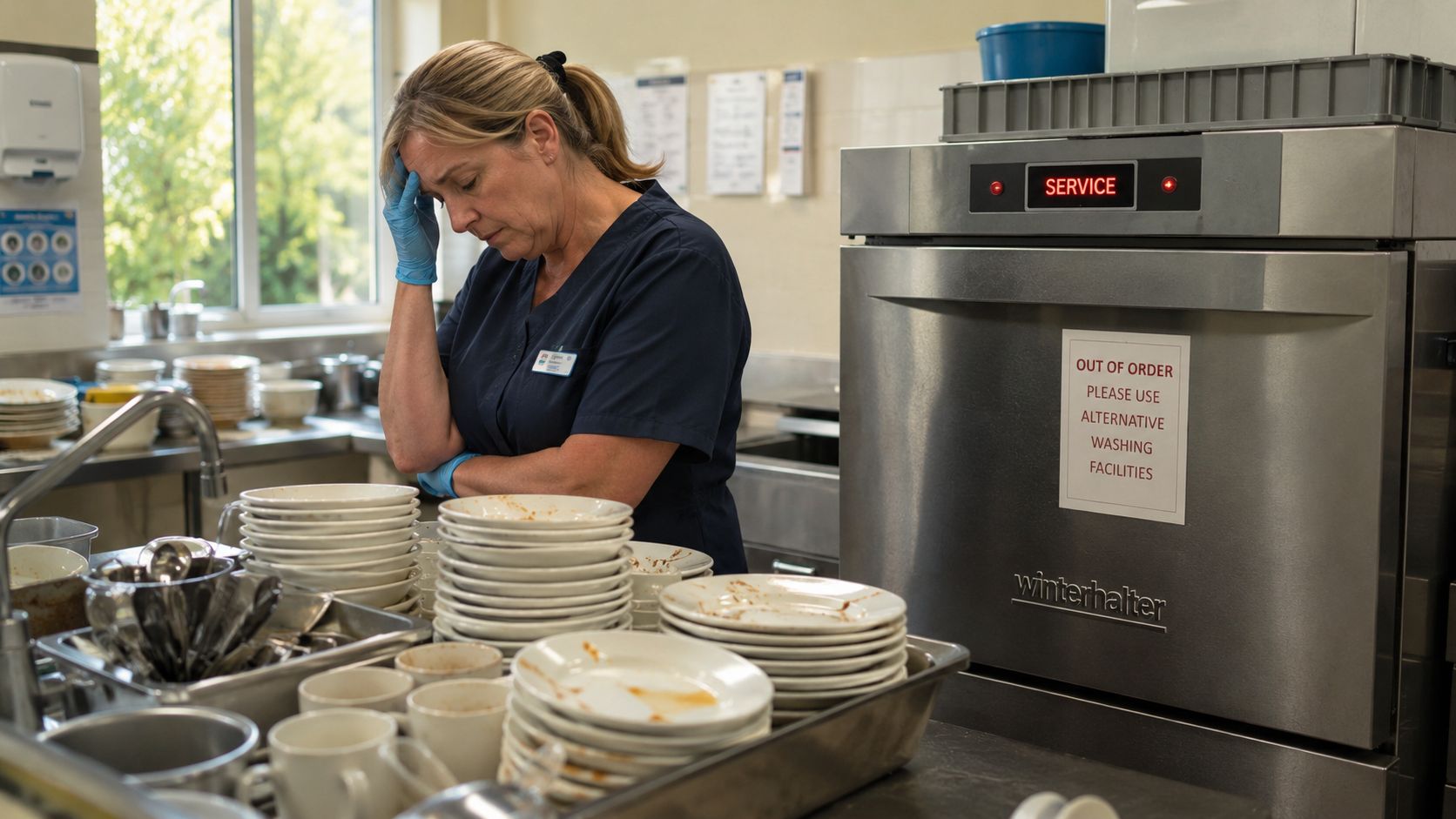
In aged care, downtime creates a chain reaction. The kitchen team doesn't just lose a machine. The facility loses time, certainty, and breathing room. Staff then have to compensate somewhere else, often in the middle of already fixed care schedules.
Downtime hits more than the kitchen
New Zealand staffing realities make this sharper. Carers often travel over an hour to reach aged care facilities in some regions, meaning delayed equipment disrupts tightly scheduled personal care routines like dressing and showering, forcing facilities to prioritise reliable, always-functioning equipment over feature-rich but less dependable alternatives.
That matters because a dishwasher failure doesn't stay isolated. It can affect handover timing, break coverage, meal pacing, and the ability to recover the rest of the day's work. Many aged care operators find that an easy-to-run machine is part of staffing resilience, not just convenience.
Complexity often increases the wrong kind of risk
Feature-heavy machines can look attractive on paper. In practice, they can introduce more menus, more settings, and more chances for inconsistent use. If the machine depends on experienced operators to get the right result every time, it may not suit an environment with varied shifts and changing staff familiarity.
A common issue seen in busy care settings is that complexity gets tolerated during procurement and regretted during operation.
- More options can slow decisions: Staff pause, second-guess settings, or default to the wrong cycle.
- Extra controls can complicate training: New or casual staff need quicker confidence, not longer induction.
- Sensitive systems can increase service dependence: If minor faults halt operation, uptime suffers.
The safest machine in aged care is often the one that keeps doing the same critical job properly, regardless of who is on shift.
Prevention is cheaper than recovery
Reliability isn't just about brand reputation or build quality. It also comes from maintenance planning, water treatment where needed, correct chemical setup, and routine operator checks. Teams wanting a structured approach to uptime may find RCM reliability centered maintenance useful as a general maintenance framework.
Many operators also benefit from thinking about warewashing the same way they think about refrigeration on peak service days. If the machine fails at the wrong moment, the whole operation absorbs the stress. That's why reliable equipment protects your busiest trading days, and in aged care, the operational demands are more acute because the day isn't built around customer turnover. It's built around resident care.
Essential Features vs Nice to Haves
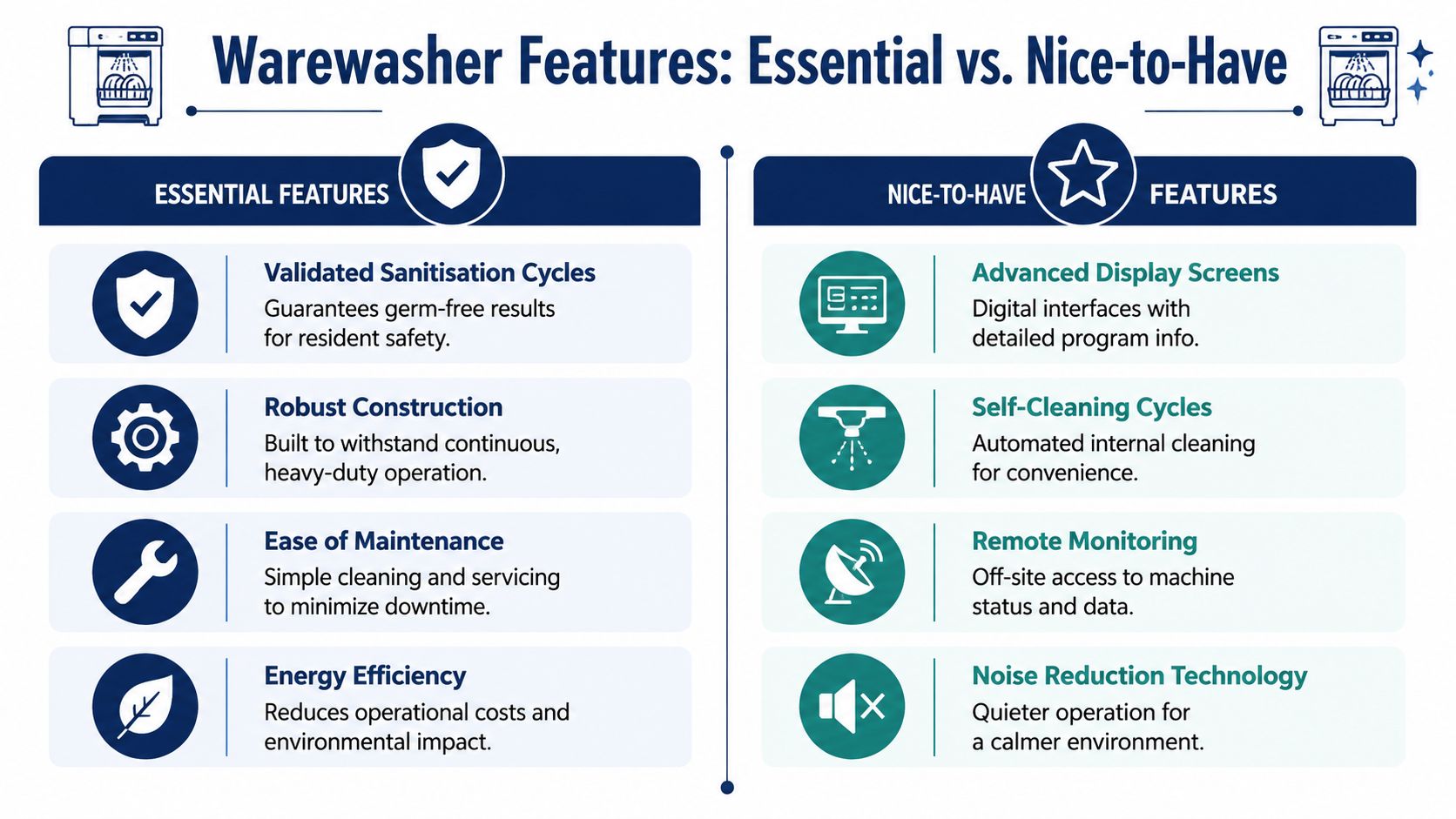
The phrase reliability vs features in aged care warewashing can be misleading if it suggests features don't matter. Some features matter a great deal. The issue is whether a feature supports sanitisation, consistency, and daily usability, or whether it mainly adds complexity.
Features worth prioritising
The most valuable features in aged care usually aren't flashy. They're the ones that protect process integrity.
| Essential for aged care | Why it matters |
|---|---|
| Validated sanitisation cycles | Supports hygiene-critical use |
| Straightforward controls | Reduces operator error |
| Robust construction | Better suited to daily repetitive use |
| Consistent wash performance | Helps standardise results across shifts |
| Easy access for cleaning and servicing | Supports preventative maintenance and uptime |
Machines such as the Rhima Med Sparkle and DVS Washer Disinfector fit this logic. They're designed for healthcare and aged care use, where documented sanitisation performance and dependable operation matter more than a long list of occasional-use programmes.
Features that often matter less than buyers expect
Some functions are useful in selected sites, but they shouldn't dominate the buying decision:
- Large numbers of wash programmes: Helpful only if staff actually need and consistently use them.
- Advanced display interfaces: Attractive, but not automatically better for training or compliance.
- Remote connectivity: Can assist monitoring, though it won't compensate for poor application fit.
- Specialist convenience modes: Worth considering only if they solve a real operational problem.
One factor often discussed is whether a feature saves effort every day or only looks good during a demo. In aged care, the answer tends to be clear quite quickly.
Why consistency beats novelty
The case for dependable systems is supported by broader care quality work. Reliability in nursing home standards has been validated through rigorous statistical analysis, with inter-rater reliability coefficients ranging from 0.93 to 0.96, indicating extremely high consistency in how care quality is assessed, according to the study on reliability of nursing home standards.
That doesn't turn a warewasher into a clinical instrument by default. It does reinforce an important principle. In care environments, consistent and dependable systems are easier to assess, easier to trust, and easier to build process discipline around.
Buying lens: If a feature doesn't improve hygiene assurance, uptime, or ease of operation, it may be a distraction.
For operators comparing mainstream dishwasher ranges, a side-by-side review proves helpful. Looking at dishwasher range features and benefits across commercial models can clarify which features effectively support the task and which ones are better suited to conventional hospitality use.
Your Aged Care Warewasher Buying Checklist
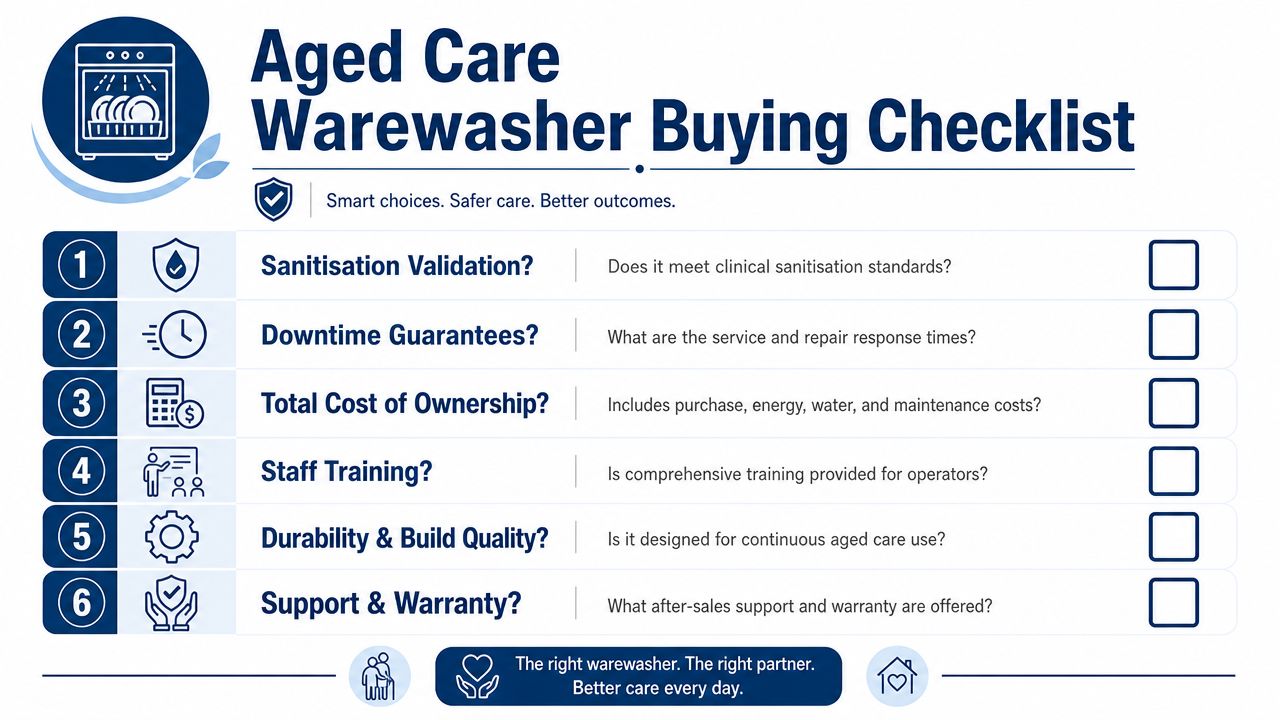
Aged care buyers usually make better decisions when they stop asking, “What can this machine do?” and start asking, “What happens if this machine becomes part of our daily care risk?” That shift leads to better supplier conversations and fewer surprises after installation.
Questions to ask before comparing quotes
Start with the application, not the brochure.
-
Is this machine suited to healthcare or aged care use?
Not every commercial warewasher is intended for hygiene-critical environments. -
How is sanitisation validated or documented?
Ask what evidence, controls, or records support the sanitisation process. -
What daily tasks does staff need to perform?
Filter cleaning, chemical checks, loading pattern, startup, shutdown, and simple fault handling should all be clear. -
What happens when the machine stops?
Response process, parts access, and support expectations matter because downtime is costly even when it's brief.
Check the human factor carefully
One of the least discussed issues in aged care equipment selection is workforce variability. The identity of fragile warewashing staff in New Zealand's aged care sector is rarely addressed, and carers often travel over an hour from their local area to serve aged care facilities, leading to inconsistent staffing and higher training gaps.
That should influence the buying checklist directly.
- Can new staff learn correct operation quickly? If not, the machine may be too complex for the setting.
- Are the controls obvious under pressure? Small mistakes become more likely during busy shifts.
- Does the machine encourage the right routine? The best setups make correct use the easy option.
Review ownership, not just purchase
A common mistake is comparing machines by sticker price and cycle count alone. Long-term value usually depends on broader questions:
- Preventative maintenance: Is regular servicing practical and scheduled?
- Cleaning access: Can staff keep the machine in good condition without awkward dismantling?
- Water and chemical compatibility: Has the site been assessed properly?
- Support coverage: Is there a clear after-sales pathway if problems arise?
Many operators use a broader commercial dishwasher buying guide for New Zealand businesses as a starting point, then tighten the criteria for aged care by focusing on sanitisation assurance, operational simplicity, and support response.
Aged care doesn't need the most complicated machine. It needs the machine most likely to be used correctly every single day.
Choosing a Partner for Long-Term Success
The safest aged care warewashing decision usually looks less exciting on paper than a feature-heavy alternative. It often involves choosing the machine with the clearest fit for hygiene-critical work, the simplest operation, and the strongest chance of delivering the same result tomorrow as it did today.
This provides clarity on reliability vs features in aged care warewashing. The issue isn't whether features are good or bad. It's whether they support the core job. In this environment, the core job is dependable sanitisation, infection control support, easy daily use, and minimal disruption to care routines.
What a sound decision usually prioritises
The right solution depends on volume, layout, workflow, and the kinds of items being washed. But in most aged care settings, the strongest buying priorities are:
- Validated sanitisation
- Reliable daily operation
- Straightforward controls
- Preventative maintenance support
- Consistent wash performance over time
A standard commercial dishwasher may still suit some back-of-house tasks. But where hygiene requirements are significantly higher, healthcare-specific options such as the Rhima Med Sparkle and DVS Washer Disinfector deserve serious consideration because they're designed around the realities of care environments rather than general hospitality convenience.
The long-term view matters most
Many aged care operators find that the better investment isn't the machine with the biggest list of functions. It's the one staff trust, managers can support, and the facility can rely on during ordinary days and difficult ones.
Choosing well means treating warewashing as part of operational stability. That mindset usually leads to fewer compromises later.
If your team is weighing up warewashing options for an aged care kitchen, Simply Hospitality can help assess the application, workflow, and hygiene requirements so the shortlist reflects real operational needs, not just brochure features.