

Which Piece of Commercial Kitchen Equipment Saves the Most Labour?
The popular answer to Which Piece of Commercial Kitchen Equipment Saves the Most Labour? is usually “a commercial dishwasher” or “a food processor”. That answer is incomplete. The best labour-saving purchase is the machine that removes the largest recurring bottleneck in a specific kitchen, whether that bottleneck is warewashing, vegetable preparation, batch cooking, mixing, portioning, or unnecessary walking between poorly positioned stations.
New Zealand operators should measure the work before comparing appliances. Careers New Zealand records 16,374 kitchenhands at the 2018 Census and identifies dishwashing and kitchen cleaning as core duties across restaurants, cafés, hotels, bars, caterers, schools, universities, hospitals, and care homes. The same source gives a typical kitchenhand wage of approximately NZ$24 per hour (Careers New Zealand hospitality kitchen information). That makes repetitive manual work a commercial decision, not just an equipment decision.
Why There Is No Universal Labour-Saving Machine
A machine that saves a few seconds on an occasional task may have less value than one that saves several minutes on a job repeated throughout every service. A café with limited preparation may gain little from a large vegetable processor, while a sandwich operation preparing vegetables continuously could find that same category central to its capacity.
The practical calculation is:
Time per task × repetitions per day × true hourly labour cost = potential labour value tied up in that task
“True hourly labour cost” should reflect more than the base wage. Operators should consider overtime, training, recruitment pressure, and the cost of covering absences. Stats NZ describes the Labour Cost Index as a measure of changes in employers' labour costs while controlling for changes in the mix of workers, including pressures such as skill shortages, overtime-rate trade-offs, economic growth, and consumer inflation (Stats NZ Labour Cost Index information).
Start with the task, not the catalogue
Commercial kitchens lose staff time through many small, repeated activities:
- Preparation: Chopping, slicing, grating, dicing, peeling, and portioning.
- Processing: Mixing, blending, puréeing, and refining.
- Warewashing: Clearing, scraping, pre-rinsing, racking, unloading, and returning clean items.
- Cooking supervision: Turning, checking, adjusting, transferring, and monitoring batches.
- Movement: Walking between refrigeration, preparation, cooking, storage, and service areas.
The largest opportunity may not be the task that looks most technically impressive. A dishwasher might remove the greatest amount of work in a busy bar, while a Robot Coupe food processor could matter more in a high-volume salad kitchen. A bakery may gain more from a commercial mixer than either option.
Practical rule: The winning machine is the one that removes the most recurring paid minutes after setup, cleaning, loading, unloading, and maintenance are included.
Time released doesn't automatically become cash profit. It may reduce overtime, let existing staff complete preparation earlier, increase peak-period capacity, improve consistency, or delay the need for another hire. Operators assessing workflow and staffing assumptions can also use science-backed retail assessments as broader context, but the purchasing decision still needs local observation and timed measurement.
Warewashing and the Kitchenhand Bottleneck
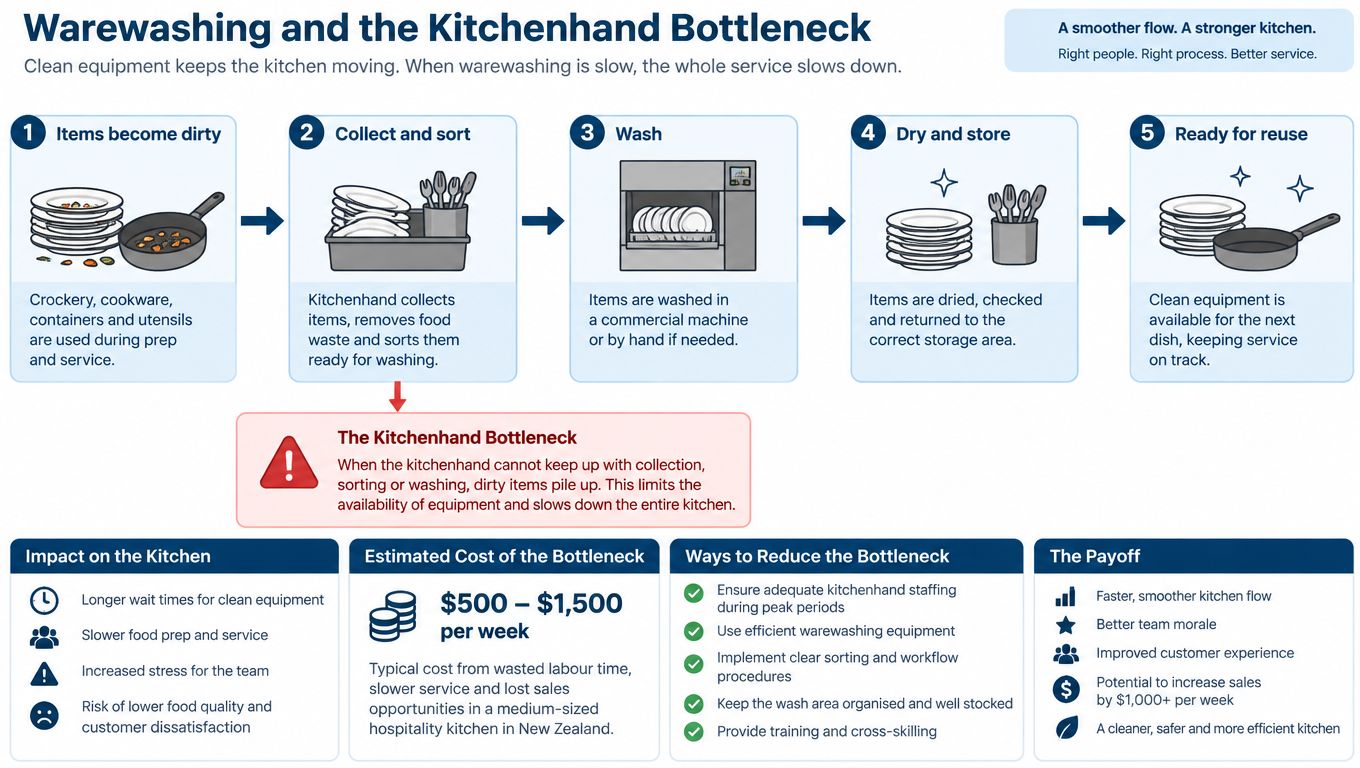
For many high-volume New Zealand kitchens, warewashing is the most continuous manual task. The work runs throughout service, and delays quickly affect plates, glasses, trays, utensils, and the staff who need them back.
The relevant workflow is:
Clear → scrape or pre-rinse → rack → machine → unload → return
A commercial dishwasher doesn't eliminate every step. Staff still need to clear tables or benches, scrape food waste, load racks correctly, unload clean ware, and return it to the right location. The gain comes from replacing manual washing, rinsing, and sanitising with a controlled machine process, while allowing staff to work through a more predictable sequence.
Capacity means completed ware, not cycles alone
A New Zealand pass-through dishwasher specification reports rapid wash cycles, while comparable rack machines are rated at approximately 80, 95, or 150 racks per hour, depending on configuration (Rhima RH60 pass-through dishwasher). Those ratings describe machine capacity, not guaranteed labour reduction.
A rack holds multiple plates, bowls, glasses, and utensils. The better question is how many completed place settings the team can process per labour hour after loading and unloading. A machine rated at 150 racks per hour may be unsuitable if the kitchen can't supply clean, correctly loaded racks quickly enough, or if the return path creates a queue.
Pass-through designs can help because scraping, racking, washing, and unloading follow a linear workflow. Heat-recovery options may remove the need for a separate extraction fan and reportedly reduce dishwasher energy costs by about 35%, but the supplier specification should be checked against the proposed site, ventilation requirements, and installation conditions.
When a dishwasher is the right answer
A rack or flight-type machine deserves serious consideration when:
- The dish area runs continuously: Staff spend much of service returning to washing, rinsing, or unloading.
- Front-of-house staff leave service: Wait staff or bar staff repeatedly wash items because the kitchen can't keep up.
- Manual washing needs a dedicated person: A commercial machine can target a large, recognisable kitchenhand workload.
- The peak is predictable: Dirty racks generated during the busiest 30-minute period can be measured, then compared with a machine whose rated capacity sits comfortably above that peak.
Manual dishwashing versus commercial equipment also involves chemical dosing, water temperature, hygiene procedures, bench space, drainage, access, and service support. The practical cost comparison should include all of those factors, not just the purchase price. Operators assessing the difference should also review manual dishwashing versus commercial dishwashers.
Combi Ovens and Active Cooking Supervision
A combi oven can save more productive labour than a dishwasher when cooking, regeneration, or end-of-service cleaning is the venue's bottleneck. Its value depends on the repetitive work it removes from the workflow, not on a universal claim about replacing staff or other equipment.
Commercial combi ovens combine steaming, roasting, baking, braising, frying, regeneration, and low-temperature cooking. Programmable recipes let an operator load a batch, select a validated programme, and work elsewhere while the cycle runs. Depending on the model and control system, adaptive controls can adjust cooking time, temperature, and humidity after the programme begins. The practical question is whether those functions match the menu and production pattern.
Active supervision versus batch management
Traditional cooking can keep a skilled operator tied to a grill, pan, oven, or pot. They check progress, adjust heat, turn product, manage timing, and transfer food between stages. A programmable combi oven changes that work into loading, programme selection, verification, and unloading, leaving the operator available for other tasks.
That arrangement suits consistent batch production in hotels, caterers, schools, hospitals, and aged-care facilities. Restaurants may also benefit when they regularly switch between steaming, roasting, baking, and regeneration, particularly if one programmed unit can replace several separate cooking steps.
Automatic washing belongs in the labour calculation too. A combi oven with an automatic cleaning cycle can reduce scraping, chemical handling, supervision, and post-service restoration. Manufacturer material describes automatic cooking programmes, adaptive cooking controls, and automatic washing. Those are manufacturer-specific workflow claims, not independent NZ field measurements (UNOX commercial combi ovens).
Where a combi oven earns its space
A 10-tray configuration may suit a restaurant, hotel, caterer, school, or aged-care kitchen producing batch meals, provided its capacity matches the menu mix and peak demand. One published comparison found that a 10-tray ENERGY STAR-certified electric combi oven used up to 52.2% less energy than an electric commercial grill under a modelled workload of 50 kg of food per day over 10 years. That result describes energy use under a modelled workload, not a guaranteed labour saving.
Before investing, record active minutes per batch, monitoring time, cleaning time, the appliances the combi oven would displace, and meals produced per paid labour hour. A suitable UNOX or Convotherm combi oven can produce strong labour savings when its programmable functions are used often. If staff still cook small, irregular batches manually, the same machine may occupy capital and space without removing much work.
Food Preparation and Repetitive Manual Tasks
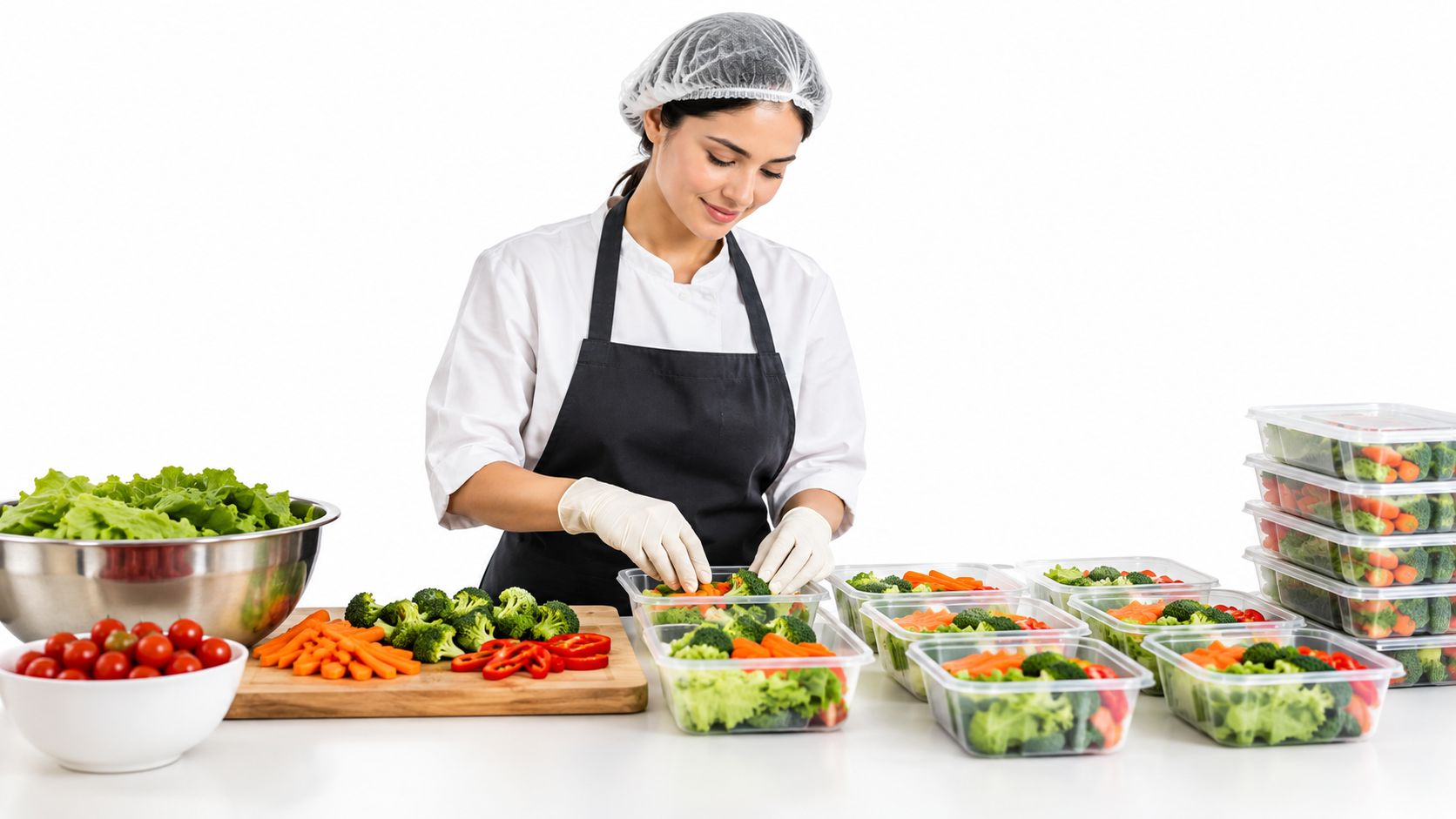
Food preparation equipment earns its keep when the same manual action occurs repeatedly and consistently. Slicing a few onions by hand isn't the same labour problem as preparing vegetables for a large salad, sandwich, catering, or institutional production run.
Robot Coupe is a strong example for kitchens that regularly slice, grate, chop, or process vegetables and other ingredients. A food processor can standardise the action and reduce repetitive knife work, but operators still need to select the correct disc, blade, batch size, loading method, and cleaning procedure. Dicing capability also depends on the appropriate configuration and product.
Match the machine to the menu
A salad and sandwich operation may spend hours on vegetable preparation. In that environment, a Robot Coupe food processor or suitable Fimar preparation machine can remove substantial repetition. A small café with limited daily prep may gain little from a large machine if staff spend more time setting it up, washing it, and storing it than they would spend preparing the ingredients manually.
Other equipment may be the better answer:
- Commercial mixers: Bakeries, pizzerias, and production kitchens can use them to remove repeated mixing and dough-development work.
- Stick blenders: Soups, sauces, purées, and batch preparations may justify a high-duty model.
- Commercial blenders: Smoothies, drinks, sauces, and fine blended preparations can create a regular processing bottleneck.
- Meat slicers: Delis, cafés, and sandwich operations may reduce repeated slicing work where volume justifies the setup.
- Potato peelers: High-volume kitchens can assess peeling as a separate recurring task rather than treating it as general preparation.
- Meat tenderisers: Butchery and production kitchens may gain capacity where tenderising is frequent and standardised.
The comparison should be between active manual minutes and active machine minutes, not between a machine's headline output and an idealised hand process. Robot Coupe food processors and labour considerations provide a useful framework for making that comparison without assuming a universal result.
Calculating Your Equipment Payback Period
A purchase needs a local calculation. Before requesting a quote, staff should record the task over representative services rather than relying on memory or a supplier's general performance claim.
A useful worksheet includes:
- Task: Name the activity precisely, such as slicing cabbage or washing dinnerware.
- Minutes per occurrence: Record active staff time, not just elapsed machine time.
- Occurrences per day: Include normal and peak service patterns.
- Staff involved: Note whether one person performs the task or several staff interrupt other duties.
- Peak-period impact: Record queues, delayed service, or missing clean equipment.
- Current labour cost: Use the relevant loaded hourly employment cost.
- New machine time: Include loading, unloading, programming, setup, and cleaning.
- Capacity created: Decide whether the released time reduces overtime, supports more production, or gets redeployed.
Illustrative Business Example
The following example uses illustrative assumptions only.
| Metric | Manual Process | Automated Process | Difference |
|---|---|---|---|
| Active staff time per day | 90 minutes | 30 minutes | 60 minutes released |
| Labour value per day | 1 hour × true hourly cost | 0.5 hours × true hourly cost | 1 hour × true hourly cost |
| Operating days | Selected local operating days | Selected local operating days | Released hours multiplied by operating days |
| Annual labour capacity | 90 minutes × operating days | 30 minutes × operating days | 60 minutes × operating days |
The calculation is:
60 minutes released per day × true hourly labour cost × operating days = annual labour capacity created
The result represents capacity, not guaranteed profit. If the freed time is redirected to preparation, cleaning, service, or production, the business may gain operational value without removing a position from the roster.
For a planning estimate, an operator can calculate:
Equipment cost ÷ monthly labour value created = approximate payback period
That estimate should include chemicals, electricity, servicing, finance costs, training, replacement parts, and any extra time needed for cleaning. A more detailed formula for discounted payback can account for the timing of cash flows, but a simple local model is often enough to reject an unsuitable machine.
Measure net time, not brochure time: A machine that saves preparation minutes but adds substantial setup and cleaning may create less labour capacity than expected.
The same approach applies to mixers. Operators considering whether a spiral mixer is justified can compare the equipment cost with local labour value using the hand-mixing comparison for spiral mixers. The calculation should still be tested against actual batch frequency and cleaning requirements.
Labour Substitution Versus Labour Gain
A labour-saving machine does not need to remove a rostered position to pay its way. In many New Zealand kitchens, the practical result is labour gain: the existing team serves more covers, completes more production, or maintains consistency through a difficult shift.
MBIE's 2024 hospitality-related sector report estimated 12,200 kitchenhands in 2022, within an uncertainty range of 9,200 to 15,200. Kitchenhands accounted for 13.82% of the sector's estimated 88,300 employees (MBIE hospitality-related sector report). That makes repetitive warewashing, preparation, lifting, and cleaning tasks sensible targets for equipment investment.
Unlike an AI project, which the MBIE 2025 workforce survey indicates can stall without management support, physical equipment needs practical training, maintenance, clear procedures, and staff acceptance. Those requirements still affect the return.
What labour gain looks like in practice
A programmable cooking system can let a less experienced operator follow a validated programme while a senior cook handles another task. A commercial dishwasher can keep clean ware moving during a peak, reducing the need for front-of-house staff to leave customers. A food processor can allow one prep cook to complete several repetitive jobs while another handles deliveries, stock rotation, or service preparation.
Measure the operational result, not just the machine's cycle time:
- Meals or covers per paid labour hour
- Rework and preparation errors
- Training time before independent use
- Peak-period throughput
- Absence and split-shift resilience
- Cleaning and maintenance interruptions
Food-waste monitoring shows why claims need careful testing. Industry-provider material cited in the NZ workforce source reports 40–70% waste reductions within 6–12 months and 2–8% food-cost savings for users of AI-enabled monitoring. Treat those figures as claims to validate, not as a local benchmark. For equipment decisions, the more dependable measure is labour minutes per meal or cover, alongside the effect on service flow. The right machine addresses the venue's largest repetitive bottleneck, rather than chasing a universal labour-saving winner.
Workflow Design and the Limits of Automation
A machine can't repair a poor workflow by itself. A dishwasher positioned away from the clearing point may create repeated carrying, while a food processor placed far from refrigeration and preparation benches can turn a fast process into a walking exercise.
The same applies to refrigeration. A fridge positioned beside the prep station can reduce repeated movement and handling without automating the task. Correct underbench storage, an appropriate landing bench, and a clear return path may protect more labour capacity than buying a larger appliance.
Follow the work before choosing the machine
Operators can use a straightforward sequence:
Observe → time → identify the bottleneck → choose the solution → measure again
The observation should include the busiest service, not only a quiet period. Staff should record where they wait, where dirty or prepared items accumulate, and where one task interrupts another. A machine that performs well in isolation may still create a queue if the surrounding benches, racks, power, drainage, ventilation, or storage aren't suitable.
Installation also affects the ownership calculation. Operators should confirm access routes, electrical requirements, water and drainage connections, ventilation, floor space, service access, chemical storage, and cleaning procedures before committing to equipment. Reliability matters because a failed dishwasher, oven, or mixer can force staff back into the manual process at the worst possible time.
A common issue is sizing equipment for average demand rather than peak demand. Undersized equipment creates queues and overtime, while oversized equipment can consume space, capital, and attention without removing enough paid work. The right solution depends on the venue's menu, service model, staff capability, layout, and the task that consumes the most recurring time.
Kitchen workflow design that saves time on every service can help operators assess the relationship between equipment placement and labour. The final decision should be based on measured net minutes released, not the most automated specification.
Simply Hospitality supplies commercial food processors, dishwashing systems, combi ovens, mixers, and related kitchen equipment for New Zealand hospitality and institutional operators. Visit Simply Hospitality to discuss the recurring task consuming the most staff time and find a suitably sized solution for the venue's workflow, installation requirements, and operating model.