


Best Dishwashing Detergent: What Commercial Kitchens Need
Is the best dishwashing detergent really the strongest chemical on the shelf, or is the answer the product that works reliably with a particular machine, water supply and food load? For New Zealand hospitality kitchens, detergent is only one part of a validated warewashing system. The right choice must suit the dishwasher, dosing equipment, wash temperature, rinse programme, water conditions and documented operating procedures, while producing clean, safe ware at the correct dose.
That applies to cafés, restaurants, hotels, caterers, schools, hospitals, aged-care kitchens and marae. A detergent that performs well in one site may leave another site with cloudy glassware, greasy plates, residue or excess foam. The practical answer is to assess the whole process before changing chemistry.
Why There Is No Single Best Dishwashing Detergent
Which detergent gives the best result in a commercial kitchen? The one that fits the whole warewashing system: the machine, the water, the soil load, the dosing setup and the way the site is run day to day. A busy restaurant washing greasy pots needs a different setup from a café putting mostly cups and plates through a glasswasher or undercounter machine. The label alone does not decide performance.
In New Zealand, warewashing sits inside a wider compliance framework. Food businesses operate under the Food Act 2014 cleaning framework, usually through a registered Food Control Plan or National Programme. The practical point for operators is clear. Premises need suitable facilities and equipment for cleaning and sanitising food-contact items, and dishwashers need to be used and maintained to the manufacturer's instructions.
That is why detergent choice should be treated as one setting within a validated process, not as a standalone fix. If rinse temperature is low, spray arms are blocked, racks are overloaded or the dispenser is out of calibration, changing to a harsher product rarely solves the root cause. It can leave you with residue, wasted chemical, damaged ware or extra load on the machine and, in some councils, unnecessary trade-waste pressure from poor dosing and excess carryover.
A simple rule helps here.
Practical rule: Change detergent after checking the wash system.
A sound specification usually covers:
- Machine compatibility, including the dishwasher's chemical requirements, cycle design and dosing method.
- Water conditions, particularly hardness and mineral content where spotting or scale is present.
- Soil load, such as grease, starch, protein, baked-on residue or lighter café soils.
- Ware type, especially delicate or premium glassware.
- Thermal control, because cleaning and sanitising are separate stages.
- Verification, including dosing checks, temperature records, staff training and documented procedures.
New Zealand guidance for commercial dishwashing has historically pointed operators to around 60°C for washing and 77°C for rinsing where the machine is being used to sanitise crockery, cutlery and equipment, as set out in the commercial dishwashing fact sheet.pdf). Those figures matter because detergent only does its part when temperature, contact time and mechanical action are also in range.
For a broader explanation of product roles, soil types and safe chemical selection, see understanding commercial cleaning chemicals. In practice, the best dishwashing detergent is the one that delivers clean, safe ware consistently on that site, at the correct dose, through a process the staff can repeat every service.
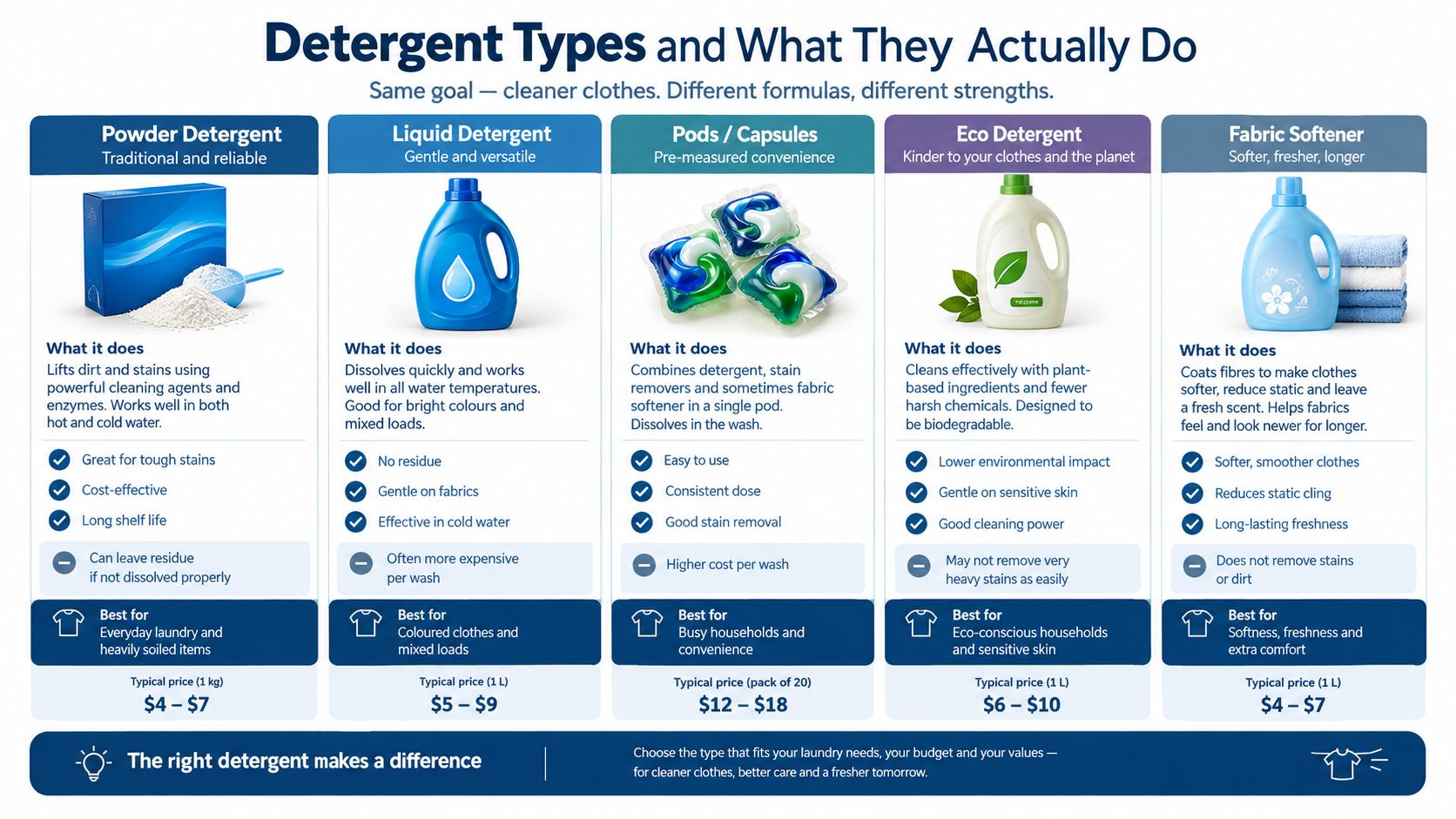
Detergent Types and What They Actually Do
Dishwashing products may look similar on a storeroom shelf, but they perform different jobs. Substituting one for another is a common cause of foam, residue, spotting, poor cleaning and avoidable equipment stress.
Commercial automatic dishwasher detergent
This is the primary wash chemical for commercial machines. It is designed to work with the machine's water volume, spray pressure, temperature, cycle time and dosing system. The formulation helps loosen and suspend food soils so the wash action can remove them from plates, pans, cutlery or utensils.
Commercial formulations are generally low-foaming because excessive foam can interfere with spray pressure and dosing. A manual dishwashing liquid, even one that cuts grease effectively in a sink, isn't a suitable substitute for an automatic machine unless the manufacturer specifically approves it.
Rinse aid
Rinse aid works during the final rinse rather than replacing detergent. It helps water run off ware and supports drying, and it can reduce visible spotting when correctly matched and dosed. Wet plates and spotted glasses don't automatically indicate weak detergent. The rinse-aid supply, water quality, final-rinse conditions and machine operation may be responsible.
Manual dishwashing liquid
Manual liquid is formulated for sink washing, where staff provide much of the mechanical action. It can be useful for pots, pre-soaking, utensils or items unsuitable for the machine, but it normally creates foam that automatic dishwashers aren't designed to handle.
Domestic tablets and powders
Domestic dishwasher tablets and powders are designed for household machines with different dosing, water volumes and cycle characteristics. They shouldn't be placed in a commercial dispenser or assumed to suit a hospitality dishwasher.
Glasswasher detergent and descaler
Glasswashers require chemistry appropriate to the machine and the glassware. Specialist products may be needed where the machine supplier specifies them. Descaler serves a different purpose again. It removes mineral scale during maintenance and isn't a substitute for detergent during normal washing.
The commercial cleaning products available in New Zealand should be assessed by application, label, SDS and machine requirements, not by the word “industrial” on the container.
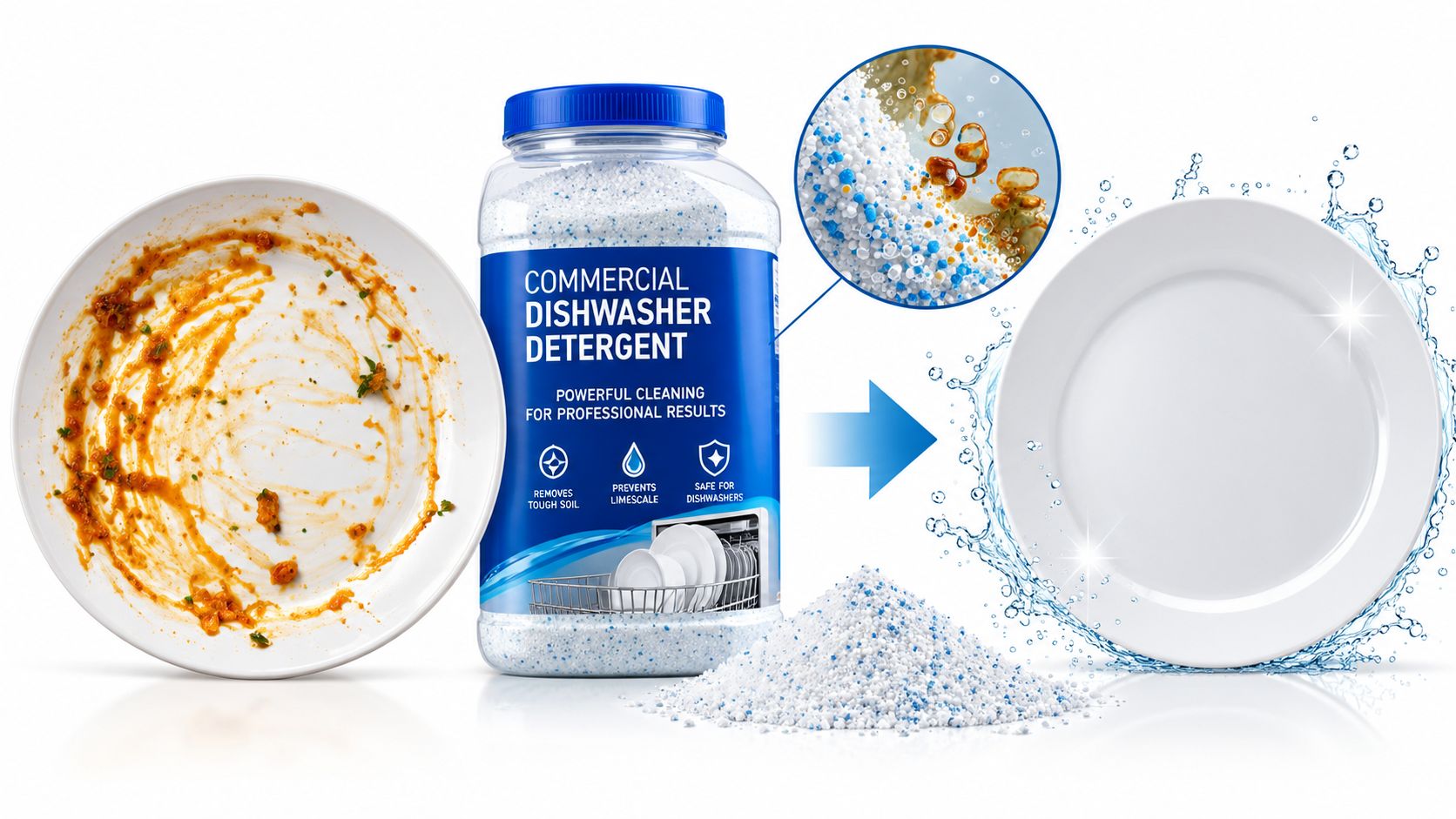
How Commercial Dishwasher Detergent Removes Soil
Why does one kitchen get clean ware from a moderate detergent, while another still has greasy plates after switching to a stronger one? In practice, detergent only works properly when it matches the warewashing system, the soil load and the machine's operating conditions.
Commercial detergent is part of a combined cleaning process. The chemistry helps loosen grease, protein, starch and other food residue. Heated wash water keeps those soils mobile. Spray pressure and rack layout then decide whether the solution reaches the surface that needs cleaning. If one part is off, changing detergent alone often gives a disappointing result.
The formulation matters because different soils behave differently. Surfactants improve wetting and help lift oily residue. Alkaline components support the breakdown of grease and baked-on food. Some products also include ingredients that reduce interference from minerals in the water or are tuned for specific ware, such as glassware versus mixed kitchen loads. Stronger chemistry is not automatically the right answer. It can leave residue, shorten ware life or fall outside the machine supplier's dosing and material guidelines.
A practical wash sequence looks like this:
- Food soil is removed or softened. Scraping reduces the load entering the machine.
- Detergent reaches the ware. Correct dosing allows the chemistry to work at the intended concentration.
- Heat and contact time support cleaning. The wash stage loosens grease, protein, starch and other residue.
- Mechanical action removes the soil. Spray arms, rack position and water pressure determine whether the solution reaches all surfaces.
- The final rinse supports sanitation and drying. Rinse aid may assist drainage and reduce spotting, but it doesn't replace detergent.
The machine still has to run within its specified conditions and within the temperature benchmarks outlined earlier. Final-rinse heat also helps clear detergent film from the ware and supports drying, which is why a machine can produce ware that looks chemically wrong even when the detergent itself is suitable. Detergent handles soil removal. Thermal sanitation happens in the final hot rinse as a separate control.
That split is useful when diagnosing faults. Greasy ware usually points to scraping, loading, dosing, wash temperature or spray action. Clean but wet or spotted ware usually points to rinse aid, water quality, final-rinse performance or maintenance. Regular checks of filters, nozzles, wash arms, heaters and chemical pickup lines matter, and good commercial dishwasher maintenance advice helps keep those controls aligned.
Diagnosing Poor Wash Results Before Changing Detergent
Why change chemical before you know which part of the warewashing system is failing? In commercial kitchens, poor results usually come from a mismatch between soil, machine setup, dosing, water condition and operator practice. The right check is sequential. Start at the dirty item and follow it through the validated wash process before blaming the detergent.
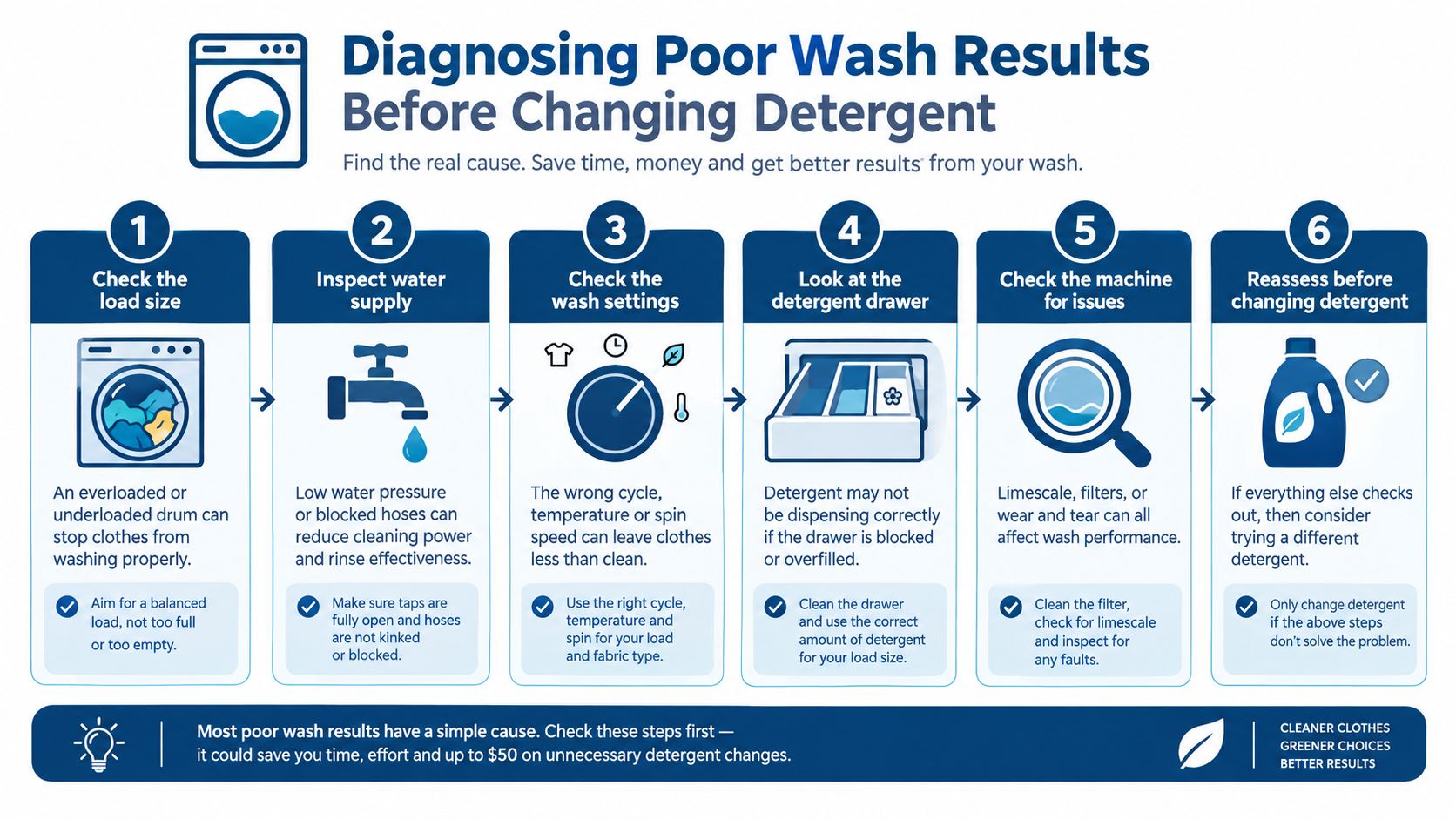
The troubleshooting sequence
-
Scraping and pre-rinsing
Remove heavy food soil before ware enters the machine. Thick grease, starch and baked-on residue can overload the wash cycle, while excessive pre-rinsing wastes water and can work against site efficiency targets. -
Correct racking
Rack ware so spray can reach all surfaces. Plates need spacing, cups need to drain, and cutlery needs open exposure to the wash. If racks are overloaded or items are nested, chemistry cannot reach the soiled area properly. -
Wash and rinse operation
Confirm the machine is reaching its intended wash and rinse conditions. Blocked spray arms, low water level, heater faults or interrupted cycles will all produce poor results with a suitable detergent. In practice, many misdiagnoses begin here. Operators swap product when the machine falls outside its designed operating window. -
Detergent supply and dosing
Check the basics first. Make sure the container has product, the pickup tube is seated correctly, and the dispenser is drawing and delivering chemical. Automatic dosing is more consistent than staff estimating quantities by eye, but only when the pump is set correctly for that machine, that product and that site's water conditions. -
Rinse aid performance
Separate the symptom before changing anything. Dirty ware points to a different fault from wet ware or spotted ware. If glassware is coming out marked, review the common causes of spotty glassware before increasing detergent, because rinse aid, mineral carryover and final-rinse performance often sit behind the finish issue. -
Water quality and machine cleanliness
Hardness, dissolved minerals, scale, blocked filters, dirty tanks and neglected wash arms all affect cleaning and finish. In New Zealand sites, water condition also matters beyond appearance. Poor control can increase chemical carryover, residue and unnecessary trade-waste load, especially when staff respond by turning up the dose instead of correcting the cause.
Record the symptom, the rack position and the cycle time before touching the chemistry.
That record matters because a recurring fault on one rack position often points to spray coverage or loading. A symptom that appears only at busy periods may point to interrupted cycles, poor scraping or a machine that is not recovering properly between racks. A symptom that appears mainly on glasses usually points operators back to rinse performance, minerals or machine cleanliness rather than detergent strength alone.
Overdosing can leave residue. Underdosing can leave food soil behind. A dispenser check, titration process where specified, and inspection of finished ware will give a more reliable diagnosis than watching the chemical level drop in the container.
Concentrated Detergent and Cost per Wash Cycle
Container price and operating cost are two different numbers, and the gap between them is where many kitchens overspend on chemistry. A concentrated detergent only saves money when it is matched to a validated warewashing setup, dosed correctly for that machine, and still delivers clean ware without extra handling, rewashing or discharge issues.
Start with the supplier's documented dosing and application instructions for the exact machine and site conditions. Then compare what the kitchen gets from each container:
- Container cost, using the invoiced purchase price.
- Container volume, in the unit stated by the supplier.
- Correctly dosed cycles, based on the machine, water condition and programmed setting.
- Rewash frequency, because failed racks add labour, water, heat and delay.
- Chemical use per rack or cycle, measured from the dosing system rather than guessed from how fast the drum empties.
- Staff intervention, including top-ups, pump adjustments and product swaps.
A worked example makes the point clearly. A $90 pail delivering 600 validated racks is the better buy than a $45 pail delivering 200 racks at twice the dose. Put the dosing sheet beside the invoice before reordering, and check that the result holds under normal service conditions, not just during a short supplier demonstration.
That matters in New Zealand kitchens because chemistry decisions do not sit on their own. If staff keep increasing detergent to force a result from the wrong setup, costs rise and so can residue, unnecessary chemical discharge and trade-waste load. The right question is whether the detergent, dispenser and machine are working together within the site's food-safety and operating requirements.
A useful site trial is practical and controlled. Use the same machine, similar rack loading, the usual soil pattern and normal operating periods. Assess wash results, rewash activity, chemical drawdown and ease of handling. Concentration is only part of the value calculation.
Automatic dosing removes much of the guesswork that comes with manual measuring, but it still needs routine checks. Inspect chemical lines, pumps, probes and pickup tubes, and make sure staff can identify detergent and rinse aid before replacing containers.
The wider real cost of manual dishwashing compared with commercial dishwashers also includes labour, water, heat, rework and workflow. Detergent cost per cycle only makes sense inside that full operating picture.
Water Quality and Its Impact on Detergent Performance
Water chemistry can change the result without any change to the detergent. Hard water contains calcium and magnesium that consume detergent performance and contribute to mineral films, spotting and scale. Increasing chemical concentration may raise consumption while leaving cloudy glasses if the underlying water condition remains unresolved.
New Zealand Ecolabelling guidance requires detergent directions to account for different water-hardness and soiling conditions, and recommends obtaining hardness information from the water supplier or local authority. That makes a site-specific water check more useful than assuming every Auckland, Wellington, Christchurch or regional supply behaves the same way.
Signs that water quality needs investigation
- Cloudy glassware can indicate mineral film, rinse-aid issues, unsuitable detergent or poor final-rinse conditions.
- Scale around heating elements and spray arms suggests mineral deposition that may affect machine operation.
- Spotting after otherwise clean cycles points towards water quality, rinse aid, drying or loading.
- Changing results between sites may reflect different water conditions rather than inconsistent staff effort.
The investigation should start with local hardness information or appropriate testing. If the results and symptoms support it, operators can assess softening, filtration or reverse osmosis with a qualified supplier. Treatment shouldn't be installed just because hard water is discussed, and detergent shouldn't be changed repeatedly without identifying the operating condition being corrected.
Water hardness can be expressed in different units. Tasman District Council explains hardness in milligrams per litre as calcium carbonate and notes that conversion to millimoles per litre can be made by dividing approximately by 100, as described in its water hardness information. That helps operators compare council information with chemical or dishwasher documentation, provided the units are checked carefully.
The reverse osmosis and warewashing article provides further context for sites where glass finish, mineral content and water treatment need to be considered together. The right response may be a water-treatment adjustment, a rinse-aid change, a descaling programme or a dosing correction rather than a stronger detergent.
Choosing the Right Detergent for Your Kitchen
The right choice depends on the kitchen's machine, soil profile and water. Product selection should begin with the dishwasher manufacturer's chemical requirements, whether the machine is a Classeq, Winterhalter, Rhima, Starline or another commercial system. No detergent should be treated as universally compatible.
Standard restaurant dishwasher
A standard restaurant should prioritise a low-foaming commercial machine detergent with supplier-confirmed dosing for the dishwasher and typical soil load. High grease and protein loads require attention to scraping, wash temperature, rack configuration and detergent delivery, not a more aggressive formula.
Glasswashing
Glassware needs a detergent and rinse aid combination appropriate to the glasswasher and the items being washed. Premium or decorated glassware may have specific manufacturer requirements, so compatibility should be confirmed before introducing a chemical. Visible spotting should trigger checks of rinse aid, water quality, loading and machine cleanliness.
Hard-water conditions
Where water testing and symptoms indicate hardness, the chemical programme should be reviewed alongside softening, filtration or reverse osmosis. Increasing detergent without correcting mineral interference is unlikely to provide a reliable finish.
Lower-volume operations
A lower-volume café or bar still needs commercial chemistry if it uses an automatic commercial machine. The key considerations may be correct storage, container shelf management, accurate dosing and staff familiarity, especially when chemicals are used less frequently.
High-soil kitchens
Hotels, caterers, hospitals, aged-care kitchens and large restaurants may face varied soils across a shift. Operators should document the usual load, identify exceptional residue such as starch or baked-on food, and confirm whether the selected chemical and machine programme are designed for that work.
Matthews Packaging & Hygiene dishwashing detergents, rinse aids and associated warewashing chemicals available through Hospitality should be assessed using the current product label, SDS and manufacturer information. Before purchase or substitution, verify:
- Intended application and machine format.
- Container size and storage requirements.
- Dosing guidance and dispenser compatibility.
- Water-condition recommendations.
- Safety information and handling controls.
- Any manufacturer claims relevant to the site.
New Zealand trade-waste guidance adds another selection consideration. Wairoa District Council explains that commercial wastewater discharges may require trade-waste consent and that kitchen sinks and dishwashers can discharge through a grease trap. Detergents dissolve grease, allowing it to pass through the trap, which can contribute to blockages, overflows, treatment-plant loading, public-health hazards and river pollution, as outlined in the Wairoa trade-waste guidance.
Chemical storage matters too. Waikato District Council recommends keeping cleaning chemicals in a designated area or enclosed cupboards away from food preparation, storage and display areas. Commercial detergents can be strongly alkaline, so staff should use the current manufacturer SDS and label for handling, storage, PPE and dosing information. Chemicals should remain in their original labelled containers, and staff should never mix cleaning chemicals unless the manufacturer explicitly instructs it.
A documented trial should record the machine, detergent, rinse aid, water conditions, soil load, dosing checks, wash and rinse temperatures, rewash observations and maintenance findings. That evidence gives the Food Control Plan a stronger foundation than a product ranking based only on label strength or container price.
Hospitality supplies commercial dishwasher systems, detergents, rinse aids and Matthews cleaning chemicals for New Zealand hospitality operations, with advice on matching products to machines, water conditions and workflow. Visit Simply Hospitality to review suitable warewashing options or contact the team for help selecting and validating the right setup.