


Choosing the Best Cafe Dishwasher for Your NZ Business
A lunch rush can expose a poorly chosen cafe dishwasher within minutes. Dirty plates and cups return together, the pre-rinse bench fills, clean ware runs short, and staff start moving backwards through the kitchen. The right machine isn't selected by daily dish totals alone. It should keep the wash area moving when the greatest volume arrives in the shortest period, while meeting New Zealand food-safety, plumbing, power and maintenance requirements.
For many cafés, a 500 × 500mm rack undercounter dishwasher is the practical starting point. Busy operations may need a passthrough machine, but the decision should follow the venue's peak workflow and site conditions. In our experience, the most useful comparison includes water, electricity, chemicals, labour and rewashing, not just the purchase price or advertised cycle speed.
Choosing a Dishwasher for Your Cafe's Busiest Hour
The first question for a cafe owner isn't how many dishes are washed over a full trading day. It's what happens when several tables finish at once, takeaway orders are being packed, barware returns from the service counter, and the kitchen still needs clean plates for the next wave.
A dishwasher that copes comfortably with quiet periods can still become a bottleneck during the busiest 60 to 90 minutes. Staff may stack dirty ware on the wrong side of the bench, delay scraping, or run partially filled racks to recover basic crockery. Those workarounds add movement and labour, and they can create pressure to rush loading or skip proper cleaning steps.
Practical rule: Size the machine around how quickly dirty dishes arrive during peak service, not the total number washed by closing time.
The ideal flow is simple:
- Dirty return: Plates, cups, cutlery and glassware arrive at one defined point.
- Scrape and pre-rinse: Food waste is removed before ware enters the rack.
- Wash: The rack moves through a correctly programmed commercial cycle.
- Clean landing: Washed items leave onto a separate clean bench or rack.
- Storage: Dry, clean ware returns to service without crossing back through the dirty area.
That sequence matters as much as the machine. A fast dishwasher placed too far from the dining room, bar or kitchen pass can still make staff walk unnecessarily. A smaller unit with a clear dirty-to-clean path may perform better for a compact cafe than a larger machine forced into an unsuitable corner.
A common issue we see is an operator choosing equipment after measuring only the available width. The dishwasher must also suit rack handling, bench space, door clearance, drainage, chemical storage and the movement of staff around it. Peak demand provides the starting point, then the kitchen layout determines whether the chosen capacity can be used consistently.
Sizing Your Machine for Peak Service Not Daily Volume
Daily covers and seating capacity can help describe a cafe, but they don't tell the whole warewashing story. A venue with fewer seats may experience a sharp return of plates and cups after a concentrated service period, while a larger site may spread its dish flow more evenly.
Start by observing the busiest service window and listing the ware that returns together. Count the racks required to prevent the dirty side from growing faster than the team can process it. The useful question is not “How many dishes are washed today?” but “How many complete racks must leave the wash area during the rush?”
Build a realistic rack estimate
A simple planning exercise should account for:
- Peak returns: Separate plates, cups, saucers, cutlery and barware that arrive during the busiest period.
- Rack pattern: Work out whether one rack carries plates, cups, mixed crockery or glassware. A mixed load may use space less efficiently than a dedicated load.
- Cycle time: A shorter cycle only helps if staff can scrape, load, unload and replace racks at the same pace.
- Holding space: Allow room for dirty racks before the machine and clean racks after it. Without that buffer, the rated capacity may not translate into usable throughput.
- Service interruptions: Include periods when staff open the machine, change chemicals, clear a blockage or deal with oversized items.
A cafe dishwasher's theoretical racks-per-hour figure isn't the same as the number of clean racks a team can produce during service. Loading technique, rack availability, pre-rinsing, staff allocation and the distance between the return point and storage all affect actual output.
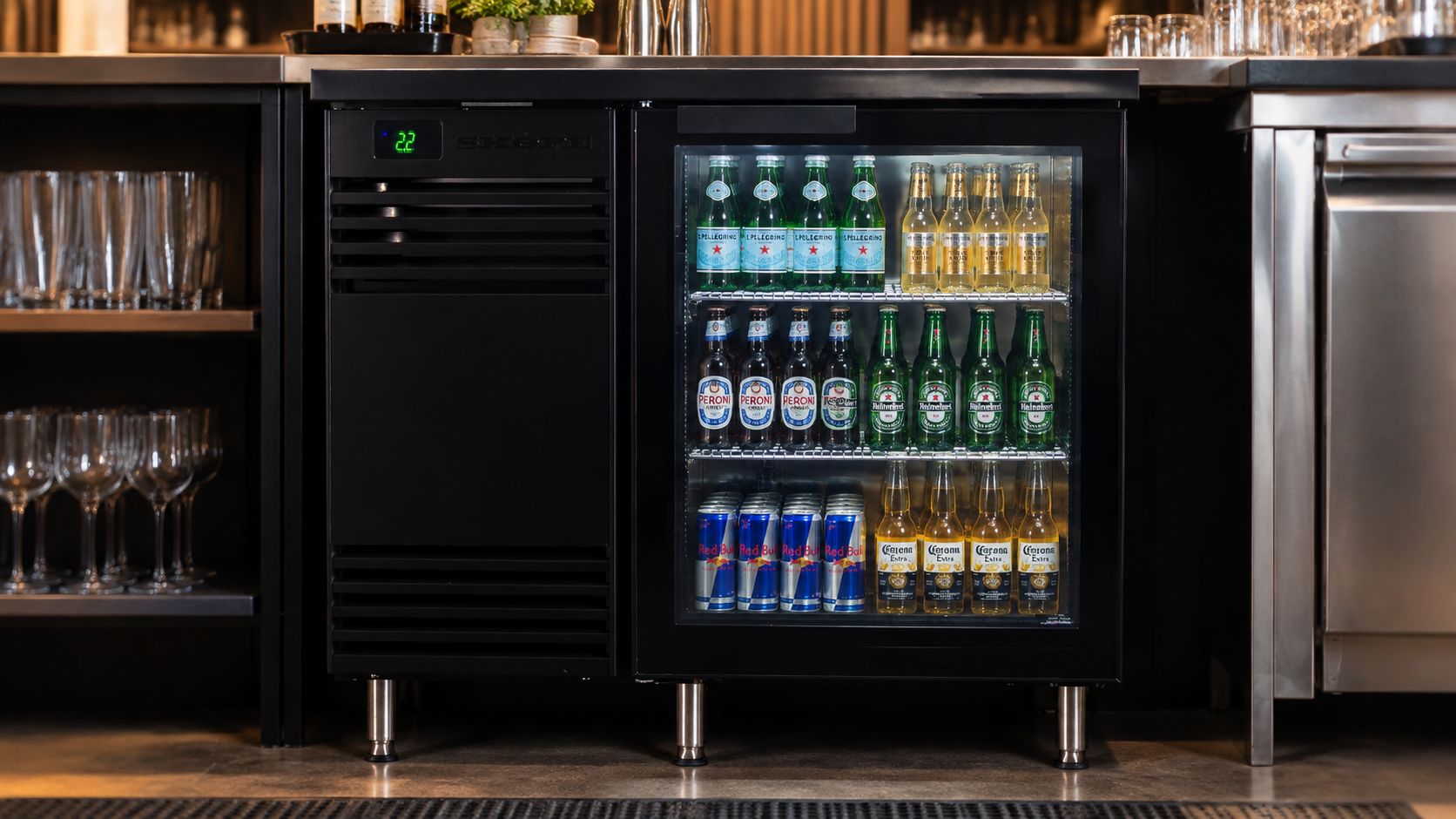
The same planning principle applies across the kitchen. For example, the SKOPE BackBar Glass Chiller - GC.1.GSW is a purpose-built bar cabinet whose door format, depth and left-hand configuration need to fit the service layout. It isn't a dishwasher, but it illustrates why equipment selection must account for the complete working area rather than one isolated specification.
A machine is only fast when the dirty return, rack handling and clean storage can support its cycle.
Operators should also distinguish between plate and cup washing and glasswashing. A glasswasher can suit a bar-led operation, while a cafe serving substantial crockery may need the versatility of a full dishwasher. The decision depends on what returns during the rush, not on the equipment label alone.
Undercounter vs Passthrough Dishwashers for Cafes
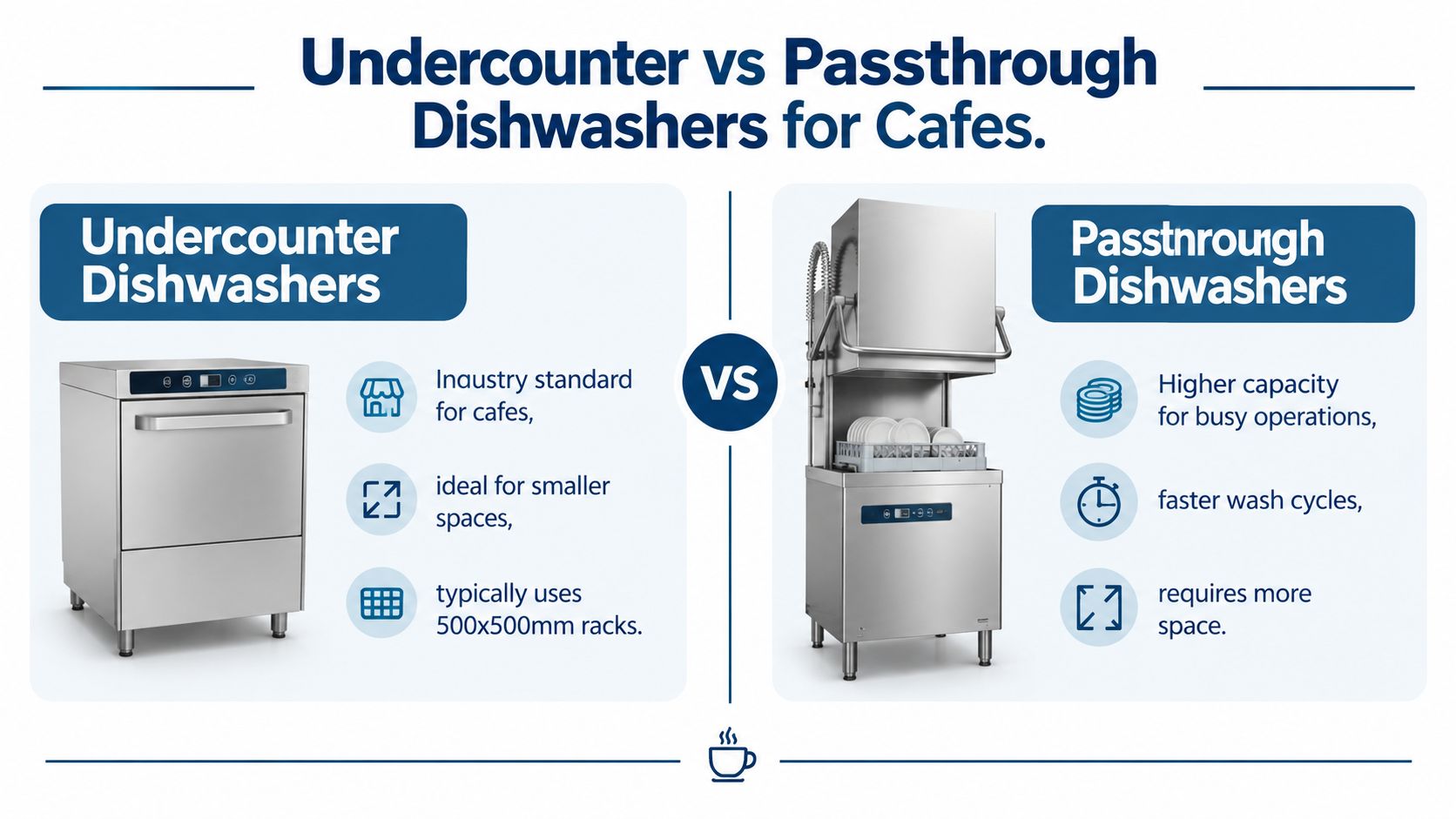
During a busy service, the right machine is the one that keeps racks moving without taking over the kitchen. For many cafés, a 500 × 500mm rack undercounter dishwasher is a practical starting format. It fits beneath a suitable bench, uses a compact footprint and can sit close to the dirty return. Starline, Classeq and Winterhalter provide established commercial options to compare against rack demand, available utilities and local service support.
When an undercounter machine fits
An undercounter unit generally suits a café where:
- Space is constrained: The wash area must share a compact back-of-house footprint.
- Rack flow is manageable: Staff can scrape, load and unload without dirty ware obstructing other work.
- Demand is moderate or uneven: The venue does not build a sustained rack queue during its busiest period.
- The layout is close to service: Clean crockery can reach the pass, bar or storage area without excessive carrying.
A consistent rack system also improves handling and storage. The Dishwasher Rack, Glass Rack 36 Compartments 500mm is listed as a stackable plastic glass rack with separate compartments and easy-grip indents. Match its compartment layout to the café's actual glassware, including the shapes and sizes returned during service.
Undercounter machines suit compact workflows, but staff still need enough bench space to stage dirty and clean racks. If that handling becomes the constraint, changing to a larger machine may improve output more than increasing the number of wash cycles.
When a passthrough earns its space
A passthrough, or hood-type dishwasher, becomes more appropriate when an undercounter machine creates a repeated queue during peak service. Its value comes from the station layout as well as the wash capacity. A dirty loading side, hooded wash area and clean unloading side can keep staff moving through the station instead of reaching repeatedly into a confined underbench space.
The installation needs more planning. Allow room for racks, benches, hood clearance, staff movement and drainage. Utility demand can also rise, depending on the machine specifications and operating pattern.
The New Zealand comparison illustrates why machine class matters. A commercial undercounter glasswasher operating at 30 cycles per hour and 2.5 litres per cycle uses about 75 litres per hour, or 600 litres during an 8-hour shift. A hood-type machine at 20 cycles per hour and 5 litres per cycle uses about 100 litres per hour, or 800 litres in a shift. These figures come from the New Zealand dishwasher water-use comparison. Compare capacity, rack flow and utility use together rather than choosing on throughput alone.
For guidance on choosing between equipment types, see glasswasher versus dishwasher guidance for different venues. A passthrough earns its space when peak rack volume and workflow justify the larger station.
Calculating the True Cost Per Clean Rack
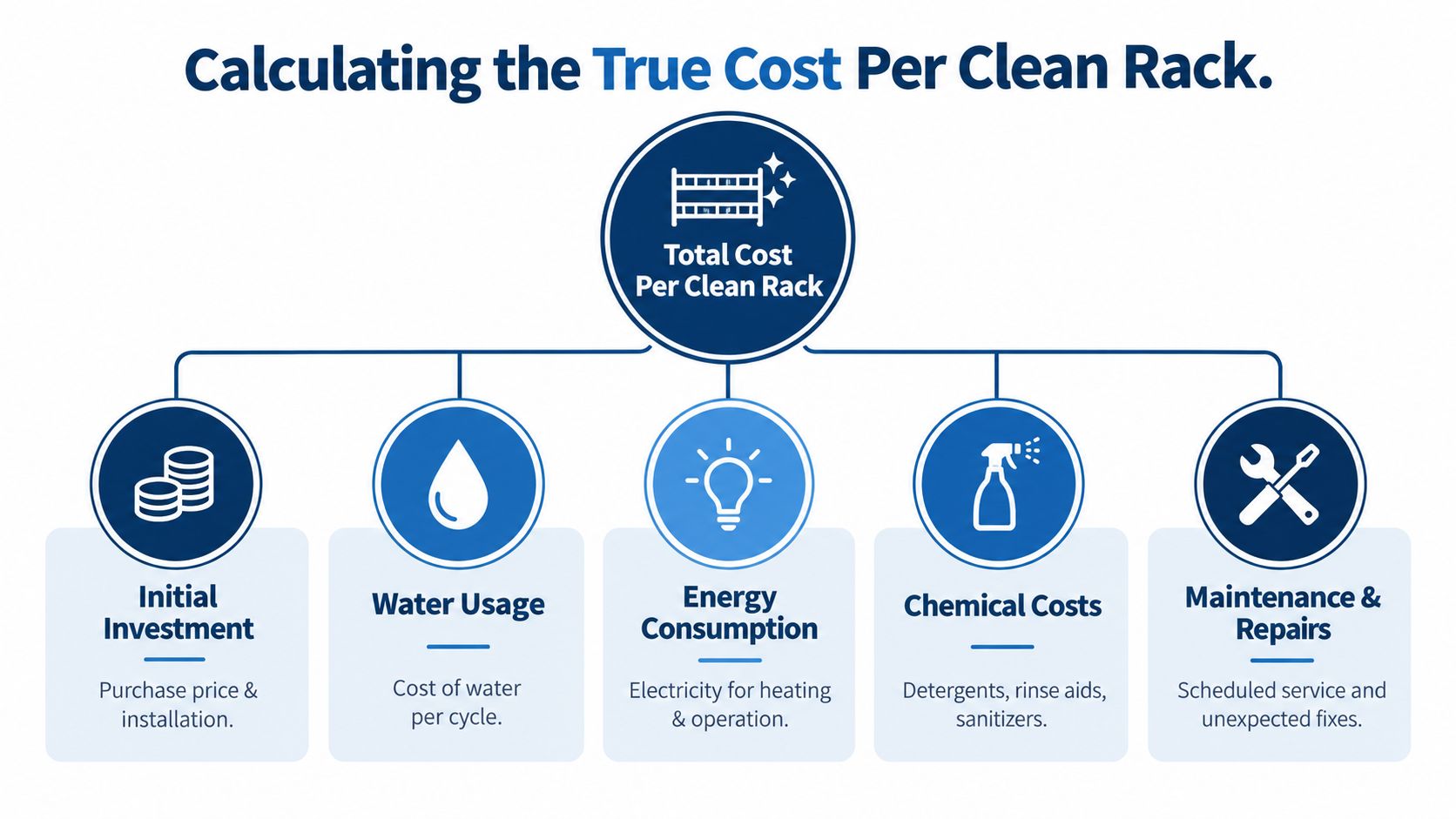
The sticker price tells a cafe what the machine costs to buy. It doesn't explain what each successfully cleaned rack costs to produce. That figure should include water, electricity, chemicals, labour and rewashing, with installation and ongoing support considered separately as ownership costs.
Five costs belong in the calculation
Water is easy to overlook where the lease doesn't show it as a separate bill. New Zealand business data records that 16.8% of hospitality operators paid for water as a directly itemised cost, while 99.4% used reticulated electricity, making it important to assess both utilities rather than ignoring water because it isn't visible on the invoice. These figures are reported in the BEES hospitality business data.
Electricity can be significant because the machine must heat wash or rinse water and recover temperature between cycles. Commercial guidance indicates wash water is generally about 55 to 65°C, while high-temperature final-rinse systems use 82 to 85°C for heat sanitisation without chemical sanitiser. A New Zealand calculator example shows about 75 litres of water per day and 31.4 kWh per day of heating energy, demonstrating why rinse temperature and recovery efficiency deserve close attention. The figures are detailed in the commercial dishwasher water and energy calculator.
Chemicals include detergent and rinse aid. Automatic dosing can reduce variation caused by manual measuring, but the settings still need to match the machine, water quality and soil load. Operators should also review the related dishwasher detergent guidance before comparing chemical consumption.
Labour includes scraping, pre-rinsing, rack loading, unloading, sorting and returning clean items to storage. A machine that needs frequent staff intervention may cost more to run even if its water figure looks attractive.
Rewashing is the cost most often missed. Cloudy glassware, food residue or poorly rinsed cups consume another cycle, more chemicals, additional labour and extra utilities. The manual dishwashing versus commercial dishwasher analysis gives this comparison useful operational context.
The best machine isn't necessarily the one with the lowest water use per cycle. It may be the one that produces more consistently clean racks with fewer interventions. That is why cost per clean rack is a stronger commercial measure than a single water or energy figure.
Key Technical and Installation Requirements
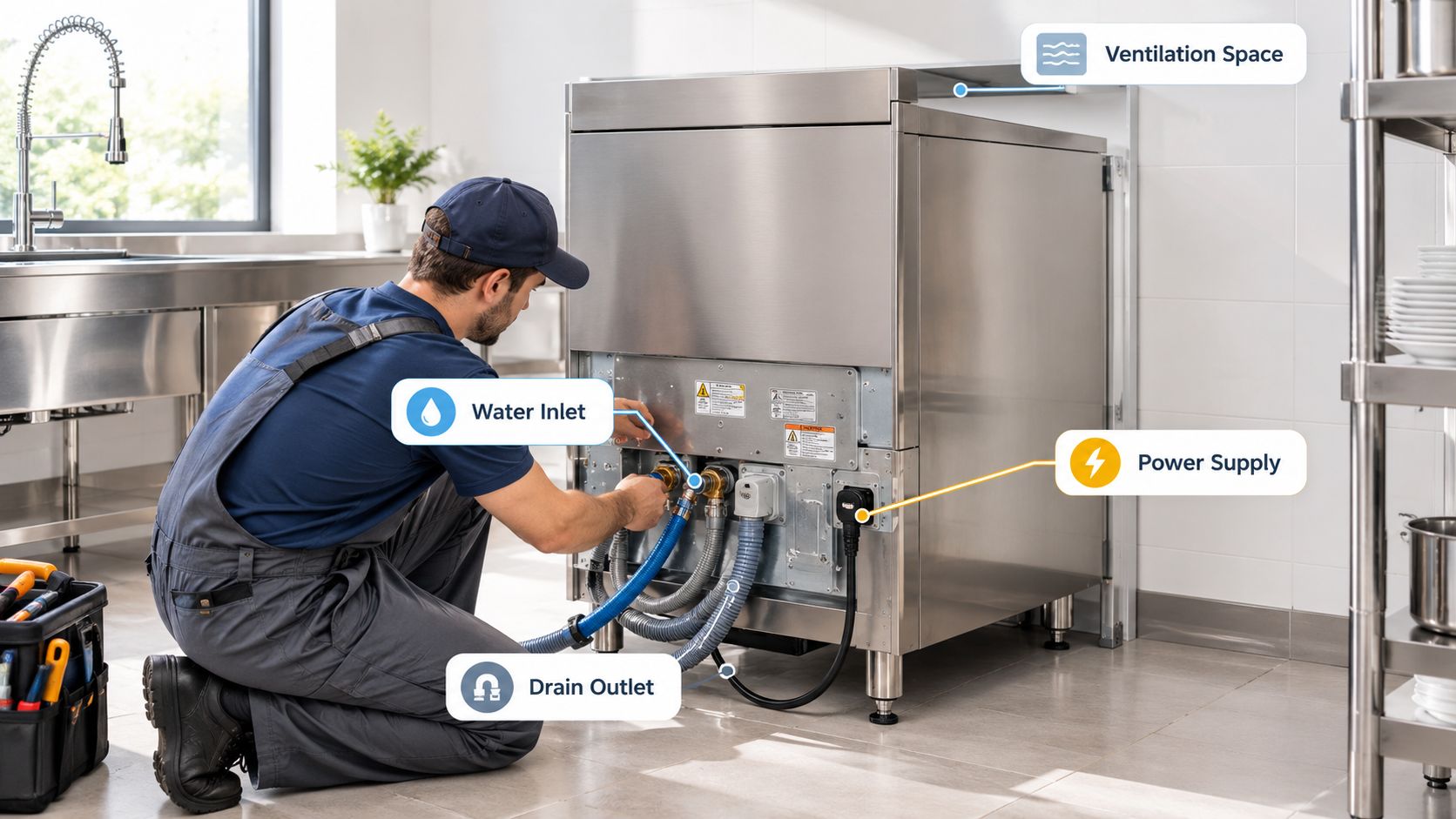
A dishwasher quote should be checked against the site before the order is finalised. The machine may be suitable on paper but unusable if the cafe lacks the required power supply, water connection, drain route or ventilation arrangement.
Confirm the utilities
Ask the electrician to verify whether the selected machine requires a dedicated 10-amp or 15-amp single-phase connection, or three-phase power. The correct requirement depends on the specific model, heating system and site supply. A machine that needs more electrical capacity than the premises can provide may require work before installation.
The plumber should confirm water inlet position, supply temperature, pressure, isolation access and backflow prevention. New Zealand food business guidance specifies an accurate thermometer and backflow prevention for plumbing connections, alongside the required wash and rinse conditions. The site also needs a practical way to receive and remove racks without crossing the clean and dirty paths.
Drainage requires particular care. Council guidance for food businesses can specify that dishwashers must not discharge through a grease trap, so the drain route should be confirmed before cabinetry and equipment are fixed in place. The same guidance treats dishwasher installation as both a food-safety and plumbing-compliance issue.
Check water quality early
Hard or mineral-rich water can leave scale on heating elements, spray arms, tanks and ware. Water quality can also affect detergent and rinse-aid performance, so the machine should be specified with the appropriate treatment where required. The water quality and dishwasher performance guide provides a useful basis for that discussion.
Ventilation and room conditions matter too. A high-temperature machine can add heat and moisture to a compact wash area, so the kitchen design should consider extraction and staff comfort. For broader advice on cost-effective commercial HVAC solutions, a cafe owner can review the linked installation resource while discussing the complete room environment with the relevant tradespeople.
Compliance Cleaning and Long-Term Servicing
During a busy service, a dishwasher can sanitise only when staff prepare ware correctly and the machine reaches the required conditions. New Zealand's food hygiene legislation sets a hot-water wash of at least 60°C, followed by a rinse of at least 77°C for 10 seconds.
Scrape food residue before loading, leave space for spray to reach every surface, and select the longest, hottest setting that achieves sanitising conditions. The machine must be capable of sanitising utensils, but the result still depends on loading, cycle selection and staff habits.
Daily habits protect results
At the end of each operating period, staff should follow the manufacturer's cleaning instructions. A workable routine includes:
- Remove debris: Empty filters and clear food particles before they harden.
- Inspect spray areas: Check spray arms and jets for blockage.
- Clean contact surfaces: Wipe seals, doors, handles and nearby benches.
- Check chemicals: Confirm detergent and rinse aid are connected and dosing correctly.
- Leave the machine ready: Complete the shutdown and draining procedure instead of leaving dirty water in the tank.
These tasks prevent residue, odour, blocked components and inconsistent washing. A machine rated for sanitising still requires correct operation and regular cleaning.
Keep a clear service plan before installation. Hospitality does not operate the machines or directly perform dishwasher servicing, so a breakdown response time should not be promised. Ask who will attend faults, which parts are held locally, and how the cafe will manage service if the machine is unavailable.
Starline, Classeq and Winterhalter are established commercial warewashing brands worth assessing, but brand choice alone does not guarantee convenient support. Parts availability, technician access and service arrangements can affect the total cost of ownership as much as the initial specification. In a cafe, a failed dishwasher can reduce crockery availability, redirect staff and disrupt the whole service flow.
Use this commercial dishwasher maintenance guidance to formalise daily care and planned servicing. Consistent records, clean equipment and a defined fault process also help operators pass health inspections and avoid fines. Over the machine's life, these controls protect cleaning performance and keep each clean rack from carrying avoidable labour and repair costs.
Your Cafe Dishwasher Purchase Checklist
Before ordering, walk the supplier, electrician, plumber and kitchen team through the busiest service period. Confirm:
- Peak demand: Count racks needed during the rush, not average daily volume.
- Format: Compare a 500 × 500mm undercounter unit with a passthrough based on workflow and available space.
- Clean-rack cost: Include water, electricity, detergent, rinse aid, labour and rewashing. This gives a more useful total-cost view than purchase price alone.
- Site readiness: Check power, water pressure, backflow prevention, drainage and room conditions.
- Workflow: Map dirty returns, scraping, pre-rinsing, washing, clean landing and storage.
- Support: Confirm cleaning requirements, parts access and servicing for brands such as Starline, Classeq and Winterhalter.
Use this commercial dishwasher planning guide to check the machine against the wider fit-out.
Simply Hospitality supplies commercial warewashing equipment and cleaning products for New Zealand hospitality businesses. Visit Simply Hospitality to discuss rack demand, utilities, workflow and cafe dishwasher format before purchase.