

How to Choose a Cast Iron Dutch Oven for Your Kitchen
The most popular advice about a cast iron Dutch oven is to buy the largest one a kitchen can afford. That's poor hospitality advice. The right vessel matches the dish, batch size, cooktop, oven, storage space and the staff member who has to lift it when it's full and hot. Cast iron remains valuable, but only when its weight, finish and maintenance requirements fit the operation.
For restaurants, cafés, hotels, caterers and professional kitchens, the decision comes down to practical questions. Will the pot handle braising, stews, curries, soups, casseroles, bread or slow cooking? Does the venue need oven-to-table presentation? Is the team prepared to maintain bare iron, or would enamelled cast iron produce a smoother daily workflow? A well-selected pot can move from cooktop to oven and then to the pass, but a poorly selected one becomes an awkward, expensive item on the shelf.
Why Cast Iron Still Earns Its Place in a Modern Kitchen
Cast iron Dutch ovens aren't just nostalgic cookware for home kitchens. They remain deliberate commercial tools because their thermal mass gives operators steady cooking rather than rapid temperature changes. Cast iron absorbs heat gradually, retains it efficiently and distributes it evenly, which helps reduce hot spots during braising and slow cooking. New Zealand guidance on cast-iron cookware also notes that the material takes longer to heat and cool, so lower heat can be used after preheating to maintain a stable cooking environment.
That characteristic matters when a pot is loaded with cold stock, vegetables or marinated protein. A thinner vessel can lose heat quickly, while a heavy cast iron body recovers more steadily. The operator still has to manage the heat correctly, but the cookware gives the dish more stability during long cooks.
A well-fitted lid adds another useful feature. Condensation returns to the food instead of escaping rapidly, supporting moist braises, stews and casseroles. The same pot can often move from cooktop to oven and then to the pass, provided the individual product is rated for those applications and its handles and knob are oven-safe.
Practical rule: Buy cast iron for the way the kitchen cooks, not because traditional cookware looks appealing in a catalogue.
New Zealand has a genuine history of this style of cooking equipment. Te Ara records that early European settlers cooked outdoors over open fires, later using Dutch or camp ovens, described as lidded pots on legs. By the 1850s, cast-iron ranges were already being installed in some houses, and Henry Shacklock designed the Orion range in 1873 to work with New Zealand's local coal. Trade information and historical context for cast-iron cookware in New Zealand show how this equipment adapted to local cooking and fuel conditions.
The important decisions are practical:
- Construction: Bare cast iron needs seasoning and careful drying. Enamelled cast iron is simpler to maintain but needs protection from chips and thermal shock.
- Capacity: The vessel should suit the normal production batch, not the largest theoretical menu requirement.
- Handling: The mass improves heat retention, but it also increases the risk of strain, dropped lids and unsafe movement.
- Presentation: A suitable enamelled pot can move from oven to table, while bare iron may suit back-of-house cooking better.
For operators comparing cookware with broader commercial equipment planning, reliable commercial cookware performance is a useful point of reference. The same principle applies here. Traditional construction still earns its place when it solves a current operational problem.
What a Cast Iron Dutch Oven Actually Does
A cast iron Dutch oven is a thick-walled, lidded cooking vessel designed for controlled heat and moist cooking over extended periods. Its weight isn't a defect to tolerate. It's the feature that allows the vessel to absorb heat gradually and release it slowly.
When cold ingredients enter a preheated pot, the cast iron body helps moderate the temperature drop. That makes it useful for browning meat before adding liquid, then continuing with a braise, stew, curry or casserole. The operator gets one vessel for multiple stages rather than transferring food between a frying pan, stockpot and oven dish.
The lid is equally important. A close-fitting lid helps retain moisture and heat, while the heavy construction supports steady cooking during long oven cycles. For bread, the enclosed environment can help maintain moisture during baking. For braised dishes, it reduces the need for constant liquid adjustment, although staff still need to check the food and follow the recipe.
Heat retention as a workflow advantage
Cast iron's stored heat helps during the gap between cooking and service. Food can remain hot while staff finish garnishes or coordinate plates, although food safety controls still apply and the kitchen must follow its own temperature procedures. The vessel's heat retention also supports slow cooking where a stable temperature matters more than quick response.
That benefit has a trade-off. Cast iron takes longer to reach temperature and longer to cool. It isn't the best choice when a kitchen needs instant heat changes for every dish. It suits operators who value stable cooking and can plan preheating, holding and handling safely.
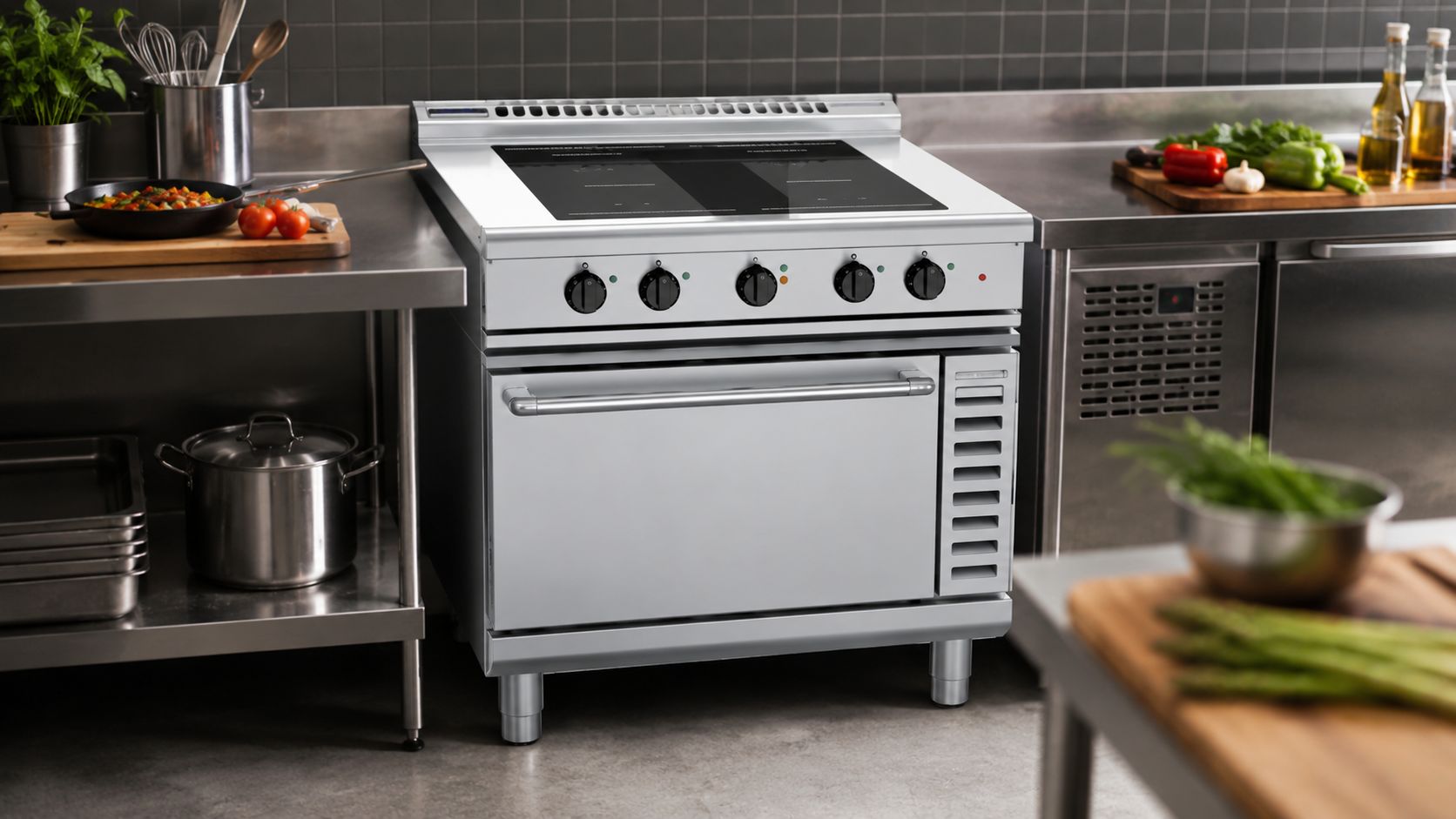
A cookline with induction requires more checking than choosing an iron pot. The Waldorf 800 Series INL8410ECF, 900mm Induction Range Convection Oven Low Back Version has four electric induction cooking zones over a GN 2/1 electric convection oven, with automatic pan detection and thermostatic control from 50 to 320°C. Its four full-area heating zones are rated at 5.0kW each, so the kitchen must verify pan bases, electrical infrastructure and simultaneous load before ordering.
The operating test is simple:
- Preheat with purpose: Allow the vessel to come to temperature before loading it.
- Use the lid properly: Keep moisture inside for braises, stews and casseroles.
- Plan movement: Treat a full pot as a two-person handling task where weight and heat make that necessary.
- Check the specification: Confirm oven, induction and handle compatibility for the exact product.
Bare Cast Iron or Enamelled Cast Iron
Bare and enamelled cast iron can both produce excellent cooking results, but they demand different behaviour from staff. Bare iron suits kitchens that can manage seasoning, drying and storage discipline. Enamelled iron suits venues that want easier surface maintenance and a more polished oven-to-table appearance.
Bare cast iron needs a seasoning layer to protect the cooking surface. Staff should wash it according to the manufacturer's instructions, dry it thoroughly and apply a very thin layer of oil while the vessel is still warm. New Zealand cast-iron care guidance recommends hand washing, immediate drying and a light coat of vegetable oil after use.
Enamelled cast iron doesn't require traditional seasoning in the same way. That makes it a more straightforward choice for kitchens where many staff members share equipment or where a pot moves between cooking and front-of-house presentation. The enamelled surface still needs care. Abrasive treatment, impacts and sudden temperature changes can damage the coating.
| Criterion | Bare Cast Iron | Enamelled Cast Iron |
|---|---|---|
| Seasoning | Requires seasoning and ongoing light oil maintenance | Doesn't require traditional seasoning |
| Cleaning | Hand wash, dry immediately and protect the surface | Hand wash with enamel-safe methods and avoid abrasives |
| Moisture risk | Wet storage can encourage rust | The coating reduces direct exposure, but damaged areas still need attention |
| Acidic dishes | Requires careful use according to the product instructions | Often more convenient for tomato, wine and other acidic recipes, subject to the manufacturer's guidance |
| Presentation | Functional, traditional appearance | Better suited to colour-coordinated oven-to-table service |
| Damage risk | Can develop surface rust if neglected | Enamel can chip from impact or thermal shock |
| Best fit | Disciplined back-of-house teams and high-heat cooking | Mixed teams, front-of-house presentation and simpler daily care |
Choosing for the actual cleaning routine
The right finish depends on who cleans the pot at the end of service. If staff routinely leave cookware wet, bare iron is the wrong choice until that workflow changes. If the venue relies on aggressive scouring, enamelled cast iron is also vulnerable.
A common issue in hospitality kitchens is treating both finishes as if they need the same routine. They don't. Bare iron needs surface protection, while enamel needs protection from impact, harsh abrasives and rapid temperature changes. Advice on choosing and caring for cast-iron casseroles in New Zealand helps frame the decision around use rather than appearance alone.
Decision point: Choose bare cast iron when the kitchen can train staff to clean, dry and oil it correctly. Choose enamelled cast iron when presentation and simpler surface care justify the extra care required to protect the coating.
Neither finish is automatically more commercial. A well-made vessel should be assessed for casting quality, lid fit, handle construction, cooking-surface finish, weight balance and enamel quality where applicable. Purchase price alone doesn't reveal whether the pot will suit the service.
Choosing the Right Size for Your Service
Capacity should follow the batch that the kitchen produces. Buying the largest cast iron Dutch oven available creates avoidable problems, including excessive weight, awkward storage, slower handling, and a vessel that may not sit properly on the available burner or rack.
Operators should begin with the busiest normal batch for one dish. A smaller pot may suit individual or shared dishes, while a larger one may be justified for banquet production, staff meals, stocks or catering. The vessel should hold the food comfortably without being so oversized that the contents spread thinly and lose the cooking pattern the recipe requires.
| Size | Approx. portions per batch | Best fit |
|---|---|---|
| 4 L | Around 3 to 4 portions | Small braises, shared dishes and compact casseroles |
| 6 L | Around 6 to 8 portions | À la carte mains, stews and curries |
| 9 to 10 L | Batch cooking for banquet portions, staff meals and stocks | High-volume kitchen production |
| Above 12 L | Specialist high-volume use | Large catering or particular production requirements |
These capacity anchors are planning guides, not guarantees. Portion size, ingredient density, headspace and the recipe itself change the usable volume. A soup may use the available depth differently from a braise, and a bread dough needs room to expand.
Match shape to the dish
Deep bodies suit soups, stews and liquid-heavy dishes. A shallower vessel provides more surface area for browning and can work well for casseroles, roasting and dishes intended for presentation. Lid shape matters too. A lid handle should clear shelving, oven racks and salamander space, while the main handles should provide a secure grip with oven gloves.
Storage needs attention before purchase. The pot must fit existing racks, cupboards and wash-up areas, and staff must have enough room to lift it without striking nearby equipment. A full cast iron vessel can become difficult to control quickly, so the chosen capacity should reflect the team's handling ability as much as the recipe volume.
The practical rule is simple. Select the size that matches the busiest single batch, not the largest theoretical production run.
Cooktop Compatibility, Ovens and Shared Kitchens
Cast iron works well across many cooking environments, but compatibility must be confirmed against the individual product specification. Gas, electric and induction are not interchangeable from a planning perspective, especially when a kitchen uses mixed hobs or shared equipment.
Induction is a particular point of attention. Cast iron is generally suitable for induction because the iron body is magnetic, but the operator should still confirm the manufacturer's induction rating and check the base dimensions. A vessel that overhangs the active zone or sits awkwardly on a smaller hob can be unstable and inefficient to use.
Glass and ceramic surfaces create another practical risk. Raw cast iron should not be dragged across glass because it can scratch the surface. Staff should lift the vessel rather than slide it, and they should avoid placing a very heavy pot where it could be knocked or tipped.
Check the whole kitchen path
A pot can be cooktop-compatible and still fail operationally if it doesn't fit through the workflow. Before purchase, check:
- Oven clearance: Confirm the pot, lid and handles fit the oven cavity and rack positions.
- Rack and shelf space: Measure storage locations rather than relying on catalogue photographs.
- Passage width: Check pass-through openings, trolley access and shared-kitchen routes.
- Heat protection: Confirm that staff have suitable oven gloves and clear lifting procedures.
- Cooktop area: Match the vessel base to the burner or induction zone.
For kitchens using portable or temporary induction equipment, portable induction cooktop planning provides relevant context. The same principle applies to a permanent cookline. The pan, cooking zone and electrical setup must work together, and the operator should verify that combination before ordering.
A cast iron Dutch oven can move from cooktop to oven where the exact product allows it. The lid knob and handle construction matter, so the specification must be checked rather than assumed. A product that works on induction may still have an oven limitation caused by its knob, coating or handle material.
Seasoning, Cleaning and Rust Prevention in Humid Conditions
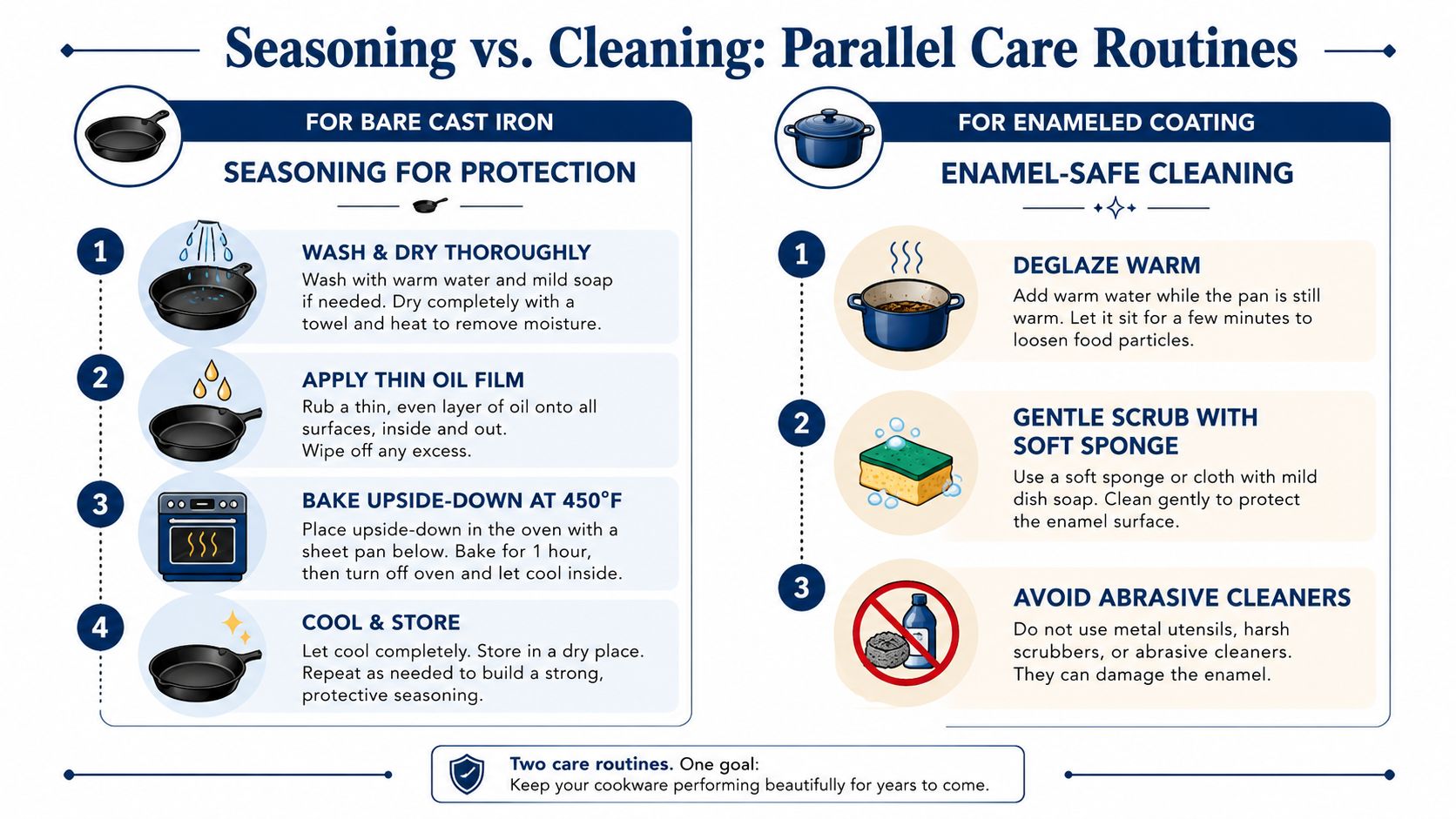
Bare and enamelled cast iron need separate care routines. Bare iron needs seasoning protection and immediate drying. Enamelled iron needs gentle cleaning, protection from impact and careful cooling before washing.
For bare cast iron, the operating routine should be consistent:
- Wash according to the manufacturer's instructions.
- Dry the vessel completely, using heat if the product guidance permits.
- Apply a very thin oil layer while the cookware is warm.
- Wipe back excess oil so the surface isn't left greasy or sticky.
- Store in a dry, ventilated place with moisture able to escape.
A New Zealand care document recommends a teaspoon of oil or conditioning balm before storage, while also emphasising that the layer should remain light. Cast-iron care guidance for seasoning protection supports using a thin coating rather than heavy greasing.
Enamel-safe cleaning
Enamelled cast iron should cool before washing. Plunging a hot pot into cold water creates thermal shock, which can damage the enamel. New Zealand enamelled cookware care guidance also recommends thorough drying before storage.
Staff should use warm water, a soft brush or sponge and a suitable detergent. Metal scourers, aggressive abrasive products and careless stacking can mark or chip the coating. Enamel is easier to maintain than bare iron, but it isn't indestructible.
For teams that need a separate resource on the seasoning process, season cast iron perfectly provides additional practical guidance. Staff training should still follow the exact care instructions supplied with the cookware.
Storage in damp conditions
Humid coastal storage can expose bare iron to rust if staff leave lids closed on damp cookware. A practical routine is to dry the pot and lid fully, store the lid slightly ajar where possible and keep the vessel in a dry, ventilated cupboard. A paper towel or coffee filter between the pot and lid can help absorb residual moisture, but it shouldn't replace proper drying.
If surface rust appears on bare iron, staff can remove the affected area, dry the vessel thoroughly and re-season it according to the manufacturer's instructions. Rust under or through damaged enamel is different. That generally indicates a replacement decision rather than a routine seasoning repair.
Cleaning chemicals need to match the surface and the kitchen's hygiene system. New Zealand guidance on effective cleaning chemicals is relevant when standardising products and procedures across a professional wash-up area.
How Different Venues Actually Use Them
A bistro may use a small enamelled Dutch oven for an oven-to-table braise, while a hotel kitchen may keep bare iron vessels in the back of house for long-cooked meat, stock reduction and batch production. A café may need one compact pot for soup, whereas a caterer may decide that cast iron is too heavy for repeated transport between venues.
The menu is only part of the choice. Lid handling, storage, wash-up capacity, presentation expectations and the distance between the oven and pass often matter more than the recipe title.
| Venue type | Typical capacity | Preferred finish | Primary service use |
|---|---|---|---|
| Bistro or casual restaurant | Small to medium | Enamelled for presentation or bare iron for back of house | Braises, casseroles and shared dishes |
| Hotel or banquet kitchen | Medium to large | Bare or enamelled, depending on workflow | Batch braises, curries, stocks and banquet production |
| Café | Small to medium | Often enamelled for simpler surface care | Soup, stew, bread and limited daily batches |
| Caterer or event kitchen | Capacity matched to transport and production | Finish depends on handling and wash-up setup | Off-site cooking, shared dishes and batch service |
| Hotel, motel or accommodation kitchen | Small to medium | Enamelled where presentation matters | Breakfast casseroles, shared meals and table service |
The bistro pass
For a bistro, the vessel may be part of the presentation. A smaller enamelled pot can carry a braise directly to the table, reducing a transfer step and giving the dish a deliberate visual finish. Staff still need a clear lid-lifting routine and a safe place to set the hot lid.
The hotel production kitchen
A hotel or banquet team usually values capacity and repeatability over colour. Bare cast iron can suit a disciplined back-of-house system where staff understand seasoning, drying and storage. The kitchen must still account for the weight of a full vessel when moving it from a range to an oven or holding area.
The café and caterer
A café shouldn't buy a large Dutch oven for a soup batch that rarely needs that capacity. A smaller vessel can be easier to lift, wash and store. Caterers need to consider transport weight, protective packaging and the risk of impact during delivery, especially when cookware is moved between kitchens.
Hospitality businesses often find that the same pot succeeds in one venue and becomes a nuisance in another. The correct choice follows the service pattern, not a generic idea of what professional cookware should look like.
Procurement, Safety and Total Cost of Ownership
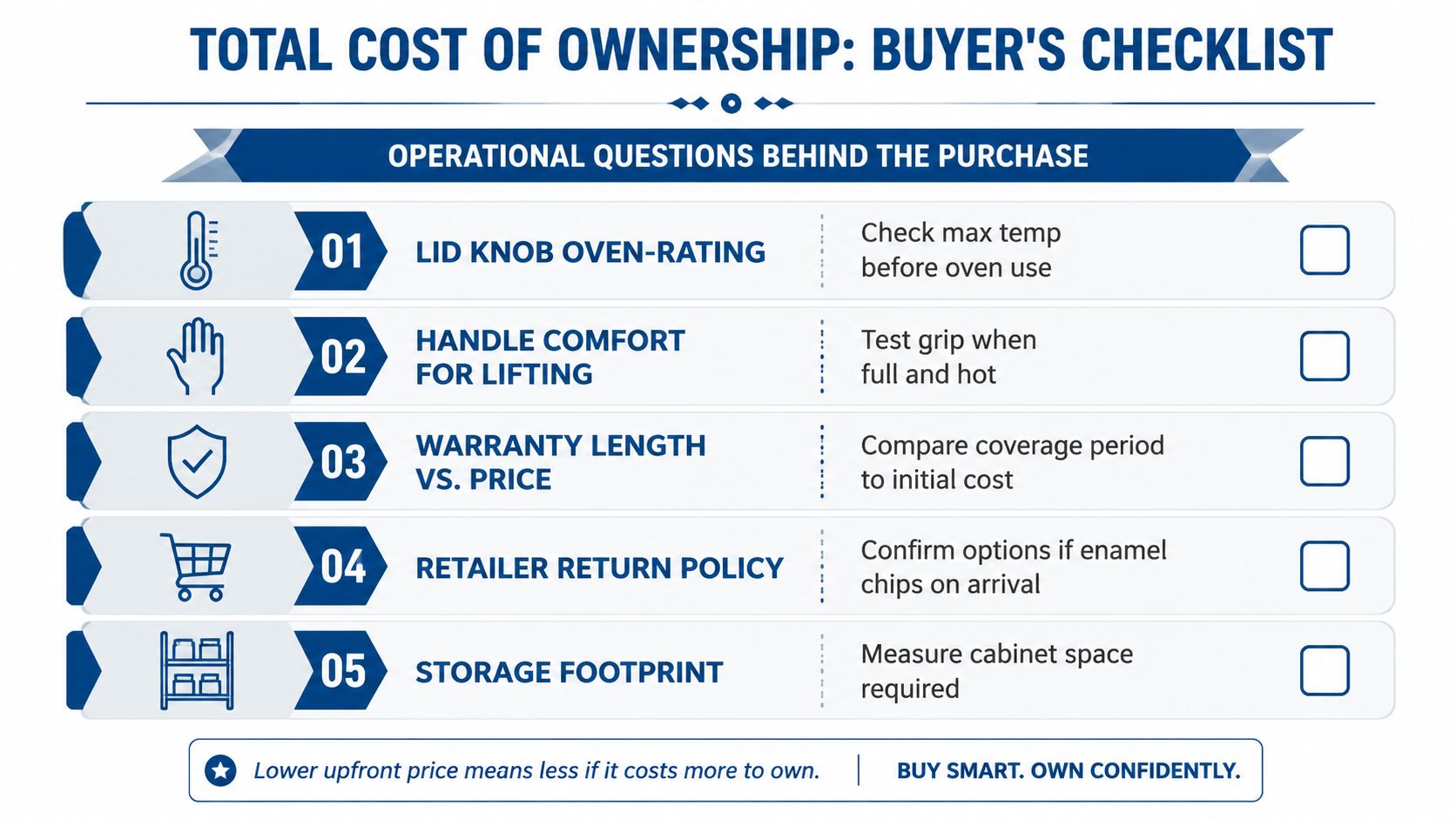
The purchase decision should answer five operational questions: what dishes will be cooked, what is the normal batch size, who will handle the vessel, where will it be stored and how will staff clean it? Those answers determine whether bare or enamelled cast iron is appropriate and whether the pot should be used for cooking only or also for presentation.
Before ordering, the kitchen should inspect the specification for:
- Lid fit and weight: A close lid supports moist cooking, but staff need a safe lifting method.
- Handle construction: Handles must remain usable with oven gloves and when the pot is full.
- Knob rating: Confirm the maximum oven temperature for the lid knob.
- Base compatibility: Check gas, electric and induction support for the exact product.
- Surface finish: Look for a smooth, usable cooking surface and consistent enamel where applicable.
- Storage footprint: Measure the shelf, cupboard or trolley space required.
- Replacement support: Confirm how damaged lids, knobs or vessels will be handled.
A full, hot Dutch oven can cause burns or strain injuries if staff lift it without suitable gloves, clear routes and an agreed team-lift procedure. Fire and Emergency New Zealand advises placing a lid over a burning pot or frypan to cut off oxygen, turning off the stove if safe and never throwing water onto the burning pot. New Zealand cooking-fire safety guidance is especially relevant in kitchens where heavy cast iron retains heat after the burner is switched off.
The total cost includes more than the initial purchase. Operators should consider frequency of use, versatility, maintenance requirements, replacement availability and cost per use. Quality cast iron can provide a very long service life when appropriately used and maintained, but that value disappears if the vessel is too large, difficult to handle or repeatedly damaged by unsuitable cleaning.
For broader cookware purchasing, commercial cookware set planning can help operators compare individual vessels with wider kitchen requirements.
The most reliable specification is the one staff can use safely every service. A restaurant may prioritise a medium enamelled vessel for oven-to-table dishes. A hotel may need several capacities for production. A café may need one compact pot with manageable lifting weight. A caterer should assess transport and storage before selecting traditional cast iron.
Simply Hospitality can help hospitality operators compare cast iron Dutch ovens by capacity, finish, cooktop compatibility and service use, alongside related cookware and commercial kitchen equipment. Visit Simply Hospitality to discuss the right vessel for the venue's batch sizes, handling routines and maintenance requirements.