

Cheese Slicer NZ: Choosing the Right Option for Hospitality
A cheese slicer NZ buyers choose for a café, deli, or commercial kitchen needs to do more than make neat slices. It has to match the cheese being used, the volume going through prep, and the space available on the bench, because the pressure in service is consistency, not just speed. A slicer that holds the same thickness from the first sandwich to the last helps back-of-house teams keep portions tidy, repeatable, and easier to cost.
A useful way to think about it is this. A café making 100 sandwiches a day, with two slices of cheese per sandwich, is already at 200 slices a day, about 1,400 a week, and more than 70,000 a year. That is an illustrative production example, not measured customer data, but it shows why the humble slicer becomes a workflow decision rather than a drawer accessory.
The central point is simple. A good cheese slicer doesn't just make slicing faster, it makes the 100th portion look and weigh more like the first. That matters in cafés, restaurants, accommodation kitchens, and delis where cheese is part of sandwiches, toasties, platters, breakfast service, and prep lines. The right choice comes down to a few practical questions, and those questions sit behind every recommendation below.
Why the Right Cheese Slicer Matters in a New Zealand Kitchen
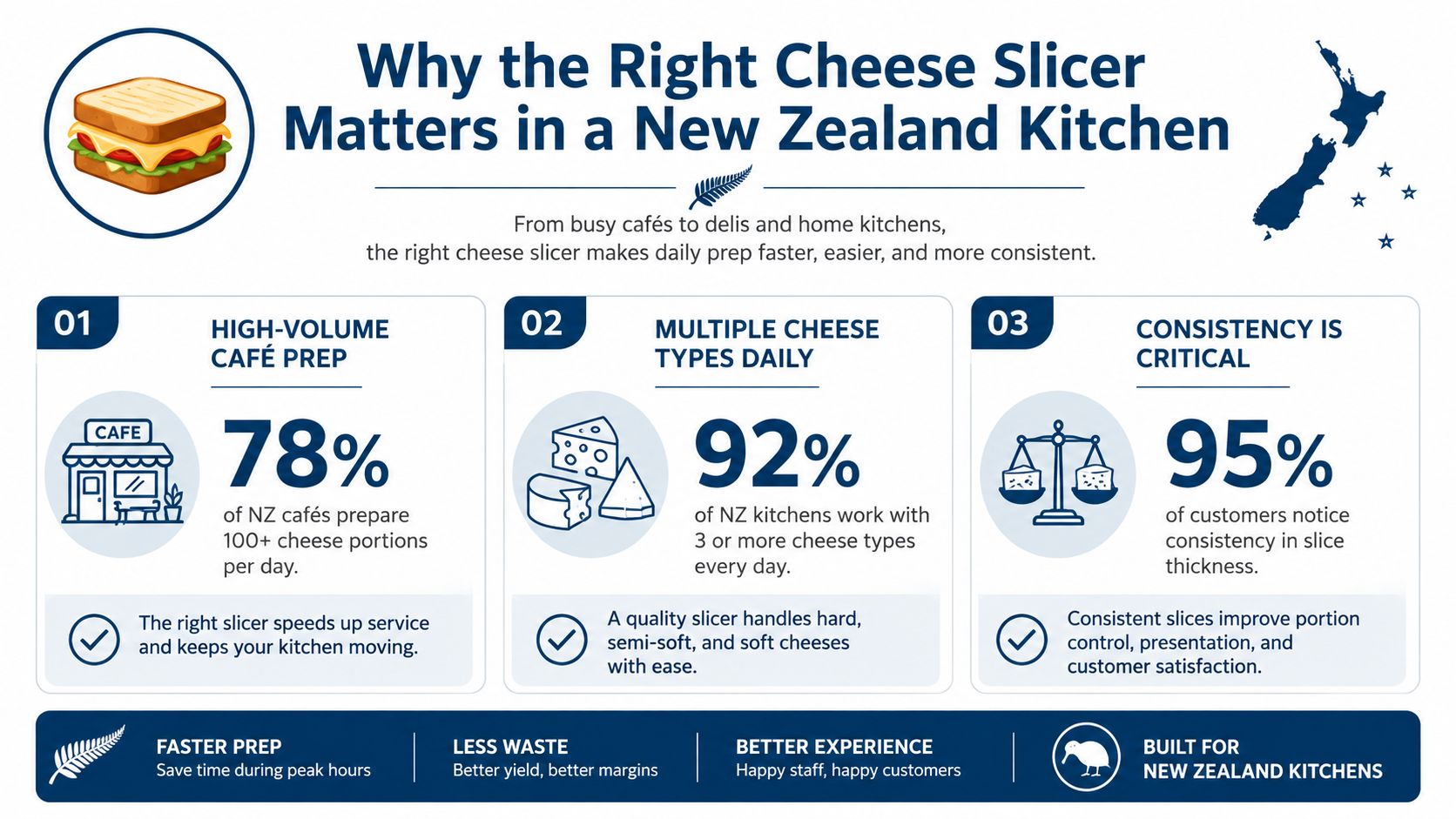
A lunch rush in a New Zealand café leaves little room for guesswork. Someone is slicing cheese for sandwiches, another person needs neat portions for toasties, and the prep bench is already crowded with other jobs. In that setting, the slicer is not just a speed tool, it's a control tool, because the difference between “close enough” and “same every time” shows up across the whole day.
That's why the buyer's mindset matters. Cheese slicing is one of those jobs that looks small until it repeats hundreds of times, then the labour, consistency, and waste implications become hard to ignore. Even the retail side of the market shows that cheese is a staple input in New Zealand, with processed sliced cheese rising from NZ$3.47 per 250g in February 2016 to NZ$4.75 per 250g in February 2026, about 36.9% over the decade, with a short-term peak of NZ$5.04 per 250g in March 2025 (Figure.NZ processed sliced cheese series).
Portion control is the quiet advantage
A slicer earns its keep when the menu depends on repeatable portions. If one staff member cuts a slice a touch thicker than another, the differences are small at the bench and meaningful over time. The operator who controls thickness controls presentation, consistency, and ingredient use.
For New Zealand hospitality, that matters because cheese isn't an occasional garnish. It's a core sandwich and breakfast ingredient, and New Zealand's cheese sector is large enough to support serious downstream foodservice demand, with cheese and curd exports rising from NZ$1.439 billion in 2010 to NZ$2.009 billion in 2019, about 39.6% over the decade, and a 2025 USDA forecast putting production at 375,000 metric tonnes and exports at 370,000 metric tonnes (Figure.NZ cheese export series).
Practical rule: if the slicer helps the team hold the same portion all week, it's doing more than speeding up prep.
That's the right way to frame cheese slicer NZ searches. Not, “Which one looks strongest?” but, “Which one keeps the cheese portion honest when the kitchen gets busy?”
Wire, Blade and Electric Slicers Compared
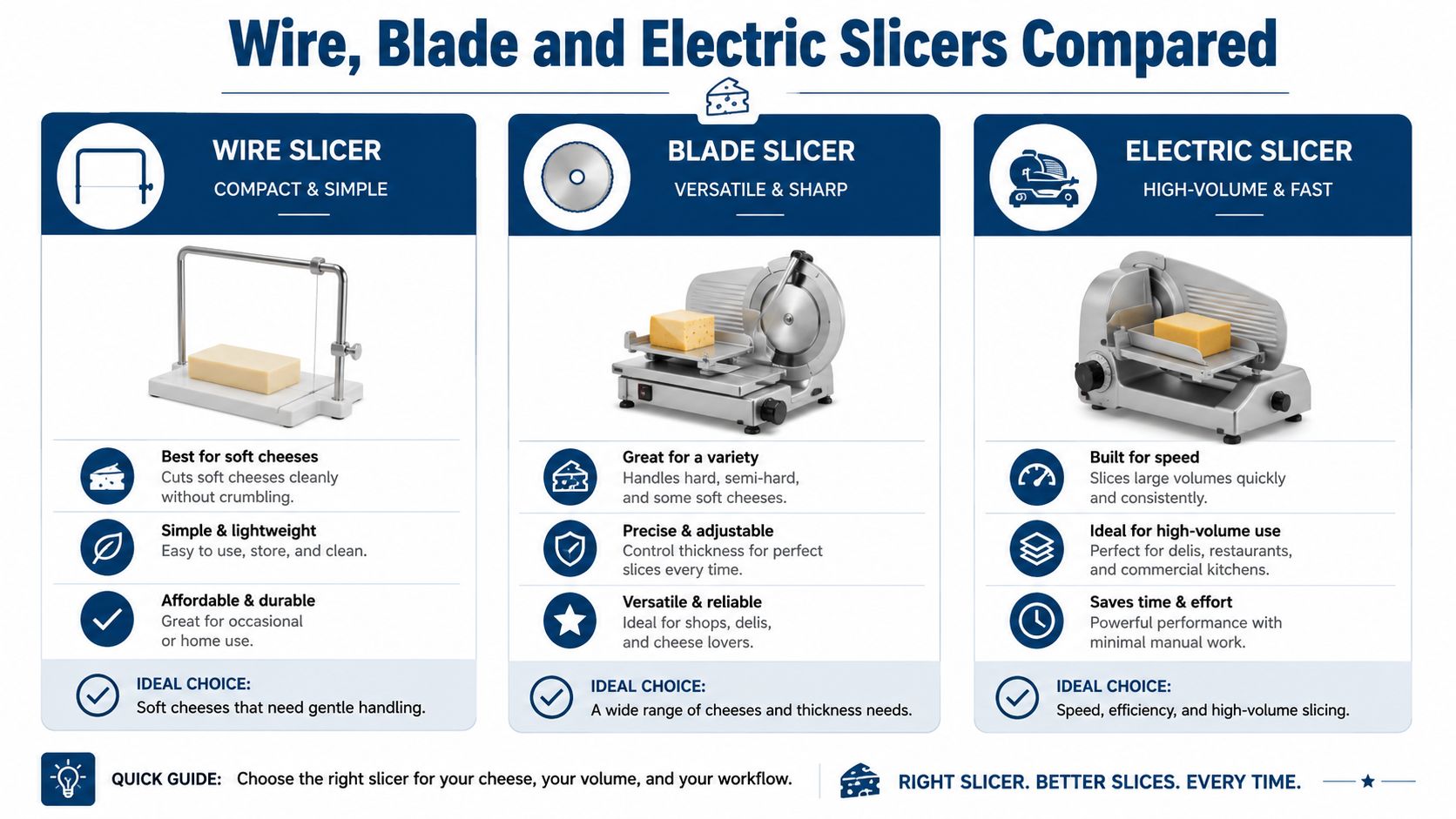
Wire, blade, and electric slicers each solve a different problem. The mistake is treating them as if they're interchangeable, because they're not. The right one depends on the cheese texture, the daily slice count, and whether the kitchen needs simple portioning or repeatable production.
Wire slicers suit simple, clean portioning
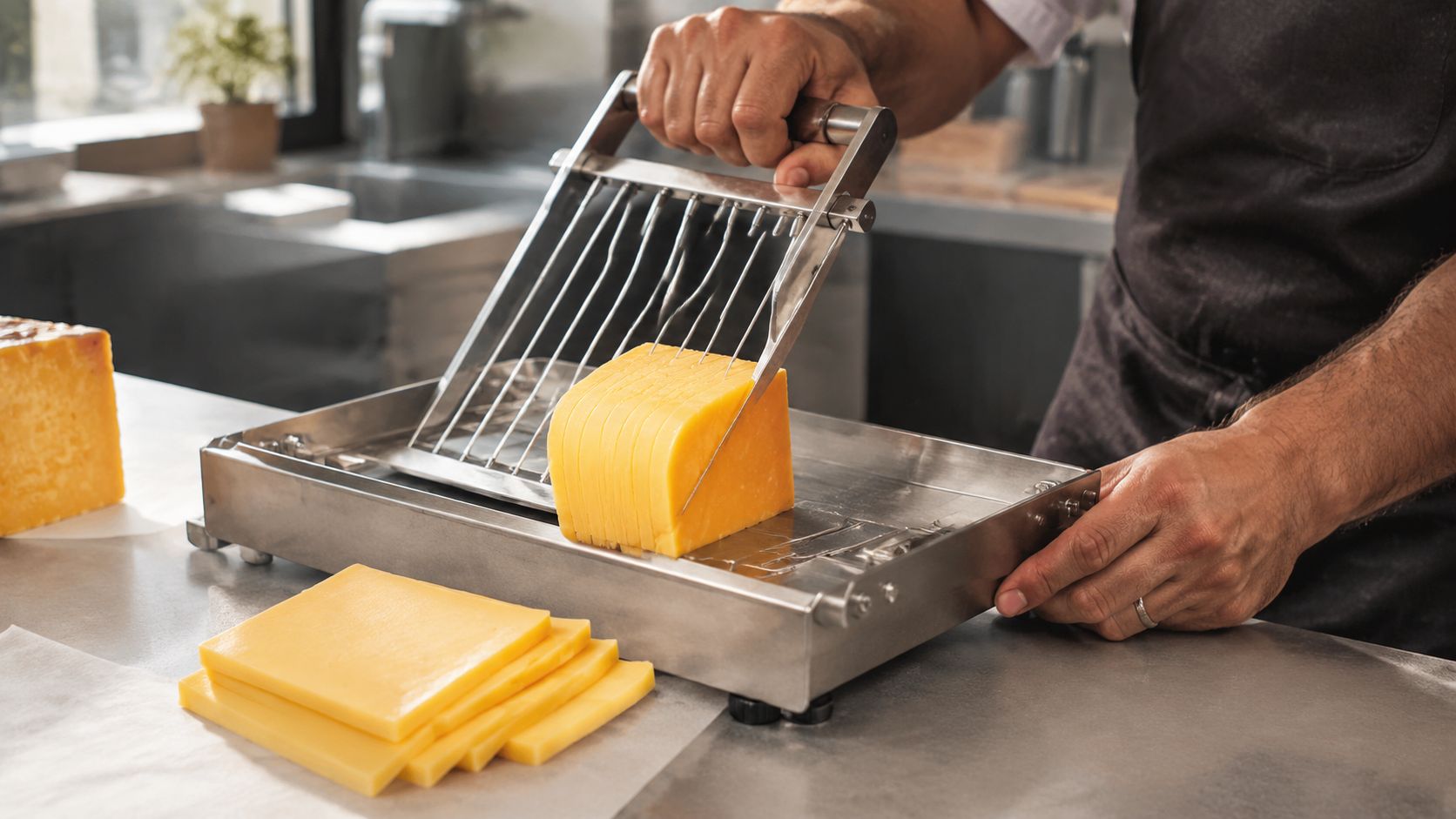
Wire tools are compact and straightforward. They suit softer or semi-soft cheeses where the goal is a neat cut without much bench space or operator training. In a small café, a wire slicer can make sense where volumes are modest and the cheese doesn't need constant thickness adjustment.
The limitation is clear. Wire tools are not the answer when the operation needs fast repetitive slicing or a wide range of thicknesses. They're about tidy portioning, not high-throughput prep.
Manual blade slicers do routine work with little fuss
Manual blade slicers sit in the middle. They're handy for regular prep, don't take much space, and are easy to understand on day one. For venues that slice cheese as part of a wider prep run, that simplicity matters.
They're a practical fit when the operation wants control without stepping into powered equipment. For many operators, that's enough. The trade-off is that manual cutting still depends on staff consistency, so the result is only as even as the person using it.
Electric slicers make sense when the volume climbs
Commercial electric slicers are the right conversation when hundreds of slices are needed and every slice should land close to the last one. A benchtop electric slicer commonly sold in New Zealand uses a 190 mm stainless-steel blade, 200 W motor, 0–15 mm thickness range, and a compact footprint of about 370 × 270 × 270 mm with 220–240 V, 50 Hz supply. Larger commercial units are specified with 305–350 mm blades, and some Hobart units are listed at 0.37 kW, while Titan systems go up to 20 mm maximum thickness.
A useful related read is the Simply Hospitality note on choosing a food slicer NZ setup, which helps operators think through bench space and service style before buying: food slicer NZ.
One practical menu point: operators planning cheese-forward dishes sometimes need plant-based alternatives on the same prep line. For that reason, a reference such as dairy-free mozzarella for pizzas can be useful when menus are being built around sandwich or pizza consistency rather than dairy alone.
A heavy-duty cookline can also influence slicer placement and bench planning. The Waldorf 800 Series INL8400R5F-CB - 900mm Electric Induction Cooktop Low Back Version - Cabinet Base is a good example of how a fixed working module is planned around width, service access, and a low-back profile in a coordinated kitchen.
Questions to Answer Before You Buy
The easiest way to avoid overbuying is to answer a few blunt questions before looking at shiny features. If the team can answer these sincerely, the right tool usually becomes obvious. If the answers are vague, the purchase is probably premature.
Start with the cheese, not the machine
What cheese is being sliced? Semi-hard and hard cheeses behave differently from soft varieties, and the tool needs to suit the product, not the other way around. A slicer that works beautifully on one cheese can be awkward on another.
That's especially relevant in New Zealand kitchens where cheddar-style, Edam-style, and Gouda-style cheeses are common in sandwiches and prep. The best fit isn't the most impressive machine, it's the one that handles the cheese you use every week without forcing workarounds.
Then count the portions
How many portions are being prepared each day? If the answer is “a few plates” or “occasional sandwiches”, a simple manual tool may be enough. If the answer is “every service, every day”, the case for a more consistent slicer gets stronger.
The volume question matters because it changes the value of speed, repeatability, and bench efficiency. A kitchen that slices cheese in short bursts can tolerate more manual handling than a venue that needs the same job done continuously.
The right slicer depends on the menu rhythm, not the biggest blade on offer.
Check the details that affect ownership
Does the slicer need adjustable thickness? How important is exact portion control? How easily can it be cleaned? Are replacement blades or wires easy to source? Those are the practical questions that affect daily use long after the purchase is made.
A straight comparison also helps. A simple manual tool suits some menus, while an electric unit suits others. For operators who want a deeper framework for measuring kitchen hardware against prep demands, the Simply Hospitality article on digital kitchen scales is a useful companion piece, because the same portion-control thinking applies.
One more thing. Do not buy a powered slicer just because the specification sheet looks impressive. Buy it because the operation needs what it does.
Slice Thickness, Portion Control and Food Cost
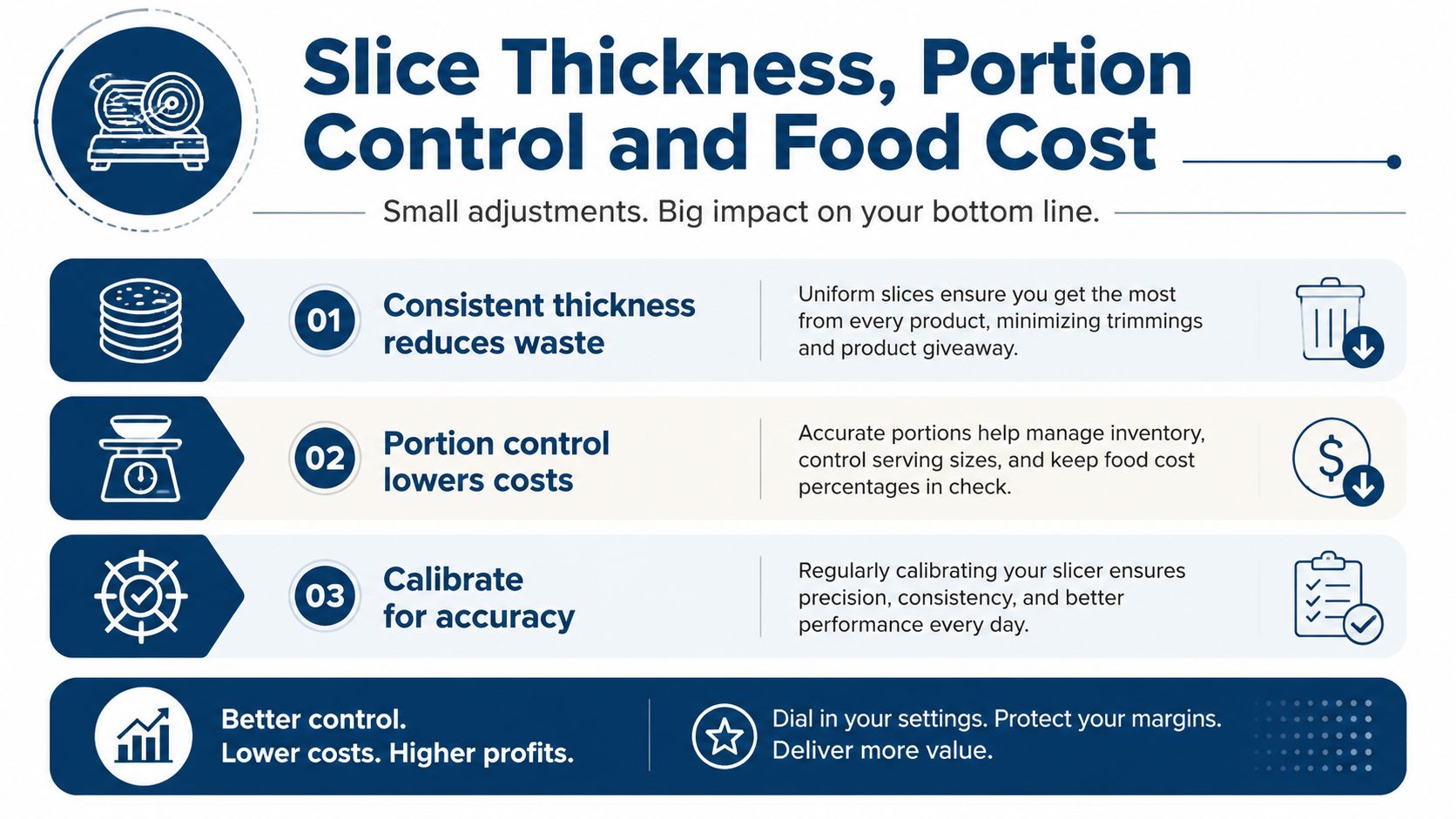
Small thickness differences become real when they're repeated every day. If a slice is a little thicker than intended, the difference doesn't look dramatic on one sandwich, but it multiplies across the week and year. That's why consistency matters more than the novelty of a fast machine.
The café example makes the point clearly. At 200 slices a day, a tiny shift in thickness across each portion means the kitchen can move more cheese than the menu intended. A 0.5 mm or 1 mm drift doesn't sound like much on the bench, but across 1,400 slices a week and more than 70,000 slices a year, that drift can become meaningful. The arithmetic is simple, even if the exact food cost impact will vary by product and service style.
Different dishes need different thicknesses
Thin slices suit sandwiches, toasties, burgers, and charcuterie presentation where the cheese is part of a balanced bite or a clean-looking board. Thicker portions make more sense when the cheese needs to stand out on the plate or hold its shape in a warmer application.
That's where adjustable slicers earn their place. Once the chef sets the thickness, every portion can follow the same standard instead of relying on whoever is on prep that day.
A helpful way to think about portion control is to compare it with other kitchen measuring habits. The same discipline that helps a kitchen improve consistency with tools like save families money baking at home also applies in hospitality, with the difference being that commercial service repeats the decision all day long.
Repeatability is the real operational gain
A slicer isn't just about moving faster. It's about making the second tray look like the first and the final rush order look like the first one of the morning. That consistency supports presentation, buying discipline, and staff confidence.
For operators, the takeaway is straightforward. If the business cares about cheese cost, plate appearance, and standardised prep, the slicer needs to hold thickness reliably. If it doesn't, the kitchen is back to eyeballing every cut, which is exactly where portion creep starts.
Cleaning, Sanitation and Blade Care in a Commercial Kitchen
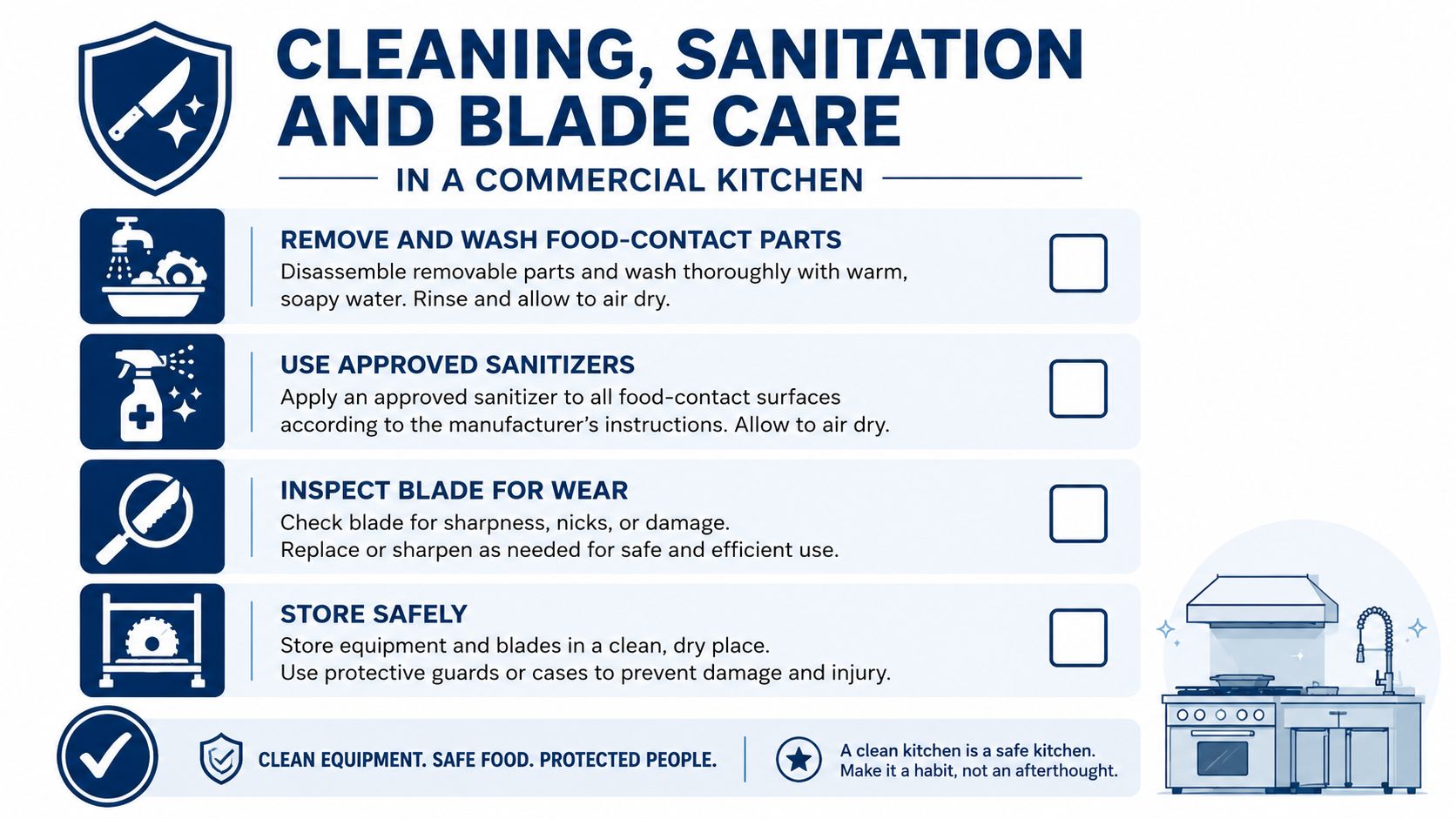
Cheese slicing equipment lives in a messy part of the kitchen. It deals with sticky residue, repeated contact, and fast turnarounds, so cleaning can't be an afterthought. A slicer that's hard to strip down or awkward to wipe clean will slow the team down and invite shortcuts.
Safe cleaning starts with the design
Commercial slicers should have stable construction, suitable guards, and food-contact parts that can be removed and washed properly. Staff should never have to bypass guards to save time. That's especially important in busy kitchens where people move quickly and cleaning often happens between service periods.
The practical cleaning habit is simple. Remove the food-contact parts, wash them down, sanitise according to site procedure, dry them correctly, and store the equipment safely. That routine matters in any HACCP-aligned kitchen because the cleaner the workflow, the easier it is to keep the slicer in daily rotation without becoming a hygiene headache.
Blade and wire replacement are normal wear items
Replacement blades and wires are part of ownership, not a surprise failure. Intervals depend heavily on how often the slicer is used, how it's cleaned, and what products are being sliced. A team that keeps the machine clean and uses it on the right products will usually get better service from it than a team that treats it like a catch-all cutting station.
For maintenance routines and cleaning chemistry, a useful internal reference is the Simply Hospitality article on effective cleaning chemicals NZ for hospitality. The main point is that the chemical choice, the cloth, and the cleaning frequency all affect long-term condition.
Practical insight: if staff can clean it quickly and safely after each run, they're far more likely to keep using it correctly.
The same logic applies to powered slicers. Train staff before they operate the machine, use the guards that come with it, and treat replacement parts as part of normal operating cost. That's the difference between a slicer that stays useful and one that becomes a storage problem.
Matching Slicers to Different New Zealand Venues
A busy café usually wants speed, compact size, and a clean way to standardise sandwich cheese. A deli or specialty cheese counter often needs more variety, because different cheeses can ask for different tools. The right answer changes with the service model, which is why venue type matters as much as the machine type.
Cafés, sandwich shops and quick-service counters
These venues tend to benefit from a tool that keeps prep simple and the bench uncluttered. If the operation is mostly sandwiches, toasties, and plated breakfast service, a compact wire or manual blade tool can be enough when volumes stay moderate. Once the same cheese slicing repeats all day, electric equipment becomes more attractive because it keeps portions uniform under pressure.
Delis, restaurants and hotels
Delis usually want control and presentation. Restaurants may only slice cheese for specific dishes, so the tool can be smaller and more specialised. Hotels sit somewhere in between, with breakfast buffets, room service, and banqueting all pulling the equipment in different directions, which makes cleaning access and repeatability more important than flashy features.
Caterers and institutions
Caterers need equipment that travels well in operational terms, even if it stays in one kitchen. The slicer has to be dependable, easy to clean, and clear enough for different staff members to use without confusion. Institutional kitchens in schools, hospitals, aged care, and marae settings need that same clarity, plus durability and good training habits because the work often spans multiple shifts and multiple people.
The broader restaurant-equipment perspective in the Simply Hospitality article on restaurant equipment NZ is useful here because slicer choice never sits alone, it sits inside the wider workflow.
A related ownership question is whether the operation can justify a powered unit or should stay with a simpler tool. If the venue is still building volume, a manual path can be sensible. If cheese prep is a daily production line, commercial electric slicing starts to make more sense.
Ownership, Service and Sourcing Considerations
Buying the slicer is only the start. Long-term value depends on whether the business can get parts, support, and sensible purchasing terms when the equipment needs attention. A slicer that's hard to service can become an operational nuisance long before it fails outright.
Look at the full ownership picture
Warranty support matters, but so does the availability of replacement blades, wires, and safety components. A commercial kitchen is better off with equipment that can be maintained than with a machine that looks rugged but is awkward to service. That's especially true where the slicer is used every day and has to stay in the prep rotation.
The supplier also matters. A hospitality supplier that understands commercial kitchens can help match the slicer to bench space, workflow, and cleaning access rather than just pushing the most expensive unit. Hospitality also supports buyers with quotes, trade accounts, certified used equipment, and finance options such as SilverChef, which can make a higher-end commercial slicer easier to fit into a fit-out budget.
Used equipment can be a sensible path
For some operators, certified used equipment is the practical route. It can suit a venue that needs a commercial tool but isn't ready to tie up too much capital in a single machine. The important point is to buy used gear with realistic expectations around condition, parts, and service support.
A useful reference on that decision is the Simply Hospitality article about used commercial kitchen equipment NZ. The same advice applies here, the machine has to fit the operation, not just the budget.
A cheaper slicer that can't be maintained properly is often more expensive in the long run.
The best buying decisions are usually the boring ones. Clear quote, clear parts path, clear cleaning routine, and a supplier who knows what the kitchen does every day.
Getting the Right Slicer for Your Operation
The right slicer is the one matched to cheese type, production volume, and bench space, not the one with the biggest blade or the highest wattage. A compact wire tool can suit a small café, a manual blade slicer can cover routine prep, and a commercial electric slicer can carry sustained production when portion consistency really matters. For layout thinking, the same practical logic used to create an efficient kitchen layout applies here too.
If the choice still feels unclear, Simply Hospitality can help match the slicer to the menu, the team, and the day-to-day workload. Talk to Simply Hospitality for practical advice on a cheese slicer NZ setup that fits your operation, from compact manual tools through to commercial electric options for higher-volume kitchens.
If you're weighing up a cheese slicer for your café, deli, or commercial kitchen, Simply Hospitality can help you compare the practical options and choose equipment that suits your cheese, your volume, and your bench space. Reach out for a custom quote, parts advice, or a fit-out conversation that's grounded in how your kitchen really works.