

Choosing Disposable Gloves for Commercial Kitchens
Choosing disposable gloves gets treated like a price decision far too often. That's the mistake that causes the most trouble in busy kitchens, because the cheapest box is rarely the lowest-cost option once fit, tear rate, change frequency, and food-safety behaviour are counted in. In New Zealand, glove choice is shaped by how the glove will be used, not by brand loyalty, and the Ministry for Primary Industries' Food Control Plan guidance is clear that single-use gloves can be used for ready-to-eat food, but they must be changed between tasks and they're not a substitute for handwashing, because misuse can create contamination risk even when the glove looks clean.
A good glove purchase starts with a straightforward question. What's being handled, how often will the glove be changed, and how much dexterity does the task need? For a kitchen manager or purchasing lead, that's more useful than asking which box is cheapest on the shelf. It also keeps the conversation anchored to buying cheap versus buying once, which is often the right lens for consumables that affect workflow every minute of service.
Practical rule: disposable gloves should be chosen like any other kitchen consumable, by task, risk, and change-out habits, not by the assumption that one product suits the whole venue.
Why the Cheapest Box of Gloves Is Rarely the Best Buy
One of the biggest misconceptions in hospitality is that gloves automatically make food prep safer. They don't. Disposable gloves support food safety, they don't replace it, and that matters because gloves pick up contamination the same way hands do. If staff keep the same pair on through multiple jobs, or use them as a substitute for washing, the box price has already stopped mattering.
Task-fit beats box price
In practice, the right glove depends on the task, the grip needed, staff comfort, and how often the glove will be changed. A glove that feels fine for fifteen minutes can become a problem in a long prep run if it's too loose, too thin, or too awkward for wet work. That's why a hospitality buyer should think in cost per task, not cost per box.
The same principle shows up in other operational purchases. The wrong fit or format creates workarounds, and workarounds create waste. A supplier conversation should sound less like “What's cheapest?” and more like “What gets changed cleanly, fits the team, and holds up to the job?” A box that looks economical can end up costing more if it drives tears, contamination, or constant glove changes.
Glove pricing only makes sense after the task has been defined. Without that, it's just a number on a carton.
The other thing that gets overlooked is that comfort affects use. Staff are more likely to keep gloves on correctly when the fit is right and the glove doesn't fight the work. That's where task-based buying starts to save money in a real operational sense, because fewer interruptions and fewer mistakes usually matter more than a small difference in carton price.
For broader procurement thinking, hospitality teams often apply the same discipline to packaging and storage choices, then to gloves. That mindset works here too. A glove range should support the workflow, not try to flatten every task into one product.
Matching Glove Material to the Job at Hand
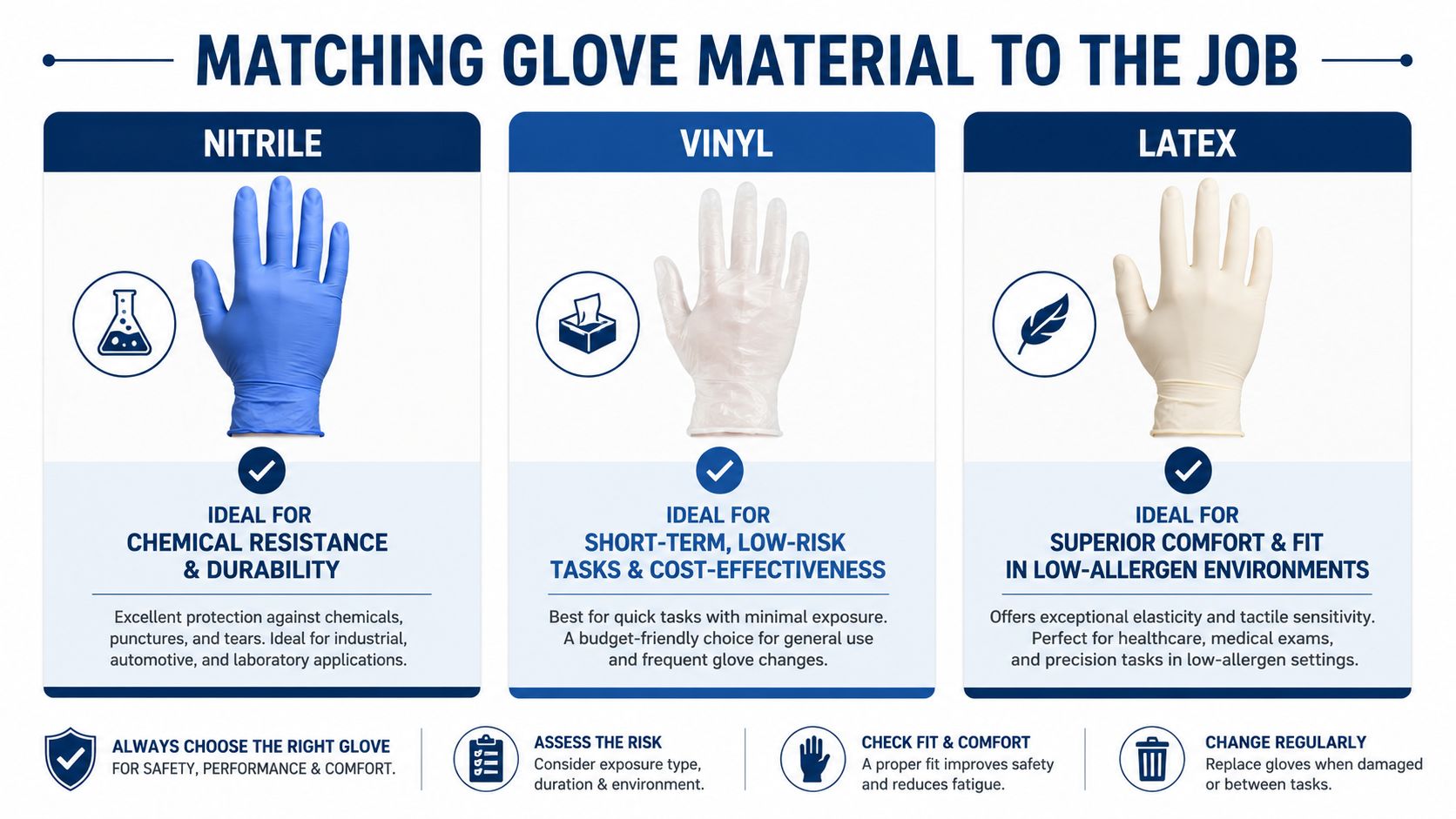
The first decision is material, and that decision should follow the work, not the label on the box. Nitrile, vinyl, and latex each have a place, but they're not interchangeable in a commercial kitchen. The wrong one creates either waste or poor protection, and sometimes both.
Nitrile for mixed-use kitchen work
Nitrile is usually the most practical default for busy commercial kitchens because it gives a strong mix of durability, puncture resistance, and chemical resistance. That makes it a sensible choice for prep, back-of-house cleaning, and tasks where gloves are being changed often but still need to hold up under constant movement. International review evidence used in infection-control guidance found no statistically significant difference in touch sensitivity or psychomotor performance between latex and nitrile gloves, while subjective comfort ratings did differ significantly, which is why fit and feel still matter even when the basic performance is comparable.
Vinyl for short, light-duty tasks
Vinyl suits lighter-duty food preparation where gloves are changed frequently and the main need is a low-risk barrier for short periods. It's cost-effective, which is why many operators use it for brief, repetitive jobs, but it should be chosen with that limitation in mind. If the task involves chemical contact, sharper objects, or longer wear, vinyl stops being the sensible option very quickly.
Latex where feel matters and allergy risk is managed
Latex still has one strength that operators notice immediately, excellent flexibility and tactile feel. That can help with precision work, but it's less common now because of allergy considerations for both staff and customers. In shared hospitality settings, that's enough to make many buyers prefer latex-free options unless there's a specific reason to keep it in the mix.
For a useful procurement model, keep a small range instead of forcing one glove across the whole venue. A service area with short plating tasks, a prep bench, and a cleaning station do not have the same needs. That's why one glove box rarely solves everything.
For teams that manage stock and work orders across multiple roles, the logic is similar to strategies from Facility Management Insights, where the right category is matched to the right job rather than guessed at the point of use.
Best fit wins: nitrile for durability, vinyl for short low-risk use, latex only where tactile feel matters and allergy risk is controlled.
The practical outcome is simple. The best disposable glove isn't the strongest one, it's the right one for the task. That's the difference between a glove range that supports service and one that gets in the way.
The Simply Hospitality storage containers article is a good reminder that storage systems work best when they're matched to what's being handled, and gloves are no different. Even a product like the Emile Henry XL Plate 28cm - Powder Pink/Ivory sits in that same operational world of choosing the right item for the right use, because durable, easy-care serviceware and task-matched disposables both reduce friction in the kitchen.
Thickness, Dexterity, and the Real Trade-Offs
Thickness changes how a glove feels and how long it lasts under pressure. That trade-off matters because a glove that feels nimble can still fail too soon, while a tougher glove can slow fine work and frustrate staff. The useful benchmark for buyers is not “thick is better”, it's “thickness should match the shift”.
Light work needs feel
Lighter gloves around 2 to 3 mil suit short, low-risk prep where staff need fine motor control. They're easier to work in, especially for tasks like portioning, plating, or handling small items where feel matters more than toughness. But they also fail sooner under abrasion and rough handling, so they're a poor fit for cleaning or repeated contact with wet surfaces.
Mid-weight nitrile is the practical workhorse
A 4 to 6 mil glove is the workhorse range for routine cleaning, dish area work, and high-change environments. That's where many kitchens land because the glove still gives usable dexterity while coping better with repeated removal, wiping, and contact with food residue or cleaning agents. For cafés, restaurants, and aged-care kitchens, that middle ground often reduces glove wastage because the glove survives the shift better.
Heavy-duty gloves are not for every station
Heavier options at 8 mil+ are generally overkill for most hospitality work. They have their place in heavier-duty protection, but they can be too stiff for routine food prep and slow down repetitive tasks. If staff are struggling to pinch, grip, or fold because the glove is too bulky, the purchase is working against the service flow.
A common mistake is standardising on one general-purpose glove for the whole operation. That looks tidy on paper, but it usually means one of two problems. The glove tears too often in one area, or it feels clumsy in another.
| Task type | Better starting point | What to watch |
|---|---|---|
| Short prep and plating | Lighter glove | Fine motor control, frequent changes |
| Cleaning and dish area work | Mid-weight nitrile | Tear resistance, grip in wet conditions |
| Heavy handling or rough surfaces | Stronger glove | Over-specification, reduced dexterity |
The core buying decision involves matching glove thickness to the shift profile. If the same team moves between prep, bins, washdown, and plating, the glove has to survive that pattern without becoming a bottleneck. That's where a single SKU often stops making operational sense.
Fit, Grip, and Why Comfort Affects Productivity
A glove that fits badly isn't just uncomfortable, it's a safety issue. Loose, baggy gloves can cause work errors or even a spill or leak, which is why fit should be treated as a standard purchasing specification rather than an optional extra. The University of Tennessee guidance also advises checking each glove for holes, tears, or other manufacturing defects before use, and that pre-use check belongs in the opening routine, not after something has gone wrong.
Why fit changes the way the job feels
Gloves that are too loose make knife work clumsy and can reduce control during wet prep. Gloves that are too tight wear staff out quickly, which often leads to early removal or bad habits like stretching a pair past the point where it should have been changed. In a kitchen, that affects more than comfort, it affects pace, grip, and confidence.
Texture matters too. Smooth gloves can feel slippery when hands are wet, greasy, or moving quickly between containers and utensils. A bit of grip can make a noticeable difference during repetitive tasks, especially where staff are handling small produce, cutlery, or plated food.
For venues trying to improve the whole prep environment, the same attention to detail applies to anti-fatigue flooring and workstation layout. That's why the anti-fatigue mat article sits naturally beside glove selection, because comfort and control usually go together in back-of-house work.
Comfort often improves productivity. When gloves fit properly, staff tend to work more cleanly, with better grip and less interruption.
What to set in the purchase spec
A practical glove spec should cover:
- Correct sizing: enough sizes to fit the team properly
- Grip texture: useful for wet or greasy work
- Powder-free construction: cleaner handling and less mess
- Pre-use inspection: every glove checked for damage before use
That sounds basic, but basic is where many kitchen problems start. A good glove spec prevents avoidable friction before service even begins. It also makes staff more likely to wear the glove correctly, which is half the battle in a busy operation.
Food Safety, Allergies, and Compliance in NZ Kitchens

Gloves only work when they're part of a clean routine. They should be worn when contact with blood, body fluids, mucous membranes, non-intact skin, or potentially infectious material is anticipated, and the WHO leaflet says reuse after reprocessing is not recommended. That principle carries straight through to kitchens and aged-care settings, because gloves are a task-specific consumable, not a shield for the whole shift.
The change points that matter
The most important habit is changing gloves between different preparation activities. That means moving from raw to ready-to-eat food, switching from food prep to waste handling, or touching surfaces that break the clean chain. It also means changing them after visible contamination or any tear, because a damaged glove is no longer doing the job.
Handwashing still comes first
Gloves are not a substitute for handwashing, and staff still need to clean their hands before putting gloves on and after taking them off. The cross-contamination article reinforces the same basic message that food businesses rely on every day, gloves support hygiene, but they don't replace it. That's particularly important in fast service periods, when people are tempted to treat one pair as enough for the whole run.
Allergy risk is part of the selection process
Latex allergy concerns are one reason latex is less common in modern kitchens. In shared workplaces, that risk affects staff wellbeing, and in customer-facing operations it can affect how a venue manages its duty of care. For many operators, that's enough reason to keep latex out of general-use stock unless there's a very specific need.
The strongest compliance habit is a simple one. Staff should know when to change gloves, when to wash hands, and when gloves aren't needed at all. If the task doesn't justify a glove, hand hygiene is usually the better answer.
That same task-based logic is why hygiene rules matter more than how clean a glove appears. A glove can look fine and still be the wrong glove for the moment. In food service, that distinction is everything.
Cost per Task, Waste, and the Sustainability Question
The sustainability question gets muddied when buyers focus only on carton price. A thin glove that tears often can create more waste, more interruptions, and more contamination risk than a better-fitting glove that stays usable for the actual task. Cost per task is the better lens because it captures the glove's real effect on the shift, not just the invoice.
Waste starts with failed wear
When gloves tear, they have to be replaced immediately. In a fast kitchen, that means extra consumption, more box openings, and more staff time spent changing rather than working. The recent study of gloves used for ready-to-eat foods found damaged gloves had significantly higher mean standard plate counts than undamaged gloves, which is a reminder that damage isn't just inconvenient, it changes hygiene risk.
Sustainability also cuts both ways. Thicker gloves may use more material per pair, while thinner gloves can drive more frequent waste if they fail quickly. Guidance on sustainable practice notes that recyclable or biodegradable materials can help where feasible, but suitability for the job still comes first, because a glove that doesn't hold up is still a poor environmental choice.
What to weigh before ordering
A buying review should look at:
- Gloves consumed per shift
- Tear rate and change frequency
- Downtime caused by replacement
- Waste handling under local rules
- Whether the glove fits the task
That list is more useful than comparing box prices in isolation. It also helps operators avoid the trap of choosing a glove that looks green on paper but performs badly in service.
Some venues now look at sustainable disposables alongside other packaging decisions, including ranges such as Biopak sustainable products. That approach makes sense, as long as environmental claims don't outrun task suitability.
A glove is only sustainable if it works reliably in the role it's bought for. Otherwise, waste just moves from the bin to the workflow.
The best procurement decision is usually the one that reduces rework, changes cleanly, and stays suitable long enough to do its job. That's where the savings sit.
Procurement Tips and Getting the Right Stock Mix
A sensible glove range doesn't need to be large, it needs to be well chosen. For most hospitality operations, the cleanest approach is a small core mix, then clear rules for where each glove is used. That keeps ordering simpler and makes staff behaviour easier to manage.
A practical starting range
Many operators can work from three positions:
- Mid-weight nitrile for general prep and cleaning
- Lighter vinyl for short, low-risk tasks with frequent changes
- Latex only where allergy concerns are controlled and tactile feel is the priority
That mix gives flexibility without forcing every task into the same box. It also makes it easier to align glove choice with the way the venue runs, whether that's a café prep bench, a hotel breakfast line, or an institutional kitchen with heavy cleaning demand.
Stock for the team, not the shelf
Sizing matters as much as material. If the team can't get a proper fit, the wrong size will get used anyway, and that leads straight back to tears, discomfort, and waste. It's also sensible to hold a small surplus for surge periods, because glove use rises quickly when a service is busy and tasks are changing fast.
Review glove use alongside hygiene habits
Glove consumption should be reviewed with food-safety behaviour, not as a standalone purchasing line. If a site is burning through gloves unusually fast, the issue may be fit, task assignment, or poor change-out habits rather than the glove itself. That's the sort of conversation that leads to better stock control and fewer surprises.
Hospitality can help venues compare glove types, size ranges, and task use across kitchens, cafés, aged-care sites, and institutional operations. A short conversation usually makes it much easier to narrow the range before ordering in volume.
If your venue is choosing disposable gloves and you want a stock mix that fits the way your team works, Simply Hospitality can help you match glove material, thickness, and sizing to the job. Get in touch for practical advice on food prep, cleaning, and hygiene stock that supports service instead of getting in the way.