

Choosing Takeaway Coffee Cups for NZ Hospitality
The popular advice is to choose between paper, plastic and compostable cups. That's too narrow for a New Zealand hospitality business. Choosing takeaway coffee cups means choosing a complete serving system, made up of the beverage, cup, lid, sleeve where required, customer handling and disposal pathway. A low carton price means little if the lid leaks, staff need to double-cup hot drinks, or the venue has no waste stream that can process the packaging.
That decision matters in a market where about 295 million single-use coffee cups are sent to landfill in New Zealand each year, according to national reporting and public guidance summarised by Queenstown Lakes District Council's recycling information. Conventional takeaway cups generally can't go into kerbside recycling because their paper and lining are bonded together, while “compostable” packaging may still go to landfill if the local facility doesn't accept it.
Why the Unit You Are Buying Is a Serving System
The cheapest cup carton can produce the most expensive drink on the bench. Buyers need to assess the finished serve, including the cup, lid, sleeve, extra handling and waste created when one component fails.
A morning rush exposes weak combinations quickly. A barista makes a flat white, fits a lid that does not seat properly, adds a sleeve, then double-cups after a leak. One drink has required extra touches, more packaging and a possible remake before it reaches the customer.
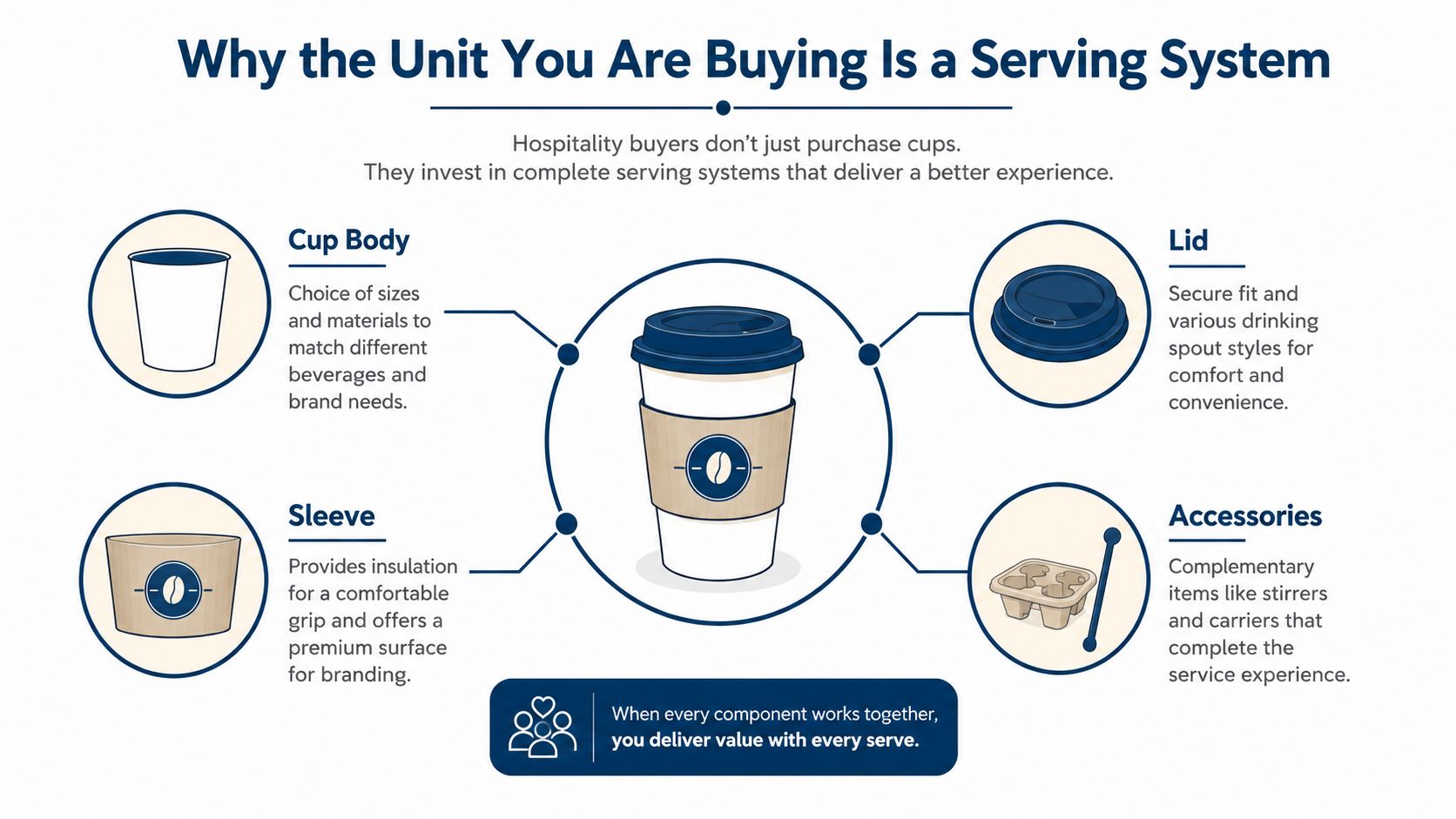
Assess each component by its job:
- Cup body: Check capacity, rigidity, construction and suitability for the beverage.
- Lid: Confirm the diameter, seal, drinking opening and fit with the cup.
- Sleeve or second wall: Decide how the drink will be held safely, stored and served.
- Accessories and disposal: Account for stirrers, napkins, carriers and the waste route after use.
These choices affect service speed as well as packaging spend. A cup may suit the recipe but fail with its lid. A secure lid may still make drinking awkward. A single-wall format may work for some drinks and need a sleeve or second cup for others. Disposal also determines whether a material claim has practical value.
Practical rule: Compare the complete cup, lid and sleeve combination, not the cup carton alone.
Calculate the cost of a successful serve as cup cost + lid cost + sleeve cost where used + expected avoidable waste. A small per-drink difference becomes a material annual cost across tens of thousands of drinks. Staff time, leaks, remakes and unnecessary double-cupping can outweigh the original carton saving.
Standard paper-looking cups and their lids also require a deliberate disposal decision. The Ministry for the Environment says a takeaway coffee cup cannot currently be recycled at kerbside because it is made from mixed materials and should go in the rubbish bin, as reflected in the New Zealand recycling guidance.
Set the buying process around the finished service: test the menu combination, confirm the lid fit, decide whether a sleeve is required, price avoidable waste and check the disposal route. The right cup is the one that works reliably as part of that complete system.
Mapping Your Menu to Cup and Lid SKUs
Cup selection should begin with the drinks being sold, not the sizes shown in a supplier catalogue. Each menu item needs a practical capacity, a compatible lid and a place in the venue's stock system.
A useful mapping exercise lists espresso-based drinks, long blacks or Americanos, tea, hot chocolate and cold beverages separately. The operator then records the usual beverage volume, the required cup capacity, the lid format and whether that combination overlaps with another menu item.
| Drink Category | Typical Volume | Cup Size | Lid Type | Notes |
|---|---|---|---|---|
| Espresso-based drinks | Venue-specific | Match the recipe | Matching hot-drink lid | Don't assume every café uses the same portion |
| Long blacks and Americanos | Venue-specific | Allow for water and headspace | Secure hot-drink sip lid | Test movement and drinking comfort |
| Tea | Venue-specific | Match the brew method | Hot-drink lid | Check clearance for tea bags or infusers where relevant |
| Hot chocolate | Venue-specific | Match milk and topping volume | Sip or dome lid where suitable | Toppings may require additional clearance |
| Cold drinks | Venue-specific | Allow for ice and condensation | Cold-drink lid | Verify cold cup and lid construction together |
The mapping should produce the smallest sensible number of formats, not the smallest number at any cost. A café may need several hot sizes and a separate cold-drink format, but it shouldn't carry extra sizes merely because the menu has accumulated them over time. If one drink genuinely needs a different capacity, removing that size can create more service problems than it solves.
The same discipline applies to lids. Standardising lid fit can sometimes matter more operationally than standardising cup volume. Fewer lid diameters can simplify ordering, storage, stock counts, replenishment and staff selection during service. Compatibility still needs to be checked against the actual product specifications, because one range's lid isn't automatically universal across another range.
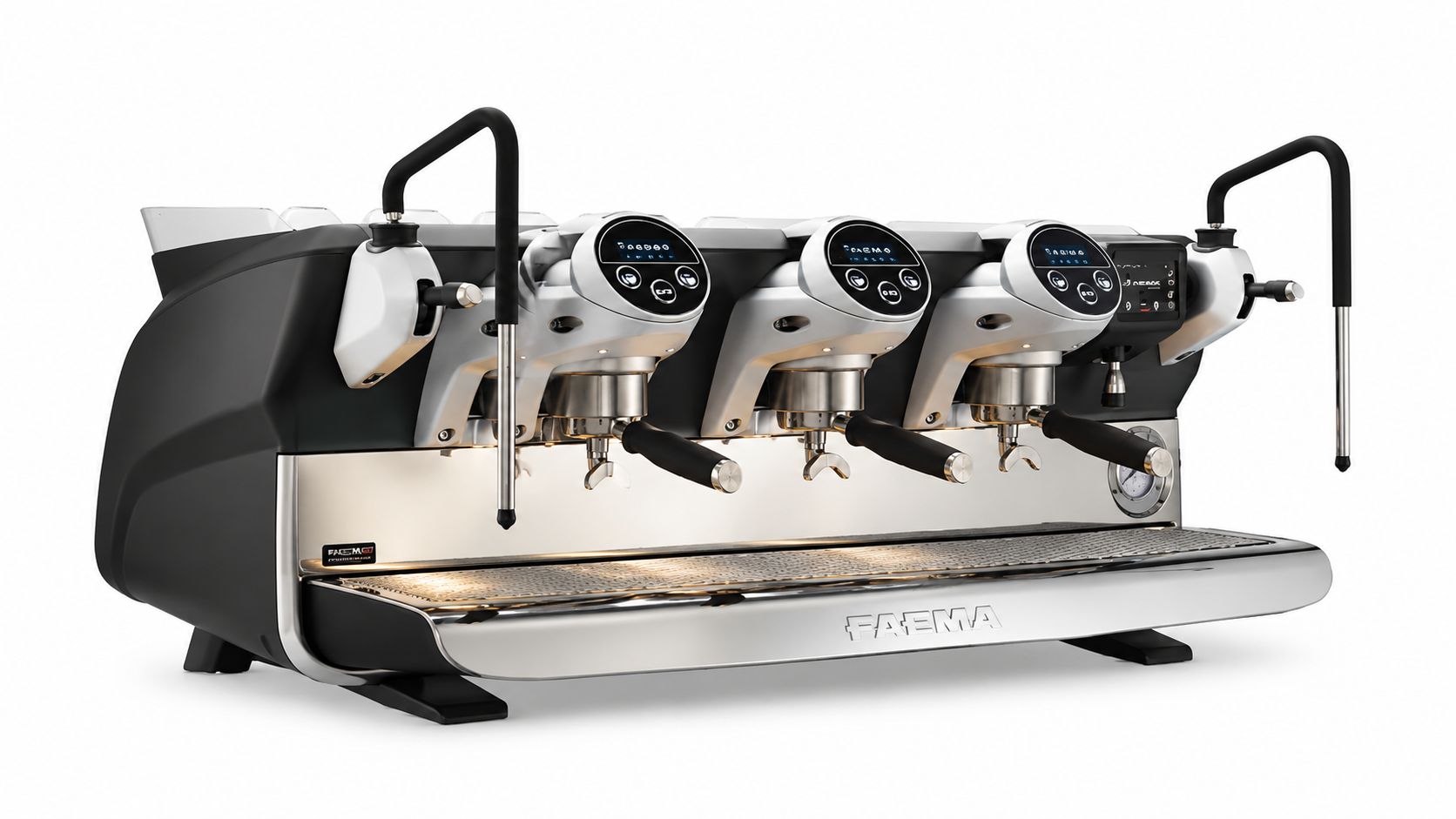
A coffee programme built around equipment such as the Faema E71E Commercial Espresso Machine may serve different coffees at different temperatures through its independent groups, with GTi infusion management and long cold-touch steam wands. That level of drink control makes it even more important that packaging choices preserve the intended serving experience.
The packaging considerations for takeaway businesses also need to be assessed alongside bar workflow. Cup and lid should be treated as a matched pair from the beginning, with the supplier's compatibility information recorded before purchasing decisions are based on wall construction or branding.
Single-Wall vs Double-Wall as Complete Systems
Single-wall and double-wall cups should be compared as finished serving methods.
A single-wall cup uses one primary layer and may suit cold drinks or hot drinks served with a separate sleeve. That arrangement can be lighter and easier to stack, and the cup itself may have a lower unit cost. The trade-off is that the sleeve becomes another item to buy, store, replenish and fit during service.
A double-wall cup adds another layer of construction and can provide a different grip and insulation experience without a separate sleeve. It may cost more per cup, but that higher cup cost can be partly offset when the sleeve is removed from the serving sequence.
| Factor | Single-Wall + Sleeve | Double-Wall + Lid |
|---|---|---|
| Handling | Sleeve needs to be fitted or kept available | No separate sleeve step where the design provides sufficient grip |
| Storage | Requires cup and sleeve storage | Requires cup storage only for the serving system |
| Insulation | Depends on sleeve fit and the beverage | Depends on the cup's construction and beverage |
| SKU complexity | Cup, lid and sleeve formats may need coordination | Cup and lid still require confirmed compatibility |
| Best choice | Suitable where sleeves fit the service and menu | Suitable where integrated construction suits handling |
| Main caution | Avoid unnecessary double-cupping | Don't assume every double-wall cup suits every drink |
Neither option wins automatically. A single-wall cup with a well-fitting sleeve may be the right choice for a venue that already has an efficient sleeve station. A double-wall system may make more sense where staff need to move quickly and the venue wants fewer separate components at the handover point.
Thermal performance should be tested with the actual drinks, not inferred from the product name. A flat white, long black and hot chocolate may behave differently because beverage temperature, fill level and holding time affect the customer's experience. The question isn't whether a cup is “insulated”. The question is whether the completed drink remains comfortable to carry and drink under the venue's normal conditions.
The disposable food containers guidance for NZ hospitality reinforces the wider point. Packaging performance depends on the interaction between material, construction, lid and use case.
The right comparison is single-wall cup plus sleeve plus lid versus double-wall cup plus lid. A carton comparison leaves out too much.
Before committing to volume, operators should test both systems side by side. Staff should handle filled cups, fit the lids repeatedly, move drinks through the handover area and assess whether sleeves are being used consistently. A system that looks cheaper on paper can become less attractive if it adds avoidable steps or extra components.
Calculating Real Cost per Takeaway Drink
The useful number isn't the cost of one cup in a carton. It's the cost of a completed drink leaving the venue.
A practical calculation includes:
- Cup: The selected construction and capacity.
- Lid: The compatible lid, not an assumed substitute.
- Sleeve: Included when the cup requires one for the intended service.
- Accessories: Stirrers, sugar packets, napkins or carriers where supplied with the drink.
- Avoidable waste: Cups, lids or sleeves discarded because of poor fit, handling errors, remakes or damage.
For the required illustrative example, Option A has a complete system cost of 24 cents per drink, while Option B costs 21 cents per drink. The difference is 3 cents per drink. At 200 takeaway drinks per day across 350 trading days, the calculation is:
- 200 × 350 = 70,000 drinks annually
- 70,000 × $0.03 = $2,100 annual difference
These figures are illustrative only. They aren't Simply Hospitality product pricing or customer results. Their purpose is to show how a small unit difference can become a significant operating cost when repeated across a high-volume service.
| Cost Component | Single-Wall + Sleeve | Double-Wall |
|---|---|---|
| Cup | 21 cents | 24 cents |
| Lid | Included in the illustrative complete-system figure | Included in the illustrative complete-system figure |
| Sleeve | Included in the illustrative complete-system figure | Not required in the illustrative comparison |
| Complete system | 21 cents per drink | 24 cents per drink |
| Annual volume used | 70,000 drinks | 70,000 drinks |
| Annual difference | $2,100 lower in this illustration | $2,100 higher in this illustration |
The table intentionally keeps the comparison at complete-system level. Actual purchasing requires the operator to enter the specific cup, lid, sleeve and accessory prices, then record the number of successful drinks served.
A venue should also measure what gets discarded before reaching the customer. Lids can be mis-seated, sleeves can be forgotten, cups can be rejected because of damage or presentation, and drinks can be remade after a leak. The number doesn't need to be perfect to be useful. A simple record of cups purchased, drinks sold, cups discarded or remade and packaging cost per drink can expose patterns over a representative period.
Commercial discipline: Measure the cost of a successful serve, not the price of an item before service begins.
The packaging choices for business growth should sit alongside broader purchasing decisions. For example, a venue managing chilled stock in a SKOPE ActiveCore 2 Door Display Freezer - Black - SKFT1000N-A still needs to evaluate equipment and consumables according to workflow, capacity and ownership requirements. The same principle applies to cups. The cheapest individual component isn't necessarily the lowest-cost operational system.
Sustainability Claims in the NZ Context
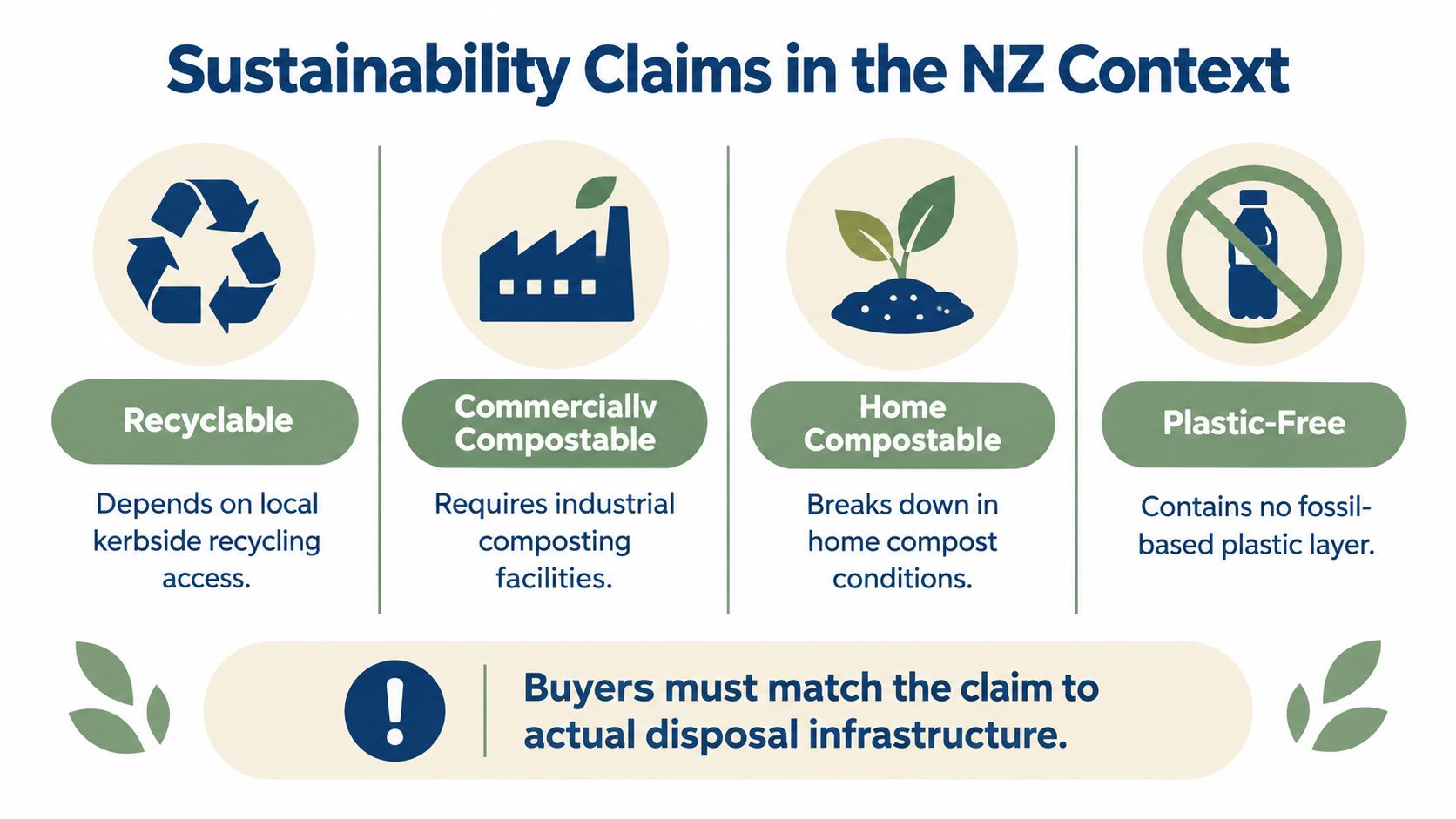
Sustainability language needs careful handling in New Zealand. Recyclable, compostable, commercially compostable, home compostable, recycled content and plastic-free are not interchangeable descriptions. Each one needs to be checked against the product specification and the waste infrastructure available to the venue.
A claim on the carton doesn't guarantee that a customer's local council or contractor can process the cup. The operator needs to ask where the cup goes after collection, whether the lid must be separated, whether sleeves enter the same stream and whether the facility accepts that exact packaging construction.
Recyclable doesn't mean kerbside accepted
Conventional takeaway cups are usually made from paper bonded to a thin plastic lining. New Zealand council guidance consistently directs these cups away from kerbside recycling because the materials aren't practically separated in normal systems. Auckland Council says plastic-lined paper cups belong in rubbish unless the cup is free from plastic lining and suitable for home composting, as outlined in its takeaway cup disposal guidance.
The Ministry for the Environment's guidance also says compostable or biodegradable packaging and cutlery can't go into food-scraps bins, as reported in this New Zealand guidance on takeaway coffee cup disposal. That means a venue shouldn't tell customers to place a compostable cup in ordinary kerbside organics unless the local system explicitly accepts it.
Compostable needs a verified destination
Commercially compostable cups require a suitable industrial composting pathway. New Zealand guidance notes that only around 10 composting facilities take compostable coffee cups, and there's no national standard for compostable packaging in New Zealand, according to the Ministry for the Environment's Transforming Recycling consultation document.
Home compostable is a different claim again. It shouldn't be treated as a guarantee of acceptance in a council food-scraps collection. Selwyn District Council states that there's currently no standardised labelling or regulatory framework for these products and that compostable packaging, including takeaway coffee cups, isn't accepted in its council organics bins, regardless of marketing claims, as explained in its biodegradable and compostable products guidance.
The Ministry for the Environment's 2025 behavioural monitoring survey found that 49% of people correctly identified coffee cups as non-recyclable for council collection, showing why clear bin signage and staff guidance matter. That figure is reported in the 2025 Waste and Resource Efficiency Behavioural Trend Monitoring Report.
The BioPak sustainable products information can help operators consider product claims, but the final decision still belongs to the venue's actual collection contract and end destination.
Trial Protocol and Storage Considerations
A cup system should be trialled before a venue commits to substantial carton quantities. Samples can look acceptable on a bench while producing different results during a busy service, particularly when staff are moving quickly and drinks are carried away immediately.
A practical trial should cover:
- Sample the shortlisted systems: Test products from at least two potential suppliers where possible.
- Pair the intended components: Use the specified cup with the specified lid, sleeve and relevant accessories.
- Use actual beverages: Test espresso drinks, long blacks, tea, hot chocolate and cold drinks where those products are part of the menu.
- Run real service conditions: Include normal handover, movement, customer carrying and a busy trading period.
- Record observations: Note lid fit, leaks, rigidity, heat handling, drinking comfort, staff speed and discarded packaging.
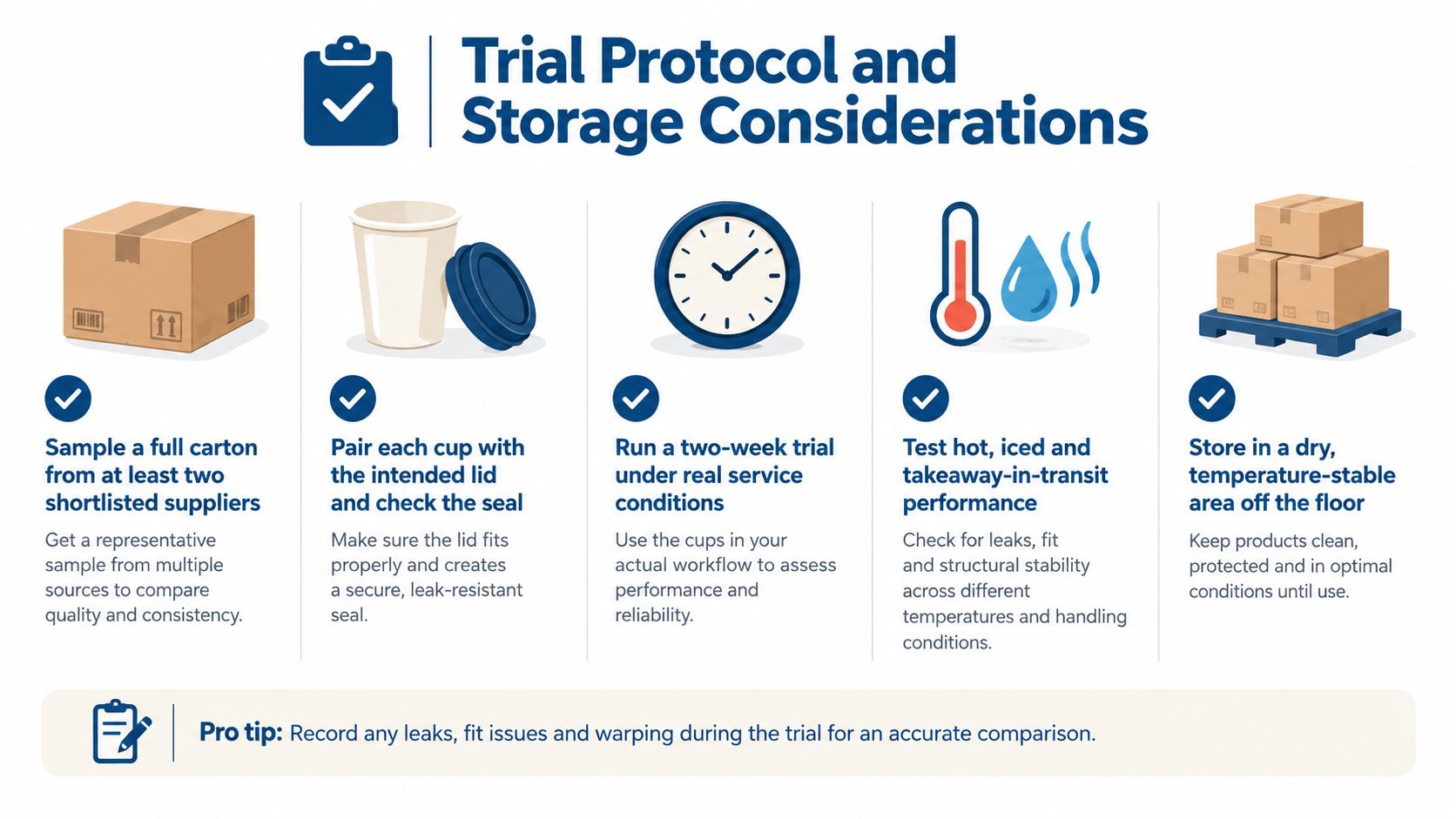
The trial should examine more than a single sample. Staff should fit multiple lids to multiple cups, carry filled drinks and check whether the result stays consistent. Cold drinks need a separate check for condensation, while hot drinks need attention to grip and lid security.
Storage can affect performance before the cup is used. Cartons should be kept dry, protected from damaging conditions and stored where stock can be rotated. A crushed carton can distort cup walls and make lid fit less reliable, so cartons shouldn't be stacked beyond the manufacturer's recommendation.
The venue should also decide its SKU structure during the trial. Four cup sizes paired with two lid types already represent eight packaging SKUs. That may be justified, but the operational cost should be visible before ordering begins.
Trial note: The best sample is a completed drink carried through the venue's real handover process, not an empty cup inspected at a desk.
Stock controls should be simple. The kitchen storage container guidance is relevant to the same underlying issue, which is keeping consumables organised, accessible and protected from avoidable damage. Cup stock needs a defined location, clear labels and a replenishment routine that doesn't force staff to search during service.
A Practical Checklist and Where to Go Next
A sensible purchasing decision can be reduced to three tests: compatibility, suitability and commercial cost. Sustainability, presentation, storage and branding matter, but they shouldn't distract from those fundamentals.
Compatibility
- Lid seal: The selected lid must fit the selected cup consistently.
- Diameter control: The venue should know how many lid diameters it needs to stock.
- Sleeve fit: A sleeve should sit securely on the chosen cup rather than sliding during handling.
- Accessory pairing: Carriers, stirrers and napkins should suit the order sizes and service process.
Suitability
- Menu capacity: Cup sizes should match actual drink recipes, not assumed national standards.
- Temperature handling: Hot drinks need a cup and lid that staff and customers can handle comfortably.
- Cold service: Cold cups and lids need to cope with condensation and the intended drink presentation.
- Bar workflow: The system should be quick to select, fill, close and hand over.
- Storage footprint: Carton size, order quantities and replenishment access need to suit the venue.
Commercial cost
- Complete serve: Add the cup, lid, sleeve where used and relevant accessories.
- Avoidable waste: Record discarded cups, unused sleeves, incorrect lids and remade drinks.
- Volume effect: Multiply the difference by realistic daily takeaway volume and trading days.
- Inventory complexity: Fewer SKUs can simplify purchasing, but genuine menu requirements shouldn't be removed just to make the stock list look smaller.
The waste pathway needs the same direct scrutiny. A paper appearance doesn't make a cup kerbside recyclable. A compostable claim doesn't confirm acceptance by a council food-scraps service. A plastic-free cup can still create disposal problems if the lid and collection pathway don't match.
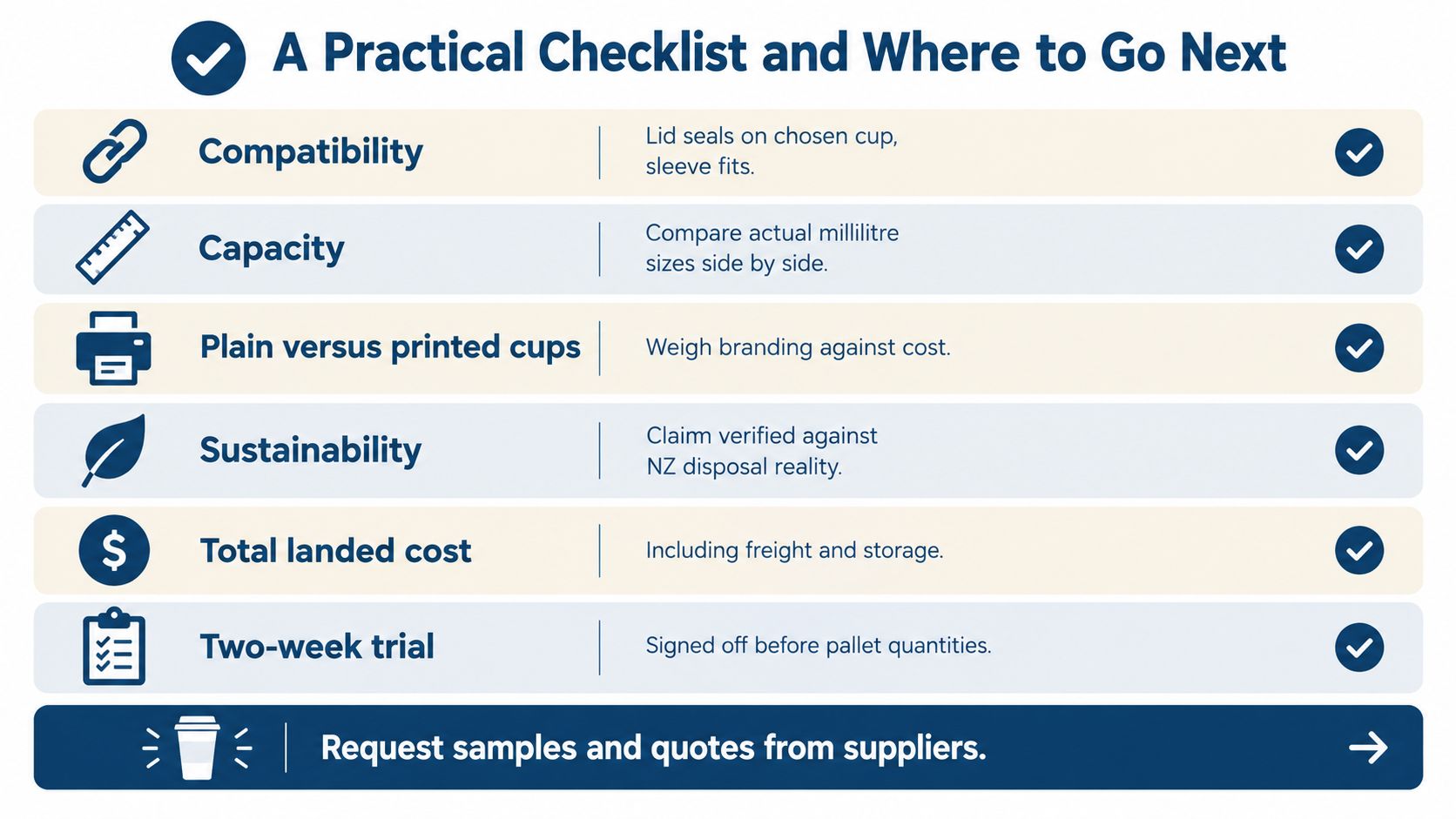
The final decision should follow a sample trial, not just a catalogue comparison. Request matched cups and lids, test them with the venue's real drinks and service conditions, then compare the complete cost per successful serve with the current system.
Hospitality partners can help operators map menu sizes to compatible cup and lid formats, review suitable takeaway and café consumables, and assess the wider workflow around storage and service. Visit Simply Hospitality to request practical advice, product options and a quote suited to the venue's operating requirements.