


Coffee Percolator NZ: How to Choose for Busy Service
A conference break can expose the limits of a coffee setup very quickly. If 40 guests leave a meeting room at once, the service problem isn't whether one coffee can be made quickly. It's whether enough coffee is already available when the queue forms. That's where a commercial coffee percolator in NZ can make sense, particularly for conferences, hotels, staff rooms, functions, catering and self-service beverage stations.
The central advantage is batch production. A percolator isn't intended to make one coffee better or faster than a skilled barista. Its job is to prepare a large quantity before demand arrives, then let people serve themselves with minimal labour during the busiest part of the service window.
The right choice depends on more than a cup figure on a product label. Operators need to check actual litre capacity, usable output, brewing time, holding, recovery for a second batch, bench space, power, dispensing and cleaning. A large unit isn't automatically the right unit, especially when only a modest number of people need coffee at the same time.
The following guidance reflects the practical questions hospitality suppliers regularly work through with cafés, hotels, caterers, community facilities and institutional kitchens. It also places percolators in the wider coffee workflow, alongside espresso machines, filter brewers and other beverage equipment. For broader peak-service planning, operators can also review these ways to improve kitchen efficiency during peak service.
Introduction
A coffee percolator suits a venue that needs a batch of brewed coffee ready for a group at roughly the same time, rather than a venue focused on individually prepared espresso drinks. That makes it practical for hotel breakfasts, conference breaks, staff rooms, functions and catering stations where people arrive in waves.
A conference break creates a clear example. Many guests may reach the beverage station together, so brewing before the doors open reduces pressure at the busiest point. Staff can concentrate on cups, milk, sugar, replenishment and general service instead of preparing each drink to order.
Practical rule: Size the percolator for the busiest service window, not for the total number of people who could use it over a day.
The same decision applies to corporate offices. A staff room with many employees may need only a moderate unit if coffee consumption is spread across the morning. A smaller meeting may require a larger batch when nearly everyone serves themselves during one short break. In New Zealand operations, available bench space, power access and the unit's holding arrangements also affect whether the machine fits the station.
A percolator is a poor match for a café built around espresso quality, milk texturing and individual customisation. That workflow calls for barista-led equipment and service. For batch service, a percolator can prepare coffee ahead of demand and support self-service, without being treated as an alternative to a quality espresso machine.
Start the buying decision with timing. Establish how many cups must be available together, how long brewing takes, whether staff can prepare a second batch before the first runs out, and how the coffee will be held and dispensed. Confirm cleaning and food-safety requirements as part of the setup, not after installation. These checks are more useful than selecting the largest advertised model, and they support the wider kitchen efficiency measures for peak service.
What a Commercial Coffee Percolator Is and How It Works
For busy venues, the advantage of a percolator is simultaneous availability. It prepares a batch for a conference break, breakfast service or catered function, rather than producing one customised drink at a time.
A typical electric model includes:
- A main vessel for water and brewed coffee.
- A hollow internal stem that carries heated water upwards.
- A grounds basket positioned around the stem.
- A spreader or cover that distributes water across the grounds.
- A lid and dispensing arrangement for serving.
The operating cycle is straightforward. Water heats in the lower vessel, rises through the central stem, spreads over the coffee grounds and returns to the vessel as brewed coffee. The cycle repeats while the machine is operating. A clearer explanation is available in this guide to how a percolator works.
Percolated coffee belongs to a different workflow from espresso. Espresso uses pressure, controlled extraction and an individual puck of coffee. A percolator recirculates heated water through a batch of grounds, producing a fuller, traditional brewed-coffee character without the same extraction control, crema or barista adjustment.
That distinction matters in New Zealand hospitality operations. A percolator supports self-service and advance preparation when many guests need coffee together. An espresso machine suits made-to-order drinks, milk texturing and individual customisation. Treating the percolator as a batch-service tool leads to more realistic equipment and station planning.
Many commercial units use stainless-steel construction, particularly where the appliance is visible to guests or receives repeated handling. Material alone does not determine working life. Body construction, internal parts, the heating system, handles, tap design, cleaning access and parts support all affect daily reliability.
Coffee quality depends on the whole brewing process. Coffee selection, grind, coffee-to-water ratio, water quality, brewing procedure, holding time and equipment cleanliness can change the result. Follow the manufacturer's recommended quantity and grind instead of assuming that a different basket or material will produce a cleaner cup.
For a venue comparing batch brewing with barista-led preparation, commercial coffee machine guidance provides broader context. The Faema E71E Commercial Espresso Machine belongs to a different workflow, with group-specific temperature control, GTi infusion management, long cold-touch steam wands and a barista-focused interface.
Choosing the Right Size for Your Service Window
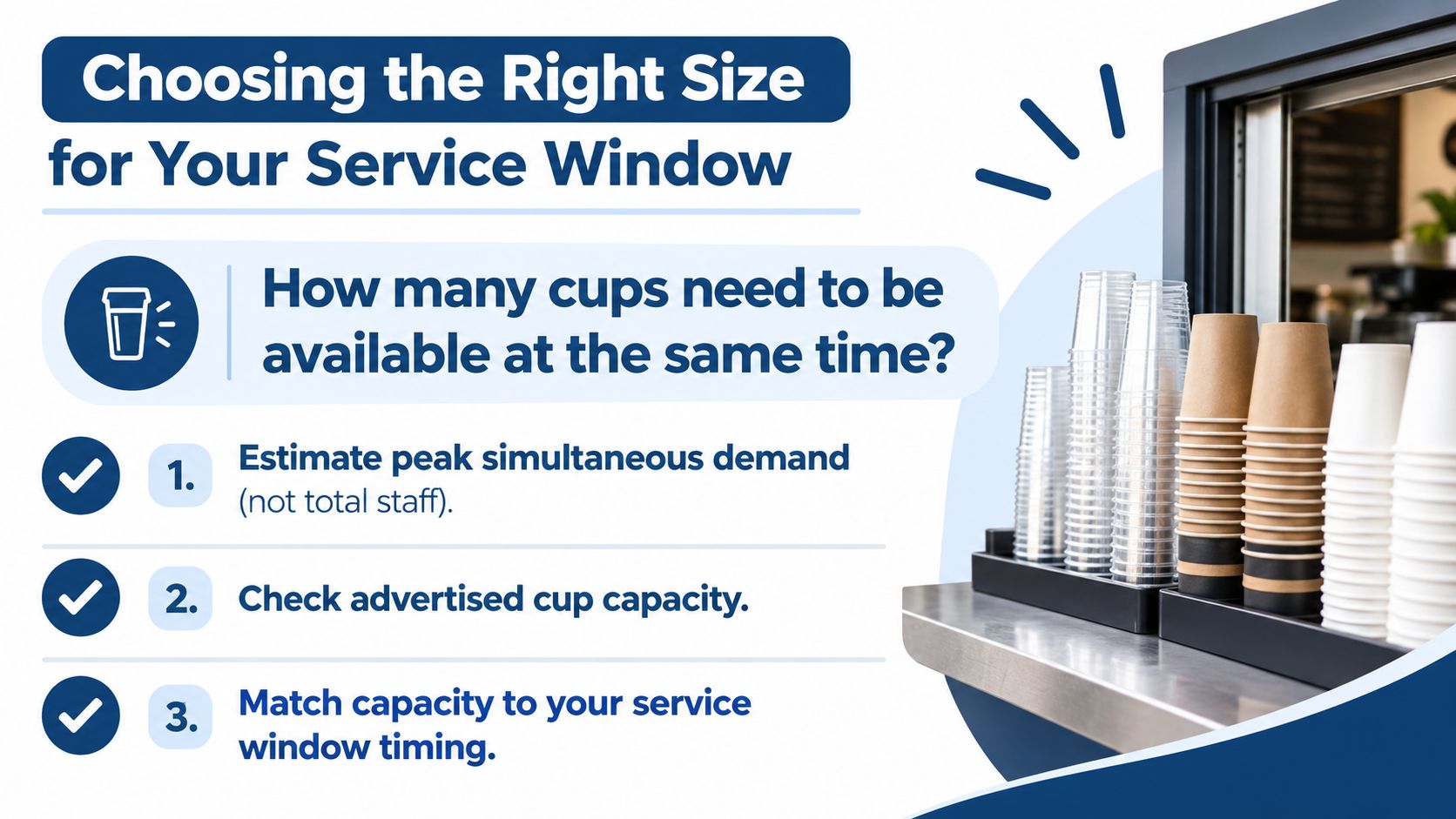
A percolator earns its bench space when several people need coffee within the same service window. The first question is:
How many cups need to be available at approximately the same time?
Staff numbers, room capacity and daily guest totals provide context, but they do not set the batch size on their own. An office may serve coffee steadily through the day, while a conference break can create a sharp rush. Similar total demand can therefore require very different equipment planning.
Start with usable output
Product names and advertised cup counts need checking. Manufacturers may use different serving sizes when defining a “cup”, so the figure is not a universal measure. Confirm the actual litre capacity, then compare it with the venue's intended serving size and the amount that can be poured comfortably without making the vessel awkward to handle.
Use this sizing check:
- Peak demand: Count the people likely to want coffee during the busiest service window, rather than the full workforce or guest list.
- Serving size: Establish whether the station uses small cups, standard mugs or larger takeaway cups.
- Brewing time: Confirm how long the appliance takes to prepare the required batch.
- Holding: Set a practical limit for how long brewed coffee can remain available before quality and temperature decline.
- Recovery: Check whether another batch can be ready before the first is finished.
- Footprint: Measure the bench, clearance, tap position and access required for filling, dispensing and cleaning.
A staff room serving coffee to its whole group at once may need a modest batch supported by a clear top-up plan. A meeting venue with one scheduled break may need greater capacity or a second-batch strategy. Choosing a larger unit than the service requires can consume valuable bench space and create unnecessary brewing.
Match equipment to the service pattern
| Service pattern | Main sizing focus | Operational question |
|---|---|---|
| Office or staff room | Simultaneous drinkers | Can the batch cover the busiest shared break? |
| Meeting | Short, predictable demand | Can coffee be ready before attendees leave the room? |
| Conference | Concentrated service window | Is one batch enough, or is recovery required? |
| Hotel breakfast | Extended availability | Can staff refill without interrupting the buffet flow? |
| Function or catering | Group arrival pattern | Can the station remain simple and self-service? |
A product name may suggest capacity, but the litre figure and service timing provide the more useful basis for comparison. Allow for coffee that remains in the vessel after pouring, since nominal capacity is not always the same as practical served volume.
The refill plan matters as much as the first batch. If demand arrives in waves, confirm where the next batch will be prepared, who will monitor it and whether staff can refill without crossing the guest flow. A percolator that suits a hotel breakfast may be poorly matched to a compact catering station if its filling and cleaning routine is difficult.
Bench space can decide the purchase in a small staff room or prep area. Leave room for filling, lifting, dispensing and cleaning, not only the base footprint. A tap too close to the bench edge can make pouring awkward, while a lid that cannot be removed comfortably can slow routine cleaning. Check power access and the position of nearby food preparation before committing to the station layout.
For a broader view of equipment planning in New Zealand hospitality environments, see this café kitchen equipment planning guidance.
Where Percolators Work Best and How They Compare
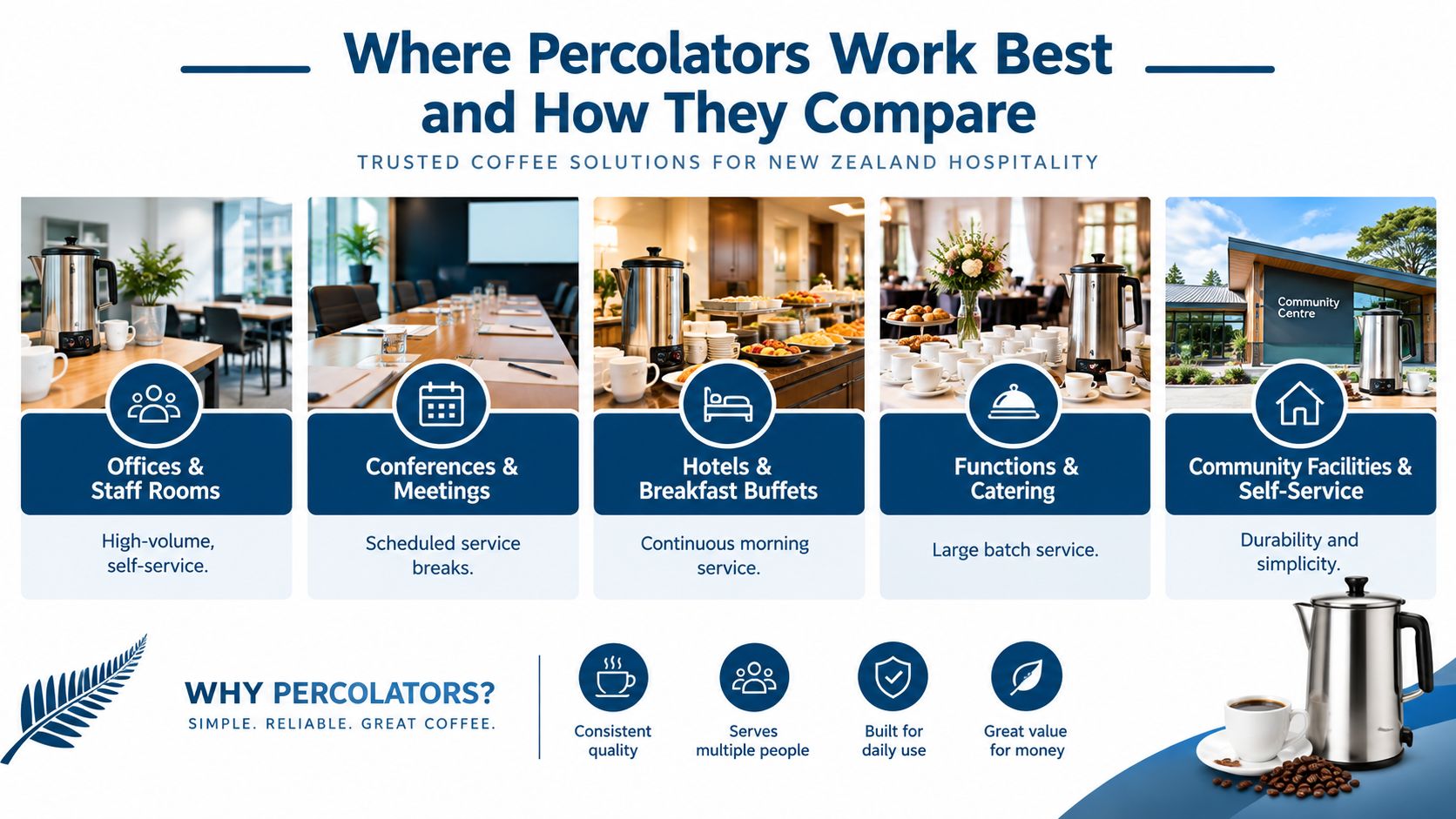
When dozens of people need coffee during the same service window, a percolator can keep distribution moving with batch readiness, simple dispensing and low intervention during service. It suits offices and staff rooms, conferences, meetings, hotel breakfasts, functions, catering operations, community facilities and self-service beverage stations.
An office can place one in a staff room so employees serve themselves without asking a colleague to prepare every drink. A conference venue can brew before a scheduled break, then set out cups, milk and sugar. A hotel breakfast service can offer straightforward brewed coffee alongside food. A caterer can use the same batch-service approach at a function or community event.
The alternatives support different workflows:
| Equipment type | Strength | Trade-off |
|---|---|---|
| Percolator | Produces a batch for self-service | Coffee is less individually adjustable than espresso |
| Espresso machine | Supports espresso, milk drinks and barista control | Needs trained labour and individual preparation |
| Filter brewer | Offers batch brewing with a different extraction process | May require separate brewing and holding arrangements |
| Hot water urn | Provides hot water for tea and instant beverages | Doesn't brew coffee itself |
A percolator is not an espresso substitute. Espresso equipment provides more control over extraction, customisation and milk drinks, but each order requires preparation and usually trained labour. A percolator gives up that individual control to serve basic brewed coffee to a group without creating a barista bottleneck.
Filter brewers also produce batch coffee, but their extraction method and holding setup differ. The practical choice depends on the equipment already available, the coffee profile the venue wants, how long the batch will be held and how staff will clean the unit. A percolator's recirculating process requires consistent brewing and holding practice, particularly when coffee is prepared well before service.
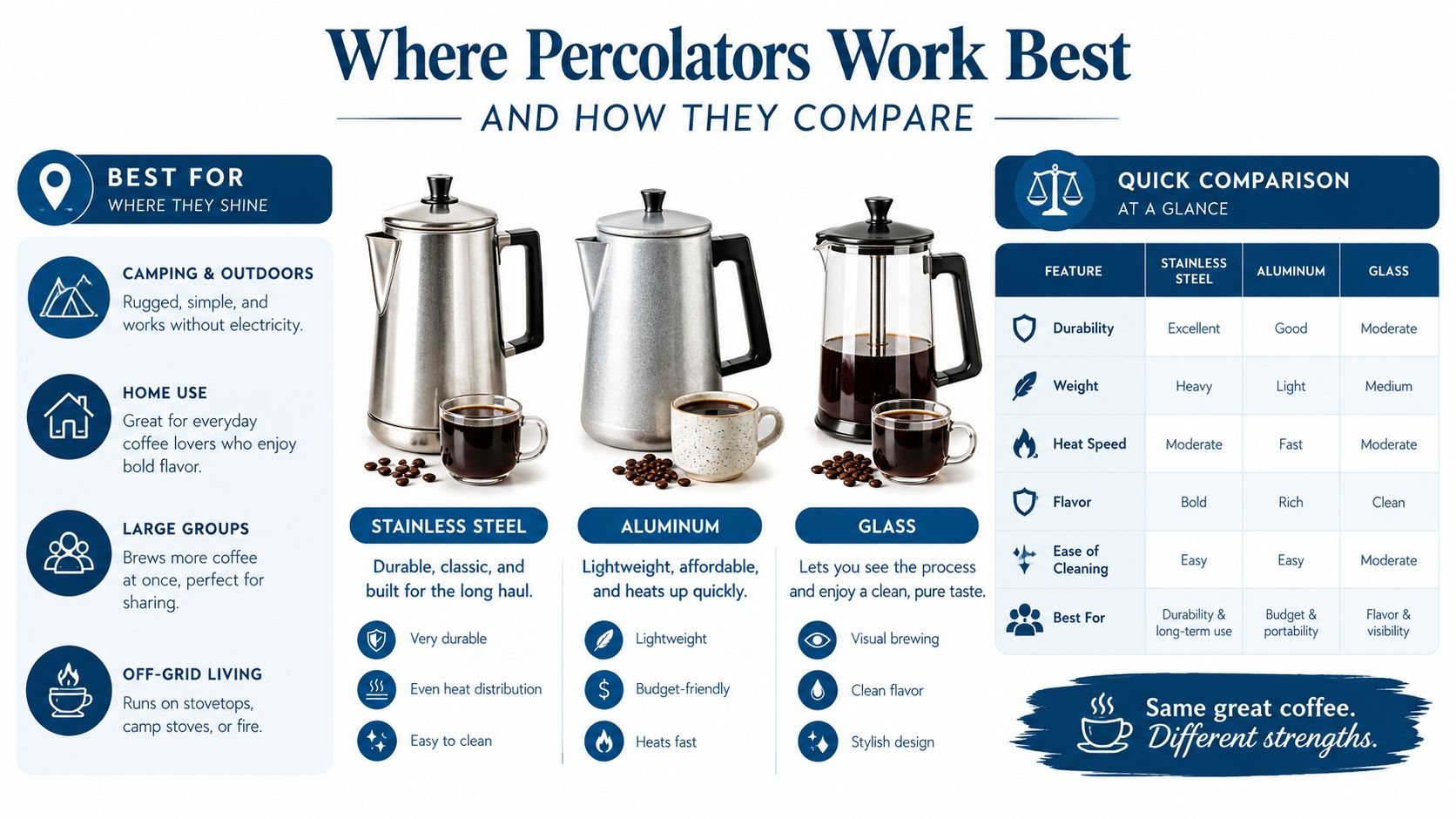
Materials need a complete assessment
Stainless steel is common in commercial beverage equipment. It suits a visible service station because it presents a professional appearance and is generally straightforward to wipe. Aluminium and glass appear in other designs, but material alone does not determine whether a unit will work well in hospitality.
Assess the construction as one working system:
- Vessel and lid design.
- Heating components.
- Internal stem and basket.
- Handles and tap.
- Stability when full.
- Access for cleaning.
- Availability of replacement parts where applicable.
The distinction between domestic, semi-commercial and commercial equipment provides useful context. A household appliance may handle occasional use, while a hospitality operator must account for repeated brewing, frequent handling, cleaning demands and the disruption caused by a breakdown during a scheduled service.
Technical and Operational Details That Affect Daily Use
A percolator earns its place when a team needs one predictable batch for a busy breakfast, meeting break or shared kitchen. Daily performance depends less on the appliance looking simple and more on how it fits the site, service routine and cleaning schedule.
Check the site before ordering
Confirm the available power point, cord reach, bench space and heat-resistant surface before purchase. The filled vessel must remain stable, and staff need a safe way to lift or reposition it. Avoid placing it where a full unit has to cross a busy pass.
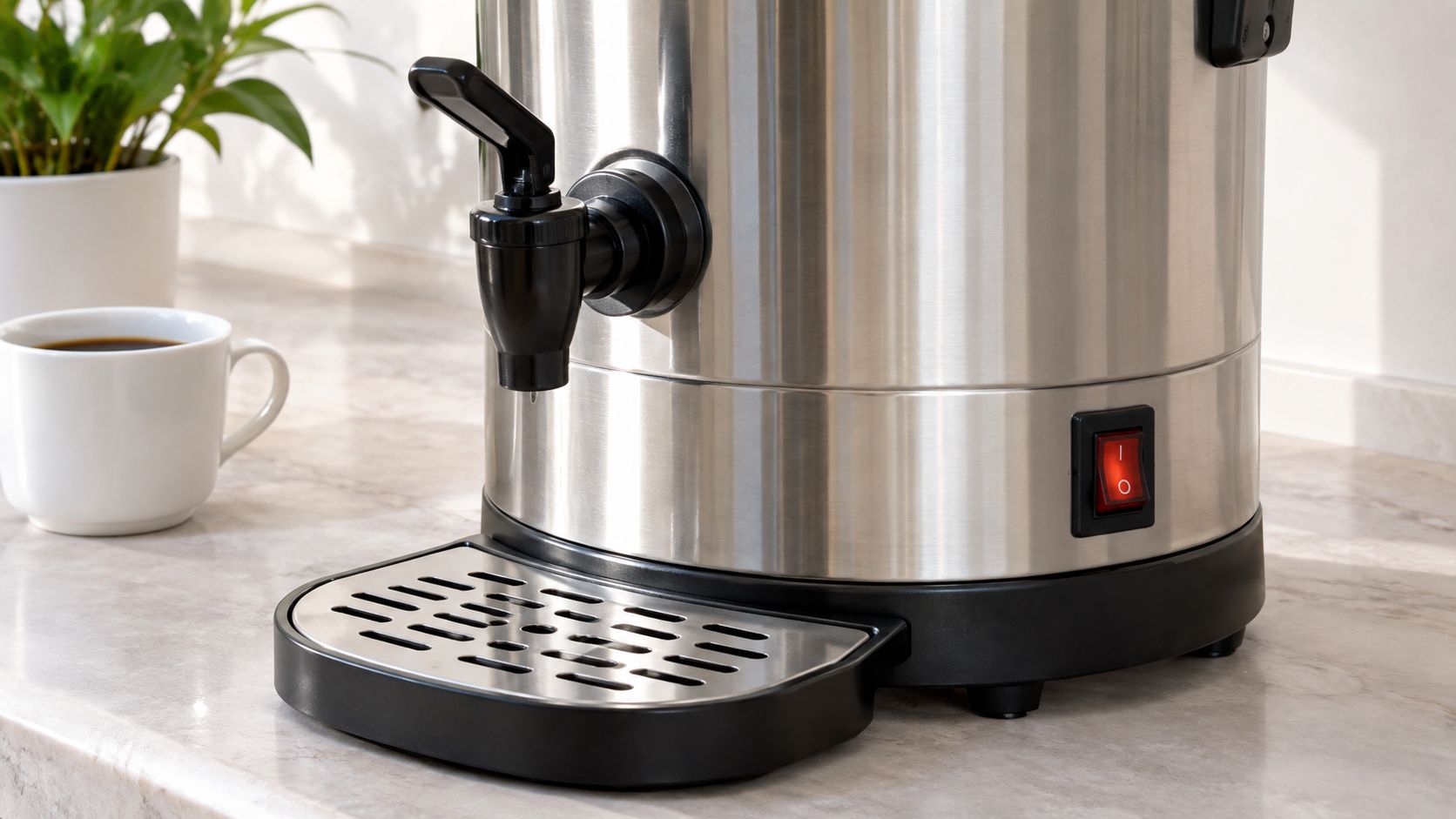
Tap position affects service speed. Cups and jugs should sit beneath the outlet without splashing, while staff should be able to dispense coffee without reaching across hot surfaces. A self-service station also needs space for cups, lids where relevant, milk, sugar, stirrers and waste.
Allow room around the appliance for the lid, basket and internal parts to be removed during cleaning. This small check prevents a common installation problem, where the unit fits the bench but cannot be serviced comfortably.
Treat brewing as a repeatable process
Use the manufacturer's instructions as the starting point for coffee quantity, grind and operating procedure. Staff should avoid overfilling the basket, check the water quality and follow one recorded method so batches remain consistent across shifts.
Holding time needs a clear service rule. Decide when brewing starts, how long the batch remains available and when the next batch should begin. Coffee changes while it sits, so a percolator works best when brewing is timed close to demand rather than completed well before guests arrive.
Service habit: Assign one person to check the beverage station, top up accompaniments and monitor the remaining batch during a scheduled break.
Cleaning protects flavour and hygiene. Coffee oils and residue can collect in the vessel, stem, basket, lid and tap. A daily routine should include:
- Emptying promptly: Remove used grounds and leftover coffee after service.
- Washing removable parts: Clean the basket, stem, spreader and lid according to the manufacturer's instructions.
- Cleaning the tap: Flush and wash the dispensing path so residue does not remain inside.
- Wiping the exterior: Clean the handles, controls and customer-facing surfaces.
- Descaling when required: Follow the product instructions and local water conditions instead of relying on an improvised schedule.
The percolator is not self-cleaning. Coffee cycles through its internal components, so every part that contacts the drink needs appropriate attention. Clean equipment supports cup quality and safe food-service practice, alongside proper handling of milk, cups and other accompaniments.
Cost Compliance and Sourcing in New Zealand
The purchase price is only one part of owning a commercial coffee percolator. Operators should consider energy use, cleaning products, replacement parts, servicing, staff time and the operational cost of a unit that doesn't match the service window.
A unit that's too small may force repeated batches, extra handling and interruptions during a meeting or breakfast period. A unit that's too large may occupy valuable bench space and brew more coffee than the venue can use within an acceptable holding period. The right choice balances capacity with the actual workflow.
New Zealand operators also need to treat electrical safety as a supply and commissioning requirement. The Electricity (Safety) Regulations 2010 require every new or used appliance sold or supplied to be electrically safe, and compliance is deemed where the appliance meets AS/NZS 3820 or the applicable standard in Schedule 4.
The specific appliance scope matters too. IEC 60335-2-15:2024 covers appliances for heating liquids at rated voltages up to 250 V DC, including coffee-makers and other boiling-water appliances with capacities up to 10 L, as described by Standards New Zealand. A percolator used in a café, motel, marae kitchen or community facility should therefore be selected as a compliant low-voltage liquid-heating appliance, not treated as an unregulated countertop accessory.
WorkSafe's guidance on appliances and fittings states that suppliers and manufacturers of electrical products in New Zealand must ensure those products are safe. That makes conformity evidence important when an operator commissions equipment, prepares an asset register or responds to an electrical inspection.
Ask for evidence before delivery
A useful sourcing conversation should cover:
- Compliance: What evidence supports the appliance's NZ electrical-safety pathway?
- Warranty: What does the warranty cover, and who handles the service request?
- Parts: Are baskets, stems, taps or heating components available where applicable?
- Cleaning: Which parts can be removed, and what cleaning method is approved?
- Capacity: What is the actual litre volume, not just the advertised cup count?
- Installation: What power, clearance and bench conditions are required?
- Ownership: Is new equipment or certified used equipment more suitable for the venue?
The country's wider energy-safety framework is based on the Electricity Act 1992 and Gas Act 1992, as outlined by MBIE's energy-safety information. Operators can also compare capital purchase and finance considerations through lease versus buy guidance for commercial kitchen equipment.
Practical Buying Checklist and Next Steps
A busy morning service exposes a percolator's strengths quickly. Before requesting a quote for a coffee percolator in NZ, confirm the following:
- Service window: How many cups must be available at roughly the same time?
- Usable capacity: What is the manufacturer's actual litre capacity, and how does it compare with the advertised cup count?
- Brewing plan: Can the first batch finish before demand arrives, with enough time for another batch if required?
- Site fit: Is there sufficient bench space for filling, dispensing, cleaning and safe handling?
- Power: Does the proposed location have a suitable connection and practical cord reach?
- Dispensing: Can staff or customers pour without awkward access, splashing or congestion?
- Holding: How long can coffee remain in the vessel before the next fresh batch is needed?
- Cleaning: Can staff remove and clean the basket, stem, lid and tap within the daily routine?
- Compliance: Is conformity evidence available for the New Zealand electrical-safety pathway?
- Workflow: Will a percolator reduce individual preparation, or would espresso or filter equipment suit the venue better?
A percolator earns its place when it prepares batch coffee before a group arrives. A large cup count alone does not make it suitable. Match the appliance to the service window, then set up cups, accompaniments and replenishment so the station is ready alongside the coffee.
Record the batch size, holding plan and cleaning responsibilities before comparing models. That makes the quote easier to assess and exposes workflow problems before equipment reaches the bench.
Our team can help compare capacity, review site requirements and source a percolator suited to your workflow. Reach out through Simply Hospitality before ordering, so batch size, compliance evidence and the daily service routine are considered together.