

How to Choose a Commercial Blender NZ Operators Can Trust
Most advice about a commercial blender NZ buyers should trust starts in the wrong place. People obsess over wattage, peak speed and sticker price, then wonder why the machine slows service, annoys staff or becomes a bottleneck at the bar.
A better buying decision starts with three questions, how many blends does the team complete each day, what happens if the blender stops mid-service, and how much labour is spent waiting on the jug? For cafés, bars, accommodation kitchens and caterers, those are the numbers that matter because they shape throughput, consistency and downtime risk, not just blending force.
The basic function is simple enough, a blender is an appliance used to mix, crush, purée or emulsify food and other substances, but the commercial question is never that simple. The right unit has to keep pace with real service, whether that means frozen drinks at the bar, smoothies at breakfast, or prep work in the back of house.
Why Wattage Is the Wrong Place to Start
Bigger motors do not automatically make better hospitality blenders. In a busy venue, the key comparison isn't watts, it's smoothies per hour, consistency after repeated cycles, and how well the machine fits the service pattern.
Start with service, not specs
The hospitality businesses that get this right usually work backwards from the menu. A high-turnover smoothie café needs repeatable output and fast turnover, while a bar needs noise control and fast recovery between orders. A kitchen doing soups and purées cares more about batch handling and cleaning than front-of-house presentation.
Practical rule: If the blender can't keep up with the pace of the shift, the motor size on the brochure doesn't matter.
That's why local buying advice should focus on workflow fit. The question is not whether a machine sounds powerful. The question is whether it helps staff keep serving when the queue builds.
For operators who still need a clean distinction between domestic and trade gear, the simplest starting point is the practical differences laid out in Simply Hospitality's guide to domestic, semi-commercial and commercial equipment. That's the kind of comparison that saves time before a quote even gets written.
The hidden cost is waiting
One of the biggest hidden costs in blender selection is staff standing around waiting for a cycle to finish, or resetting a machine that can't handle back-to-back orders. The purchase price is paid once, but productivity is delivered every service, every day.
For cafés, bars and hotels, that means the cheapest quote is rarely the cheapest outcome. A lower upfront number can still cost more if it slows the line, interrupts workflow or fails at peak.
The Main Commercial Blender Categories
Operators don't really buy a generic commercial blender. They buy a machine that suits a very specific job, and the wrong category is where a lot of expensive disappointment starts.
Match the blender to the menu
High-performance bar blenders suit frozen cocktails, ice-crushing and smoothies. They belong in venues where speed and drink consistency matter more than delicate prep. These machines are a fit for busy bars, high-volume smoothie counters and restaurants that push a lot of blended drinks through service.
Heavy-duty prep blenders make more sense for soups, purées and sauces. They sit better in kitchens than on a visible front counter, because their real value is batch work and repeatability rather than showy drink service.
Compact countertop units suit smaller cafés, accommodation breakfast rooms and venues with lighter output. They're easier to place, easier to live with, and usually a better match for lower daily volume.
Sound-enclosed models are the practical choice where customers are close to the action. In New Zealand hospitality settings, that matters because lower acoustic disruption can make a real difference at the bar or front counter while still keeping throughput moving.
Venue fit beats broad claims
A venue building a practical cocktail programme might also think about how the blender sits alongside presentation glassware. A product such as Ocean Eco Madison Cocktail Glass 285ml - Set 2 suits bars, restaurants and event venues that want stronger drink presentation without moving into premium crystal ranges. That kind of pairing matters because equipment and serviceware should support the same front-of-house standard.
A useful operational resource for venues comparing service tools is ReceiptsAI hospitality features, especially where consistency and order flow are part of the broader service system. It's the type of back-of-house thinking that helps operators make smarter menu equipment decisions.
The wrong category creates friction all day. The right one disappears into the workflow.
Specifications That Actually Shape Daily Performance
Spec sheets are full of numbers that sound useful and tell operators almost nothing about day-to-day service. The better question is what changes labour, cleaning and output.
The short list that matters
Jar capacity matters because it shapes batch size and how often staff need to stop and restart. Jar material matters because it affects durability, weight and how easily the jug fits the task. Blade design matters because it changes how well the blender handles thick mixtures and harder ingredients.
Duty cycle matters too, especially in busy trade use. A machine that looks fine on paper can still be the wrong choice if it can't handle repeated runs without forcing staff to pause service.
Noise deserves real attention in cafés and bars. Front-of-house service is different from back-of-house prep, and noise control can be a deciding factor when customers sit close to the blender.
A sensible lid, a stable base and an interface staff can use quickly are more useful in service than another fancy number on the spec sheet.
What to check first
| Specification | What to Look For | Why It Matters Day to Day |
|---|---|---|
| Jar capacity | Size that matches batch volume | Fewer interruptions, less rework |
| Jar material | Durable, practical, easy to handle | Better fit for service and cleaning |
| Blade design | Built for your ingredients | More consistent output |
| Duty cycle | Suits repeated commercial use | Less stoppage in peak periods |
| Programmable cycles | Simple, repeatable settings | Faster staff training and consistency |
| Noise control | Lower disruption near customers | Better front-of-house experience |
| Jug system | Spare jug or stackable setup | Less downtime during cleaning |
For buyers comparing premium options, Simply Hospitality's article on whether a premium commercial blender is worth the extra money is a useful way to separate real operational value from marketing noise.
A compact rule helps here. If two units look similar on a quote, the better one is usually the one that supports cleaning speed, stable service and repeatable cycles, not just the one with the bigger number printed on the box.
The Smoothie Cafe Productivity Example
The buying decision becomes practical. Consider a busy smoothie café producing 150 smoothies a day at an average selling price of NZ$9. That means around NZ$1,350 of daily smoothie revenue is moving through the blender every shift.
A few seconds add up fast
If one commercial blender completes each blend 8 seconds faster than another, the gain sounds tiny. It isn't.
That difference works out to roughly 20 minutes recovered each day, around 120 labour hours each year, and approximately NZ$2,874 of annual labour value using New Zealand's adult minimum wage. That calculation is an illustrative example designed to help operators think about cumulative productivity, not a measured performance claim.
The point isn't that every venue will land on the same dollar figure. The point is that a blender is a production tool, and production tools should be judged by how much time they give back across a year of trading.
Run the same logic on your own menu
A café owner can apply the same approach with a simple checklist:
- How many blends leave the bench each day?
- How long does one cycle take during service?
- How much staff time is lost waiting for the next jug?
- How much of the menu depends on repeatable consistency?
That last question matters because customers notice texture, not motor specs. If the product has to be the same every time, the blender needs to produce the same result every time.
The same logic applies outside smoothies. Frozen drinks, thick bowls and mixed prep all create small time losses that stack up over a week.
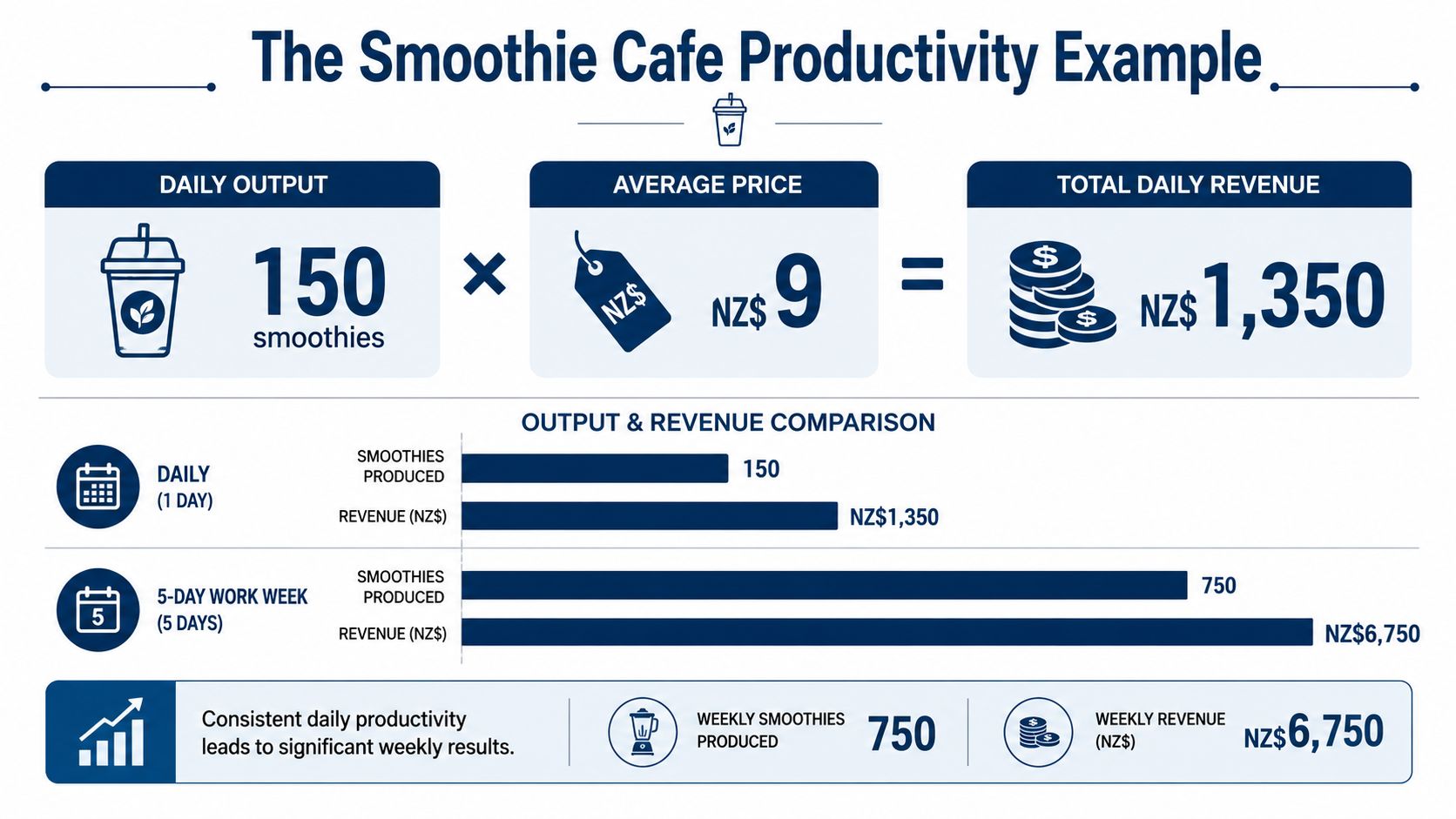
The key lesson is simple. Every blend may save only a few seconds, but those seconds accumulate throughout the year.
Vitamix and Hamilton Beach as Premium NZ Options
For demanding commercial work, brands matter because they signal how a blender is built to behave under repeated use. In New Zealand hospitality, Vitamix and Hamilton Beach sit in the premium conversation because they're designed for continuous service, not occasional domestic blending.
What premium use really means
That matters when the blender has to deal with difficult ingredients all day, frozen berries, feijoa, frozen banana, ice, nut butters and thick smoothie bowls. Those ingredients are hard on any machine, and the test is not the first good blend. It's the hundredth.
In practical terms, these brands are chosen for repeated output, not one-off performance. Operators who need a blender to stay useful through service cycles generally want a unit that holds texture, keeps pace and fits the workload without becoming a daily nuisance.
Use case first, brand second
A venue owner should still ask what the blender is being asked to do. Smoothie service, bar service and prep work all ask different things of the machine, and a premium label doesn't remove that decision.
The main point is that premium commercial blenders are judged by duty cycle, support and how they hold up across repeated service, not by a loose promise of being “strong enough”. That's where the better buying conversations happen.
For operators exploring the broader category, Simply Hospitality's commercial blender page is a sensible place to anchor the discussion around commercial use rather than domestic-style blending.
If a venue is working with thick or awkward ingredients every day, the right recommendation comes back to workload, not marketing language. The blender should be able to keep serving when the pace rises.
Reliability Protects Revenue
A blender failure during peak service is not a small inconvenience. It stops sales, slows staff and creates immediate pressure on the rest of the bar or kitchen.
Downtime hits harder than the repair bill
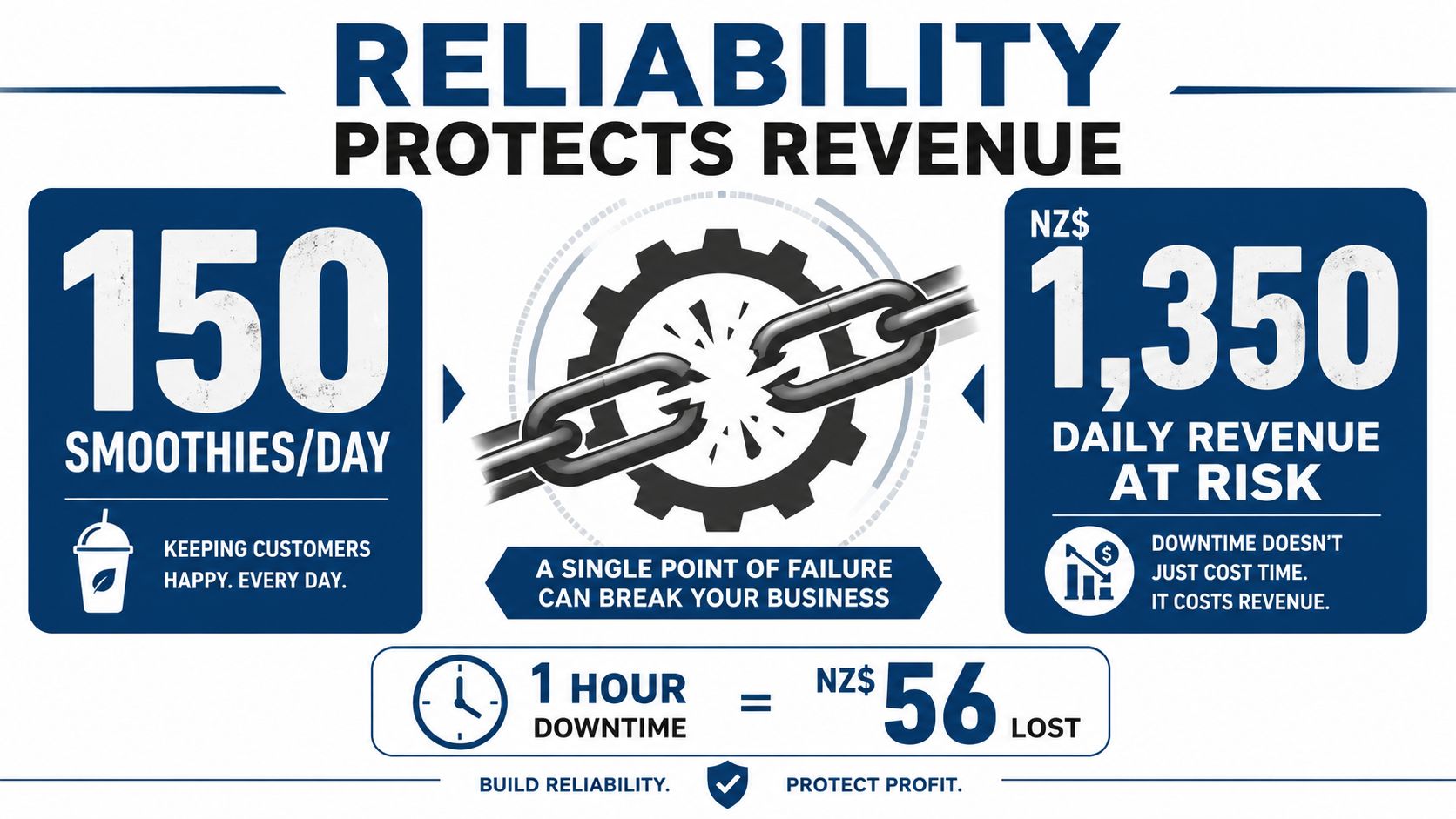
Using the smoothie café example again, 150 smoothies a day at NZ$9 each means about NZ$1,350 of daily smoothie revenue is exposed to a single point of failure at the blender. If the machine goes down during the busiest hour, the lost trade can easily outweigh the repair conversation.
That is why premium commercial blenders get bought for business continuity as much as for blending performance. Operators are really buying the ability to keep trading when the queue is longest.
Reliability protects revenue. That's the part of the purchase price most quotes never mention.
Support matters when service stops
Local service access, warranty support and the option to finance the purchase can all affect how a venue handles the upfront decision. Hospitality also offers trade support across equipment categories, including quotes, certified used options, warranties and finance pathways through SilverChef, which can help spread the cost when the right machine is needed now rather than later.
For owners comparing risk, a useful read is Simply Hospitality's article on reliable equipment and busy trading days. It gets to the point that matters, equipment needs to support sales, not threaten them.
The commercial test is blunt. If the blender stops, can the venue still serve? If the answer is no, reliability stops being a nice-to-have and becomes part of revenue protection.
Maintenance Habits and the Purchasing Checklist
Good blenders are easier to live with when staff use them properly. Most of the pain comes from poor habits, not from the machine itself.
Keep the clean-down routine simple
One of the most useful service habits is straightforward. Fill the jug with warm water and a small amount of detergent immediately after use, run the blender for 20 to 30 seconds, rinse thoroughly and keep going. That prevents residue from drying onto the blades and jug, which cuts cleaning time and keeps the machine working properly.
A second jug is worth having during busy service. One jug can be cleaned while the other stays in use, which reduces downtime and stops staff from stalling the queue just to wash equipment.
Buy with the day in mind
The purchasing checklist should be short enough to use in a real supplier conversation:
- Match the blender to the menu rather than the brand name.
- Check daily blend volume and whether the machine can keep pace.
- Ask what happens during peak service if the blender fails.
- Review warranty and service access before looking at finish or colour.
- Think about jug systems and spare parts so cleaning doesn't become a bottleneck.
- Factor in noise if the blender sits near customers.
- Consider finance options if the machine is needed now.
That's a better decision process than comparing two glossy brochures and hoping for the best.
For operators deciding between cheap and sensible, Simply Hospitality's article on buying cheap versus buying once is worth a look because the principle shows up clearly in blender purchases.
If a venue can answer the checklist properly, it usually ends up with the right category, the right support and fewer surprises later.
Putting It Together for Your Venue
The right commercial blender NZ operators should buy is the one that improves throughput, protects service and fits the actual menu. That means looking at blends per hour, not just wattage, then checking what happens when the machine gets busy, noisy or unavailable.
The practical decision is usually clearer than people expect. Smoothie counters need speed and consistency, bars need noise control and recovery time, and kitchens need batch handling and easy cleaning. The best choice is the blender that supports the day's workflow without creating extra labour.
For operators still weighing the trade-offs, the simplest test is to ask three blunt questions, how many blends leave the bench, what happens if the machine stops, and how much staff time disappears into waiting and cleaning. If those answers are weak, the spec sheet won't save the purchase.
Hospitality can help compare commercial blender options against real venue use, from smoothie service and bar service to back-of-house prep.
For help choosing the right commercial blender for your café, bar, hotel or kitchen, contact Simply Hospitality and talk through your daily volume, menu and service setup.