

Commercial Charcoal Grill for Restaurant: A Practical Guide
The popular advice is to choose the grill first and solve the kitchen around it. For a commercial charcoal grill for a restaurant, that order is backwards. The grill may deliver high heat, char, smoke and live-fire theatre, but the project can fail before the first service if the building, extraction system, fire controls, fuel storage and staff workflow aren't suitable. Charcoal cooking should begin with a site and menu decision, then move to equipment selection.
Why Charcoal Is a Site Decision, Not Just an Equipment Choice
A solid-fuel installation is rarely defeated by the cooking surface itself. The difficult questions sit in the building envelope, the ventilation design, local approvals and the daily process for lighting, cooking, cleaning and extinguishing the fire.
New Zealand building guidance records that a solid-fuel appliance requires a separate exhaust system, and treats that requirement as mandatory rather than optional. The relevant building determination should be reviewed alongside advice from qualified ventilation and building professionals before a quotation is accepted.
The building has to support the fuel
Operators often discover too late that an existing canopy, fan, duct route or roof penetration was designed around conventional gas or electric equipment. Charcoal introduces combustion products, smoke, grease and ash, so the ventilation design must be assessed for the particular appliance and site. A generic airflow figure isn't a responsible substitute for an engineered design.
The same applies to fire safety. Fire and Emergency New Zealand advises that charcoal BBQs and grills must be used in an open, well-ventilated area, not indoors, under a roof overhang, on an apartment balcony or in another enclosed or confined space. During a restricted fire season, a suitable extinguisher must be within 5 metres when the grill is being used. Fire and Emergency's charcoal BBQ guidance should be considered with local council requirements and the conditions applying to the property.
Treat feasibility as the first purchase gate
A practical kitchen planning process protects the menu, the budget and the service. Kitchen layout guidance from Simply Hospitality is relevant here because the grill's position affects staff movement, pass access, refrigeration, prep space and cleaning routes.
Practical rule: no restaurant should choose a charcoal grill model until qualified specialists confirm that the site can support solid-fuel cooking.
The correct sequence is simple:
- Menu decision: confirm that charcoal adds flavour, theatre or process value that the concept will use consistently.
- Site review: have ventilation, fire, building and other relevant specialists assess the proposed location.
- Approval check: confirm whether permits, consent changes, local fire controls or discharge conditions apply.
- Equipment selection: compare grill models only after the first three answers are clear.
A charcoal grill is the final part of the decision, not the starting point.
What Restaurants Are Actually Buying When They Choose Charcoal
Restaurants don't choose charcoal merely to cook food over a different heat source. They choose it for a combination of high-temperature cooking, char, smoke, live-fire process and customer-facing theatre that can become part of the menu's identity.
Charcoal can give proteins a pronounced seared surface and a smoke profile that gas equipment doesn't reproduce in exactly the same way. Seafood, vegetables, steaks, flatbreads and selected accompaniments can be designed around that cooking method. The strongest concepts don't add a charcoal grill to an existing menu and hope the equipment creates differentiation. They build dishes where the fuel is part of the proposition.
The flavour premium has to earn its place
Charcoal also creates more variables. Fuel size, fire arrangement, temperature zones, loading, timing and cook technique all affect the result. A chef who understands the fire can use those variables deliberately. A team without a clear method may produce inconsistent char, uneven cooking and slower ticket progression.
Gas chargrills from Blue Seal and Waldorf can produce strong grill marks and reliable cooking without the same solid-fuel handling burden. The comparison isn't charcoal equals quality and gas equals compromise. Gas often suits a repeatable production programme, while charcoal suits a venue where smoke, live fire and visible cooking are central to what guests are buying.
Charcoal and gas at a glance
| Attribute | Charcoal | Gas Chargrill |
|---|---|---|
| Heat character | Intense radiant heat with live-fire variation | Controlled burner heat with repeatable zones |
| Flavour | Char and smoke can be central to the dish | Grilled flavour and searing without charcoal combustion |
| Menu role | Strong fit for dishes designed around live fire | Strong fit for consistent, high-volume grill programmes |
| Start-up process | Requires fire preparation and heat-up planning | Generally simpler ignition and temperature management |
| Staff skill | Fire management becomes part of the cooking method | Burner zones and standard grill technique remain the focus |
| Theatre | Can support a visible cooking experience where the site allows it | More often functions as a production appliance |
| Operational load | Fuel, ash, smoke and grease need dedicated procedures | Gas safety, grease and cleaning remain important, without charcoal ash |
The Waldorf cooking equipment range helps operators compare conventional commercial cooking equipment as part of a wider kitchen plan. The right answer depends on whether guests are paying for the food alone or for a recognisable live-fire experience built into the service.
Site Feasibility Before You Choose a Grill Model
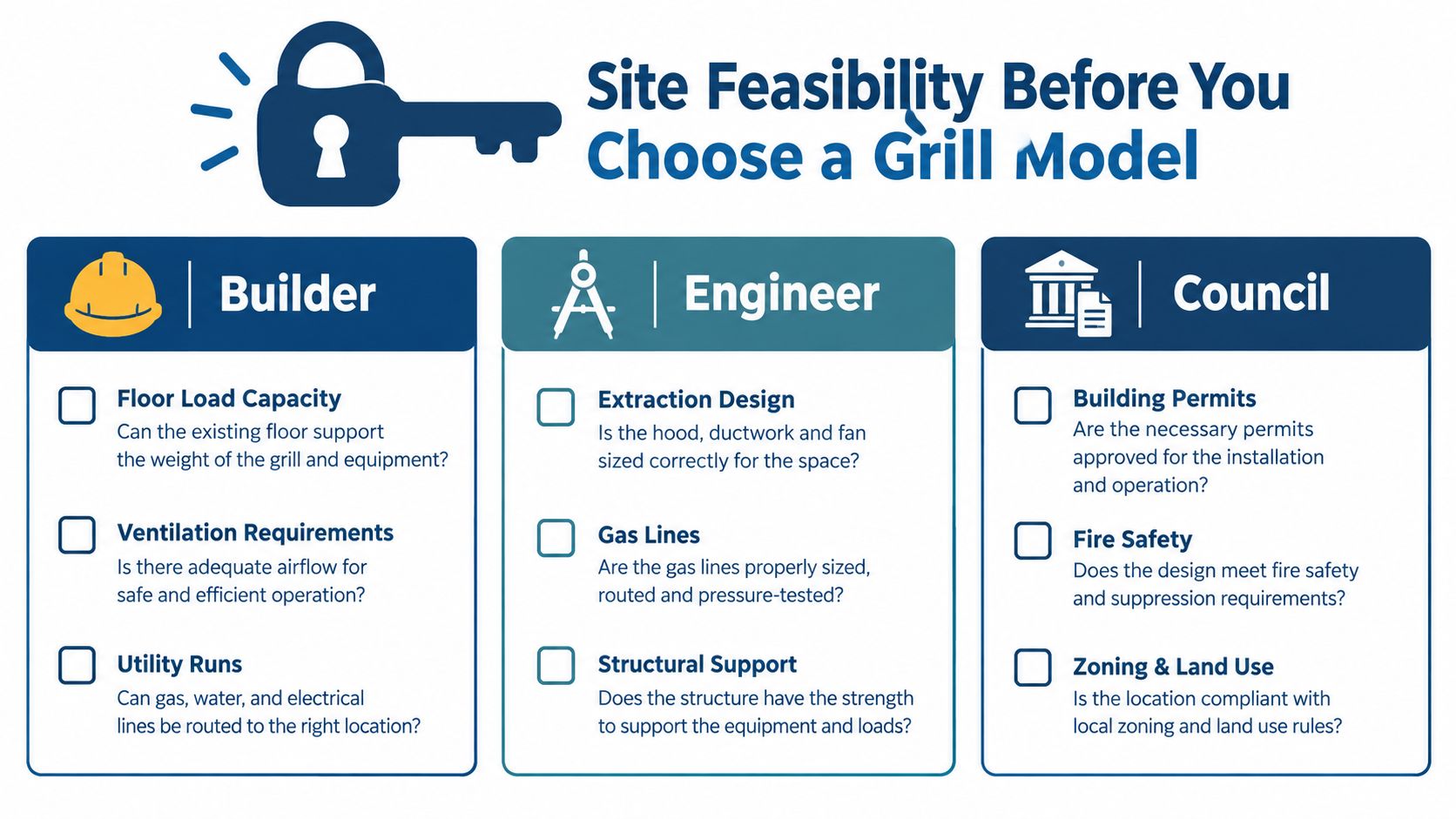
The site review should produce a clear answer before anyone builds a grill shortlist. A builder, ventilation engineer, fire specialist and council contact may all have a role, depending on the tenancy and proposed installation.
Start with the existing infrastructure. Is the canopy appropriate for solid-fuel effluent? Can the duct route, fan and discharge arrangement handle the appliance specified by the manufacturer? Does the proposed location allow safe access for cleaning, inspection and maintenance? Where will charcoal be stored, and how will staff move it without crossing customer routes or congesting the cookline?
Ask the right specialists the right questions
A qualified ventilation specialist should assess the full extraction system, including capture, ducting, fan performance, discharge and make-up air. The commercial kitchen exhaust hood guidance provides useful context, but the installation still requires a site-specific design.
A builder or engineer should check the floor, wall and ceiling construction around the appliance, along with service access and the route for ductwork. Fire professionals should review ignition, extinguishing, separation, storage and emergency procedures. Council involvement may be necessary where building consent, resource consent, local bylaws or air-discharge controls apply.
New Zealand examples show how specific those controls can become. A Canterbury and Nelson-style consent example requires charcoal combustion to discharge vertically through a stack at least 4.5 metres high, with opacity no darker than Ringelmann Shade 1, except during a cold start or brief hourly events, and without creating offensive smoke or odour. The consent example isn't a universal specification for every restaurant, but it demonstrates why local discharge conditions must be checked rather than assumed.
Use a simple go, stop or investigate screen
Before requesting a final equipment quote, mark each issue as yes, no or needs investigation:
- Extraction: can the proposed system be designed and approved for solid fuel?
- Building: can the floor, canopy, duct route and service access support the installation?
- Fire safety: are ignition, extinguishing, separation and emergency arrangements acceptable?
- Fuel storage: is there a dry, controlled location away from ignition sources and unsuitable adjacencies?
- Council position: has the relevant authority confirmed the approval pathway?
- Workflow: can staff handle fuel and ash without disrupting food preparation or customer movement?
A “needs investigation” answer isn't a green light. It means the project remains at risk.
If refrigeration must also be planned around the cookline, the SKOPE ActiveCore 3 Door Storage Freezer - Stainless - SKFT1500NS-A combines a removable refrigeration platform with a three-door stainless cabinet configured for frozen storage. Its stated operating range is -21°C to -18°C, adjustable from -26°C to -12°C, and it's rated for ambient temperatures up to 40°C. That isn't a charcoal feature, but it illustrates the wider fit-out point: every item must fit the working architecture, service access and storage plan.
Daily Operations, Fuel and Labour Implications
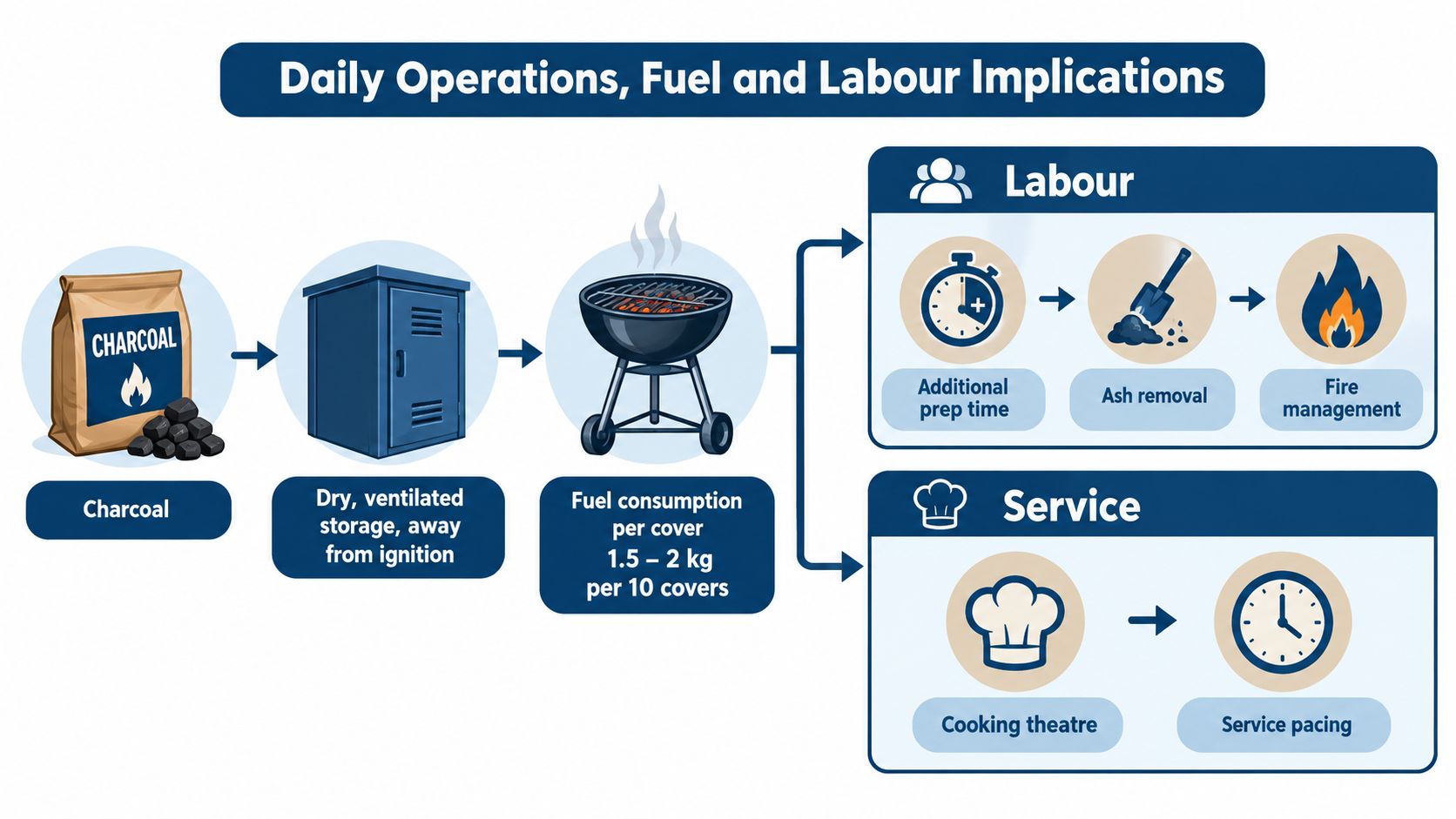
A charcoal grill changes the shift before food reaches the grate. Staff need a controlled fuel store, a lighting routine, a heat-up plan, fire management during service and a close-down process that deals with hot ash and residue.
The exact fuel demand depends on the appliance, menu, service length, fire intensity and operating method. A New Zealand foodservice listing for the Pujadas Charcoal Oven90 states consumption of 14 to 16 kg of charcoal per service and capacity for 80 to 90 covers. That equipment listing offers a concrete planning benchmark, not a promise for every grill or restaurant.
Fuel is an operating input, not a background purchase
Charcoal needs to stay dry and be stored in a controlled area away from ignition sources. Restaurant supply can also be less straightforward than buying a standard gas connection or arranging electricity. Some New Zealand commercial charcoal listings require direct office contact for restaurant use, which points to a supply channel that needs active planning rather than casual retail replenishment.
Operators should establish:
- Fuel specification: decide which charcoal type and format suit the menu and appliance.
- Stock control: set a reorder process that accounts for supplier lead times and service demand.
- Storage: keep the fuel protected from moisture and separated from incompatible hazards.
- Handling: define who moves, weighs or loads fuel, and where that work happens.
- Disposal: confirm how ash and contaminated residue will be cooled, contained and removed under the venue's waste procedures.
Ash is not a minor cleaning detail. It can remain hot, spread through the work area and interact with grease and food debris. The team needs a dedicated process for checking, removing and storing ash safely, with clear responsibility at close.
Labour and service pacing change
The person lighting the grill needs time before service, and the person closing it needs time after the last ticket. During service, staff may need to shift food between hotter and cooler areas, manage flare-ups, replenish fuel and keep the cooking surface usable.
That labour may be worthwhile when live-fire cooking is central to the menu. It becomes wasteful when the grill is purchased for occasional novelty dishes that don't justify the extra preparation and supervision. Kitchen equipment training guidance is useful when building a training plan, especially where the people working the station during busy service weren't involved in the purchase decision.
The menu should carry the fuel burden. If the concept doesn't use charcoal deliberately, the operation is paying for complexity without receiving its full value.
Charcoal Compared With Gas Chargrills From Blue Seal and Waldorf
Gas and charcoal shouldn't be compared as if one produces a superior version of the other. They solve different operating problems.
A Blue Seal or Waldorf gas chargrill generally fits a kitchen that values predictable ignition, repeatable heat zones and straightforward production. Charcoal suits a business prepared to manage a live fire because the flavour and theatre matter enough to justify the added controls.
The buyer-facing comparison
| Attribute | Charcoal Grill | Gas Chargrill, Blue Seal or Waldorf |
|---|---|---|
| Heat control | Depends on fuel placement, airflow and fire management | Burner controls provide a more direct operating method |
| Recovery | Varies with fire condition and loading | Easier to standardise across shifts |
| Training | Requires cooking technique plus fire management | Focuses on burner zones, product handling and grill cleaning |
| Installation | Must account for solid-fuel smoke, combustion products and ash | Still requires compliant gas and extraction work, but without solid-fuel handling |
| Menu identity | Supports smoke-led and live-fire concepts | Supports dependable grilled food programmes |
| Labour profile | Lighting, refuelling, ash and close-down add tasks | Simpler start-up and shutdown routine |
| Cost picture | Depends on fuel use, supply, labour and throughput | Depends on gas supply, extraction, labour and throughput |
| Customer experience | Can offer visible fire and a distinctive process | Usually prioritises efficient production over fire theatre |
The Blue Seal cooking equipment range gives operators a useful reference point when assessing gas equipment for a professional cookline. Gas isn't flavourless, and charcoal isn't automatically more productive. A gas chargrill may be the better commercial decision when the menu needs reliable output and the building doesn't justify a solid-fuel conversion.
Decide what the venue is selling
The comparison should be made against the complete operating model:
- If the restaurant sells smoke and live-fire identity, charcoal may be integral to the offer.
- If it sells fast, repeatable grill items, gas may provide a cleaner workflow.
- If the venue has limited scope for construction or approval changes, gas or another cooking method may be more realistic.
- If the grill is customer-facing, the visual process may contribute to the experience, but only where ventilation and fire controls support that layout.
New Zealand gas regulations list commercial barbecues, charbroilers and rotisseries under AS 4563:2022 Commercial catering gas equipment. The regulations reinforce that gas alternatives still require proper compliance. Charcoal doesn't remove compliance work. It changes its nature.
Safety, Cleaning and Ongoing Maintenance Reality
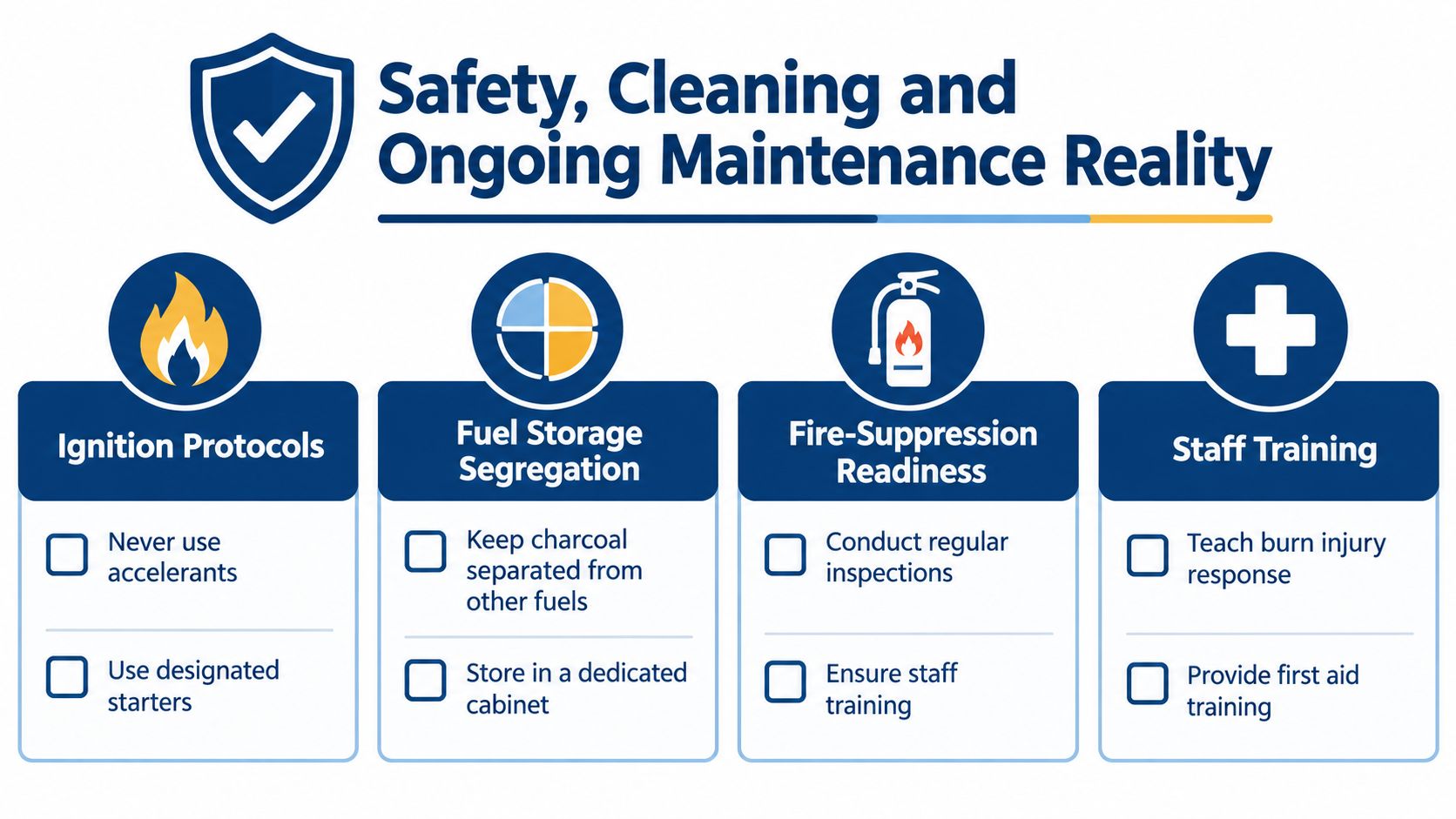
Charcoal equipment needs written standard operating procedures before it enters service. The procedures should cover who may light the fire, which starter method is permitted, how fuel is stored, how staff respond to flare-ups and burns, and how the fire is managed at close.
Fire and Emergency guidance classifies charcoal BBQs or grills as an authorised fire type in New Zealand, while also distinguishing charcoal from manufactured gas-operated appliances and noting that permits may still be needed during fire prohibitions. The relevant New Zealand guidance supports a practical conclusion: the fuel type matters, but fire-season controls and local conditions matter as well.
Build the routine around the manufacturer
Each grill manufacturer should provide cleaning and maintenance instructions for the particular appliance. Those instructions should govern grate cleaning, ash removal, firebox inspection, component checks and replacement decisions.
A sensible operating record can include:
- Before lighting: check the grill, ash area, fuel condition, surrounding surfaces and extraction readiness.
- During service: remove debris safely, control grease, monitor smoke and keep fire equipment accessible.
- After service: follow the specified extinguishing process, secure remaining fuel and handle ash only through the approved method.
- At scheduled intervals: inspect grates, firebox components, dampers, hinges and the associated extraction system according to manufacturer guidance.
Charcoal residue differs from conventional electric cooking residue because it includes ash and combustion deposits. Grease can also accumulate around areas that are harder to access, especially where smoke and fat travel into the extraction system. Cleaning access should be checked before installation, not after the first difficult close-down.
Safety documentation protects the operation
Staff training should include burn injury response, first aid, extinguisher awareness, fuel segregation and escalation procedures. Fire-suppression equipment needs inspection and staff need to know its location and operating limits.
For broader plumbing and facility checks during a fit-out, EZ Plumbing's plumbing checklists can help teams organise questions that sit alongside the kitchen equipment review. The checklist doesn't replace advice from the qualified specialists responsible for the actual installation.
Record-keeping matters: cleaning logs, inspection notes and staff sign-offs make the operating standard visible and help the business identify problems before they interrupt service.
Pre-Purchase Checklist and Next Steps With Simply Hospitality
A serious purchase conversation needs more than a preferred grill width and a product brochure. The operator should bring evidence about the menu, the building and the intended service so equipment advice can be matched to the actual project.
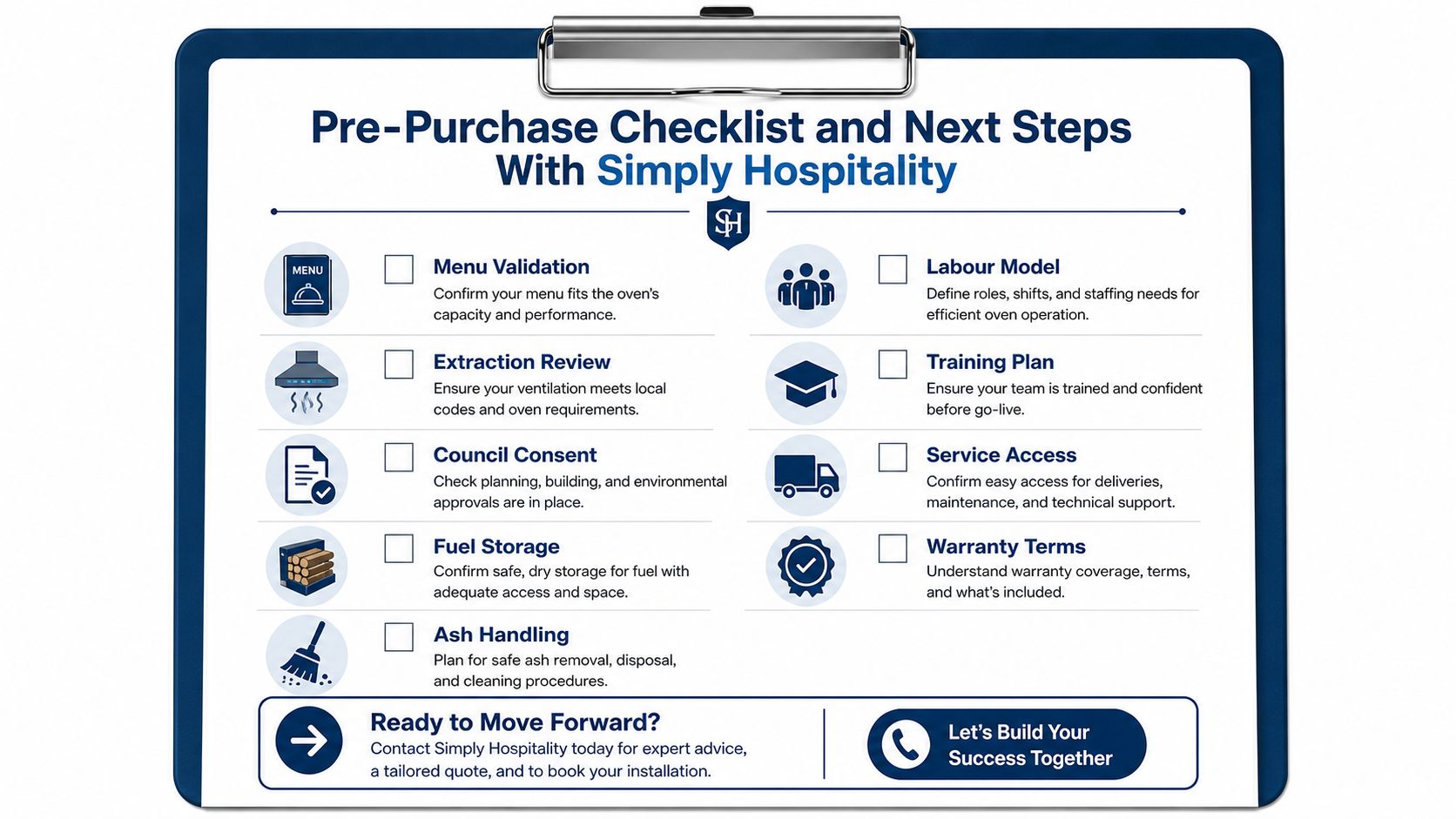
The information to prepare
- Menu validation: identify the dishes that depend on char, smoke or live fire, rather than listing every item that could be grilled.
- Extraction review: provide current hood, fan, duct and discharge information, then obtain a solid-fuel assessment from a qualified specialist.
- Council consent: confirm the building, resource, fire and local discharge pathway before ordering equipment.
- Fuel storage: show where charcoal will be stored, how it will stay dry and how staff will move it.
- Ash handling: document cooling, containment, removal and waste procedures.
- Labour model: assign responsibility for lighting, fire management, refuelling, cleaning and close-down.
- Training plan: nominate the staff who will run the station and establish written procedures before opening.
- Service access: check delivery routes, door widths, installation access, cleaning clearance and future maintenance access.
- Warranty terms: read the manufacturer's cleaning, installation and documentation requirements before signing off the purchase.
- Finance and timing: discuss available finance pathways and confirm delivery lead times only after the site and approval position are understood.
The target menu, intended covers per service, kitchen plan with dimensions and current extraction specifications should accompany the equipment discussion. These details allow a supplier to identify whether a charcoal grill is suitable, whether a gas chargrill is a more practical alternative, or whether the project needs further design work first.
The mistakes that cost the most
Buying the grill before checking the building is the most obvious mistake. Retrofitting extraction or consent work can change the entire project. Underestimating ash disposal creates a daily operational problem, while skipping training leaves the least-prepared shift responsible for a live fire.
Hospitality can help restaurants compare cooking equipment, discuss the broader kitchen layout and identify the information required for a more useful quote. The final choice should be based on the menu and verified site conditions, not on a model becoming the centre of attention too early.
Hospitality supplies commercial kitchen equipment and can help restaurant operators assess charcoal, gas chargrill and wider cookline options against their menu, site and workflow. Contact the team before ordering a grill, prepare the kitchen plan and extraction details, and visit Simply Hospitality for equipment advice and project support.