

Commercial Coffee Machine Auckland
The biggest mistake in choosing a commercial coffee machine in Auckland is starting with the machine. The first decision is whether the café should own the equipment at all. Once that is settled, the right specification depends on the busiest hour, not the daily coffee total, and on the complete production system: machine + grinder + barista workflow + milk + water + layout.
Auckland is a dense hospitality market, with 7,398 businesses recorded in cafés, restaurants and takeaway food services in February 2025, including 4,053 businesses in the narrower cafés and restaurants category, according to Auckland café and hospitality business data. The region also had 1,025 cafés in 2025, compared with 422 in Wellington and 394 in Canterbury, making equipment reliability, servicing and practical fit-out decisions particularly important for local operators.
Start With the Bigger Question Before the Machine
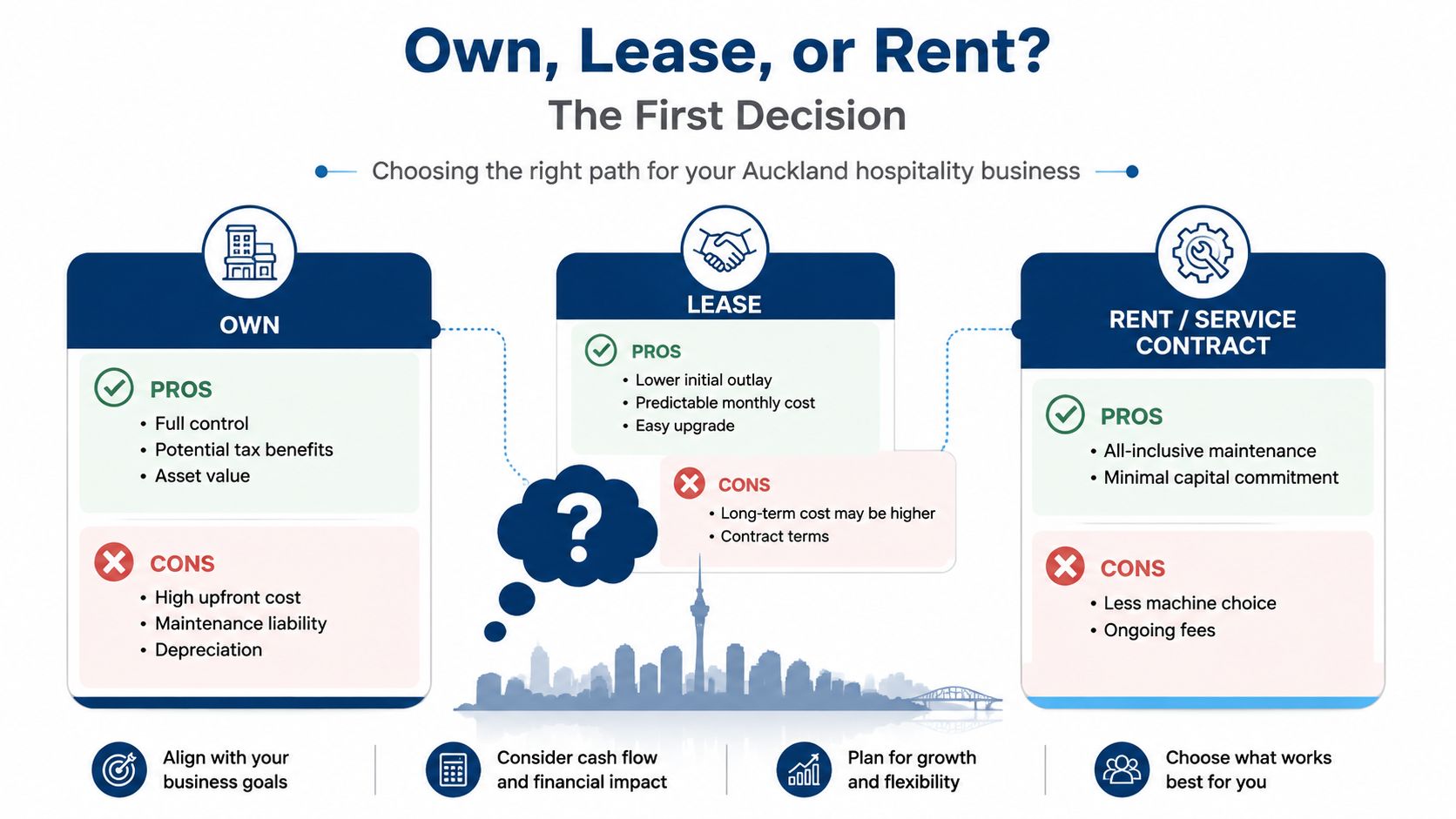
Before comparing group heads, boilers and screens, a café owner should ask a more commercial question: should the business buy its coffee machine, or use one supplied by its coffee roaster?
That choice affects capital tied up in equipment, responsibility for repairs, control over coffee supply and the consequences of downtime. A roaster-supplied machine may reduce the initial financial burden or provide access to technical support, but the agreement can also influence coffee purchasing, contract length, upgrade options and who controls the equipment at the end of the arrangement.
Owning the machine gives the operator more control over brand, coffee selection and future equipment decisions. It also places the maintenance liability, replacement planning and service coordination directly with the business. Leasing or a managed service arrangement can spread the commitment, but the total commercial terms matter more than the monthly payment alone.
Ownership is a business model decision
Many operators choose a roaster arrangement during the early stage of a café because it preserves cash for fit-out, staffing and other equipment. Others prefer to own the machine because coffee is central to the venue and they want control over the coffee programme.
The correct answer depends on:
- Capital position: Buying ties up funds that could otherwise support the opening or refurbishment.
- Maintenance exposure: Ownership means planning for cleaning, servicing, parts and eventual replacement.
- Downtime risk: A fault during the morning rush can disrupt the product that drives a large part of the workflow.
- Barista capability: A traditional machine rewards consistent dialling-in, milk texturing and cleaning discipline.
- Contract flexibility: A supplied or leased machine may come with conditions that limit equipment or coffee choices.
A commercial espresso machine should be assessed as a long-term commitment, not a single-season purchase. The national cafés and restaurants industry was valued at NZ$8.9 billion in 2026 and included 9,762 businesses, with a 1.7% CAGR from 2021 to 2026, according to IBISWorld's New Zealand cafés and restaurants data. That scale supports an active replacement and servicing market, but it doesn't make ownership automatically right for every venue.
For a deeper comparison of the commercial implications, operators should read Your Coffee Machine or the Roaster's: Which Actually Costs Less? before selecting a model.
Size the Machine Around Your Busiest Hour
Daily coffee volume hides the pressure point. A café selling coffees steadily across the day may need less capacity than a smaller venue that receives a concentrated commuter rush. The working unit should be drinks produced during the busiest hour, with espresso, milk, grinding and handover considered together.
A two-group machine can produce 120 to 180 espresso-based drinks per hour with one skilled barista, according to the supplied industry reference, but that potential assumes grinding, extraction and steaming happen in parallel. It isn't a guarantee of finished drinks, because the barista, grinder and milk workflow can all reduce actual output.
Count the constraints, not just the groups
Group heads affect simultaneous espresso preparation. Steam capacity affects how quickly milk drinks can leave the station. Barista numbers set the human ceiling, even when the machine has unused technical capacity.
| Machine config | One barista | Two baristas | Three baristas |
|---|---|---|---|
| Single group | Suitable for lower-pressure service where espresso and milk preparation can be sequenced | Usually limited by shared access and workflow | Staff capacity is unlikely to be the limiting factor |
| Two group | A practical option where one trained barista manages grinding, shots and milk in parallel | Often balances extraction and milk preparation for a busy café | Can work where the grinder, refrigeration and handover area also keep pace |
| Three group | Usually unnecessary unless the barista is supported by a very capable station | Suits concentrated rushes where multiple shots must run together | Appropriate only when demand, steam, grinding and handover all justify the footprint |
A 60-seat Auckland café producing roughly 250 cups on a Saturday morning shouldn't size the machine from the daily total alone. The operator should record the busiest hour, separate espresso-based drinks from other beverages, count baristas on the station and assess the milk mix. That profile could point to a two-group machine, or a compact three-group configuration if the rush is tightly concentrated and the supporting workflow is strong.
A simple planning principle is to allow capacity above the busiest projected hour rather than buying exactly to the forecast. The buffer needs to be agreed with the supplier using the venue's actual drink mix and staffing, not invented from a generic sales formula. The Coffee Machine for Cafe article provides related guidance, but the practical decision still comes from observing the service.
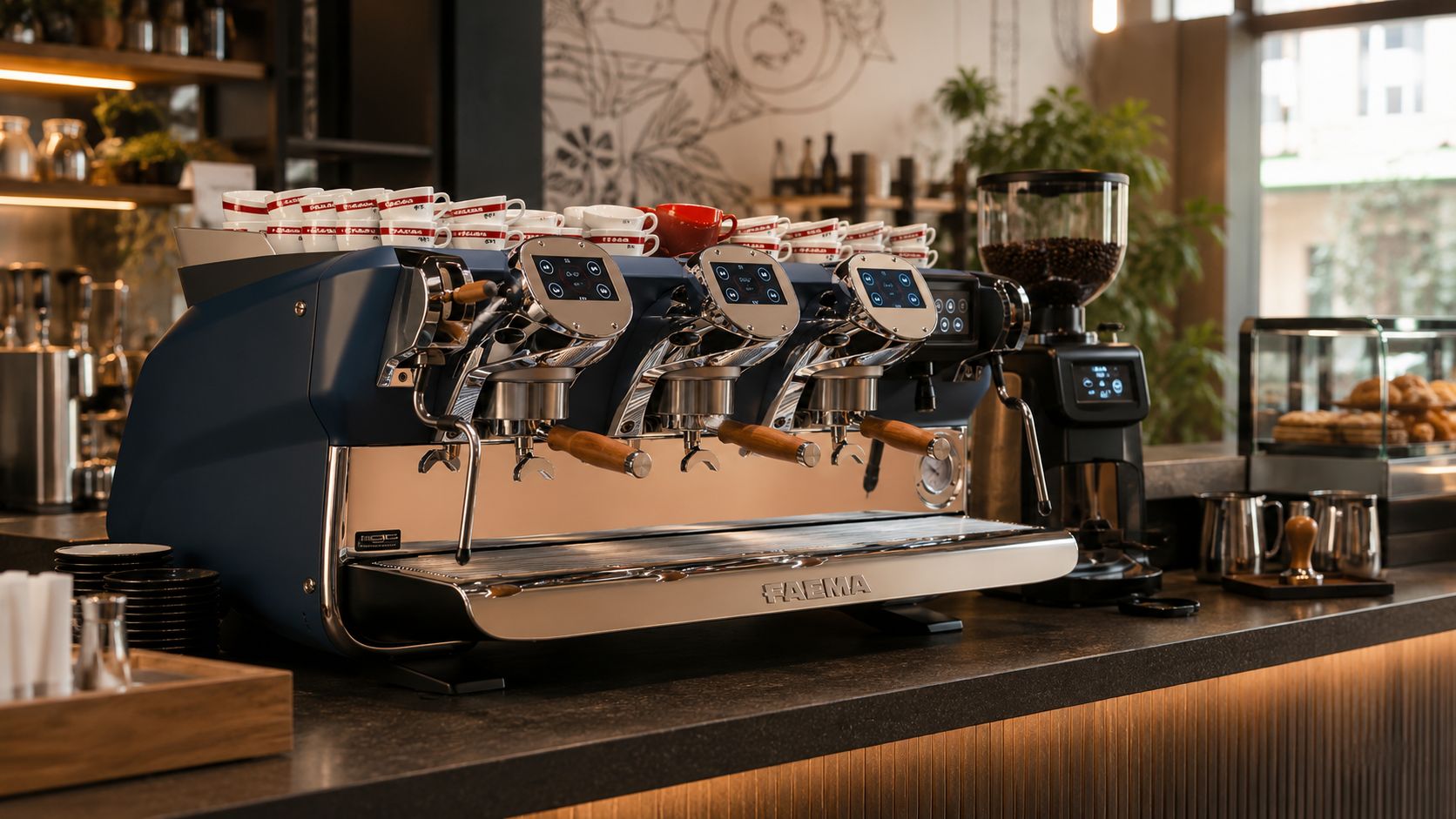
The Faema E71E Commercial Espresso Machine uses an independent-boiler platform, group-specific temperature control, GTi infusion management, long cold-touch steam wands and a barista-focused interface. It suits a coffee programme where barista control and thermal separation matter, with two- and three-group configurations available in the listed range.
The Coffee Station Is One Production System
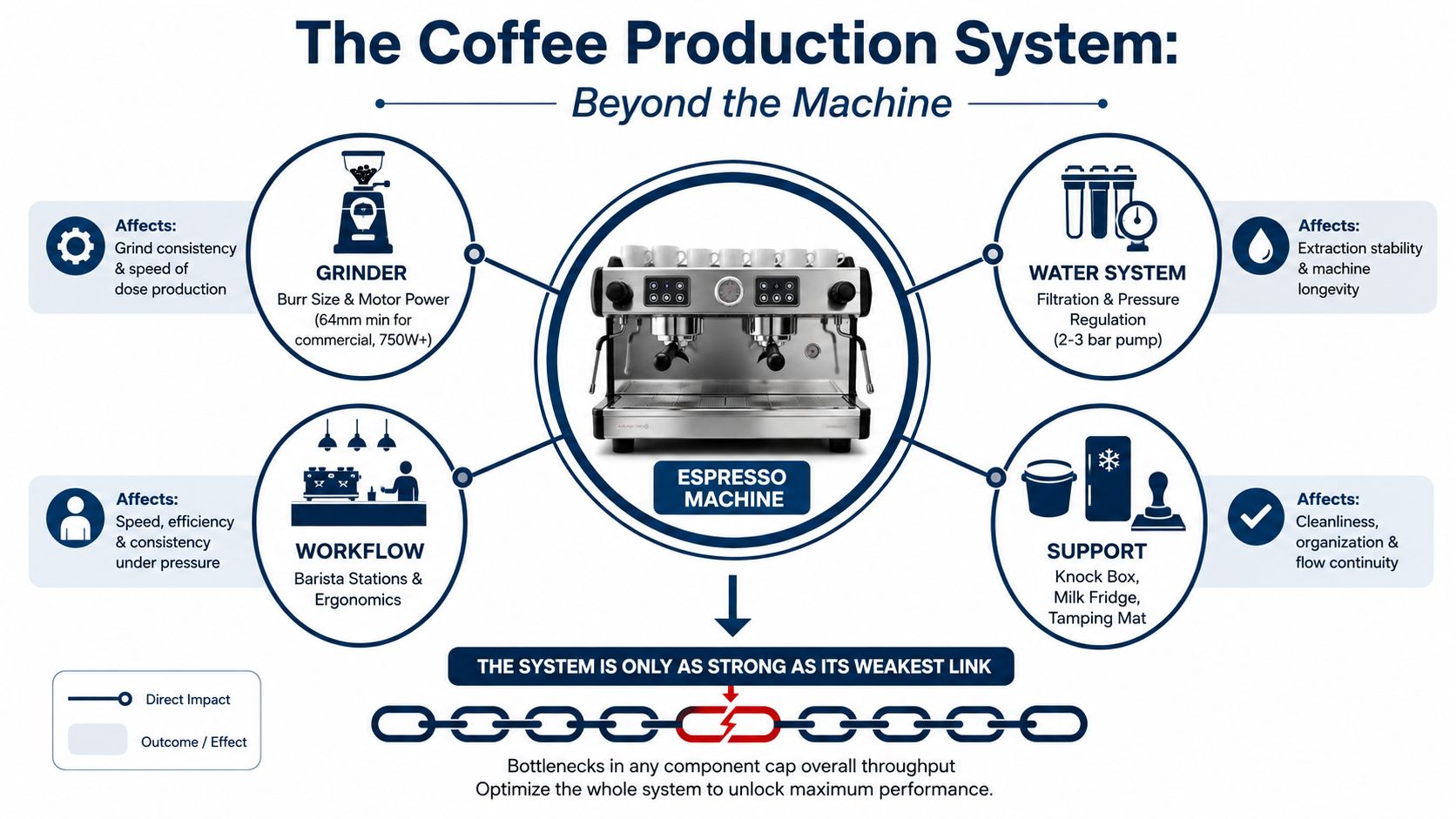
A large espresso machine doesn't create output by itself. The station works as a chain, and the weakest link controls the finished drink rate.
A high-output machine paired with one on-demand grinder may still throttle at roughly 90 drinks per hour, regardless of the machine's rated capacity, according to the supplied planning example. That figure belongs to the example, not a universal machine specification, and it makes the point clearly: a faster espresso platform won't solve a grinder bottleneck.
The hidden bottlenecks sit around the machine
The grinder needs to dose consistently and recover quickly between orders. Burr design, motor capability, hopper capacity and the number of grinders all affect whether baristas can keep the groups supplied. A second grinder may be more useful than a larger machine when the coffee menu requires separate beans or when one grinder would otherwise hold up the line.
Milk creates another constraint. A fridge under the bench keeps milk close to the steam wands, but it consumes valuable storage space and must allow staff to remove containers without blocking one another. A side-bench fridge may offer easier access, yet force baristas to turn, reach or cross paths during the rush.
Practical rule: A machine upgrade won't increase finished drinks if the grinder, milk supply or handover bench still makes staff wait.
Water pressure and filtration need to support the selected machine rather than being added after installation. Long pipe runs, poor pressure regulation or an unsuitable filter can affect recovery, brew consistency and service reliability. Bench layout matters just as much. The grinder, knock box, tamping area, groups, steam wands, cups and pass should follow the order in which staff work.
The wider equipment lesson is familiar across hospitality. A dedicated process often outperforms an improvised one when maintenance affects consistency. For example, the Frymax EOF-25 25L Electric Oil Filter Machine is a mobile electric machine designed to remove crumbs and sediment from fryer oil away from the cooking tank. It isn't coffee equipment, but it illustrates the same operational principle, equipment should support a repeatable workflow rather than leave a critical task to ad hoc handling.
Before adding a group head, the operator should map every movement from dose to handover. If the fridge sits across the room or the grinder can't keep up, more espresso capacity becomes expensive unused potential.
Technical Specs That Actually Change the Coffee
Coffee-machine specifications deserve ranking. Some directly affect extraction and milk service, while others mainly make a brochure look impressive.
Boiler architecture matters when the venue switches rapidly between brewing and steaming. A single boiler may suit modest or intermittent service, while a heat exchanger can support simultaneous brewing and steaming within its design limits. Dual or multi-boiler systems provide more independent control, but they also bring greater complexity, space requirements and installation considerations.
Group count matters because it changes how many espresso preparations can happen together. It should be matched to barista numbers and rush intensity, not selected as a status symbol.
Prioritise the working specifications
| Spec Category | High Impact on Coffee | Low / Cosmetic Impact |
|---|---|---|
| Thermal control | Stable brew temperature, suitable boiler design and independent control where the menu needs it | Decorative lighting or finish |
| Extraction control | Pre-infusion, pressure control and repeatable programming that baristas can use consistently | A long feature list that staff never adjust |
| Steam system | Recovery, wand arrangement and practical clearance for the milk volume | Styling that doesn't improve jug movement |
| Grinder pairing | Consistent dosing, fast recovery and suitable capacity for the busiest service | Choosing a grinder only because it visually matches the machine |
| Group configuration | Enough simultaneous espresso capacity for the rush | More groups than the barista team or bench can use |
| Interface | Clear controls that support repeatable operation | Screens or menus that add steps without helping the workflow |
PID temperature control can be valuable where the coffee programme demands stable, adjustable brewing conditions. Pressure profiling can also support deliberate extraction work, but it isn't a substitute for fresh coffee, a capable grinder or trained staff. A machine with advanced controls still produces poor drinks when the grind is inconsistent or the barista doesn't understand the settings.
Water pressure and power must be checked against the exact machine documentation. One New Zealand commercial listing specifies 220 to 240 V, 2700 to 3100 W, a 4 L tank or a G3/4 water connection, while a New Zealand La Marzocco specification gives a water-pressure range of 0.2 to 0.6 MPa, or 2 to 6 bar, and a recommended minimum input flow of 100 L/h. These details come from the New Zealand commercial machine technical listing, and the listed machine must not be treated as a specification for every model.
The grinder remains a critical component. A premium espresso platform can't rescue uneven particle size, slow dosing or a grinder that stalls under pressure.
Water, Power, Plumbing and Ventilation in Auckland
Utilities belong on the purchase checklist before the order is placed. A machine can fit the bench physically and still fail the site review because the circuit, water connection, drainage or clearance isn't adequate.
Commercial coffee machines sold for New Zealand use must be rated and marked for 230 V, or 400 V multi-phase, at 50 Hz, according to New Zealand electrical supply requirements for commercial dispensing appliances. The applicable appliance safety standard covers equipment up to 250 V for single-phase appliances and up to 480 V for other appliances, as set out in the relevant New Zealand and Australian commercial dispensing appliance standard.
Confirm services against the installation drawing
- Power: The electrician should confirm the machine's rated load, circuit protection and available site capacity. A larger configuration may require a different electrical arrangement from the existing machine.
- Water: The plumber should provide the connection, pressure conditions and filtration specified by the manufacturer. One New Zealand La Marzocco specification identifies 2 to 6 bar operating pressure and a 100 L/h recommended minimum input flow, but the selected model's manual takes priority.
- Drainage: The waste connection, trap, fall and floor-waste arrangement should be checked before the bench is fabricated. The installation drawing should determine the final position.
- Bench and access: The bench must support the equipment and leave enough room for operation, cleaning and technician access.
- Filtration: Water treatment should be specified with the machine. A manufacturer-guidance source recommends bottled drinking water above 21 °dH, which shows why hardness requirements must be checked rather than guessed. See the New Zealand water-hardness guidance.
Ventilation is often misunderstood. The espresso machine itself may not drive the extraction design in the same way as a cooking line, but nearby appliances contribute heat and moisture. The NZ Building Code G4 acceptable solution specifies mechanical ventilation for plant rooms at 3.6 m³/h per kW for forced or induced draught gas appliances and 7.2 m³/h per kW for atmospheric burners, as stated in the NZ Building Code G4 ventilation document.
Auckland Council also notes that mechanical extract ventilation must cover cooking equipment where natural ventilation isn't satisfactory. Operators planning a combined coffee and cooking area should assess the complete heat and moisture load, then review commercial kitchen exhaust hood planning alongside the machine documentation.
Servicing, Parts and Long-Term Support
Service access should influence the shortlist as much as boiler type. A machine with excellent specifications becomes a poor business choice if the venue can't obtain parts, technician support or a clear response during a critical service period.
Operators should ask specific questions before signing:
- Technician coverage: Who services the exact brand in Auckland, and who handles urgent faults?
- Parts location: Which seals, valves, pumps and control components are held locally?
- Response expectations: Is there a stated response time, or only a general promise to assist?
- Warranty boundaries: Which installation, water and electrical conditions affect warranty support?
- Continuity plan: Is a loan machine available, or does the venue need a backup arrangement?
- Preventative care: What cleaning, filter replacement and planned service tasks does the manufacturer require?
High-volume sites should pay close attention to daily cleaning, group heads and associated components, steam wands, grinder maintenance, water filtration and changes in machine performance. The exact service routine belongs to the specific machine and service provider. Operators shouldn't adopt an arbitrary interval just because another venue uses it.
Planned maintenance can make more sense than waiting for a breakdown, particularly when coffee is central to morning trade. A technician should be able to explain the expected care for gaskets, group components, valves, boilers and grinder parts, as well as the records the venue should keep.
For related building-services planning, operators can browse Total Plumbing & Hot Water Systems to understand the wider plumbing work that may sit around a hospitality installation. The coffee-machine supplier, plumber and electrician still need to coordinate against the selected machine's documentation.
A machine should also be assessed against the cost of ageing equipment, not only its purchase price. The article on whether ageing equipment is costing more than it seems provides a useful prompt for reviewing downtime, repeated faults and replacement planning.
Matching the Machine to Different Venue Types
The same espresso machine won't suit every Auckland venue. The useful comparison starts with the service pattern, then works backwards through steam demand, staff numbers, bench space and support.
| Venue Type | Machine Class | Typical Groups | Key Trade-off |
|---|---|---|---|
| High-volume all-day café | Multi-group traditional machine with strong steam capacity and dual grinders | Two or three | Higher capital and footprint in exchange for workflow headroom |
| Suburban brunch café | Compact traditional espresso machine with a focused station | Two | Sensible space and capacity without oversizing |
| Hotel breakfast service | Reliable machine with strong milk workflow and quiet operation | Two | Short bursts and captive demand may favour boiler capacity over extraction speed |
| Restaurant or bar | Heat-exchanger single or compact two-group machine with a quality grinder | Single or two | Consistency and cost need to be balanced against intermittent use |
| Caterer or pop-up | Portable or plumbed-flexible system selected around the event setup | Varies | Portability can matter more than sustained café throughput |
A commuter café needs a different answer
An all-day café on a commuter route may have several baristas working through a concentrated morning queue. That operation needs group capacity, steam recovery, grinder redundancy and a handover area that keeps orders moving. A multi-group machine can be justified when the supporting equipment and staff are ready to use it.
A suburban brunch café may have a smaller footprint and a less compressed rush. A two-group machine, one capable grinder and an underbench milk fridge can be the more disciplined choice. Buying a larger platform without enough bench or labour can make the station harder to operate.
Hotels present a different problem. Breakfast service creates short, sharp demand, often with many milk drinks and staff working under time pressure. Reliable operation, easy jug movement, accessible milk storage and quiet service may matter more than advanced extraction adjustments.
Restaurants and bars often sell espresso intermittently around meals. A compact machine paired with a good grinder can provide consistency without consuming the space and capital required by a high-volume café installation. Caterers and pop-ups need the supplier to confirm whether the machine can work from the available power, water and drainage arrangements before the event is booked.
Getting the Right Advice Before You Commit
Are you choosing the machine first, or confirming what the business needs? The machine is only one part of the decision. Ask a supplier to review the busiest service, barista numbers, drink mix, milk storage, grinder position and order handover before recommending equipment.
Before committing, confirm:
- The machine, grinder, milk refrigeration and handover area fit the bench.
- Power, water, filtration and drainage match the installation requirements.
- Commissioning includes testing and staff handover.
- Warranty terms state the operator's responsibilities for water, cleaning and electrical work.
- Parts and technician coverage are available for the chosen brand in Auckland.
- Filters, cleaning products and other consumables can be supplied consistently.
- Ownership has been compared with a roaster arrangement, lease or managed service.
The Commercial Coffee Machine NZ article offers broader New Zealand context, but the recommendation must fit the venue's peak-hour workflow. If ownership is still undecided, resolve that question before comparing models. A larger machine does not fix an unsuitable commercial arrangement.
Give the supplier the venue type, busiest-hour demand, drink mix, barista numbers and available services. Hospitality can assess the machine, supporting equipment, layout, installation requirements and ongoing operating needs as one coffee station.
Hospitality supplies commercial hospitality equipment and helps Auckland café operators assess the complete coffee station rather than the espresso machine alone. Visit Simply Hospitality to discuss machine selection, supporting equipment, fit-out requirements and the ownership decision before committing to a long-term arrangement.