


Commercial Dishwasher Descaler Guide
The most common commercial dishwasher descaler mistake is treating every poor wash result as proof that a machine needs stronger acid. Descaling removes mineral deposits, but it doesn't correct incorrect chemical dosing, blocked wash arms, unsuitable water treatment or mechanical faults. The safer approach is to identify the likely cause, follow the dishwasher and chemical manufacturers' instructions, and investigate the water entering the machine when scale returns quickly.
Hospitality supplies commercial warewashing equipment and products, but it doesn't perform dishwasher servicing or descaling. Operators should use qualified commercial dishwasher technicians for work beyond the machine's approved maintenance procedure, particularly where electrical, heating, pumping or warranty-related components are involved.
Understanding Scale in Commercial Dishwashers
A typical warning sign appears during service. Glasses come out with a chalky haze, a wash arm dribbles instead of spraying properly, or the machine slows down while staff are trying to keep up with a busy shift. Those symptoms can point to limescale, but they can also have other causes, so the first response shouldn't automatically be a more concentrated chemical.
Limescale is mineral deposit, mainly calcium and magnesium, left behind when hard water is heated. Commercial dishwashers are particularly exposed because they repeatedly heat and circulate water through wash tanks, rinse systems, heaters, pipework, spray arms and nozzles. Continuous daily operation gives mineral-rich water many opportunities to leave residue on internal surfaces.
Three conditions influence how quickly deposits form:
- Incoming water hardness: Hardness is commonly expressed in parts per million or mmol/L in appliance documentation. A Tauranga water source is described at about 10 mg/L as calcium carbonate equivalent, classified as soft, while an Auckland Council groundwater fact sheet cites 200 mg/L total hardness as the Drinking Water Standards of New Zealand guideline value and shows that hardness varies between supply zones. Tauranga water information and Auckland water hardness guidance provide useful context for local assessment.
- Heat: Heating pushes dissolved minerals towards deposit formation on elements, tanks and heated pipework.
- Evaporation and concentration: Water that evaporates leaves residues behind, particularly around rinse jets, wash-arm openings, seals and other surfaces that stay wet between cycles.
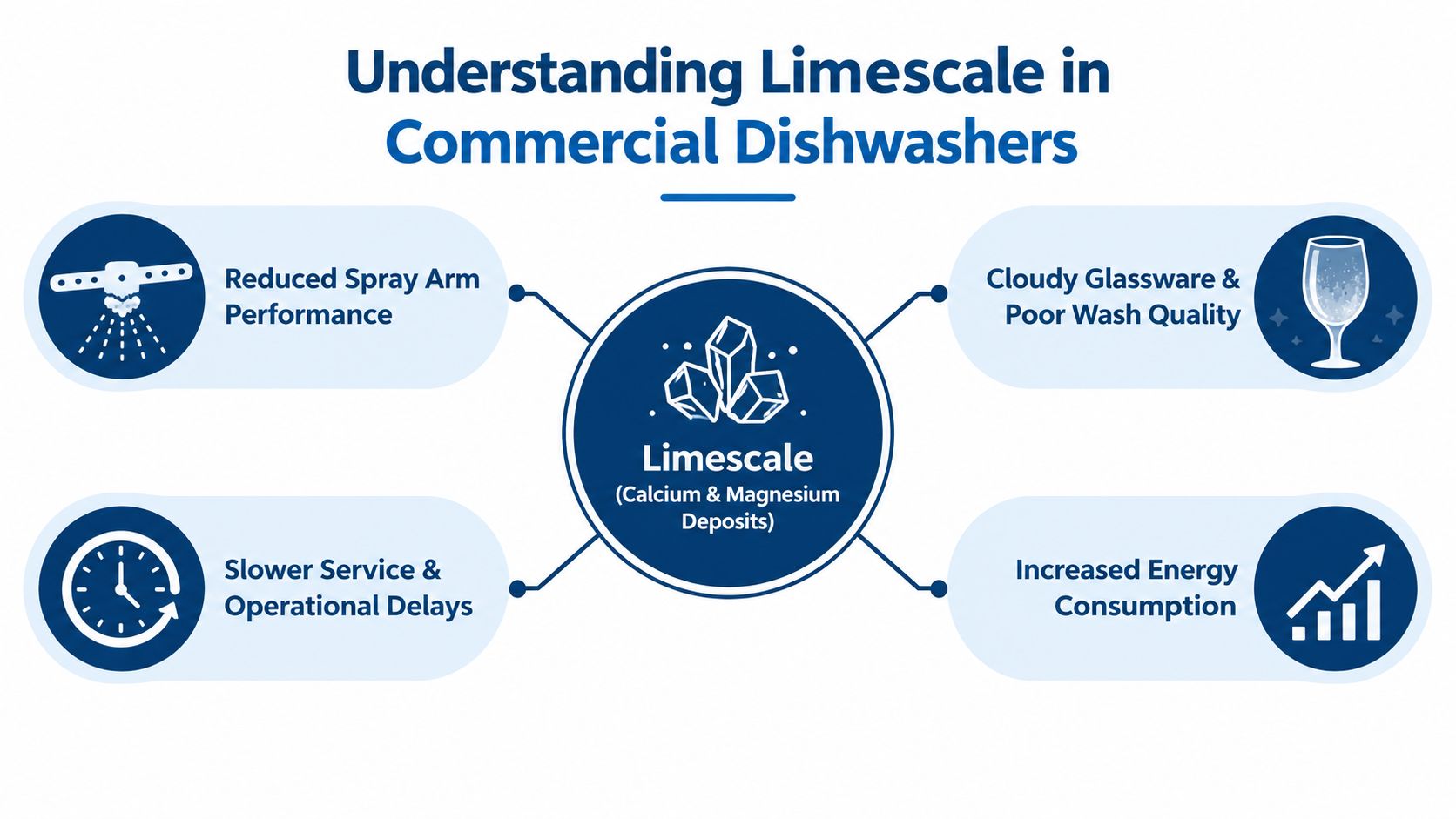
The practical point is that scale is a symptom of water and operating conditions, not automatically a routine cleaning step. A commercial dishwasher manual states incoming water hardness should sit around 20 to 100 ppm, with pH between 7 and 8, and warns that values outside the stated range can increase component wear and shorten useful life. The same guidance says the softener must be set to local hardness, which means descaler can't replace proper water-softener control. Commercial dishwasher water-quality guidance is a useful reminder that water quality can be an equipment specification, not just a maintenance preference.
Operators dealing with mineral deposits elsewhere in a building may also find practical background in this guide to tackling hard water stains in bathrooms. The chemistry and materials aren't identical to a dishwasher, so that information shouldn't be transferred directly into a machine-cleaning procedure.
For dishwasher-specific decisions, operators should also review how water quality affects dishwasher performance. Any descaling action must follow both the dishwasher manufacturer's instructions and the descaler manufacturer's directions, including approved materials, dilution, contact time, rinsing and recommissioning.
Recognising Scale and Other Wash Problems
Visible deposits are useful evidence, but they aren't a diagnosis on their own. Scale becomes more likely when a chalky film appears alongside white crust around rinse jets, door seals or wash-arm openings, gritty residue remains inside the chamber, or heating elements show dull, patchy deposits.
A partially blocked wash arm can reduce spray coverage, but a blockage may contain food debris rather than minerals. Similarly, cloudy glassware may result from scale, detergent residue, rinse-aid problems, unsuitable water quality, glass etching or incorrect rack loading.
Start with inspection, not chemical dosing
A short assessment helps prevent unnecessary chemical exposure and avoids confusing unrelated faults with limescale.
- Check local water information. Ask the water supplier or water-treatment provider for hardness data, and compare it with the machine's stated operating range.
- Inspect spray patterns. With the chamber empty and the machine operated only as the manufacturer permits, check whether wash arms rotate and discharge evenly. Never put hands into a running machine.
- Use a torch on accessible areas. Look at heating elements, jet openings, filters and seals for hard, pale deposits.
- Review chemical records. Check detergent, rinse aid, dosing settings and refill history. Incorrect dosing can leave residue or produce poor results without any scale being present.
- Confirm temperatures safely. A Hygiplas T Shaped Digital Probe Thermometer has an easy-to-read LCD display, a protective sleeve and a food-grade design intended for kitchen temperature checks. It isn't suitable for medical use, and operators should measure only where the machine and thermometer instructions permit.
The article on what causes spotty glassware can help teams separate water-related spotting from broader wash-quality problems. The comparison below gives a practical starting point.
| Symptom observed | Likely scale | Likely other cause |
|---|---|---|
| White crust around jets or heating areas | Hard, fixed deposits that remain after ordinary cleaning | Food debris, detergent residue or damaged components |
| Cloudy glassware | Mineral film linked with hard-water conditions | Glass etching, rinse-aid dosing, detergent, loading or water-quality issues |
| Weak spray from a wash arm | Mineral deposits partially blocking nozzles | Blocked filter, worn arm, pump issue or trapped food soil |
| Gritty residue in the chamber | Mineral particles or loosened scale | Food soil, grease, detergent build-up or inadequate cleaning |
| Poor final finish with no visible deposits | Scale remains possible, but evidence is weak | Chemical dosing, rinse aid, temperatures, loading or machine condition |
Practical rule: If the machine has poor results but no visible mineral deposit, investigate dosing, loading, filters, temperatures and mechanical condition before choosing a commercial dishwasher descaler.
Preparing and Dosing a Commercial Dishwasher Descaler
Commercial descaling chemicals aren't interchangeable, and an apparently stronger treatment isn't automatically a better treatment. Different products have different dilution instructions, while machines vary in their internal materials, circulation systems and approved service procedures.
Prepare the site and the operator
Before opening a container, the person handling the chemical should read the product label and safety data sheet. Suitable chemical-resistant gloves, eye protection, an apron and closed-toe footwear should be selected according to the product's hazard information and site procedures.
The machine should be taken out of service, clearly identified and prepared according to its handbook. That normally means removing racks and ware, clearing food debris, and inspecting accessible filters and wash arms. If the chemical manufacturer requires isolation of detergent and rinse-aid feed lines, that step must be completed before the descaling treatment begins.
Confirm materials and machine approval
Stainless-steel interiors may be compatible with a particular product, but operators shouldn't assume every internal part is stainless steel or acid-safe. Aluminium components, soft seals, decorative finishes, conveyor belts and some boiler coatings may react differently to an acidic chemical.
The compatibility check should cover:
- The machine type, such as passthrough, flight, rack-conveyor or utensil washer.
- The materials used in tanks, heaters, seals, pumps, sensors and pipework.
- The components the manufacturer permits operators to treat.
- Any warranty or service conditions attached to chemical maintenance.
- The required PPE, ventilation and spill response.
Follow the label rather than improvising
The dosing decision starts with the product label, not an online recipe. The operator should identify the specified dilution, determine whether the chemical must be pre-diluted, and confirm how the machine's capacity and observed scale condition affect the stated process.
That doesn't authorise a universal concentration, contact time or volume. A product intended for one machine or deposit condition may be unsuitable for another. Understanding commercial cleaning chemicals provides useful context for why labels, safety data and material compatibility matter.
Chemical safety point: More concentrated descaler or longer contact isn't a shortcut to a cleaner machine. It may damage seals, sensors, heating elements or other components.
Where significant deposits are present, or where the correct process isn't clear, an appropriately qualified commercial dishwasher technician should be engaged. Hospitality can supply commercial warewashing equipment and products, but it doesn't perform servicing or descaling.
Running the Descale Cycle and Rinsing Thoroughly
The machine's approved descaling programme should control the process. A generic recipe can't safely cover every commercial dishwasher because tank sizes, heating systems, chemical feed arrangements and internal materials differ.
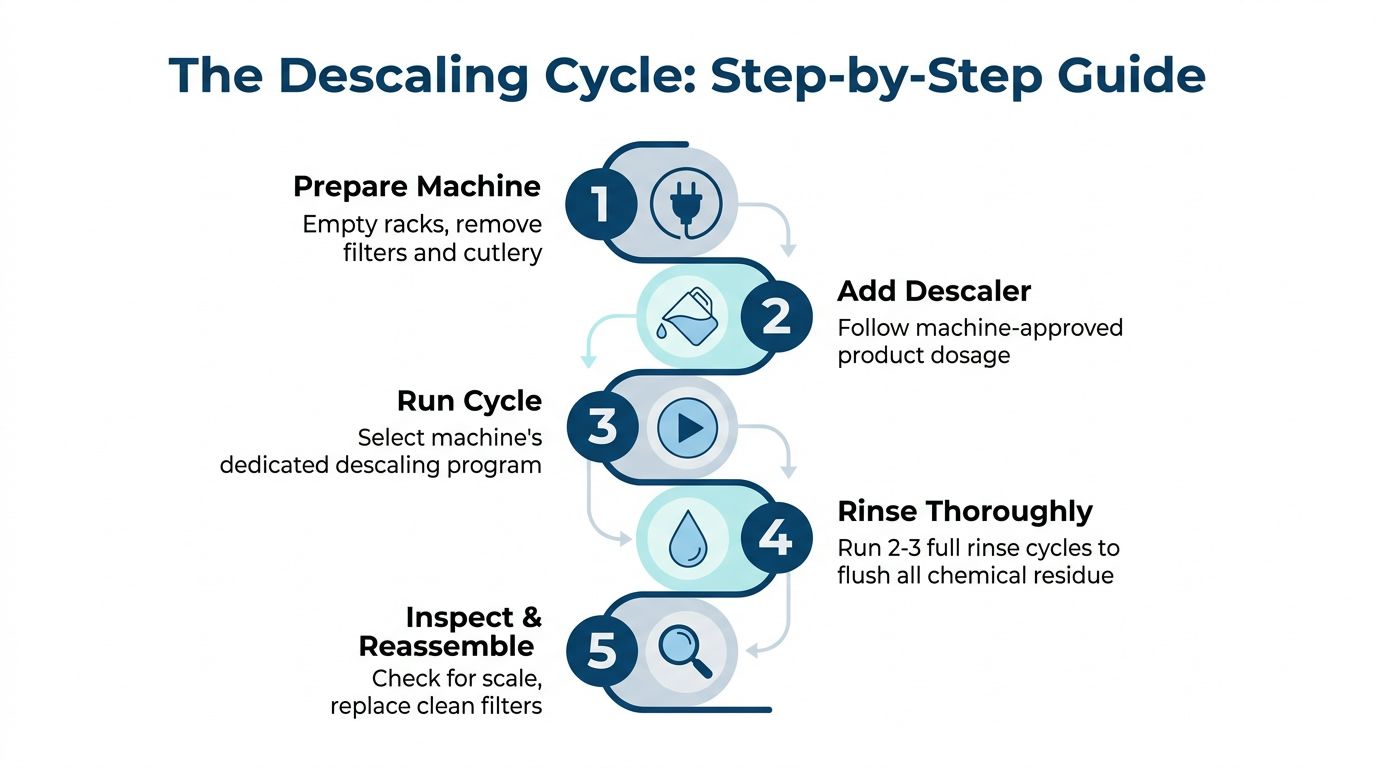
Before starting, the operator should remove racks, cutlery, filters and loose debris, leaving the chamber empty of ware. The descaler should be placed only in the dispenser, basket or wash water location specified by the machine and chemical instructions. If the manufacturer requires isolation of automatic detergent and rinse-aid dosing, that isolation should be confirmed before the cycle begins.
Keep the cycle controlled
Select the machine's dedicated service or descaling programme where one exists. The door should remain closed, and the cycle shouldn't be interrupted while chemical remains inside. Opening the machine mid-cycle can expose staff to chemical mist, hot liquid or vapour, depending on the equipment and product.
Operators shouldn't extend the contact period or restart the programme repeatedly unless both manufacturers' instructions allow it. If the first approved treatment doesn't remove significant deposits, the next step may be inspection or professional service, not a stronger improvised dose.
Drain, rinse and recommission
Once the approved treatment is complete, the machine should be drained and inspected for remaining deposits. Filters, wash arms and other removable components should be cleaned and refitted only as instructed.
The machine then needs the required clean-water rinse cycles, with no detergent or ware present. The provided process visual refers to two to three full rinse cycles, but the exact rinsing requirement must come from the machine and chemical instructions. The aim is to remove chemical residue from the tank, pipework, jets, seals and other treated surfaces.
After rinsing, refill detergent and rinse aid if they were isolated or depleted. Run a test wash with suitable glassware or crockery, then check final-rinse temperature, finish, odour and any sign of chemical taint before returning the machine to service. Poor results after correct rinsing should trigger investigation rather than repeated dosing.
Preventing Scale Through Better Water Management
Descaling is reactive. It removes mineral deposits after they form, while water treatment addresses the conditions that create those deposits. If scale returns quickly, the more useful question is often what is happening with the incoming water.
Hardness, heating and repeated evaporation all encourage deposits on heaters, jets and wash arms. The New Zealand Ecolabelling Trust standard places strict phosphorus limits on qualifying institutional dishwashing chemistry, including 0.4 g/L solution for total phosphorus in dishwashing detergent and pre-soaking liquid in soft-to-moderately soft water, and 0.04 g/L solution for drying agents. It also states that relevant products aren't to be formulated or manufactured with phosphorus, including phosphates and phosphonates. NZ commercial dishwashing chemistry information illustrates why maintenance chemicals must be selected alongside, rather than in isolation from, the site's wash chemistry and environmental requirements.
Compare prevention options carefully
The right treatment depends on the water report, machine specification, menu, throughput, available space and chemical programme. Potential approaches include:
- Water softeners: Reduce hardness entering the machine when correctly sized, set and maintained. They don't remove deposits already present.
- Reverse osmosis polishing: Can treat water for specific equipment or finishing requirements, but needs correct installation, maintenance and confirmation of machine suitability.
- Phosphate-based systems: May be restricted by product, site and environmental requirements, so operators should confirm compliance rather than assume suitability.
- Chemistry matched to hardness: Detergent and rinse aid can be selected and dosed with water conditions in mind, but they can't compensate for every water-treatment or mechanical problem.
| Approach | How it helps | Key consideration |
|---|---|---|
| Periodic descaling | Removes deposits after mineral build-up | Reactive, chemical compatibility and rinsing are critical |
| Water softener | Reduces hardness at the supply point | Must be set to local hardness and maintained |
| Reverse osmosis | Provides treated water for suitable applications | Requires equipment-specific design and ongoing care |
| Chemistry review | Aligns detergent and rinse aid with site conditions | Incorrect dosing can create new wash problems |
A reverse-osmosis option such as Winterhalter reverse osmosis water treatment should be assessed against the dishwasher manufacturer's requirements and the venue's water-quality objectives. It isn't a universal substitute for a softener or for descaling.
Operators can also reduce avoidable stress by keeping wash arms and nozzles clear, loading racks correctly, avoiding unnecessary partial-load operation, and shutting the machine down according to the manufacturer's procedure between shifts. These controls won't change water hardness, but they help prevent food debris and residue from being mistaken for mineral build-up.
Setting a Practical Descaling and Maintenance Schedule
A fixed descaling interval can create two opposite problems. It may expose a soft-water site to unnecessary chemical treatment, or it may leave a hard-water, high-use machine untreated while deposits accumulate. A useful schedule combines the manufacturer's maintenance requirements with evidence from the machine and the site.
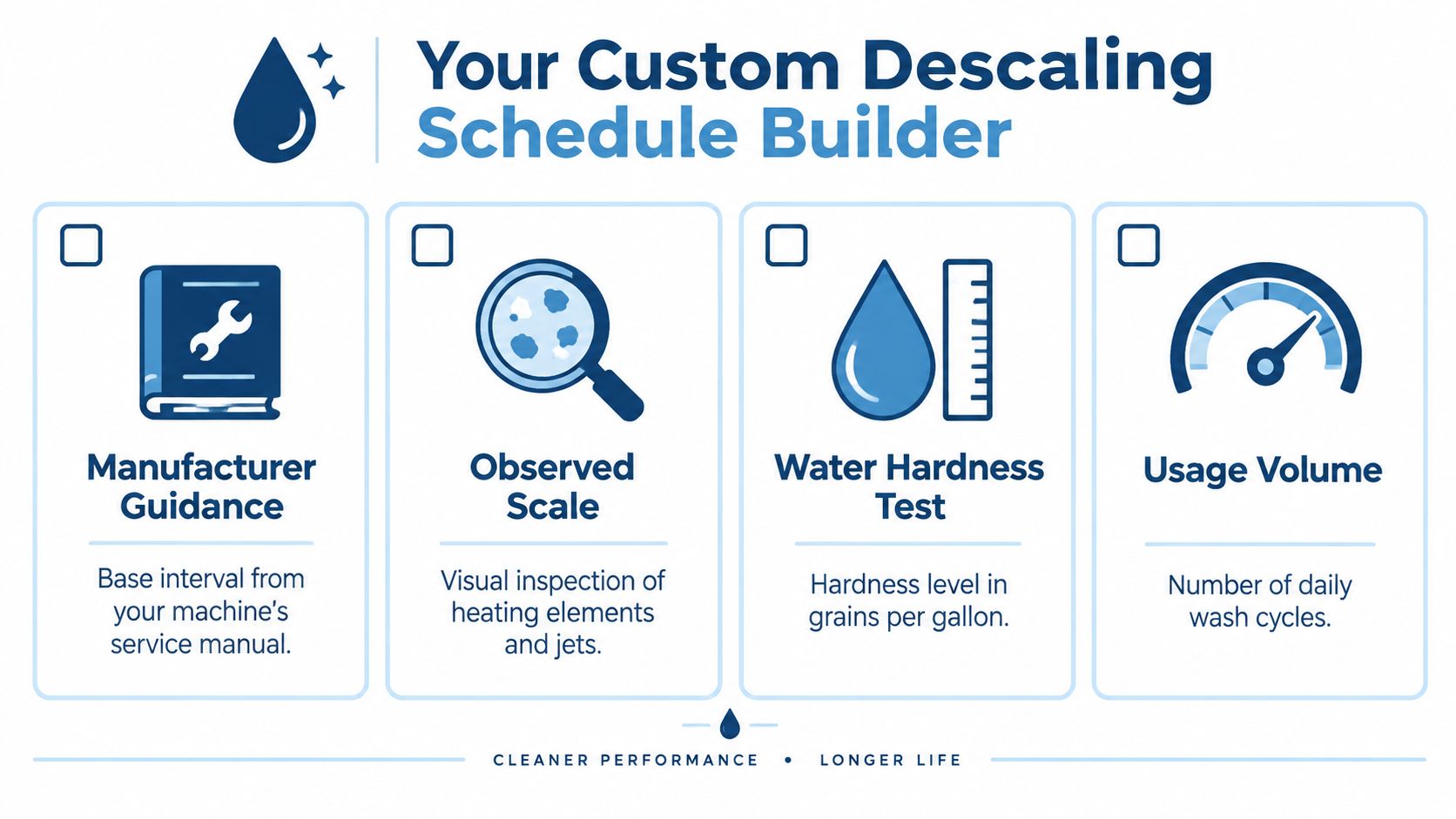
Four inputs deserve a place in the maintenance log:
- Machine guidance: Record the service and descaling requirements in the equipment handbook.
- Observed condition: Note deposits on heaters, jets, filters, seals and wash arms.
- Water hardness: Record supplier or treatment-provider information and any changes to the incoming supply.
- Usage and treatment: Track operating intensity and whether a softener, filtration system or reverse osmosis system is installed and maintained.
Build a layered routine
Daily care should cover seals, filters, chamber debris and chemical levels. Weekly checks can focus on wash arms, rinse jets and any changes in spray coverage. A deeper inspection can be scheduled around the machine's documented maintenance requirements, with descaling performed only when the approved guidance and observed condition support it.
The log should include the date, machine, water-treatment status, observed deposits, chemical product, operator, manufacturer procedure used, rinse completion and any follow-up required. This makes recurring scale easier to identify and helps show that staff followed the approved process.
A small coffee machine has different construction and chemical requirements, but a descaling a coffee maker guide can help explain the general difference between removing existing mineral deposits and controlling the conditions that create them. Commercial dishwasher procedures must still take priority for commercial equipment.
The schedule should be revisited when the venue changes detergent, rinse aid, menu, machine, water source or treatment system. For broader machine-care practices, operators can also review commercial dishwasher maintenance.
Troubleshooting Results and Knowing When to Call a Technician
A correctly completed descale doesn't guarantee perfect wash results. It removes mineral accumulation, but it doesn't repair a pump, restore a failing thermostat, correct a dosing fault or unblock a filter filled with food soil.
Begin with checks that staff can complete safely and that don't alter protected machine components. Confirm detergent and rinse aid are present, check wash-arm openings and filters for blockage, review rack loading, and verify wash-tank and final-rinse temperatures against the manufacturer's documented setpoints.
Use stop conditions
The following signs call for escalation rather than repeated chemical treatment:
- Persistent cloudy glassware: Results remain poor after two correctly completed descale cycles.
- Visible damage: Etching, corrosion or changes to stainless panels and racks appear.
- Water leakage: Door seals leak during operation.
- Repeated fault indications: E-codes or fault lights keep returning.
- Unclear procedure: The operator can't confirm the approved chemical, materials, dilution, contact time or rinsing process.
- Mechanical symptoms: The pump, heating system, drainage or electronic controls behave abnormally.
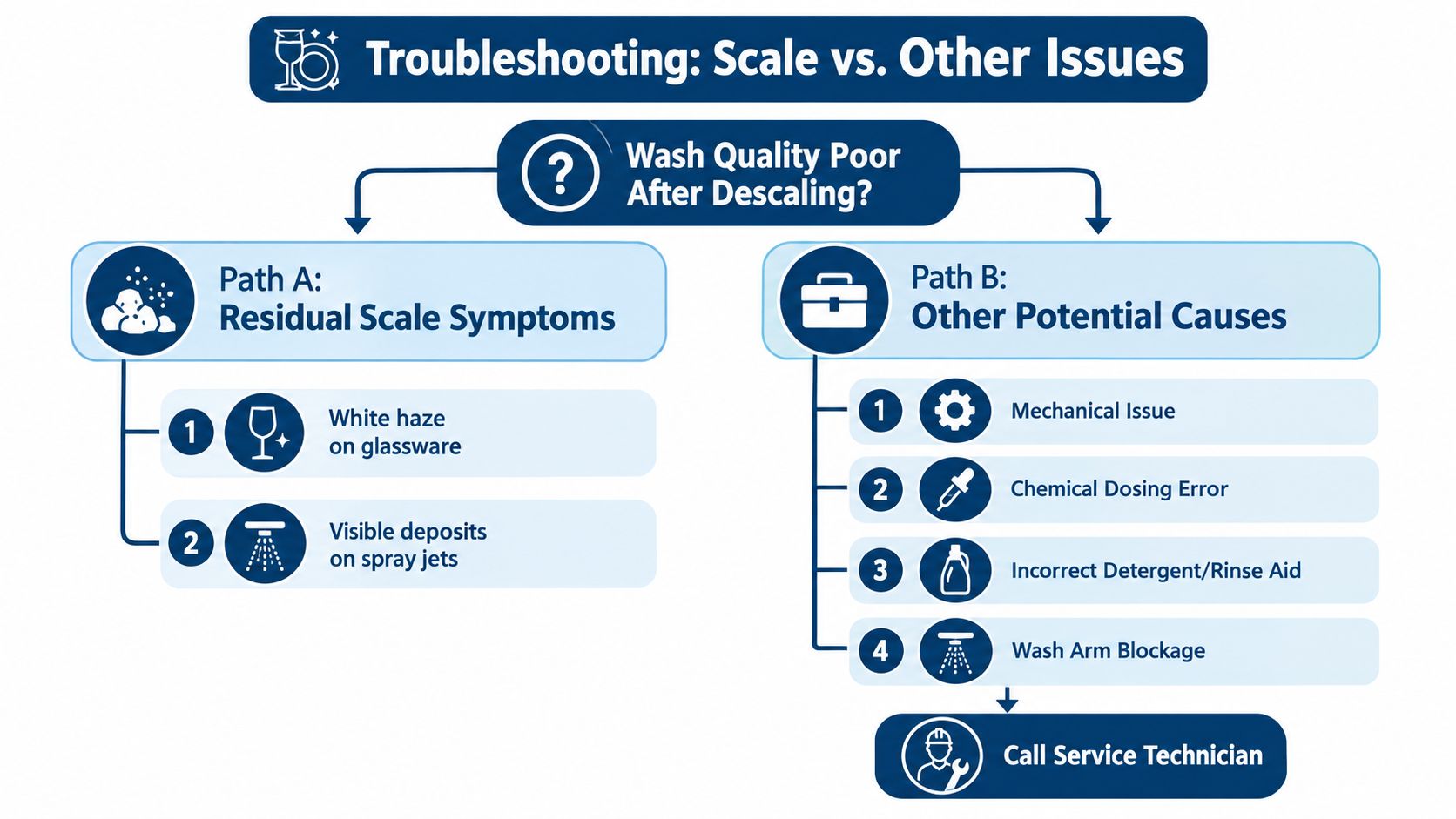
A service technician should handle pump or element replacement, electronic diagnostics and interventions that may affect warranty coverage. The equipment manufacturer or an appropriately qualified commercial dishwasher technician can also assess whether a water-treatment problem, chemical dosing fault or machine condition is responsible.
Hospitality doesn't perform dishwasher servicing or descaling, so operators shouldn't treat product supply as a substitute for technical diagnosis. A commercial dishwasher descaler is appropriate only when scale is supported by evidence and the treatment is approved for that machine.
Stop using chemical treatment when the evidence points to equipment condition rather than mineral build-up. Repeated descaling won't fix a worn pump, failed sensor or incorrect chemical feed.
Hospitality supplies commercial dishwashing equipment, dishwasher detergent, water-treatment options and related cleaning products for hospitality and institutional kitchens. Visit Simply Hospitality for help comparing equipment and product options, or to discuss which solution fits the site's water conditions and maintenance requirements.