

Best Commercial Freezer NZ for Hospitality: Buyer's Guide
Choosing a commercial freezer in New Zealand usually happens at a busy point in a business. A new kitchen is being fitted out, storage is already too tight, or an older unit is starting to become a risk. In that moment, the cheapest option can look tempting, but the wrong freezer often costs more through poor workflow, awkward installation, inconsistent holding performance, and avoidable service issues.
That's why a good commercial freezer nz decision starts with how the unit will be used. Capacity matters. So do temperature control, access during service, ventilation, and whether the freezer still suits the business when the menu grows or delivery patterns change. For hospitality operators, healthcare kitchens, food production spaces, and specialist storage environments, the right choice is the one that fits the application properly and keeps working under pressure.
Why the Right Commercial Freezer is a Critical Investment
A commercial freezer isn't just another stainless appliance on the equipment list. It protects stock, supports food safety, and affects how quickly staff can work during prep and service. If frozen inventory is hard to access, packed badly, or stored in a unit that struggles under load, the problem shows up everywhere else in the operation.
Many hospitality operators start by looking at purchase price and external dimensions. That's understandable, but it's rarely enough. A freezer also has to match ordering patterns, fit the available space, maintain compliance, and cope with repeated access in a hot working kitchen.
A common issue seen during fit-outs is that operators replace a failing unit with something similar without asking whether the original setup was ever right in the first place. In some cases, the business has outgrown the freezer. In others, the problem is ventilation, door swing, or a layout that forces staff to open the unit too often. The article on when it's time to replace commercial fridges is useful for operators weighing up repair versus replacement.
Practical rule: Buy for the real operating environment, not the empty floor plan and not the first week of trade.
A well-chosen freezer supports smoother service, safer storage, and fewer compromises behind the scenes. That's what makes it an operational decision, not just a purchasing one.
Freezer Types and NZ Temperature Requirements
A freezer that suits one venue can be a poor fit in another. The right format depends on how stock moves through the kitchen, how often doors are opened, and whether the unit is holding service stock, bulk product, or retail lines.
Common freezer formats
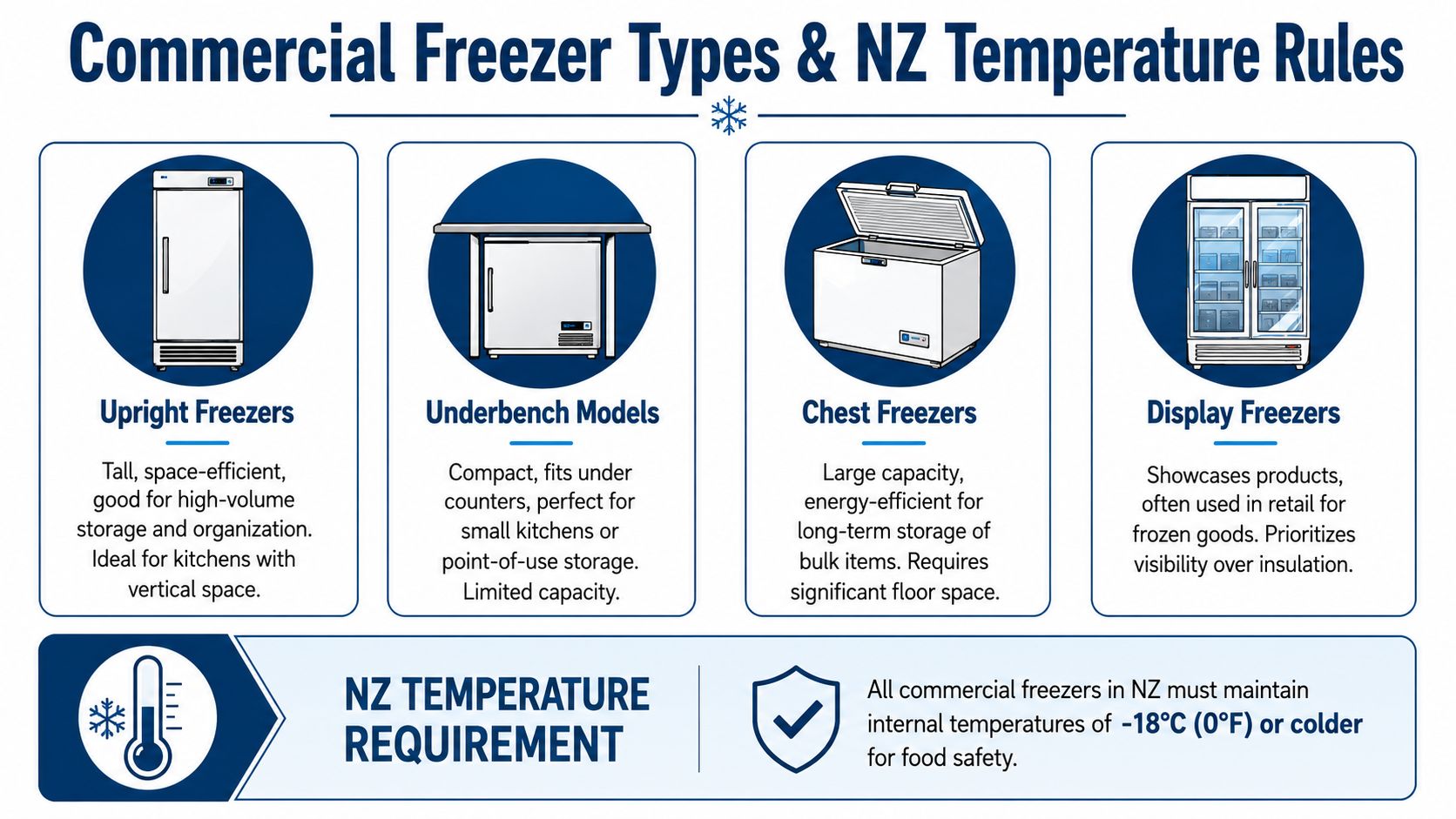
Upright freezers are a practical choice for many restaurants and hospitality kitchens. They use vertical space well, keep product visible, and usually make stock rotation easier than bulk-storage formats. In busy service periods, faster retrieval can reduce door-open time, which helps temperature recovery and cuts strain on the system.
Underbench freezers suit prep stations, dessert sections, bars, and compact kitchens where staff need frozen product close at hand. The trade-off is lower storage volume and less flexibility if the menu grows. They work best when operators are clear about what needs to be within arm's reach and what should be stored elsewhere.
Chest freezers are often chosen for bulk holding. They can make sense for lower-cost overflow storage, but day-to-day access is slower, organisation is weaker, and stock at the bottom is easier to lose track of. For some operators, the lower upfront spend is offset by wasted labour and poorer stock control over time.
Display freezers are designed for customer-facing frozen retail rather than back-of-house holding. Visibility matters more here, so the buying criteria are different from a freezer used in a hard-working kitchen.
NZ temperature rules matter
New Zealand food businesses need frozen goods stored at or below -18°C under the Food Act requirements. In practice, operators should avoid buying a freezer that only just holds that line in ideal conditions.
Real kitchens are rarely ideal.
Summer heat, poor airflow, repeated door openings, and warm product loads all make a freezer work harder. That is why temperature stability matters as much as the nominal set point. A unit that performs acceptably in a quiet test environment can struggle in a tight Auckland café kitchen or a busy Queenstown restaurant during peak service.
Matching type to application
A small café may choose an underbench freezer because workflow matters more than bulk capacity. A larger restaurant or production kitchen will often be better served by an upright unit with clearer shelf separation and easier stock access across multiple menu lines. Healthcare and institutional sites may also need closer monitoring, stronger temperature consistency, and a setup that supports documented checks.
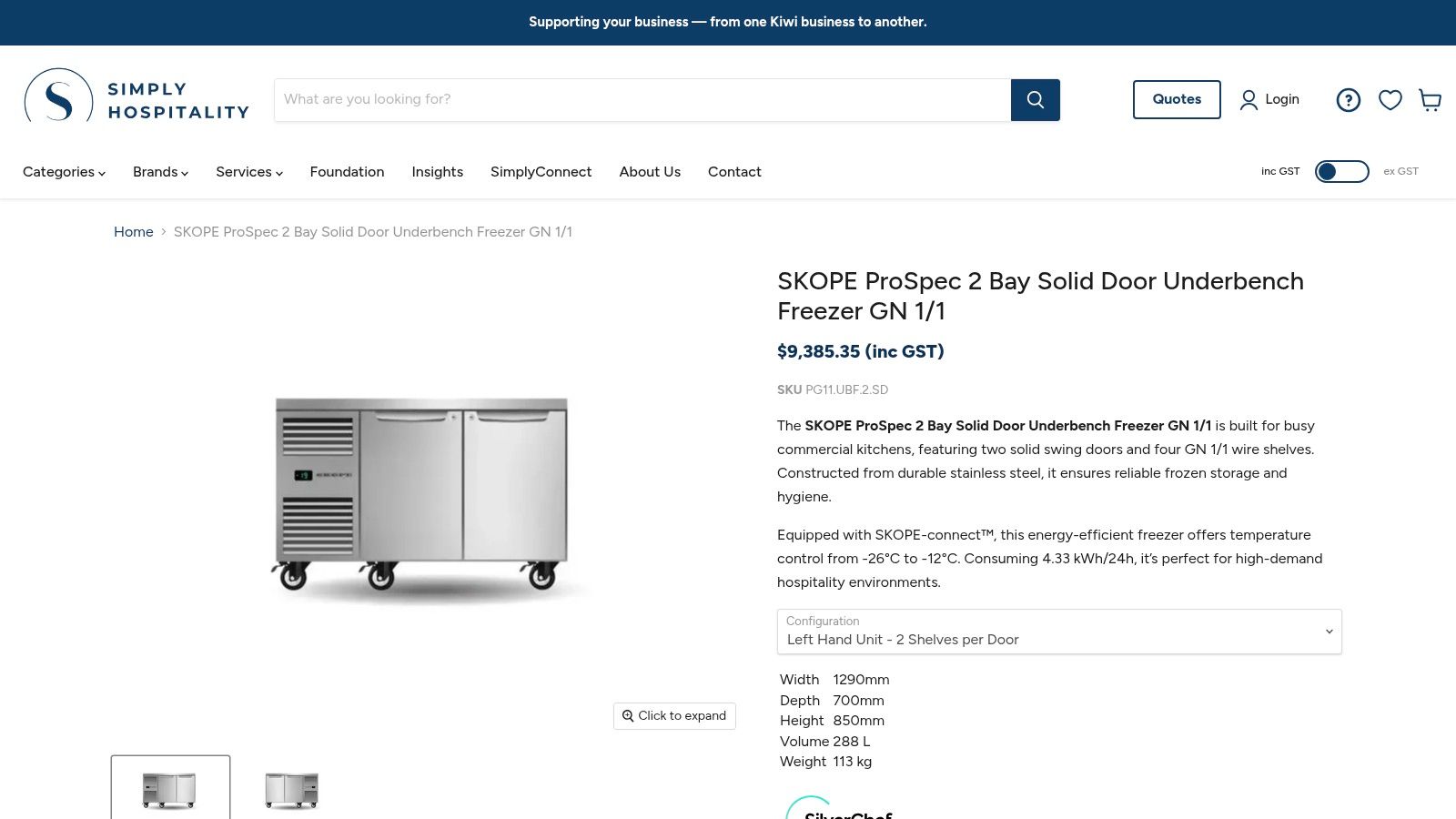
For operators comparing underbench options, the SKOPE ProSpec 2 Bay Solid Door Underbench Freezer GN 1/1 is one example of a commercial underbench format aimed at professional kitchen use. Product suitability should still be checked against the exact site, required storage pattern, and installation conditions before purchase, especially where catalog availability and option details are not confirmed.
Operators weighing standard frozen storage against faster pull-down equipment can also review blast chillers and shock freezers and whether they're worth the investment, particularly if production timing, food safety, and batch prep are starting to put pressure on the existing freezer setup.
How to Plan Your Capacity and Footprint
Friday night service is the wrong time to find out your freezer plan was too small. The usual pattern is predictable. Stock is stacked too tightly, staff spend extra time hunting for product, the door stays open longer, and the freezer starts working harder than it should.
Capacity planning starts with stock behaviour
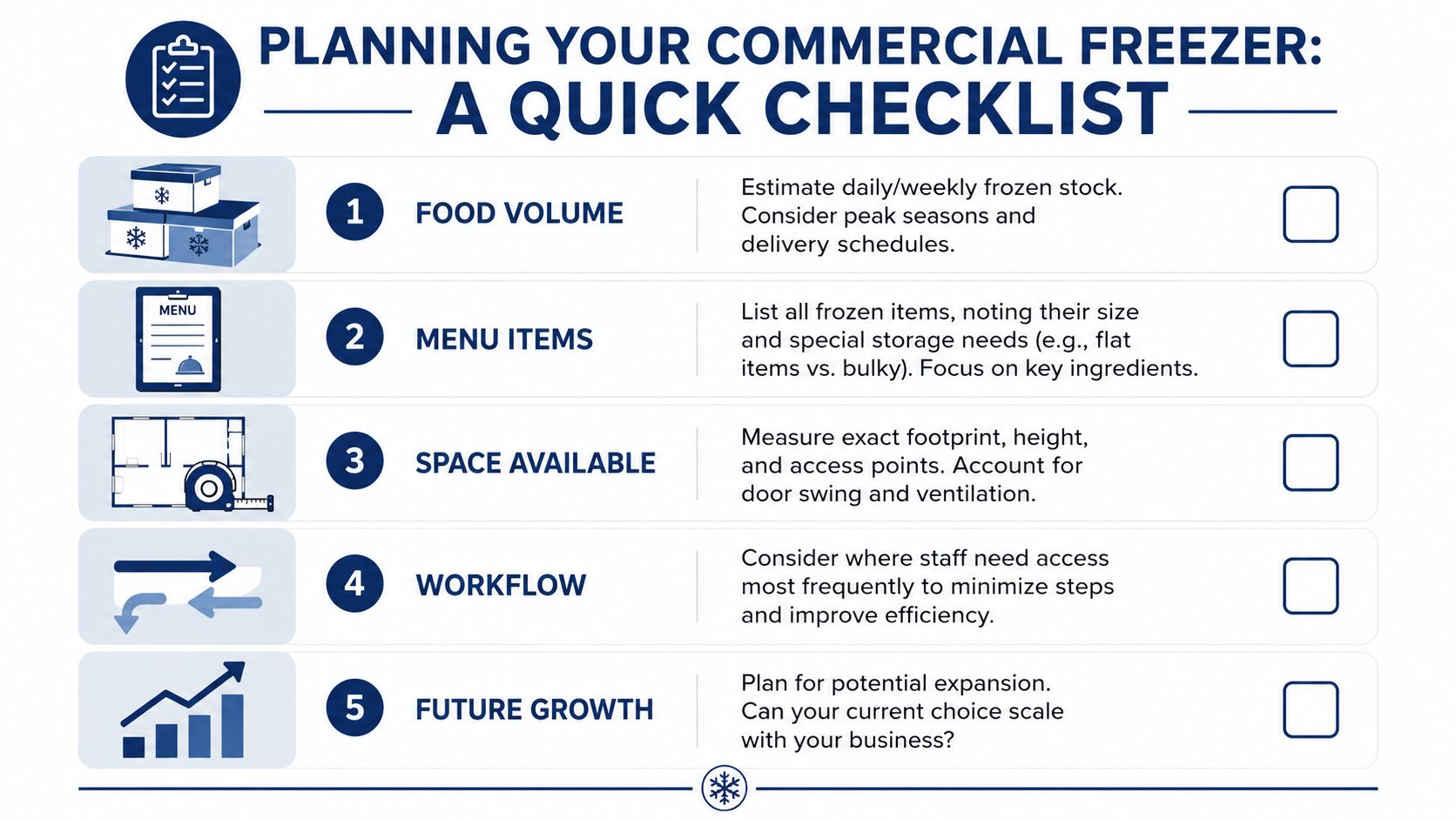
Good freezer sizing starts with what moves through the kitchen each week. Delivery frequency matters. So does menu mix, prep style, and how much stock needs to be held before peak trade periods.
A café storing boxed desserts and a few backup protein lines needs a very different setup from a restaurant holding bulk meat, frozen chips, seafood, sauces, and prep containers. The litre rating on a spec sheet only tells part of the story. Usable capacity depends on pack size, shelf spacing, and whether staff can separate fast-moving stock from longer-hold items.
Growth matters too. A freezer that runs near full from the first month often costs more over time because it leaves no room for seasonal volume, menu changes, or supplier shifts that force you to buy in larger quantities.
Footprint affects workflow every day
The right footprint supports service speed, stock rotation, and safe access. Width and depth are only part of the decision. Door swing, reach height, aisle space, and the room needed for staff to load and unload product all affect how well the freezer fits the kitchen.
I usually advise operators to watch the actual movement pattern around the prep area before choosing a unit. If frozen product is used constantly during service, placing the freezer in the wrong corner adds wasted steps every shift. That labour cost is easy to ignore at purchase time and hard to ignore six months later.
The article on choosing refrigeration based on your business stage is a useful reference because a startup café, a growing restaurant, and a production kitchen rarely need the same balance of flexibility, reserve capacity, and bench space.
Plan for the storage system, not a single cabinet
Freezer planning works best when it is considered alongside chilled storage, dry goods, and packaging space. Back-of-house pressure usually comes from the combined storage layout, not one appliance on its own.
That is why operators should check how frozen stock will be received, labelled, rotated, and accessed before settling on a cabinet size. A slightly smaller freezer in the right position can outperform a larger unit that is awkward to organise. A second unit can also make more sense than one oversized cabinet if it gives better stock separation, backup cover, or easier access across different sections.
A practical check before buying:
| Question | Why it matters |
|---|---|
| Will the unit run close to full most weeks? | Packed shelves slow access and can make stock rotation harder |
| Can staff reach priority items quickly? | Faster access reduces door-open time and service delays |
| Is there spare capacity for menu changes or seasonal demand? | Replacing a freezer too early adds avoidable capital cost |
| Does the layout support safe loading and unloading? | Tight access creates daily friction and raises handling risk |
A freezer should suit the operation, the stock profile, and the way the venue is likely to grow.
Installation and Ventilation A Common Sticking Point
Many freezer problems start before the unit is ever switched on. The issue isn't the refrigeration system itself. It's that the freezer was ordered before anyone properly checked access, clearances, and the room around it.
Measure the route, not just the destination
One of the biggest issues in tight back-of-house spaces is getting the freezer into position. Before any order is finalised, operators should check:
- Door widths throughout the delivery path
- Hallways and corners that affect turning space
- Ceiling heights if the unit needs to be tilted or manoeuvred
- Stairs, ramps, and thresholds that complicate handling
- Final bench and wall clearances once the freezer is in place
Spending a few extra minutes measuring access before ordering can save significant time and cost on installation day. That's especially true in older buildings, small tenancies, and converted hospitality sites where dimensions are tighter than expected.
Ventilation affects performance and lifespan
A commercial freezer removes heat from inside the cabinet and releases that heat into the surrounding space. If the unit can't breathe, the refrigeration system has to work harder. That can lead to overheating, poor holding performance, and unnecessary wear on key components.
Many operators focus on internal capacity and forget that external clearance is part of performance. The right solution depends on the model, the room, and where the condenser rejects heat. Manufacturer installation requirements should always be checked before purchase.
Poor ventilation doesn't usually fail dramatically on day one. It shows up as a unit that runs harder, struggles in summer, and becomes a service problem earlier than it should.
Site conditions need the same attention as the freezer
Power supply, surrounding heat load, and extraction all affect how a freezer behaves in a real kitchen. If a unit is installed beside cooking equipment or in a poorly ventilated back room, it may face a much harsher environment than expected. Operators reviewing broader heat management should also look at commercial kitchen exhaust hood planning, because room conditions influence refrigeration performance as much as appliance choice does.
The safest approach is simple. Measure twice, confirm clearances, check power, and don't assume a freezer that fits on a spec sheet will fit in the building.
Understanding Energy Use and Long-Term Running Costs
The sticker price is only one part of the cost. Over the life of a freezer, operating habits, kitchen conditions, maintenance, and cabinet quality usually matter more than operators expect.
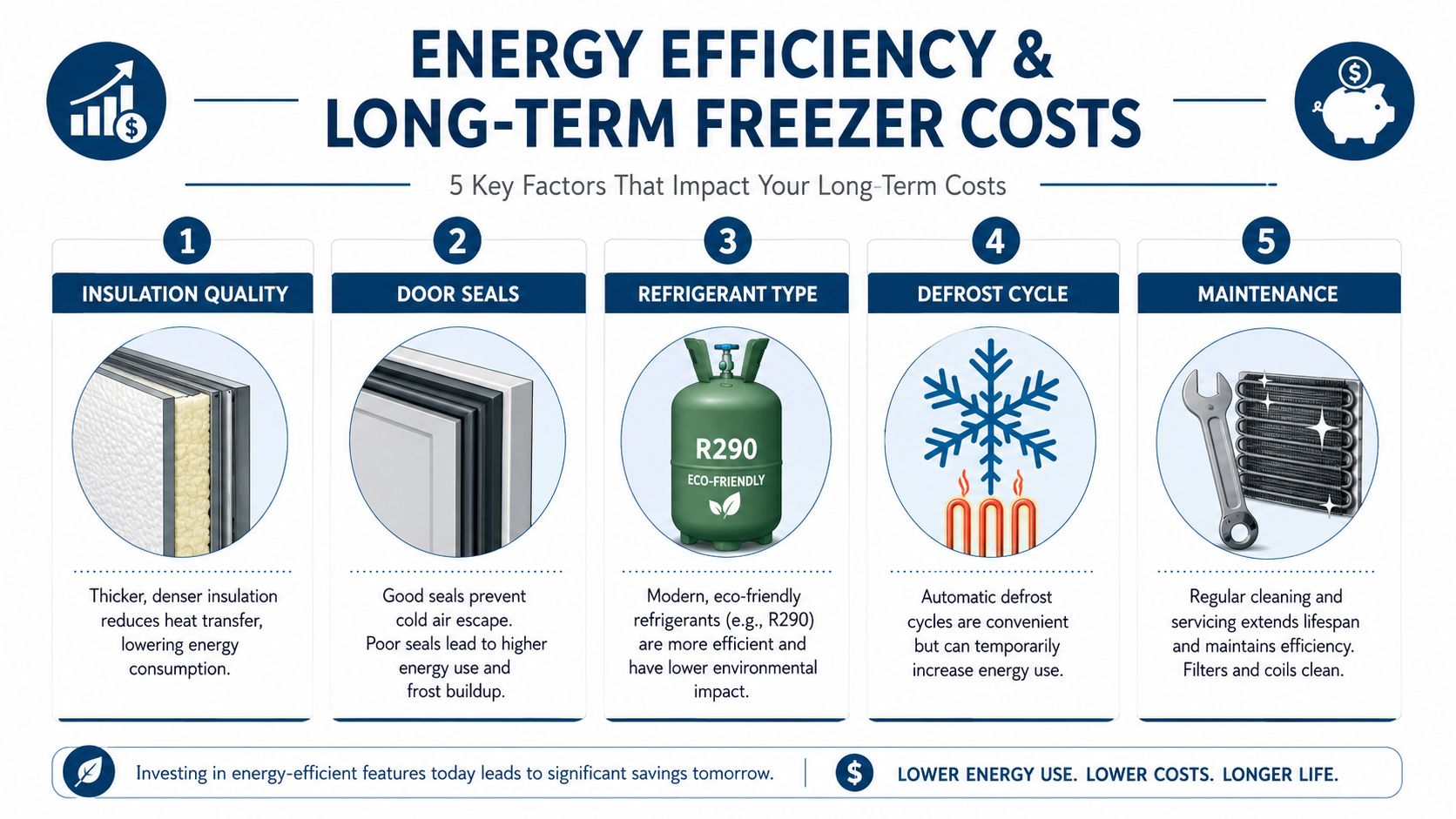
What actually drives running cost
Several factors shape long-term freezer performance:
- Insulation quality affects how much heat enters the cabinet.
- Door seals matter because damaged gaskets let cold air escape and moisture enter.
- Compressor and control design influence how hard the unit works to recover after door openings.
- Ambient temperature changes the load dramatically in hot kitchens.
- Door-opening frequency is a daily operational factor, not a minor detail.
A common consideration is that the same freezer can behave very differently in two venues. A lightly used prep room and a high-volume pass line create very different workloads.
NZ standards are relevant
New Zealand updated the Minimum Energy Performance Standards (MEPS) for refrigerated cabinets with an implementation date of 1 December 2019, requiring new test reports for previously registered cabinets imported or manufactured before that date, as set out in this regulatory impact statement. For operators, that doesn't remove the need to compare equipment carefully, but it does mean energy performance and testing standards are part of the purchasing process.
Testing requirements also matter in the background. EECA documentation states that commercial refrigerated cabinet performance verification is conducted at 32°C and 16°C under specified standards in this EECA regulations summary. That's useful because it reflects the fact that refrigeration equipment has to perform under different ambient conditions, not just in a mild showroom environment.
Where operators can reduce avoidable cost
Operational habits have a direct impact on freezer efficiency and longevity. Many hospitality businesses improve outcomes by tightening a few basics:
- Keep stock organised so staff aren't standing with the door open deciding what to grab.
- Check seals regularly because damaged gaskets are easy to overlook.
- Clean condenser areas in line with manufacturer guidance.
- Avoid overfilling if it blocks airflow and slows recovery.
- Keep the unit away from unnecessary heat sources where possible.
For operators trying to identify broader electrical load issues in the building, this article on understanding high power bills gives a useful overview of common causes beyond the appliance alone.
Long-term value usually comes from matching the freezer to the application, then running and maintaining it properly.
For a wider look at refrigeration choices, energy-efficient appliances for hospitality businesses is a useful starting point when comparing equipment categories.
Choosing the Right Freezer for Your Venue
The best commercial freezer nz choice depends on the venue, the stock profile, and how much pressure the unit will be under during a normal day. A freezer that works well in a small café may be the wrong fit for healthcare, production, or institutional use.
Café and compact kitchen environments
A smaller venue often needs quick access and efficient use of limited floor area. Underbench freezers can work well here because they place frozen storage close to prep or service points. The trade-off is capacity. If the business starts carrying more menu lines, bulk desserts, or larger prep volumes, that compact format may become restrictive quite quickly.
Many operators choose underbench storage when speed matters more than bulk holding. That makes sense in sandwich bars, dessert counters, and smaller kitchens with short service lines.
Busy restaurants and high-volume service
Restaurants with frequent door openings need something tougher than a freezer that performs well only under light use. In demanding kitchens, repeated access during service is the definitive test. The freezer has to recover consistently while protecting stock quality.
In practical terms, SKOPE ActiveCore is an excellent all-round option for general hospitality use where reliability, day-to-day workflow, and dependable frozen storage matter most. It suits many restaurants, cafés, and similar venues that need a commercial-grade freezer built for regular service pressure.
The real test isn't a laboratory. It's a kitchen where the freezer is opened constantly during service and still needs to protect valuable stock.
Healthcare, food production, and specialist storage
Some environments place a higher priority on precision and consistency. Healthcare kitchens, institutional catering, laboratories, and specialist food storage often need closer control and stronger confidence in how the cabinet performs.
That's where SKOPE ProSpec is often the better fit. It's the premium choice when precise temperature control is critical and the application leaves less room for variation. That doesn't make it the automatic answer for every venue. It means the freezer should match the level of risk and sensitivity involved.
A related point is standards alignment. ISO 22041:2019 specifies requirements for verifying performance and energy consumption of refrigerated storage cabinets and counters designed for professional use in commercial kitchens, hospitals, canteens, and institutional catering areas in New Zealand, as outlined by Standards New Zealand's ISO 22041:2019 listing. That reinforces why premium equipment is often chosen for more exacting professional environments.
A simple venue comparison
| Venue type | Usually matters most | Common freezer direction |
|---|---|---|
| Small café | Compact footprint and point-of-use access | Underbench freezer |
| Busy restaurant | Recovery during frequent door openings | Robust upright or high-use commercial freezer |
| Hotel or institutional kitchen | Capacity and organised storage | Larger upright or multi-unit setup |
| Healthcare or specialist storage | Precise temperature control | Premium cabinet such as SKOPE ProSpec |
| Food production | Reliability, consistency, and stock protection | Heavy-duty commercial freezer suited to repetitive access |
One factor often discussed is future change. A venue may not need a premium specialist freezer today, but if product sensitivity, compliance demands, or production complexity are increasing, buying too low in the range can create an early replacement problem.
What to Look for in a Supplier and After-Sales Support
A freezer failure rarely starts with the cabinet itself. It often starts with a sale made without enough questions. The wrong supplier will sell on size and price, then leave the owner to sort out access problems, slow parts supply, warranty arguments, or service delays once the unit is on site.
That matters because after-sales support affects total ownership cost just as much as the purchase price. A cheaper freezer can become the more expensive option if it sits out of action waiting for a controller, door seal, or technician while stock is at risk and staff are working around the gap.
Questions worth asking before ordering
- What does the warranty include? Parts-only cover and parts-plus-labour cover lead to very different repair costs.
- Who handles service locally? A supplier should be clear about who to call, where they are based, and how support is arranged in your area.
- Are common replacement parts available in New Zealand? Imported parts with long lead times can turn a minor fault into weeks of disruption.
- Will the supplier check the site before delivery? Door widths, stairs, power supply, condenser clearance, and final positioning should be confirmed early.
- What happens if the model is wrong for the application? It is worth asking how returns, restocking, or model changes are handled before money changes hands.
- Can the purchase structure match the business stage? Trade accounts, finance, or certified used equipment can make sense for a new fit-out or a staged upgrade.
Good suppliers ask practical questions before they recommend a unit. They want to know what stock is going in the freezer, how often the door will open, whether the kitchen runs hot, how much backup storage is available, and what happens if the cabinet is down for a day. Those details shape the right recommendation and reduce expensive surprises later.
Simply Hospitality is one example of a supplier that supports operators with quotes, trade accounts, service requests, certified used equipment, and finance options as part of its wider hospitality equipment offering.
A freezer is easier to own when the supplier helps prevent predictable problems before delivery day.
Let Us Help You Find the Right Solution
A commercial freezer should suit the way the business runs, not just the space it fills. Capacity, temperature consistency, ventilation, access, door-opening frequency, and future growth all shape whether a freezer will perform well over time. For some venues, a reliable all-round model is the right answer. For others, tighter control and application-specific performance matter more.
If a business is weighing up freezer options, planning a fit-out, or replacing an ageing unit, Simply Hospitality can help assess the application and narrow the options to equipment that fits the venue properly. A short conversation about layout, stock profile, and service demands often prevents expensive mistakes later.