


Commercial Gas Cooktop Auckland: Buyer's Guide 2026
An Auckland restaurant can have the right menu, capable chefs and a carefully planned kitchen, then lose time and money because the cookline was specified around burner count rather than production demands. A commercial gas cooktop in Auckland needs to suit the cookware, service rhythm, available footprint, gas supply, extraction design and long-term support plan. The strongest choice isn't automatically the unit with the biggest burners. It's the cooktop that gives the kitchen the right number and output of burners for the cooking chefs do during peak service.
Choosing Your Commercial Gas Cooktop in Auckland
A cookline for a busy restaurant might need to handle stockpots, saucepans, sauté pans and heavy cookware at the same time. A café preparing breakfast pans and sauces may need a different balance, particularly if bench space is limited. Hotels, caterers, institutional kitchens and casual dining venues each create their own pattern of simultaneous demand.
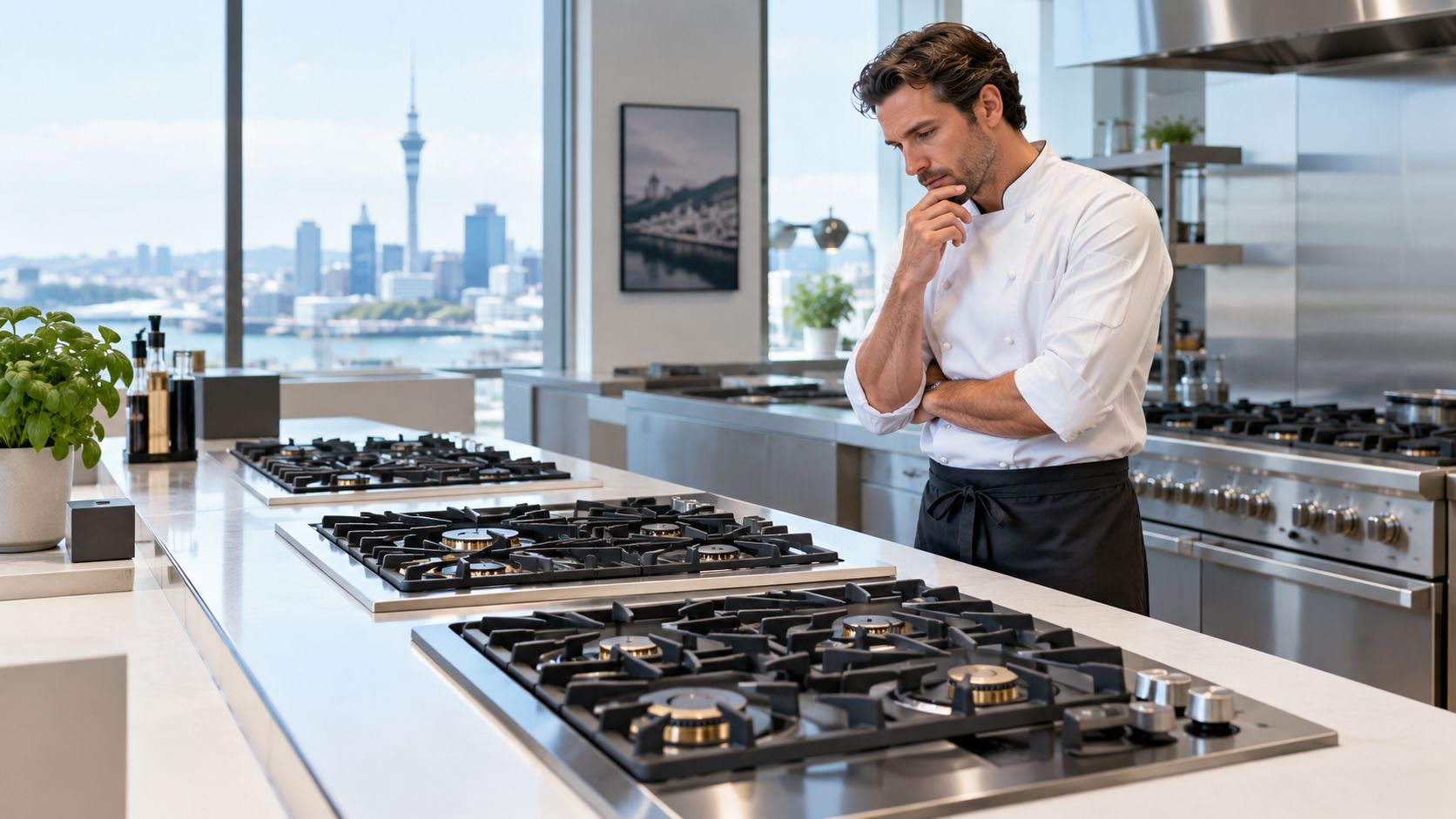
The first decision should therefore come from the menu and workflow. Operators should identify which dishes require rapid heating, which need controlled simmering, how many pans are active during peak service and whether the cooktop must support other equipment such as fryers, chargrills or an oven range.
Start with the working kitchen
A useful specification conversation covers:
- Menu production: Identify the dishes that place the greatest demand on the cookline.
- Cookware: Check the diameter, weight and base shape of the pots and pans chefs use.
- Simultaneous cooking: Count the burners likely to operate together, not just the maximum number available.
- Available footprint: Measure the intended bench, stand or range position before choosing a format.
- Site services: Confirm gas, extraction, ventilation and access requirements before finalising the equipment order.
- Support requirements: Consider cleaning access, replacement parts and qualified servicing over the appliance's working life.
Open-burner cooktops remain a core professional format because chefs understand the controls and can use them with a broad range of cookware. Blue Seal, Waldorf and Cobra provide different configurations and footprints, allowing operators to compare the practical fit rather than selecting on brand recognition alone.
Practical rule: Specify the combined cooking line before site services are finalised. The cooktop, fryer, chargrill and oven range must be considered as one gas and ventilation load.
New Zealand's commercial gas market is tightly regulated. The 2024 Regional Heat Demand Database records 14 commercial sites with 25 boilers in Auckland, with 93.03495 GWh of recorded commercial heat demand, including 90.95863 GWh from natural gas. The same entry records 32.648 MW of total commercial heat capacity, including 30.448 MW from natural gas. These figures describe the dataset's commercial heat infrastructure, not cooktop sales, but they show why natural gas remains an important consideration for Auckland businesses using gas equipment. EECA's regional heat demand data provides the underlying regional figures.
Matching a Cooktop to Your Menu and Workflow
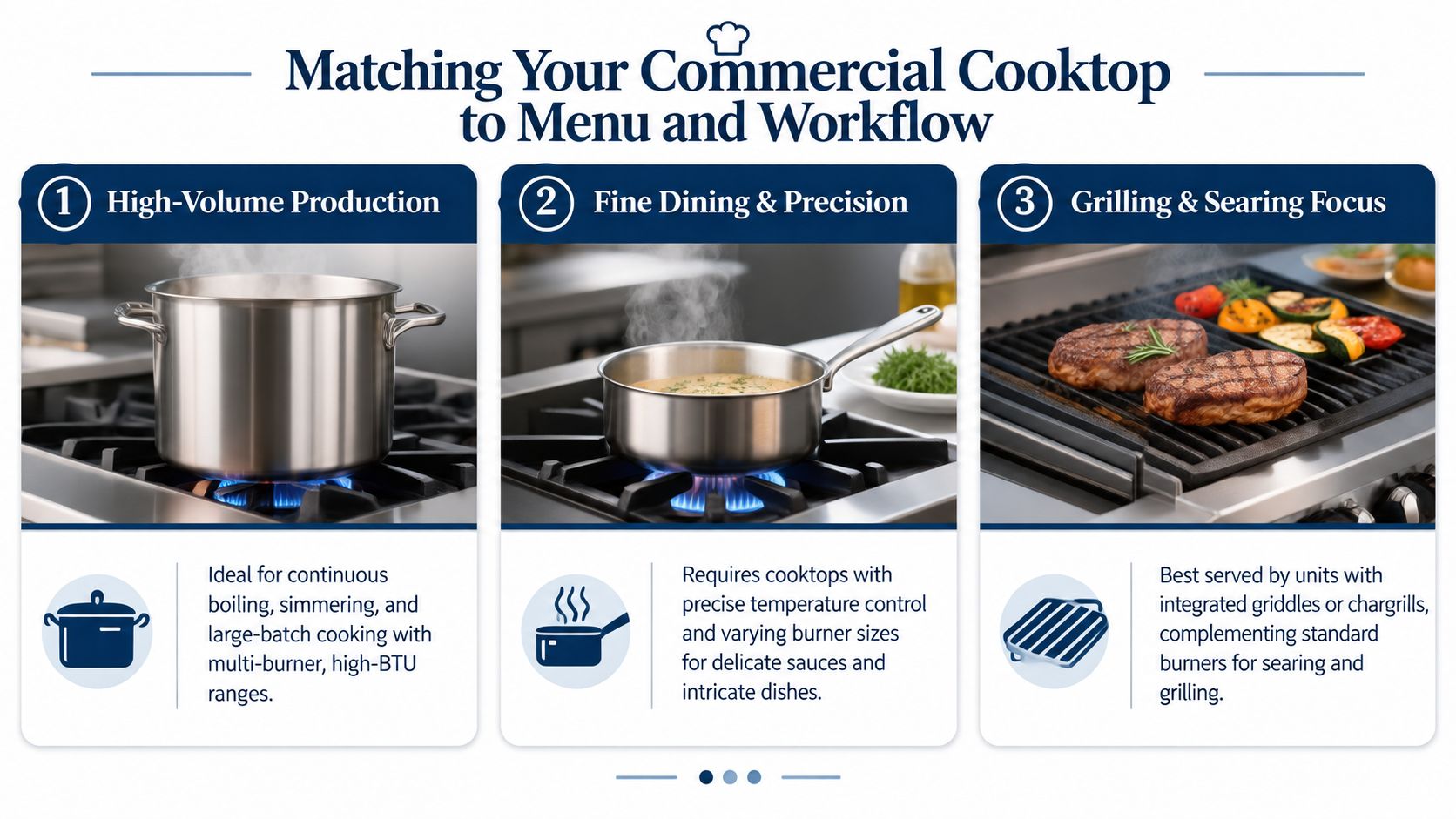
The right question isn't “which cooktop has the most power?” It's “what must the kitchen produce at the same time?” A venue cooking large batches of soup, stock or curry needs stable support for substantial cookware. An à la carte kitchen may gain more from burners spaced for several smaller pans, with enough control for reductions and simmering.
Commercial open-burner cooktops are versatile because they accommodate different pan sizes and cooking techniques. They're a familiar choice for restaurants, cafés, hotels and production kitchens, particularly where gas control and compatibility with existing cookware matter.
Compare the main formats
Bench-mounted cooktops suit kitchens that already have a suitable stainless bench or that need a compact cooking module. They can preserve flexibility in a smaller kitchen, but the bench must provide appropriate support and allow practical access for cleaning and service.
Cooktops on stands create a dedicated floor-standing station. This can make sense where the cookline needs open storage below, a consistent working height or a more substantial equipment arrangement. The available clearance and cleaning access still need to be checked against the kitchen layout.
Four-burner configurations can suit smaller menus, cafés and preparation areas where several pans are used but the kitchen doesn't require a long continuous cookline. The limitation appears when large cookware occupies adjacent burner space.
Six-burner configurations offer more simultaneous cooking capacity for restaurants and higher-volume kitchens. They're useful when sauces, vegetables, proteins and boiling pans all share the same service period, provided the spacing works with the cookware.
Larger cooklines and oven ranges make more sense where the kitchen needs sustained production and an integrated oven. A range can consolidate equipment and simplify the working sequence, but it also commits more floor space and should be selected only when the oven is part of the daily production plan.
Blue Seal, Waldorf and Cobra collections can be compared through the Blue Seal Gas Cooktops, Waldorf Gas Cooktops and Cobra Gas Cooktops ranges. Waldorf's Waldorf Bold Gas Cooktops collection is another option to assess where the intended footprint and production demands align.
Let cookware determine the spacing
A large stockpot can occupy more than one burner position in practical use, even when the cooktop technically has enough burners. Smaller saucepans may allow every position to operate independently, but only if controls and pan supports remain accessible to the chef.
Production kitchens should consider the weight of cookware, the ease of moving pots between burners and whether the supports feel stable during service. A high-output burner that is difficult to control or poorly matched to the pan base can create more work rather than improving output.
A kitchen focused on grilling and searing may need a griddle or chargrill alongside standard burners rather than a larger gas cooktop. A fine-dining menu may value varied burner sizes and responsive control, while a batch-production operation may prioritise stable support and capacity for large pots.
For operators comparing cooking technologies, the Waldorf 800 Series INL8400R5F-CB, 900mm Electric Induction Cooktop Low Back Version, Cabinet Base is a separate electric induction option, with four cooking zones, a cabinet base, automatic pan detection and a flat ceramic glass surface. Its 2 x 5 kW round zones and 2 x 5 kW full-area zones still need to be matched to compatible pans and the site's simultaneous electrical load.
Peak-service planning also benefits from reviewing ways to improve kitchen efficiency during peak service, particularly when several stations share the same pass and storage points.
Key Technical Specs Beyond Just Heat Output
Heat output matters, but headline output alone doesn't describe how effectively a cooktop will work in a commercial kitchen. A higher-powered burner can help with rapid heating and large cookware, yet it also contributes more heat to the room and may increase the demands placed on extraction and make-up air.
The useful comparison is between the cooking work required and the gas consumed to complete it. Operators should review the manufacturer's declared gas consumption, total connected input, burner arrangement and intended fuel configuration rather than relying on a single output figure.
Read the specification as a system
The New Zealand standards framework sets a general appliance input limit of 1000 MJ/h under AS/NZS 5263.0. It distinguishes domestic cooktops under AS/NZS 5263.1.1:2020 from commercial catering equipment such as ranges and griddles under AS 4563:2022. That distinction matters because a domestic appliance isn't an appropriate substitute for equipment certified for repeated professional use. Standards New Zealand's AS/NZS 5263.0 information provides the relevant framework.
A practical specification check should include:
- Total connected input: Review the combined demand of the proposed cookline, not just one appliance.
- Fuel configuration: Confirm whether the unit is set up for natural gas or LPG and whether it matches the site.
- Burner mix: Look for a useful balance of rapid heating and controlled cooking.
- Pan support: Check stability, spacing and compatibility with the cookware used in service.
- Construction: Assess stainless surfaces, removable components and the durability of burner supports.
- Footprint: Confirm the cooktop will sit comfortably within the bench, stand or range plan.
Cast-iron supports can provide a stable platform for heavy cookware, while stainless surfaces are generally easier to wipe and maintain when the design avoids unnecessary ledges and inaccessible corners. The most durable specification still becomes difficult to own if staff can't remove spill trays, reach burner components or clean beneath the supports.
Avoid paying for unused capacity
A restaurant preparing large batches may justify stronger burners than a café cooking smaller pans. The reverse can also be true. A kitchen with moderate output but poor spacing may perform worse than one with lower headline output and a more suitable layout.
A lower-powered unit isn't automatically more economical if it takes substantially longer to complete the required cooking. Equally, maximum output isn't automatically efficient if chefs rarely use it and the excess heat makes the kitchen less comfortable.
Operators considering an integrated oven should assess whether a range improves the workflow. Commercial gas ranges and ovens can consolidate functions, but an oven base adds its own specification, service and ventilation considerations. The correct choice depends on menu volume, available floor area and whether the oven will be used consistently.
NZ Gas and Ventilation Rules for Auckland Kitchens
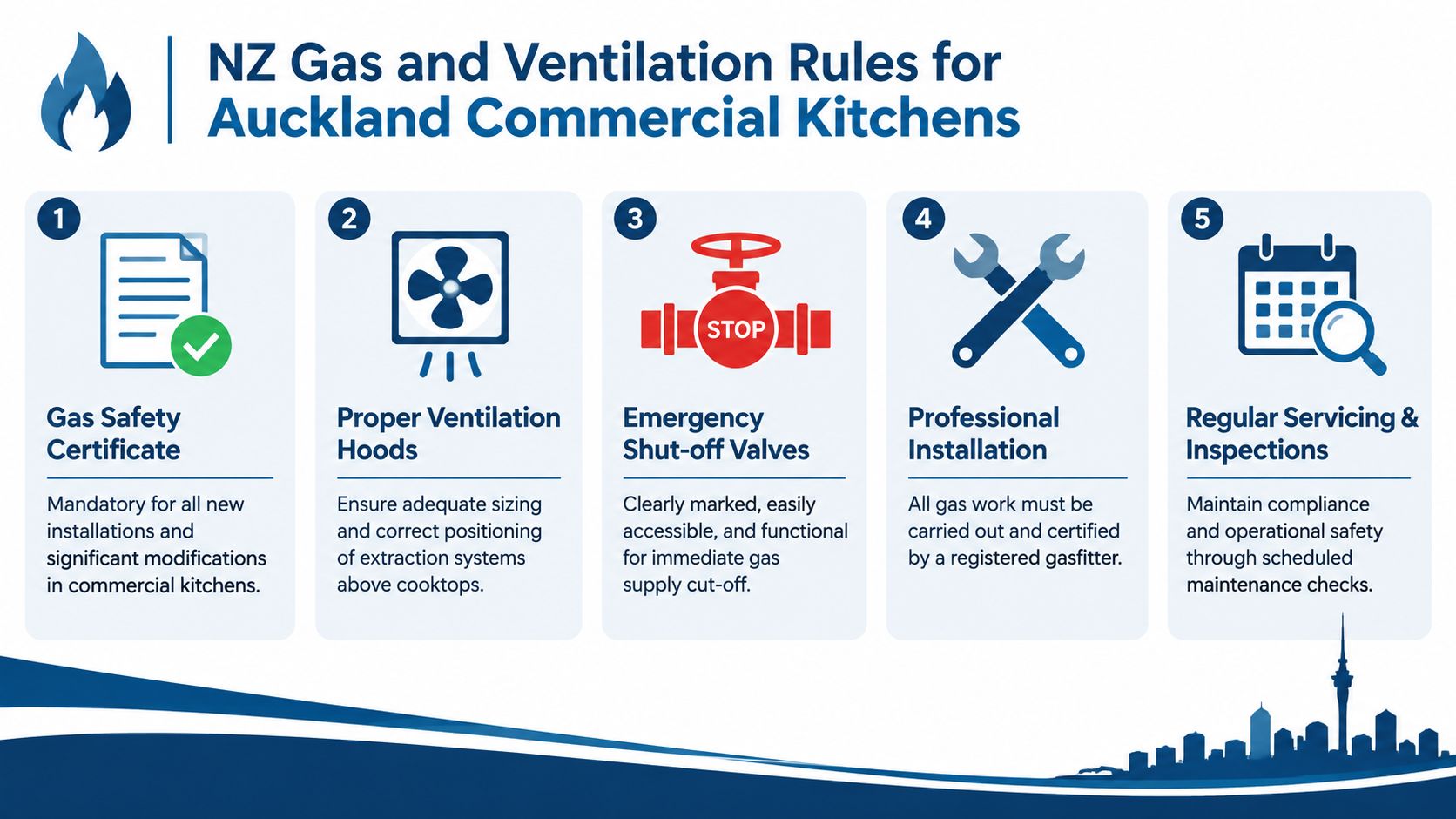
A commercial gas cooktop isn't assessed as an isolated appliance. The gas connection, pipework, flues, air ducts, ventilation and related components form part of the wider installation. New Zealand's Gas (Safety and Measurement) Regulations 2010 regulate commercial catering equipment, while the current applicable category standard is AS 4563:2022 Commercial catering gas equipment, including Amendment 1.
Commercial equipment such as ranges, griddles, ovens, fryers, stockpots and boiling tables sits within this regulated framework. WorkSafe states that anyone who manufactures, imports, sells, hires, leases or installs a gas appliance must ensure it is safe so far as is reasonably practicable. Appliances also need to be appropriate for the intended fuel, typically natural gas to NZS 5442 or LPG to NZS 5435.
Treat ventilation as part of selection
The Building Code's G4/AS1 acceptable solution applies to building ventilation and gas-fuel appliances. It connects room air supply, exhaust and flue locations with the appliance installation, so the canopy and cooktop should be planned together. The Building Code G4/AS1 ventilation guidance sets out the compliance pathway.
For mechanically ventilated plant rooms, the referenced ventilation standard specifies outdoor air at 3.6 m3/h per kW for forced or induced draught appliances and 7.2 m3/h per kW for appliances with atmospheric burners. It also specifies mechanical exhaust at one third of the inlet rate, or natural high-level openings of at least 600 mm2 per kW of total gas consumption for all appliances in the room. These requirements come from the G4 ventilation acceptable solution document.
The important planning question is whether all equipment can operate together. A cooktop beside a fryer, chargrill and oven range creates a different ventilation and gas demand from a single bench-mounted unit. The designer and gasfitter need the complete proposed equipment schedule before finalising services.
Build compliance into the equipment brief
Auckland operators should ask for documentation covering:
- Certification pathway: Confirm the appliance is certified for sale and use in New Zealand.
- Fuel type: Match the declared configuration to the site's natural gas or LPG supply.
- Ventilation design: Check canopy, make-up air, exhaust and flue arrangements together.
- Storage controls: Where LPG is used, confirm the site can meet applicable storage limits.
- Gas isolation: Ensure shut-off arrangements are accessible and understood by staff.
- Transition planning: The 2025 Gas Safety amendments include a compliance deadline of 12 to 13 November 2026 for certain certification pathways, so buyers planning fit-outs or replacements should check whether the proposed model and documentation remain supportable through the transition. WorkSafe's certification regime information should be checked before purchase.
For operators wanting broader background on the causes and warning signs associated with gas issues, this resource on understanding gas leak causes can provide useful context. It doesn't replace a qualified inspection or installation assessment.
A properly specified commercial kitchen exhaust hood should be assessed with the cooking equipment, not added after the cooktop has been selected.
Planning Your Installation and Long-Term Servicing
Installation problems usually begin during specification, not when the gasfitter arrives. The cooktop may be suitable on paper, but the full line can still exceed the available gas supply, conflict with the canopy position or leave insufficient access for cleaning and service.
Gas installations in Auckland are generally straightforward when requirements are identified early. The practical safeguard is to provide the equipment schedule, declared input information and layout to the relevant trades before benches, extraction and services are fixed.
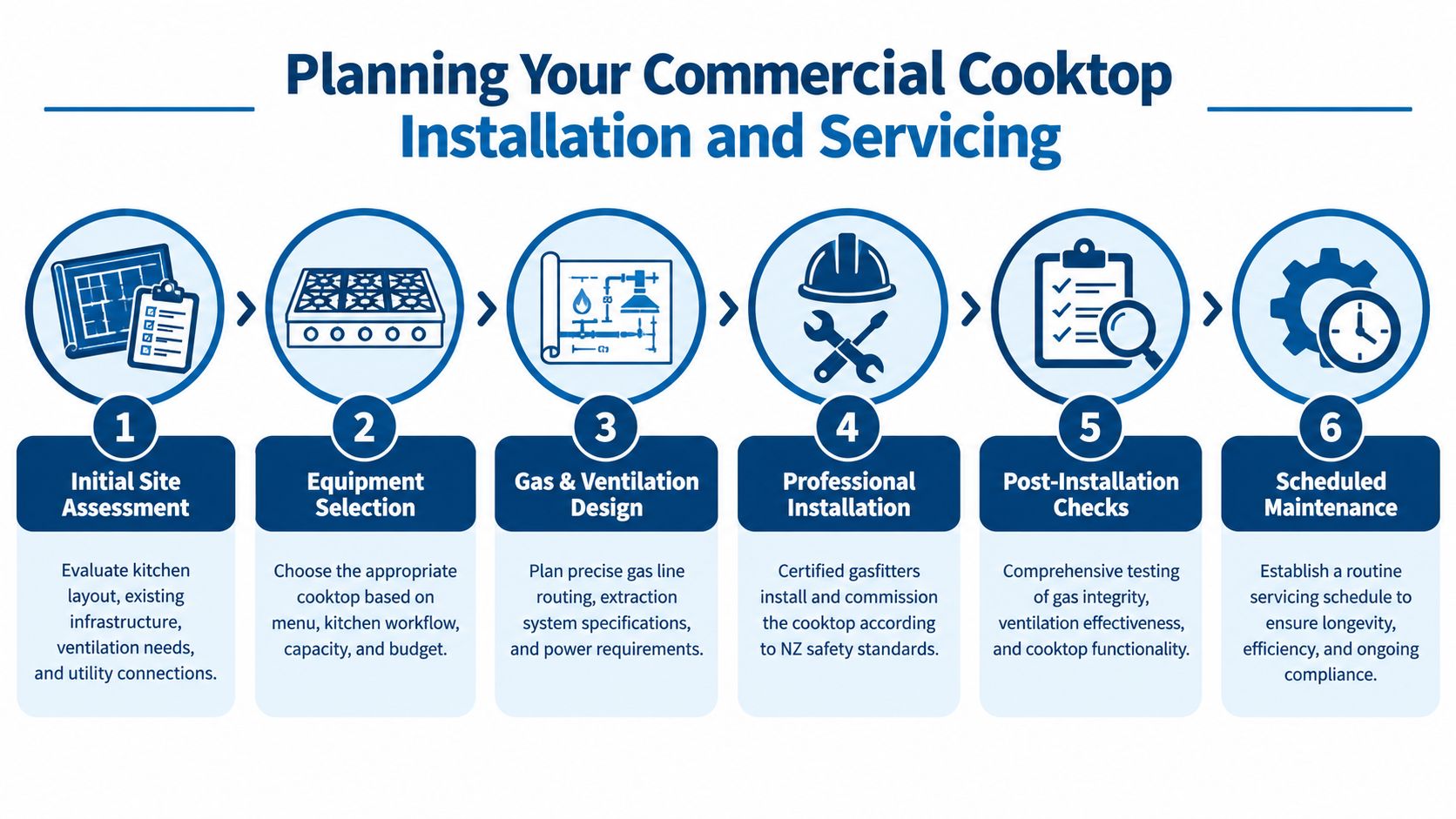
Use a staged installation plan
- Assess the site: Review layout, existing gas infrastructure, ventilation, access and the position of adjacent equipment.
- Select the equipment: Match the cooktop to menu, cookware, production capacity, footprint and budget.
- Design services: Confirm gas routing, extraction, make-up air, flues and any electrical requirements for associated equipment.
- Book qualified trades: WorkSafe states that gasfitting must be completed by a currently licensed gasfitter or certifying gasfitter. WorkSafe's guidance on getting gas work done sets out this requirement.
- Commission the line: Test gas integrity, ignition, flame behaviour, ventilation performance and the operation of every control.
- Plan maintenance: Record the manufacturer's requirements, identify service contacts and confirm the availability of likely replacement parts.
Protect the working life of the unit
Daily cleaning should focus on the cooking surface, burner components, pan supports and areas where grease or food debris collect. Spills are easier to remove when dealt with routinely, and changes in ignition or flame behaviour shouldn't be ignored.
Simply Hospitality doesn't perform gas-appliance servicing directly, so operators should use appropriately qualified technicians and follow the manufacturer's maintenance requirements. Parts availability matters because a cooktop that is easy to repair and supported by an established supply chain can be more practical to own than a superficially cheaper model with uncertain support.
The installation itself should be documented. Commercial kitchen installation planning is useful when several trades need to coordinate equipment, services, ventilation and commissioning responsibilities.
Buying New vs Certified Used and Financing Your Cooktop
New equipment can provide current certification documentation, manufacturer support and a clear warranty pathway. A new Blue Seal, Waldorf or Cobra cooktop may be appropriate when the venue needs predictable commissioning, a specific configuration or equipment that will form part of a new fit-out.
Certified used equipment can suit an operator with a tighter capital budget, provided the unit's condition, certification status, service history and parts support are properly checked. A used cooktop should still match the intended fuel, installation context and workload. Age alone doesn't establish suitability, and a low purchase price can lose its advantage if the appliance needs substantial work before commissioning.
Compare ownership, not just purchase price
The decision should consider:
- Documentation: Confirm certification and installation records are available.
- Condition: Inspect burner components, controls, pan supports, surfaces and signs of heat or grease damage.
- Compatibility: Check the fuel configuration, connected load and fit with the planned extraction system.
- Support: Establish whether service technicians and replacement parts remain available.
- Downtime risk: Consider how disruptive a repair or delayed component would be during trading.
- Cash flow: Review whether outright purchase or an appropriate finance arrangement better fits the venue's wider fit-out needs.
The same reasoning applies to other major hospitality assets. A practical guide to business coffee machine decisions can help operators compare ownership and leasing considerations across equipment categories, although a gas cooktop still requires its own compliance and installation checks.
Financing can preserve working capital for extraction, refrigeration, preparation equipment and other parts of the fit-out, but it shouldn't be used to justify an unsuitable appliance. The menu, cookware, burner arrangement, site services and support pathway remain the primary decisions.
Hospitality offers new commercial cooking equipment, certified used options, product information, trade support and finance pathways through its hospitality equipment service. Its guidance on why certified used products from SilverChef are recommended provides further context for operators comparing equipment ownership options.
Simply Hospitality can help Auckland operators compare Blue Seal, Waldorf and Cobra gas cooktops against their menu, cookware, footprint and planned gas line. Visit Simply Hospitality to review commercial cooking equipment and request practical support before the cookline and site services are finalised.