

Choosing a Commercial Kitchen Kettle: A Practical NZ Guide
A busy service can expose the wrong kettle quickly. Staff fill a domestic-style appliance, wait for the boil, pour a few drinks, refill it, and repeat while customers queue. A production kitchen faces the opposite problem, with soup, stock or sauce moving through large batches that need controlled heat and safe transfer. Both operators may search for a commercial kitchen kettle, but they aren't looking for the same equipment.
The starting question is simple: is the kitchen heating water for drinks, or cooking food in volume? From there, capacity, throughput, power, plumbing, cleaning and placement all need to match the actual workflow. A café occasionally boiling water has a different requirement from a conference venue running continuous beverage service or an institutional kitchen producing bulk soup.
Two very different products share one name
The phrase commercial kitchen kettle covers two very different equipment decisions. The first is a beverage appliance, such as a portable electric kettle, hot-water urn or plumbed water boiler. These units heat and hold water for tea, coffee, breakfast service, conferences, staff drinks and similar applications.
The second is a commercial cooking kettle, usually a steam-jacketed or bulk cooking vessel. It is designed for soups, stocks, sauces, gravies, braises and other liquid or semi-liquid food production. A tilting braising pan can sit in the same broad equipment conversation, but it still follows a food-production workflow rather than a beverage-dispensing workflow.
The first filter: decide whether the appliance needs to deliver hot water or cook food. A kettle that does one job well won't automatically do the other.
Match the equipment to the job
A beverage kettle normally needs practical dispensing, safe filling, temperature control and enough recovery to keep drinks moving. It may sit on a bench in a café, breakfast room, meeting area or staff facility. The operator should care about the service window, how often staff refill it and whether water needs to be held at a usable temperature between orders.
A cooking kettle needs a very different specification. Batch capacity matters, but so do heat distribution, product transfer, cleaning access, floor space and the services required by the heating system. A stationary vessel may suit draw-off production, while a tilting model may make it easier to transfer a cooked batch into containers.
These products also bring different installation and ownership questions. Beverage equipment may need a suitable socket or water connection. A bulk cooking kettle can require more substantial services, drainage, ventilation and clearance around the vessel. Product construction, controls, warranty conditions and replacement parts should reflect the intended commercial workload.
For background on why workload and intended use matter across hospitality equipment, operators can read the differences between domestic, semi-commercial and commercial equipment.
A quick self-selection test
The right path becomes clearer when the operator answers these questions:
- Tea, coffee and hot drinks: Look first at an electric kettle, hot-water urn or commercial water boiler.
- Conference or event service: Focus on holding capacity, dispensing and recovery during the busiest service period.
- Soup, stock and sauces: Investigate a cooking kettle, steam-jacketed vessel, braising pan or stockpot workflow.
- Occasional low-volume use: A commercial beverage appliance may be unnecessary if a suitable existing unit can handle the duty safely.
- Frequent bulk production: Compare dedicated cooking equipment against range-top pots, including handling and cleaning labour.
A smaller venue may need both types. A café may only need a beverage boiler, while a hospital, school, marae or aged-care kitchen may have a stronger case for bulk cooking equipment. The important point is to choose the category before comparing litre figures or browsing model features.
The three kettle types and what each one is actually for
The three main categories are commercial electric kettles, hot-water urns or water boilers, and commercial cooking kettles. They overlap in everyday language, but they don't overlap in purpose.
Commercial electric kettles
A commercial electric kettle is generally a portable benchtop appliance for boiling relatively small quantities of water. It suits a staff room, small service point, occasional catering requirement or a café that only needs modest quantities outside its main beverage workflow.
The attraction is flexibility. Staff can position the appliance where it's needed, and manual filling avoids a permanent water connection. The trade-off is that someone must fill it, wait for it to boil, pour it and start again. That cycle becomes a bottleneck when several staff are serving drinks at once.
A commercial electric kettle is the wrong choice when the kitchen needs continuous dispensing, substantial holding capacity or fast recovery after repeated draws. It also shouldn't be selected solely because its listed capacity appears large enough. The question is whether it can keep up with the way water leaves the appliance.
Hot-water urns and commercial water boilers
A hot-water urn or commercial water boiler is built for repeated tea, coffee and hot-drink service. Manual-fill models give operators flexibility, while autofill or direct-plumbed equipment reduces repeated refilling and can support a more continuous service pattern.
These units may offer thermostatic control, insulated construction, dispensing taps or other features designed for holding and serving hot water. Some are intended to boil water, while others are designed to maintain hot water at a selected temperature. Those functions shouldn't be treated as identical.
An urn is useful for breakfast service, offices, tearooms, functions and event stations. It becomes the wrong tool when the kitchen is trying to cook food. Water-heating equipment won't replace a cooking kettle for soup, stock, sauce or bulk production.
Commercial cooking kettles
A commercial cooking kettle is closer to a controlled bulk-cooking system than a large beverage urn. Steam-jacketed, stationary, tilting and countertop designs can suit soups, stocks, ragouts, porridge, goulash, sauces and other products that benefit from heat around the vessel rather than a single hot surface beneath it.
The jacket transfers heat around the vessel, supporting more even cooking and reducing the need to manage a large pot directly over a range. A tilting design may improve transfer into pans or containers, while a stationary design may work better where product leaves through a draw-off arrangement.
The wrong tool here is an oversized cooking kettle bought for occasional production. A stockpot on a suitable commercial range may remain the sensible choice where batches are modest or the menu changes often. Operators considering larger pots can also use practical guidance on choosing big cooking pots before committing to dedicated bulk equipment.
The central distinction is straightforward. Electric kettles and urns deliver hot water. Cooking kettles produce food. A supplier should challenge any purchase that tries to make one category cover the other.
Capacity versus throughput, the real commercial question
Capacity tells the operator how much the appliance holds. Throughput tells the operator whether it can keep up. Those are different measurements, and commercial buyers who focus only on litres often end up with equipment that looks suitable on paper but struggles during the busiest part of service.
For beverage planning, the first calculation is:
Serves required × water per serve = water requirement during the peak period
An illustrative calculation makes the point. If 100 drinks require approximately 250 ml of hot water each, the service needs around 25 litres of water. That figure alone doesn't identify the right appliance. Those drinks could be served over ten minutes, an hour or an entire morning, and each scenario creates a different recovery requirement.
A simple yield calculation
The table below is an illustrative calculation based on 160 ml per cup. It shows how many cups a fill might theoretically provide before allowing for steam, unused water, minimum operating levels or the practical need to retain water in the vessel.
| Urn capacity | Usable water | Cups per fill, 160 ml |
|---|---|---|
| 20 litres | 18 litres | Approximately 110 |
| 30 litres | 27 litres | Approximately 169 |
| 40 litres | 36 litres | Approximately 225 |
A 20-litre urn holding 18 litres of usable water can therefore produce roughly 110 standard 160 ml cups from one fill, but that doesn't reveal how quickly the fill is consumed or how soon the unit can restore its temperature. A large vessel may offer a comfortable opening position and still fail to recover quickly enough once staff draw water continuously.
Commercial rule: size the appliance for the busiest service window, not for the quiet period when the vessel appears comfortably full.
Recovery changes the decision
A café serving drinks in a concentrated rush needs a different answer from a venue serving the same total volume across a morning. A smaller boiler with strong recovery may outperform a much larger urn if the smaller unit restores usable hot water quickly and staff don't need to wait between draws.
Manufacturers may publish heat-up times, recovery rates or hourly output. Those specifications should be used when available. They shouldn't be replaced with guesses based on the tank size or wattage alone.
Cooking kettles follow the same logic. The relevant questions are how much product each batch produces, how many batches the kitchen needs, how quickly the next batch must start and how staff transfer the finished food. A larger vessel isn't automatically better if it takes longer to load, clean, empty or bring back into the production cycle.
The best capacity is the one that supports the actual rhythm of service. Operators should record peak demand, service duration and batch timing before choosing a model. Planning equipment for consistent meal service provides a useful framework for connecting equipment decisions with the wider production workflow.
Power, plumbing and placement that decide what you can install
A promising specification can become unusable once the site services are checked. Before selecting an electric urn, water boiler or cooking kettle, the operator should confirm the available voltage, wattage, plug and socket arrangement, circuit capacity and phase requirements.
In New Zealand, electrical products for domestic or similar use must be rated and marked for the standard mains supply of 230 V, or 400 V multi-phase, at 50 Hz, and products supplied with a lead and plug must have an appropriate New Zealand plug, as set out by WorkSafe's electrical product requirements. A Supplier Declaration of Conformity is required for household and similar appliances in the relevant medium-risk category, according to WorkSafe's medium-risk product guidance.
Check the service before the model
Don't assume a commercial water boiler will run from a standard outlet. Check the manufacturer's stated requirements and have any new circuit or electrical work completed by an appropriately qualified person. Gas equipment brings its own connection, ventilation and compliance considerations, so the site should be assessed before the purchase is finalised.
| Configuration | Typical power or fuel | Water connection | Best fit |
|---|---|---|---|
| Manual-fill electric unit | Electric supply specified by the manufacturer | None beyond manual filling | Flexible, lower-demand beverage points |
| Autofill or plumbed boiler | Electric supply specified by the manufacturer | Mains water inlet, with installation requirements | Continuous beverage service |
| Gas cooking kettle | Gas supply, with associated ventilation needs | Depends on the design | Bulk food production where gas services suit |
| Electric cooking kettle | Electric supply, potentially with higher service demands | Depends on the design | Bulk production where electrical capacity is available |
| Direct-steam kettle | Existing steam supply | Water and condensate arrangements may apply | Sites with suitable steam infrastructure |
Manual-fill equipment is easier to position, but staff carry the refill responsibility. Plumbed equipment removes that repeated task, though it requires a suitable water supply and may need filtration or treatment depending on the equipment and local water conditions.
Plan the footprint, not just the bench
A benchtop urn needs stable support, clear access to its controls and enough surrounding space for filling and dispensing. A large filled vessel should remain in its working position wherever possible, because moving hot water creates unnecessary handling risk.
A tilting cooking kettle needs room for the movement itself, the receiving container and the person operating the transfer. Stationary units need access for loading, draw-off and cleaning. Steam-jacketed equipment may also require condensate management, drainage, ventilation and suitable floor loading.
For a broader discussion of energy sources and New Zealand kitchen planning, operators can review gas and induction considerations for NZ kitchens. The practical answer remains site-specific. A technically capable appliance is not a good purchase if the kitchen can't safely supply, drain or service it.
Safety, cleaning and water quality across a full service
Boiling water and steam create real injury risks. WorkSafe advises safe practices around electrical appliances and hot liquids, while Fire and Emergency New Zealand guidance on burn and scald prevention reinforces the need to keep people away from steam and boiling water sources. In mixed-use environments, the same controls matter even more.
The appliance should sit on a stable, suitable surface with enough room for safe filling and dispensing. Staff should avoid overfilling, keep clear of steam outlets, use the intended handles and controls, and avoid moving a vessel containing hot water unless the equipment and procedure specifically allow it.
Build safety into the routine
A large urn becomes heavier as it fills, and a cooking kettle can hold a substantial hot batch. Operators should define who can fill, dispense, tilt, decant and clean the equipment. In schools and early-learning settings, appliances must be located or fitted so children can't access them without adult assistance or supervision, as stated in Education Ministry guidance for kitchen appliances.
WorkSafe states that kettles sold in New Zealand are declared medium- and high-risk articles, with safety standards requiring two safety switches to prevent overheating and fire, in addition to the thermostat that cuts power when water boils. That requirement is described in WorkSafe's kettle safety notice. Operators should still check the product documentation, markings and installation instructions for the specific appliance.
Cleaning must follow the equipment
A beverage boiler's internal surfaces, dispensing point, lid and exterior should be included in the daily cleaning routine. Water left standing overnight should be managed according to the manufacturer's instructions and the site's food-safety procedures. A cooking kettle also needs attention to the vessel, jacket-related components where accessible, lid, outlet, tilting mechanism and surrounding floor.
Mineral deposits can affect heating elements, valves and dispensing performance over time. Water conditions and usage vary, so there isn't a universal descaling interval. The operator should follow the manufacturer's approved chemical, method and frequency rather than applying a generic cleaning recipe.
A clear commercial kitchen cleaning protocol can help managers organise responsibilities across equipment, floors, contact surfaces and closing tasks. Guidance on how water quality affects dishwasher performance is also relevant to the wider principle that incoming water can affect commercial equipment, although the kettle manufacturer remains the authority for filtration and treatment requirements.
Operating discipline: the safest kettle is one that staff can fill, use, empty and clean without awkward lifting, rushed transfers or unclear responsibility.
Steam-jacketed and bulk cooking kettles for food production
A steam-jacketed kettle is not a bigger hot-water urn. It is a cooking vessel with a jacket around the product chamber. Steam or another heating medium transfers heat around the vessel, rather than relying only on a conventional hot surface beneath a stockpot.
That arrangement suits liquid and semi-liquid products that need controlled, even heating. Soups, stocks, sauces, gravies, curries, jams, glazes, porridge and other bulk recipes may fit the workflow, provided the selected model is designed for the product and the site's production needs.
Choose the vessel around product movement
Stationary kettles suit kitchens that load, cook and draw off through a planned outlet. Tilting kettles can make it easier to pour into pans or containers, but they need clearance and a safe transfer procedure. Countertop models may suit smaller production where a floor-standing unit would crowd the room.
The operator should assess:
- Batch capacity: The vessel must support production batches without forcing unsafe overfilling.
- Product consistency: Recipes with milk, sugar or other ingredients that can catch on a hot surface may benefit from controlled heat transfer, but the model still needs to match the recipe.
- Transfer method: Draw-off, ladling, pump transfer and tilting each create different labour and cleaning requirements.
- Heating source: Direct steam, self-contained electric steam generation and gas-fired systems depend on the services already available.
- Access and cleaning: The lid, vessel, outlet, controls and surrounding floor must be practical to clean after a heavy batch.
The commercial case depends on repeated production, not on the word “bulk” alone. A hotel, hospital, school, aged-care kitchen or catering operation with regular batch cooking may need dedicated equipment. A small restaurant producing occasional soup may be better served by a suitable stockpot on a commercial range.
Compare the alternative honestly
A stockpot offers flexibility. Staff can change recipes, move pots between burners and use existing equipment, but large batches bring handling, heat-management and transfer demands. A cooking kettle takes more planning and may consume valuable floor space, but it can provide a more dedicated production path where the workload justifies it.
Services can determine the choice before cooking performance does. The kitchen may need gas, electrical capacity, steam infrastructure, ventilation, drainage, condensate handling and enough clearance for the operator to work safely. A supplier should inspect or discuss those constraints rather than recommending capacity in isolation.
A step-by-step way to choose the right kettle for your venue
The most productive buying conversation starts with the kitchen's routine, not a product code. A chef or manager should be able to describe the busiest beverage period or the most demanding food batch before comparing models.
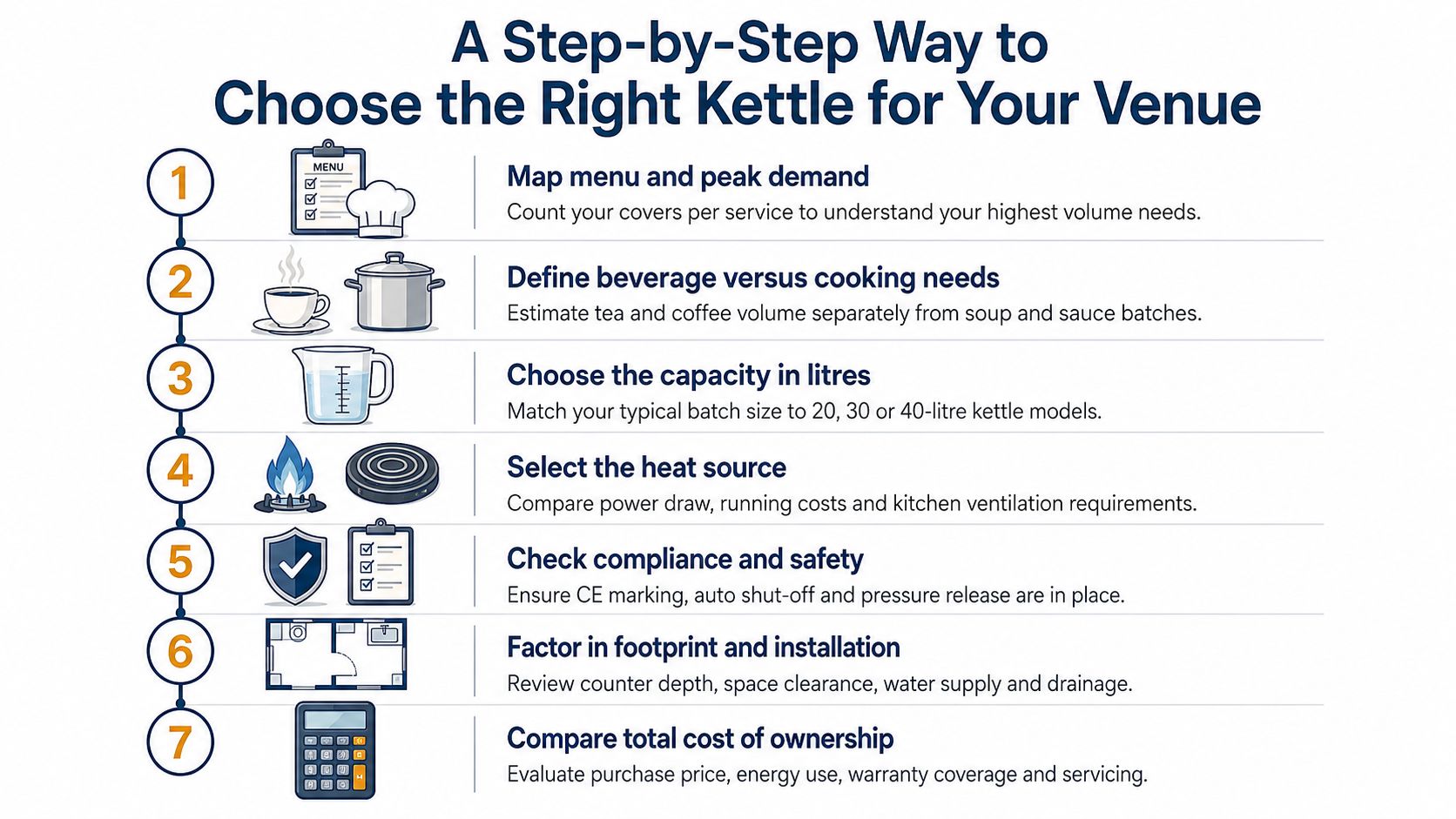
Seven questions to settle first
-
What is being heated?
Separate water service from food production immediately. Tea, coffee and event beverages point towards kettles, urns or boilers. Soup, stock and sauce production points towards a cooking kettle, braising pan or stockpot workflow. -
How much is needed at peak?
Count drinks, covers, batches or containers during the busiest service period. The total daily volume matters, but the peak determines whether the equipment creates a queue. -
How quickly is it consumed or transferred?
A vessel that holds enough at opening may still struggle when staff draw water continuously. For food, the timing of loading, cooking, portioning and transfer determines the useful batch size. -
How quickly must the unit recover?
Ask for published heat-up, recovery or output specifications where the manufacturer provides them. Don't substitute a guessed performance figure based on litres alone. -
Will the unit be manual-fill or plumbed?
Manual-fill equipment offers positioning flexibility but creates refill work. Plumbed equipment can support continuous service but needs suitable water connection, installation and any manufacturer-specified filtration. -
What services and space are available?
Confirm voltage, wattage, plug, circuit, phase, gas, water, drainage, ventilation and clearances. A model that doesn't fit the room or service supply shouldn't make the shortlist. -
How will staff use and clean it?
Check filling height, dispensing controls, lid access, hot surfaces, tilt movement, product transfer and descaling access. Warranty terms and replacement parts should also reflect the intended commercial use.
Test the shortlist against the whole workflow
Two or three suitable models are enough for a meaningful comparison. The operator should ask for the exact dimensions, service requirements, capacity, temperature controls, manual or plumbed operation, published output information and warranty conditions.
A site discussion can expose problems that a catalogue won't show. The bench may not have enough depth, the receiving pan may not fit beneath a draw-off point, or the available circuit may not support the selected boiler. A short conversation with a specialist should include those constraints and should challenge an oversized or poorly matched purchase.
The final checklist is simple:
- Water or food?
- How much is required at peak?
- How quickly is it consumed?
- How quickly must it recover?
- Manual-fill or plumbed?
- What power and services are available?
- Where will it sit?
- How will it be filled and cleaned?
- Is it designed for the required commercial workload?
Choosing well comes back to peak demand and workflow
A kettle isn't bought by the litre. It's bought for the busiest part of the operation, whether that means a concentrated beverage service or a production run that needs a cooked batch ready for transfer.
That principle applies to both products hidden behind the search term. Beverage equipment must heat, hold, dispense and recover in line with demand. Cooking equipment must load, heat, transfer, clean and restart without creating a new bottleneck.
Oversizing “just in case” is poor planning. A larger unit can cost more to install, occupy more room and take more effort to fill, clean and empty. It may also suit the wrong batch pattern. The better approach is to anchor every specification to covers, service timing, batch behaviour and the number of staff available to operate the equipment.
A commercial kettle should remove a bottleneck, not relocate it from boiling to filling, dispensing, transfer or cleaning.
Hospitality can help operators compare commercial kitchen kettles, hot-water urns, beverage equipment and surrounding kitchen requirements, including practical fit with benches, plumbing and extraction. Finance options through SilverChef may also be relevant where a specialist purchase needs to be managed alongside a wider fit-out.
Simply Hospitality supplies commercial kitchen equipment and related hospitality essentials for NZ venues, with product guidance for beverage service, cooking, cleaning and workflow planning. Visit Simply Hospitality to discuss the right kettle or water-heating solution for the demand, services and space available in the kitchen.