

Commercial Kitchen Supplies NZ: The Essential Guide
The busiest kitchens rarely fail at the stove. They stall when the gloves run out, the dishwash chemical gets forgotten, the wrong bin liner tears, or the paper goods cupboard is emptier than anyone realised. That is why commercial kitchen supplies NZ operators buy should be treated as a working system, not a loose pile of products, because the everyday consumables shape workflow, stock control, labour, hygiene, operating cost, and the customer experience at the pass.
For operators who want the practical side of kitchen discipline, the logic lines up closely with broader restaurant operation management ideas such as restaurant profit strategies with Splash Access. The same thinking applies across the kitchen, front of house, and storage room. If the consumables are organised, the service is calmer.
Why Consumables Decide How a NZ Kitchen Actually Runs
The moment a service starts to wobble is usually small. A glove box empties halfway through prep. A dishwasher cycle is delayed because the chemical dose wasn't checked. A bin liner splits on the way to the skip, and one staff member leaves the line to clean up the mess.
That isn't a minor inconvenience. It changes pace, adds friction, and makes the rest of the shift harder than it needed to be.
The hidden workload sits in the consumables
Equipment gets the attention because it's visible and expensive. Consumables do the daily work. Cleaning chemicals keep surfaces usable, food packaging keeps takeaway and delivery moving, paper hygiene products keep washrooms and service areas functioning, and gloves and prep consumables support safe handling without constant interruption.
A useful way to think about it is simple. If a product touches cleaning, waste, packaging, service, or hygiene, it affects time. And if it affects time, it affects labour and the customer experience too.
Practical rule: if staff have to stop, search, substitute, or improvise, the consumable system is already costing the kitchen more than the product price suggests.
That is why the most useful buying conversations are rarely about a single item. They're about how the whole range works together. A kitchen can have good equipment and still run badly if its consumables are fragmented, inconsistent, or allowed to run out.
The strongest operators build routines around the boring things. They know what gets used every day. They know what sits in the cleaning cupboard. They know what must never hit zero. Consistent prep habits matter too, which is why many operators keep a close eye on processes that support consistency, including guidance like why consistent prep creates consistent profits.
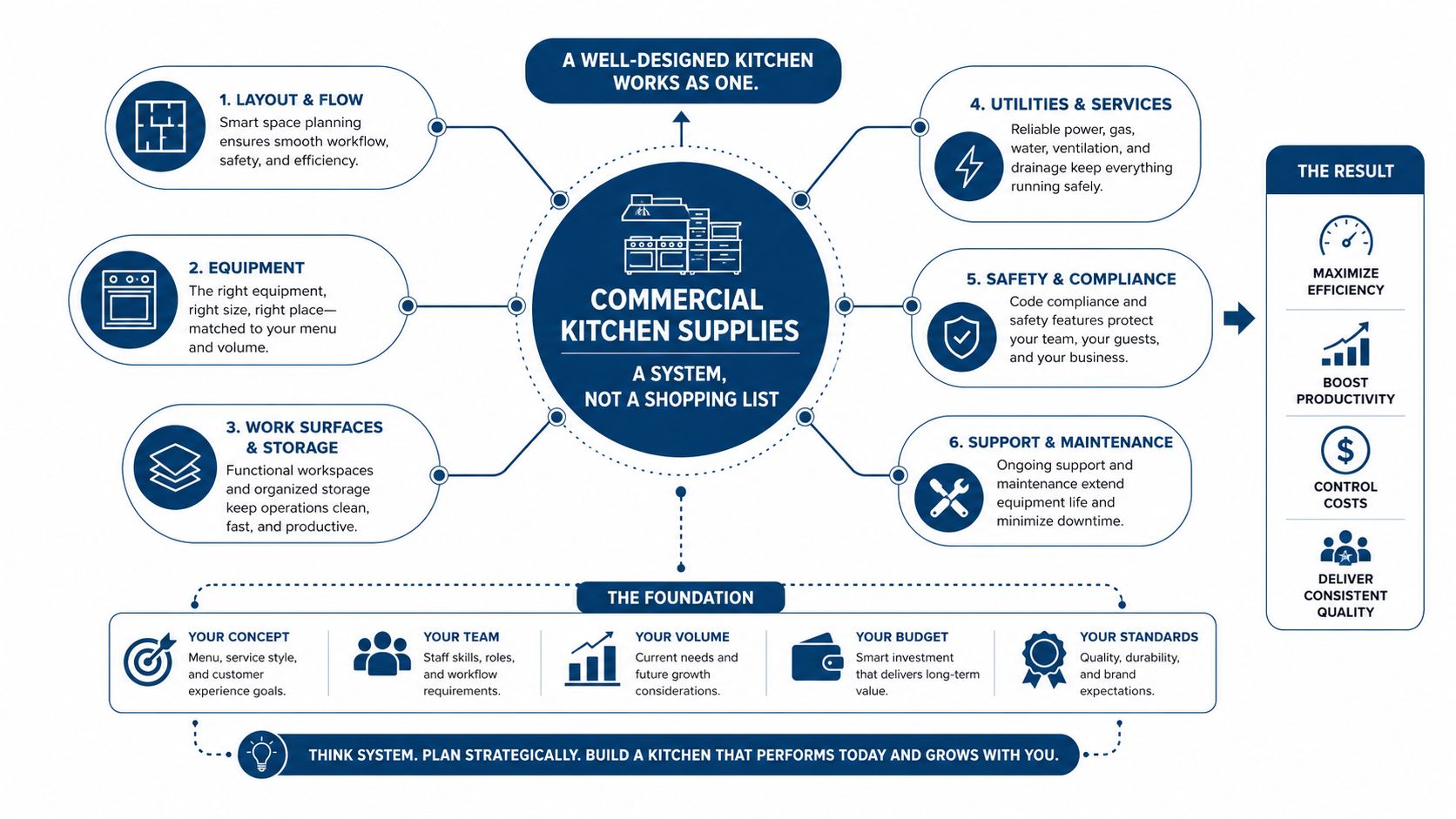
Commercial Kitchen Supplies as a System, Not a Shopping List
A shopping list leads to scattered decisions. A system connects the dots between what gets used, what gets stored, what gets ordered, and what the kitchen can support. That matters because consumables don't sit on their own, they sit beside equipment, workflow, cleaning routines, and compliance requirements.
Start with the workflow, then match the consumables
Cleaning chemicals, food packaging, gloves, paper hygiene, dishwashing chemicals, bin liners, tableware, storage, stock management, reordering, supplier reliability, and total cost of ownership all interact. A product that looks fine on paper can be awkward in practice if it slows the team down or needs a different storage method.
Take dishwashing. The chemical choice has to suit the machine, the dosing method, and the service rhythm. If the machine is doing heavy work under pressure, the staff need a repeatable setup, not a chemistry experiment before lunch service. The same logic applies to waste handling. Bin liners need to fit the container properly, otherwise staff waste time double-bagging, cleaning spills, or hunting for the right size at the wrong moment.
Where the kitchen layout is constrained, the consumables decision becomes even more important. The Classeq C400 is a compact passthrough dishwasher with heavy duty stainless steel construction, economical water consumption rates, integrated heat recovery, and powerful rinse heating. That kind of specification only works properly when the consumables and the machine are planned together.
Standardisation does the heavy lifting
Standardisation simplifies everything. Ordering gets shorter. Staff familiarity improves. Inventory management becomes cleaner. Storage is easier to plan. Supplier conversations become more useful because the volume is concentrated on fewer lines.
A café group using one cup and lid specification across sites has fewer errors at the till and fewer surprises in dry storage. A kitchen that aligns glove size and material across front and back of house reduces reordering confusion. A venue that keeps one standard for dishwasher chemicals has fewer compatibility issues and fewer “which one do we use here?” moments.
One consideration we regularly discuss with customers is whether they're still buying as though every product is separate. That usually creates too much choice and too little control. The better question is which items work as part of the same operating model.
Questions worth asking
- Which products do we use every day?
- Do we have minimum stock levels?
- Are we buying on cost per use, or just purchase price?
- Can we simplify the range without creating risk?
- Are we relying too heavily on one product or one supplier?
Planning equipment for consistent meal service reinforces the same principle. Equipment and consumables work best when they're planned as one operating system.
The Four Consumable Categories That Reorder Themselves
Some consumables move so often that they deserve their own control system. These are the items that disappear fastest, create the most friction when they're short, and cause the most unnecessary interruptions when nobody is watching the stock level closely.
Cleaning chemicals and hygiene products
Cleaning chemicals sit at the centre of food safety, surface care, and shift-end routines. The wrong product can be awkward on stainless steel, unsuitable for a bench surface, or clumsy for staff to use quickly between services. The right range is the one the team can apply consistently without second-guessing the label.
The mistake many operators make is buying purely on price, then ending up with a mix of incompatible products across different sites or stations. That creates confusion during training and increases the chance of misuse. It also makes stock control harder because the cupboard fills with near-duplicates.
Food packaging and disposables
Packaging supports takeaway, delivery, front-of-house service, and backup service formats when the room gets slammed. The trouble starts when the range is too broad. Staff spend too long choosing between similar containers, lids don't match cleanly, and storage gets cluttered.
A practical packaging review usually starts with use case, not appearance. For a venue focusing on growth, packaging needs to suit the menu, hold up in transit, and stay simple for staff to grab in a rush. That's the thinking behind choosing packaging for growth.
Paper hygiene and washroom consumables
Paper towels, toilet paper, and similar items rarely get much attention until they run out. Then the problem becomes visible to staff and customers at the same time. These products need boring reliability, simple storage, and a clear reorder rhythm.
Gloves and food preparation consumables
Gloves sit at the intersection of hygiene, comfort, and speed. A poor fit slows the team down. A mismatched product forces people to change gloves too often or work awkwardly. Food prep consumables behave the same way, if the product is fiddly, the kitchen feels it immediately.
Common issue: the most frequently reordered products are often the ones that look minor in isolation but create the most disruption when they're missing.
This is why standardising within each category matters. A tighter range reduces decision fatigue, gives staff familiar products, and creates predictable reorder cycles instead of random shortages.
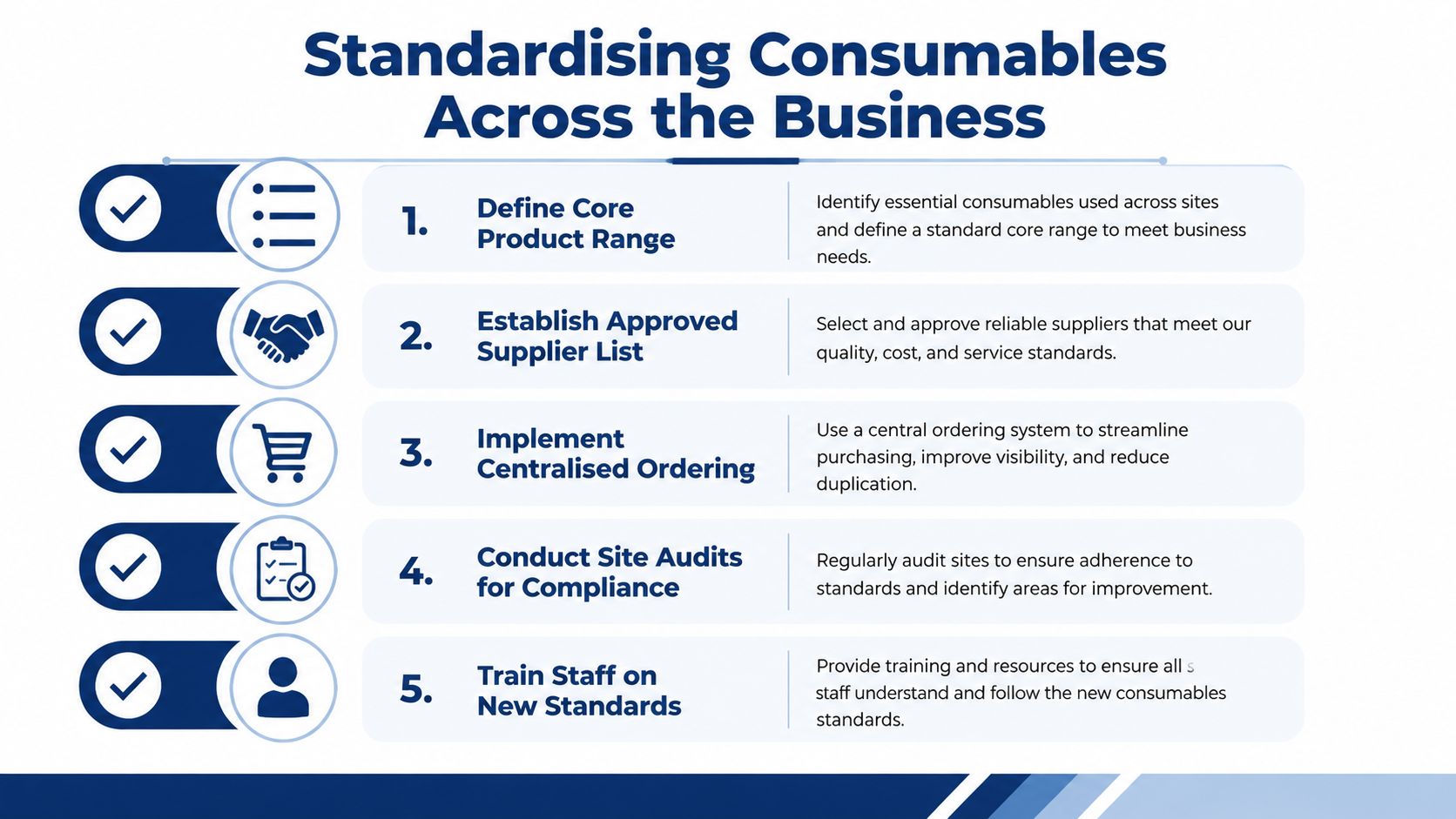
Standardising Consumables Across the Business
Standardisation is one of the few changes that improves ordering, storage, training, and supplier management at the same time. It works because it removes unnecessary variation from the system.
What standardisation changes in practice
When a site uses the same glove type across prep, wash-up, and service, staff know what to reach for and ordering becomes easier to approve. When a group uses one dishwasher chemical matched to the machine in use, there's less chance of product drift. When takeaway cups and lids are aligned across locations, storage is tidier and fewer mistakes reach the counter.
That doesn't mean flexibility disappears. It just moves to the supplier relationship instead of product sprawl. A supplier with a broad range can usually offer practical alternatives when a line is temporarily unavailable, which keeps the business moving without forcing a complete reset.
For kitchens that need better storage discipline as part of standardisation, storage containers for kitchen use are a useful example of how one simple category can affect labelling, shelf space, and stock rotation.
The objection is understandable, but narrow ranges usually win
Some operators worry that standardisation limits choice. That can be true if the range is cut too aggressively. In practice, the bigger risk is the opposite, too many products, too many exceptions, and too many staff making small decisions under pressure.
The lowest purchase price doesn't always produce the lowest operating cost if the product gets replaced more often or creates extra waste. That is why cost per use matters more than shelf price. A cheaper item that creates mess, downtime, or rework usually isn't cheap at all.
A disciplined range also makes approvals easier. Orders get shorter, managers review them faster, and staff waste less time trying to work out which version is “the right one” this week. Standardisation simplifies everything.
Minimum Stock Levels and Reorder Discipline
Running out of consumables is rarely a supply problem. It's usually a stock management problem. The easiest way to reduce last-minute stress is to set minimum stock levels for the items that are used every day.
Build reorder points around real usage
The process does not need to be complicated.
- List the daily-use items. Start with gloves, paper towels, toilet paper, cleaning chemicals, food packaging, dishwasher chemicals, and bin liners.
- Check normal movement. Look at what disappears between deliveries and what gets touched every shift.
- Set the reorder point early. The goal is enough time for replenishment before a cupboard hits zero.
- Assign one owner. Someone needs to check the levels, not assume someone else has done it.
- Review after busy periods. Seasonal peaks, functions, and menu changes all affect usage.
A helpful overview of stock timing is also covered in small business reorder points, which aligns closely with the discipline hospitality teams need on the ground.
What happens when stock levels are ignored
Emergency purchasing usually creates the worst version of every problem. It can trigger premium freight, limit product choices, and force substitutions that break standardisation. It also burns time, because staff are usually solving the shortage while trying to run service.
Running out of consumables is rarely a supply problem. It's usually a stock management problem.
Good kitchens manage consumables before they become urgent. The best purchasing systems prevent emergencies rather than responding to them. That means the stock room is treated as part of the operation, not as a place where random boxes gather until somebody complains.
The simplest habit is often the most effective. Keep a visible minimum level, review it often, and order before the line is under pressure. That discipline is what keeps busy kitchens moving without avoidable panic.
NZ Compliance, Utilities, and Equipment Sizing
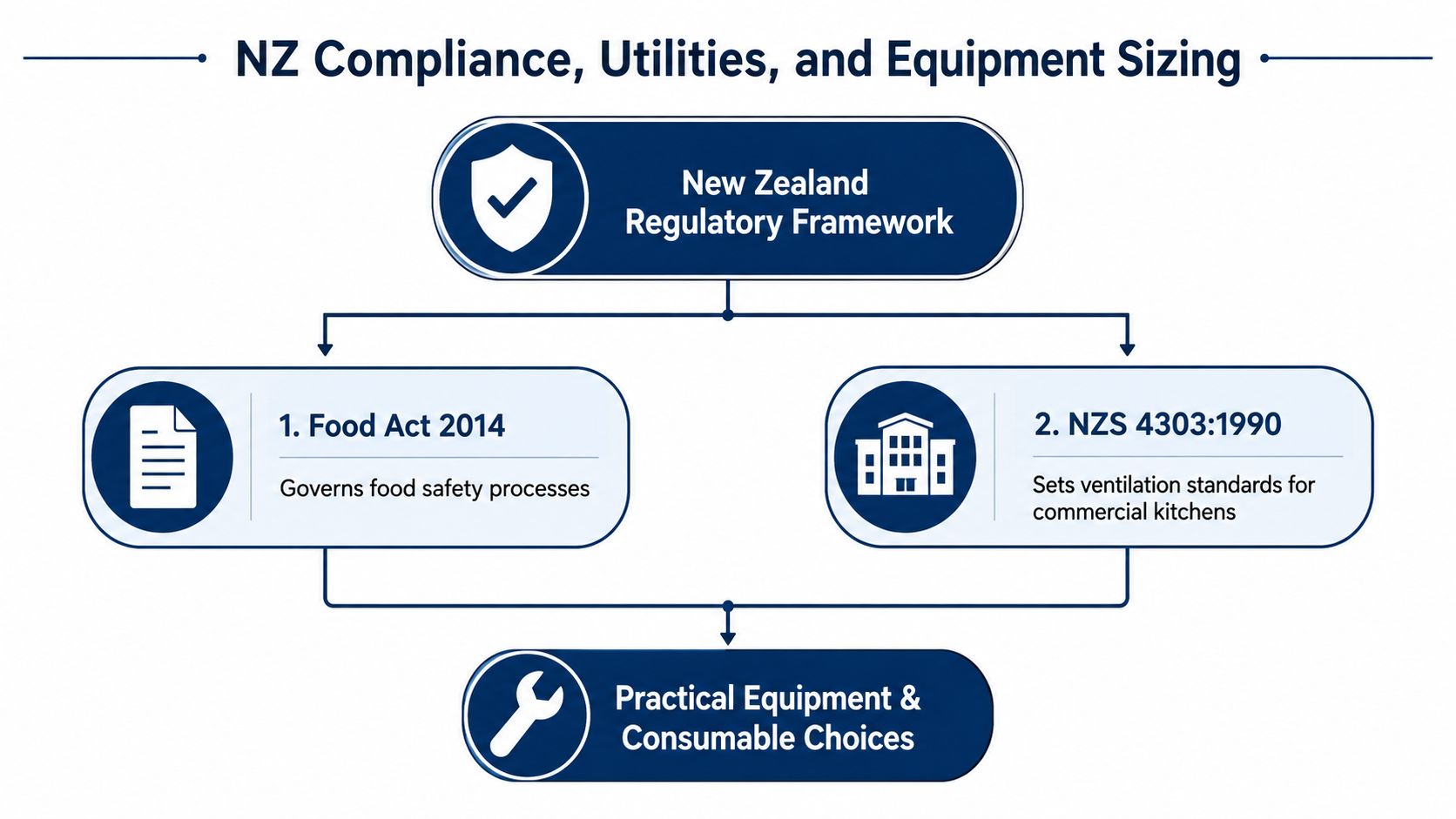
Consumables and equipment don't sit outside the compliance environment. In New Zealand, the Food Act 2014 sits alongside NZS 4303:1990 ventilation standards, certified electrical systems, and food-safe stainless preparation surfaces, and all of that shapes what a kitchen can safely run. Equipment choices have to fit the menu, but they also have to fit the infrastructure that supports them.
Performance margin matters under real service load
Foodservice guidance in New Zealand sets clear operating expectations. Hot-holding equipment should stay at or above 60°C, refrigerators and cool rooms below 5°C, freezers below -18°C, and sinks need continuous piped hot water at a minimum of 63°C at sink units, according to the South Waikato District Council commercial-kitchen guideline (SWDC guideline). Those numbers matter because a machine that looks adequate on paper can drift under peak load.
That's where specification becomes practical. Weak recovery, poor insulation, or undersized compressors can push refrigeration outside the safe band when the kitchen is busy. A similar problem shows up in hot-hold and wash-up areas, where recovery time matters more than nameplate capacity.
For teams wanting a deeper look at airflow and extraction planning, commercial kitchen ventilation guidance is useful context on why ventilation and cleaning discipline affect day-to-day kitchen performance.
The utility side is often the real constraint
A product can only work if the site can support it. Some foodservice equipment sold into New Zealand specifies 3-phase 400V supplies at 32A or 63A per phase, a 15mm potable water line, and a 50mm waste connection, with installation requiring a flat, level site for truck access. That means the bottleneck is often infrastructure, not the appliance itself.
If the switchboard, drainage, or water reticulation is undersized, the operation pays later in retrofit work and downtime. Planned procurement avoids that trap. The kitchen can stage upgrades in a way that matches the building, instead of forcing the building to catch up after the purchase.
Kitchen exhaust hood planning becomes relevant here as well, because extraction, electrical load, and waste planning all need to line up before the gear arrives. In practice, the best kitchen decisions are usually the ones that respect the site as much as the menu.
Procurement Strategy and Supplier Relationships
A tight consumables system needs a procurement model that can cope with interruptions. Depending on one supplier or one product creates fragility, especially for venues that can't afford to stop because a single line is delayed.
That's why a broad-range hospitality supplier matters. It gives operators practical alternatives when supply issues arise, and it helps consolidate spend across consumables, equipment, and support. Trade accounts also make ordering cleaner, because the business can keep approvals, repeat buying, and support in one place.
For venues needing specialist equipment without heavy upfront cost, finance options such as SilverChef can help stage the acquisition. Certified used equipment can also be a fit-for-purpose option for constrained sites, new ventures, and non-traditional venues such as marae, schools, aged care, hospitals, and small accommodation operators, where modular fit-outs and staged purchasing often make more sense than a full new fit-out.
Warranties and service requests matter too, because long-term ownership is never just about the purchase moment. Good kitchens manage consumables before they become urgent, and the best purchasing systems prevent emergencies rather than respond to them.
Hospitality helps New Zealand operators put the whole kitchen system together, from consumables and tableware through to refrigeration, dishwashing, and storage. If the goal is a cleaner reorder process, fewer stock emergencies, and a consumables range that fits the way the kitchen runs, visit Simply Hospitality and talk through the options with a team that understands service pressure on the ground.