


Commercial vs Semi-Commercial Appliances for Workplace Environments
The popular advice is wrong in both directions. A workplace doesn't automatically need fully commercial equipment, and a staff room shouldn't automatically be fitted with domestic appliances. The right choice depends on how often each appliance runs, how many people use it during the busiest period, how quickly it must recover, and what happens if it fails.
A twenty-person office might need little from its oven but place intense demand on a microwave or dishwasher during lunch. A community hall may sit quiet for days, then run appliances repeatedly during a busy weekend. The most reliable approach to commercial vs semi-commercial appliances for workplace environments is therefore simple: specify each appliance around its own workload, not the building's label.
Why Workplace Appliance Choices Are Not What They Seem
“Workplace” describes the setting, not the duty cycle. An office staff kitchen, school, workshop, marae, camp, community organisation and corporate catering facility can all have completely different patterns of use.
The first shortcut, workplace equals commercial, can lead to unnecessary capital expenditure. A fully commercial oven may be difficult to justify in an office where staff mainly reheat meals and hold occasional functions. The second shortcut, staff room equals domestic, causes a different problem. A domestic microwave or dishwasher may handle one meal perfectly well but struggle when many users need the same appliance within a short break.
Practical rule: The appliance must cope with the busiest period, not merely complete the task once.
The useful questions are operational:
- Who uses it? Staff, students, volunteers, residents, visitors or the public?
- When does demand arrive? Is use spread throughout the day or compressed into one break?
- How repetitive is the work? Does the appliance run once, or repeatedly with little recovery time?
- What is being prepared? Reheating lunches creates a different duty profile from cooking meals, catering events or teaching food production.
- What happens if it stops? A rarely used oven can wait. A refrigerator holding food for a service or care environment may create an immediate operational and food safety concern.
A common issue in workplace fit-outs is mismatched specification. The coffee station may be over-specified because buyers recognise the word “commercial”, while the microwave is under-specified because it looks like a domestic product. The result isn't a balanced kitchen. It's a collection of appliances chosen by category rather than use.
The same applies to ownership decisions. A cheaper appliance can become poor value if it isn't intended or warranted for the environment where it will operate. Guidance on buying cheap versus buying once is relevant here, but “buy once” shouldn't mean buying the heaviest specification everywhere. It means buying the specification that matches the actual job.
In New Zealand, workplace buyers also need to separate electrical safety and duty suitability. WorkSafe says suppliers and manufacturers must ensure electrical products are safe, while regulated appliances sold, hired or leased in New Zealand must meet obligations under the Energy Efficiency (Energy Using Products) Regulations 2002. A workplace therefore needs safe, correctly installed and properly maintained equipment, but that doesn't create a blanket rule that every appliance must be fully commercial. WorkSafe's appliance guidance makes the risk-control question more important than the marketing label.
Defining Domestic, Semi-Commercial and Commercial Equipment
The three categories are useful for discussion, but they aren't interchangeable. Domestic equipment is primarily designed and warranted for household use. Fully commercial equipment is designed for demanding workplace applications, repeated duty cycles and the installation conditions associated with professional kitchens or institutional foodservice.
Semi-commercial or light-commercial equipment sits between those points, but the phrase isn't one universal technical classification. One manufacturer may use it for a sturdy domestic-style appliance. Another may use it for a light-duty commercial product. The manufacturer's stated application, rating plate, technical documentation and warranty terms matter more than the wording on a sales page.
The three categories in practical terms
Domestic equipment generally suits occasional or moderate household-style use. It can be sensible in a workplace where the appliance has low demand, users are controlled and the manufacturer permits that application. It becomes risky when many people use it in quick succession, when cleaning is inconsistent or when commercial use is excluded from the warranty.
Semi-commercial equipment can suit selected offices, staff rooms, clubs, schools, churches and community facilities where demand is above normal household use but below continuous hospitality production. It may offer stronger components, greater capacity or more practical controls than domestic equipment. It still needs a specific check of intended use, operating limits and service support.
Fully commercial equipment is appropriate where the appliance must handle concentrated demand, repeated cycles, longer operating hours, high-volume preparation or serious consequences of downtime. Commercial construction often comes with different electrical, ventilation, water, drainage and installation requirements, so a commercial rating isn't automatically a benefit if the site can't support it.
| Attribute | Domestic | Semi-commercial | Commercial |
|---|---|---|---|
| Primary design intent | Household use | Selected lower-demand workplace or light-duty applications | Repeated professional or institutional use |
| Duty cycle | Occasional to moderate | Moderate, subject to model limits | Demanding and repetitive |
| Label meaning | Usually clearer | Not a universal technical class | Usually tied to a defined commercial application |
| Warranty question | Commercial use may be excluded | Conditions vary by manufacturer and model | Usually written for the stated commercial application |
| Typical workplace fit | Low-demand staff facilities | Offices, clubs, schools or community kitchens where appropriate | Hospitality, high-throughput, institutional or critical operations |
| Main buyer check | Is workplace use allowed? | What exactly does the manufacturer permit? | Do the site and workload match the specification? |
The legal and practical boundary can also vary by appliance type. WorkSafe distinguishes products intended for domestic and similar situations from products supplied exclusively to industry, where the business user manages safe use. For workplace buyers, the appliance's NZ certification, marked current rating, plug, supply arrangement and installation all deserve attention. WorkSafe also states that electrical installations and works must comply with the Electrical (Safety) Regulations 2010, with AS/NZS 4024 used as the machinery safety benchmark. The lessons from helping hospitality businesses choose equipment reinforce the same purchasing discipline: specifications and support matter more than labels.
Starting with Workload, Concurrency and Peak Periods
Headcount is only a starting point. Workload means the amount of work an appliance performs. Concurrency means how many users need it at roughly the same time. Peak period is the busiest window, when the greatest demand arrives.
Those three factors often change the answer completely. A workplace with fifty users might be easy for a refrigerator if people arrive throughout the day, but difficult for a microwave if everyone reheats lunch inside one short break. Average daily use hides that pressure.
A practical assessment records:
- Users: Staff, students, residents, volunteers, visitors and the public.
- Timing: Working hours, meal breaks, meetings, functions and hire periods.
- Repetition: How many consecutive cycles the appliance must complete.
- Task type: Reheating, cooking, washing, chilling, holding or serving.
- Recovery requirement: How soon the appliance must be ready again.
- Failure impact: Whether a failure is inconvenient, disruptive or a food safety concern.
A real-world hospitality example involved a youth camp that replaced a domestic microwave with a commercial microwave because the domestic unit couldn't cope with the workload during busy meal periods. The appliance could perform the task correctly once. The problem was asking it to repeat that task continuously while meal demand was concentrated.
That principle applies well beyond microwaves. A dishwasher may need to turn cups, plates and cutlery around quickly in a school staff room. A refrigerator may face constant door opening even where little food is prepared. An oven may be used only occasionally, yet still require a commercial specification if it supports regular volume cooking or curriculum training.
The ways to improve kitchen efficiency during peak service are equally relevant to non-hospitality workplaces. The key isn't to count users and stop there. It's to understand how many simultaneous demands the equipment must absorb before the next break, sitting or service begins.
Head-to-Head Performance Across the Workplace Decision Criteria
The right choice is rarely “semi-commercial for the whole kitchen” or “commercial for everything.” Compare each appliance against its workload, peak demand, site constraints and warranty coverage. Product brochures may list power and capacity, but facility teams deal with queues, cleaning time, access to parts, electrical requirements and support after installation.
Energy use needs the same practical comparison. A higher-rated appliance may draw more power per cycle but finish sooner. A lower-powered unit may run longer. Compare energy and water demand with the workload, operating schedule and required throughput. New Zealand's energy-efficiency rules are changing, with the Energy Efficiency (Energy Using Products) Amendment Regulations 2025 taking effect on 1 May 2026 and updating MEPS and labelling requirements across product classes, as outlined by MBIE's energy-efficiency strategy.
| Criterion | Semi-commercial | Commercial |
|---|---|---|
| Repeated duty | Suitable where cycles are moderate and the model permits the application | Built and specified for demanding repeated use |
| Shared operation | Simpler controls can help untrained users, but safe use and supervision still matter | Often designed for professional workflows, with heavier-duty hinges, switches and door assemblies rated for repeated daily use |
| Throughput | Can be adequate where demand is intermittent or spread out | Better suited to compressed peaks and rapid turnaround |
| Footprint | Often easier to fit into existing staff rooms and compact facilities | May need more floor, bench, ventilation or service space |
| Energy and water | Can be sensible where operating hours are limited | May be justified where speed, capacity and repeated cycles outweigh a smaller initial load |
| Maintenance | May have fewer commercial service options, depending on brand | Usually easier to match with commercial service and parts support |
| Failure exposure | Acceptable for non-critical tasks if a backup exists | More appropriate where downtime disrupts service, care or food handling |
| Warranty | Conditions vary significantly and commercial use may be restricted | Usually aligned with the stated commercial application, subject to the manufacturer's terms |
Electrical safety applies to small appliances as well as large equipment. WorkSafe says there is no legal requirement to test and tag every in-service appliance and lead, but businesses remain responsible for keeping equipment electrically safe and properly maintained. AS/NZS 3760 provides an accepted testing and tagging method, with intervals tied to the environment. Low-wear offices can have longer intervals, while commercial cleaning equipment is listed at every 6 months and hire equipment before every hire and then at least every 3 months, according to the Electrical Safety Regulator.
Shared use, movement between rooms and site conditions should influence the specification. WorkSafe also says domestic appliances such as microwaves and kettles should have RCD protection on site, while construction-site electrical equipment requires RCD protection. Treat installation, protection and servicing as part of the purchase decision.
Equipment choice can also affect food quality, as explained in this guide to the effect of equipment choice on food quality. That is only one part of the assessment. Choose the duty level appliance by appliance, then confirm that the warranty, electrical setup, cleaning requirements and service support match the way each unit will be used.
Specifying Each Appliance Independently in a Workplace Kitchen
A workplace shouldn't choose one equipment category for the entire kitchen. The microwave, dishwasher, refrigerator and oven may all deserve different duty levels because they experience different workloads.
Microwaves
Microwaves often expose under-specification first. Lunchtime demand creates short, sharp bursts, and repeated use leaves little recovery time. A heavy-duty commercial model such as the Menumaster MOC5241 2400W Heavy-Duty Microwave can suit a workplace that needs rapid, repeated single-portion reheating, but wattage alone isn't enough. Cavity size, controls, door operation, user behaviour and manufacturer intent all matter.
A low-demand office may be adequately served by an appropriate semi-commercial or domestic model if users are dispersed and the warranty permits workplace use. A busy staff facility, camp or school with concentrated meal periods should assess commercial capacity.
Dishwashers
Dishwashers are commonly sized by total dishes per day, but that misses the main workplace problem: how quickly dirty items arrive and how soon they need to become available again.
A domestic dishwasher may suit a small office where staff load it gradually and the cycle can finish outside working hours. A commercial undercounter dishwasher can make more sense in a school staff room, where many people may use cups, plates and cutlery during a short break. Hospitality has increasingly supplied commercial undercounter dishwashers into this type of environment, but that doesn't mean every workplace needs one.
Refrigeration
Refrigeration needs a separate assessment. A workplace refrigerator may have little food production but heavy door-opening frequency, lunch-box traffic, milk storage and peak loading. Space, freezer requirements and whether the unit stores staff food or regulated foodservice stock all affect the specification.
An appropriate semi-commercial appliance may be sufficient for a modest staff room. Genuine commercial refrigeration, including relevant SKOPE and Atosa options, becomes more appropriate where access is frequent, recovery matters and the refrigerator supports a higher-risk or higher-volume operation. Buyers comparing models can use the commercial fridge guidance for New Zealand workplaces when assessing capacity, placement and operating conditions.
Ovens and cooktops
A conventional office staff room may need only reheating and occasional functions. A school may require equipment for cooking classes. A community organisation may prepare meals regularly, while an aged-care or institutional kitchen may need reliable volume production and controlled food handling.
Fully commercial ovens and cooktops are justified when cooking is frequent, consecutive or operationally important. A selected semi-commercial oven may be better suited to occasional use, provided the model's warranty and intended application support it.
| Appliance | Office/Corporate | School/Camp | Cafe/Marae/Small Hospitality | Aged Care/Hospital |
|---|---|---|---|---|
| Microwave | Semi-commercial or commercial at concentrated lunch peaks | Commercial where meal use is repeated | Commercial | Commercial or specified institutional equipment |
| Dishwasher | Domestic for light, spread-out use, commercial for short break surges | Commercial undercounter often suits concentrated staff use | Commercial | Commercial or institutional, based on throughput and hygiene requirements |
| Refrigerator | Appropriate semi-commercial may be enough | Depends on lunch-box, milk and food programme demand | Commercial is commonly more suitable | Commercial or institutional where food storage is critical |
| Oven/cooktop | Domestic or semi-commercial for reheating and occasional functions | Semi-commercial or commercial, depending on curriculum and meal production | Commercial | Commercial or institutional for regular meal preparation |
For hospitality businesses that also need to consider broader operational exposure, practical risk planning can sit alongside equipment selection. A resource such as cafe insurance from ABS Insurance Brokers may help operators think through cover separately from the appliance specification itself.
Warranty, Consequence of Failure and Site Services
The purchase decision has three gates: warranty, failure consequence and site capability.
Domestic and semi-commercial products can have commercial-use exclusions or conditions that vary by manufacturer. Before purchase, the buyer should confirm the intended application, permitted operating pattern, warranty exclusions, usage limits, service process and spare-parts availability in New Zealand. A product that appears suitable on paper isn't a sound choice if the manufacturer won't support its actual workplace use.
Failure consequence deserves equal weight. A microwave failure in a camp creates queues and inconvenience. A refrigerator failure in a marae, aged-care facility or foodservice operation can create a food safety and stock-management problem. Equipment importance isn't determined by purchase price.
Site services can rule out an otherwise suitable model. The check should cover:
- Power: Voltage, current, dedicated circuits, plug and socket, and whether single-phase or three-phase supply is required.
- Water and drainage: Inlet requirements, pressure, waste connections and floor drainage for dishwashers.
- Ventilation: Clearances, heat removal, extraction and any gas flueing requirements.
- Access: Doorways, lifts, benches, corridors and safe installation space.
- Protection: RCD protection and a maintenance system appropriate to the environment.
Gas equipment needs particularly careful verification. New Zealand Gazette notices distinguish commercial catering gas equipment under AS 4563-2004, domestic or similar cooking appliances under AS/NZS 5263.1.1, and industrial or commercial gas-fired appliances under AS 3814:2018, as set out in the relevant gas appliance notice. The standard cited on the rating plate or compliance documentation can affect whether the appliance matches the planned duty.
A Practical Selection Framework and Decision Checklist
Each appliance should pass the same questions before procurement:
- How many people use it? Count staff, students, residents, visitors and other users.
- How often will it run? Estimate cycles, door openings or preparation tasks.
- What is peak demand? Size for the busiest period, not the average day.
- Are uses consecutive? Repeated cycles can expose an under-specified appliance.
- What does the manufacturer say it's designed for? Treat the technical documentation as more important than “semi-commercial” wording.
- Is workplace use covered by the warranty? Confirm exclusions in writing.
- How important is speed? Short breaks and service windows may justify commercial throughput.
- What happens if it fails? Consider food safety, care obligations, queues and replacement access.
- What services and support are available? Check power, ventilation, water, drainage, parts and authorised service.
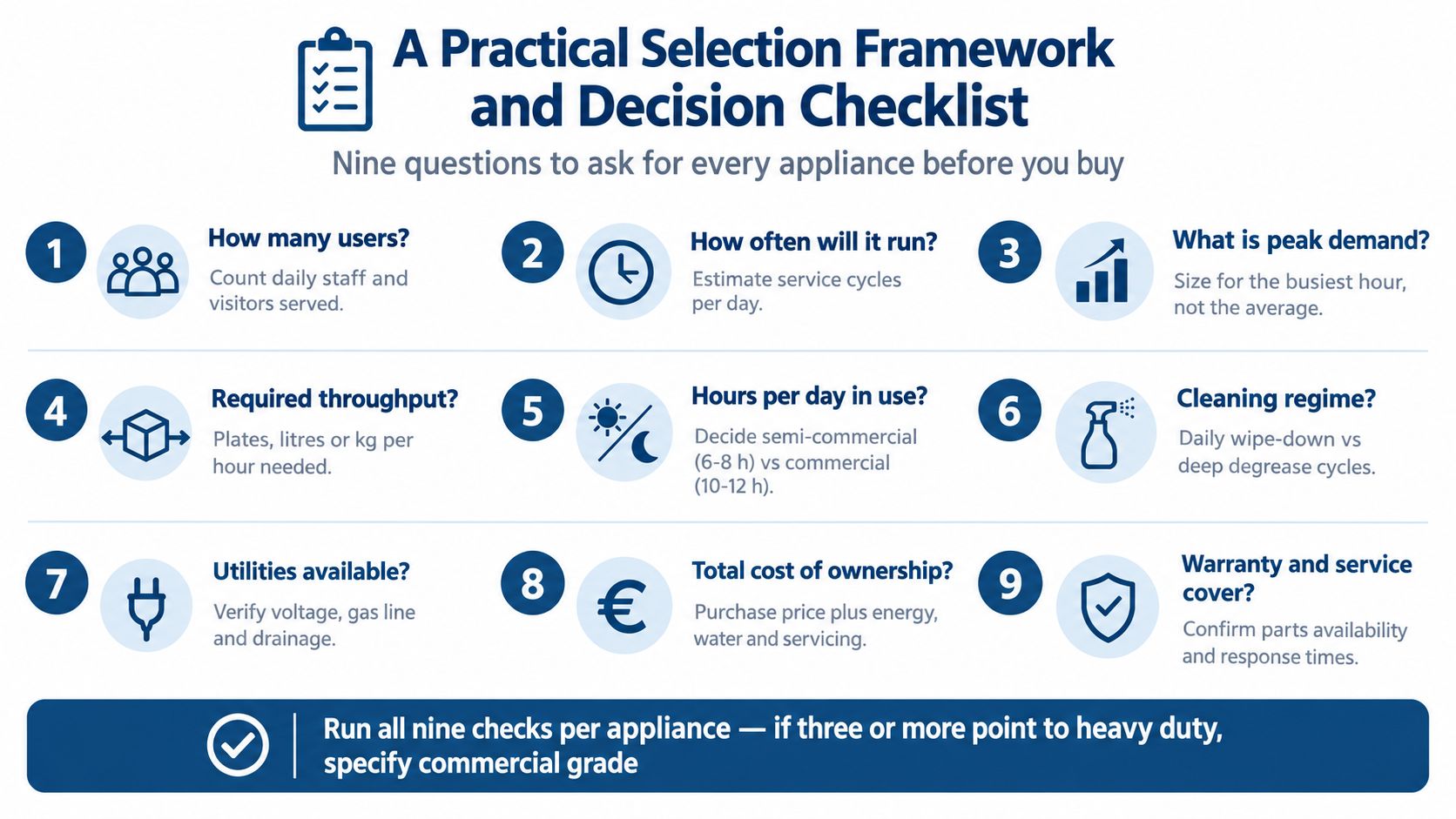
The procurement checklist should then test the site, not just the quote:
- Audit the space: Measure access routes, bench depth, ventilation clearances and installation locations.
- Verify services: Confirm electrical supply, phase, sockets, RCD protection, water pressure and drainage.
- Check support: Ask about New Zealand parts, authorised technicians, response arrangements and service documentation.
- Review used equipment carefully: Certified used equipment can be considered where its service history, condition and warranty are documented.
- Read the warranty: Don't assume a domestic or semi-commercial warranty covers shared workplace use.
- Compare whole-of-life cost: Purchase price + workload + downtime consequences + replacement or service requirements + energy and water + labour implications.
The final equation is practical, not theoretical. A fully commercial appliance that is barely used may be unnecessary capital expenditure. Replacing an under-specified appliance repeatedly can also be poor value. Buyers should compare the actual operating requirement with the consequences of choosing too little equipment, without assuming that the heaviest specification is always the answer.
Workplace Scenarios and When to Talk to a Supplier
A corporate office with steady lunch peaks may need a commercial microwave and dishwasher, while an occasional-use oven can remain semi-commercial if the warranty permits. Refrigeration should be sized around lunch-box volume, door opening and staff numbers.
A secondary school may need commercial dishwashing where staff-room demand is compressed, plus commercial or durable semi-commercial cooking equipment for curriculum use. A youth camp with repeated meal bursts should examine microwaves, dishwashers and refrigeration separately rather than relying on domestic equipment across the board.
A community organisation with intermittent weekday hire may suit selected Award Appliances, provided the specific model is intended and warranted for that application. Hospitality and SACH generally specify fully commercial equipment for demanding hospitality kitchens, while sports clubs, churches and similar lower-demand facilities may suit appropriate Award Appliances. That doesn't make every Award product suitable for every commercial workplace.
A small marae or aged-care kitchen may have limited capital but serious consequences if refrigeration, cooking or washing equipment fails. Commercial or institutional equipment often deserves priority in the appliances supporting daily meals, while lower-demand support equipment can be assessed separately.
Workplace catering can also overlap with staff amenities such as vending, especially where users need food and drink access outside a shared kitchen. A practical resource on workplace vending for business owners can help facilities teams consider that option alongside, rather than instead of, core kitchen capacity.
Supplier advice is most useful when the load profile is unusual, the site has electrical or ventilation constraints, the warranty position is unclear, or a refurbishment involves several connected appliances. A short discussion before purchase can prevent a costly mismatch between the equipment ordered and the workplace that must operate it.
Simply Hospitality can help workplace buyers compare commercial, semi-commercial and domestic options appliance by appliance, including microwaves, dishwashers, refrigeration and cooking equipment. Visit Simply Hospitality with the user numbers, peak periods and site services available, and the team can help match the specification to the actual workload.