

Convection Oven vs Conventional Oven: Which Suits You
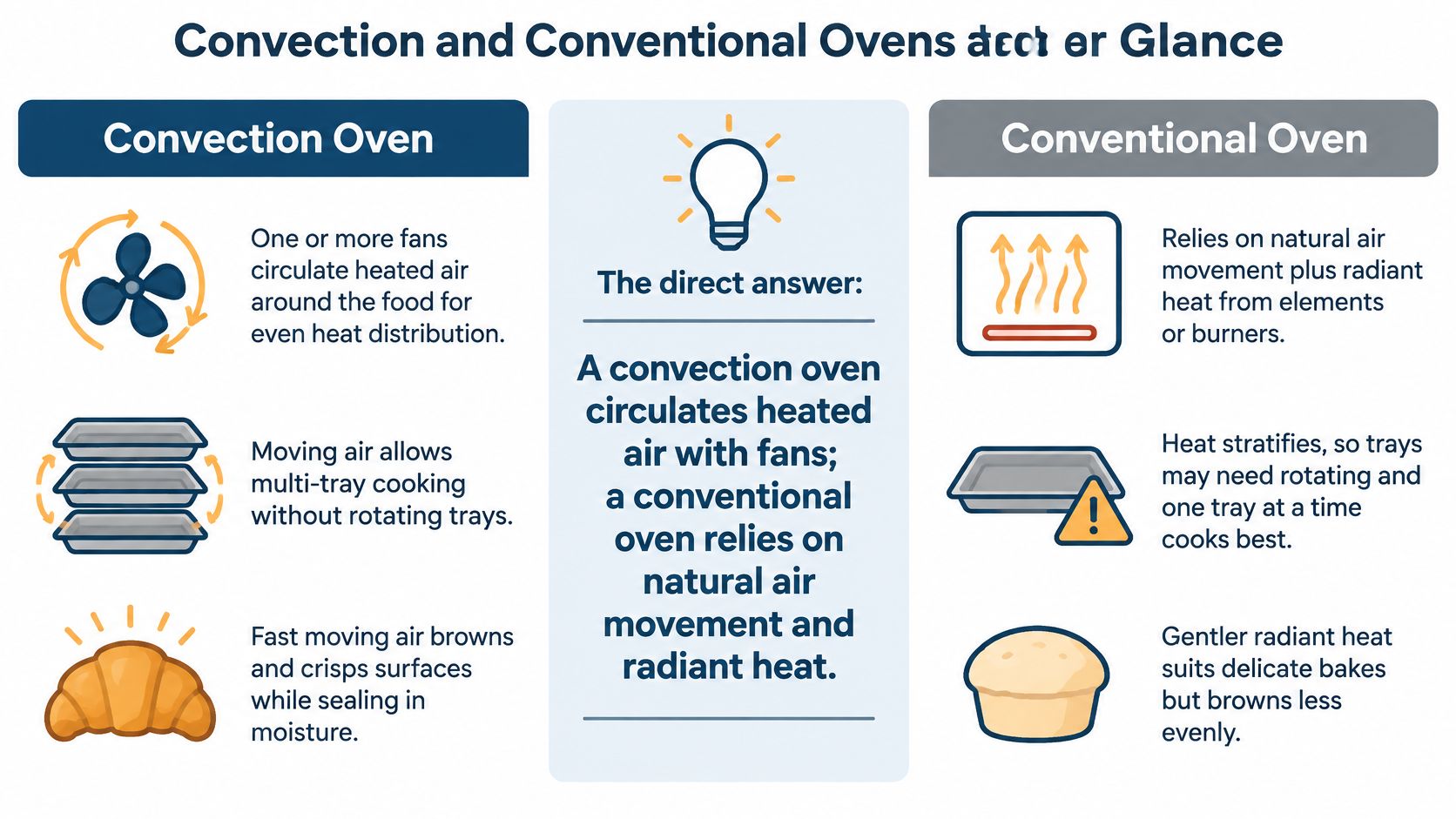
A convection oven uses one or more fans to circulate heated air around food, while a conventional oven relies mainly on natural air movement and radiant heat from elements or burners. In New Zealand, convection ovens are commonly called fan-forced ovens.
The familiar advice to always choose fan-forced cooking misses an important point: stronger airflow isn't ideal for every product. The useful convection oven vs conventional oven comparison is about the food, the usable batch capacity and the kitchen's service demands, not which oven finishes first.
Convection and Conventional Ovens at a Glance
A fan can improve heat distribution, but it can't compensate for blocked airflow, unsuitable trays or a poorly matched recipe. Some domestic and commercial ovens offer both cooking modes, allowing the cook to select the heat pattern that suits the dish.
Convection oven vs conventional oven key differences
| Feature | Convection oven | Conventional oven |
|---|---|---|
| Heat distribution | Fans circulate heated air around food, helping reduce cold spots | Natural convection and radiant heat can create differences between shelf positions |
| Cooking speed | Often shorter when the recipe and load suit forced airflow | Often slower surface heat transfer; conventional recipe timings provide a starting point |
| Temperature consistency | Can be more uniform across the chamber when loaded correctly | Temperatures can differ between shelves and near elements |
| Multi-tray cooking | Well suited to several trays when airflow spacing is respected | Workable, but trays in different positions may cook differently |
| Browning and crisping | Moving air supports surface drying, browning and crisping | Less forced surface drying, useful for some delicate bakes |
| Moisture loss | Exposed, thin or lightweight foods can dry quickly | Gentler airflow can help limit surface drying |
| Baking suitability | Useful for roasts, biscuits, pastries and many breads | Useful for delicate sponges, soufflés and set custards |
| Energy consumption | Can reduce energy demand under comparable operating conditions | Assess measured consumption against usable output |
| Equipment cost | Compare equivalent capacity, controls, construction and service support | Check whether a dual-mode model provides useful flexibility |
The energy comparison needs particular care. A lower cooking temperature doesn't automatically establish lower running costs, and a higher electrical rating doesn't establish higher consumption per finished batch.
What the comparison means on the floor
A conventional oven can be a sensible choice for a narrow menu built around gentle baking. A convection oven becomes more attractive when several shelves need to produce saleable food together.
Practical rule: Compare the quantity of acceptable finished food from a loaded oven, not the number of empty rack positions.
Neither type is universally superior. Even with fan-forced cooking, tray rotation may remain necessary after testing, and browning doesn't seal moisture inside food. Those distinctions matter when interpreting simplified equipment comparisons.
How Each Oven Heats and Why It Matters
Consider a tray of biscuits placed above another tray in the same oven. In conventional mode, each tray receives a different combination of radiant heat and naturally moving hot air, so shelf position can affect colour and spread.
Switching on a cooking fan changes how heated air reaches the trays. The Gen Less technical guidance on indirect electric resistance heating distinguishes natural convection from forced convection produced by a mechanical fan, explaining the mechanism behind commercial convection ovens.
Design matters beyond the fan
A rear fan doesn't make every oven perform alike. The heating arrangement, fan direction and chamber shape determine how air travels around the load.
- Element placement: Heat from above, below or around the fan changes the balance between surface colour and base cooking.
- Fan design and control: Air velocity affects delicate batter, loose baking paper and lightweight products.
- Construction and insulation: Door seals, cavity insulation and door fit influence heat retention.
- Temperature controls: The thermostat setting isn't a measurement of every shelf or the food's centre.
A gas burner also needs combustion air, unlike an electric element. Some gas designs use a glow bar for ignition, so the fuel label alone doesn't describe the appliance's operating behaviour.
Check the mode, not just the symbol
An oven may provide conventional bake, fan-assisted cooking and fan-forced cooking through different element combinations. A cooling fan outside the cavity doesn't prove that an appliance has a convection cooking mode.
For a useful comparison, check the manual's mode descriptions, fan-speed options and temperature range. An oven-rated temperature logger or suitable air probe can help map shelf temperatures, while a food probe checks the actual product.
Testing should use the intended trays and loading arrangement. An empty-chamber temperature check won't reveal what happens when deep pans obstruct the air path.
Which Foods Suit a Fan Mode or Conventional Heat
Food preferences are starting points for testing, not universal rules. Tray material, dough formulation, product size and the required finish can change the best choice.
Preferred oven type or mode by food and cooking application
| Food or cooking application | Preferred oven type or mode | Reason |
|---|---|---|
| Roasted meats and vegetables | Fan mode for browning; conventional for some slow, moist roasts | Airflow encourages crisp edges; gentler circulation can limit exposed-surface drying |
| Biscuits and cookies | Fan mode for batch production; either mode for a single tray | Airflow can support consistent colour, while conventional heat may suit the desired spread |
| Bread | Fan mode for some crusty products; conventional for a gentler finish | Surface drying changes crust development |
| Cakes and delicate sponges | Conventional or a validated low-fan setting | Less aggressive airflow can help prevent uneven setting and rise |
| Pastries | Fan mode, with reduced airflow for delicate products | Moving air supports crisp layers but can dry or disturb lightweight pastry |
| Pizza | Select by base heat and topping finish; test both modes | Strong top colour doesn't guarantee a cooked base |
| Casseroles | Conventional or an adjusted fan setting | Exposed toppings may dry or brown before the centre is ready |
| Multi-tray baking | Fan mode | Circulation can improve consistency between shelves when loading allows airflow |
Delicate products need more than a temperature change
A sponge that rises unevenly may need a lower fan speed rather than a substantially lower thermostat setting. Reducing temperature alone can extend the bake without correcting the directional airflow affecting the batter.
Pastry needs similar judgement. Steam generated inside laminated dough helps separate the layers, while oven airflow affects the outside finish. More fan isn't automatically more lift.
For bread, the decision also includes humidity and base heat. A dry convection chamber shouldn't be treated as a substitute for steam capability where the recipe needs controlled moisture.
Compare the finished product
A useful test keeps the recipe, portion weight, tray and starting condition consistent while changing the cooking mode. Record colour, rise, centre doneness, crust texture and the condition after cooling, not just the appearance at the oven door.
- Thin products: Check brittleness and moisture loss after cooling.
- Roasts: Assess internal doneness alongside surface colour and resting loss.
- Covered dishes: Check the centre before removing the lid to finish the topping.
The discussion of how equipment choice affects food quality more than recipes is particularly relevant when a dependable recipe produces a different result after an equipment change.
Do Convection Ovens Cook Faster in Practice
Often, but not automatically. Moving air can accelerate heat transfer at the food's surface, yet the centre of a thick roast or deep casserole still takes time to heat.
Conventional recipes may need a lower fan-mode temperature, an earlier doneness check or both. Common conversion guidelines are starting points, not validated settings for every oven and product.
Adjust the process without losing control
Tray spacing, load size, food thickness and fan speed all affect the result. A crowded chamber can reduce the advantage of forced airflow, while aggressive airflow may brown the outside before the centre reaches its target.
A practical validation routine is:
- Select the densest and coldest routine load, using the normal trays and portion sizes.
- Use the recipe's fan setting or the manufacturer's recommended conversion as the initial setting.
- Measure representative food centres, including products placed in the oven's known cold spot.
- Record cooking time, centre temperature, loading pattern and surface condition.
- Adjust one variable at a time, then repeat until the batch meets both safety and quality requirements.
For meat and meat products, Ministry for Primary Industries cooking guidance gives safe internal combinations including 75°C for 30 seconds, 70°C for 3 minutes, or 65°C for 15 minutes, with centre-temperature checks rather than colour alone.
A golden surface is a presentation result, not proof that the coldest part of the batch is safely cooked.
Reheating needs its own check
For potentially hazardous food reheated for hot holding, Food Standards Australia New Zealand guidance specifies rapid reheating to at least 60°C, ideally within two hours or less. The coldest portion still needs checking with a clean, suitable probe.
Record reheating trials separately from initial cooking trials. Chilled trays, deeper portions and different coverings can change the process enough that an existing cooking programme isn't suitable.
The principles behind energy-efficient appliances are useful here: efficiency should come from a controlled process, not from shortening a cycle before the food is ready.
Convection Ovens in Commercial Kitchens
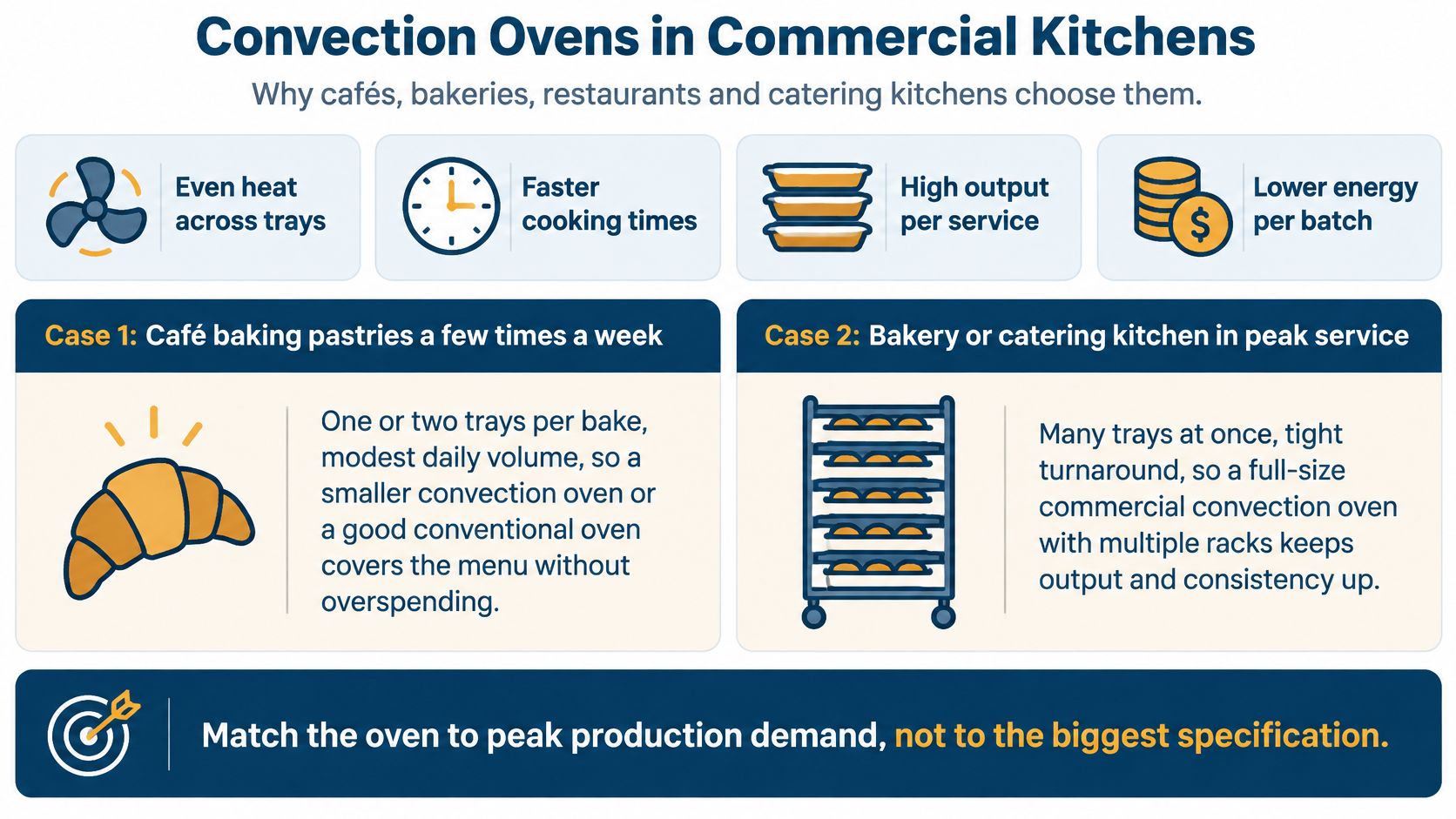
Commercial convection ovens suit cafés, bakeries, restaurants and caterers because they combine useful tray capacity with repeatable batch production. The purchasing question is whether that capability matches the actual production schedule.
A café baking pastries intermittently may get more value from a compact, flexible oven than a large chamber. A bakery loading trays throughout the day needs close attention to colour across shelves, temperature recovery and the time staff spend unloading, checking and reloading.
Switching between fan and conventional modes also changes what the kitchen has to validate. A programme proven at one fan speed can underperform in still heat, because recovery, surface drying and the behaviour of each tray position all shift with air velocity. Any mode change on a production item deserves its own check before service rather than an assumption that the existing settings carry over.
Energy figures worth using carefully
New Zealand's Ministry of Business, Innovation and Employment guidance estimates that fan ovens use approximately 20–30% less energy than conventional ovens and states that only about 10–15% of a conventional oven's consumed energy cooks the food. These are general guidance figures, not guaranteed per-batch savings for a particular commercial appliance.
The Energy Efficiency and Conservation Authority's commercial baking technology scan reports that the oven stage can account for more than 60% of total energy use in a bakery. That makes measured oven performance particularly relevant to production baking.
Ask suppliers for measured kWh per comparable cooking cycle, usable output and the test loading conditions. Rated power describes the connected load, not the energy needed to finish a batch.
Match the equipment to service
Turbofan commercial convection ovens are a relevant range to assess, particularly where baking and roasting share the same production space. The discussion of why Turbofan ovens continue to be a favourite in New Zealand bakeries provides related reading.
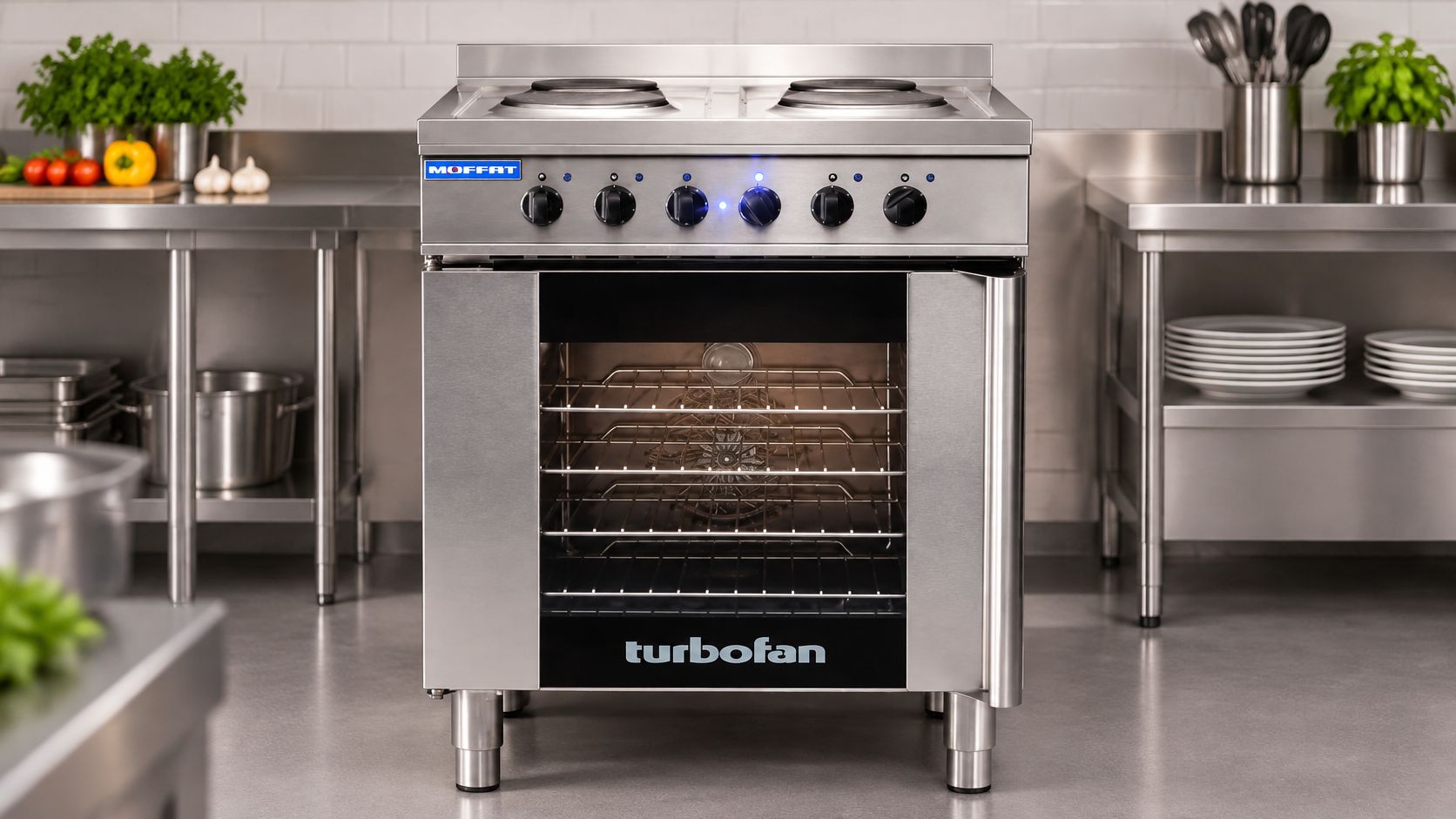
The Turbofan E931M Convection Oven and Cooktop puts a cooktop and convection oven in a single unit, which suits sites where top cooking and oven production need to share one footprint. Check the product page for current specifications, and confirm services, clearances and ventilation against the model documentation before ordering.
- Log preheating: Note when the oven starts heating and when the first batch enters.
- Track door openings: Repeated checking can disrupt an otherwise suitable programme.
- Check the handover: Include unloading, replenishment and safe holding in the production plan.
TopFoodApp's kitchen setup checklist for restaurants can support broader equipment planning alongside the detailed appliance checks.
Hospitality lists commercial equipment brands including Blue Seal, Cobra, Convotherm, Cookrite and Turbofan. Brand selection should follow the menu and operating requirements, including whether specialised products need conventional heat or adjustable airflow.
Convection Ovens Versus Combi Ovens
A standard convection oven cooks with circulated hot air. A combi oven adds steam-only and combination modes, so the operator manages heat and humidity together on the same load.
That distinction matters for menus covering roast meats, fish, bread, vegetables and reheating. Controlled moisture can hold the required texture without covers, added liquid or separate steaming equipment. It also changes validation: a steam-assisted programme can produce a moist, tender surface while the core temperature still needs confirming with a probe before the product leaves the kitchen.
Decide whether steam earns its place
A kitchen running steam and combination programmes every service has a different requirement from a café that occasionally steams vegetables. Match the oven to the products that need humidity control and how often they are made, then weigh the extra water, energy and cleaning load against that use.
Unox and Convotherm combi ovens are relevant ranges to compare, but the specific model's functions need checking. Programme names, humidity adjustment and cleaning systems vary within a brand's own lineup.
The comparison of combi ovens vs convection ovens and what's best for the menu weighs steam capability against what the menu calls for.
Allow for the supporting infrastructure
Combi ovens generally involve more installation and operating considerations than straightforward dry-heat convection ovens.
- Water and drainage: Check supply quality, any treatment requirements and the specified drain arrangement.
- Ventilation: Confirm the model's requirements for heat, moisture and door-opening emissions.
- Energy use: Compare measured energy data under comparable loads, since steam generation adds to the draw on services.
- Cleaning: Budget staff time and the correct cleaning consumables.
- Training: Operators need to understand humidity, probe programmes and safe loading, not just select a temperature.
Steam capability pays back only when the menu uses it and staff can maintain the appliance correctly.
Domestic combi-steam equipment sits in a different class from commercial production ovens. The Award Built-In Combi-Steam Oven, for example, is a 60 cm electric built-in appliance with 12 cooking functions, including steam-only, steam-assisted and steam with fan-forced cooking, plus a meat probe for core-temperature checks. The duty rating still needs confirming against the intended production volume before any appliance takes a place on a commercial line.
Confirm Capacity and Specifications Before You Buy
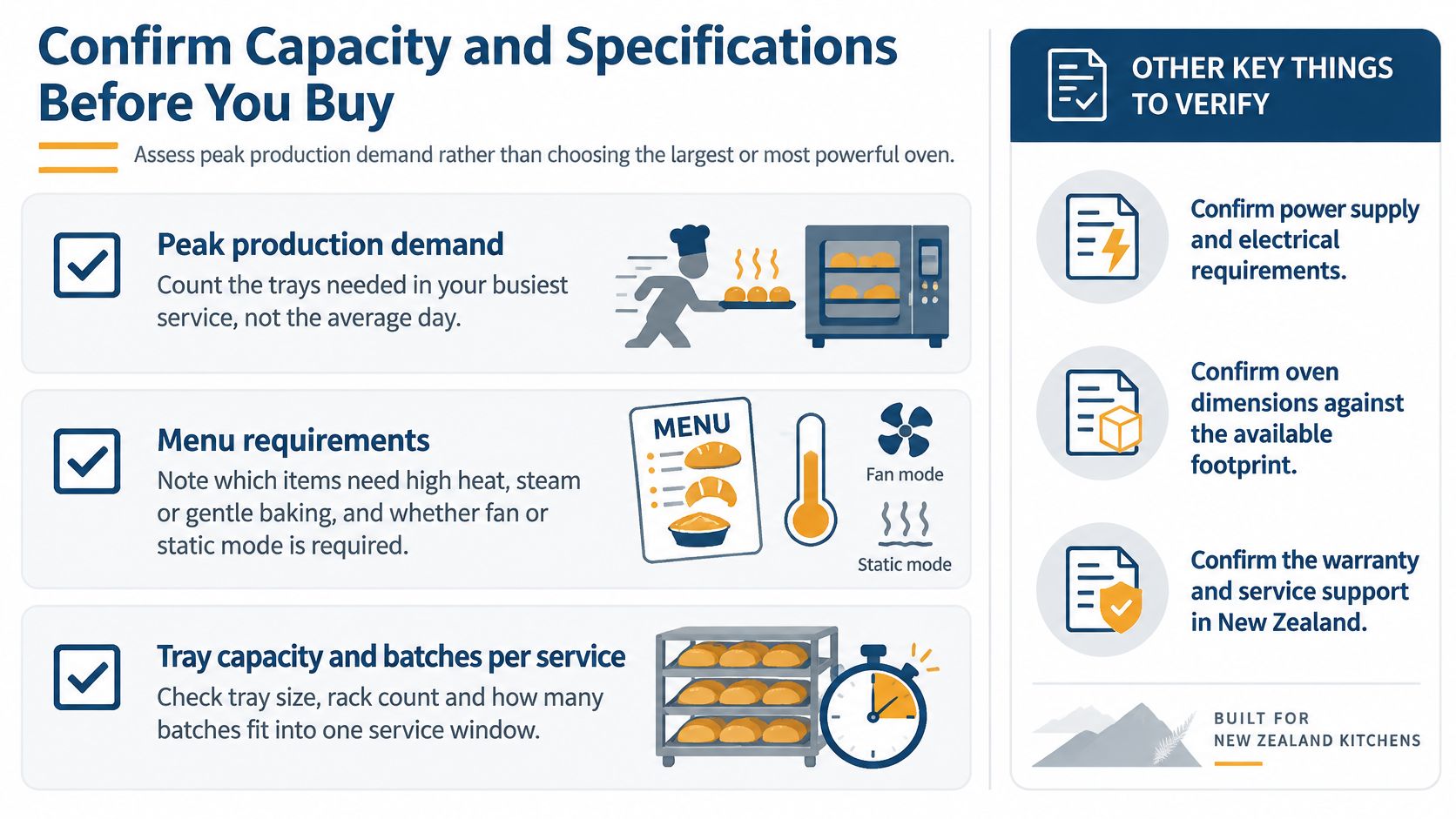
Size the oven around peak production demand, not the largest specification that fits the budget. Count trays required within the service window, then allow for cooking, unloading, recovery and the next load.
The largest chamber can be inconvenient for small batches, while an undersized oven can force staff into overlapping programmes and hurried checks. Nominal rack capacity is useful only when the intended products fit with the required clearance.
Buying considerations for a convection or combi oven
| Buying consideration | Why it matters | What to verify |
|---|---|---|
| Menu requirements | Determines the required cooking methods | Main dishes and whether they need fan, conventional, steam or combination cooking |
| Tray capacity | Establishes usable output per batch | Peak tray demand, tray dimensions and clearance above the food |
| Cooking modes | Determines which tasks the oven can cover | Exact modes in the current model manual |
| Fan controls | Helps accommodate delicate products | Available speeds and how operators select them |
| Temperature recovery | Influences successive batches | Loaded performance after normal door openings |
| Energy consumption | Affects running costs | Measured energy data under comparable conditions |
| Electrical or gas requirements | Determines site suitability | Supply type, phase, capacity and installer requirements |
| Ventilation | Affects heat, moisture and kitchen operation | Extraction requirements and installation clearances |
| Cleaning | Determines daily labour and hygiene access | Accessible surfaces, cleaning procedure and consumables |
| Warranty and service | Affects support during downtime | Commercial-use terms, service access and replacement parts |
Separate household needs from commercial requirements
Home cooks may prioritise shelf flexibility, cabinetry fit and familiar baking modes. Hospitality buyers also need to assess repeated loading, cleaning access, serviceability and whether the warranty covers the intended use.
For smaller footprints, the discussion of benchtop ovens in New Zealand provides another useful purchasing perspective. A compact appliance still needs suitable services, working clearance and safe access for hot trays.
Plan ownership beyond installation
Keep the model identification and installation documentation accessible to staff responsible for maintenance. Replacement parts can look interchangeable but differ in lugs, clearances and airflow, so the appliance model, version and product code should be verified before ordering.
Hospitality also allows finance applications on the Award Built-In Combi-Steam Oven product page. Payment arrangements should follow suitability checks, rather than determine which cooking system the kitchen selects.
Simply Hospitality Range and Related Reading
The most useful shortlist starts with an equipment category and a production task. Brand preferences then get tested against the controls, footprint and support required by the kitchen.
Match the range to the job
- Commercial convection ovens: Turbofan is worth comparing for dry-heat baking, roasting and repeated tray production. Match the oven to the tray format already used in preparation and storage, since fan modes only pay back their capacity when trays move through in volume.
- Combi ovens: Unox and Convotherm cover menus that need steam and controlled-humidity cooking. Build water treatment, drainage and cleaning into the comparison, and check how each humidity setting affects the validated core temperatures your food-safety plan depends on.
- Commercial ranges and ovens: Waldorf, Blue Seal and Cobra suit kitchens where oven work forms part of a wider cooking line. Assess hob requirements and oven production together rather than as unrelated purchases.
A second product worth comparing is the Turbofan G32D4 Digital Gas Convection Oven, which offers a bi-directional fan and electronic controls with manual or programme modes. Gas availability alone does not establish suitability; the installation and intended tray workflow still need checking.
Connect capacity with kitchen layout
Related reading in this series includes What Is Commercial Cooking?, which separates household cooking features from the demands of professional production, and Is Bigger Catering Equipment Always Better?, which examines sizing decisions. Designing a Kitchen Around Service Requirements covers equipment placement and staff movement.
The oven should sit within a workable route from preparation to loading, unloading and service. A suitable appliance can still create delays if hot trays have nowhere safe to land or staff must cross the washing area to reach the pass.
The final choice therefore reflects the food, production volume and available infrastructure together. Conventional heat remains useful for particular products, convection supports batch production where fan modes shorten cycle times and trim energy per tray, and combi cooking adds humidity control where the menu needs it. Confirm each mode against your validated cooking temperatures before committing.
Hospitality supplies commercial ovens and cooking equipment for New Zealand hospitality businesses, with options for convection cooking, combi cooking and integrated cooking lines. Visit Simply Hospitality to discuss the menu, peak tray demand and available power, gas and ventilation before choosing an oven.