

Cotton Tea Towel Buying Guide for Hospitality Kitchens
A busy service doesn't usually fall apart because of one big equipment failure. More often, it's the small items that create pressure. A cotton tea towel is a good example. When the clean pile runs low, staff start stretching use, picking up whatever cloth is closest, or using one towel for jobs it was never meant to do.
That's why the useful question isn't which towel has the lowest unit price. It's whether the business has enough of the right towels, in the right rotation, for cafés, restaurants, bakeries, caterers, bars, hotels, and commercial kitchens to keep moving without creating hygiene problems or extra replacement cost later.
Why Cotton Tea Towels Still Matter in a Busy Commercial Kitchen
Mid-service is where tea towel decisions show up fast. The clean stack drops, someone grabs the nearest cloth for glassware, then the same towel ends up on a damp bench or in a staff member's hand at the pass. In a commercial kitchen, that is not a minor linen issue. It affects pace, hygiene, rewash volume, and whether staff can keep tasks separated when pressure builds.
Cotton still earns its place because it suits the day-to-day demands of hospitality use. NZ product listings commonly specify cotton tea towels with machine-washable construction and practical sizing for kitchen handling, often around the standard tea towel formats operators already stock. Those details matter, but they do not tell the full story. A towel that looks right on paper still causes problems if the venue does not carry enough stock to keep clean and used towels moving through a proper rotation.
The issue is usually the system around the towel
In our experience, operators get better results when they treat cotton tea towels as part of a rotation and hygiene system, not as a one-off buying decision. One stack for service is not enough. Staff need clean replacements easy to reach, a clear point for used towels, and enough volume in reserve that nobody feels pushed to reuse a damp or questionable cloth.
That is why stock depth often matters more than chasing a small unit-price saving. If the clean pile runs short, teams start blending jobs. Drying crockery, polishing glassware, wiping light moisture, and grabbing spills all get blurred together, which creates hygiene risk and usually sends more towels into the wash.
Practical rule: If staff are reusing a towel because replacements are not immediately available, the business has a rotation problem before it has a fabric problem.
Many operators also review towels alongside aprons and other washable textiles because laundering behaviour needs to make sense across the whole site. If you are lining those decisions up together, it can help to compare apron fabric types while weighing absorbency, drying behaviour, and wash durability.
Commercial use puts more pressure on the basics
A home kitchen can get by with a couple of towels and a casual wash routine. Commercial kitchens cannot. Tea towels sit inside a bigger working setup that includes task allocation, clean and dirty storage, laundry turnaround, and food-safety controls.
That is why task separation needs to be built into the way towels are stocked and used, not left to staff memory during a rush. If you are reviewing towel use as part of a wider hygiene reset, it is worth revisiting cross-contamination controls in food service. Cotton remains a solid choice, but its value comes through when the kitchen supports it with enough stock, clear job separation, and laundering that can stand up to repeated commercial use.
How Cotton Works as a Hospitality Textile
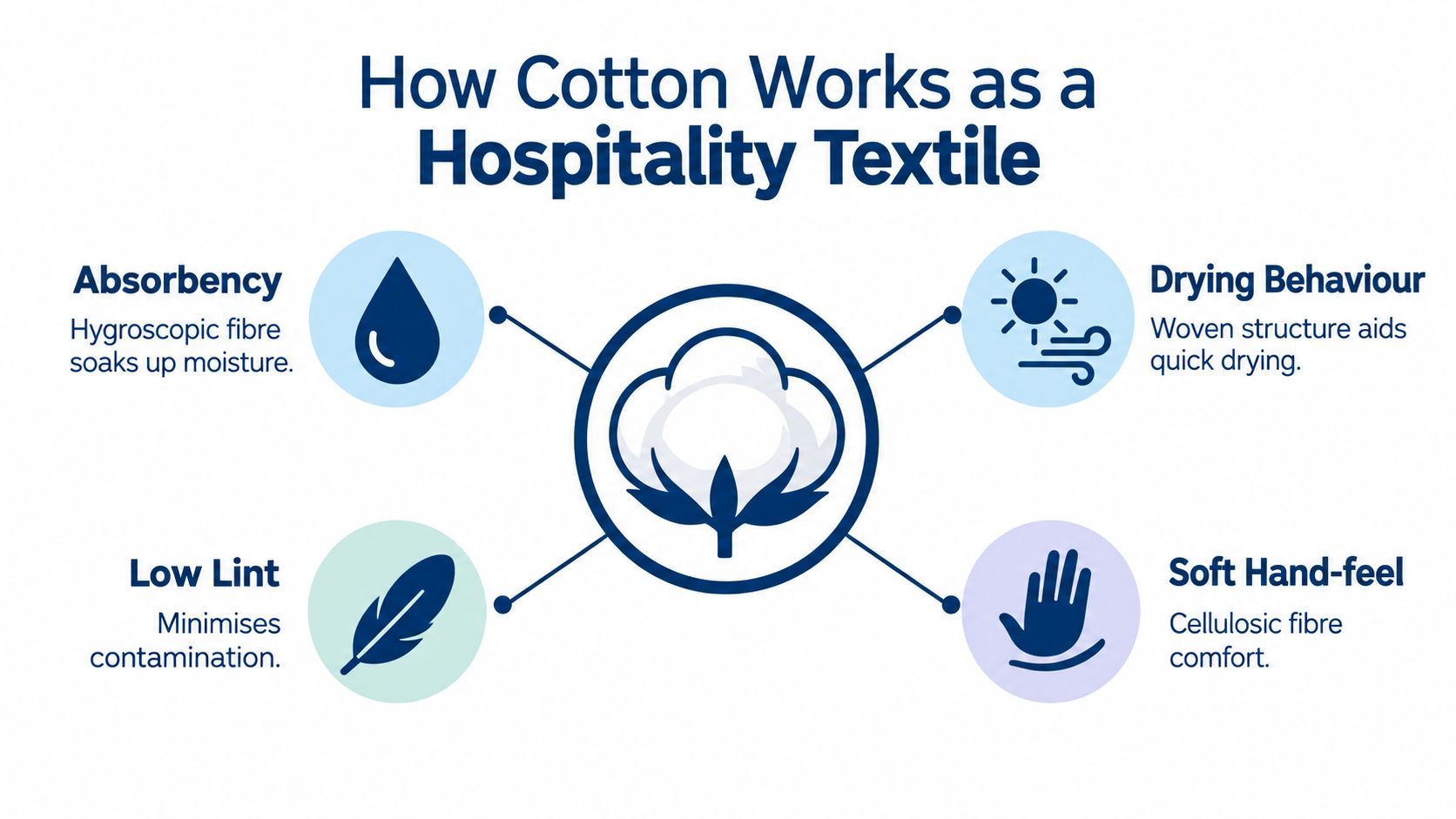
Mid-service, a tea towel has to do more than soak up water. It needs to dry a stack of cups, cope with another quick task, then come out of service before it turns damp and questionable. That is why cotton works in hospitality. The fibre absorbs well, washes well, and usually stays serviceable through repeated commercial use when the site has enough stock in rotation.
Cotton remains common for tea towels because of how the fibre behaves. RNZ notes that tea towels are commonly made from cotton or linen because these natural cellulose fibres are hygroscopic, meaning they attract and hold water, and it also notes that washing can improve absorbency by creating more surface texture (RNZ on why tea towels dry the way they do).
What that means in practice
Cotton pulls moisture into the fibre instead of just pushing it around the surface. In a commercial kitchen, that makes it useful for drying crockery, handling light bench moisture, and other low-grease tasks where quick uptake matters.
The trade-off is straightforward. A towel that absorbs well can also hold onto that moisture for longer, especially if it is heavier or being reused too many times in one service.
That is why cotton should be judged as part of a working system, not as a single product on a shelf. Real value comes from how many clean towels are available, how clearly jobs are separated, and how well the cloth stands up to repeated washing and reissue.
A towel can be perfectly decent on paper and still fail in service if staff keep reaching for a damp one because the clean stack has run short.
Construction changes how cotton behaves
Cotton tea towels vary a lot once you get past the fibre label. Weave, finish, and weight affect how quickly the cloth picks up water, how bulky it feels in the hand, and how it behaves after dozens of wash cycles.
Some operators prefer a flatter cloth for glassware or crockery because it feels easier to control and may leave less lint. Others choose a more textured construction for general drying because it grabs moisture faster. Neither is automatically better. The right choice depends on the job mix, the wash routine, and how quickly towels need to move back into service.
A practical example helps. A venue serving tea in a stoneware item like the Brew Maya Blue Stackable Teapot 500ml usually needs a towel that can handle repeated drying of heavier pieces without becoming waterlogged too early in the shift.
What buyers often get wrong
Problems usually start with one of these assumptions:
- Heavier cotton must be better
- Soft hand feel on day one matters more than wash performance
- Any cotton towel will suit any task
- A good towel can make up for thin stock levels or poor rotation
In our experience, the last point causes the most frustration. Cotton performs well in hospitality because it supports a repeatable system. If the towel is absorbent, durable enough for commercial laundering, and easy to cycle out before reuse becomes risky, it is doing its job.
Choosing Weight Weave Size and Construction for the Job
Mid-service is when poor tea towel specs show up. The stack looked fine at delivery, but two hours into a breakfast run the towels are heavy, slow to dry, and staff start using whatever is nearest for the wrong task. That is usually a specification problem, but it is also a system problem.
Weight still matters, but it is only one part of the buying decision. Size, weave, edge finish, and how the towel behaves after repeated commercial washing all affect whether it works in a real kitchen. Common commercial sizes in New Zealand include 76 x 49 cm, 50 x 75 cm, and 46 x 78 cm. Those measurements sound close on paper, yet they handle quite differently once folded, clipped to an apron, or rotated through a wet service. A local hospitality supplier also lists a 100% cotton tea towel at 46 x 78 cm and 100 g, with the practical note that more absorbent constructions can also hold more water between uses.
Match the spec to the task
Buy for the repeated job, not for the sample in your hand.
A flatter weave usually suits drying and polishing better because it stays easier to control and can feel cleaner for crockery and glassware work. A terry or more textured towel can pull in moisture faster, which helps on heavier drying jobs or quick spill pickup, but it also tends to feel wetter sooner in service. Heavier cloth can improve absorption. It can also slow the cycle back to a usable state if staff are working from a small live stack.
| Task Type | Preferred Construction Clues | Operational Trade-off to Consider |
|---|---|---|
| Drying clean crockery | Smooth cotton construction, manageable size, easy handling | If too heavy, it can feel slow and damp during service |
| Glassware finishing | Lower-lint feel, consistent weave, dedicated use only | A towel used for anything else will quickly lose suitability |
| Light bench moisture | Good absorbency, fast rotation, practical hand size | Larger towels can become awkward if constantly folded and refolded |
| Spill response | Higher absorbency, potentially heavier cloth or terry-style construction | More absorbency often means slower drying between uses |
| General kitchen support | Dependable cotton build, easy laundering, straightforward replacement supply | Cheap stock can create inconsistency if supply changes later |
Many operators choose one towel for drying and another for messier support work. That split often delivers better hygiene control and better towel life than trying to make one spec cover every job.
Size and construction affect workflow more than buyers expect
A towel that is slightly larger can stay useful longer before it feels saturated, but oversized stock becomes awkward fast. Staff bunch it, drag corners across benches, or keep refolding the same damp section into the hand. Smaller towels are easier to control, though they can drop out of service earlier if the job is high-volume drying.
Construction details matter as well. Twill, terry, and flatter plain weaves do not just feel different on day one. They wear differently, release moisture differently, and respond differently to repeated laundering. Hemming quality matters too. If the edges start fraying early, the towel exits the rotation before the cotton body is finished, which pushes up replacement frequency.
Tea towels are not dish cloths
Operators often blur the line under pressure, especially in smaller kitchens. That is where hygiene drift starts. Tea towels used for drying should stay in that lane, and wiping cloths should be specified separately. If you are comparing the two on task fit, this guide to dish cloth selection for New Zealand hospitality use is useful alongside tea towel planning.
The practical test is simple. Choose a spec that works for the task, then check whether it still works once you factor in stock depth, laundering time, and clean-versus-dirty separation. A slightly cheaper towel that needs replacing early, stays wet too long, or encourages cross-use is rarely the lower-cost option in a commercial kitchen.
Building a Rotation System That Prevents Reuse Under Pressure
Most cotton tea towel problems aren't caused by cotton. They're caused by insufficient rotation.
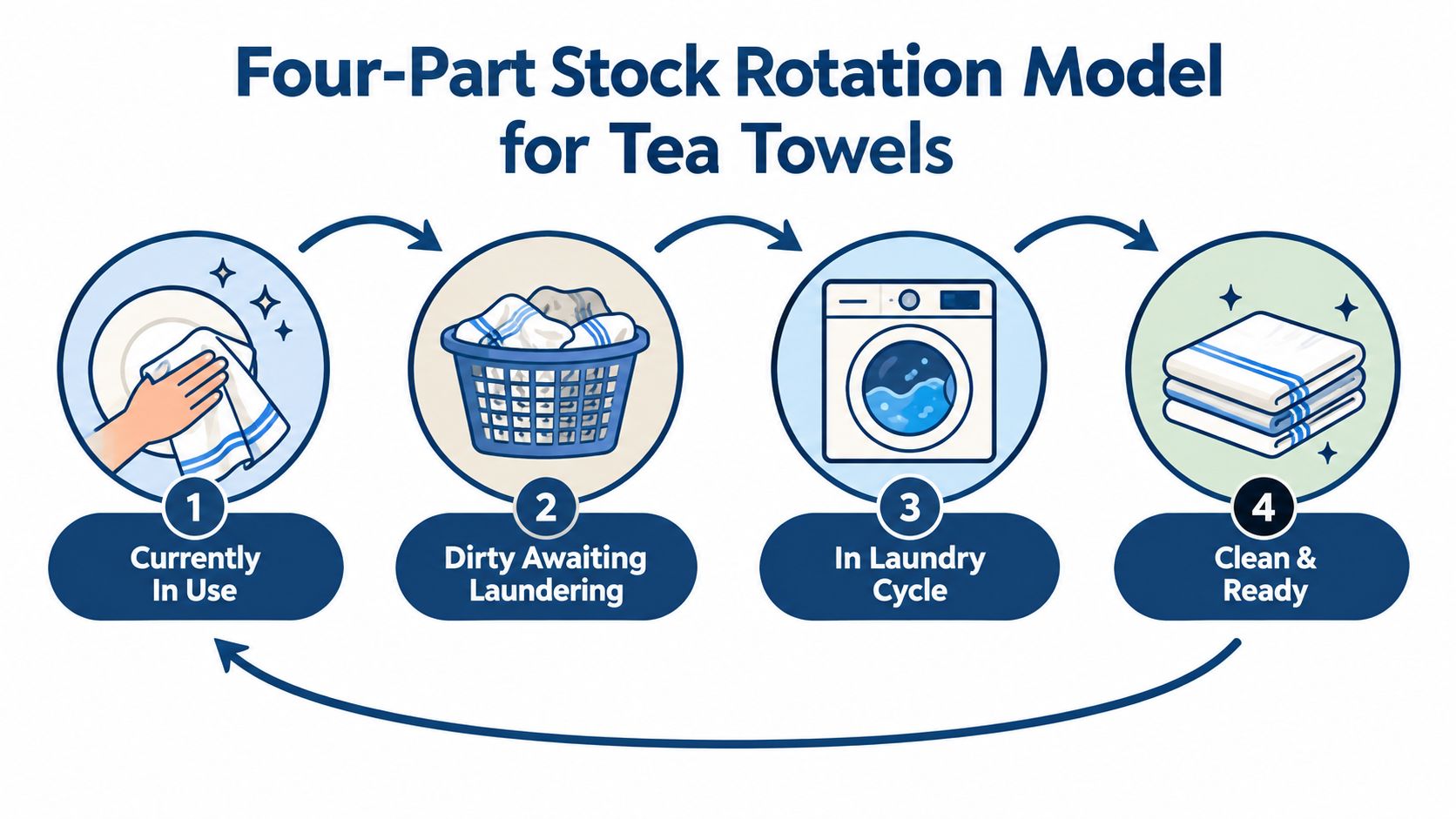
A commercial operation needs enough towels to cover four states at all times: currently in use + dirty awaiting laundering + in the laundry cycle + clean reserve. If one of those states is understocked, staff start stretching towel use past the point where the towel should have been removed.
The stock level depends on usage and laundry frequency
Many venues miscalculate. They buy by staff count or by habit, rather than by actual turnover through a day and through the wash process.
A small café with frequent laundering may need fewer towels on hand than a larger site sending textiles off-site or running limited laundry cycles. The useful measure is how quickly clean stock turns into dirty stock, and how long it takes for that stock to come back ready for safe reuse.
A practical rotation checklist
- In-use stock: Towels actively working across service points
- Dirty holding stock: Used towels removed promptly and kept separate from clean stock
- Laundry stock: Towels currently being washed, disinfected, dried, or awaiting completion of that cycle
- Reserve stock: Clean towels stored and immediately available during peak periods
Clean storage matters as much as buying volume
A venue can own plenty of towels and still have rotation problems if clean stock is hard to access. If the clean reserve is buried in a back room, mixed with unrelated linen, or not folded in a way staff can grab quickly, people improvise.
Many operators choose simple systems such as:
- Separate shelves or bins by task
- Clearly marked clean-reserve locations
- Immediate removal points for used towels
- Dry storage only for fully laundered stock
Damp towels sitting in a half-clean, half-dirty grey area create confusion and poor reuse habits.
The right par level isn't based on how many staff are rostered. It's based on how many towels move through use, holding, washing, drying, and reserve before the next clean batch is ready.
Laundry equipment affects the rotation pace
If drying capacity is limited, the rotation slows down. If laundering is off-site, reserve stock usually needs to be deeper because the turnaround is less flexible. Operators planning around towel flow often need to look at their wider laundry setup, not just the towel specification itself. That's where a broader review of commercial dryer choices for hospitality operations can help identify where the bottleneck sits.
Buying too few towels is one of the easiest ways to create non-compliant behaviour without meaning to. Staff rarely set out to misuse towels. They usually do it because the clean replacement isn't there when needed.
Hygiene Task Separation and Laundering That Stays Compliant
A tea towel shouldn't become the all-purpose cloth of the kitchen. That shortcut creates both hygiene risk and operational confusion.
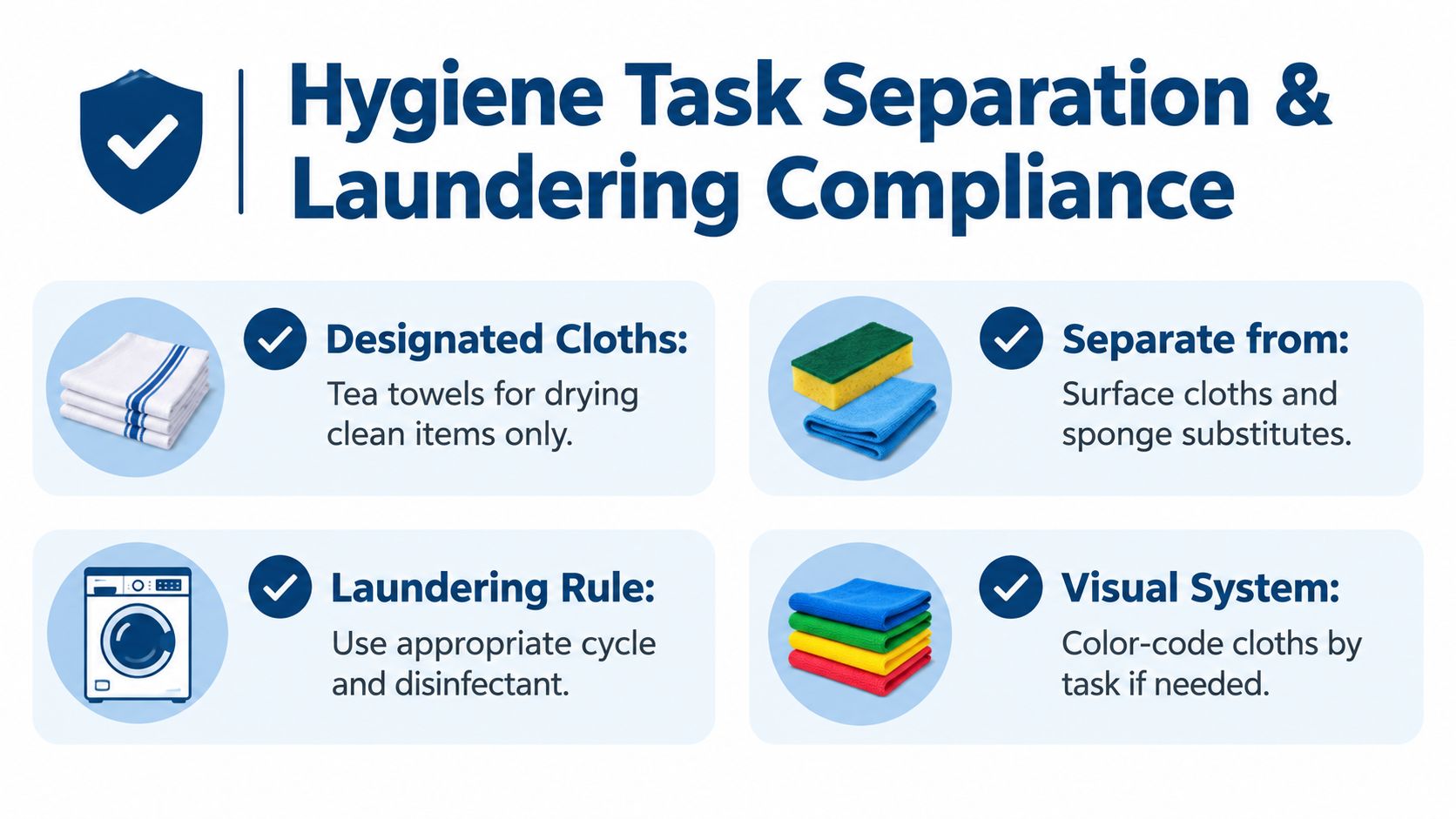
In hospitality, different cloths may be needed for drying appropriate clean items, general cleaning, food-preparation surfaces, spill management, and other designated tasks. Cotton can be suitable in parts of that system, but the key point is task separation. A towel used for drying clean dishes or glassware shouldn't also become the cloth for benches, hands, or spill pickup.
Set roles for each cloth type
Colour coding or another visual system helps, especially in larger kitchens, hotels, aged-care sites, caterers, and institutional settings.
A clear system might separate:
- Tea towels for drying clean items
- Cloths for general cleaning
- Cloths designated for food-preparation surfaces
- Separate materials for spill management
- Any other venue-specific cloth categories
The goal isn't complexity. It's removing guesswork during busy periods.
Kitchen discipline: When a cloth's role is obvious at a glance, staff are less likely to reuse it for the wrong job.
New Zealand laundering expectations matter
For eatinghouses in New Zealand, current hygiene rules require tea towels used in the premises to be washed in warm water with detergent and then immersed in boiling water for at least 5 minutes daily, and they also prohibit use of a tea towel that is not clean or is otherwise unsuitable for wiping utensils (New Zealand eatinghouse hygiene regulations).
That requirement changes the conversation. The question isn't only whether a cotton tea towel dries well. It's whether the venue's laundering process keeps that towel clean, suitable, and in circulation without staff being pushed into reuse.
Separate laundering streams reduce cross-contamination
New Zealand education guidance on hygienic laundering says linen should be cleaned using a washing machine that can meet thermal disinfection requirements, specifically water above 60°C with adequate hold time, and that kitchen items should be laundered separately from bathroom and bedding items to reduce cross-contamination risk (NZ laundering guidance for thermal disinfection and separation).
For hospitality teams, that points to a few practical habits:
- Remove used towels promptly instead of leaving them draped around prep areas
- Store soiled towels separately from clean stock
- Keep kitchen towel laundering separate from unrelated linen streams
- Replace towels when they are no longer fit for purpose, not on an arbitrary calendar alone
Durability and compliance are linked
A cotton towel that weakens, distorts, or becomes unsuitable after repeated hot sanitation stops being good value, even if it was cheap to buy. One NZ textile supplier notes AWTA testing showing a classic cotton towel's strength dropping from 460 N to 220 N and from 220 N to 140 N after 60 washes. That makes durability under repeated sanitation a genuine purchasing issue, not a nice-to-have consideration.
For venues reviewing machine capacity and laundering setup alongside towel compliance, commercial washing machine selection for New Zealand hospitality is part of the same conversation. The towel and the laundry process have to work together.
Understanding Whole of Life Cost Beyond the Unit Price
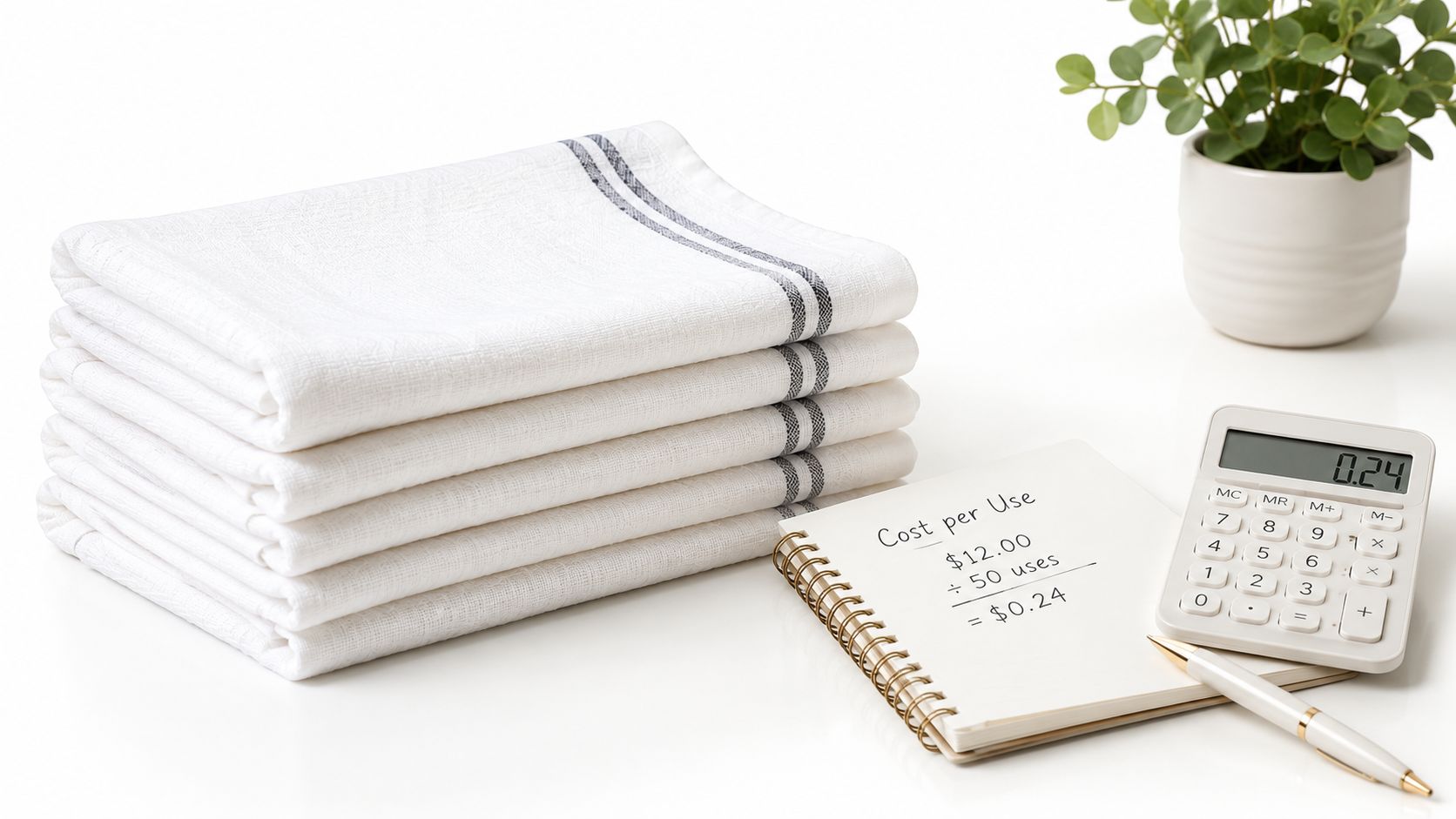
The cheapest cotton tea towel in the box isn't always the lowest-cost option in operation. Whole-of-life value is usually a better lens: purchase price + useful laundering life + absorbency and handling performance + replacement frequency.
That approach matters because cotton towels are washed, dried, reused, and replaced constantly. If a towel performs poorly after repeated laundering, the low starting price stops mattering quite quickly.
Durability changes the real value
One of the more overlooked issues with cotton tea towels is strength loss through repeated wash cycles under commercial conditions. As noted earlier in the hygiene discussion, hot laundering and sanitation are part of compliance. They also put stress on the fabric.
Care benchmarks are useful here. IKEA New Zealand's tea towel care guidance specifies maximum shrinkage of 4%, machine washing at up to 60°C, tumble drying at normal temperature up to 80°C, and ironing up to 200°C (tea towel care benchmark sold in NZ). Those figures don't define commercial suitability on their own, but they are a practical reminder that shrinkage, heat tolerance, and post-wash shape all affect service life.
A low unit price can hide operating cost
A towel that twists, shrinks badly, loses absorbency, or becomes rough and unsuitable can create hidden cost in several ways:
- More frequent replacement
- More stock pressure during laundering gaps
- More staff frustration during service
- Greater risk of towels being kept in use when they should be removed
That's why many operators weigh pack quantity and replacement availability alongside product spec. For something continually used and laundered, supply continuity matters.
Think beyond the towel shelf
Tea towels sit inside a wider cleaning and hygiene system. If the venue is reviewing towel performance, it often makes sense to check the surrounding consumables and procedures too, including commercial cleaning products used in hospitality settings.
One factual example of where another product may suit a different task is Matthews Roll Feed Paper Towels. They're designed for exterior roll feed dispensing to maximise hygiene and minimise waste, and are described as suitable for cleaning up oil, grease and water spills in commercial kitchens or industrial areas. That kind of separation can help keep cotton tea towels in their intended role rather than turning them into universal spill cloths.
Specifying and Ordering Cotton Tea Towels With Confidence
Friday lunch service is half an hour away, the clean towel bin is running low, and staff start grabbing whatever is left for any job. That is usually not a product problem alone. It is a specification and stock-planning problem.
The best cotton tea towel orders are written around how the site runs. Include fibre content, intended task, preferred construction, approximate size, wash conditions, pack quantity, and how many separate towel streams the kitchen uses. If the site wants one towel for glassware, another for bench drying, and none crossing into spill cleanup, that needs to be stated at ordering stage.
A short buying checklist helps keep that brief tight:
- Fibre content: Confirm cotton if cotton is the requirement.
- Allocated task: State the job clearly, such as drying cleaned crockery, handling light service tasks, or back-of-house bench work.
- Construction: Ask about weave or cloth style where absorbency, grip, or linting matter.
- Size: Nominate the format that suits the team, whether that is a compact towel or a larger size commonly sold around 50 x 75 cm or 76 x 49 cm.
- Laundry conditions: Confirm the towel suits the site's wash temperatures, detergents, dryers, and turnaround times.
- Rotation quantity: Order enough for the full cycle. In use, in the wash, cooling or drying after laundry, and held as clean reserve.
- Task separation: Set quantities by role so one stream does not get pulled into another under pressure.
- Replacement continuity: Check that the same or equivalent stock will still be available for repeat orders.
Many operators save money without chasing the cheapest unit price. A towel that fits the laundry cycle and rotation system is easier to keep in its assigned role, easier to replace consistently, and less likely to be reused past the point it should be binned.
For purchasing teams, the useful question is usually simple: how many towels does this kitchen need to keep clean stock available through a full trading week without staff borrowing from the wrong pile? Once that is clear, the product choice gets easier.
Hospitality supplies hospitality businesses across New Zealand with commercial smallwares, cleaning and hygiene products, laundry-related equipment, and front and back of house essentials that connect directly to day-to-day towel use and textile rotation. For help choosing a practical cotton tea towel setup for the venue, including stock planning around laundering and task separation, visit Simply Hospitality.