


Choosing a Display Fridge NZ: A Buyer's Guide
A display fridge in a café or bar isn't just a cold box beside the counter. It's one of the first things customers notice, and it shapes what they buy in the few seconds before they order. That's why the right display fridge NZ operators choose should be judged first as a merchandising tool, then as a refrigeration appliance.
Customers buy with their eyes first. Good display refrigeration sells as well as stores, because presentation influences purchasing decisions and the cabinet should encourage customers to stop. In practical terms, that means the right unit affects product visibility, grab-and-go sales, workflow, energy use, and the cabinet's long-term operating cost, not just temperature control. For a useful starting point on the sales side, see how a better display cabinet can influence food sales.
Why a Display Fridge Sells Before It Cools
A customer walks in, scans the front counter, and decides what looks fresh, worth the money, and easy to grab. If the cabinet is well lit, clean, and organised, the products look more valuable. If it's dim, crowded, or fogged up, the same products suddenly look like leftovers.
That's the job of a display fridge. It protects food, but it also shapes buying behaviour by putting the right items in the right line of sight. In a café, bakery, or takeaway site, the cabinet is often the first selling surface the customer sees, which makes presentation almost as important as refrigeration performance.
Practical rule: choose the cabinet around the products, not the other way around.
That's the framework worth using. Before comparing litres, door counts, or cabinet finishes, ask five questions. What are the products, where will the cabinet sit, how much stock needs to be shown, how often will it be replenished, and what impression should it create? Those questions keep the purchase tied to actual trading conditions, not brochure language.
A lot of operators get this backwards. They start with cabinet size, then try to force cakes, drinks, or sandwiches into a unit that wasn't really chosen for those products. The better approach is simple, and it keeps the cabinet doing two jobs at once, holding food safely and helping sell it.
The Five Questions to Answer Before You Look at Specs
What products are being displayed
Cakes, sandwiches, drinks, desserts, and grab-and-go meals all behave differently in a cabinet. Cakes need visibility and spacing. Sandwiches and meals need easy front-facing access. Drinks usually suit a different shelf rhythm again, because the goal is fast grab-and-go rather than delicate presentation.
Where will the cabinet sit
Cabinet position changes everything. A front counter unit facing the queue has a different job from a bar-back display or a bakery cabinet near the entrance. The same product can perform very differently depending on whether customers pass it slowly, queue beside it, or only catch it in peripheral vision.
How much stock needs to be shown
Display capacity is not the same as storage capacity. A cabinet should look full enough to feel generous, but not so packed that products blend together. Overcrowding makes presentation sloppy and can make replenishment harder for staff.
How often will products be replenished
A high-turnover café can live with a cabinet that is refreshed often. A venue that batches food once a day needs a format that stays attractive for longer stretches. That difference matters more than many buyers expect.
What impression should the cabinet create
A cabinet sends a message before the customer speaks to staff. It can look premium, casual, busy, organised, or tired. Great merchandising begins with great presentation, and a display fridge should support the image the venue wants to project.
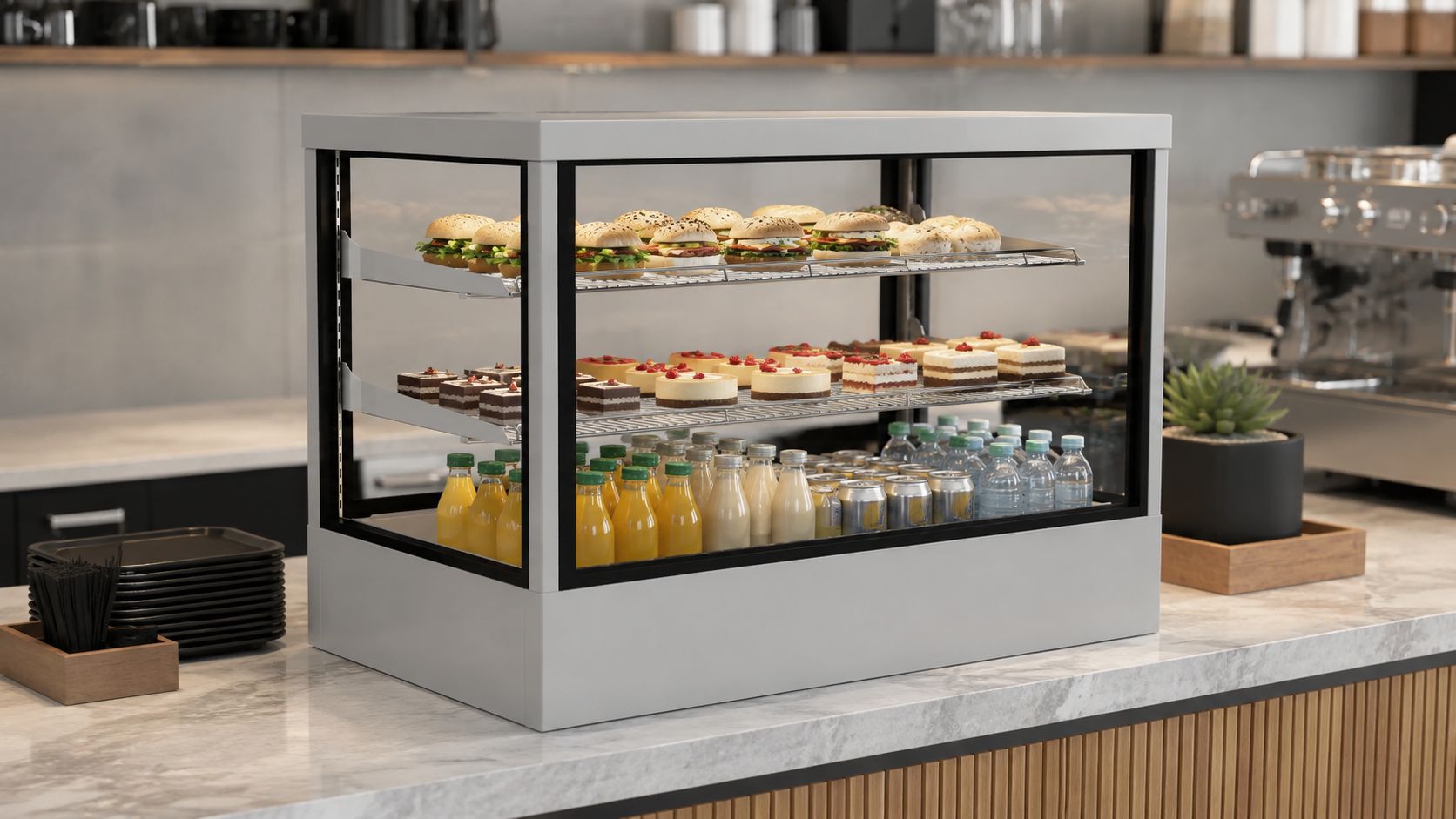
A compact counter-top cabinet can be a smart fit when the product range is narrow and the serving area is tight. The Festive Devon Chilled Compact Counter Top uses Festivé's MiniTek technology, runs at 4°C operating temperature, and comes in lengths of 900, 1200, 1530, 1770, and 2370 mm. That sort of range matters because some venues need a short counter unit, while others need a longer run for a broader product mix.
For a broader buying lens, a useful follow-up is choosing refrigeration based on your business stage. Different trading stages usually call for different cabinet priorities, and the wrong stage-match is where many early purchases go off track.
Matching Cabinet Format to Product and Venue
Format matters before features do
Not every display fridge suits every site. An upright glass-door merchandiser works well when speed and visibility matter. A curved glass cake cabinet suits front-of-house presentation where the product is meant to be admired, not just grabbed. Open front impulse units suit fast-moving sites, but they need the right traffic pattern and constant replenishment.
Undercounter display units fit tight bars, service passes, and compact cafés where floor space is limited. Specialised deli or bakery cabinets suit operators whose products need a more curated look. The point is simple, format first, features second.
| Format | Typical products | Best suited to |
|---|---|---|
| Upright glass-door merchandiser | Drinks, grab-and-go items, packaged foods | Cafés, convenience-led sites, bars |
| Curved glass cake or deli cabinet | Cakes, slices, deli items, desserts | Bakeries, cafés, front counters |
| Open front impulse merchandiser | High-turnover drinks and quick snacks | Busy service points with steady foot traffic |
| Undercounter display unit | Bottles, desserts, small grab-and-go items | Bars, passes, tight service areas |
| Specialised bakery or deli cabinet | Premium pastries, deli presentation, artisan food | Sites where presentation carries the sale |
Match the format to the buying moment
A bar that sells drinks to people already standing at the counter needs a different cabinet from a bakery trying to tempt walk-ins from the street. In the first case, the cabinet supports speed. In the second, it has to draw attention.
That's where NZ operators should be blunt with themselves. If the site is low traffic, an open-front cabinet may stay half-empty and look tired. If the site is busy and the team can replenish often, the same style may work very well. The cabinet should fit the rhythm of the venue, not fight it.
One practical option in the category is the Cossiga BTGRF15 Freestanding Refrigerated Display Cabinet, which is set up for product visibility, LED lighting, adjustable shelving, and self-contained installation. That sort of feature mix suits venues that want presentation and flexibility in one footprint.
Placement, Ventilation, and Installation on the Floor
The cabinet has to breathe
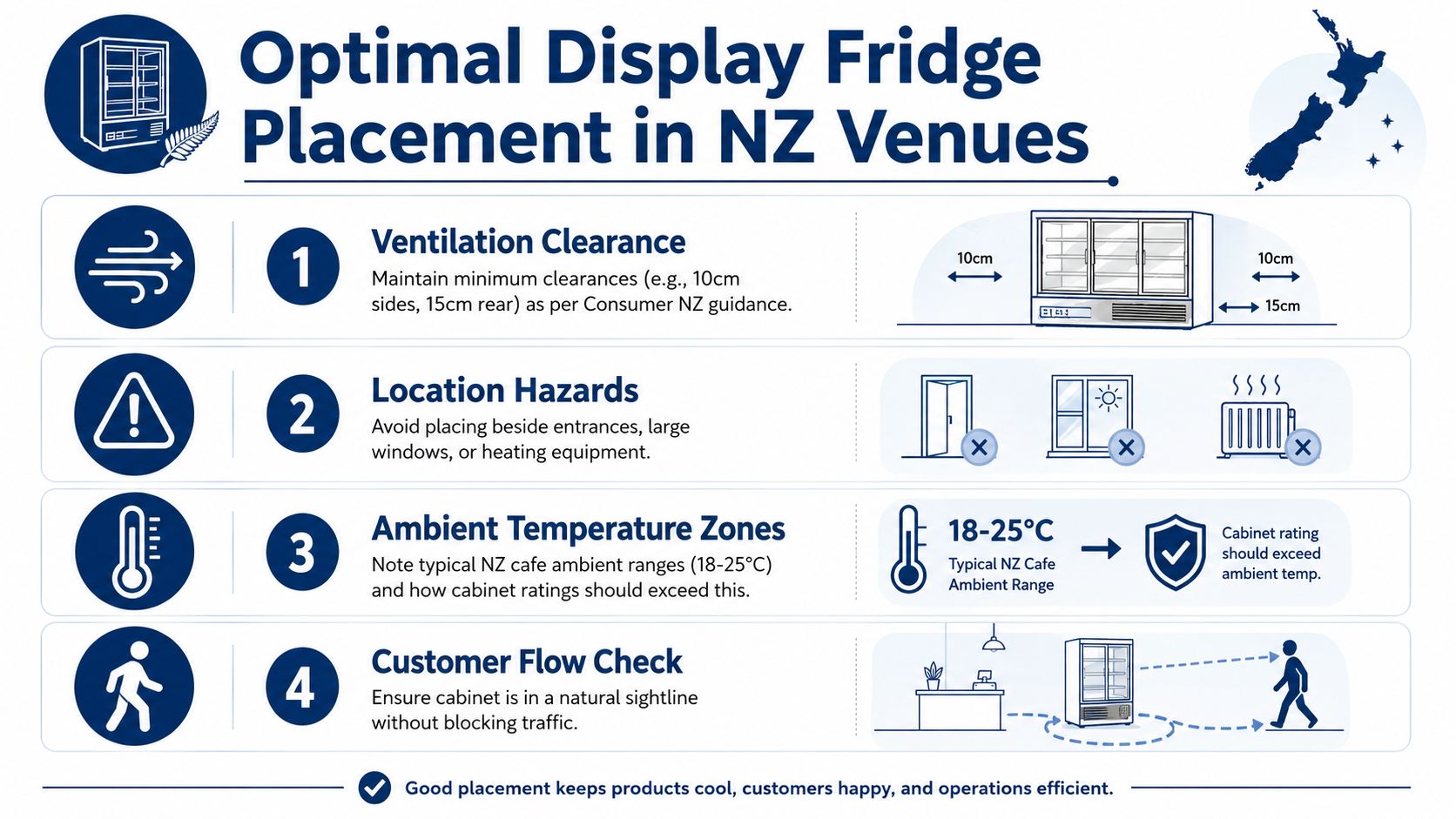
A display cabinet can't perform properly if it's boxed in. Consumer NZ advises allowing about 5 cm of space on the sides and back and 30 cm on top for ventilation, and that's the kind of clearance operators need to build into the fit-out from day one. Staff often focus on floor space, but airflow is what protects the cabinet's working life and cooling stability. See the detailed guide to commercial fridge NZ placement and fit-out planning for a broader layout view.
Heat, light, and traffic all matter
One of the biggest mistakes seen on site is putting display refrigeration beside entrances, large windows, or heating equipment. That forces the cabinet to work harder than it should. Direct sunlight and hot ambient conditions also make presentation worse, because condensation risk rises and the cabinet has to fight the room all day.
Don't place display refrigeration where it has to battle the room before it even battles the product load.
Fit the cabinet to the workflow
Door swing matters. Replenishment access matters. So does the path staff use when carrying trays, drinks, or garnishes. If a cabinet blocks movement or forces awkward lifting, it slows service and increases the chance of damage. The best placement keeps products visible to customers and easy to access for staff without crowding the counter zone.
Ambient ratings are worth checking too. A unit rated for warmer conditions is the safer choice in a non-air-conditioned site or a busy back-of-house area that gets hot during service. The cabinet needs to match the environment it will live in, not the ideal temperature in a showroom.
Energy Use and Running Cost Over the Life of the Cabinet
A display fridge purchase should be treated as a running-cost decision, not just a capital buy. EECA's commercial refrigeration guidance shows why energy efficiency matters, with a 7-star fridge and freezer combination saving $105 per year and $1,155 over 11 years compared with a 1-star model at $0.25/kWh. That benchmark is for domestic appliances, but the principle is the same for commercial display refrigeration, energy rating and operating cost compound over time. For a broader building-efficiency angle, cut energy costs in commercial spaces is a useful external read.
Compare kWh per 24h, not just litres
The key decision metric is not cabinet volume alone. It's the amount of cooling energy the unit consumes for the work it does. A SKOPE ActiveCore three-door upright display fridge with 1,433 L gross volume uses 4.99 kWh/24h and is rated for 40°C ambient operation, while a larger 975 L glass-door unit can use 8.37 kWh/24h while still only holding 0–10°C. That's a clear reminder that glazed surface area and cabinet design can push running cost up even when the holding band looks similar.
Refrigerant choice also matters
NZ-spec units increasingly use R290 or R600a. Both are low-GWP hydrocarbons, and both tend to sit alongside efficiency-focused cabinet designs. A 1,200 mm upright display fridge with 875 L capacity lists R290, 363 W power, and a 0–10°C operating band, while a compact 86 L countertop display fridge uses R600a, 2.0 kWh/24h, and a +4 to +12°C range. That tells operators that refrigerant type, cabinet size, and product use all have to line up.
The trade-off is straightforward. Entry-level units can look cheaper on day one, but better-specified equipment is often easier to live with. A practical reference point on that decision is does premium refrigeration always make sense, which helps frame when extra specification is justified and when it isn't.
Food Safety, Cleaning, and Day-to-Day Maintenance
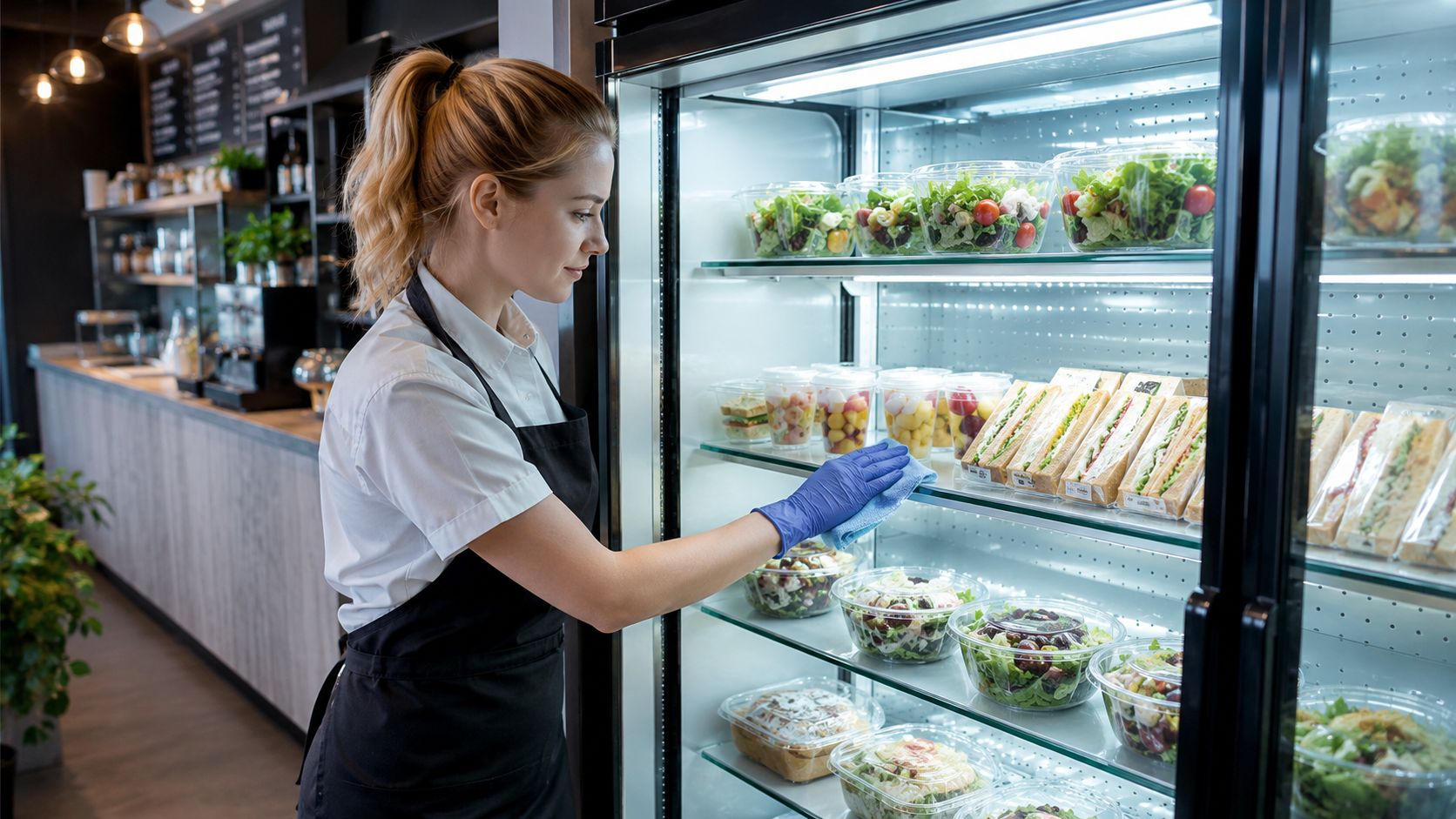
A display cabinet that looks good on delivery day can still become a problem if staff can't clean or load it properly. That's why the temperature band has to suit the product. Chilled beverages, dairy display, fresh food, and grab-and-go meals all need the cabinet working in the right range so condensation, face temperature, and product presentation stay under control.
Clean it like it sells food, because it does
Glass, shelves, seals, and handles need regular wiping with food-safe cleaners. Crumbs, spills, and smudges should be removed quickly, not left until the end of the week. Condenser coils also need attention, because dust buildup reduces performance and makes the cabinet work harder than necessary.
A display fridge that's awkward to clean becomes a hygiene issue long before it becomes a mechanical one.
Keep service access simple
Busy venues need cabinets that are easy to replenish without knocking over product or blocking service. That matters for both speed and food safety. If the cabinet is hard to restock or awkward to access, staff tend to rush, and that's where mess and temperature inconsistency usually start.
For operators thinking more broadly about cold-chain habits, cold chain management is a sensible companion read. The same discipline that protects back-of-house storage also protects the cabinet customers can see.
NZ food safety expectations are simple in practice. Keep food in the right band, keep the cabinet clean, and keep records or checks organised enough that staff don't guess. A display fridge should support that routine, not make it harder.
Common Mistakes We See Operators Make
A common issue we see is buying on litres alone. A bigger cabinet isn't automatically a better one if it creates more heat load, needs more space, or doesn't suit the products being sold. The smarter approach is to compare kWh per 24h per litre, not just capacity.
Another mistake is placing display refrigeration where it has to fight the room. Next to an entrance, under a hot window, or beside cooking equipment, the cabinet works harder and usually looks worse. In our experience, that kind of placement creates avoidable temperature stress and poor presentation.
Open front cabinets also get chosen for the wrong sites. They can work well in high-traffic, high-turnover settings, but they're a poor fit when stock is slow-moving or replenishment is infrequent. The cabinet ends up looking patchy, and that hurts the sale.
If the cabinet can't stay full and attractive through service, it's the wrong format for that venue.
Door swing, access space, and cleaning are often underpriced in the decision. The same goes for maintenance access behind the unit. A cheap-looking purchase can become an expensive annoyance if every restock or service call turns into a workaround.
Your Selection Checklist and Getting the Right Cabinet
Before asking for a quote, work through this list:
- Product type: cakes, sandwiches, drinks, desserts, or grab-and-go meals.
- Cabinet location: counter, bar, window line, or traffic-facing position.
- Display capacity: enough to look full without overcrowding.
- Replenishment pattern: frequent top-ups or once-daily loading.
- Ambient conditions: sunlight, entrances, nearby heat, and room temperature.
- Ventilation clearance: enough breathing room around the cabinet.
- Energy rating and kWh use: compare the running cost, not just the ticket price.
- Refrigerant type: check whether R290 or R600a suits the application.
- Warranty and after-sales support: don't ignore what happens after delivery.
A helpful way to think about front-of-house refrigeration is to compare it with the way a product display box has to present stock clearly as well as hold it safely. For a broader packaging lens, the types of display boxes guide is a useful contrast, even though the cabinet job is far more demanding.
For operators who want a straightforward recommendation, Hospitality can help match cabinet format, footprint, and operating conditions to the venue. That usually saves time, avoids the wrong-spec purchase, and gives the cabinet a proper job from day one.
Hospitality helps NZ hospitality businesses choose refrigeration that fits the product, the floor plan, and the way service runs. If a venue needs a display fridge that looks right, works in the space, and holds up over time, visit Simply Hospitality and talk through the options with a team that understands commercial kitchens and front-of-house merchandising.