

Fridge Freezer Ice Maker vs Dedicated Ice Machine
A busy summer service can expose the limits of a fridge freezer ice maker very quickly. The unit may make ice reliably for household use, yet still leave a café, bar, restaurant, or accommodation operation short when drinks, iced coffees, smoothies, and food displays all draw from the same supply. The key decision isn't just how much ice a venue uses in a day. It's how much must be available during its busiest service window.
For hospitality operators, the more relevant issue is how quickly ice runs out during peak service. A built-in ice maker may be fine for light, occasional use, but when iced drinks, smoothies, food displays, or back-to-back orders draw from the same supply, a dedicated machine often provides the storage and recovery needed to keep service moving.
Why Your Fridge Freezer Ice Maker May Not Be Enough
A café manager can start a hot Saturday with an apparently adequate ice supply, serve iced coffees and cold drinks through lunch, and find the integrated bin empty before the busiest orders have cleared. The appliance may continue making ice, but its output and small reserve don't match the concentrated demand. On paper, the daily production might seem acceptable. At the counter, the timing is wrong.
That mismatch is common because an integrated fridge freezer ice maker is generally designed as part of a household refrigeration appliance. It occupies limited space, usually produces one ice format, and stores a relatively modest quantity. A dedicated commercial ice machine separates refrigeration from ice production, allowing the operator to select production, storage, cube type, drainage, and ventilation around the venue's actual workflow.
Practical rule: The right ice solution is sized around when the venue needs ice, not simply how much it uses across a full day.
Operators comparing refrigeration options should still consider the fridge and freezer itself. A useful resource for assessing built-in appliance dimensions is find the best built-in fridge size, particularly where cabinetry, access, and kitchen layout affect the installation. For NZ hospitality businesses, the relevant question is whether the integrated unit supports the service pattern, not whether it fits neatly into the joinery.
A fridge freezer can be entirely suitable for a motel room, office, staff area, or low-volume accommodation setting. It becomes less suitable when the venue needs fast recovery between rushes, a substantial ready reserve, specialist ice, or a clear sanitation and drainage arrangement. Operators reviewing seasonal appliance options can also compare refrigeration requirements through the fridge freezer sale NZ information, while keeping commercial ice demand as a separate equipment decision.
Production Capacity vs Storage Capacity Explained
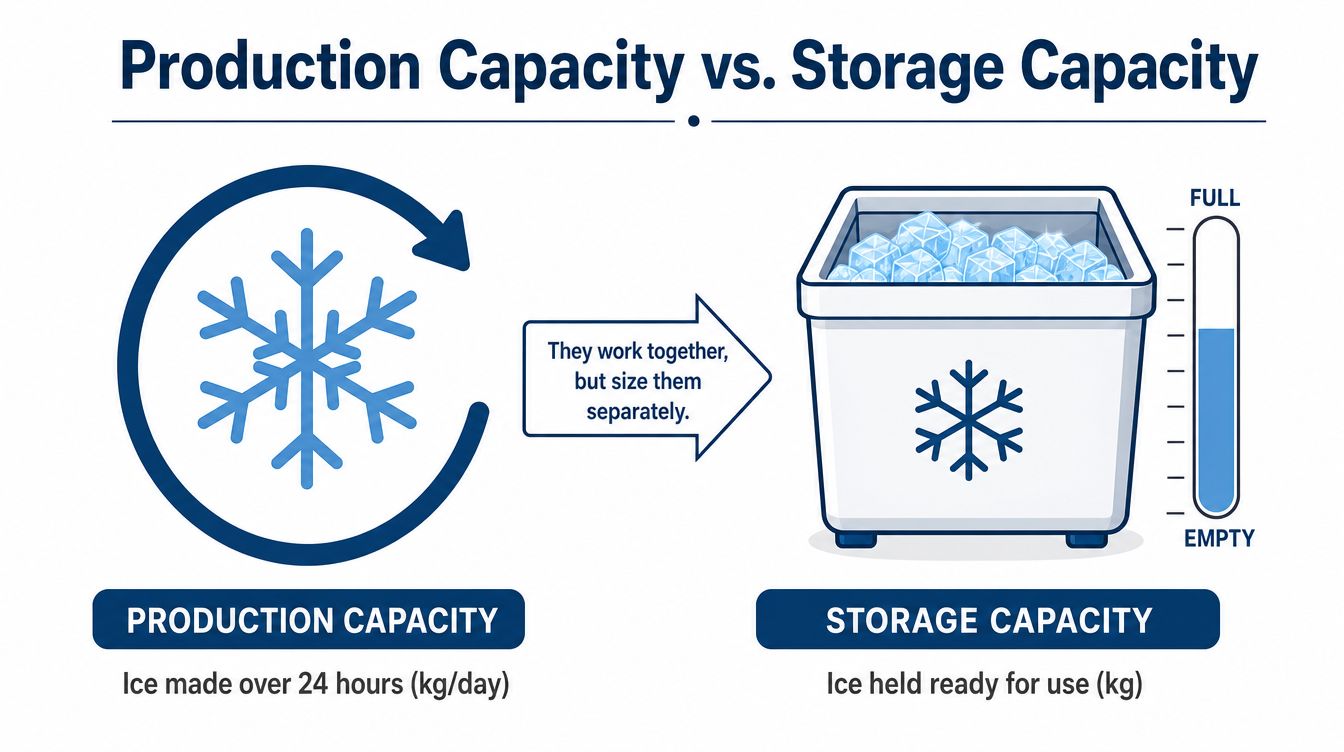
Production capacity is the amount of ice a machine can make over a specified period, commonly expressed in kilograms per day. Storage capacity is the amount of finished ice the bin can hold ready for service. These figures work together, but they solve different operational problems.
Consider a machine rated to produce 30 kg per day with a storage bin holding 10 kg. If a lunch rush requires 15 kg within two hours, the machine can theoretically produce enough across a full day and still leave the venue short during service. The machine's daily yield isn't the same as its immediately available reserve.
Read the specification in context
Published production figures depend on operating conditions. Incoming water temperature, ambient air temperature, ventilation, and installation conditions can all affect how quickly a machine freezes and harvests ice. A headline kg/day figure shouldn't be treated as a guarantee that the same output will apply inside a hot NZ kitchen during February.
The specification needs to be read alongside the bin size and the service timetable:
- Production capacity: How much ice the machine can make over the stated period.
- Storage capacity: How much ice is available before the bin needs recovery.
- Recovery pattern: How quickly the machine can rebuild stock after a rush.
- Operating conditions: The water and ambient temperatures used for the published rating.
The ice makers NZ buying guidance helps frame these figures as part of a wider equipment choice. A commercial example is the ITV GALA MDP150 A Ice Maker, an ITV ice system supplied by SKOPE with a stainless steel 304 AISI cabinet, R290 refrigerant, a 22 g individual ice weight, a 43°C maximum ambient rating, and a 2 Year Warranty. Its role should be assessed against the required ice format, storage arrangement, and peak service demand, rather than its daily production figure alone.
Integrated Ice Makers vs Dedicated Commercial Units
An integrated fridge freezer ice maker keeps refrigeration and ice production in one appliance. That can simplify a small installation, but it also limits the operator to the space, output, storage, and ice style designed into that appliance. A dedicated commercial machine gives the venue more control over the equipment match.
Integrated units often suit low-volume users who want occasional ice without adding another appliance, water connection, drain, and service location. Dedicated units are more appropriate where ice is part of the daily sales workflow, especially when staff need a reliable reserve during concentrated service.
| Criteria | Integrated Fridge Freezer Ice Maker | Dedicated Commercial Ice Machine |
|---|---|---|
| Primary role | Refrigeration with ice as an integrated convenience | Purpose-built ice production |
| Output planning | Usually tied to the appliance design and domestic use pattern | Selected around venue demand and recovery needs |
| Ice formats | Commonly one built-in format | Options can include full cubes, half cubes, gourmet-style ice, nugget ice, and flake ice |
| Storage | Limited bin space within the freezer compartment | Separate storage capacity can be matched to service timing |
| Peak recovery | May struggle when demand is concentrated | Designed for repeated production and commercial service patterns |
| Venue suitability | Offices, accommodation, staff areas, and low-volume use | Bars, cafés, restaurants, caterers, and high-volume beverage service |
| Site requirements | Shared with the refrigerator installation | Requires dedicated attention to water, drainage, ventilation, power, and access |
Ice format should follow the application. Bars may prefer an attractive format for premium drinks, cafés may need a practical option for iced coffees and high-volume beverages, and food presentation can call for flake or another specialist format. Nugget ice has a different mouthfeel and use case from a hard cube, so the machine shouldn't be chosen from appearance alone.
The guide to choosing the right ice machine for hospitality provides a useful starting point. The practical test is straightforward: if ice directly affects beverage throughput, presentation, or customer experience, a dedicated commercial unit usually gives the operator a more controllable solution.
Sizing Ice Equipment Around Peak Summer Demand
Daily averages hide the service problem. A café might use 20 to 30 kg on an ordinary day, yet require considerably more during hot weather as iced coffees, cold drinks, and smoothies increase. The correct response isn't to copy an average figure into a product search. It's to map the busiest period and size production and storage around that pattern.
Start with the service window
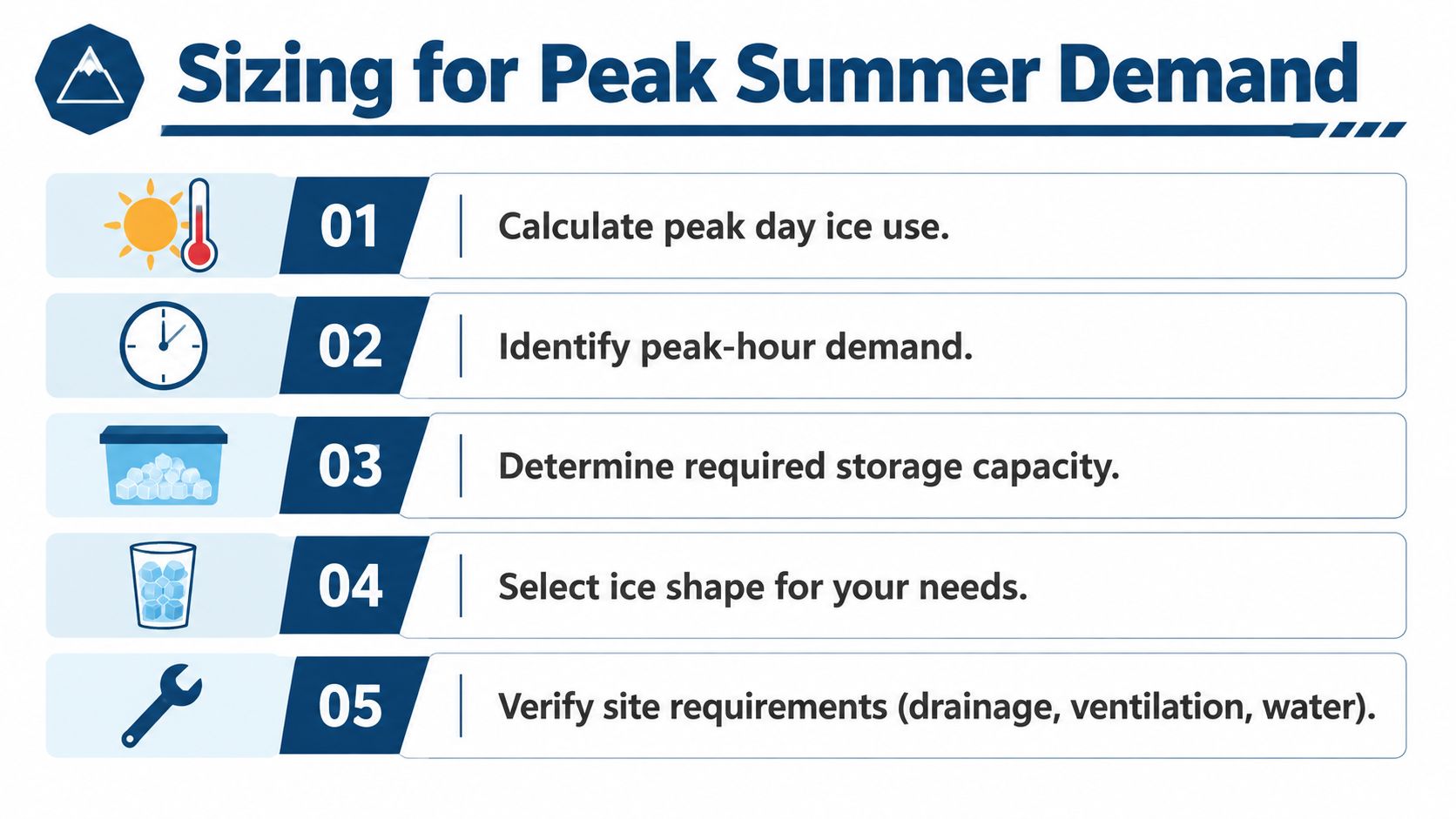
Operators should answer these questions before selecting a machine:
- How much ice is used on the busiest summer day? Review beverage recipes, display requirements, cold storage practices, and any ice used by functions or catering.
- When is that ice required? Separate breakfast, lunch, afternoon, and evening demand. A venue that uses most of its ice in a short window needs more ready storage than a venue with evenly spread demand.
- What reserve is needed? Storage should cover the concentrated rush without relying on production during every order.
- Which shape suits the work? Full cubes, half cubes, gourmet-style ice, nugget ice, and flake ice each serve different drink or display purposes.
- Can the machine recover? Check how the selected equipment performs after the bin is drawn down, using manufacturer specifications and realistic site conditions.
A common mistake is sizing around today's average with no allowance for seasonal peaks or future changes in the menu. Another is buying a high-production machine with a bin that cannot hold enough ice for the lunch or evening rush.
The right combination may be a moderate production rate with a larger reserve, or faster production with storage sized to the service pattern. It depends on the venue's opening hours, staffing, menu, delivery access, and ability to manage ice safely.
Installation Requirements That Determine Reliability
A commercial ice machine needs more than a nearby power point. Drainage, water supply, ventilation, clearances, and access must be confirmed before the equipment is ordered. A machine that is correctly specified but poorly installed can develop apparent performance faults that originate with the site.
Confirm the services first
Drainage deserves particular attention. The installer should confirm the manufacturer's drainage requirements, the location of the floor waste, the route for discharge, and whether the site can handle the required fall. A self-draining tray may help with water management, but it doesn't remove the need to plan the waste connection correctly.
Ventilation is equally important. Operators should check the required clearances and whether the machine vents into the room or through a defined discharge path. A unit rated for warmer conditions has more tolerance, but it still needs the manufacturer's specified airflow.
The GALA MDP150 A specification includes operation in ambient temperatures up to 43°C, which is relevant for hot kitchens and poorly ventilated back-of-house areas. That rating doesn't replace proper installation. It gives the operator a clear condition to consider when comparing equipment.
Water pressure, connection details, filter placement, electrical supply, and service access should be checked with the installer. Where a site needs electrical work or a new circuit, a qualified contractor can also assess the commercial electrical panel requirements before equipment arrives.
Poor site conditions can look like an equipment fault. Check the services before blaming the machine.
Access matters during cleaning and servicing. A unit installed tightly against a wall or beneath obstructed shelving may work initially but become difficult to inspect, sanitise, or repair safely.
Water Quality and Cleaning Discipline Drive Uptime
Brand selection matters, but incoming water and cleaning discipline often determine whether an ice machine remains dependable. Excess sediment and scale can clog distribution tubes and interfere with water flow. Chlorine residual can contribute to odour, corrosion, and added maintenance demands, particularly in high-turnover foodservice environments.
Water filtration should therefore be assessed by location and application, not treated as an automatic accessory or ignored as an unnecessary expense. NZ commercial food-service guidance identifies filtration as a way to help protect ice equipment from biofilm build-up and protozoan cysts, while also reducing the impact of sediment and scale (commercial ice filtration guidance).
Treat ice as food-production equipment
Cleaning and sanitising should follow the manufacturer's instructions and the venue's food-safety procedures. The plan should account for:
- Ice-making components: Keep water-contact and ice-forming parts clean and correctly reassembled.
- Storage bins: Clean the bin interior and surfaces that contact finished ice.
- Water systems and filters: Inspect for scale, sediment, flow restrictions, and filter condition.
- Scoops and scoop storage: Store the scoop so it stays protected from contamination.
- External food-contact areas: Include handles, access points, and surrounding surfaces in routine hygiene checks.
The correct interval varies by machine, water quality, usage, and the manufacturer's directions. No single cleaning schedule suits every installation. Operators dealing with hard water can use specialist advice such as water softener repair San Antonio as general background on water-treatment issues, but NZ venues should select treatment equipment and servicing appropriate to their own supply.
The same discipline applies to refrigeration. A venue can review commercial refrigeration maintenance advice alongside its ice-machine cleaning procedure, provided staff understand that ice systems have their own water, storage, and sanitation controls.
Energy Efficiency and Compliance Considerations
A fridge freezer with an integrated ice maker should be assessed as a refrigeration appliance, while a stand-alone commercial ice maker needs its own technical and operating review. EECA's guidance confirms that fridge and freezer Energy Rating labels show both the star rating and annual energy consumption, giving buyers a way to compare models rather than judging efficiency by appearance alone (NZ fridge and freezer energy labels).
The comparison can be material. One NZ 569 L French-door refrigerator with an ice maker is rated 3.5 stars and uses 433 kWh/year, while another NZ 470 L model with an ice maker is rated 4 stars and uses 340 kWh/year under the stated testing conditions. The ice feature itself doesn't determine efficiency. Compressor design, controls, insulation, and the overall appliance configuration matter.
Check the rule that applies to the product class
New household fridge and freezer MEPS and labelling requirements take effect from 1 May 2026, although EECA says the exact enforcement date for the new requirements isn't yet provided (EECA fridge and freezer requirements). The scope excludes stand-alone ice makers and several other products that buyers may confuse with integrated fridge-freezer systems.
Procurement should therefore check:
- Energy use: Annual consumption for integrated refrigeration.
- Water use: Commercial ice-maker performance in litres per kilogram.
- Maintenance: Filtration, sanitation, access, and servicing requirements.
- Compliance: Whether the exact product category and supply date fall under the relevant NZ requirements.
EECA's commercial ice-maker analysis identifies potable water targets of no more than 22.5 litres per 10 kg of ice for standard efficiency and 12 litres per 10 kg for high-efficiency products (commercial ice-maker regulatory analysis). Specifying lower litres-per-kilogram performance can expose hidden operating costs that a purchase-price comparison misses. Further guidance on selecting efficient equipment is available in energy-efficient appliances for hospitality.
Choosing the Right Ice Solution for Your Venue
An integrated fridge freezer ice maker can be sufficient for low-volume accommodation, offices, staff areas, or venues where ice is occasional and a single built-in format is acceptable. It's less suitable when a bar, café, restaurant, caterer, or event venue needs substantial ice during a concentrated summer rush.
A dedicated commercial ice machine gives operators more control over production capacity, storage capacity, ice format, recovery, filtration, drainage, ventilation, and cleaning access. The choice should be based on peak-hour demand, not an annual average, with the water and site services confirmed before purchase.
Hospitality supplies commercial refrigeration and ice-making equipment for NZ hospitality businesses, including options from brands such as ITV supplied by SKOPE. For practical advice on matching production, storage, ice style, installation, and maintenance requirements, operators can visit Simply Hospitality and discuss the venue's actual service pattern.