

Choosing Gas Cooktops NZ for Your Kitchen
Opening a first venue often means making equipment decisions before service has even started. The cooktop usually sits at the centre of that pressure. It affects how quickly a kitchen moves, how much bench space stays usable, how easy close-down feels at night, and whether the business is buying for today or for the next stage of growth.
For most operators looking at gas cooktops NZ wide, the smartest choice isn't the biggest unit or the most premium badge. The right choice depends on the menu, the number of chefs on the line, the available gas type, the fit-out, and the budget that still needs to cover refrigeration, extraction, prep space, warewashing, and front-of-house basics. A practical overview of gas stove tops for hospitality kitchens can help narrow the field, but the key decision comes from matching the appliance to the way the kitchen is designed to run.
Choosing Your First Commercial Gas Cooktop
A first commercial cooktop purchase usually happens at the same time as a dozen other expensive decisions. That's why overbuying is common. New operators often assume they need the heaviest-duty model available because it feels safer to buy “bigger” up front.
In practice, that can create the wrong kind of cost. A larger unit takes more floor or bench space, can force compromises elsewhere in the line, and may leave burners sitting idle for much of the week. Many hospitality operators find that a cooktop should be chosen as part of the whole kitchen, not as a standalone hero piece.
Start with the business, not the spec sheet
The strongest buying decisions usually come from four questions:
- What's on the menu: A café doing breakfast, eggs, sauces, and light lunch service has different burner demands from a bistro running multiple pans through dinner.
- How many people cook at once: A two-person line needs access and spacing. Extra burners don't help if staff can't move around each other.
- What stage the venue is in: A new business may need dependable commercial gear without stretching capital too far.
- What the site can support: Gas type, extraction, commissioning, and available space all shape the right answer.
Practical rule: A cooktop should solve a service problem, not create a layout problem.
What works for most first venues
In day-to-day supply conversations, the most practical cooktops for first-time buyers are usually the ones that balance flexibility and restraint. Four-burner and six-burner configurations remain popular because they cover most café and casual dining needs without dominating the kitchen.
A common issue seen in new fit-outs is choosing equipment based on ambition alone. The venue may plan to expand the menu later, but that doesn't always mean the first appliance purchase should be a premium, top-end unit on day one. Long-term value comes from buying equipment that suits the current workload and can operate reliably from the first week of trade.
The goal is usable capacity
A cooktop becomes valuable when every burner has a purpose during busy periods. If service relies on two pans, one stockpot and one finishing burner, the right four-burner unit can outperform a poorly planned six-burner setup because the station is cleaner, faster, and easier to manage.
That's the lens that matters most. Not prestige. Not maximum output on paper. Fit, workflow, and business stage usually decide whether a gas cooktop feels like a good investment six months after opening.
Matching Your Cooktop to Your Kitchen Workflow
Before comparing brands, it helps to look at the line during peak service. The cooktop sits inside a chain of movement that includes cold prep, plating, pass access, dish return, and wash-up. If that chain is awkward, even a strong appliance won't fix the kitchen.
A useful starting point is the kitchen flow advice in this article on designing a kitchen that saves time on every service. The cooktop decision makes more sense when it's tied to movement, not just cooking capacity.
Burner count and real service pressure
Four and six-burner cooktops continue to be the most common choices for Kiwi cafés because they give enough flexibility for most services without creating dead space.
A simple way to judge burner count is to map a busy period:
- Two burners committed: Eggs, proteins, or sauté pans that are almost always occupied
- One rotating burner: Sauces, reheats, or small-batch prep
- One utility burner: Water, holding, or overflow during rushes
That pattern already justifies a four-burner unit in many cafés. A six-burner model starts to make more sense when the menu has more pan work, more simultaneous components, or a larger brigade sharing the line.
Bigger isn't always more productive. A compact, well-used station often moves faster than an oversized line with poor access.
Benchtop, oven range, or modular line
The form factor matters as much as the burner count. Each option changes the way the kitchen functions.
| Format | Best suited to | Main trade-off |
|---|---|---|
| Benchtop cooktop | Smaller kitchens, flexible layouts, sites pairing cooking with separate underbench storage or ovens | Needs surrounding benches and support equipment planned carefully |
| Cooktop with oven base | Venues wanting one central cooking station | Saves space, but ties two functions into one footprint |
| Modular line-up | Kitchens with a defined hot line and room to customise stations | Requires stronger planning up front |
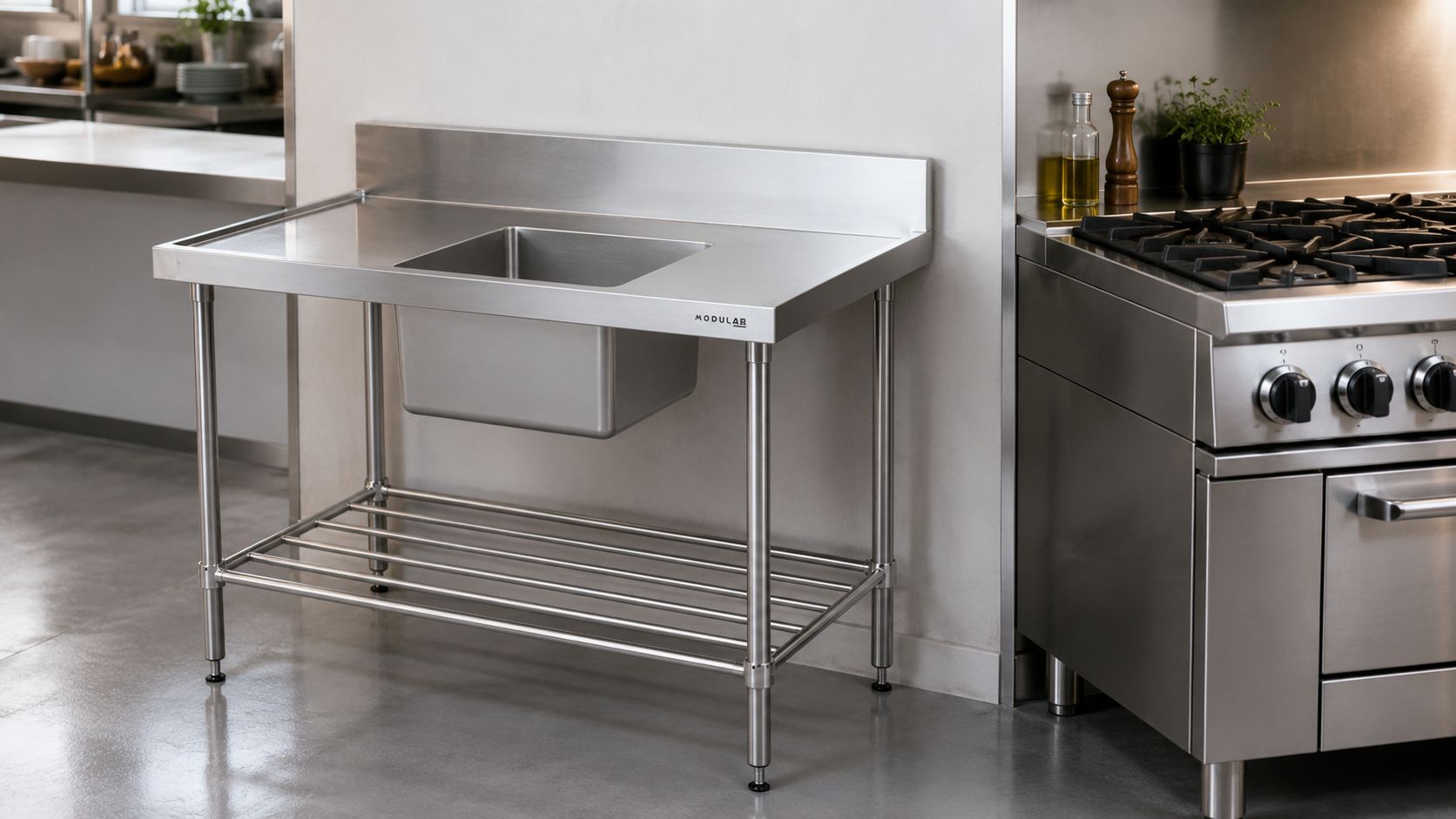
One consideration regularly discussed with customers is what sits immediately beside the cooktop. If staff are carrying hot pans across the kitchen to wash vegetables, fill pots, or reset mise en place, time gets lost every service. That's where surrounding stainless matters. A Modular Stainless Single Bowl Sink Bench can be relevant in the same zone because its 700 mm depth, 450 × 450 × 300 mm bowl, 150 mm splashback, and options for width and bowl position help shape a cleaner prep-and-cook run beside the line.
Think in movements, not appliances
A cooktop should reduce crossings and handoffs. That usually means asking practical questions such as:
- Can one chef reach oils, pans, plating bench, and wash-up support without turning constantly?
- Does the cooktop crowd the pass or choke the prep bench?
- Will two staff be able to work side by side during the rush?
The right solution depends on the menu. A breakfast café might prioritise multiple medium-duty burners and open bench space for plating. A pub kitchen may need stronger integration with oven cooking and finishing. A compact bar kitchen may be better served by a benchtop unit that protects floor area.
The mistake isn't choosing four burners instead of six. The mistake is buying a cooktop before deciding how service is meant to move.
Natural Gas vs LPG in New Zealand
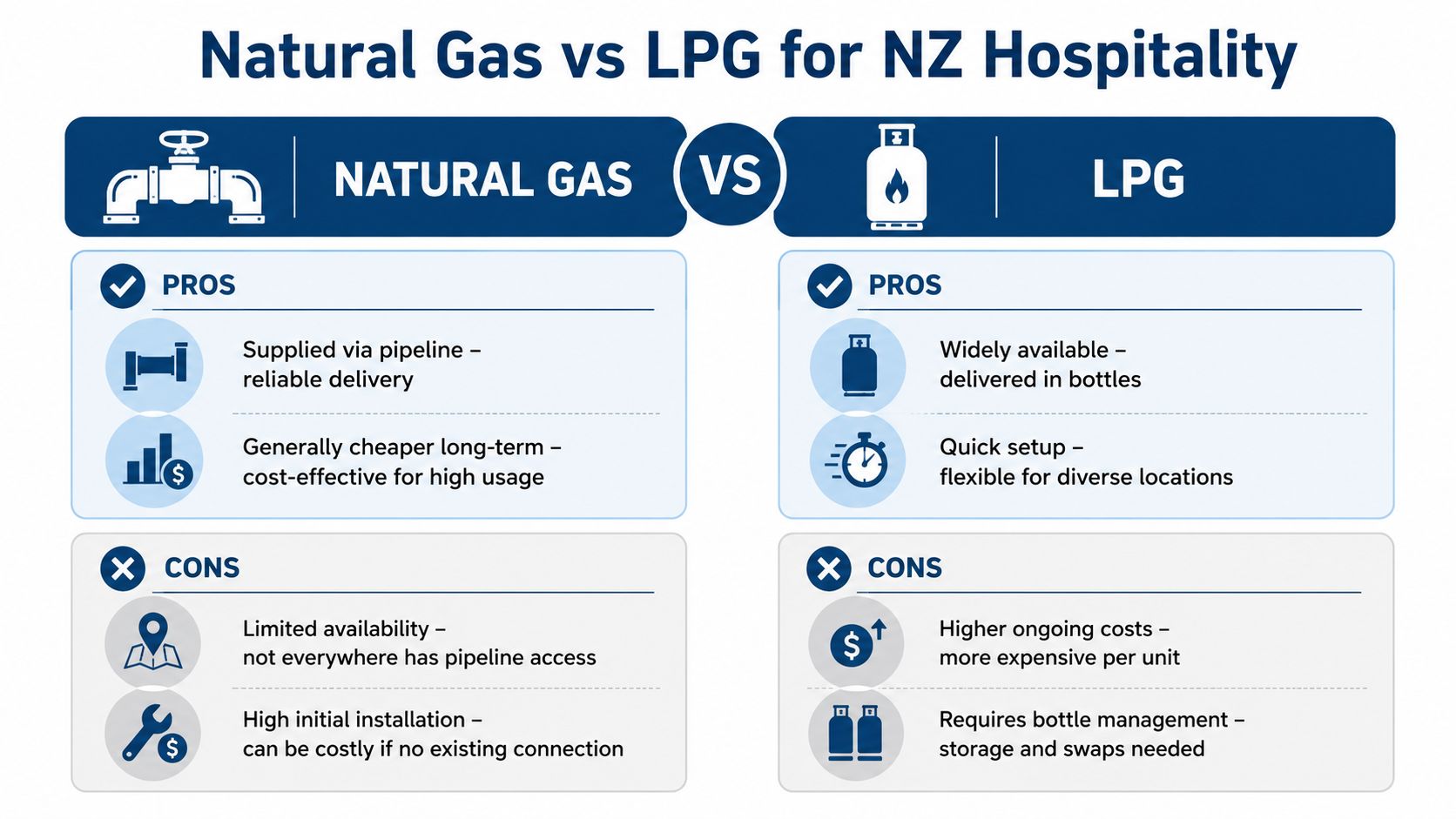
For commercial kitchens, the natural gas versus LPG question usually comes down to site conditions first and equipment second. If the building already has a natural gas connection, that can simplify planning. If it doesn't, LPG often becomes the workable option, especially for rural sites, temporary kitchens, and mobile operations.
The decision still needs caution. Fuel type isn't something to sort out after purchase. It needs to be confirmed before ordering because the appliance, supply, pressure, and commissioning all need to match.
The practical difference for operators
Natural gas is generally chosen where pipeline supply is already available. That can make daily operation simpler because there's no bottle handling and no swap logistics to plan around.
LPG suits venues where pipeline access isn't available or doesn't stack up for the site. It gives flexibility, but it also adds operational tasks around bottle storage, delivery, and continuity during busy periods.
A common consideration is running cost. Some buying guides cite $122.64 per year for gas cooktops and $41.98 for induction in New Zealand, but the bigger issue for many hospitality buyers is how that sits against changing supply conditions, including commentary that natural gas production is declining more rapidly than expected and that natural gas will likely remain available for at least another 20 years with no LPG shortage, as noted in this New Zealand comparison of induction and gas cooktops. For commercial kitchens, that doesn't produce a one-size-fits-all answer, but it does mean fuel choice should be treated as a long-term operating decision rather than just a purchase checkbox.
The misconception that causes problems
The most persistent mistake is assuming LPG is simple because it comes from a bottle. It isn't. An LPG appliance still needs correct installation and commissioning by a licensed gas fitter. That applies every bit as much as it does for natural gas.
Another issue appears in online purchasing. When buying LPG cooktops online in New Zealand, operators need to verify that the appliance has been tested specifically for New Zealand LPG, which is a propane and butane mixture. Imported LPG units may be certified only for pure propane, which won't operate safely on the local mix, so the Supplier Declaration of Compliance needs to be checked carefully, as explained in guidance on buying gas appliances for New Zealand LPG.
If the gas type is wrong, the cooktop isn't a bargain. It's a compliance and performance problem waiting to happen.
What to confirm before ordering
A clean buying process usually includes these checks:
- Gas supply at the site: Natural gas connection or LPG bottle setup
- Appliance configuration: Built for the correct fuel type
- Documentation: Compliance paperwork and installation instructions in English
- Commissioning plan: A licensed gas fitter booked before the unit arrives
For gas cooktops NZ operators are considering for a first fit-out, fuel choice isn't just about what burns. It affects compliance, servicing, future flexibility, and how much complexity the kitchen team takes on every week.
Choosing the Right Brand for Your Business Stage
Brand selection gets easier once the kitchen layout and gas type are settled. The key question isn't which brand sounds most impressive. It's which brand suits the business at its current stage.
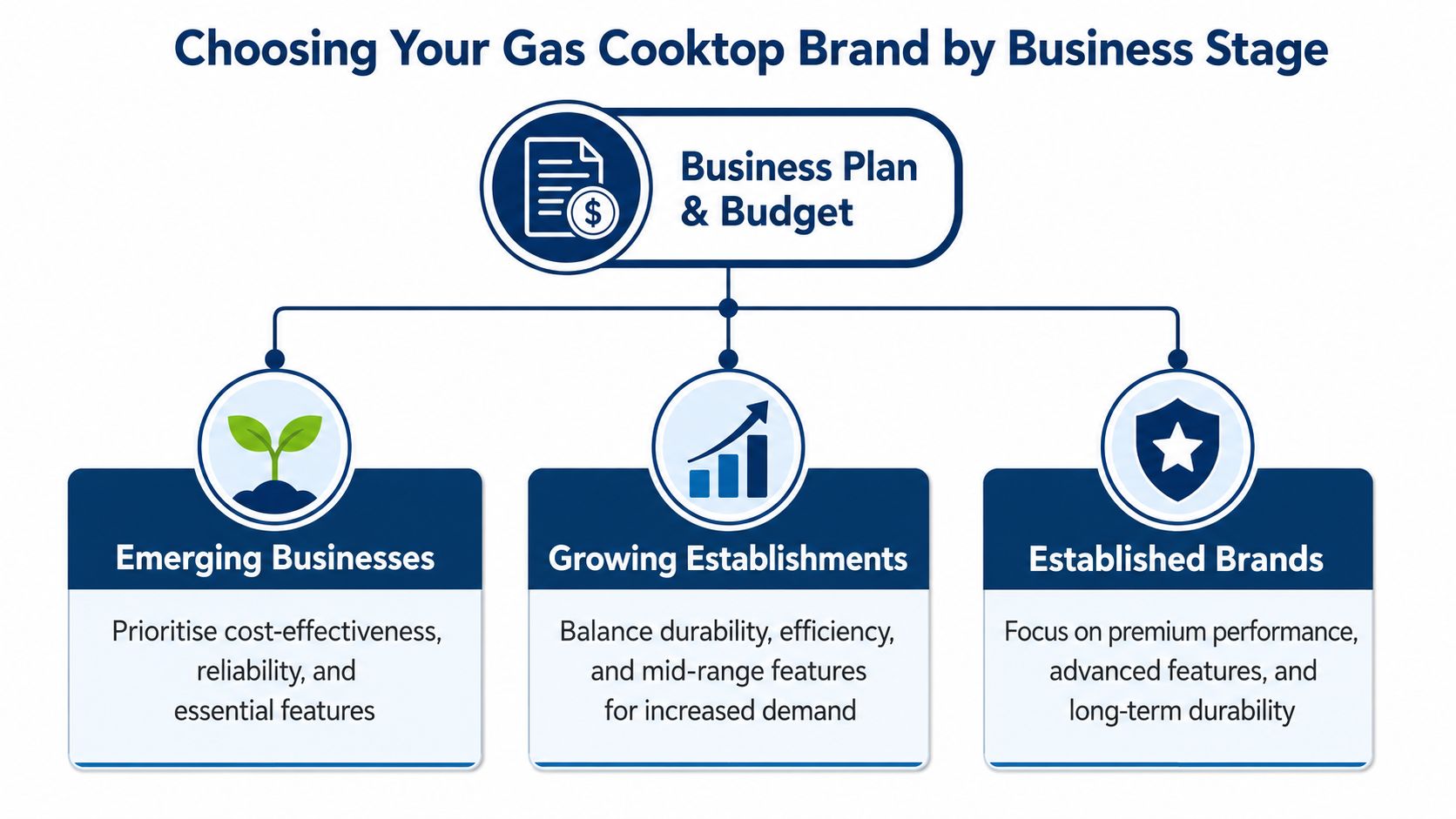
Many operators compare cooktops the same way they compare coffee machines or combi ovens. That can lead them toward the premium end too early. Cooktops are different. The best purchase is often the one that preserves capital while still giving the kitchen dependable commercial performance. There's useful adjacent reading in this overview of commercial oven brands, because the same principle applies. Brand choice should match service volume, business confidence, and replacement plans.
Cookrite for emerging venues
Cookrite is often a very sensible starting point for new cafés, takeaways, and first restaurants. It sits in the value part of the market and appeals to operators who need commercial-grade equipment without pushing too much of the opening budget into a single line item.
In practical terms, that matters. A startup still needs extraction, refrigeration, prep benches, smallwares, fit-out work, signage, and cash reserve. Many new operators choose Cookrite because it lets them prove the concept with brand-new equipment and keep financial flexibility for the first year of trading.
That doesn't mean treating the cooktop as disposable. It means matching the appliance to the risk profile of a new business.
Blue Seal and Cobra for proven day-to-day service
Once a venue has steadier trade and clearer service patterns, Blue Seal and Cobra become very common options. These are established commercial cooking brands with a long track record in working kitchens, and they're often chosen when operators want proven durability and a platform they expect to run hard over time.
For many cafés and casual restaurants, these brands sit in the practical middle ground. They aren't chosen just because they're familiar. They're chosen because many hospitality operators find the product range, service familiarity, and commercial build quality fit busy kitchens well.
A brand becomes the right choice when it matches the venue's workload, not when it carries the highest price.
Waldorf for long-term finish and presentation
Waldorf usually enters the conversation when the kitchen presentation matters as much as output, or when the operator is investing with a long ownership horizon in mind. Open kitchens, premium fit-outs, and venues where visual finish supports the overall brand often lean this way.
One factor often discussed with customers is the difference between buying for proof of concept and buying for permanence. If the venue is already well funded, well tested, and designed around a premium kitchen aesthetic, Waldorf can make sense from the start. If the business is still validating demand, that same money may be better allocated elsewhere.
A simple way to think about the brand tiers
- Cookrite: Best suited to startups and cost-conscious openings that still need commercial reliability
- Blue Seal and Cobra: Strong fit for established kitchens wanting familiar, proven workhorses
- Waldorf: Better aligned with premium environments, presentation-focused fit-outs, and long-term investment thinking
Across gas cooktops NZ buyers compare every day, four and six-burner units remain the most popular configurations. The established names continue to be Blue Seal and Cobra, with Waldorf often chosen when finish and aesthetics matter more. More recently, demand has shifted upward for Cookrite because it offers a balance of price and performance that suits first-time operators well.
NZ Installation Ventilation and Compliance Rules
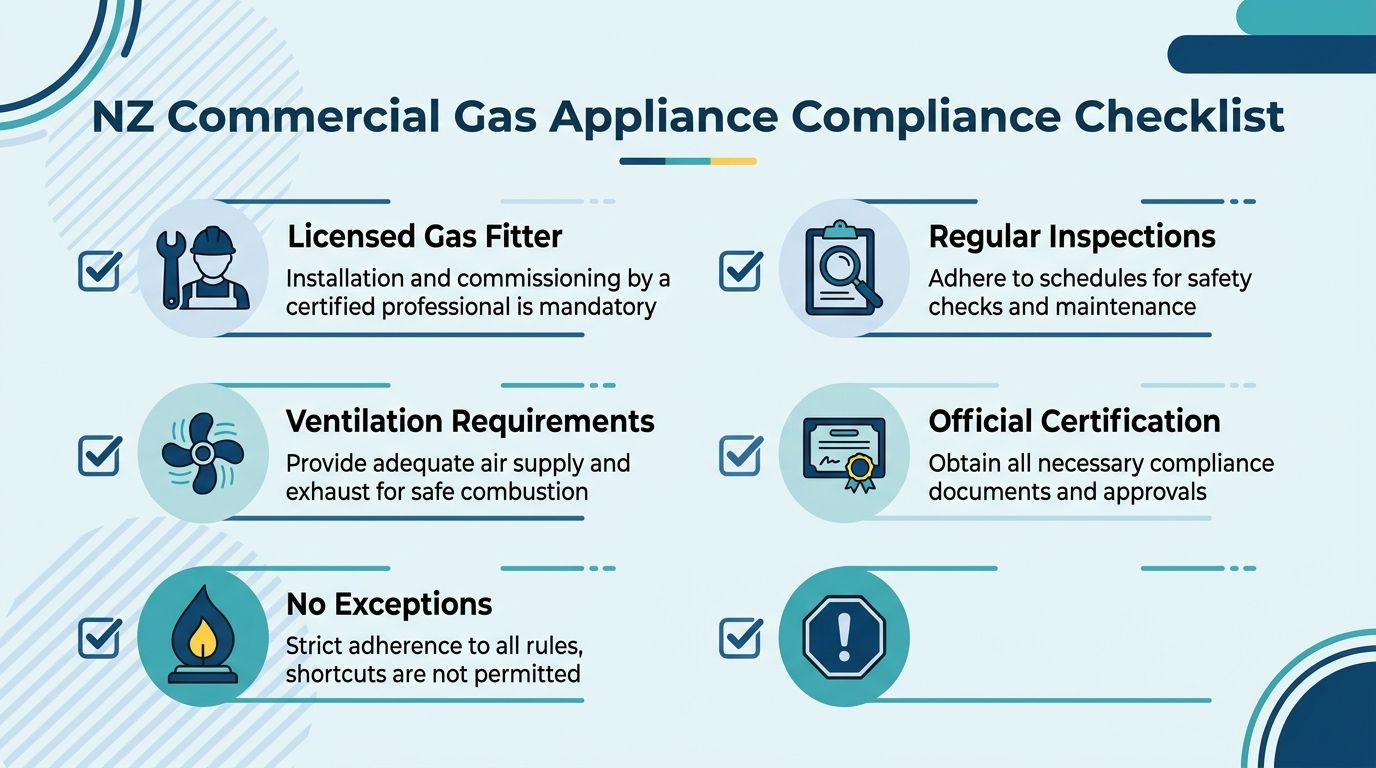
This is the part that should never be treated as optional. In New Zealand, commercial and domestic gas cooktops must comply with AS/NZS 5263.1.1:2020, which sets requirements for testing flame stability, ignition reliability, and combustion efficiency under New Zealand fuel gas conditions. Appliances that don't meet the standard aren't certified under the Gas (Safety and Measurement) Regulations 2010, which means they can't be legally installed by certified gasfitters, as outlined in the New Zealand standard for gas appliances.
What a compliant installation includes
All gasfitting work must be carried out by a licensed gasfitter. That includes installation, repairs, and modifications. DIY gasfitting is illegal in New Zealand, and after installation or significant repair the licensed gasfitter is required to issue a gas compliance certificate confirming the work meets regulatory standards, as explained in this overview of New Zealand gas safety regulations.
For commercial buyers, the practical checklist looks like this:
- Appliance certification: The unit should carry the New Zealand gas safety compliance label and the correct documentation for the declared fuel type.
- Correct commissioning: The gasfitter checks ignition, combustion, and operating performance on site.
- Certificate of Compliance: Installation requires a licensed New Zealand gasfitter to issue a Certificate of Compliance confirming leak tests, correct burner ignition, and even flame distribution. Local councils such as Auckland Council often require ducted rangehoods for high-output commercial cooktops above 15 kW total burner output to prevent heat accumulation and oxygen depletion, according to this summary of installation requirements.
- Ventilation planning: Extraction needs to match the appliance and the kitchen environment.
Online buying needs extra care
A critical problem with online purchasing is that a listed make and model may look identical to a compliant New Zealand unit while being configured for different gas settings. WorkSafe warns buyers to check the Supplier Declaration of Compliance database for the importer and notes there's no reliable way of determining the safety of second-hand appliances, which makes undocumented online bargains especially risky, as outlined in WorkSafe guidance for buying and selling gas appliances online.
That matters for commercial kitchens because a cheap online unit can become expensive very quickly if it can't be installed legally.
Ventilation and surrounding services matter too
Gas cooktop compliance doesn't stop at the appliance. Operators also need the rest of the fit-out coordinated properly, including extraction, gas access, and nearby services. Where site planning includes sink relocation, water points, or broader bath and kitchen plumbing, those services need to be aligned with the gas layout early, not after the cookline has been ordered.
For extraction planning, this guide to commercial kitchen exhaust hoods is often relevant because the cooktop decision and the hood decision are tied together from the start.
Maintenance Safety and Long-Term Value
A commercial gas cooktop earns its keep over years, not on delivery day. The purchase price matters, but the long-term value usually comes from reliability, cleanability, service support, and whether the appliance still performs consistently during a hard Friday service.
Cleaning affects performance
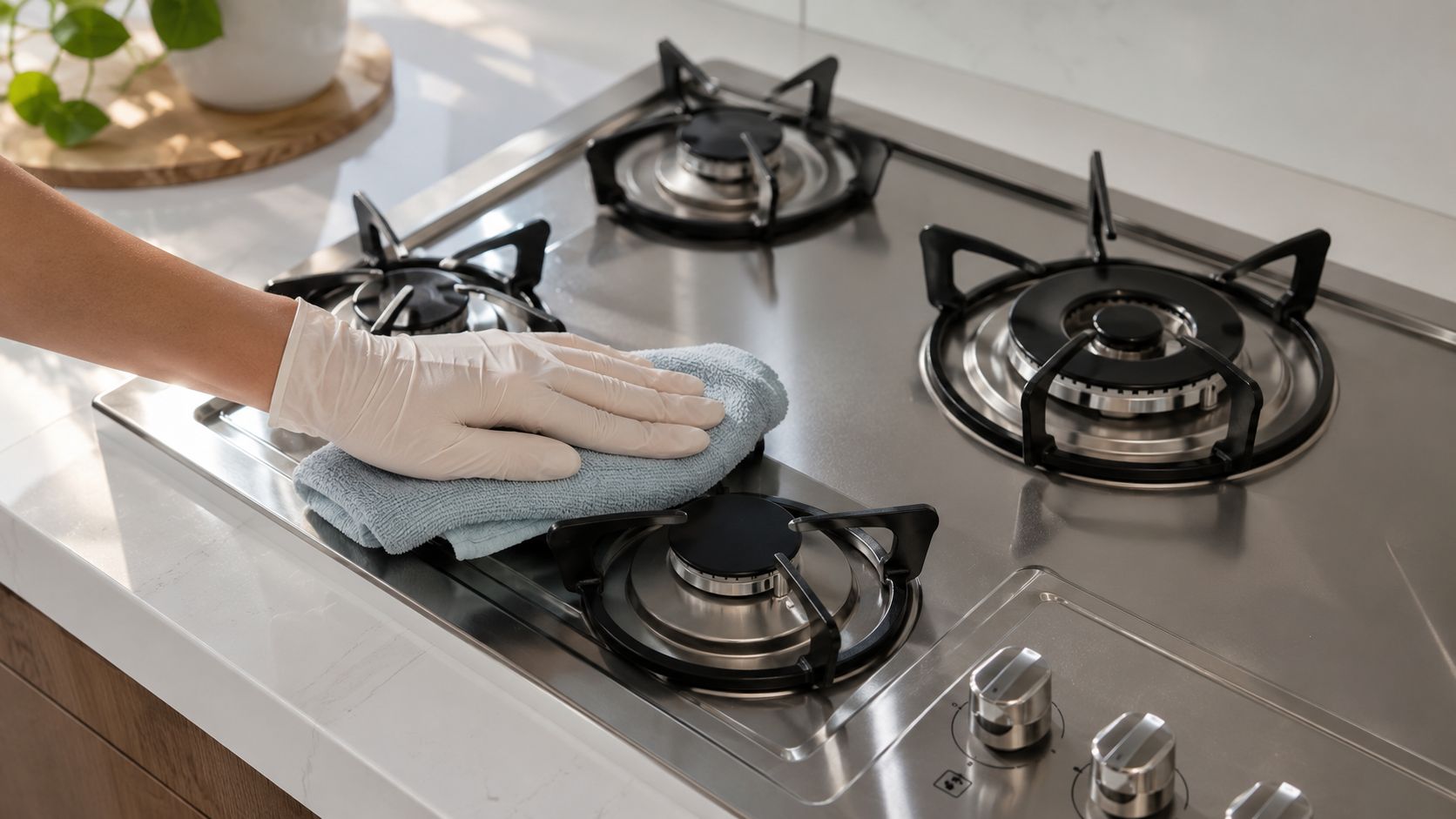
Hospitality businesses often discover that poor cleaning habits show up first as “equipment problems”. Burners clog. Ignition becomes unreliable. Spill trays become difficult to remove. Stainless starts looking tired long before it should.
The practical fix is consistency:
- Daily wipe-downs: Keep spills from baking onto surfaces and around burner assemblies
- Routine burner cleaning: Remove food debris before it affects flame quality
- End-of-week checks: Look at trivets, trays, knobs, and high-use contact points
- Professional servicing: Have qualified technicians inspect operating condition when performance starts to drift
Clean equipment is usually easier to diagnose, safer to run, and less frustrating for staff.
Value is bigger than the sticker price
A cheaper cooktop can still be the right choice if it suits the business stage and stays maintainable. A premium unit can still be poor value if it's oversized for the venue or difficult to integrate into the line.
One factor often discussed is labour. Equipment that's easier to clean and easier to access for service tends to create fewer headaches over time. Operators usually replace ageing cooktops because they want better reliability, stronger burner performance, and simpler maintenance, not because they've calculated exact fuel savings. Related signs often show up across the kitchen, which is why this article on whether ageing equipment is costing more than expected is useful when reviewing the whole line.
A final buying lens
For most first-time buyers, the right gas cooktop is the one that:
- Fits the menu
- Supports the team's workflow
- Matches the site's gas type
- Can be installed and commissioned correctly
- Makes sense for the current business stage
That combination usually outperforms buying on prestige alone.
If a venue is weighing Cookrite against Blue Seal, Cobra, or Waldorf, or trying to decide between four burners and six, Simply Hospitality can help narrow the options based on kitchen layout, menu, gas type, and budget. A practical recommendation early in the fit-out can prevent expensive changes later.