


Commercial Gas Stoves and Ovens for NZ Kitchens
Choosing a commercial gas stove or oven by burner count is one of the quickest ways to create an expensive mismatch. The useful question is how many pans must be working at the same time during the busiest service, then how that requirement affects the range layout, oven capacity, gas supply, extraction and the rest of the cooking line. For NZ hospitality operators, the decision also sits within a long-established mixed-fuel market, where gas cooking remains widely used but electric appliances are more common overall. EECA's 2024 consumer research found that just under half of households use gas in some form, while the BRANZ House Condition Survey recorded 80% of houses with all-electric cooking.
Commercial gas ranges still earn their place in restaurants, cafés, hotels, caterers, pubs, institutional kitchens and other venues that need responsive open burners, durable cooking surfaces and an oven or finishing area in the same footprint. The right choice depends on the menu, service pattern, available services and how the entire cooking line will work together, not on a catalogue specification viewed in isolation.
Why Burner Count Is the Wrong Starting Point
The reflex to choose a four-burner or six-burner commercial range before examining the menu is understandable, but it reverses the proper order of decisions. Burner count should follow peak simultaneous pan usage, not define it.
A kitchen with several chefs on the line may rarely load every burner at once. Another kitchen with a compact à la carte menu can fill four burners quickly with a pan for protein, a sauce, vegetables and a stock or reduction. Ticket times, station splits, pan diameter and the number of dishes finishing together matter more than the number printed in a product title.
Start with the busiest service moment
The practical exercise is straightforward:
- List the cooking methods: Separate pan-frying, boiling, simmering, sauce work, blanching and finishing.
- Map the stations: Identify which chef or station owns each pan during peak service.
- Count simultaneous pans: Record the maximum number on heat together, not the total number used across the shift.
- Check pan sizes: Four small pans don't create the same layout requirement as four wide sauté pans.
- Allow operational headroom: Consider recovery after a ticket surge, menu specials and events without treating unused capacity as automatically valuable.
A larger range can consume cooking-line space that the kitchen needs for a griddle, chargrill, fryer, landing bench or refrigeration. A smaller unit can create constant pan competition, forcing staff to hold food, move pans or use equipment intended for another task.
Practical rule: Specify the menu first, count the pans second, select the range third, and confirm the services before the order is placed.
That sequence is consistent with the wider lessons from helping hospitality businesses choose equipment. Once the peak pan count is known, the choice becomes more useful: open burners for direct high heat, solid tops for gentler and distributed heat, a griddle where proteins or breakfast items stack up, and an oven base that suits the production pattern.
A range also affects extraction, clearances, gas load and electrical connections. More burners can mean more gas demand and more heat entering the canopy, while a range with a salamander or other upper cooking component changes the capture problem again. The correct path is menu to pan count, pan count to equipment, and equipment to services.
Common Commercial Gas Stove and Oven Formats
Commercial cooking lines use several gas stove and oven formats, each solving a different production problem. Heavy-duty commercial gas ranges from Blue Seal Evolution, Waldorf, Waldorf Bold and Cobra are common reference points for pan work, sautéing, simmering and general line cooking. The useful comparison isn't just which brand appears on the front. It's how the configuration fits the station.
Heavy-duty ranges for daily line cooking
The Blue Seal gas cooktops and Blue Seal oven ranges cover layouts built around open burners, griddle sections, solid tops and oven bases. Blue Seal Evolution suits operators wanting a modular, heavy-duty cooking line where burner and oven combinations can be matched to the menu.
Waldorf gas cooktops and Waldorf oven ranges provide another established commercial format, including Waldorf 800 configurations for everyday pan work. Waldorf Bold gas cooktops are relevant where a strong line and practical configuration matter more than filling every available millimetre.
Cobra gas cooktops, including Cobra by Moffat ranges, are suited to kitchens that need commercial open burners and modular cooking equipment within a coordinated line. The trade-off across these heavy-duty formats is clear: greater cooking capacity can increase footprint, gas demand, heat output and extraction requirements.
Ovens and specialist formats
A separate convection or deck oven can be a better choice where baking, roasting or reheating needs a dedicated chamber rather than an oven beneath the range. The Blue Seal E60 and Waldorf RN8510 are useful references when comparing standalone oven requirements with an oven-range base. Deck ovens offer a distinct chamber and cooking surface, while convection ovens suit consistent circulating heat across suitable trays.
Combi ovens can consolidate several cooking processes when steam injection, programmable recipes and controlled oven production are central to the menu. They may reduce the need for separate equipment, but they also demand careful planning around electrical supply, water, drainage, ventilation and staff training.
Pizza-specific gas deck ovens, including Think Pizza, Cuppone and Zanolli, should be treated as their own category. They earn consideration when pizza is a meaningful production stream, rather than being selected as a substitute for a general-purpose range.
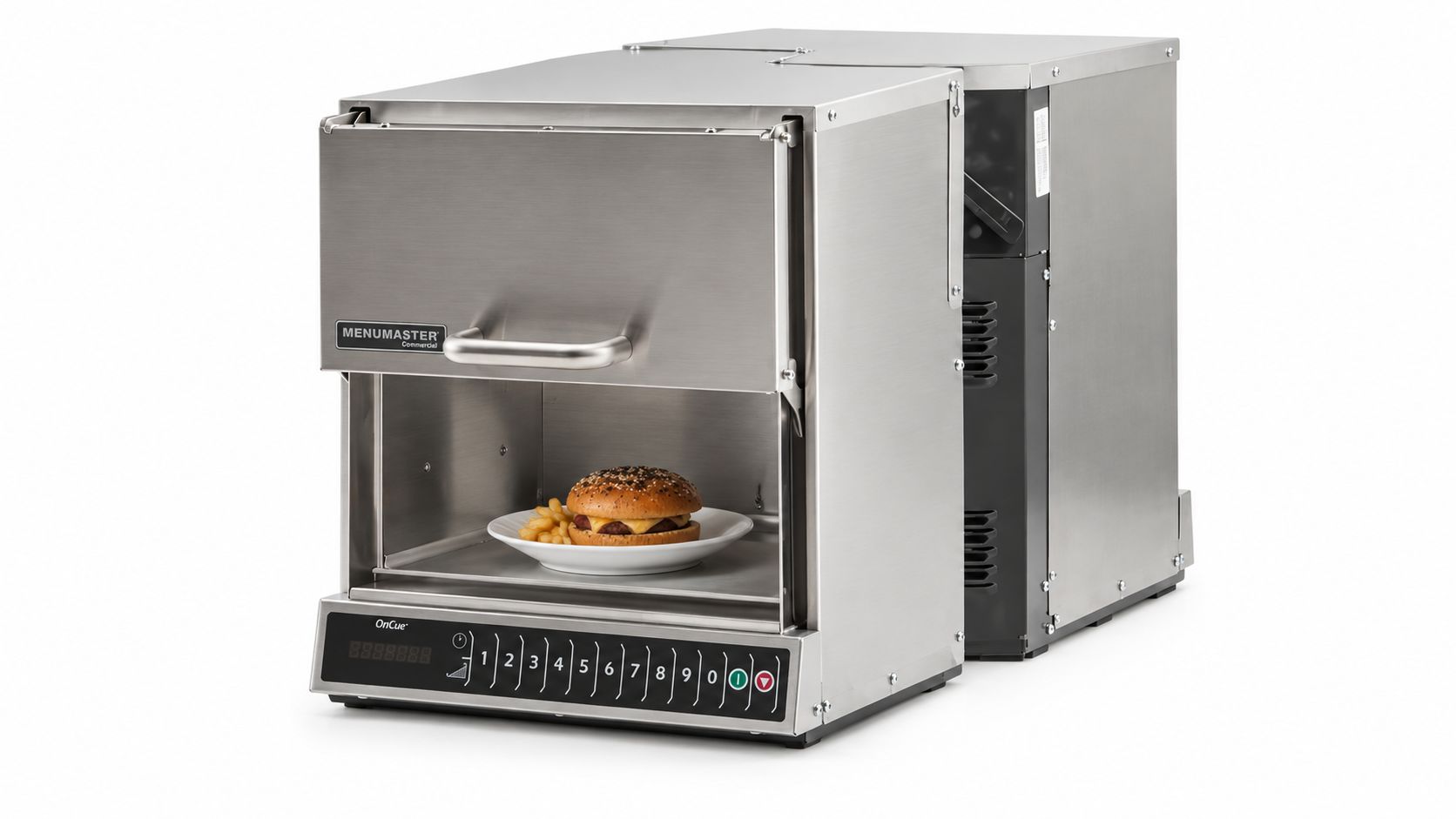
Small-format reheating can sit outside the gas line entirely. The Menumaster MOC5241 2400W Heavy-Duty Microwave has a 2400W output, a 9-litre cavity and a compact design for single-portion regeneration, bun warming and rapid sauce or side-dish heating. A practical overview of gas stove tops can help operators compare where gas belongs and where a separate appliance removes pressure from the cooking line.
Sizing the Range to Your Menu and Service
Range sizing becomes more accurate when the menu is treated as a production map rather than a list of dishes. A restaurant may need burners for sauté and sauce work, but depend on a nearby griddle for breakfast, a fryer for sides and a separate oven for batch production. A café may need fewer pans yet require fast access, compact width and an oven base for finishing.
A practical sizing method
Start with the busiest service period and write down each station's simultaneous work. Count the pans a single chef can reasonably supervise on the heat, then repeat the exercise across the line. Note whether pans are small saucepans, large sauté pans, stockpots or specialist vessels, because burner spacing and usable surface area can be more important than the headline count.
The cooking surface should then match the work:
- Open burners: Suitable for direct pan cooking, sautéing, boiling and rapid heat changes.
- Solid tops: Useful for distributed heat and gentler simmering, with a different recovery pattern from open flames.
- Griddle sections: Appropriate when eggs, burgers, vegetables, sandwiches or proteins need a dedicated hotplate.
- Oven bases: Select around the trays, racks, dishes and batch sizes the kitchen uses.
Footprint can change materially between apparently similar options. A Waldorf 800 four-burner range with oven is approximately 900 mm wide, while the six-burner version is approximately 1200 mm wide. A Blue Seal Evolution G505 four-burner oven range is 600 mm, compared with 900 mm for the six-burner version. These specifications should be checked against the current manufacturer documentation before final layout approval.
| Range Sizing Reference: Burners, Footprint and Typical Fit | Burners | Approx Width | Typical Fit |
|---|---|---|---|
| Waldorf 800 four-burner with oven | 4 | 900 mm | General pan cooking where the line has separate specialist equipment |
| Waldorf 800 six-burner with oven | 6 | 1200 mm | Higher simultaneous pan demand with sufficient line width |
| Blue Seal Evolution G505 four-burner oven range | 4 | 600 mm | Compact cooking line with limited width |
| Blue Seal Evolution G505 six-burner oven range | 6 | 900 mm | Broader pan capacity within a moderate footprint |
Oven capacity needs its own calculation
An oven underneath the range shouldn't be treated as a bonus. Confirm whether the kitchen needs GN containers, sheet pans, roasting trays, baking trays or a particular chamber height. A deck oven, convection oven and combi oven each create different loading patterns, and a separate salamander or overhead broiler can remove finishing work from the oven calculation.
A range that handles the pans but can't fit the required oven load still leaves the kitchen with a bottleneck. The equipment planning guidance for consistent meal service is relevant here because consistency depends on matching capacity to the actual production sequence. Peak pans and oven workload should be sized together, then checked against available floor space.
Planning Gas, Extraction and Services Early
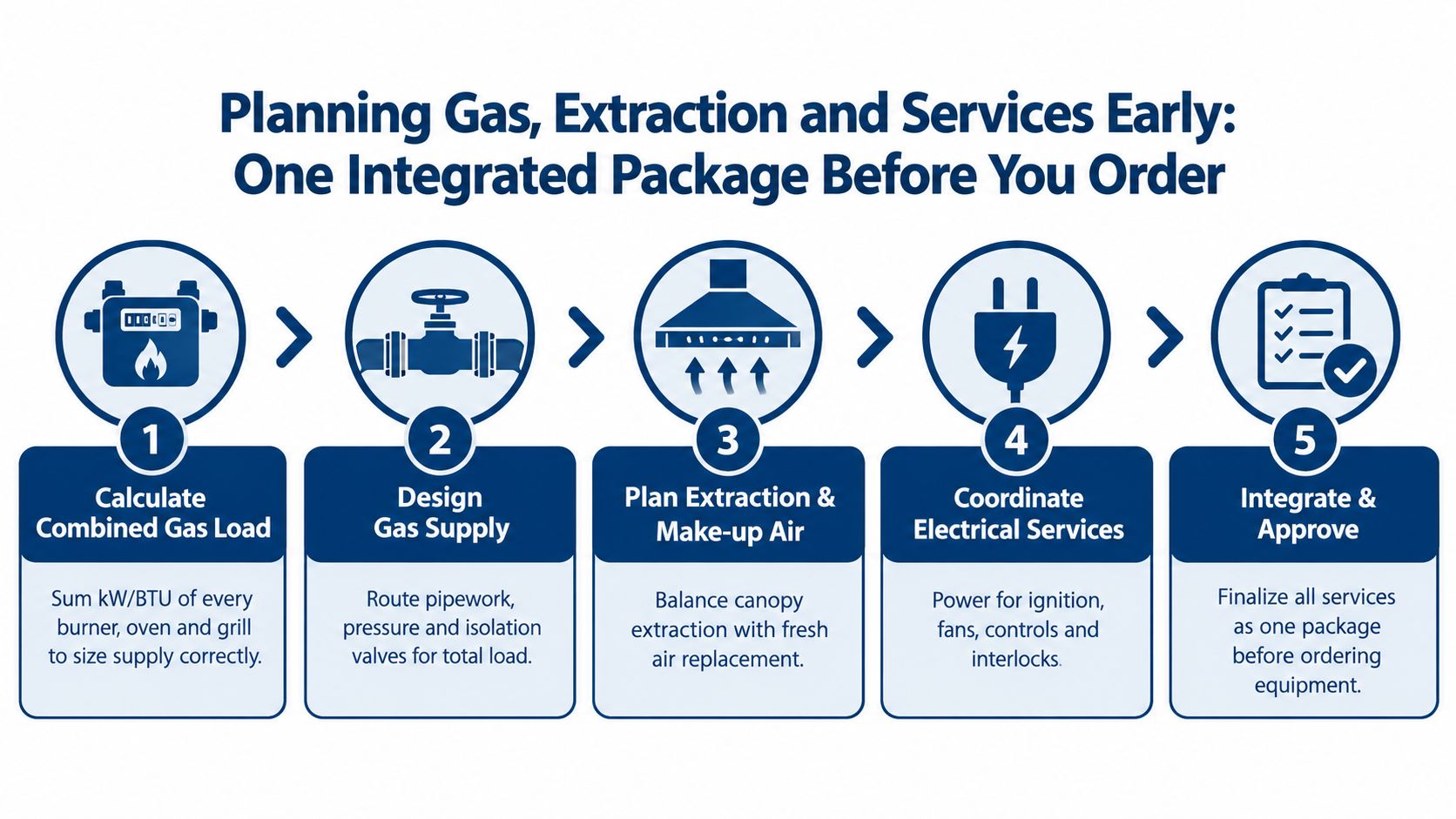
The range order should follow the services plan, not lead it. Start with the maximum number of pans likely to run together, then confirm the gas supply, extraction and electrical requirements for the complete cooking line. Burners, oven bases, griddles, chargrills and other gas appliances all contribute to the combined gas requirement, so one appliance specification cannot define the project.
Before finalising the order, have the project team verify:
- Gas type: Confirm whether the site uses mains gas or bottled gas, and check that every selected appliance suits that supply.
- Individual appliance requirements: Obtain current manufacturer specifications for each burner, oven, grill and pilot.
- Combined load: Add the simultaneous demand across the proposed line, then check the meter, pipework and LPG regulator capacity.
- Extraction design: Match the canopy, filters, fan and duct route to the cooking duty and equipment arrangement. Review this commercial kitchen extraction design guidance before fixing the canopy position.
- Make-up air: Plan replacement air where applicable, so the canopy does not create excessive negative pressure or interfere with combustion.
- Electrical services: Allow for ignition, controls, fans, lighting, interlocks, and any electrical oven or combi functions.
- Access and clearances: Confirm rear connections, service panels, flue terminations, wall finishes and delivery access before the line is fixed.
Ventilation is a safety system
Ventilation capacity must match appliance input. For non-room-sealed appliances above 1 kW per cubic metre of room volume, additional vents are required. Mechanical ventilation for plant rooms must supply 3.6 cubic metres per hour of outdoor air per kilowatt for forced- or induced-draught appliances, or 7.2 cubic metres per hour per kilowatt for atmospheric burners. Exhaust removal must be either one-third of inlet flow mechanically or through high-level openings sized at no less than 600 square millimetres per kilowatt of total gas consumption. These requirements are set out in NZ Building Code G4 ventilation guidance.
Poorly balanced extraction can affect combustion, staff comfort and appliance performance. Gas cooking is also a significant indoor source of NOx and PM. EECA estimates an annual indoor NO2 exposure increment of 2.88 μg/m³, with a range from 0.30 to 7.43 μg/m³, in homes with gas stoves, as reported in its NZ indoor combustion study. Commercial operators should specify effective capture ventilation and appropriate make-up air, particularly in open kitchens and compact back-of-house areas.
A frequent project failure starts with services being roughed in before the cooking equipment is specified. Hospitality can provide technical specifications for the proposed equipment, allowing gasfitters, ventilation specialists, designers and other qualified trades to plan around the actual line. Confirm those services before the range order is released.
Designing the Cooking Line Around the Range
A range works as part of a sequence. The chef takes product from refrigeration, cooks or finishes it at the line, transfers it to the pass, and returns for the next task. If the fryer, griddle, chargrill, refrigeration and preparation bench sit in the wrong places, extra burners won't solve the workflow problem.
Map the busiest dishes by cooking method. Pan-fried proteins may need open burners, while chips and other fried components belong at the fryer. Breakfast service may justify a griddle beside the range, and a chargrill can remove high-heat searing from the open burners. The oven should be positioned according to who loads it and where plated or garnished food goes next.
| Cooking line placement around a commercial gas range | Recommended Position | Reason |
|---|---|---|
| Fryer | Beside the range, subject to heat and safety planning | Keeps fried components within the active hot line |
| Griddle | Adjacent to the range or within the same cooking bank | Supports shared breakfast and à la carte workflow |
| Chargrill | Beside or near the range where searing is frequent | Separates direct grilling from pan burners |
| Refrigeration | Close to the working side of the line | Reduces unnecessary movement for raw and prepared ingredients |
| Preparation bench | Upstream of the range | Gives staff a controlled landing and staging area |
| Pass shelving | Downstream of the cooking equipment | Supports finishing and handover without crossing the line |
Output matters as well as capacity
Burner count alone doesn't describe cooking performance. Manufacturer specifications may show different burner outputs within different range families and configurations. A four-burner Waldorf 800 with 30 MJ burners can provide a different working profile from a six-burner unit with 18 MJ burners, so the operator should compare heat output, burner spacing and recovery requirements rather than assuming the larger unit is automatically stronger.
Modular widths such as 300, 600, 900 and 1200 mm can help designers build around the menu, but the final line still needs a practical landing surface and service access. The restaurant kitchen layout guidance is useful for considering movement, adjacency and station separation before the equipment schedule is locked.
A commercial range should earn its footprint by supporting the peak service, not by occupying space simply because a larger configuration is available.
NZ Safety, Compliance and the 2025 Gas Rules
Gas equipment must be treated as regulated infrastructure, not as plug-and-play kitchen furniture. Relevant installation work should be completed by appropriately qualified professionals, with the appliance, gas supply, ventilation and building requirements assessed as one system.
The Gas (Safety and Measurement) Amendment Regulations 2025 took effect on 13 November 2025. Appliances arriving in New Zealand after 13 November 2026 must meet the new certification requirements, including updated standards for ovens and wall ovens, as described in the legislation establishing the amendment regulations. Importers and operators planning replacement equipment in the transition period should confirm the certification pathway and applicable product standard before committing to an order.
Checks before commissioning
The project team should verify the following with the relevant trades and authorities:
- Certification: Confirm that the proposed appliance has the required current approval for its intended use in New Zealand.
- Gas installation: Arrange connection and commissioning through an appropriately qualified gasfitter.
- Ventilation: Check canopy design, airflow, make-up air and discharge arrangements against current requirements.
- Combustion safety: Ensure the system supports stable operation when multiple appliances run at high duty.
- Clearances: Confirm distances from combustible materials, wall linings, shelving and adjacent equipment.
- Domestic sleeping areas: Where a domestic gas cooker is installed in a non-room-sealed space also used for sleeping, permanent outside venting is required, with the vent size appropriate to the cooker input under NZ Building Code guidance.
- Documentation: Keep installation records, certificates, equipment specifications and relevant drawings on site as required for the premises.
Commercial kitchens also need a practical emergency plan. Staff should know how to isolate equipment if instructed, while only qualified people should alter gas connections, regulators, burners, controls or safety devices. Fire protection and emergency arrangements must be coordinated with the cooking load and site requirements rather than added after installation.
Cleaning, Servicing and Operator Watchpoints
Daily cleaning belongs to the kitchen team. Technical gas work doesn't. That distinction protects the appliance, staff and venue, particularly when a range has removable burner components, pilots, thermocouples, regulators or internal panels that require specialist assessment.
During and after service, staff can remove food debris and grease from accessible surfaces, clean cast-iron trivets according to the manufacturer's instructions, wipe burner surrounds, empty drip trays and clean oven interiors once the equipment has cooled appropriately. Hot glass and enamel surfaces shouldn't be shocked with cold water, and abrasive products can damage finishes.
A useful general reference for routine surface care is the Canes Cleaners stove maintenance guide. Commercial appliances still require their own manufacturer instructions, especially where burner heads, grates, oven linings or catalytic surfaces differ.
| Operator Tasks vs Qualified Service Tasks | Operator Responsibility | Qualified Trade Required |
|---|---|---|
| Surface and trivet cleaning | Remove food, grease and residue using approved methods | No, unless damage or contamination needs assessment |
| Drip tray and oven cleaning | Empty, wash and inspect accessible parts | No, unless components are damaged or seized |
| Burner observation | Report irregular flames, ignition faults or burner outages | Yes, for diagnosis and repair |
| Gas jets and regulators | Do not remove, adjust or modify | Yes |
| Thermocouples and safety controls | Report suspected faults | Yes |
| Interior panels and gas connections | Keep staff out of technical areas | Yes |
| Combi-oven cleaning cycles | Follow the appliance procedure and chemical instructions | Yes, for persistent faults or servicing |
Report changes early
Staff should flag yellow flame tips, inconsistent ignition, pilot outages, unusual soot around burner ports, damaged controls, excessive grease accumulation or a change in oven performance. These signs don't identify a fault by themselves, but they justify assessment rather than improvised repair.
Manufacturers set cleaning and maintenance requirements for each appliance. Service intervals should reflect trading hours, cooking duty and the equipment environment, not just a convenient calendar reminder. Staff shouldn't work on gas jets, regulators, thermocouples or internal panels, and operators should check warranty conditions because scale build-up, misuse or unauthorised alterations may affect coverage.
Lifecycle, Warranty and Getting the Project Right
A commercial range is a long-term operating decision, even when the initial question sounds simple. Heavy-duty burners, oven controls, hinges, ignition components and other parts all influence future service requirements, while deck and combi ovens bring their own heating, water, drainage and control considerations. The purchase should therefore be assessed against menu fit, access to qualified service, spare-parts support, cleaning requirements and the consequences of downtime.
Warranty has two separate dimensions. Manufacturer warranty generally relates to the appliance and its covered components, while installer workmanship concerns the gas, electrical, ventilation or building work carried out on site. The operator should identify who is responsible for each part before commissioning, retain the documentation and clarify what routine cleaning or descaling is required to keep coverage valid.
Procurement checks that prevent rework
Before the equipment is signed off as operational, the project team should confirm:
- Site survey: Measure doorways, corridors, floors, walls, canopy position and service access.
- Equipment schedule: Lock the exact model, configuration, dimensions, burner outputs and oven arrangement.
- Gas calculation: Confirm the combined demand of the complete cooking line with the relevant gasfitter.
- Extraction design: Approve canopy, ducting, fan, filters and make-up air where applicable.
- Electrical coordination: Check ignition, controls, interlocks, fans and any electric oven or combi requirements.
- Compliance sign-off: Arrange the required inspections, certificates and commissioning records.
- Pre-delivery access check: Confirm that the unit can reach its final position and that service panels remain accessible.
Hospitality can support equipment specification, kitchen design and layout modelling, product selection around the menu and available services, quotes, trade accounts, certified used options, warranties, service requests and finance pathways through SilverChef. The useful role is coordination, while gas connection, ventilation design, electrical work and technical servicing remain with the appropriately qualified trades.
The central procurement test remains practical: will the selected range support the pans, oven work and movement required at peak service without overwhelming the available services? If the answer is unclear, the range isn't ready to order.
For help matching Blue Seal Evolution, Waldorf, Waldorf Bold or Cobra gas stoves and ovens to a menu, cooking line and site services, contact Hospitality's equipment team. Visit Simply Hospitality to review commercial cooking equipment and discuss the specifications that gasfitters, ventilation specialists and designers need before installation.