

Hotel Kitchen Equipment NZ: A Practical Buyer's Guide
At 7:30am, a hotel kitchen may be running a full breakfast buffet, sending room-service trays upstairs, preparing lunch production and starting mise en place for an evening function. That workload has little relationship to the number of guest rooms alone. Hotel kitchen equipment NZ planning must account for breakfast, à la carte dining, bars, conferences, banqueting, buffet service and in-room dining operating from the same production infrastructure, often at the same time.
The right specification starts with concurrent demand, not a generic equipment list. Rooms, restaurant covers, function capacity, service formats and the worst overlap between them determine cooking capacity, refrigeration, warewashing, storage, extraction and front-of-house movement. A hotel kitchen should be designed for the difficult morning when breakfast is full, room service is active and the banquet team is preparing for a large evening event.
Why Hotel Kitchens Are Different From Restaurant Kitchens
A standalone restaurant usually has a clearer service rhythm. Its kitchen prepares for lunch, transitions into dinner, and works around one primary menu and one dining room. A hotel kitchen has several operating patterns to manage, and those patterns can overlap without warning.
Breakfast may require buffet replenishment, egg cookery, pastry bake-off, coffee support and high-volume dish returns. At the same time, room service may need plated meals, the restaurant may be preparing for lunch, the bar may require food components, and the events team may be staging canapés or banquet mise en place. Staff meals, dietary requests and late-night in-room orders add further variation.
Multiple revenue streams share one back-of-house
Hotel equipment needs to pivot between formats during the same shift. A combi oven may support breakfast rolls, roasted proteins, steamed vegetables and banquet regeneration. Refrigeration may hold raw ingredients, prepared function food, plated room-service components and buffet items. Warewashing must cope with crockery, glassware, trays, gastronorm pans and banquet equipment without allowing dirty returns to obstruct production.
That makes versatility and recovery more important than buying the largest version of every appliance. Equipment must handle sustained use, but it also needs to remain practical during quieter periods. Oversized machinery can consume valuable floor space and create unnecessary cleaning and service demands, while undersized equipment creates queues at the exact moment several departments need it.
Practical rule: A hotel kitchen must be tested against its busiest overlap, not its average day.
The physical layout matters just as much as the equipment schedule. Function plating shouldn't cross the main restaurant pass. Room-service trays need a clear dispatch point. Dirty crockery needs a return route that doesn't pass through pastry or cold preparation. Service lifts, corridors, storage rooms and loading access all affect whether the kitchen works as drawn on paper.
New Zealand's accommodation sector provides a useful planning signal because Stats NZ tracks accommodation capacity, occupancy rates and guest nights at national, regional and lower levels. IBISWorld estimates 294 businesses in New Zealand's Hotels & Resorts industry in 2026, with market revenue of about $2.2 billion and projected annualised growth of 8.1% over the five years through 2026–27. Those figures indicate a sizeable, relatively concentrated sector where demand for kitchen equipment comes from new builds, refurbishments, compliance upgrades and replacement of ageing assets.
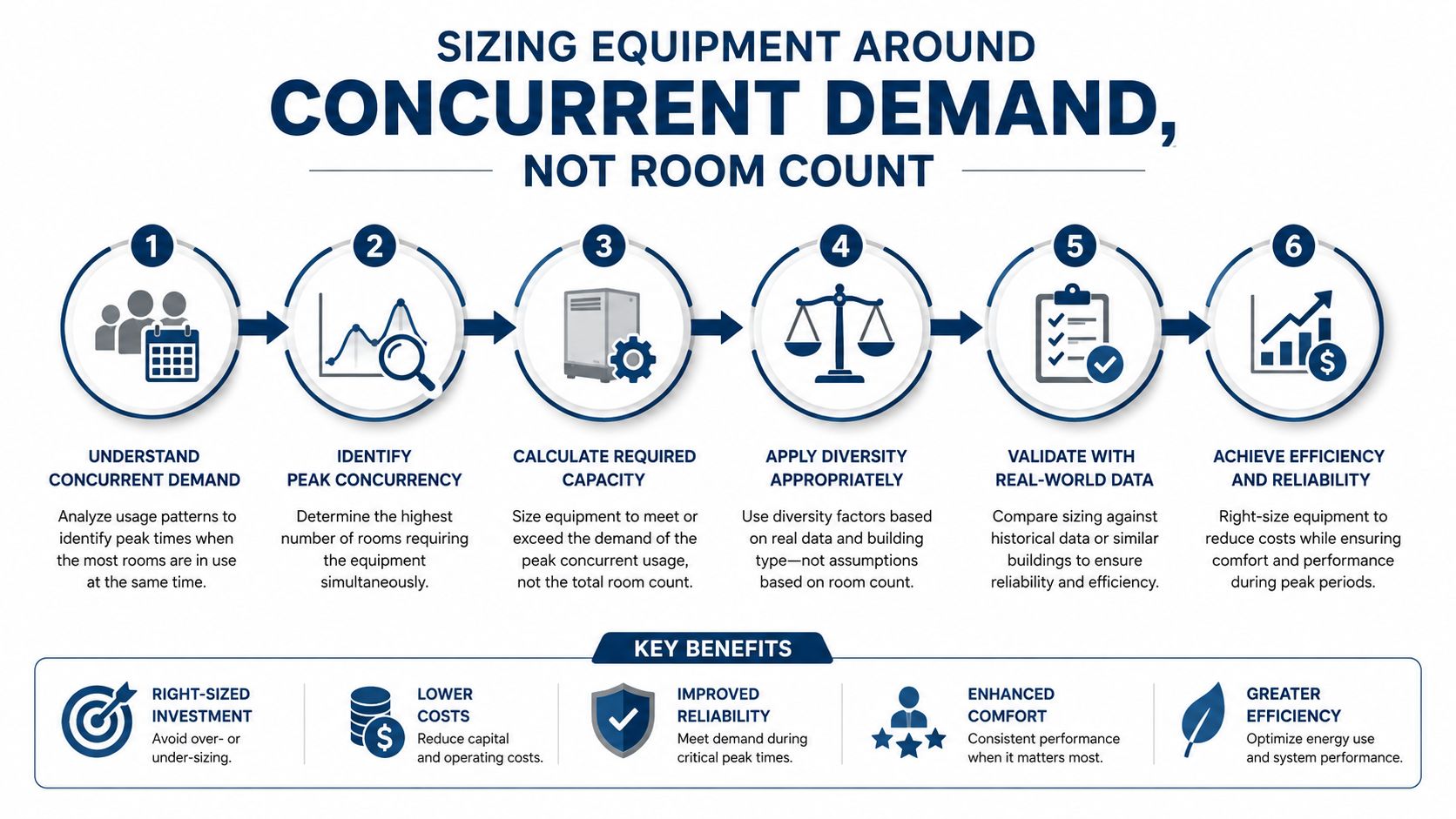
Sizing Equipment Around Concurrent Demand, Not Room Count
A 100-room property with a busy conference floor and weekend weddings can require a more capable kitchen than a larger limited-service hotel serving breakfast only. Room count estimates guest-related demand, but it does not show restaurant covers, function production, buffet replenishment or how many services run at the same time.
Use four inputs to set the equipment schedule:
- Rooms: This affects breakfast volume, room-service demand and the amount of crockery entering the return stream.
- Restaurant covers: Lunch and dinner production sets requirements for the cooking line, pass space, preparation benches and service refrigeration.
- Function capacity: Banquet seating, buffet throughput and event menus determine batch cooking, holding, plating and warewashing needs.
- Peak overlap: The busiest operating window shows whether breakfast, room service, restaurant production and functions can share appliances without creating delays.
Translate demand into equipment decisions
Convert those four inputs into working specifications. Function cooking may set combi oven pan capacity, while restaurant service may determine burner numbers, griddle area and fryer baskets required at the pass. Breakfast and room service can also increase the need for underbench refrigeration at working stations, rather than relying only on a remote cold room.
Warewashing must match concurrent returns. A hotel with heavy breakfast turnover and banquet equipment returning later needs enough machine capacity and landing space to clear both peaks without building a backlog of dirty ware. Cold storage follows the same rule. Function mise en place must not take the space needed for daily breakfast ingredients.
A hotel with 120 rooms, an 80-cover restaurant and a 150-person function room cannot be specified like a 120-cover restaurant. Its cooking line may need greater production flexibility, holding capacity and refrigeration access because restaurant service, guest services and functions can overlap. A fixed multiplier cannot replace the actual menu, service timings and production methods. Base the specification on the peak schedule.
Build a sizing worksheet
Start with a service matrix:
- List each meal period, event and service format.
- Record the busiest expected overlap.
- Identify dishes that are cooked, regenerated, held or plated.
- Assign every process to a specific appliance.
- Check whether departments need that appliance simultaneously.
- Confirm access, storage, cleaning and dispatch routes.
Use this guide to plan equipment for consistent meal service, especially when production must remain consistent across different service periods. Include menu changes, seasonal functions and maintenance downtime in the worksheet. Buy duplicate equipment only where the operating plan shows a real requirement, not for every theoretical scenario.
Cooking Equipment for Multi-Format Hotel Service
The cooking line should be built around appliances that can move between service formats. A hotel doesn't need every cooking method duplicated in every section. It needs a sensible combination of high-capacity production equipment, responsive à la carte appliances and enough separation to prevent one service from blocking another.
Start with flexible production
Combi ovens are often the anchor because they can support roasting, steaming, baking and regeneration within one coordinated workflow. Models from brands such as Convotherm and Unox can be considered where menu range, programme control, installation services and local support align with the project. A combi is most useful when the kitchen has a clear pan plan and staff know which products belong in batch production, which belong in live cooking and which require holding.
A Turbofan convection oven can work well as a secondary unit for pastry, baking, breakfast items or dedicated bake-off. The advantage of separating some baking demand from the combi is operational availability. The trade-off is additional floor space, extraction or electrical demand, and another appliance to clean and maintain.
A commercial range remains valuable for sauces, pans, finishing and responsive restaurant service. Blue Seal and Waldorf equipment can suit cooklines where sturdy modular construction and familiar controls matter. Gas may provide a direct response that chefs prefer, while induction offers a different approach to heat control, cleaning and utility planning. The correct choice depends on the menu, available services, extraction design and the operating team.
Fryers need to be judged by peak demand and recovery behaviour, not tank size alone. A breakfast griddle may handle bacon and eggs, while an evening chargrill supports steaks, seafood or vegetables. These appliances often become bottlenecks when a hotel tries to serve restaurant orders while producing banquet items, so placement and access to refrigeration and landing benches deserve close attention.
Match the appliance to the service stream
| Service Stream | Primary Equipment | Typical Capacity / Spec |
|---|---|---|
| Breakfast buffet | Combi oven, convection oven, griddle, heated holding | Pan production, bake-off and replenishment without blocking à la carte work |
| À la carte restaurant | Range, cooktop, fryer, griddle or chargrill | Responsive cooking across individual orders |
| Room service | Combi oven, convection oven, underbench refrigeration, hot holding | Small-batch production and controlled dispatch |
| Functions and banquets | Combi ovens, bulk cooking equipment, holding cupboards | Batch cooking, regeneration and coordinated plating |
| Bar food | Fryer, griddle, compact cooking equipment | Fast production near the service pass |
| Pasta and noodle menus | Dedicated pasta cooker, range or combi support | Confirm water recovery, basket demand and receiving station |
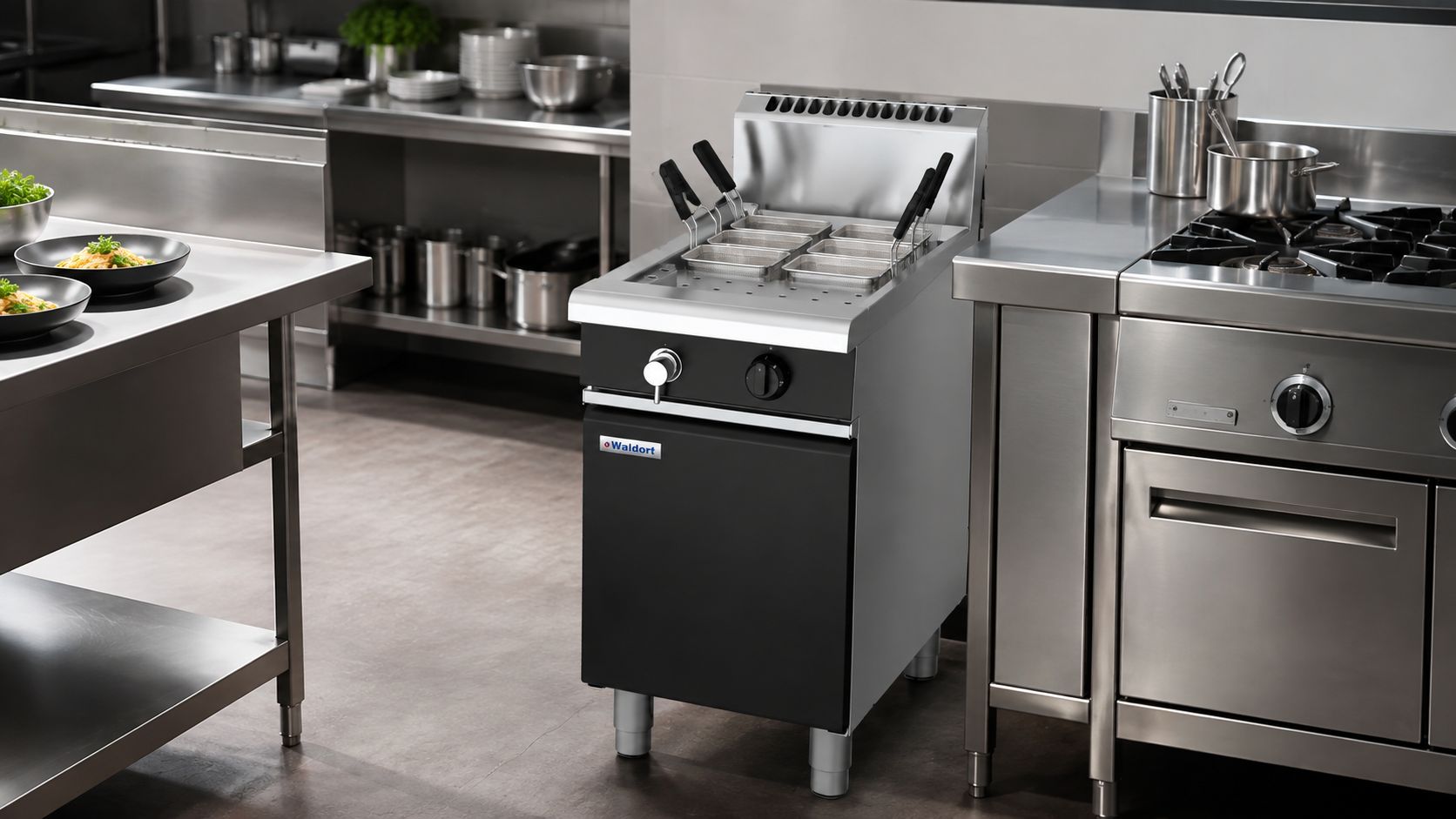
For continuous pasta or noodle production, the Waldorf Bold PCB8140G - 450mm Gas Pasta Cooker provides a 40 litre water capacity, a 47MJ/hr infrared burner, four stainless steel pasta baskets and an integrated water fill and starch-skimming faucet. Its 450mm floor-model format can work as one module in a coordinated cookline, but the specification still needs to confirm water quality, fill and drain rates, extraction and the receiving sauce or plating station.
Salamanders, bratt pans, stockpot stoves and finishing equipment should support a defined menu need. Bespoke single-purpose equipment can look efficient in a concept plan but becomes restrictive when menus change. Combi ovens for New Zealand kitchens are worth assessing as part of the complete production system, not as an isolated purchase.
Refrigeration and Cold Storage for Hotel Kitchens
Hotel refrigeration must support overlapping demand. Breakfast prep, room-service components, restaurant mise en place, buffet displays, pastry, sauces and function production may all require controlled storage during the same shift. Total volume alone does not show whether the system works. Staff also need fast access, clear product separation and enough recovery capacity when doors open repeatedly.
Design cold storage around the workflow
Upright refrigerators and freezers provide general storage for ingredients and prepared food. Atosa and SKOPE are relevant brands to consider through Simply Hospitality, subject to the project's capacity, service and installation requirements. Place underbench refrigeration at active stations so chefs can reach proteins, garnishes and mise en place without leaving the bench. Preparation refrigeration can combine a worktop with ingredient wells, reducing trips to remote storage.
Build the equipment schedule around a documented cold-chain management process, not cabinet capacity alone. The process should define receiving, storage, preparation, service, temperature checks and corrective action across breakfast, room service, restaurant and function periods.
New Zealand guidance treats potentially hazardous chilled food as requiring 5°C or below, with the danger zone defined as 5°C to 60°C. Hot food should be held at 60°C or above, and food held in the danger zone for more than four hours must be discarded, as outlined in New Zealand coolroom temperature guidance. MPI's practical refrigerator target is between 2°C and 5°C, supporting equipment that recovers reliably after repeated door opening and busy service periods, as described in its safe food storage guidance.
Look beyond the cabinet label
Blast chilling suits hotels producing batches for later service, but only when it fits the food-safety procedure, storage plan and staff training. Banquet service alone does not justify the purchase. Review the menu, production timing, batch size and available cold storage first, then confirm whether chilling removes a genuine bottleneck.
Position every refrigeration unit before the fit-out is finalised. Door swing, ventilation clearance, drain runs, cleaning access and staff routes can restrict performance and create service problems when checked late. Refrigerated cabinets in New Zealand are also subject to the Energy Efficiency (Energy Using Products) Regulations 2002. Updated test and compliance provisions for the current refrigerated cabinet framework took effect on 5 October 2024, with further test-report transition rules through 5 October 2025, according to the refrigerated cabinet compliance framework.
Assess energy use against operating hours, utilisation, production capacity and maintenance access. EECA's hotel pathway encourages practical tools and international innovations that reduce energy demand. Compare the complete operating system, including controls, workload, service requirements and whether one appliance can replace several processes.
Warewashing, Prep, Stainless Fabrication and Building Flow
Warewashing is frequently under-specified because the equipment schedule focuses on cooking. That mistake becomes obvious when breakfast plates, coffee cups, room-service trays and banquet equipment return together. A machine that handles ordinary restaurant service may not provide enough landing space, rack movement or separation for hotel peaks.
A passthrough system can improve the distinction between dirty and clean sides, provided the room layout gives staff enough space to load, unload and store racks. Classeq, Rhima and Winterhalter and in certain instances Washtech are brands worth considering where machine format, water treatment, service support and the hotel's operating procedures align. The machine must be selected with the actual ware mix in mind, including plates, glassware, cutlery, trays and gastronorm containers.
Stainless fabrication should follow the room
Custom stainless fabrication often makes better use of a hotel kitchen than a collection of standard benches. Integral sinks, wall shelving, overhead utensil racks, underbench storage and custom landing areas can reduce awkward gaps and improve cleaning access.
| Grade | Typical Use | Key Characteristic |
|---|---|---|
| 304 stainless steel | Wet zones, sinks and wash areas | Strong corrosion resistance for regular moisture and cleaning |
| 430 stainless steel | Dry areas and selected equipment surrounds | Practical for lower-moisture applications where the specification allows |
| 316 stainless steel | Specialist wet or demanding food-contact applications | Higher resistance where the equipment design calls for it |
The specified grade must match the exposure, cleaning regime and manufacturer requirements. Welded corners, coved junctions and accessible undersides matter more than a polished appearance. A bench that looks impressive but traps food behind a fixed panel creates a maintenance problem from opening day.
Map the dirty-return route before ordering
Service corridors, loading access, lift dimensions and door widths belong in the equipment plan. Trolleys need to turn without striking walls, and staff need a clear route from dining rooms and function spaces to warewashing. Storage must include clean trays, banquet furniture, buffetware, chemicals and replacement consumables, not just food.
Food preparation equipment should be based on the menu that will be run. A Robot Coupe processor, planetary mixer, slicer, vacuum packer or blender can be highly useful, but the size must match batch volume, staff technique and cleaning capacity. The kitchen design advice for saving time on service is most relevant when equipment locations are mapped against the full movement of people, food and dirty ware.
Front-of-House and Service Equipment Hotels Often Leave Too Late
Breakfast may still be running when room-service orders leave the pass and a function team needs plated meals. If the service equipment cannot support those overlapping demands, guests notice quickly. Cold room-service trays, banquet trolleys that cannot fit through a lift and buffet stations without replenishment space all expose weaknesses in the original kitchen plan.
Specify service equipment with the production system
Heated cupboards provide controlled holding between the kitchen and service point. Choose banquet and service trolleys with reliable castors, usable handles and dimensions checked against corridors, lifts, doorways and storage rooms. Clearing trolleys should keep dirty returns separate from clean service equipment, while allowing staff to move safely through guest areas.
Mobile holding suits functions plated in one location and served in another. Heated cupboards, insulated carriers and mobile induction warming can help protect service conditions, provided staff still complete temperature checks and follow documented food-safety procedures. Hot food should be held at 60°C or above, so holding capacity, travel time and operating practice must be specified together, as set out in local food-premises guidance.
Breakfast presentation needs its own equipment schedule. Include buffetware, risers, chafing systems, display stands, plate dispensers, beverage stations and shelving for replenishment. These choices affect reset time, queue movement and the volume of clean equipment required between services. Craster may suit a hotel seeking a refined buffet presentation, but premium equipment still needs to be easy to clean, store and transport.
Build room service around dispatch
A workable room-service setup includes plate covers, insulated domes, tray stands, hot bags, cutlery packs, condiment storage and a dedicated dispatch bench. Check every item against lift dimensions, corridors, guest-room doors and trolley storage. A restaurant trolley may fail in room service if it blocks a service lift or cannot be parked without obstructing a hallway.
Coffee service needs the same joined-up planning. Specify the machine, grinder, water treatment, cups, milk storage, waste handling and breakfast replenishment route as one system. Front-of-house equipment determines how the kitchen's work reaches the guest, and it can reveal access, holding and storage problems hidden inside the cooking room. Plan those constraints before purchasing equipment, not after the first busy service.
Compliance, Energy, Procurement and Getting Support From Simply Hospitality
Compliance must shape the equipment schedule before anyone places an order. Food premises need suitable building, ventilation, hygiene and temperature controls, and those requirements affect the room layout, services and equipment selection. Confirm the applicable rules with the project's food-safety adviser, council and building specialists before fabrication begins.
Resolve services before equipment arrives
Mechanical extraction must cover every cooking appliance. If natural ventilation is inadequate, the system needs suitable discharge, make-up air, noise control, fire provisions and access for cleaning. The healthy homes ventilation standard provides useful ventilation context, but a commercial hotel kitchen still needs a design based on its actual cooking load and building conditions.
Gas appliances require compliant installation by a registered gasfitter. Confirm electrical loads, water pressure, drainage, hot-water capacity, grease management, floor levels and backflow protection before stainless fabrication. Include each utility requirement in the equipment schedule, including connection points, isolation access, clearances and commissioning needs.
A late services change can force revisions to the canopy, walls, benches, flooring and delivery programme. Resolve those interfaces while the kitchen is still on paper.
Compare whole-of-life operation
EECA reports that in 2022, commercial ovens and cooking elements accounted for 15% of the sector's energy use, while refrigeration accounted for 22%, making these two equipment groups particularly important for hotel operating costs and emissions, as reported in commercial refrigeration energy guidance. Compare rated power with production capacity, utilisation, operating hours, controls, maintenance access and labour requirements. An appliance that combines several processes may reduce handling and space, even when its nameplate rating is not the lowest.
Use energy-efficient appliance guidance alongside manufacturer data and the hotel's operating pattern. Breakfast, room service, restaurant production and functions can run across the same shift, so energy comparisons must reflect concurrent use rather than a single quiet period.
Gas versus electric cooking depends on supply, tariff structure, extraction, menu and the hotel's decarbonisation direction. EECA's hotel decarbonisation pathway encourages hotels to use practical tools and consider current international innovations to reduce energy demand. Review published energy information and expected use, then avoid promising savings that have not been measured at the property.
Use a disciplined procurement checklist
Before approving an order, the project team should confirm:
- Site measure: Verify room dimensions, slab levels, doors, lifts, loading access and storage.
- Services rough-in: Confirm electrical, gas, water, drainage, extraction and ventilation requirements.
- Workflow: Draw clean and dirty routes, function dispatch, room-service staging and replenishment paths.
- Capacity: Test breakfast, restaurant, room service and function production during the same operating window.
- Documentation: Record model specifications, utility loads, installation clearances, warranty terms and commissioning requirements.
- Handover: Allow time for commissioning, temperature checks, operator training, cleaning procedures and maintenance instructions.
For larger projects, technical specification templates for procurement can help define performance, services, installation obligations and acceptance requirements before suppliers quote. Clear documents reduce disputes between the consultant, builder, installer and equipment provider.
Certified used equipment can suit a project when its service history, condition, warranty and parts support are documented. Check age, controls, refrigeration condition, compliance and expected workload before treating it as suitable for hotel demand. SilverChef weekly finance may help preserve cash flow when specialist equipment is required, but review the repayment structure and total commitment against the hotel's trading plan.
Hospitality can supply refrigeration, cooking appliances, food-preparation equipment, dishwashing systems, stainless fabrication, buffetware, room-service equipment and consumables within a wider project team. Where broader design coordination is required, SACH can support front-end kitchen design, equipment specification and project management. A consolidated trade account can also organise consumables, spare parts and warranty labour. The practical gain comes from agreeing the specification, services, movement routes and handover requirements before equipment reaches site. A hotel kitchen succeeds when its equipment, building and staff can handle overlapping service without creating a new bottleneck.
Hospitality supplies hotel kitchen equipment, refrigeration, cooking appliances, warewashing, stainless fabrication, buffetware and room-service equipment for New Zealand hospitality operations. Visit Simply Hospitality to discuss a specification based on rooms, covers, functions, service formats and peak concurrency, rather than room count alone.