

How to Sharpen Kitchen Knives for Hospitality Kitchens
A sharper knife doesn't need to be sharpened constantly. In a commercial kitchen, good knife care means preserving the existing edge for as long as practical, then removing only enough steel to rebuild it when routine maintenance no longer restores cutting performance. That distinction matters for chefs using Global, Yaxell, Wüsthof, Victorinox or Furi knives, because blade construction, geometry, workload and manufacturer guidance all affect the right approach.
A blunt knife can demand more force and make controlled cutting harder during busy preparation. New Zealand's hospitality injury data shows why this matters, with ACC reporting more than 13,000 knife-related injury claims in 2021, a figure highlighted by RNZ's coverage of knife-related ACC claims. The practical response isn't to grind every knife aggressively. It's to maintain edges properly, train staff and treat sharpening as part of safe kitchen operations.
Why Sharp Knives Need Less Sharpening Than You Think
The popular advice is simple: if a knife feels dull, sharpen it. In practice, that advice encourages unnecessary metal removal. A knife that has an edge rolled slightly out of alignment may respond well to honing, while a knife whose edge has worn away needs sharpening. Those are different jobs.
Honing realigns an existing edge. Sharpening removes blade material to recreate the edge. Confusing the two can shorten the useful life of a knife, particularly when staff use pull-through or electric sharpeners every time cutting performance drops. Consumer NZ warns that these sharpeners remove metal with each use and can progressively damage blades, while suitable steeling can realign an edge without removing metal, as outlined in its knife care guidance.
Practical rule: Maintain the edge first. Rebuild it only when maintenance no longer brings back the required cutting performance.
New Zealand workplaces treat this as more than a cooking preference. WorkSafe identifies sharpening knives or other blades as a common injury risk in cafés and restaurants, while hospitality competency standards require safe knife handling, care, storage and carrying. NZQA's unit standard 13285 also requires knife-sharpening techniques to be demonstrated according to the standard industry text, which places sharpening within assessed commercial kitchen competency rather than leaving it as an informal habit.
Why edge maintenance matters during service
A sharp, appropriately maintained blade usually supports controlled prep. A blunt edge can encourage a worker to push harder, change hand position or rush a cut. Those changes increase the importance of stable technique, clear bench space and safe storage.
WorkSafe's guidance also highlights risks associated with handling, sharpening and retrieving knives. That means a kitchen's procedure should cover who sharpens knives, where the task takes place, how equipment is secured and how blades are returned to storage. A sharpening station beside a crowded prep bench may be convenient, but it can create avoidable contact and distraction risks.
The operating principle
The correct question isn't “How often should every knife be sharpened?” It's “What does this knife need now?” A chef's knife may need routine honing, a chipped specialist blade may need professional attention, and a heavily used production knife may need a controlled sharpening process because honing no longer restores its edge.
The right method depends on the knife and the person using it. Hospitality kitchens often contain European-style chef knives alongside Japanese-style blades, filleting knives and heavier butchery tools. Treating them all as identical creates inconsistent geometry and unnecessary wear.
Preparing to Sharpen Safely in a Commercial Kitchen
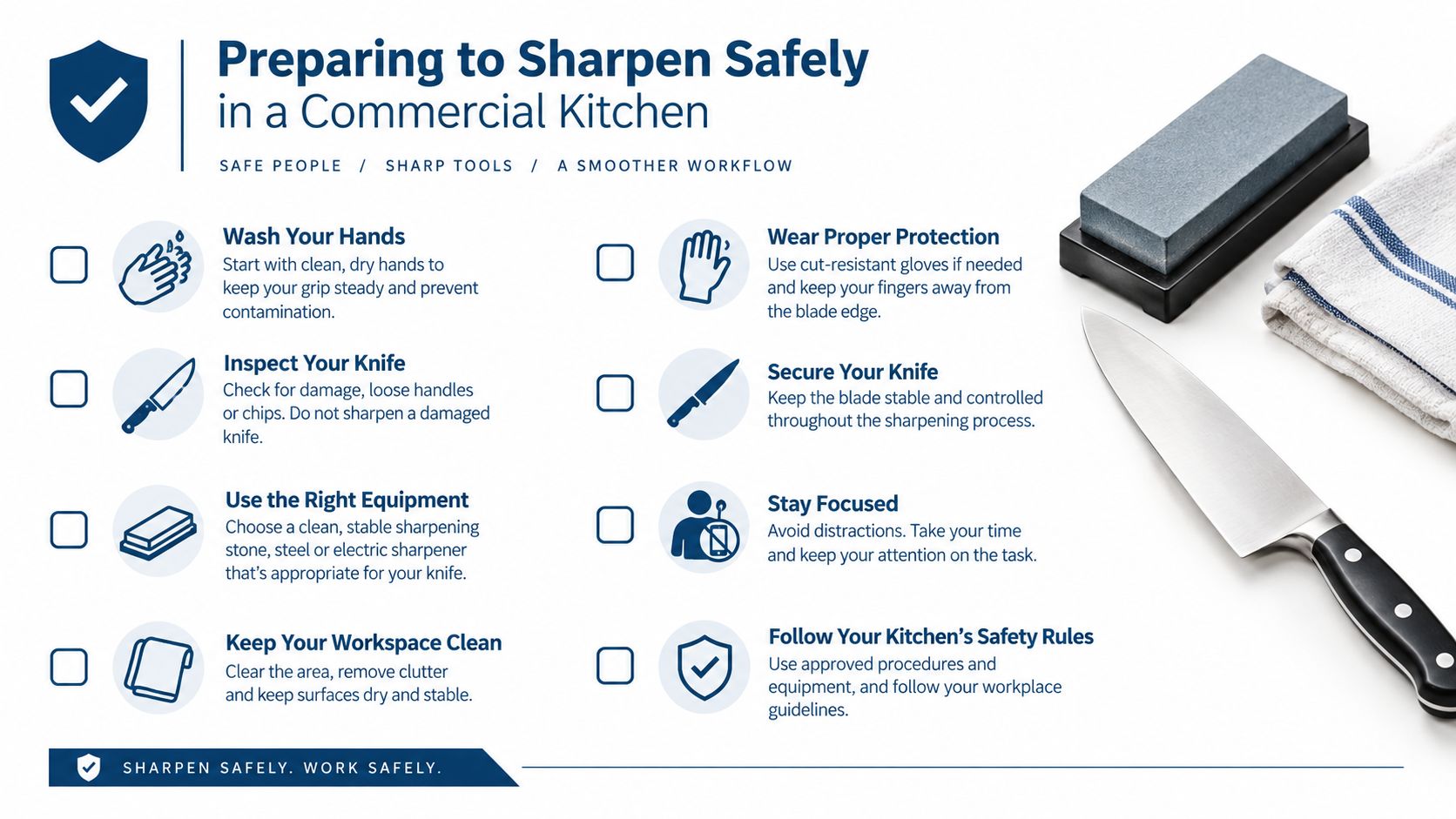
Sharpening should start with an assessment, not a stone or machine. The operator should first decide whether the knife has an aligned but tired edge, a worn edge, a chip, a bent tip or damage that shouldn't be corrected at the bench.
Wash and dry the knife before inspection. Food residue can obscure small edge damage, and moisture makes handling less controlled. Check the blade's edge in good light, look along the blade for chips or flat sections, and inspect the tip for bending. If the blade has significant damage or the intended geometry is uncertain, stop before removing steel.
NZQA unit standard 13285 expects the operator to select an appropriate sharpening method for the knife and workplace procedure. Related unit standard 40400 also requires the knife to be sharpened safely to the bevel and point shape appropriate to its purpose. That makes the preparation stage important. The operator needs to know what cutting profile the knife is supposed to have before trying to recreate it.
Secure the work area
A whetstone must not slide while the blade is moving across it. Place the stone on a non-slip base or a damp towel, keep the surrounding bench clear and position the work so the operator can maintain control without reaching across other equipment.
Water stones commonly need to be soaked for about 5 to 10 minutes, according to NZ sharpening guidance such as this practical knife-stone guide. The exact preparation depends on the stone, so the stone manufacturer's instructions should take priority. A dry water stone can behave differently from a properly prepared one and may suffer damage.
Use light, even pressure. Force doesn't make a controlled edge faster. It can remove excessive metal, destabilise the blade and make it harder to maintain the intended bevel.
Separate sharpening from other bench work
Sharpening should happen away from exposed food, clean serviceware and active production wherever possible. The stone, steel or system should be clean, and the knife should be washed again after sharpening to remove any residue before it returns to food preparation.
That separation supports the broader hygiene practices covered in guidance on preventing cross-contamination. It also reduces the chance that a staff member picks up the wrong tool during a busy changeover.
Equipment layout influences safety as well. For example, a Waldorf Bold INLB8100F-B - 450mm Electric Induction Cooktop Low Back Version - Bench Model is a bench-mounted cookline module with a flat ceramic glass surface and automatic pan detection, but sharpening equipment shouldn't be placed on an active cooking surface. Any sharpening area needs its own stable, clean working space with access to storage and washing facilities.
Choosing the Right Sharpening Method for Your Knives
No single sharpening method suits every commercial kitchen or every knife. Whetstones give an experienced operator control over the bevel and finish, but they require skill and time. Guided systems can improve repeatability across a larger knife set, while electric equipment can be convenient only when it's compatible with the blade and used correctly.
The knife manufacturer's guidance should come first. A method that suits a Victorinox chef's knife shouldn't automatically be applied to a Global, Yaxell, Wüsthof or Furi blade. Japanese-style and European-style knives may be built with different edge geometries, and repeated sharpening with the wrong system can gradually change the blade.
Comparing the practical options
| Method | Best For | Trade-off to Consider |
|---|---|---|
| Whetstones | Experienced staff who need control across different blades | Requires practice, time and consistent technique |
| Honing steels or rods | Routine alignment of an existing edge where appropriate | Won't rebuild an edge that has worn away |
| Guided sharpening systems | Kitchens seeking repeatable angles across multiple knives | The guides still need to suit the knife geometry |
| Electric sharpeners | Compatible knives and trained operators who need a faster process | Can remove metal every use, and misuse may overheat or damage blades |
| Professional sharpening | Chips, damaged blades, specialist edges or uncertain geometry | Requires planning around collection, return and operational availability |
A smooth metal or ceramic steel is generally used for routine alignment where appropriate. Rough, grooved or diamond steels can behave more like files and damage the edge, so they shouldn't be selected just because they feel aggressive or fast. Consumer NZ also warns that motorised sharpeners are easy to misuse unless the operator is very experienced.
Match the method to the kitchen
A small café with a limited number of standard knives may manage well with appropriate honing and a whetstone used by a trained person. A hotel, production kitchen or catering operation maintaining many knives may value repeatability more than the flexibility of freehand sharpening. A specialist butcher or fish preparation area may need different equipment for different blade profiles rather than one machine for the whole kitchen.
Operators comparing stone options can also review this article about knife sharpening stones. The useful question isn't which tool looks most professional. It's whether the tool matches the knives, the staff capability, the workplace procedure and the amount of control required.
Electric sharpening can be practical when the manufacturer allows it and the operator understands the machine. It becomes a poor choice when staff use it as a universal solution, repeat passes unnecessarily or apply it to blades with specialist geometry.
How to Maintain the Correct Angle and Build the Edge
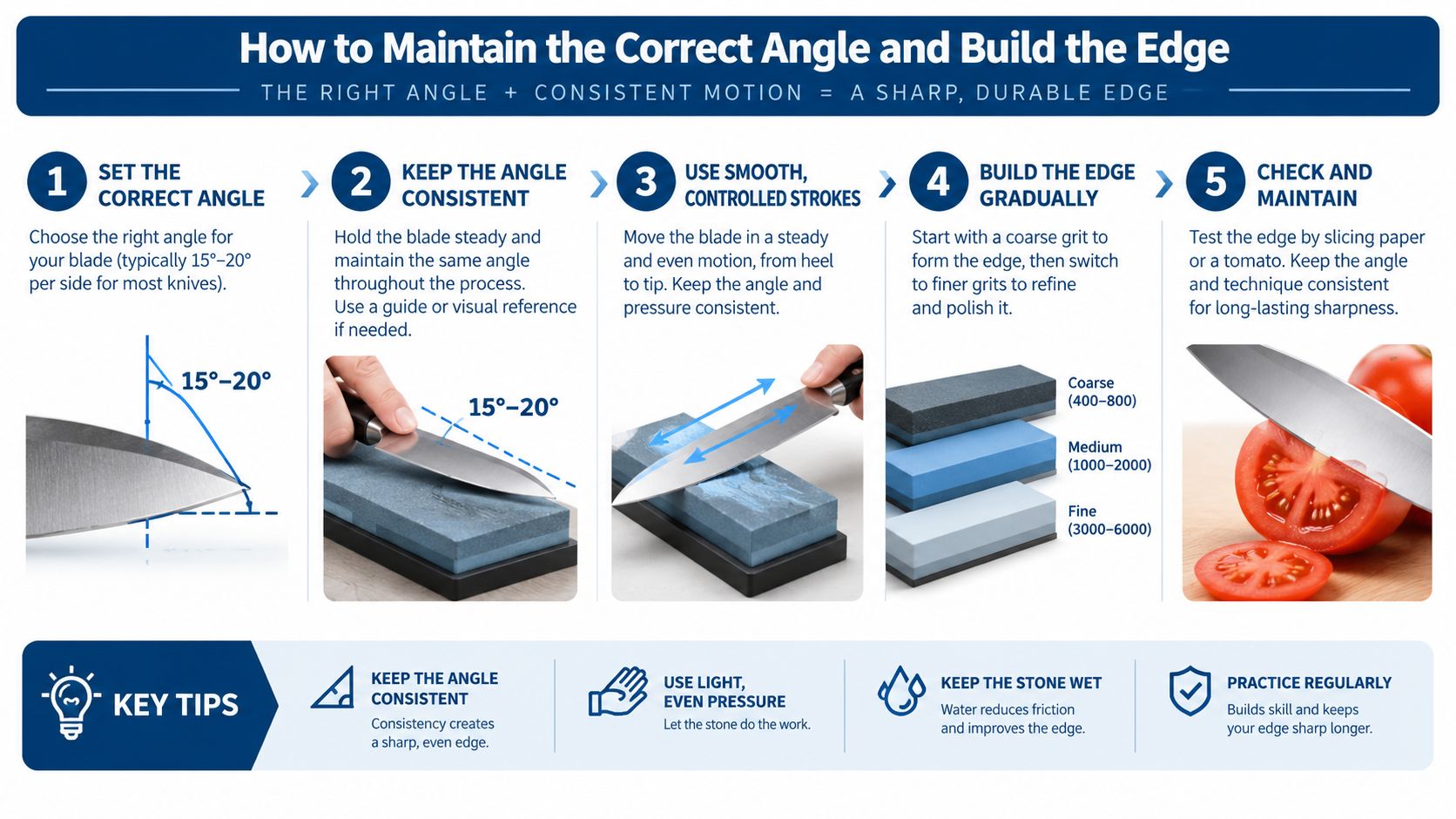
A single sharpening angle doesn't suit every knife. For most kitchen knives, a practical target is 15 to 20 degrees, while sharper filleting-style knives may sit closer to 10 to 15 degrees and tougher butchery or cleaver-style blades closer to 20 to 30 degrees, as explained in this New Zealand guide to sharpening angles. The angle affects sharpness, edge life and how the blade withstands heavy commercial use.
The target should still be checked against the manufacturer's instructions and the existing bevel. NZQA unit standard 40400 requires sharpening to the bevel and point shape appropriate to the knife's purpose. That is why a Japanese-style blade and a traditional European chef knife shouldn't be sharpened identically just because both are used for vegetable prep.
Establish the bevel
Place the knife against the stone at the required angle and keep that relationship steady. The exact hand position matters less than consistency. If the angle changes from stroke to stroke, the operator may polish one part of the edge while grinding another, creating a rounded or uneven bevel.
Move from heel towards the tip so the full blade edge contacts the stone. Use light, even pressure and make controlled passes. The knife should stay stable, and the operator shouldn't force the blade into the stone to compensate for an uncertain angle.
Form and check the burr
The working objective on the starting stone is to raise a burr along the full length of one side before changing sides or moving to a finer abrasive. A burr is a fine fold of metal at the edge, and it indicates that the abrasive has reached the apex of the bevel.
Check it carefully. A fingertip should move across the edge, never along it, because the edge itself can cut. NZ guidance recommends confirming the burr along the full edge before refining the knife on a finer grit.
Pressure should reduce as the edge improves. The coarse stage establishes the geometry. The finer stage refines it, so grinding with the same force throughout wastes steel.
Choose grit for the condition of the blade
There isn't one universal grit progression. A normally dull knife may start on a medium grit, while a damaged or extremely blunt edge may require a different starting point. Once a burr has formed along the full edge, the operator can move to a finer grit and reduce pressure to refine the edge rather than remove unnecessary material.
Work both sides in a controlled manner, then remove remaining burr material with the finishing method specified for the stone or system. A knife that cuts cleanly along the full edge is more useful than one that feels aggressively sharp in one section and catches in another.
The Wüsthof article on precision and craftsmanship is a useful reminder that the blade's intended construction matters. Sharpening should preserve the manufacturer's geometry, not impose a preferred angle chosen for a different knife.
What Affects Edge Life and How to Extend It
Sharpening frequency depends on the working environment as much as the sharpening tool. Cutting-board material, technique, task, cleaning, storage, blade construction and frequency of use all change how quickly an edge loses performance.
A hard board can wear an edge faster than a suitable softer surface. Glass, stone and ceramic surfaces are particularly unforgiving, while an appropriate commercial cutting board gives the edge a more suitable working surface. Staff technique matters too. Twisting the blade, prying, scraping food with the edge or cutting materials outside the knife's purpose can damage the geometry quickly.
Control the causes of dulling
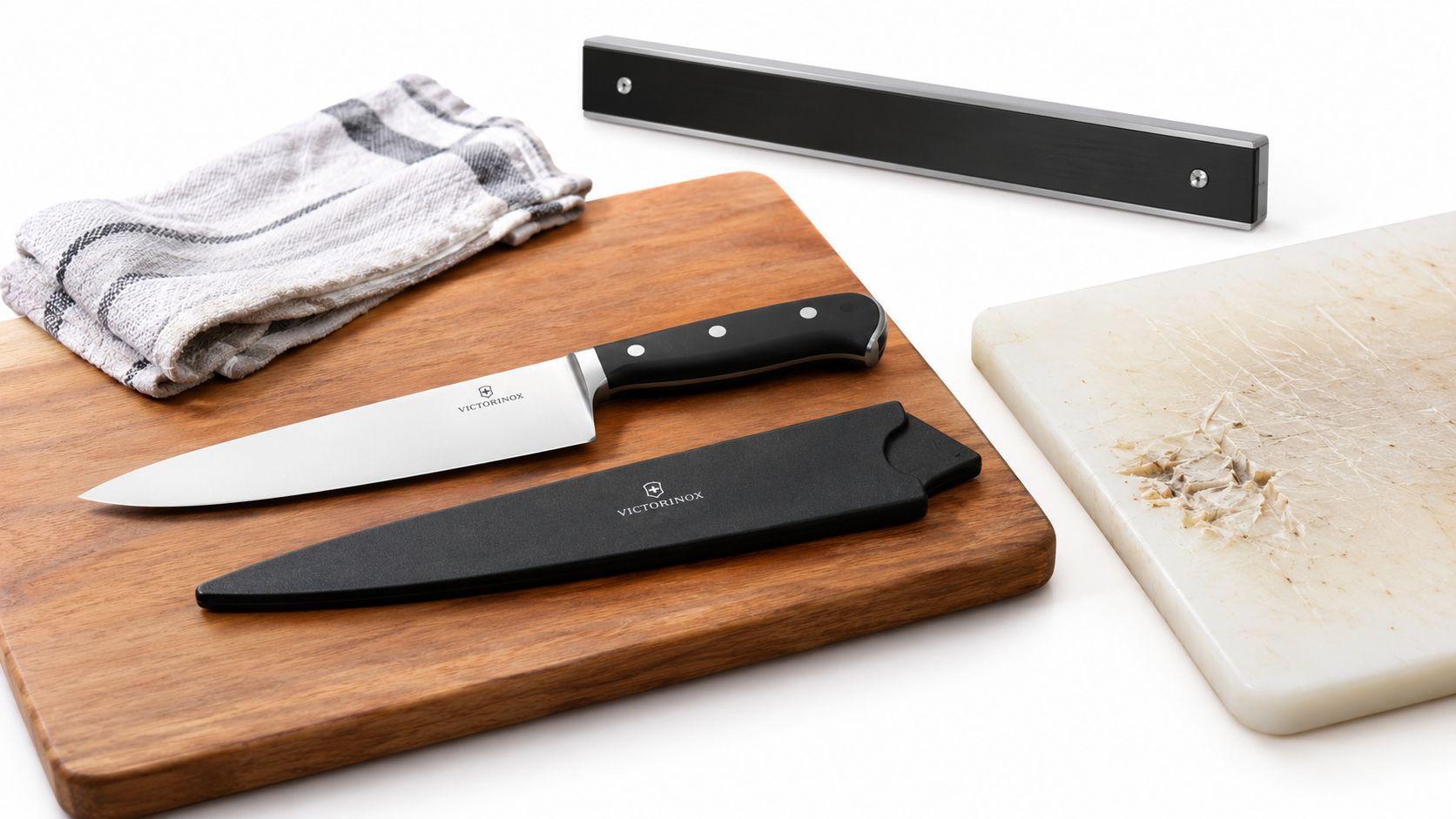
- Use the right board: Keep knives away from glass, stone and ceramic cutting surfaces where possible, and choose a board suited to commercial food preparation.
- Use each blade correctly: A chef's knife, filleting knife and cleaver don't have the same job. Don't pry, twist or force a fine edge through hard material.
- Clean promptly: Hand-wash blades with suitable detergent, rinse and dry them before storage. Moisture and residue can contribute to corrosion and edge damage.
- Store the edge safely: A sheath, suitable knife block, protected drawer system or other secure storage prevents the blade from striking other utensils.
- Account for construction: Global, Yaxell, Wüsthof, Victorinox and Furi knives may differ in steel, thickness and intended geometry. Maintenance should follow the particular blade rather than the brand name alone.
- Watch workload: A knife used throughout every service will need different attention from one used occasionally for a specific preparation task.
Honing and sharpening should remain separate decisions. NZ knife-care guidance commonly describes honing at about 15 to 20 degrees on a steel and sharpening at about 10 to 15 degrees on a whetstone, with consistent angle control through every stroke, as set out in this guidance on honing and sharpening. These figures are not a universal instruction for every knife. Manufacturer guidance remains the controlling reference.
Avoid aggressive maintenance
A common issue in commercial kitchens is sharpening a knife because it feels less responsive, when the underlying problem is board choice, poor storage or a rolled edge that needed alignment. Aggressive sharpening then removes steel without correcting the cause.
That weakens total ownership value. A knife that retains its original geometry and is handled correctly should need less intervention than one repeatedly ground by different staff using different angles. For related thinking about practical kitchen tools and cost control, this article about how a baking tool cuts costs offers useful context on choosing equipment that supports repeatable work.
Kitchens reviewing a mixed set can also compare knife sets available through Simply Hospitality, while checking that the selected blades suit the actual tasks and maintenance capability.
When to Stop and Seek Professional Help Plus Ongoing Care
Freehand sharpening is useful when the operator understands the knife's geometry and can maintain it consistently. It isn't the right answer for every damaged blade. Staff should stop sharpening themselves when the edge has substantial chips, the tip is damaged, the blade is bent, the correct geometry is uncertain or repeated passes aren't producing an even cutting profile.
A specialist edge deserves particular caution. Japanese-style knives, thin filleting blades and unusual bevels can be changed quickly by a sharpening method intended for a more traditional European-style knife. If the operator can't identify the bevel or maintain the angle, continuing to grind usually makes the problem harder to correct.
Hospitality doesn't provide knife-sharpening services, so businesses needing restoration should arrange an appropriate professional sharpening service independently. The supplier can still help operators compare knife types, brands and related kitchen equipment, while the sharpening decision remains tied to the manufacturer's guidance and the venue's procedure.
Troubleshoot the common failures
The knife is sharp in one area but dull in another. The operator may not have reached the full edge or may have changed angle during the passes. Return to the appropriate stage only if the blade geometry is understood, then work heel to tip with controlled contact.
The knife feels worse after sharpening. Excessive pressure, an inconsistent bevel or a remaining burr may be responsible. Don't keep making passes automatically. Inspect the edge, reduce pressure and follow the sharpening system's instructions.
The edge has become visibly narrower or uneven. Repeated aggressive sharpening may have altered the original profile. This is a sensible point to stop and seek an experienced service rather than trying to correct the shape by eye.
A grooved or diamond steel is being used as a daily steel. These rods can act abrasively and remove or damage edge material. A smooth metal or ceramic rod is more appropriate for routine alignment where the knife manufacturer permits honing.
Build a workable care routine
A practical kitchen routine should monitor cutting performance instead of forcing every knife onto an arbitrary calendar. One New Zealand guide recommends honing weekly and sharpening monthly for a chef's knife, with filleting knives sharpened before each use and butcher knives sharpened weekly, as described in this local knife-maintenance guidance. Those intervals are useful benchmarks, not a substitute for inspecting the knife and considering workload.
NZQA also notes that knives may need to be stoned between runs to keep edges serviceable. In a high-volume operation, the procedure should identify when that work happens, who performs it and how the knife is checked before returning to production.
The basic controls are straightforward:
- Wash and dry knives after use.
- Keep blades away from hard or unsuitable cutting surfaces.
- Store them so edges don't strike other tools.
- Use the correct knife for each task.
- Hone only when the edge and manufacturer guidance make honing appropriate.
- Sharpen only when routine maintenance no longer restores performance.
- Record damaged or withdrawn knives so they don't return to service unnoticed.
For broader operational support, SimplyConnect and its network of trusted hospitality trades may help businesses coordinate related trade requirements, although sharpening itself still requires a suitably qualified provider.
Simply Hospitality supplies commercial kitchen equipment, chef knives, knife sets and related hospitality essentials from brands including Global, Yaxell, Wüsthof, Victorinox and Furi. Visit Simply Hospitality to compare suitable knives and kitchen equipment, or contact the team for practical help matching blade selection and maintenance requirements to the venue.