


Is an Extra Commercial Fridge Cheaper Than Running Out of Space?
A busy restaurant receives its delivery before weekend service, but every refrigerator shelf is already occupied. Staff start shifting containers, discussing split deliveries and looking for temporary chilled storage. Is an extra commercial fridge cheaper than running out of space? It can be, when the full ownership cost is lower than the avoidable waste, purchasing costs, labour and lost production caused by insufficient usable capacity. The important distinction is whether another cabinet solves a genuine shortage or provides more room for the same stock-management problems.
Recognise the Hidden Cost of Full Refrigeration
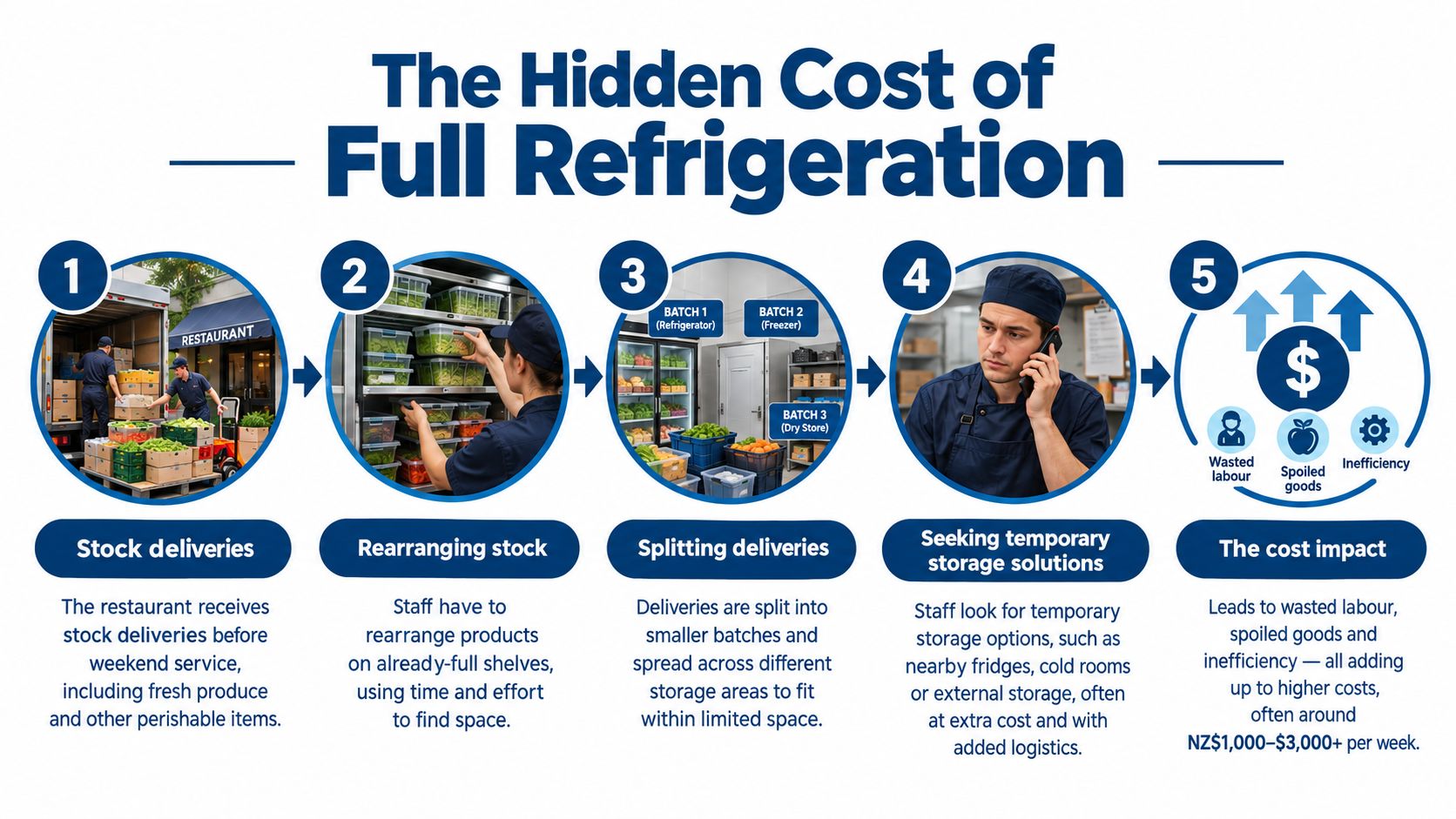
The delivery itself isn't unusual. The problem starts when receiving stock interrupts preparation because staff can't put ingredients directly into their intended storage positions.
A chef moves prepared ingredients into another cabinet. A kitchen hand rearranges containers to accommodate incoming produce. Someone contacts the supplier about holding part of the order. These are illustrative situations, not customer case studies, but each identifies an activity an operator can measure.
A full cabinet isn't necessarily an efficient cabinet. If staff can't see labels, access ingredients or rotate stock without moving other products, advertised storage volume tells only part of the story.
Separate inconvenience from recurring loss
An occasional reshuffle doesn't establish a business case for another fridge. Repeated disruption deserves closer examination, particularly when it affects the same delivery days or preparation periods.
Visible and less visible capacity costs
| Visible cost of another fridge | Less visible cost of insufficient space |
|---|---|
| Purchase or finance payments | Repeated stock handling |
| Electricity and servicing | Additional deliveries and emergency purchasing |
| Installation and occupied floor space | Restricted preparation and congested access |
| Cleaning and eventual replacement | Discarded stock and unavailable menu items |
Smaller purchases may involve higher unit prices or additional freight, but that needs checking against actual supplier terms. Likewise, restricted preparation may affect menu flexibility without necessarily causing lost sales.
For example, a café might receive more frequent deliveries to avoid storing ingredients overnight. That arrangement could be sensible if delivery terms are favourable and receiving doesn't interrupt service. It becomes a capacity cost only when the operator can identify an avoidable financial or operational penalty.
Record what actually happens
A useful shortage log captures:
- Handling time: Staff minutes spent shifting products rather than preparing or serving food.
- Purchasing changes: Additional freight, emergency purchases or split-order charges.
- Stock losses: Discarded ingredients, quantities and reasons.
- Production restrictions: Preparation postponed or menu items unavailable because chilled storage wasn't available.
Practical rule: Another fridge should solve a recurring, documented constraint, not merely make an untidy stockroom feel less crowded.
Recording these effects turns a frustrating service-day conversation into a purchasing decision that can be assessed commercially.
Calculate the Full Cost of Another Fridge
Purchase price is only the starting point. Another commercial refrigerator creates an ongoing obligation, even during quieter trading periods.
Refrigeration accounted for 22% of energy consumed by New Zealand's Accommodation and Food Services sector in 2022, compared with 15% for commercial ovens and cooking elements, according to EECA's food and beverage service sector pathway. Those figures don't predict an individual cabinet's running cost, but they establish why electricity belongs in the decision.
Build the ownership model
The quotation should be assessed alongside the costs of putting the fridge into productive use:
- Acquisition: Cabinet price, selected configuration, finance charges and any required fabrication.
- Delivery and installation: Access arrangements, positioning, commissioning and removal of displaced equipment.
- Electrical requirements: Confirmation that the proposed location has a suitable supply, with any necessary work priced separately.
- Operating costs: Electricity, cleaning labour, maintenance and servicing.
- Space requirements: Cabinet footprint, door opening, ventilation clearances and service access.
- Long-term replacement: A realistic ownership horizon rather than an assumption that the equipment lasts indefinitely.
Any glass configuration or custom work should be included where relevant. Installation planning should also consider heat rejection and whether the proposed position creates additional ventilation requirements.
Floor space deserves particular care. A cabinet occupying an otherwise unused storage position has a different opportunity cost from one displacing a preparation bench or customer seating. Operators shouldn't assign a speculative revenue value to every square metre, but neither should they treat productive space as free.
Estimate electricity without false precision
Energy consumption depends on cabinet design, size, operating conditions and usage. The practical approach is to obtain the proposed model's rated consumption, understand the rating conditions and apply the business's electricity tariff.
Connect VPP's resource on decoding your business energy bill offers supplementary billing context, although a New Zealand operator's calculation must use its own local contract. The discussion of energy-efficient appliances also provides a useful starting point for comparing equipment beyond purchase price.
Total ownership cost = acquisition + installation + financing + energy + cleaning + servicing + relevant space costs + eventual replacement.
Accounting depreciation can help allocate purchase cost across an ownership period, but it isn't the same as cash expenditure. An annual comparison should avoid counting the full purchase price, annualised purchase allowance and finance principal as separate costs for the same equipment.
Compare Fridge Ownership with Capacity Shortfalls
The strongest comparison puts an annual ownership estimate beside the costs that additional capacity could realistically remove. A general feeling that the kitchen is stretched isn't enough.
Comparing the two financial positions
| Additional fridge cost | Insufficient-capacity cost | How to measure it |
|---|---|---|
| Annualised acquisition and installation | Capacity-related discarded stock | Record quantity, purchase cost and cause |
| Electricity and maintenance | Extra freight or emergency purchasing | Compare invoices and delivery charges |
| Cleaning and stock-management labour | Repeated rearranging and receiving | Log staff time by activity |
| Occupied working space | Restricted preparation or access | Observe specific production bottlenecks |
| Finance charges | Genuine lost menu contribution | Record unavailable items and associated margin |
Separate food waste by cause
Not all discarded food creates a case for refrigeration investment. Food left on customers' plates, excessive preparation and forgotten ingredients require different responses.
A Restaurant Association summary of hospitality food-waste reduction estimated annual hospitality food waste at 24,400 tonnes, with around 61% avoidable. That scale supports careful measurement, not an assumption that extra chilled storage would prevent the waste.
Operators should code discarded stock by cause, such as expiry, temperature failure, overproduction, damaged packaging or customer leftovers. Only the portion credibly linked to insufficient usable refrigeration belongs in the capacity comparison.
Examine purchasing and labour separately
More frequent deliveries may create freight charges, minimum-order complications and additional receiving work. However, larger purchases aren't automatically economical. Any unit-price advantage must survive the cost of holding, handling and potentially discarding the extra stock.
Labour also needs disciplined treatment. Time saved can improve preparation capacity without reducing payroll. It becomes a cash saving only when rostered hours, overtime or another actual expense falls.
The commercial stakes are significant: the Restaurant Association's 2025 Hospitality Report places wage costs at approximately 40% of revenue, food costs commonly at 28–35%, and net margins at 3–5%. Operators therefore need to distinguish productive time recovered from money saved.
Value restricted sales conservatively
A caterer unable to accept work because there's nowhere to hold prepared ingredients has a different problem from a restaurant that prefers more stock on hand.
Record genuine declined production opportunities separately. Additional revenue isn't additional profit. The comparison should use the contribution remaining after the relevant food and other variable costs, rather than counting the entire selling price as a benefit.
Work Out the Refrigeration Break-Even Point
A break-even calculation asks whether the costs avoided and additional contribution earned would cover annualised ownership. It doesn't need a complicated spreadsheet, but it does need consistent assumptions.
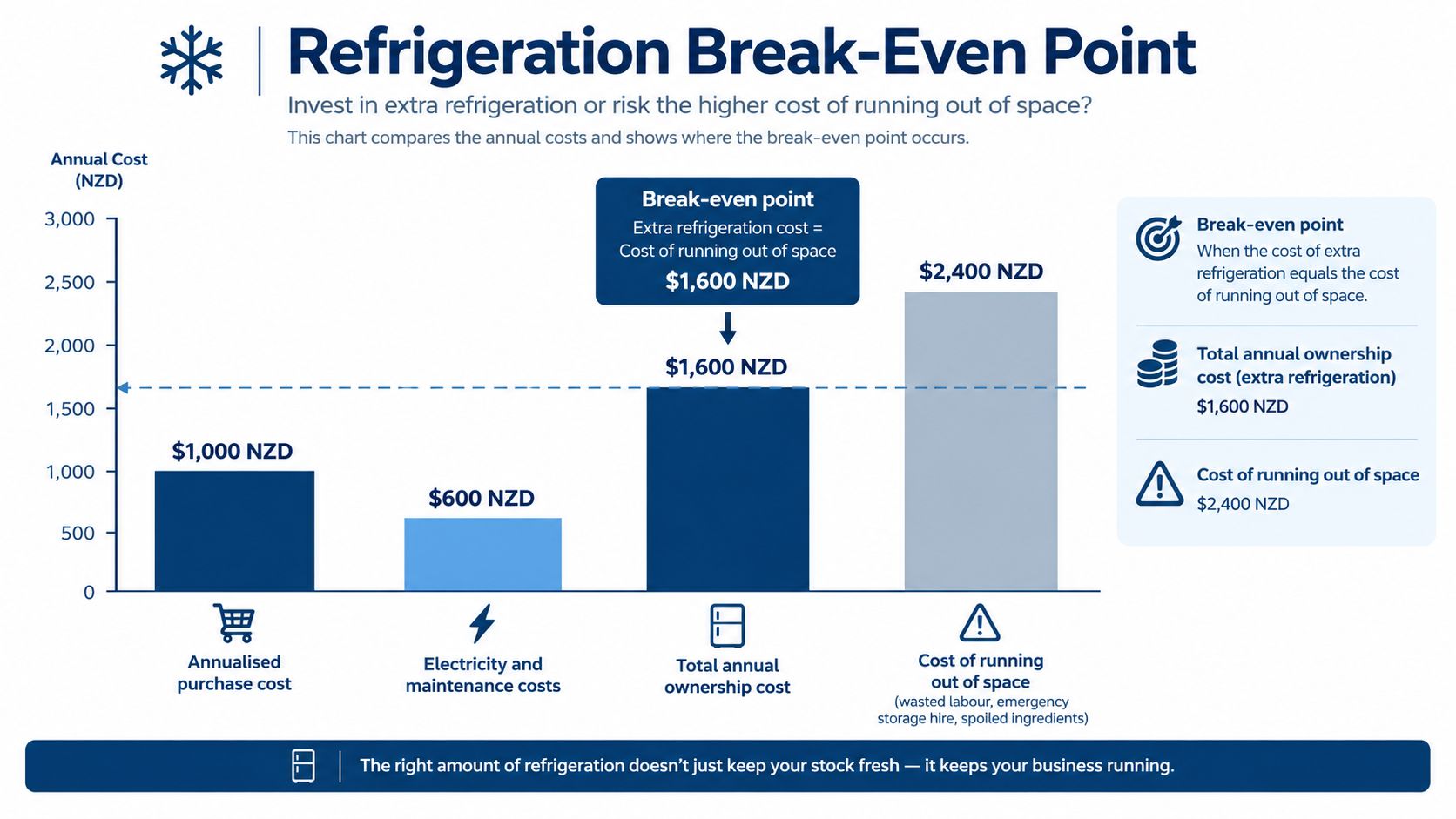
The following example uses hypothetical NZ-dollar figures only. These aren't equipment prices, quotations, measured savings or guaranteed results.
Build a transparent annual comparison
Hypothetical annual break-even example
| Cost or saving | Illustrative annual amount |
|---|---|
| Additional fridge purchase, spread over five years | NZ$1,000 |
| Electricity and maintenance | NZ$600 |
| Total illustrative annual cost | NZ$1,600 |
| Avoided food waste | NZ$900 |
| Reduced delivery costs | NZ$500 |
| Staff time saved | NZ$600 |
| Total illustrative annual benefit | NZ$2,000 |
| Illustrative annual net benefit | NZ$400 |
The arithmetic is straightforward: hypothetical annual benefits of NZ$2,000, less hypothetical annual costs of NZ$1,600, leave an illustrative NZ$400 benefit.
Annual avoided costs and additional contribution − annualised fridge ownership costs = estimated annual net benefit.
This simplified example excludes installation, finance, additional cleaning and any measurable space cost. Those items must be added where applicable before treating the result as a purchasing case.
The accompanying visual presents a separate hypothetical shortage-cost comparison. Its shortage-cost bar isn't the benefit total used in the table above, and neither illustration represents a measured business outcome.
Replace assumptions and test the result
Each input should have a supporting record:
- Waste allowance: Purchase records and a cause-coded waste log.
- Delivery savings: Freight invoices and proposed supplier arrangements.
- Labour value: Observed hours, employment costs and a clear distinction between released capacity and reduced payroll.
- Ownership estimate: Equipment quotation, installation requirements, electricity tariff, servicing allowance and financing terms.
Bookkeeping and Accounting of Florida Inc.’s explanation of how to calculate break-even point for business provides supplementary context for the calculation. The actual decision still depends on the venue's own records.
A cautious operator should test weaker outcomes: less waste prevented, no reduction in paid staffing, higher installation costs or lower utilisation during quiet periods. Extending the assumed ownership period may improve the annualised calculation, but it doesn't remove the upfront cash requirement.
A purchasing case that works only under optimistic assumptions is weaker than one that still makes sense when the expected benefits are reduced.
Diagnose a Genuine Refrigeration Shortage
A genuine shortage should be visible in operating records, not just in a photograph of full shelves. The useful question is whether the kitchen can store, access and monitor the food required for its normal production schedule.
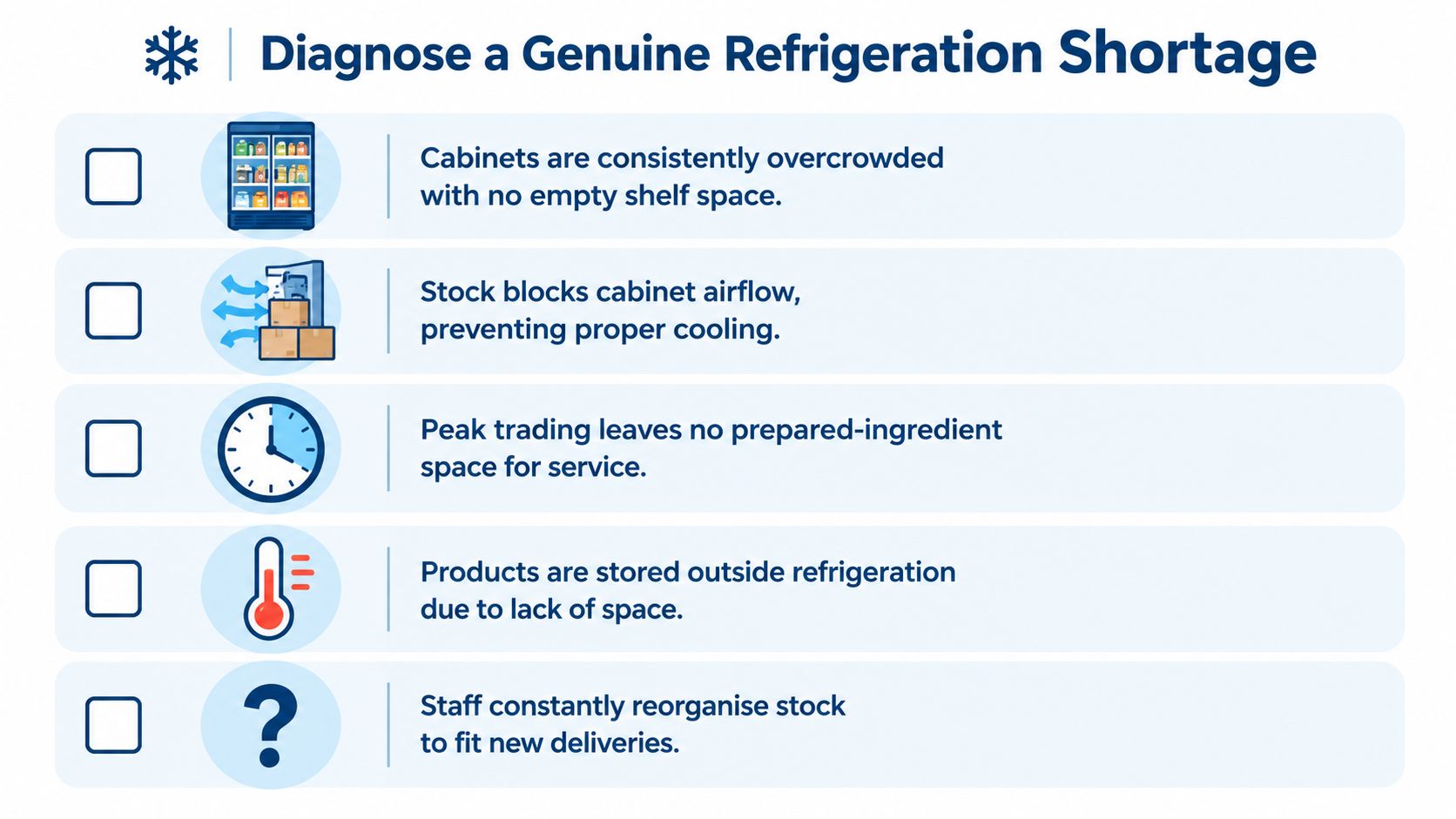
The checklist below identifies warning signs. No single sign establishes that another cabinet is the right remedy.
Check the pattern behind the crowding
- Persistent overcrowding: Cabinets remain difficult to use after obsolete or unnecessary inventory is removed.
- Restricted airflow: Products occupy spaces the cabinet's loading instructions require to remain clear.
- Preparation shortages: Peak production leaves insufficient protected space for prepared ingredients.
- Repeated transfers: Staff routinely move products between cabinets to receive deliveries or begin preparation.
- Separation difficulties: Appropriate food organisation and stock rotation are becoming harder to maintain.
- Emergency replenishment: Frequent urgent orders result specifically from inadequate holding capacity.
Record peak stock levels, delivery timing, replenishment intervals, discarded items and production limits over representative trading weeks. Cabinet utilisation should describe how the space functions, not merely how full it appears.
Treat temperature control as a separate requirement
MPI's National Programme 1 guidance requires chilled potentially hazardous food to be kept at 5°C or below and checked daily using an accurate method, such as an appropriately calibrated thermometer or monitoring system. Physical fit doesn't establish safe storage.
Depending on cabinet design and loading, overcrowding can restrict airflow and make temperature consistency harder to maintain. The relevant capacity is therefore usable, appropriately organised and demonstrably temperature-controlled capacity, not nominal litres alone.
Cooked-food cooling creates another constraint. MPI's specified cooling process requires cooling from 60°C to 21°C within two hours, then to 5°C or below within a further four hours, with cooling times recorded. Another storage fridge doesn't replace suitable portioning, shallow containers, ice baths or blast-chilling arrangements.
Practical guidance on storing food in a restaurant fridge can support the organisation review. If loading and rotation improvements resolve the problem, the original shortage may have been one of usable space rather than cabinet volume.
Test Lower-Cost Ways to Increase Usable Capacity
Buying another cabinet should compete against operational changes, not stand as the only available response. The cheapest effective intervention may be a different delivery schedule, better containers or replacement of unsuitable equipment.
For a café with awkwardly stacked preparation tubs, matching containers to shelf dimensions deserves testing before adding floor space. A restaurant holding duplicate slow-moving ingredients may need tighter purchasing controls instead.
Start with reversible changes
| Option | What it tests | Trade-off to examine |
|---|---|---|
| Reconfigure shelving | Whether existing space can hold the required stock more accessibly | Container fit and loading requirements |
| Improve rotation and labelling | Whether stock is being forgotten rather than genuinely lacking space | Ongoing staff discipline |
| Revise purchasing schedules | Whether delivery timing creates avoidable peaks | Freight terms and receiving workload |
| Reduce duplicate inventory | Whether purchasing habits inflate storage demand | Supplier reliability and menu needs |
| Change storage containers | Whether packaging wastes usable shelf space | Cleaning, handling and food suitability |
The discussion of kitchen storage containers can help operators assess container selection alongside shelving and preparation methods.
Layout also deserves scrutiny. Epic Remodeling's cost-saving kitchen remodel ideas provide general refurbishment context, but residential suggestions shouldn't substitute for commercial food-safety, ventilation or equipment planning.
Compare replacement with addition
A better-sized replacement cabinet may be more useful than retaining an unsuitable fridge and adding another. Conversely, underbench or preparation-position refrigeration may address an access problem that a larger upright wouldn't resolve.
The distinction matters commercially: more general storage and better point-of-use access are different benefits. Operators should identify which one is needed before comparing equipment.
Leased cold storage and certified used equipment are also options to investigate where suitable. Assessment should include transport, installation, operating conditions, serviceability, warranty scope and compatibility with the food-control plan.
More litres aren't the objective. The objective is enough accessible, safely rotated storage to support the required production.
A lower upfront price doesn't establish a lower ownership cost. Any alternative should be assessed using the same financial and operational tests as new equipment.
Choose Refrigeration That Fits the Workflow
Equipment format should follow the identified constraint. A kitchen short of bulk ingredient storage needs a different solution from a cookline where staff repeatedly leave their stations to retrieve ingredients.
The available formats can be compared by the work they support, rather than by cabinet size alone.
Commercial refrigeration formats by best fit
| Refrigeration format | Best suited to | Check before buying |
|---|---|---|
| Upright refrigerator | General ingredient and prepared-stock storage | Shelf arrangement, reach, footprint and door clearance |
| Underbench refrigerator | Chilled storage close to preparation or cooking stations | Working height, internal layout and ventilation |
| Refrigerated preparation counter | Suitable operations combining storage and preparation workspace | Ingredient access, cleaning and food-control requirements |
| Drawer refrigeration | Appropriate point-of-use ingredients and compartmentalised access | Container compatibility, drawer travel and usable depth |
| Coolroom | Storage needs substantially beyond individual cabinets | Installation scope, access, organisation and service arrangements |
Match the format to the workload
A larger upright may suit a caterer holding substantial ingredient stocks before production. Underbench refrigeration may be more relevant to a restaurant that has enough total storage but poor access during preparation.
Preparation counters combine functions where the workflow suits them. Drawers warrant consideration where staff need compartmentalised access, while a walk-in chiller merits investigation when cabinet-by-cabinet expansion no longer fits the storage requirement.
SKOPE and Atosa ranges can be assessed against the same operating requirements. Brand choice shouldn't replace a check of the actual cabinet configuration, rated conditions and support arrangements.
Verify the proposed configuration
The SKOPE ProSpec 3 Door Underbench Fridge - PG11.UBR.3.SD.RH is listed with solid swing doors, adjustable shelving, stainless-steel construction and a right-hand unit configuration. Its listed operating range is 1°C to 4°C, with an ambient rating up to 40°C, according to that product listing.
Those specifications illustrate relevant checks, not proof that the model suits every kitchen. Current manufacturer documentation, installation requirements and the proposed application should be confirmed before ordering.
The final equipment assessment should cover:
- Physical fit: Usable internal dimensions, shelving, footprint, door swing and working clearances.
- Operating suitability: Required temperatures, kitchen ambient conditions, ventilation and rated energy use.
- Daily management: Cleaning access, stock visibility and compatibility with monitoring procedures.
- Long-term support: Service access, warranty conditions and New Zealand support arrangements.
SKOPE BackBar SlimLine and ProSpec drawer concepts should likewise be assessed by their intended application rather than assumed interchangeable with general kitchen storage. Where multiple existing cabinets no longer fit the workflow, consolidation or replacement deserves comparison with straightforward duplication.
Make the Final Capacity Investment Decision
The decision becomes clearer when operators match the symptom to the intervention. A capacity purchase should address the diagnosed problem without introducing a larger ownership or workflow burden.
Refrigeration decision guide
| Situation | Likely best approach |
|---|---|
| Occasional overcrowding | Review stock management and delivery timing first |
| Regular peak-period shortages | Investigate additional usable capacity |
| Poor kitchen access | Assess underbench or point-of-use refrigeration |
| High food waste | Identify the actual causes before purchasing |
| Consistent growth in production | Plan refrigeration around expected operating requirements |
| Multiple ageing cabinets | Compare replacement or consolidation with addition |
Test the decision against normal trading
Several representative trading weeks provide a more useful picture than an unusually busy service or a quiet stocktake day. The assessment should include delivery patterns, preparation peaks, seasonal demand, current cabinet condition and credible future requirements.
Different venues will reach different conclusions. A caterer's event-led storage peaks may warrant a different response from a café's regular daily replenishment cycle or an aged-care kitchen's planned meal production.
Planning refrigeration around the business's stage helps keep the decision connected to operating needs rather than selecting the largest cabinet that fits.
Check affordability separately from suitability
Cash purchase, flexible equipment finance and certified used options change the funding arrangement, not the underlying requirement for suitable equipment. Finance charges belong in the ownership calculation, and agreement terms should be assessed alongside servicing, warranty and installation obligations.
An option can be operationally worthwhile yet difficult to fund immediately. Equally, manageable payments don't make an unnecessary cabinet economical.
The cheapest refrigeration setup isn't necessarily the one with the fewest fridges. Another cabinet is worthwhile when its safely usable capacity, avoided operating costs and defensible production benefits justify the full ownership cost.
The final purchasing file should therefore contain the shortage log, options considered, installation assessment and conservative annual comparison. That gives the operator a reasoned basis for buying, replacing, reorganising or postponing, rather than treating extra refrigeration as the automatic answer.
Simply Hospitality offers commercial refrigeration, equipment selection support, quotes and finance options for New Zealand hospitality businesses. Operators can bring cabinet measurements, delivery schedules and capacity records for help comparing additional storage, point-of-use refrigeration and replacement options. Contact the team to discuss a solution matched to the kitchen's workflow and full ownership budget.