

Kitchen Utensil Holder NZ: Essential Guide for Hospitality
A kitchen utensil holder NZ buyers can rely on is not a decorative cup on a bench. It is a small piece of workstation design that affects how fast staff can move, how clean the bench stays, and whether the right tool is where it should be when service gets tight. The usual mistake is buying for looks or sheer capacity, then discovering the holder is in the wrong place, too bulky for the bench, or awkward to clean.
That is why the question is not, “Which utensil holder should we buy?” It is, “Which tools need to live at this station, and how small can the holder be while still keeping them organised?” Bigger isn't always better, especially in compact NZ kitchens where every centimetre of bench space has value.
Why the Right Utensil Holder Matters in a Busy Kitchen
The wrong utensil holder slows a kitchen in ways that never show up on a spec sheet. A chef reaches for a ladle and finds a whisk, a scraper, and three tools that belong somewhere else. That extra search is small on paper, but during a Friday night rush it turns into repeated steps, blocked hands, and unnecessary movement across a crowded bench.
In hospitality, organisation is not about neatness for its own sake. It is about making sure staff can grab what they need without pausing, opening drawers, or shifting other tools out of the way. A holder that keeps the correct utensils visible and immediately reachable can make a pass or prep bench feel calmer, even when the room is not.
A kitchen utensil holder NZ operators choose for service should also support hygiene. If water pools at the bottom, residue collects around the base, or the unit takes too long to empty, staff stop cleaning it properly and start treating it like background clutter.
Practical rule: if a holder is hard to empty, hard to wash, or awkward to return to its spot, it will fall out of routine faster than anyone expects.
The practical takeaway is simple. If the holder does not reduce friction at a workstation, it is in the wrong place or the wrong format.
Designing Around Workstations, Not Utensil Categories
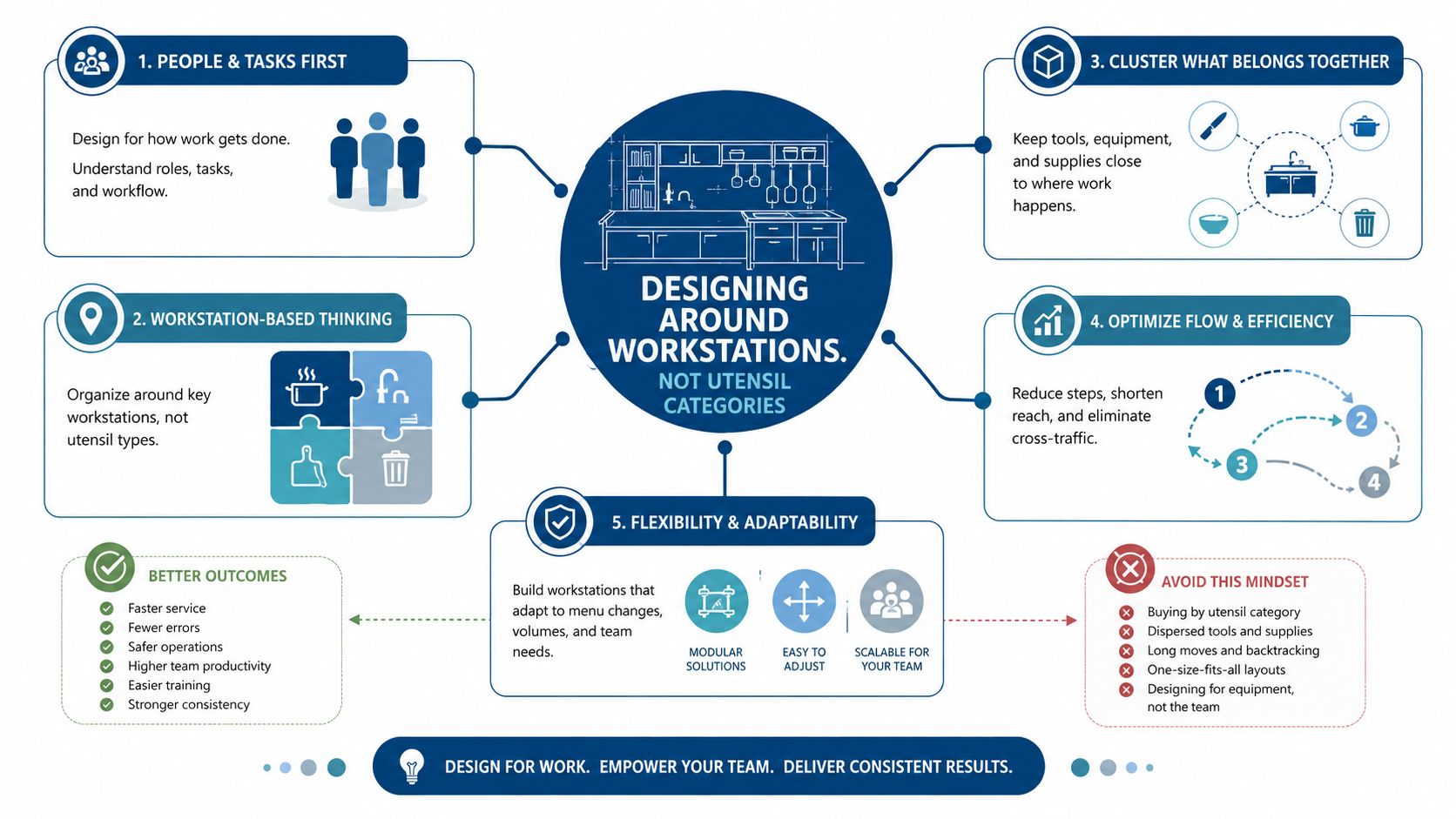
The best utensil storage systems start with the station, not the category list. A cooking line does not need every utensil in the kitchen within arm's reach. It needs the specific tools that are used there, all the time, without searching.
A grill station might need tongs, spatulas, ladles, and serving spoons close to hand. A prep area usually needs whisks, scrapers, and smaller mixing tools. If those are mixed into one oversized holder, the staff member who needs a single tool spends more time sorting than working.
One of the simplest workflow improvements is to walk the kitchen and list what is used at each point of service. That list tells the truth better than any generic product category. It also makes it obvious when several smaller holders will work better than one large one.
The same logic applies to tool shape. A Chef Inox Utility Turner Flexi Stainless Steel 76X200mm is a purpose-shaped spatula for turning, spreading, scraping, or lifting food from a work surface or pan, and its stainless-steel construction supports durable repeat use. That sort of deliberate tool choice belongs beside the workstation where that task happens, not buried in a generic catch-all holder.
For operators mapping out a bench, the question is not “How many utensils can this holder carry?” It is, “Which utensils should this station own?” That distinction matters when comparing a tidy bench against a service-ready one.
Keep the tools where they're actually used, and the bench starts to work with the team instead of against it.
For more on planning a kitchen around movement and service flow, see how to design a kitchen that saves time on every service. The idea is the same whether the kitchen is large or tight, organise around the workstation.
Materials and Durability for Commercial Service
Material choice changes how a holder behaves after the first week of use. In NZ hospitality, stainless steel is usually the default commercial choice because it suits frequent washing, sits naturally beside other stainless equipment, and handles the kind of turnover that front and back of house both create. That is especially true where the holder sits near a sink, pass, or wash area.
Plastic can make sense in lower-impact back-of-house zones, but it is more likely to stain, crack, or pick up odours over time. That makes it harder to keep looking clean, and once a holder starts looking tired, staff often stop trusting it. Decorative composite materials and timber-based holders can look good in calm presentation areas, but they are not the first choice where splash, heat, or constant handling are part of the job.
Wood and acacia have their place. A holder like the acacia and marble utensil holder listed in NZ retail, with its 18 cm height, 12 cm diameter, 1 kg weight, and indoor-only guidance, shows exactly where those materials fit, stable, presentation-led settings rather than wet prep zones Kmart NZ. That kind of product can suit a dry front-of-house bench, but it is not the answer beside a sink.
For operators who also manage barbecue or outdoor tool storage, a resource like Custom Mark BBQ tools is useful to compare because it reinforces the same lesson. Material and placement need to match the job, not just the look.
A practical rule still holds. Stainless where water and heat are present, plastic where budget or weight matters, wood only where the holder stays dry.
For practical product thinking, this Chef Inox overview sits in the same lane, because durable stainless gear tends to survive routine better than decorative alternatives.
Sizing Logic That Respects Bench Space
The size decision should start with the number of utensils needed at the station, then check whether the holder fits the bench without crowding the work area. A grill line may only need immediate access to tongs, spatulas, serving spoons, and ladles. If that is the full working set, there is no value in sacrificing prep space for another 10 or 15 tools that live there only in theory.
Work backwards from the station
That approach keeps the holder tied to the job. If the bench is tight, the smallest holder that comfortably contains the required tools is usually the right answer. Anything larger invites staff to drop in rarely used items, and once that happens the holder turns into a catch-all instead of a workstation tool.
A compact stainless-steel countertop utensil holder example sold in NZ measures 9.5 cm W × 22.2 cm L × 18 cm H, with a perforated base for drainage, a removable spoon rest, and a two-compartment layout with a removable step for smaller tools. That footprint is useful because it shows how small a practical holder can be when the station only needs a tight tool set.
| Utensil Holder Sizing Trade-Offs | Typical capacity | Bench footprint | Best use case |
|---|---|---|---|
| Small holder | Few core tools | Lowest | Grill, prep, or pass stations with a tight grab list |
| Mid-size holder | Moderate mix of utensils | Medium | Stations with mixed but predictable tool use |
| Large holder | Broad tool mix | Highest | General storage, not a tight working bench |
The main issue is access. If a utensil is not used regularly at that station, it belongs elsewhere. Compact NZ kitchens gain the most from that discipline, because the bench stays open for actual work rather than holding overflow.
For operators comparing bench layouts, stainless-steel benchtop planning helps frame holder size against the space already available, because the holder should support the bench, not crowd it.
Hygiene Features That Actually Matter
A hygienic utensil holder is not defined by appearance. It is defined by whether staff can empty it, wash it, and dry it quickly enough to keep doing that every day. If a holder slows that routine down, hygiene slips in the kitchen.
The details worth checking
The most useful features are straightforward. Open or perforated bases let water escape instead of pooling. Smooth internal surfaces make residue easier to remove. Lift-out compartments or removable liners help staff separate, wash, and reset the holder without chasing bits of debris into corners.
Dishwasher-safe construction matters too, especially in commercial service where bench tools get washed often and not always gently. Stainless steel has the edge here because it is durable, straightforward to clean, and fits naturally with other stainless prep equipment. Drainage helps, but it is not a replacement for emptying and sanitising the holder regularly.
That point matters in cross-contact control as well. The moment a holder collects residue, wet utensils, or mixed tools that should stay separate, it becomes another hygiene task rather than a support to the workflow. Cross-contamination prevention starts with simple habits, and utensil storage is part of that discipline.
A holder should be easy to clear in seconds, because anything slower usually gets postponed.
Use these questions when assessing a product:
- Does water drain fully? Look for holes or an open base that prevents pooling.
- Can it be emptied fast? If staff have to dismantle half the bench, it's too awkward.
- Are the inside surfaces easy to wipe? Corners and ridges trap residue.
- Will it survive daily washing? Commercial kitchens need equipment that fits the cleaning rhythm.
The best holders support a fast end-of-shift reset. That is what keeps small storage from turning into a hidden cleaning problem.
Countertop, Wall, Drawer and Custom Stainless Options
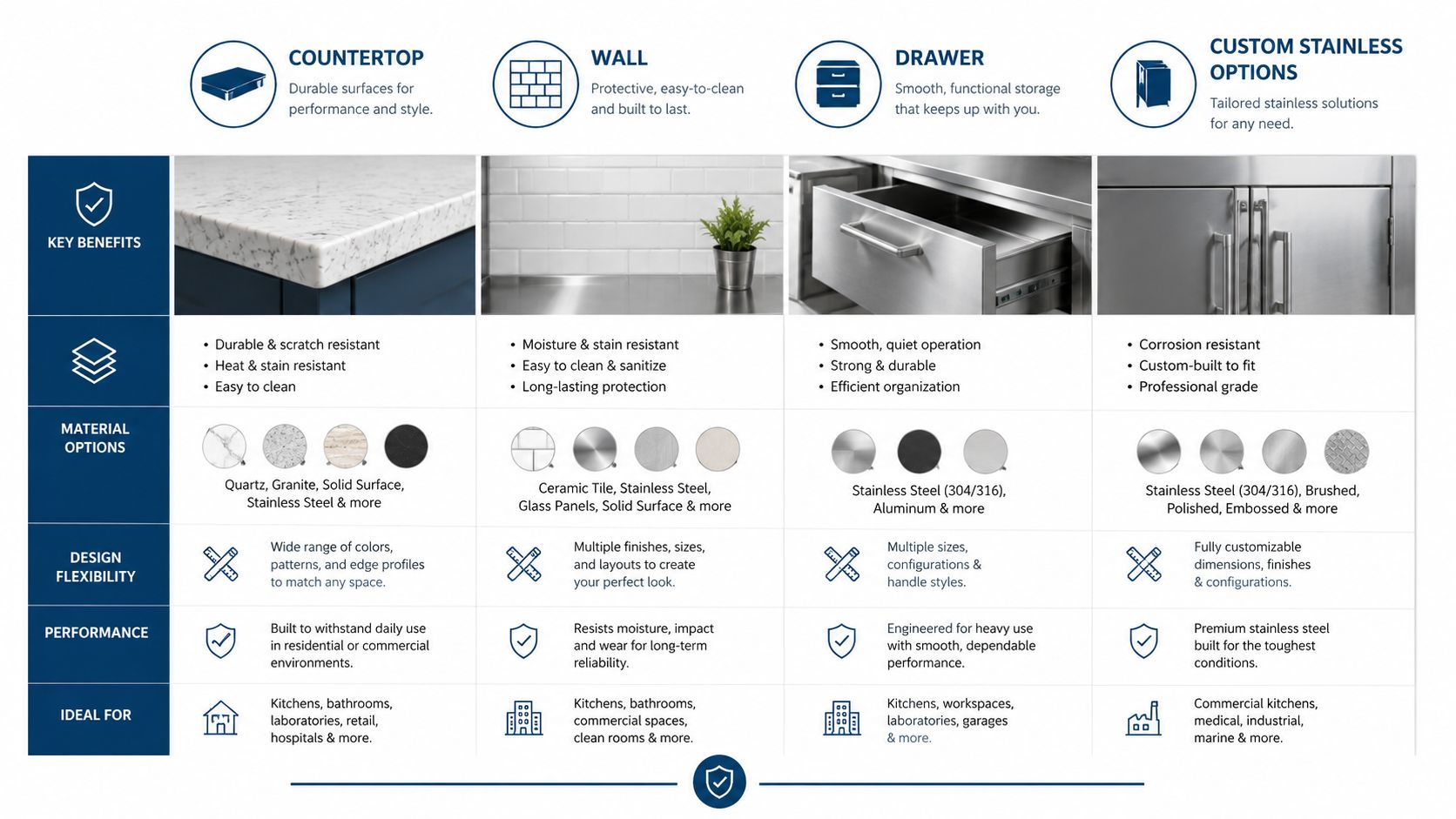
Every format solves a different space problem, and none of them is a default fit.
Countertop holders are the quickest to place and the easiest to shift. They suit stations that change during service, but they still take bench area, so the footprint has to earn its keep. On a tight line, that usually means holding only the tools that are touched all shift, not every utensil in the kitchen.
Wall-mounted rails or magnetic systems keep the bench clear and put tools where staff can see them. A NZ product built around 304 stainless steel with a 50 cm rail length shows why this format works when space is tight The Warehouse. The trade-off is installation and reach, because a wall unit only helps if it is fixed properly and placed where staff can grab from it without crossing paths.
Drawer organisers keep the tools out of sight while still keeping them close to hand. They suit controlled prep lists and tighter front-of-house prep areas, especially where the kitchen wants a cleaner visual line. The limit is speed, since drawers slow things down if staff have to search before they reach.
Custom stainless fabrication suits kitchens where the standard options do not match the bench layout or the station workflow. It becomes useful when storage can be built into preparation benches or cooking areas instead of sitting on top of them. For operators comparing fitted storage with other used fit-out choices, used commercial kitchen equipment options help frame what can be reused, adapted, or built around in a tight commercial space.
The same thinking applies to bench planning. A holder should fit the workstation, not force the workstation to bend around the holder. That is also why Silverchef sometimes come into the conversation for staged fit-outs or storage changes, and why stainless-steel benchtop planning matters when storage, prep space, and cleaning need to work together without wasting a centimetre.
Procurement, Replacements and Total Ownership
A utensil holder is easiest to buy the first time. The harder part is replacing it later without disrupting the line. That is why procurement should focus on consistent sizing, compatible materials, and a format that can be reordered or replicated without guesswork.
That is where trade accounts, warranties, and certified-used options come into the conversation. A lower-cost holder can work well at first, but if replacements become difficult to match, the kitchen ends up with a patchwork of sizes and finishes. Buying with the wider storage system in mind is usually the smarter move.
For operators needing budget flexibility, finance can sit in the background as a finance reference when a larger fit-out or storage upgrade needs to be staged rather than done all at once. The point is not borrowing for the sake of it, but keeping the right equipment path open when the kitchen needs a more considered purchase.
Used equipment is another valid angle when the goal is function rather than brand-new presentation. The discussion in used commercial kitchen equipment in NZ fits here because the same principle applies, match the item to the job, then check whether replacement and support remain practical.
Putting It Together and Getting the Right Advice
The strongest utensil storage choices are usually the least showy ones. A kitchen utensil holder NZ operators can trust is the smallest holder that keeps the right tools exactly where they are needed during service. That means building around the workstation, choosing materials that suit the cleaning load, and leaving enough bench space for the work itself.
Stainless steel is still the most practical choice in busy commercial kitchens, especially where heat, water, and frequent washing are part of the day. With drainage, smooth internal surfaces, and easy removal, the holder stops being bench clutter and starts doing a real job in the workflow.
Hospitality helps operators compare utensil holders, stainless storage, and bench integration options against the way the kitchen runs. For practical advice on choosing a holder or planning a storage layout that fits your workflow, visit Simply Hospitality and talk through the space, the tools, and the service pattern before you buy.
If you are weighing up countertop holders, wall storage, or custom stainless integration, the right advice starts with the station, not the shelf. Hospitality can help you match the storage to the job, then compare options, replacement needs, and long-term storage planning.