

Opening a Restaurant: Equipment Considerations for NZ
Opening a restaurant in New Zealand usually goes wrong when owners start with the equipment catalogue instead of the menu. The smarter question is not “what can be bought?” but what the kitchen must produce at peak service, with what workflow, and across which services. Once that's clear, the equipment list becomes a consequence of the operation, not a guess dressed up as a plan.
That matters because the opening budget is not just about buying ovens, fridges, and a dishwasher. In NZ, food safety, ventilation, refrigeration, handwashing, and dishwashing requirements all shape the fit-out from day one, and the wrong order of decisions can leave a venue over-specified in one area and underbuilt in another (2025 getting started guide, Food premises setup requirements). A first-time owner who buys gear before they've mapped covers, peaks, and workflow is usually buying stress as well as steel.
Why Opening a Restaurant Isn't an Equipment Checklist
A restaurant doesn't open as a shopping list. It opens as a production system, and the equipment only works when it supports that system properly. A 60-seat room is not automatically a 60-seat kitchen, because the kitchen may need to absorb table turns, takeaway orders, prep-heavy dishes, and a sharp burst of demand inside one service window.
That's where many first-time owners get pulled off course. They start with the obvious appliances, then discover later that the binding constraint is fridge placement, wash-up speed, or the fact that extraction and power weren't planned for the cooking line. The expensive mistake is usually not choosing the wrong brand, it's choosing equipment before the layout, services, and production pattern are settled.
Start with what the menu must produce
A practical equipment plan starts with the menu, then works backwards through covers, peak demand, production processes, workflow, services, and budget. That sequence matters because every menu item creates a different requirement, some need batch prep, some need rapid firing, some need holding, and some need fast plate turnaround.
Practical rule: if the menu hasn't been mapped to production steps, the equipment list is still premature.
That is also why kitchen planning tends to be handled as part of the opening project, not as a later purchasing task. A national view of commercial kitchen equipment in New Zealand shows the category spans ovens, fryers, combi steamers, griddles, cooktops, pizza ovens, refrigeration, display cabinets, and dishwashers, across sectors ranging from restaurants to aged care, so the equipment mix has to match the operating model rather than a generic checklist (Commerce Commission clearance material).
When the thinking starts there, the budget conversation becomes sharper. The question changes from “what do we need to buy?” to “what must the kitchen be able to do on day one without bottlenecks?” That's the right frame for opening a restaurant: equipment considerations.
Designing Equipment Around the Menu and Peak Demand
The cleanest way to size a kitchen is to work from the menu into the busiest part of service. A venue can look comfortable on an average Tuesday and still fail on a Friday night if the kitchen can't survive the busiest 15, 30, or 60 minutes. Peak demand, not daily average, is where the weak points show up.
Translate dishes into production tasks
Every dish should be broken into its cooking method, batch size, plating time, and recovery window. A kitchen that plates grilled proteins, fries, and pasta at the same time needs a different layout from one that fires mostly oven-based dishes. That's not about buying more appliances for the sake of it, it's about matching simultaneous tasks to the number of usable stations.
For a 90-cover bistro, the actual requirement is rarely “a 90-seat kitchen”. The useful questions are more like these:
- How many items must be fired at once?
- Which dishes can share equipment?
- What needs prep, hold, or finish capacity near the pass?
- How quickly does dirty crockery return to circulation?
A compact menu with strong batchability may need fewer active cooking points but more prep and holding discipline. A broader menu with grilled, fried, and sauced items needs more parallel production and tighter service zoning. Either way, the equipment only makes sense once the production map is visible.
Rule of thumb: the kitchen should be sized around the busiest service window, not the average day.
That includes warewashing. If plates, glasses, pots, and utensils can't return fast enough, the front of house runs into a wall even when the cooking line is performing. For practical planning on service flow and meal timing, this planning note on consistent meal service is worth reviewing alongside the menu map.
Building a Functional Equipment Budget
A good opening budget is organised by function, not by catalogue page. That means separating storage, prep, cooking, holding, refrigeration, warewashing, smallwares, and infrastructure, then asking what each line really needs to do. It also means acknowledging that the visible appliance price is only part of the cost.
Where the budget quietly expands
Smallwares are often treated as pocket change, then they turn into a real number once a whole kitchen needs knives, GN pans, containers, utensils, cookware, and service items. Infrastructure also tends to be underestimated because extraction, electrical upgrades, gas fit-off, drainage, and installation labour don't sit neatly beside the appliance on a spreadsheet. Those supporting costs can change the economics of the entire fit-out.
A useful planning split for a new restaurant is below. It's a budgeting benchmark, not a rule, because the menu will push the mix around.
| Category | Typical share of equipment budget | Common hidden costs |
|---|---|---|
| Storage and racking | Moderate | Shelving, bins, freight, fixings |
| Prep | Moderate | Benches, mixers, processors, sinks |
| Cooking | High | Gas, power, extraction, clearance |
| Holding and service | Variable | Pass gear, heated shelves, controls |
| Refrigeration | High | Ventilation gaps, floor space, electrical supply |
| Warewashing | Moderate | Plumbing, water treatment, detergent dosing |
| Smallwares | Often underestimated | Full kitchen pack-out, replacements, spares |
| Infrastructure | Often underestimated | Extraction, drainage, electrical, install labour |
A mid-sized venue can easily find that the equipment budget is only part of the total opening spend once fit-off and supporting services are included. That's why a cheaper appliance with a heavy infrastructure tail can end up being the more expensive choice. The same principle sits behind the advice in Which Commercial Kitchen Investments Should You Make First?, because prioritising the right categories matters more than chasing the lowest sticker price.
Specifying Refrigeration for a New Restaurant
Refrigeration fails without warning. If it is undersized, badly positioned, or starved of airflow, the problem rarely shows up on day one. It shows up later as blocked movement, temperature drift, stock that does not fit the service pattern, and staff wasting time every shift.
Size from your actual stock profile, not cabinet dimensions
Start with what the kitchen must hold. Raw ingredients, finished items, beverage storage, frozen stock, and delivery frequency should all shape the spec. Then test that against service peaks and restocking surges, and only then check whether the room can take the footprint. One upright is not always the clean answer. A mix of upright, underbench, and prep refrigeration often works better when stock needs to sit close to the point of use.
NZ food guidance expects cold perishable foods to sit below 4°C, with fridge settings recommended between 2°C and 5°C, and raw meats stored below ready-to-eat foods so drips cannot contaminate other items (safe food preparation guidance). The practical point is simple. Refrigeration has to hold temperature under real service load, not only in a quiet test room. A larger cabinet with sensible zoning and breathing room can be more useful than a cramped one packed to the door.
Practical rule: capacity that breathes is more useful than capacity that looks large on paper.
Placement, airflow, and compliance
Placement matters as much as capacity. Prep wells belong near prep stations, reach-ins need airflow, and any unit with rear or side ventilation clearance needs that space kept clear after the fit-out is finished. If the venue uses blast chilling or heavy holding, plan the plumbing, floor waste, and power supply before installation day. Do not discover them afterwards.
For operators comparing formats, a detailed commercial fridge NZ range is useful when the venue needs to balance storage, prep access, and service flow. SKOPE and Atosa both sit naturally in that conversation, but the essential decision is always about application, capacity, support, and fit, not brand slogans.
| Zone / Volume | Recommended Format | Capacity Uplift | Key Specification |
|---|---|---|---|
| Raw stock | Upright or underbench refrigeration | Allow extra breathing room | Stable cabinet temperature, airflow clearance |
| Prep stock | Underbench or prep fridge | Higher if door openings are frequent | Fast recovery, easy access from work line |
| Beverage storage | Upright or display unit | Adjust for peak service and deliveries | Separate zoning, usable shelf layout |
| Frozen stock | Freezer or combo unit | Add headroom for surges | Reliable pull-down, storage separation |
Warewashing as Production Equipment
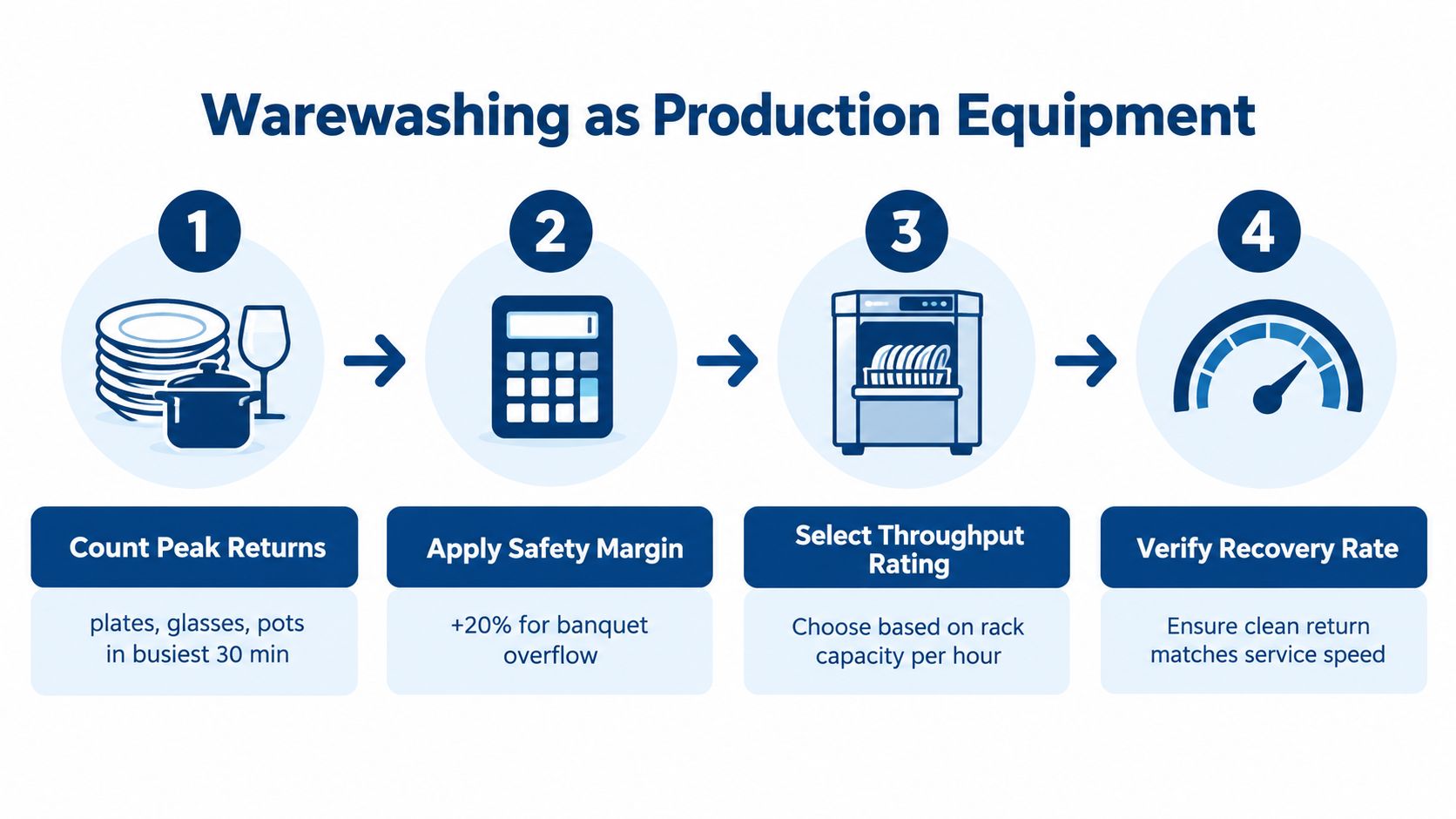
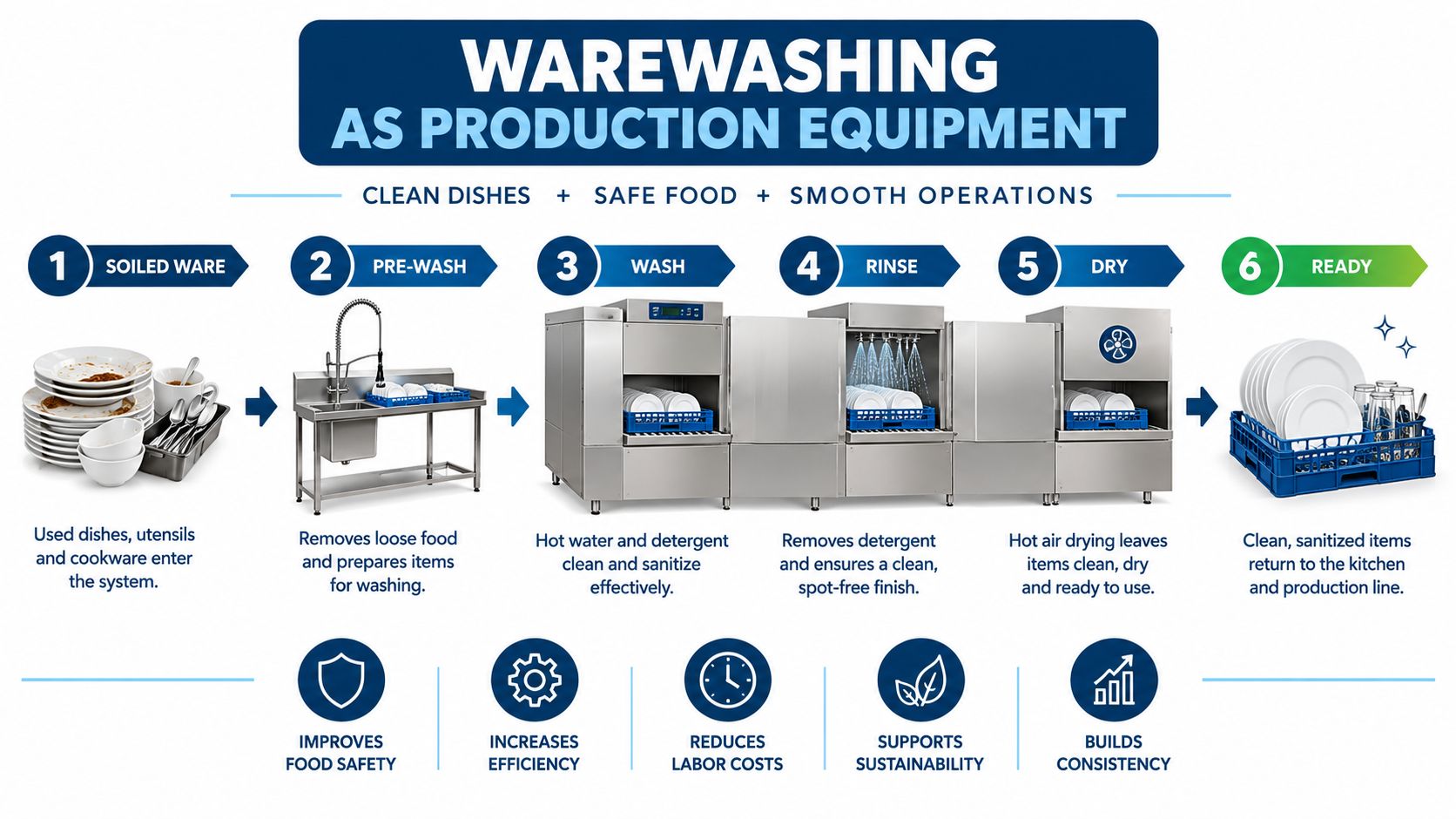
A dishwasher isn't a support item. It's a production machine that either keeps service moving or becomes the bottleneck that ruins it. The question is not whether a venue has a dishwasher, it's whether plates, glasses, utensils, and cookware can return to service fast enough during peak.
Size around return rate
The simplest way to assess warewashing is to count the items returning in the busiest 30-minute window, then make sure the machine and workflow can clear them without stacking up dirty goods. A small bar snack venue may cope with an undercounter unit and a glasswasher. A larger restaurant, especially one with banquet-style surges or serious serviceware turnover, usually needs something with more throughput.
The workflow matters as much as the machine. Dirty items should move through scrape, pre-rinse, wash, rinse, polish, and storage in one direction only. Clean plates should never cross paths with dirty returns, because that's how a useful washer turns into a hygiene and labour problem.
For venues comparing wash systems, manual dishwashing vs commercial dishwashers is a sensible read before the final decision is made.
The small things that prevent a big shutdown
Water pressure, rinse temperature, dosing, softening, and maintenance access all matter. If the system is hard to maintain or the water quality is poor, the machine may be technically installed but operationally fragile. That's a bad place to be on a Friday night.
A restaurant can have the cooking line right and still fail service because the clean plates don't circulate quickly enough. That's why warewashing belongs in the production plan, not in the “we'll sort that later” column.
Choosing Cooking Equipment That Fits the Menu
Cooking equipment should come out of the menu, the service style, and the peak load, because a kitchen is not built well by buying one of everything. A tight line that covers the actual dishes will usually serve a new venue better than a crowded set of appliances that look impressive but sit idle. The core task is to match cooking method to demand, then keep the installed cost and the cash reserve in view.
Map dishes to tasks, then to appliances
A menu built around grilled proteins, fried items, and sauces asks for a different setup than one centred on roasting and finishing. The aim is to cover the work with the fewest pieces that can still keep up. A combi oven may replace several separate units in some concepts, while a range, fryer, or chargrill is the better fit in others.
A cooking line should be tested against the actual service pattern:
- Production capacity: can it handle peak volume?
- Recovery: does it bounce back fast after loading?
- Simultaneous cooking: can it support parallel dishes without clogging the pass?
- Footprint: does it fit the room you have?
- Services: gas, electric, or induction load, plus drainage and extraction
- Cleaning: can staff clean around it properly?
- Labour: does it simplify or complicate the pass?
- Future menu changes: can the concept change without a rebuild?
Gas, electric, and induction each carry trade-offs. Induction is responsive, but it still has to match the available electrical supply and the rest of the services package. Combi ovens should be judged by pan capacity and workflow fit, not by a glossy capacity claim, and they still need clearance, hooding, and condensate drainage sorted early. For a wider look at cooking categories, cooking equipment is the right place to compare options without losing sight of the menu.
| Menu Category | Core Equipment | Capacity Driver | Installation Gotcha |
|---|---|---|---|
| Grilled mains | Griddle, chargrill, or range top | Peak fire rate | Extraction and heat load |
| Fried items | Fryer | Basket turnaround and recovery | Ventilation and oil management |
| Oven-led dishes | Combi oven or convection oven | Pan count and batch rhythm | Drainage, clearance, power |
| Finishing and holding | Pass equipment, heated shelves | Plate flow to the dining room | Space near service point |
New, Certified Used, and Finance Options for Opening Capital
New equipment, certified used equipment, and finance each solve a different opening problem. The right choice depends less on ideology and more on what the venue needs the cash to do in the first months of trade. A new restaurant often has to protect working capital just as carefully as it chooses appliances.
Compare the trade-offs honestly
New equipment gives full manufacturer warranty, known history, and current specification support, but it ties up more capital. Certified used can reduce the initial outlay and shorten lead times, but the buyer has to check condition, age, service history, warranty, parts availability, and the risk of downtime. Finance, including options such as SilverChef where eligible and subject to current terms, can preserve cash for the rest of the opening, but it does carry a financing cost and needs to be judged against cash flow, not just the monthly number.
A kitchen doesn't fail because every item was new. It fails when the opening budget leaves no room for working capital.
That's why many operators separate the purchase decision from the cash decision. A critical cooking line or refrigeration cabinet may justify buying new, while secondary items or back-of-house support gear can sometimes be bought differently. The core question is whether the business needs to spend cash now, or keep more of it available for stock, wages, rent, and the early trading wobble.
For a narrower look at sourcing options, why Simply Hospitality recommends certified used products from SilverChef is a useful companion read.
| Factor | New | Certified Used | Finance / Rent-to-Own |
|---|---|---|---|
| Upfront cash | Higher | Lower | Lower at purchase |
| Warranty | Full manufacturer cover | Shorter or limited | Depends on product and terms |
| Specification | Current | Varies by age | Current or current-equivalent |
| Downtime risk | Lower if commissioned properly | Higher if condition isn't checked | Depends on the asset |
| Capital preservation | Lower | Better | Better |
| Best fit | Core cooking and refrigeration | Secondary or staged purchases | Cash-sensitive openings |
Installed Cost, Working Capital, and Designing the Whole Kitchen First
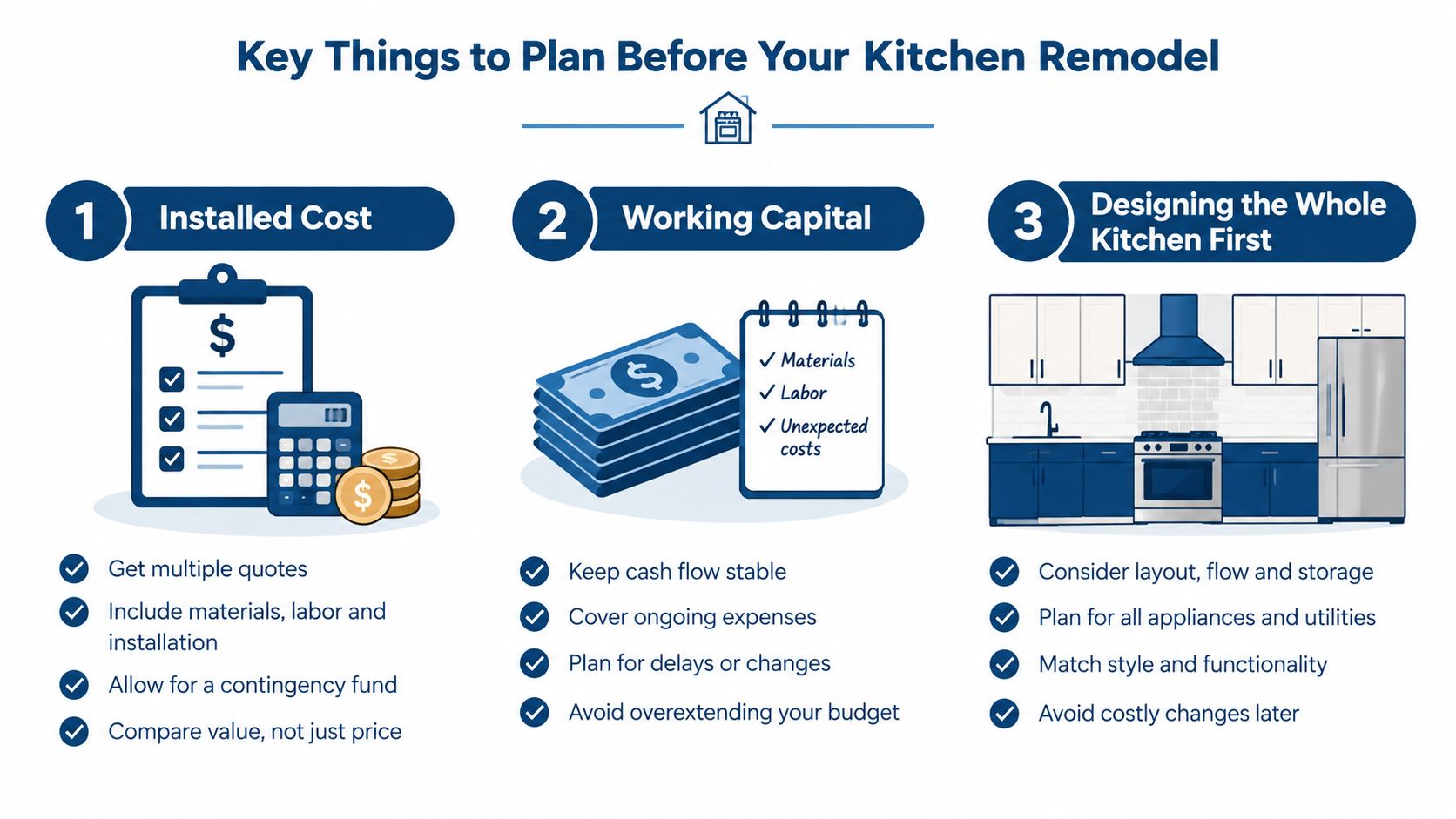
Owners often blur three different budgets into one and get surprised later. Installed cost is not the same as appliance price. It's the equipment plus freight, access, installation, required services, extraction, and accessories, and it can sit well above the sticker price once the venue is close to opening.
Keep the budgets separate
Working capital is different again. That's the cash needed to keep the business alive through initial stock purchases, wages, rent and outgoings, marketing, unexpected fit-out changes, and early trading variation. If all the cash is locked into steel and glass, the venue may open with equipment but no breathing room.
A better process is to design the whole kitchen first, then purchase in stages. A SACH-aligned design approach is useful here because layout, workflow, equipment specification, and services can be resolved before orders go in. That lets a venue buy the essential cooking line and refrigeration first, then add secondary items once trade patterns are clearer. In other words, stage the construction and purchasing, not the design.
The opening-day priority list is simple:
- Equipment essential to produce the menu
- Capacity needed to survive peak service
- Business-critical refrigeration and warewashing
- Equipment that reduces labour or bottlenecks
- Items that can be added later without rebuilding the kitchen
The most useful question isn't “what can the budget buy today?” It's what must be right on opening day, and what can be added later without tearing the kitchen apart. That's the decision that protects both service and cash flow.
If the equipment plan still feels too wide to pin down, Simply Hospitality can help translate the menu, workflow, and services into a practical opening list, including refrigeration, cooking, warewashing, and whole-kitchen planning. Visit Simply Hospitality to start a proper fit-out conversation before the orders are placed.