

How to Choose Commercial Oven Trays NZ: A Practical Guide
A tray jams against the oven runners just as the lunch prep starts. Another sits too close to the fan, browning one side of a batch while the centre remains pale. In the pot-wash area, a third tray has baked-on grease in its corners and a coating that staff can no longer clean confidently. These are common consequences of buying oven trays by appearance or price rather than by oven fit, food application and workflow.
For operators comparing oven trays in New Zealand, the practical decision is straightforward: choose a tray that fits the appliance, suits the food, handles the intended loading pattern and remains hygienically serviceable through repeated use. The best tray isn't necessarily the thickest, largest or most expensive. It's the one that performs consistently from preparation through cooking, cooling, cleaning and storage.
Choosing the Right Oven Tray for Your Kitchen
A café might need trays for pastries and small baked batches, while a restaurant may need roasting trays, GN pans and baking sheets that move between preparation and cooking. A caterer has another concern, because trays may remain occupied during cooling, transport or service. Home bakers also need to check fit, but manageable weight and versatility usually matter more than high-volume handling.
In our experience working with hospitality businesses, mismatched tray dimensions create more trouble than most buyers expect. A tray may fit inside the cavity but fail to sit properly on the runners. A high rim may restrict airflow. A warped base may cause liquid to pool or food to cook unevenly. These problems become especially frustrating when staff have already built recipes and production schedules around the oven.
Practical rule: start with the oven and the food, not the tray catalogue.
Before buying, operators should record:
- Oven cavity dimensions: Measure the usable width, depth and height, rather than relying only on the appliance's external size.
- Rack and runner format: Check whether the oven accepts shelves, rails, GN supports or bakery tray runners.
- Tray clearance: Allow for the tray rim, door clearance and airflow around loaded trays.
- Cooking application: Match a flat sheet, shallow tray, deep roasting tray or GN pan to the food being prepared.
- Handling requirements: Consider the tray's loaded weight, grip points and route between oven, bench, cooling rack and wash-up area.
A new oven can expose compatibility mistakes quickly. Operators comparing a commercial oven in New Zealand should confirm the supported tray format before ordering bakeware, particularly where the kitchen is moving between bakery trays and gastronorm pans.
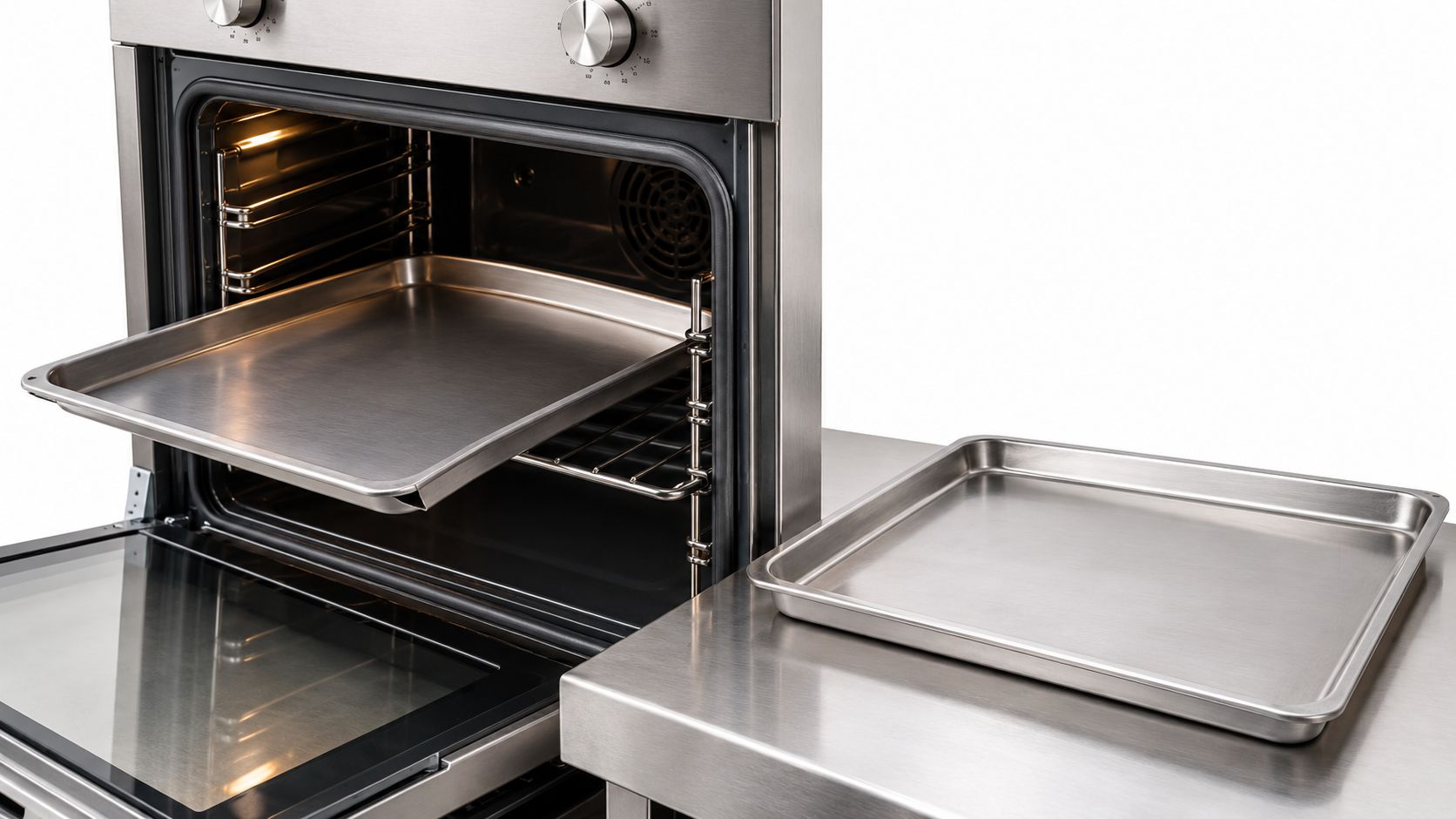
A sensible purchase often involves more than one tray type. Flat trays may handle biscuits and pastries, shallow trays may suit vegetables or lighter roasting, and deeper trays may contain liquids or substantial portions. Standardising those formats where possible makes loading, training, storage and reordering easier without forcing one design to do every job.
Key Factors to Consider When Selecting Oven Trays
Tray selection comes down to four connected questions: will it fit, will it cook appropriately, will staff handle it safely, and can the kitchen keep it clean? A product description that lists only length and width leaves out several details that affect daily performance.
Size is more than length and width
Check both the external dimensions and the internal usable cooking area. Rolled edges, handles and deep rims can reduce the area available for food. Tray depth also matters because it affects loading volume, airflow and the amount of vertical space used inside the oven.
Measure the oven cavity, rack spacing, runner width and door clearance. Then check how many trays can fit simultaneously without crowding the fan or blocking circulation. A loose fit isn't always a good fit, because movement during loading can damage food or create handling risks.
Commercial ovens from Turbofan, Unox, Convotherm, Blue Seal and Waldorf may support different formats depending on the model. GN 1/1 measures 530 × 325mm, but that dimension alone doesn't confirm compatibility. GN 1/1, GN 2/1 and standard bakery tray formats are not interchangeable, even when a tray appears close in size.
Material changes the way food cooks
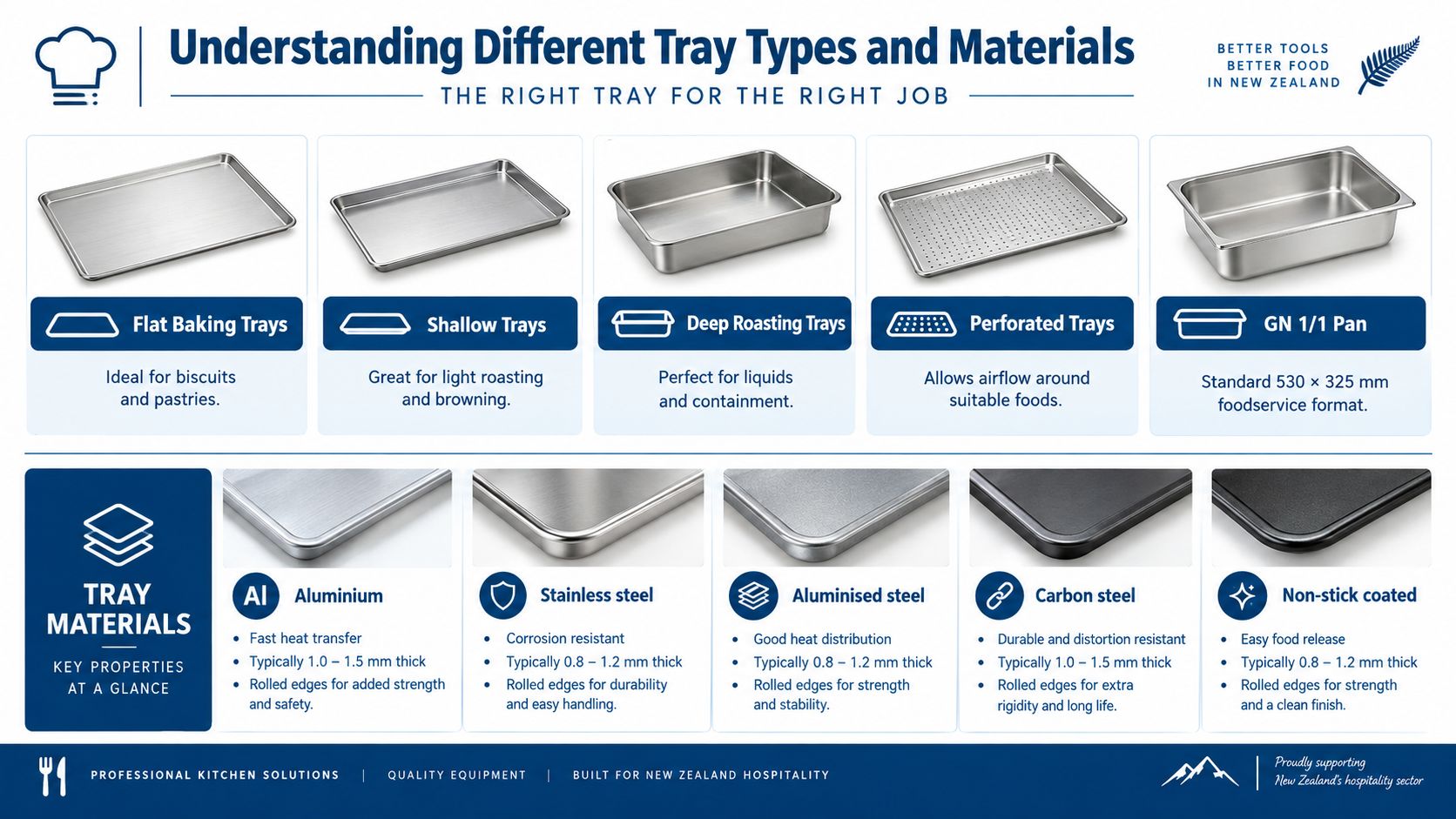
Aluminium transfers heat quickly and can suit baking applications where responsive heat transfer matters. Stainless steel offers a durable, corrosion-resistant option, though it may behave differently during browning and heat-up. Aluminised steel and carbon steel can provide a useful balance of strength and heat performance, depending on the construction.
Non-stick coatings may improve release and reduce cleaning effort, but the coating must suit the intended temperature, utensils and cleaning process. No material is universally best. The right choice depends on the food, oven programme, cleaning system and expected handling.
Construction affects handling
Look for construction details that match the workload:
- Material thickness: Thicker material can feel more stable, but added weight may make loaded trays harder to move.
- Rolled or reinforced edges: These can improve grip and reduce sharp handling points.
- Base rigidity: A tray should resist distortion under its intended operating conditions, but no tray should be described as guaranteed not to warp.
- Loaded weight: A large, deep tray may be difficult for one person to lift safely once filled.
- Surface integrity: Burrs, damaged coatings and rough areas create cleaning and food-contact concerns.
A lower purchase price can make sense for occasional home baking, while a busy commercial kitchen may place more value on repeatable fit, easy handling and cleanability. The choice between buying cheaply and buying once should be based on the complete operating cost, not the ticket price alone.
Understanding Different Tray Types and Materials
A baking tray, roasting tray and gastronorm pan can all go into an oven, but they aren't interchangeable in practice. Their depth, geometry and intended workflow determine whether they suit a particular product.
Flat and shallow formats
Flat baking trays and sheets have minimal sides and provide convenient access for biscuits, pastries and products that need space around them. They're useful where staff need to slide items off, lift them with a scraper or transfer finished products quickly.
Shallow baking trays add a modest rim for light roasting, browning and containing smaller amounts of fat or moisture. They can be more practical than a completely flat sheet for vegetables or pastries that release a little liquid.
Deep roasting trays are designed for greater containment. They suit roasting meats, foods with liquid, layered dishes and batch cooking where splashes or juices must remain within the tray. A deeper tray isn't automatically more versatile, because taller sides use oven space and can affect airflow and access.
Perforated trays
Perforated baking trays allow air to move around suitable products in a compatible convection or combi oven. They may help with certain breads, pastries and foods that benefit from airflow beneath the product.
They aren't suitable for every application. Liquids, loose mixtures and small foods may run through the openings or become difficult to remove. The oven manufacturer's guidance and the food's structure should determine whether perforation is appropriate.
GN pans and bakery trays
Gastronorm pans are standardised around foodservice equipment and may support preparation, cooking, storage and service where the pan and food application are suitable. A GN pan can be a practical restaurant choice when the oven, refrigeration, hot holding and service equipment share the same format.
Commercial bakery trays often use different dimensions and may be designed for a specific bakery oven, rack or trolley system. Bakeries generally benefit from consistent tray geometry because repeatable loading and spacing are central to production control.
Material selection also needs to reflect the task. Aluminium can provide fast heat transfer, stainless steel can offer corrosion resistance, and aluminised steel or carbon steel may suit repeated handling where the construction is durable. Non-stick coated trays can assist with release, but scratches, harsh abrasives and unsuitable temperatures may damage the surface.
For a broader look at the relationship between tray style, material and baking application, the bakeware range and guidance provides useful context. Baking paper and reusable silicone mats create another option, particularly where release and cleaning are priorities. The Silicone Baking Mats article explains how a liner changes the relationship between food and tray surface.
Matching Tray Types to Your Kitchen's Needs
A tray choice affects the full production cycle, from preparation and loading to cooking, cooling, cleaning and storage. A bakery, café and caterer may use the same oven brand yet need different formats because their workflows, batch sizes and handling demands differ.
Bakery production
Bakeries should prioritise consistent external dimensions, repeatable spacing and easy handling. A tray that fits one rack position but not another disrupts loading patterns and makes baking results harder to reproduce. Standard bakery formats suit operations where the oven, racks and trolley system are built around the same geometry.
Restaurants
Restaurants often need shallow roasting trays, deeper pans and GN formats. GN pans can support preparation, cooking and holding when the oven, refrigeration, hot holding and service equipment share the same footprint. Check the oven runners, pan depth and airflow rather than choosing on the GN label alone.
Menu variation also matters. A tray used for vegetables may be unsuitable for a sauced dish, while high sides can make unloading and plating awkward during service. Select formats that reduce handling between cooking and service.
Cafés and compact ovens
Cafés usually manage limited cavity space and frequent small batches. Measure the internal cooking area, then check clearance around the fan and sides. A smaller tray that preserves airflow and is easy to lift can outperform a larger tray that slows loading or creates awkward handling. For small baked products, compare silicone muffin trays and alternative bakeware options with standard metal formats, considering release, cleaning and storage.
Caterers and home kitchens
Caterers should assess stackability, transport, cooling, storage and cleaning turnaround. Trays may move between production areas and service locations, so edge strength and loaded handling affect both safety and workflow.
Home bakers generally need reliable oven fit, manageable weight and flexibility across biscuits, roasting and reheating. Commercial-style depth and weight are not automatically advantages for occasional use.
Standardise the formats that best suit the menu, then keep specialist trays for specialist tasks.
Map the production cycle before buying:
- Preparation: Identify whether foods need a flat sheet, shallow rim, deep containment or perforation.
- Loading: Confirm that trays can be filled and lifted safely.
- Cooking: Check spacing, rack positions and batch repeatability.
- Cooling and holding: Allow for food remaining on the tray after cooking.
- Cleaning and storage: Confirm that wash-up space and shelving suit the chosen formats.
Whole-of-life value combines purchase price, suitability, durability, cleaning effort, replacement requirements and production efficiency. A low-cost tray that distorts or fits poorly can create avoidable work. A premium design may offer little benefit for occasional baking.
Calculating How Many Trays You Really Need
Oven capacity gives only part of the answer. During a busy service, trays are also tied up in preparation, cooking, unloading, cooling, washing and storage. Your usable number is the quantity available across the complete production cycle.
Start with the busiest production period. List each product, batch size, trays required per batch and the time each tray stays unavailable. Check whether the same formats are shared between baking, roasting, cooling and storage. This method reveals workflow bottlenecks that an oven specification will not show. It also supports better planning equipment for consistent meal service.
Extra trays may be needed when:
- Cooking runs continuously: Clean trays must be ready as other batches occupy the oven.
- Cooling takes time: Cooked food may stay on the tray before transfer or refrigeration.
- Cleaning is delayed: A pot-wash queue can remove trays from service when demand is highest.
- Menus overlap: Pastry, roasting and catering work may require the same formats at once.
- Peak demand changes: A quiet morning and an event service can need different operating capacity.
Cooling also affects food safety and tray availability. New Zealand food-control requirements state that potentially hazardous food must cool from 60°C to 21°C within two hours, then from 20°C to 5°C within a further four hours. MPI guidance recommends shallow containers, smaller portions or a blast chiller to speed cooling.
A shallow metal tray can increase surface area, but staff still need to measure temperatures and follow the business's documented procedure. Overloading, stacking or placing a large mass of food in a deep tray can slow heat release, keeping the tray occupied longer.
Reheating requires the same production-cycle discipline. Food must reach at least 75°C in all parts before service or hot holding, then be served promptly or kept at 60°C or hotter, as outlined in MPI reheating guidance. Tray depth, covering and loading can affect the coldest point, so verify the result with a calibrated probe thermometer.
Cleaning, Maintenance, and Hygiene Best Practices
A tray that looks clean isn't necessarily hygienically serviceable. Soil can remain in corners, rolled edges, scratches, pits or carbonised areas, especially when staff rush the wash-up process.
Commercial trays are food-contact equipment and should be managed through the kitchen's food-control procedures. Cleaning must reach the cooking surface, rims, corners, underside and any handles. Food businesses should use the correct detergent and sanitiser process, follow chemical concentration requirements and retain cleaning records where their procedures require them.
Inspect the surface, not just the appearance
Remove a tray from service when it has:
- Deep scratches: These may retain food residue and make effective cleaning difficult.
- Corrosion or pitting: Rough surfaces can trap soil and deteriorate further.
- Flaking or damaged coating: Loose coating should not remain in contact with food.
- Persistent staining or carbonisation: If normal cleaning cannot remove the residue, reassess the tray's suitability.
- Permanent distortion: A warped base may create uneven cooking, unstable stacking or unsafe handling.
- Burrs or sharp edges: These can injure staff and compromise food-contact suitability.
New Zealand guidance requires food premises to maintain hygienic food-preparation surfaces and suitable storage for utensils and equipment. The food-contact and hygiene requirements also support a clear operational position: damaged or unsuitable equipment should be removed rather than kept in service indefinitely.
Match cleaning to the tray
Uncoated metal, non-stick coatings, silicone liners and baking paper each have different cleaning needs. Operators shouldn't assume that every commercial oven tray is dishwasher-safe. The manufacturer's instructions should determine whether the tray can enter a dishwasher, which chemicals are acceptable and whether abrasive pads are prohibited.
Store trays so they dry fully and don't rub against one another unnecessarily. Avoid dropping loaded trays, stacking wet trays and using metal utensils on coated surfaces where the manufacturer doesn't permit them. Hot trays should be handled with suitable protection and placed on heat-resistant surfaces.
MPI advises that cooling food can be placed in a preferably metal tray or larger dish to increase surface area, while ovens should be preheated before cooking. Safe food preparation guidance reinforces the connection between tray condition, preheating, cooking, cooling and temperature control.
A reliable purchasing decision therefore weighs fit, material, construction, food application, cleaning compatibility and replacement triggers together. For expert advice on oven trays, GN pans, bakeware and commercial ovens, visit Simply Hospitality. Its team can help match tray formats and specifications to the oven, menu and production workflow before a purchase creates compatibility problems.