

Pizza Box NZ: Choosing the Right Packaging for Your Pizzeria
Most advice treats a pizza box like a line item. That's the wrong starting point. A pizza box NZ operators choose is the last piece of equipment the pizza touches before it reaches the customer, so it affects heat, steam, crust texture, topping presentation, stacking strength, and the first impression of the brand. When the box is too tight, too weak, or too sealed, the kitchen can do everything right and still send out a softer, messier pizza than intended.
For NZ operators, the decision is not “which box looks nicest”. It's which box protects the pie, manages moisture, survives delivery, and fits the menu without creating avoidable storage and ordering headaches. That's why box choice deserves the same practical attention as oven selection, especially once takeaway and delivery become a meaningful part of service. For broader food packaging context, see Hospitality's practical note on what hospitality operators should know about food packaging.
Why a Pizza Box Is More Than Just Packaging
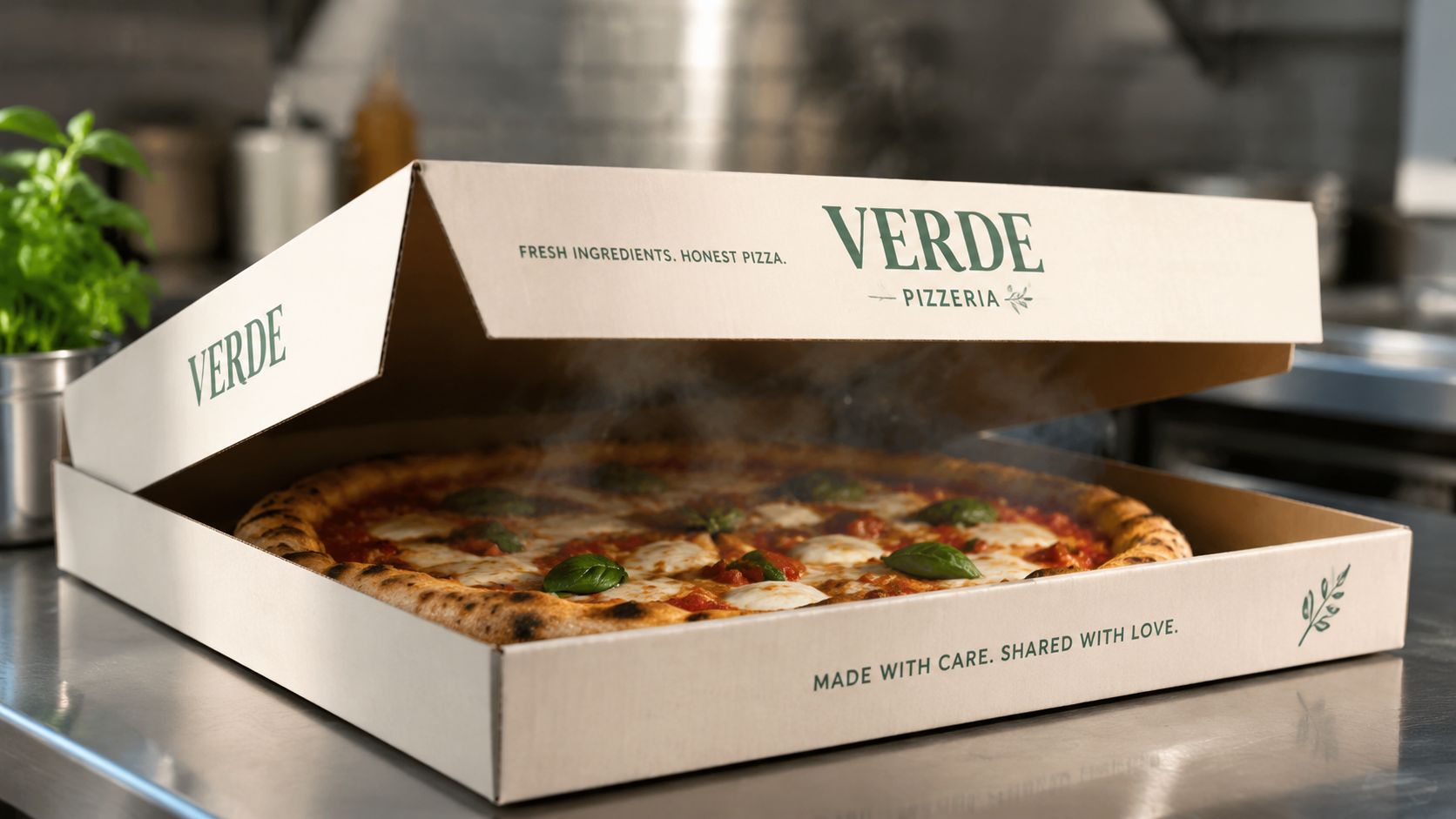
A good pizza box has to do more than hold cardboard shape. It has to protect the pizza from being crushed, keep enough warmth in for the handover, and avoid trapping so much steam that the base goes soft before the customer opens the lid. That balance matters because the objective isn't maximum heat retention, it's getting the pizza to the customer in the condition it left the oven.
The box is part of the food delivery system
In a busy venue, the box becomes part of the production line. Staff need to grab the right size quickly, close it cleanly, and trust that the base won't buckle when the order is stacked with others or moved into a delivery bag. If the box is flimsy, the pizza is more likely to shift, the toppings can smear against the lid, and the customer gets a poor opening experience even if the pizza itself was made well.
That's why fitting the box correctly matters so much. Local NZ suppliers commonly list 12-inch boxes around 300 × 300 × 43 mm or 305 × 305 × 40 mm, and 12-inch to 14-inch ranges around 305 × 305 × 40 mm to 355 × 355 × 40 mm. The practical point is simple, a snug fit with a small clearance margin helps reduce contact between toppings and lid, which is especially important during delivery.
A common mistake is treating packaging as an afterthought once the kitchen setup is done. The smarter approach is to treat the box as the final step of service design, because it directly shapes what the customer receives.
The Six Jobs Every Pizza Box Must Perform
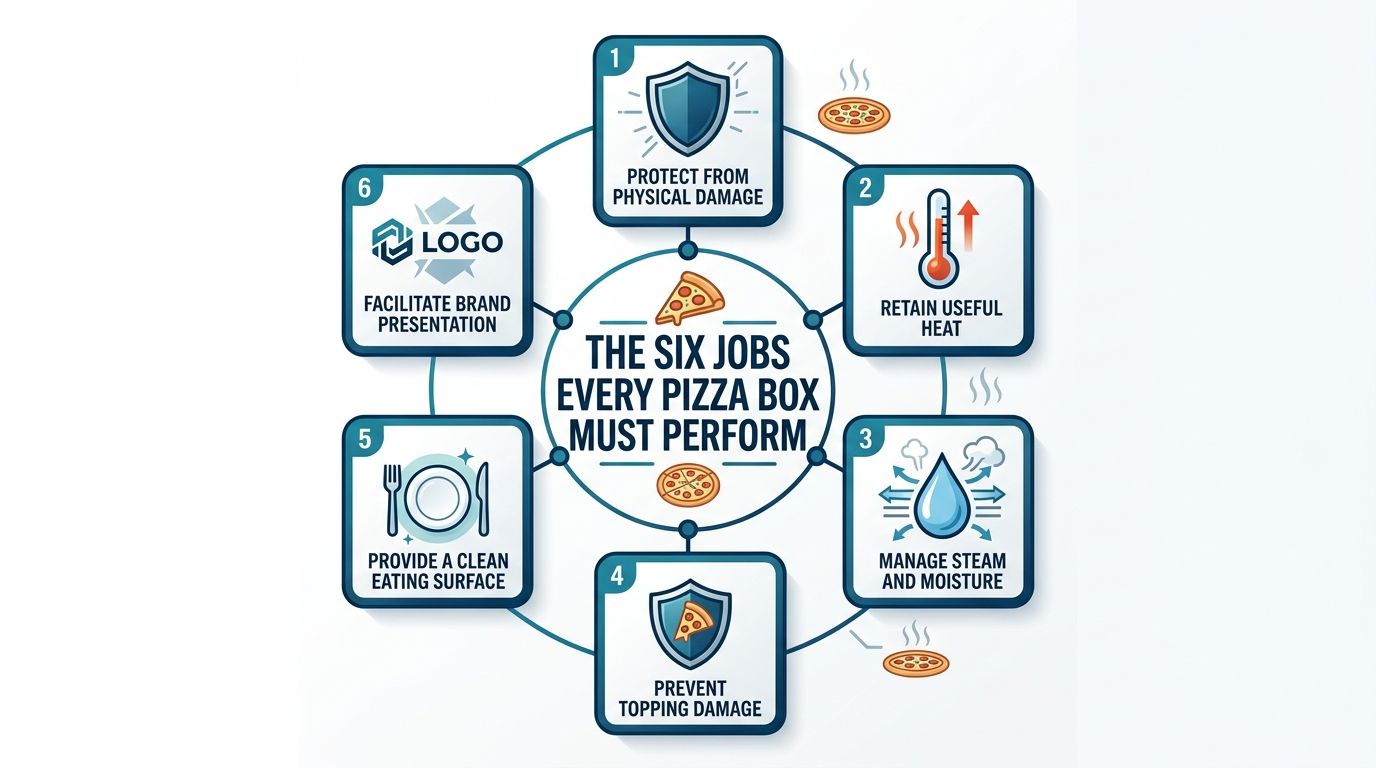
The box is the final piece of kitchen equipment in the service chain, and it has to do six jobs at once. It needs to protect the pizza, retain useful heat, manage steam and moisture, prevent topping damage, provide structural support, and make takeaway or delivery easier. Those jobs overlap, so the best box is rarely the one that just feels thickest in the hand.
Heat matters, but steam matters just as much
The biggest misconception is that more sealed-in heat is always better. Too much trapped steam softens the crust, blunts the texture, and can make the pizza feel less fresh by the time it reaches the customer. The right box keeps the pizza warm enough for service while still letting moisture behave properly.
Practical rule: if the pizza arrives hot but limp, the box is failing at moisture management, not just heat retention.
That balance matters even more when the order sits in an insulated bag or the delivery run is longer than planned. A box that works well at the counter can still need support from the rest of the service setup, which is why packaging considerations for takeaway businesses need to be treated as part of kitchen planning, not an afterthought. The packaging and the delivery system have to work together.
Where boxes fail in real service
Failures usually show up in predictable ways.
- Protect from physical damage: Corners crush when cartons are stacked carelessly or placed under heavier items.
- Retain useful heat: The pizza cools too quickly if the carton is too open or too thin for the journey.
- Manage steam and moisture: Condensation softens the base when the lid traps too much moisture.
- Prevent topping damage: Cheese, sauce, and loose toppings smear when the pizza moves inside the box.
- Provide a clean eating surface: Customers do not want dust, fibres, or greasy collapse near the food.
- Facilitate brand presentation: A clean, well-proportioned box helps the business look organised before the lid is even opened.
Local packaging listings for kraft pizza boxes describe water and oil resistance to +60°C and microwave safety up to 100°C for 30 seconds, while also describing a brown kraft exterior liner with recycled corrugations and an internal liner. Those details matter because the specification affects how the box handles grease, heat, and handling stress.
For operators using stacked dough storage systems, a model-matched part such as the Cambro Pizza Dough Box Cover - White - 457 × 660 mm shows the same principle at the prep end of the workflow, only the top box in the stack needs the cover, which keeps the system simpler and avoids buying unnecessary extras.
Choosing the Right Pizza Box Sizes for Your Menu
The right size follows the menu. Operators who try to force one box size to cover everything usually end up with wasted material, awkward fitting, or a box that moves too much in transit. A pizza that swims around inside the carton can lose presentation quality even when the base is still technically protected.
Start with the pizzas you sell
A sensible ordering range starts by mapping the menu into practical groups, such as individual pizzas, standard pizzas, large pizzas, and family-size pies. That lets the business standardise on a manageable number of box sizes instead of carrying a different carton for every possible variation.
The operational benefit is straightforward. Fewer pizza sizes means fewer box sizes, simpler purchasing, easier storage, and less chance of running out of the wrong carton on a busy night. That matters in cafés, bars, and food trucks where storage space is already tight.
The same thinking applies to the rest of the packaging system. If your team is trying to keep waste handling sensible as well, it helps to use packaging that fits the business's disposal path, including the guidance discussed in using Biopak sustainable products in the New Zealand hospitality industry.
Here's a practical view of common NZ sizing patterns.
| Box Size Label | External Dimensions (mm) | Fits Pizza Diameter |
|---|---|---|
| 10-inch | about 255 × 255 × 40 | 10-inch pizza |
| 12-inch | about 300 × 300 × 43 or 305 × 305 × 40 | 12-inch pizza |
| 14-inch | about 305 × 305 × 40 to 355 × 355 × 40 | 12-inch to 14-inch range |
| Family-size | larger square cartons | larger pies and sharing pizzas |
Fit is more important than the label
A practical technical takeaway from NZ suppliers is to allow roughly 5 to 10 mm of clearance so the pizza doesn't touch the lid during transport. That small margin reduces topping contact and helps avoid crust deformation when the box is moved, stacked, or placed into a delivery bag.
The wrong-size carton is often a workflow problem, not just a packaging problem. Staff spend longer hunting for the right box, and the pizza is more likely to arrive with damaged presentation.
The best buying question is not “What is the biggest box we can use?”. It is “What sizes do we sell, and how many box types do we really need to keep the menu moving smoothly?”
Material Options and Board Performance
Size addresses only one part of the job. Material choice determines whether the box holds up under grease, heat, stack pressure, and transport handling. For NZ operators, the decision usually sits between standard corrugated cardboard, kraft board with grease-resistant liners, and compostable or plant-based alternatives. Packaging choice also affects ordering, storage, and menu growth, so it is worth treating it as part of the buying decision rather than an afterthought, as discussed in choosing packaging for growth.
Corrugated, kraft, and compostable boards each trade off something
Standard corrugated cardboard is the workhorse option. It is familiar, usually practical for blank stock, and suits many lower-complexity takeaway operations. Kraft board with grease-resistant liners adds a more technical layer of protection, which matters when pizzas carry generous cheese, oil, or wetter toppings that can soak through weaker packaging.
Compostable or plant-based alternatives bring a different value proposition, but they should not be chosen on the label alone. Sustainability claims need to be checked against how the packaging behaves in use, whether the destination waste stream accepts it, and whether the box still performs for delivery. A box that sounds better on paper but fails in service costs more than it saves.
| Material Type | Strength | Grease Resistance | Heat Handling | Printability | Practical Use |
|---|---|---|---|---|---|
| Standard corrugated cardboard | Good for general use | Variable | General takeaway use | Good | Lower-complexity operations |
| Kraft board with grease-resistant liners | Stronger specification | Better where grease is heavy | Better specified options available | Good | Delivery-focused menus |
| Compostable or plant-based alternatives | Depends on build | Varies widely | Depends on product | Variable | Only when end-of-life and performance both fit |
Board strength affects customer complaints
Board strength matters because delivery stacks, handoffs, and travel all put stress on the carton. If the box bows, crushes, or sags, the customer sees a packaging failure even when the food itself was made well. That is why local listings that specify heat and grease resistance are more useful than vague claims about “eco” performance.
Grease resistance matters most on pizzas with oils, cheese, and high-moisture toppings. Local kraft pizza box listings that describe water and oil resistance, along with heat tolerance, show the kind of specification operators should look for when comparing options. For sustainability-focused purchasing, hospitality guidance on using BioPak sustainable products in the New Zealand hospitality industry is worth reading alongside the actual packaging spec.
NZ Recycling Rules and Composting Realities
The end-of-life question is where many pizza box conversations go wrong. A box that looks recyclable isn't always recyclable once food has touched it, and a compostable claim doesn't mean every local system will accept it. In NZ, the practical rule is cleaner and stricter than the marketing on many cartons.
Clean boxes can go in recycling, soiled ones usually cannot
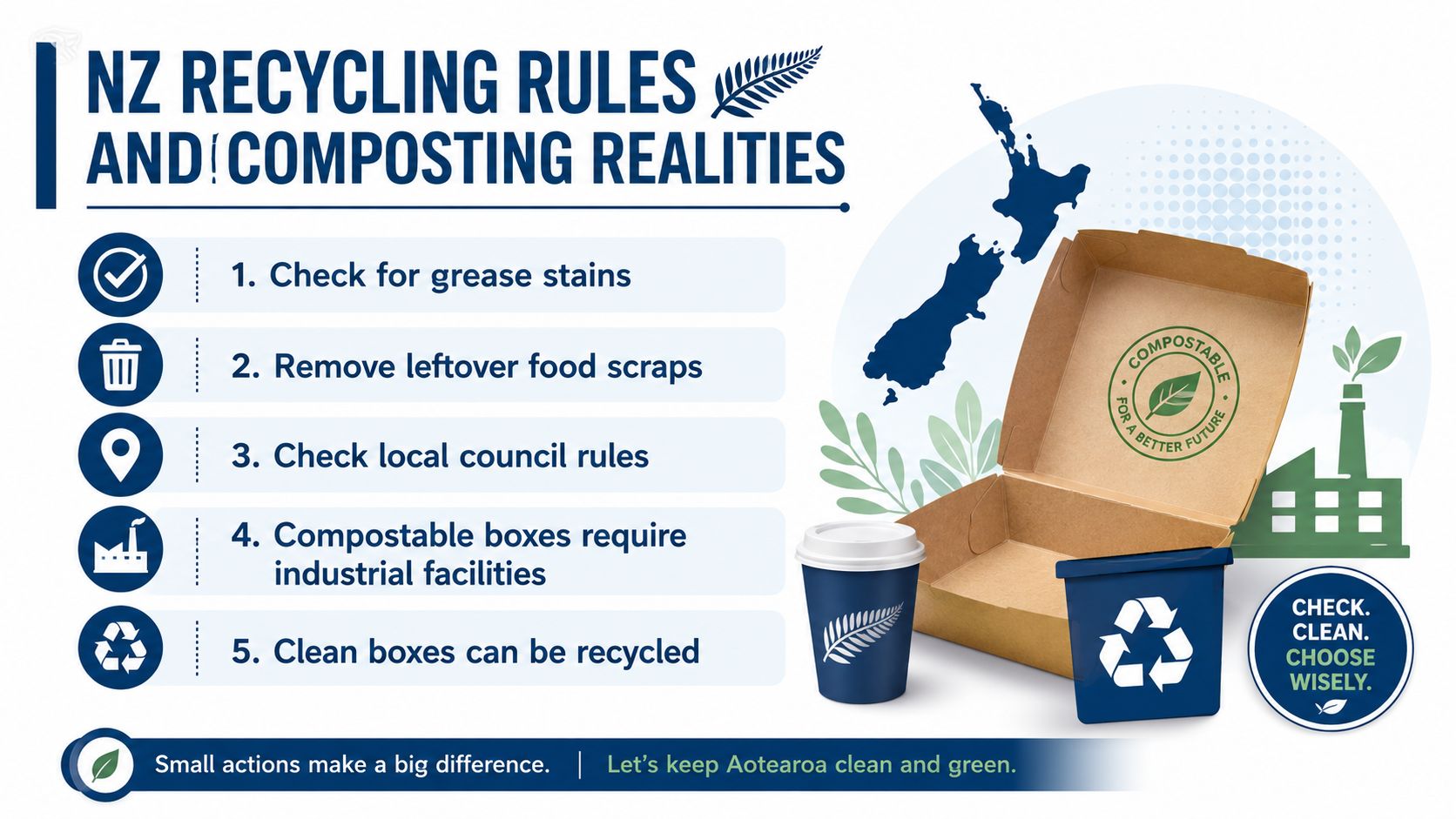
Under the national recycling standard introduced from 1 February 2024, clean pizza boxes are accepted in kerbside recycling, but they must be free of food scraps (University of Canterbury sustainability guidance). Councils also note that a small amount of grease may be acceptable, but cheese, sauce, and leftover toppings are not.
Hamilton Council warns that food, oil, and grease residue on the bottom of the box contaminates paper and card recycling, while Auckland Council says a pizza box must be free of food, with only some grease allowed (Hamilton Council). That creates a practical sorting rule for businesses, the lid may be recyclable if clean, but the greasy base often needs to go with rubbish unless the local council says otherwise.
Compostable claims need local reality checks
The harder conversation is compostability. Packaging discussions in NZ increasingly focus on whether the box is recyclable or accepted in local organics or recycling systems, because on-demand delivery has expanded single-use packaging volumes and waste outcomes still vary by council and facility (Otago University research).
Useful test: if the box is greasy, contaminated, or not accepted by the destination facility, the sustainability label doesn't solve the disposal problem.
The practical approach is to match the packaging spec to the waste stream the business uses. That means checking local council rules, not assuming all “eco” boxes behave the same way once food waste is involved. For NZ operators, honest sustainability starts with the bin, not the brochure.
Blank Boxes Versus Custom Printed Branding
Blank boxes often make sense at lower volumes. They simplify purchasing, reduce stock headaches, and let the operator keep moving if the menu changes or the takeaway offer is still being refined. For many small pizzerias, cafés, and food trucks, that flexibility is more useful than decoration.
Blank boxes suit smaller or changing operations
A blank carton still does the job on the pass and in delivery. If order volume is modest, a generic box avoids the pressure of large custom print runs, and it removes the risk of sitting on printed stock that no longer matches the menu, logo, or trading name. That is a practical advantage for businesses still testing demand or adding pizza as a secondary category.
As volume rises, custom printed boxes become easier to justify because every takeaway order becomes a branding touchpoint. The restaurant name, logo, website, and social channels can travel with the pizza, so the box carries part of the customer experience instead of just protecting the food.
For operators wanting a reference point on presentation and pack choice, the approach behind affordable custom packaging follows the same logic, once the pack is part of the customer journey, it carries brand value as well as product function.
The real cost is bigger than the carton price
The decision should not be based on carton price alone. Custom printing can bring setup requirements, longer lead times, minimum order quantities, and extra storage pressure. Blank boxes reduce those constraints, which is why they often suit businesses where space is tight or demand changes from week to week.
Hospitality's guide on choosing packaging for growth fits this decision, because packaging should match the business stage instead of forcing it.
When reviewing blank versus printed cartons, the better questions are:
- Do orders leave with a clean, consistent presentation already?
- Is the volume high enough that every box should carry branding?
- Can the business store a custom run without tying up too much space?
- Will the menu stay stable long enough to justify the print commitment?
The right answer depends on operating volume, storage, and how much branding value the business can use.
Food Safety, Storage, and Ordering Best Practices
Food packaging rules in NZ are clear enough, but they only work if the business handles boxes properly. Packaging used for food must suit its intended use and must not transfer unsafe substances into food, and MPI's guidance also expects packaging and food-contact materials to be stored and handled hygienically so they do not become contaminated before use (MPI food packaging rules).
Keep the handling system as disciplined as the cooking system
Boxes should be stored clean, dry, and protected from dust, splash, pests, raw food contact, and chemicals. Staff should not treat pizza cartons as a general-purpose storage container once they are on the floor. A pizza box is food-contact packaging, not a random box to be repurposed for prep or storage.
For everyday ordering, cost per box gives a better read than carton price alone. A cheap carton that takes up excessive storage space, forces larger minimum orders, or fails in delivery can end up costing more than a better-specified option that fits the menu more cleanly.
A short checklist that keeps ordering sane
- Store boxes flat in a cool, dry area: This protects board integrity and keeps the pack clean for use.
- Use boxes only for their intended purpose: Food packaging should stay in the food-contact workflow.
- Avoid storing food in boxes for extended periods: The carton is not a holding vessel, and long dwell times create avoidable quality issues.
- Match the box to the delivery method: Longer journeys may need insulated delivery bags as part of the handover system.
- Check the storage plan before ordering: Flat-pack cartons still occupy meaningful space in a busy kitchen or back room.
For storage discipline, Hospitality's guidance on how to store food in a restaurant fridge is useful alongside packaging decisions, because the same hygiene mindset should apply from cold storage through to the final handover.
The right pizza box fits the menu, the delivery method, the waste rules, and the workflow without creating extra work for staff. For help comparing box sizes, board types, blank or printed stock, and storage-friendly ordering options, contact Hospitality for practical advice matched to your business.