

Choosing the Right Pots and Pans for Your Kitchen
Most advice about pots and pans gets the order wrong. Buyers are pushed toward matching sets, premium finishes, and glossy claims, when the true test is simpler: does the piece suit the food, the cooktop, and the pace of the kitchen? A pan that fits the job will beat a showpiece that looks good in storage and wastes time in service.
For NZ operators, that matters because cookware is not just a purchase, it's part of workflow, food safety, and waste control. In commercial kitchens, the wrong size or construction can slow service, make cleaning harder, and create avoidable handling risks. The smarter buy is usually the one that fits how the kitchen works, not the one that looks most complete on day one. For operators thinking about the long game, this buying cheap vs buying once mindset is the right place to start.
Why the Best Pots and Pans Are Not Always the Most Expensive
The most expensive set is often the least practical buy. Plenty of kitchens end up paying for pieces that never leave the shelf, while the few pans that do all the work wear out early because they were never chosen for the right task. That is bad purchasing, not bad luck.
Buy for use, not for display
A sensible cookware decision starts with three questions. What food is being cooked, what heat source is available, and how often is the vessel going to be handled, washed, stacked, and reused? If those answers are clear, the price tag becomes secondary.
Practical rule: A working kitchen should judge cookware by frequency of use first, then by material, then by appearance.
That approach is especially important in hospitality, where one pan might be used for batch sauces at lunch, reheating at dinner, and cleanup in between. A matching set looks tidy, but tidy does not equal useful. Many operators are better off with a focused mix of pieces that cover the menu properly and nothing more.
Many buyers overspend here. They assume “premium” means “professional”, when in fact the better choice is often a straightforward, sturdy piece with the right capacity and a construction that suits the burner or induction top. If a vessel is awkward to lift, slow to clean, or wrong for the food, it costs more in practice than it did on the invoice.
The best operators think in terms of workflow, not romance. A pot is only valuable when it helps the kitchen move faster, cleaner, and more safely through service.
Matching Common Cookware Types to Real Kitchen Tasks
Every kitchen uses the same handful of shapes over and over. The mistake is buying them as if each one needs to be impressive, when most of them just need to be dependable and sized properly. For a lot of businesses, a tight, sensible selection does more than a crowded cupboard full of duplicates.
The everyday shapes that earn their keep
A saucepan is for sauces, vegetables, grains, and smaller-volume cooking. It needs control more than drama, because the job is usually precision and repeatability rather than brute capacity.
A stockpot suits stocks, soups, pasta, and larger batch prep. It is the workhorse for volume, but only if it still fits the hob and can be handled safely when full. Oversized capacity sounds useful until it becomes awkward to pour, drain, and clean.
A frying pan is the most direct everyday tool, good for searing, sautéing, and general cooking. A sauté pan does a similar job, but its higher sides make it better where shallow cooking, reducing, or tossing larger portions matters.
A casserole pot comes into its own for braising, slow cooking, and oven use. It is the kind of vessel that needs stable construction and a lid that fits properly, not one that rattles or distorts.
A wok is for high-heat, fast movement, and stir-frying where the cooktop and technique are compatible. A carbon wok approach suits kitchens that use that style of cooking, not venues buying one because it sounds versatile.
Specialist pieces, like crepe pans and grill pans, are situational tools. They are useful when the menu demands them, but they are not essentials for every venue.
Most kitchens don't need every cookware type. They need the right few pieces, in the right sizes, used hard and replaced sensibly.
Stainless, Aluminium, Cast Iron, Carbon Steel, or Non-Stick
Material matters, but not in the lazy way people often talk about it. No single metal wins every job. The right answer depends on what needs to happen in the pan, how much abuse it will take, and how much care the team will realistically give it.
How the main materials behave
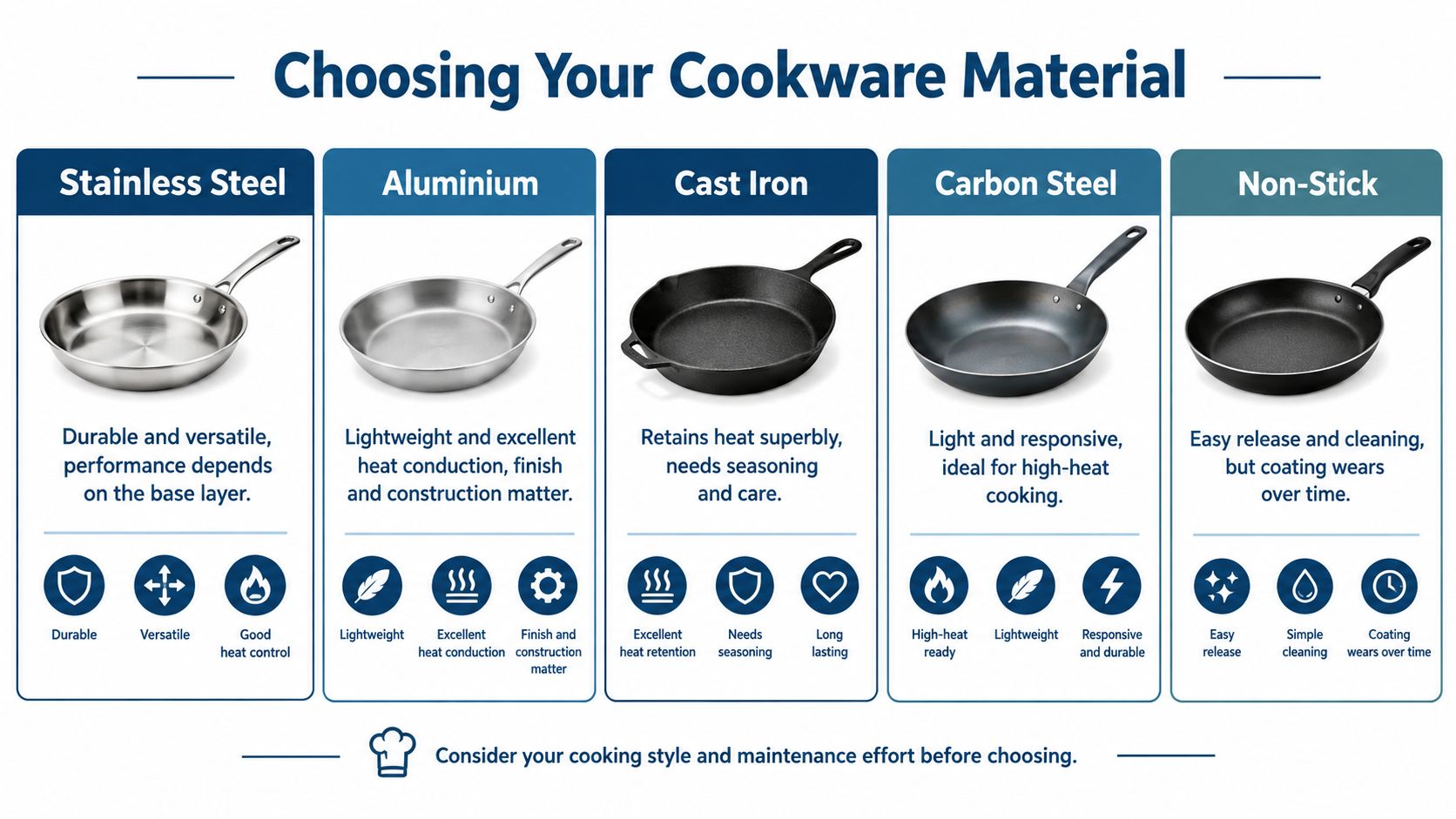
Stainless steel is the dependable all-rounder. It's durable and versatile, and performance depends heavily on the base and overall construction rather than the outer metal alone. It suits kitchens that need one piece to handle a wide range of jobs.
Aluminium is light and conducts heat well, but finish and construction decide how useful it is in practice. It can make sense where responsiveness matters and where the business values easy handling.
Cast iron holds heat very well, which is why it suits steady, even cooking and certain oven applications. The trade-off is weight, so it's not the right fit if staff are lifting and moving it constantly.
Carbon steel sits in the middle for a lot of chefs. It's lighter than cast iron, responsive on heat, and useful where high-temperature cooking or wok-style work is common, provided the team is happy to look after it properly.
Non-stick is chosen for easy release and easier cleaning, not for brute durability. It suits delicate foods and low-friction cooking, but the coating has care and temperature limits that need respect.
The key difference is heat conductivity versus heat retention. Conductivity is how fast a pan responds when heat is applied. Retention is how well it holds temperature once it's hot. A responsive pan helps with quick adjustments, while a high-retention pan helps when stability matters more than speed.
Match the metal to the technique
In a busy kitchen, stainless and aluminium tend to cover the widest range of needs. Cast iron and carbon steel are more specialised, but they're excellent when the team understands their trade-offs. Non-stick remains useful, but only where easy release is the priority and care standards are consistent.
Why Cookware Construction Matters as Much as Material
A pan can be made from the right metal and still cook badly. Construction decides how that metal behaves under heat, how evenly it works across the base, and how reliably it survives repeated commercial use. That is why product descriptions should be read carefully instead of skimmed.
What to look for in the build
Base thickness affects how quickly a pan responds and how even the heat stays. A thin base can be lively, but it can also create hot spots. A heavy base can improve stability, but it is not automatically better for every task.
Encapsulated or sandwich bases are common for a reason. They help spread heat more evenly and can make a pan behave more predictably on the hob. Multi-ply construction pushes that further by bonding layers through the body of the cookware, not just the bottom.
Handle attachment matters more than buyers expect. Rivets, welds, and fastening points should feel secure, because loose hardware turns into a service problem fast. Weight and balance matter too. A pan that feels fine empty can become awkward once it's full, especially when staff are moving quickly.
Lid fit and resistance to distortion are practical, not cosmetic. A poor lid wastes heat and makes simmering less controlled. A base that warps under normal use is a problem, not a feature.
Simple check: If the cookware looks overbuilt but feels clumsy, it probably is.
Commercial kitchens often prefer strong handles, easy-clean surfaces, and sturdy construction over sheer heft. That's because the pan has to be lifted, stacked, washed, and grabbed again all shift long. A sensible build is one that behaves well in the hands of real staff, not just in a showroom.
Choosing the Right Size and Capacity for Your Workflow
Size matters just as much as material. A pan that's too small forces crowding and poor control. A vessel that's too large can be a handling hazard and a waste of bench, hob, and storage space.
The right question is not “what is the biggest size available?” It's “what volume is being produced, on what equipment, by how many people, and how often?” That's the difference between useful capacity and dead weight.
Fit the vessel to the production pattern
Pan diameter should match the burner or heating zone so heat is transferred properly and the base stays stable. Saucepan and stockpot capacity should line up with the batch size, not the best-case scenario on a quiet day.
Available hob space matters too. A broad pan may block neighbouring burners or make stirring awkward if the handles clash. Storage is the same story. Bulky cookware can dominate a cupboard quickly if the team buys too many sizes that all overlap in function.
Weight when filled is the hidden issue. A very large stockpot can look efficient on paper, then become cumbersome to lift, drain, and clean once it's full. That is how “more capacity” becomes slower service and greater risk.
For operators wanting a large-capacity piece for batch work, this large cook pot discussion is a useful reminder that the biggest option is not always the smartest one.
A practical core usually beats a sprawling collection. Pick the sizes that match menu volume, staff strength, and bench space, then build around those.
Gas, Electric, Ceramic, and Induction Compatibility
Cooktop compatibility is a hard filter, not a detail to sort out later. A good pan on the wrong heat source is still the wrong pan. That's especially true in commercial settings, where equipment choices are tied to layout, service speed, and safety.
Check the base before you buy
Gas, electric hotplates, ceramic tops, and induction tops all behave differently. Gas gives direct flame contact. Electric and ceramic tops rely more on flat base contact. Induction demands a magnetic base that can interact with the cooktop properly.
That means stainless steel is not automatically induction-compatible. The base construction has to be checked. Some stainless cookware will work, some won't, and the difference is in what's underneath, not the label on the outside.
Base diameter and flatness matter because poor contact wastes heat and can make cooking uneven. Stability matters too, especially on smooth ceramic or induction tops where a wobbly pan feels unsafe immediately. Manufacturer temperature limits matter for oven use and for any cookware that may move from top to oven during service.
Practical rule: If the venue is moving toward induction, cookware needs to be checked against the cooktop first, not after the order is placed.
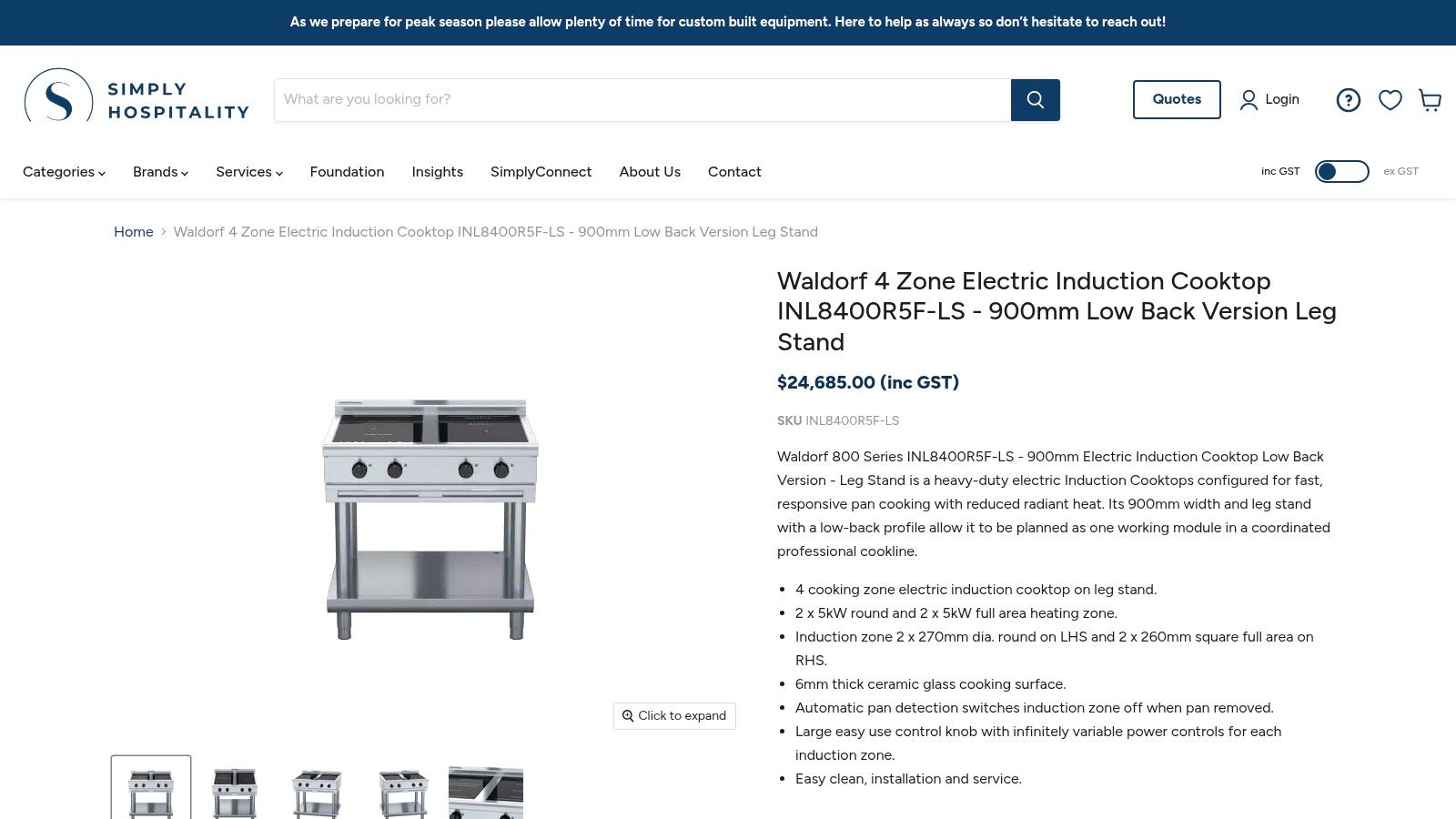
For operators working with commercial ranges and hobs, it helps to think about the whole cooking line, not just the pan. Compatibility with equipment such as Waldorf, Blue Seal, and Cobra cooking equipment can change what shape, base, and finish make sense. More detail on that issue is covered in this induction cooktop note.
What Commercial Kitchens Need From Pots and Pans
Commercial kitchens need cookware that can take punishment, stay predictable, and keep service moving. A home cook can baby a pan. A working kitchen cannot. The true test is how a piece holds up to repeated heating, cooling, carrying, washing, and restacking without slowing the line.
Commercial use punishes weak choices
Frequent heat cycles stress bases, handles, and joints. Poor balance, awkward weight, or a slippery grip shows up fast when staff are moving pans through service. Batch cooking puts even more pressure on the gear, because the team needs vessels that hold volume and still give control over the result.
Cleaning is part of the job, not a side issue. A surface that traps residue slows turnover and creates more work between shifts. Replacement supply matters too. A kitchen running a set menu cannot keep changing the cookware mix every time one piece fails.
Standard sizes solve more problems than they get credit for. Small cafés do well with a compact, standardised range that covers breakfast, lunch, and prep without clutter. Busy restaurants need more repetition in the core sizes, because that speeds service and makes training easier. High-volume catering operations favour standard sizes even more strongly, because matching pieces simplify packing, batching, and reordering, the same logic that applies across catering equipment from Ring Hot Water.
Keep the core simple
Standardising the pans used every day cuts clutter and makes stock control easier. It also reduces training friction, because staff learn a small set of pieces instead of improvising around a drawer full of odd sizes.
For many operators, the smart buy is a focused range of commercial cookware that covers daily work and can be reordered without drama. Hospitality carries cookware options that include saucepans, stockpots, frying pans, commercial cookware, induction cookware and kitchen utensils, which suits businesses that want a practical core rather than a random mix.
Non-stick has a place, but only in the right jobs. Use it for eggs, pancakes, delicate fish, and other foods where easy release matters. Stainless steel earns its keep for searing, browning, deglazing, sauces, and high-frequency cooking. Many kitchens need both, because no single surface handles every task properly.
If non-stick is in the mix, the coating needs disciplined care. Use suitable utensils, respect manufacturer temperature limits, and retire damaged pans before the surface becomes a recurring problem. Once the coating is compromised, the pan is no longer doing the job it was bought for.
Food safety raises the stakes again. If a kitchen handles raw proteins and ready-to-eat food, cookware must be separated or thoroughly cleaned, sanitised, and dried between tasks, in line with New Zealand food-safety guidance. Smooth cookware with fewer awkward fittings is easier to keep under control than pieces that trap residue in hard-to-clean joints.
Cleaning, Maintenance, and Whole-of-Life Value
Cookware should be bought with cleaning and upkeep in mind, not as an afterthought. A pan that needs special handling the team won't follow is a false economy. The right question is how the piece behaves over months of real service, not how it looks on day one.
Care should shape the purchase
Manufacturer-approved washing matters because not every pan wants the same treatment. Dishwasher compatibility has to be checked per product, not assumed from material alone. Thermal shock should be avoided where the cookware is vulnerable, especially when hot items are rushed into cold water.
Non-stick surfaces need the right utensils and a bit of discipline. Cast iron and carbon steel need seasoning where required, and that only works if the team maintains it. Handles and bases should be inspected regularly for looseness, warping, pitting, or other wear that changes performance.
Stacking and storage also matter. Cookware knocked around in a crowded cupboard wears faster and becomes harder to keep clean. If the item is hard to store safely, it will probably be hard to keep in good condition.
A useful lens is simple: purchase price + expected suitability + maintenance + replacement frequency + operational practicality. A lower-cost pan can be the correct choice for occasional use. A heavily used commercial piece may justify a higher initial spend because the cost of poor performance shows up every shift.
For kitchens weighing whether to automate more of their washing process, this commercial pot washer discussion is worth reading alongside the cookware decision.
If a venue needs help choosing cookware that fits the menu, the cooktop, and the cleaning routine, Hospitality can help narrow the options quickly. Visit Simply Hospitality to compare practical pots and pans, match them to your kitchen setup, and build a cookware mix that works in real service.