


Restaurant Equipment Repair: What to Do Next
A main oven fails during the lunch rush. The chef starts rearranging the menu, the duty manager calls a service provider, and every minute creates another operational problem. That's the reality behind restaurant equipment repair in New Zealand. The first decision isn't always which technician to call. It's whether the failure creates an immediate food-safety risk, whether the equipment can support service safely, and whether repair still makes commercial sense.
Hospitality doesn't dispatch technicians, perform service calls, or provide restaurant-equipment repair. Its role is to help hospitality operators identify the equipment, understand the manufacturer support pathway, and assess replacement options when repair is no longer the sensible choice. Qualified technicians should handle electrical, gas, refrigeration, and other specialist work.
The repair economy provides a useful local context. Stats NZ recorded 2,763 enterprises in machinery and equipment repair and maintenance nationwide in February 2024, compared with 1,812 in 2000, while domestic appliance repair and maintenance still included 432 enterprises in 2024 (Stats NZ repair-industry data). Commercial kitchen servicing sits within this broader specialist ecosystem.
When Restaurant Equipment Breaks Down and What to Do First
At a busy Auckland bistro, a main oven failing mid-service creates a very particular kind of pressure. The chef is trying to finish orders with a smaller cooking line, the front-of-house team is waiting for revised wait times, and the manager is searching for the model number while speaking to a service provider. The wrong response is to keep forcing the appliance through service without understanding the fault.
The first hour should be controlled, not frantic. The person in charge should isolate the equipment from normal production, check whether the relevant power or gas supply has been interrupted, and confirm whether the problem is an actual equipment failure or an operating condition such as an incorrect setting, overloaded chamber, open door, blocked filter, or tripped protection device. Staff shouldn't remove covers or attempt electrical, gas, or refrigeration work.
A useful record for the technician includes:
- Equipment identity: Brand, model, serial number, location, and whether the unit is fixed or portable.
- Fault timing: When the problem began and what the equipment was doing immediately beforehand.
- Visible symptoms: Error messages, temperature changes, unusual sounds, leaks, smells, smoke, or inconsistent output.
- Service impact: Which menu items, preparation tasks, or cleaning processes are now unavailable.
- Recent history: Previous repairs, changed settings, cleaning work, or installation changes.
For refrigeration, a commercial fridge service checklist can help an operator organise the information before contacting the appropriate service pathway. The checklist isn't a substitute for qualified diagnosis, but a clear description reduces the risk of sending the wrong type of technician.
Practical rule: Stop treating a recurring fault as an isolated incident. A repeat failure is evidence that the equipment, its environment, or its maintenance approach needs a broader review.
Hospitality doesn't run repair records or claim repair turnaround times. It can help clarify what equipment is involved and what replacement pathway may be appropriate. Every operator eventually faces three decisions: how urgent is the failure, who should repair it, and whether replacement is now the better commercial decision.
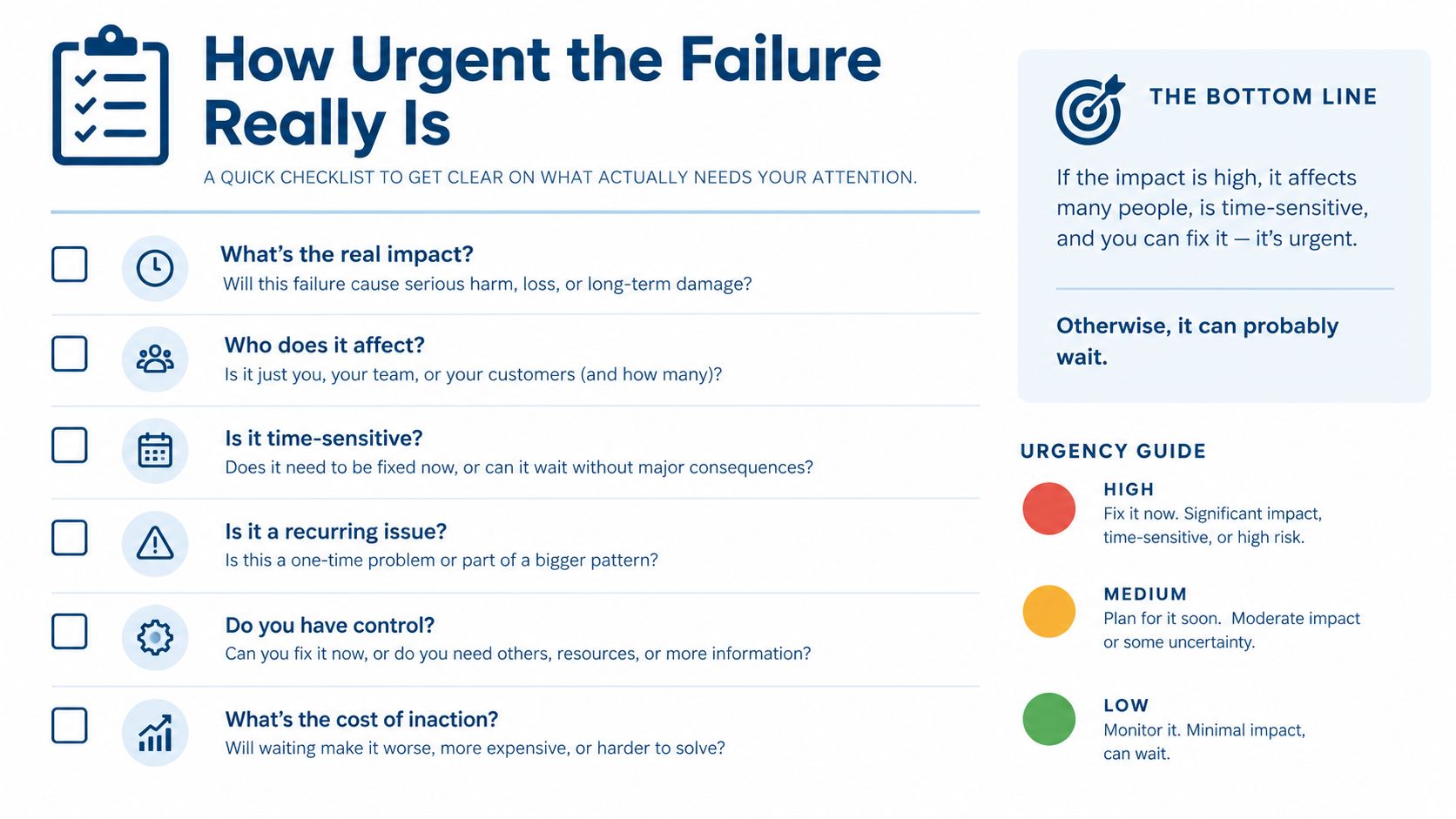
How Urgent the Failure Really Is
Urgency depends on the equipment's role, not on whether a warning light is showing. A refrigeration fault can threaten stock control and food safety. A cooking failure can remove a core menu process. A warewashing breakdown can leave dirty plates accumulating while service continues.
Same-day failures
Escalate immediately when a walk-in fridge or freezer is losing temperature, a critical hot-holding unit cannot maintain safe operating conditions, or a dishwasher cannot produce an acceptable cleaning result. A combi oven that fails to recover consistently during service also deserves urgent attention if it controls a large part of the menu.
The operator should protect food and people first, record the equipment condition, and contact a suitable qualified service provider. Continuing to use a unit that is overheating, leaking, producing an electrical smell, or behaving unpredictably can create a bigger failure and a safety concern.
Next-day failures
A cooking appliance with uneven results, a refrigerator taking longer to recover, or an ice machine producing reduced output may still allow a controlled workaround. That doesn't mean the issue should be ignored. The manager should adjust the production plan, monitor the operational impact, and arrange professional assessment before the next peak period.
Can-wait failures
Cosmetic damage, a non-critical drawer, or a secondary appliance with a reliable alternative can usually be scheduled around service. It still belongs on the maintenance register, because small faults often become disruptive when operators leave them until the equipment fails completely.
A review of ageing equipment costs is useful when a supposedly minor fault keeps returning. The decision should consider food safety, lost menu capacity, staff workarounds, and whether the equipment can be taken offline without damaging service.
For example, the SKOPE ProSpec 9 Drawer Underbench Fridge - PG11.UBR.3.D9 is configured for organised cookline storage, with nine drawers, a stainless steel 304 AISI cabinet, an operating range of 1°C to 4°C, adjustable from -2°C to +15°C, and a rated ambient temperature of up to 40°C. Its left-hand configuration may suit a kitchen where refrigeration placement and rapid access matter, but suitability still depends on the existing layout and service requirements.
Who Should Actually Repair Commercial Kitchen Equipment
The correct repair pathway depends on the equipment and the risk involved. A manufacturer-authorised service network may be the right choice for warranty work, specialist controls, or equipment that requires brand-specific diagnostics. A qualified independent technician may provide a practical option for established equipment outside warranty, provided the person has the appropriate competency for the work.
Gas appliances, refrigeration systems, and electrical equipment shouldn't be handed to a general handyman. New Zealand's competency framework for commercial refrigeration and air-conditioning includes lubrication, refrigerant systems, air distribution, insulation, heat transfer, defrost, condensate drainage, and electrical controls. Unit standard 3846 also specifies work by an Electrical Workers Registration Board-licensed Electrical Service Technician (NZQA unit standard 3846).
Compare the pathway before the breakdown
| Repair pathway | Best for | Trade-offs |
|---|---|---|
| Manufacturer-authorised support | Warranty claims, specialist controls, and brand-specific systems | Parts and technician access may depend on location and availability |
| Qualified commercial technician | Equipment outside warranty and established local service relationships | Quality, scope, and parts access vary between providers |
| Qualified gasfitter or refrigeration engineer | Gas appliances and refrigeration faults requiring regulated expertise | The technician may only cover a specific equipment discipline |
| Original equipment supplier | Identifying the model, warranty route, and replacement options | The supplier may not perform the repair itself |
At purchase time, operators should ask who will support the equipment after installation, whether genuine parts are accessible in New Zealand, what warranty conditions apply, and which records the warranty requires. A low upfront price doesn't compensate for an unclear service pathway when a critical appliance stops during peak trade.
The comparison is similar to maintenance, repair, and overhaul planning in other technical industries. A resource on MRO solutions for aerospace illustrates the broader principle that asset support depends on planned parts, technical capability, and lifecycle decisions, not just emergency response.
Operators should retain invoices, model details, serial numbers, warranty terms, service reports, and parts information. Hospitality can help customers understand the equipment and connect the purchasing decision with an appropriate support route through SimplyConnect, while the actual repair must be completed by a suitable qualified service provider.
Repair or Replace, A Practical Decision Framework
Repair versus replacement should be treated as a total-cost decision, not a reaction to the invoice sitting in front of the manager. The repair quote is only one input. A technically repairable appliance may still be the wrong asset for a high-pressure kitchen if its next failure could close a menu section or interrupt safe food storage.
The core framework is:
Repair cost + equipment age + previous failures + downtime risk + parts availability + expected remaining life versus replacement cost.
Operators can score each factor on a simple 1-to-5 scale for internal comparison, but the score isn't a scientific calculation. It's a way to force the decision-maker to examine the whole ownership picture rather than focusing only on the immediate repair price.
The six questions that matter
- What will the repair cost? Include the callout, labour, parts, freight, installation work, and any compliance work identified by the technician.
- How old is the equipment? Age matters differently across refrigeration, cooking, warewashing, and food-preparation equipment. The original duty rating and operating environment matter as much as the calendar.
- How often has it failed? A first fault on otherwise sound equipment is different from repeated service visits for the same system.
- What happens if it fails again? A secondary prep appliance may have a workaround. A main dishwasher, combi oven, or refrigeration unit may not.
- Can parts be sourced? Imported, discontinued, or poorly supported models can turn a straightforward repair into a long outage.
- What useful life remains? The question isn't whether the machine can run after repair. It's whether it can run reliably under the venue's workload.
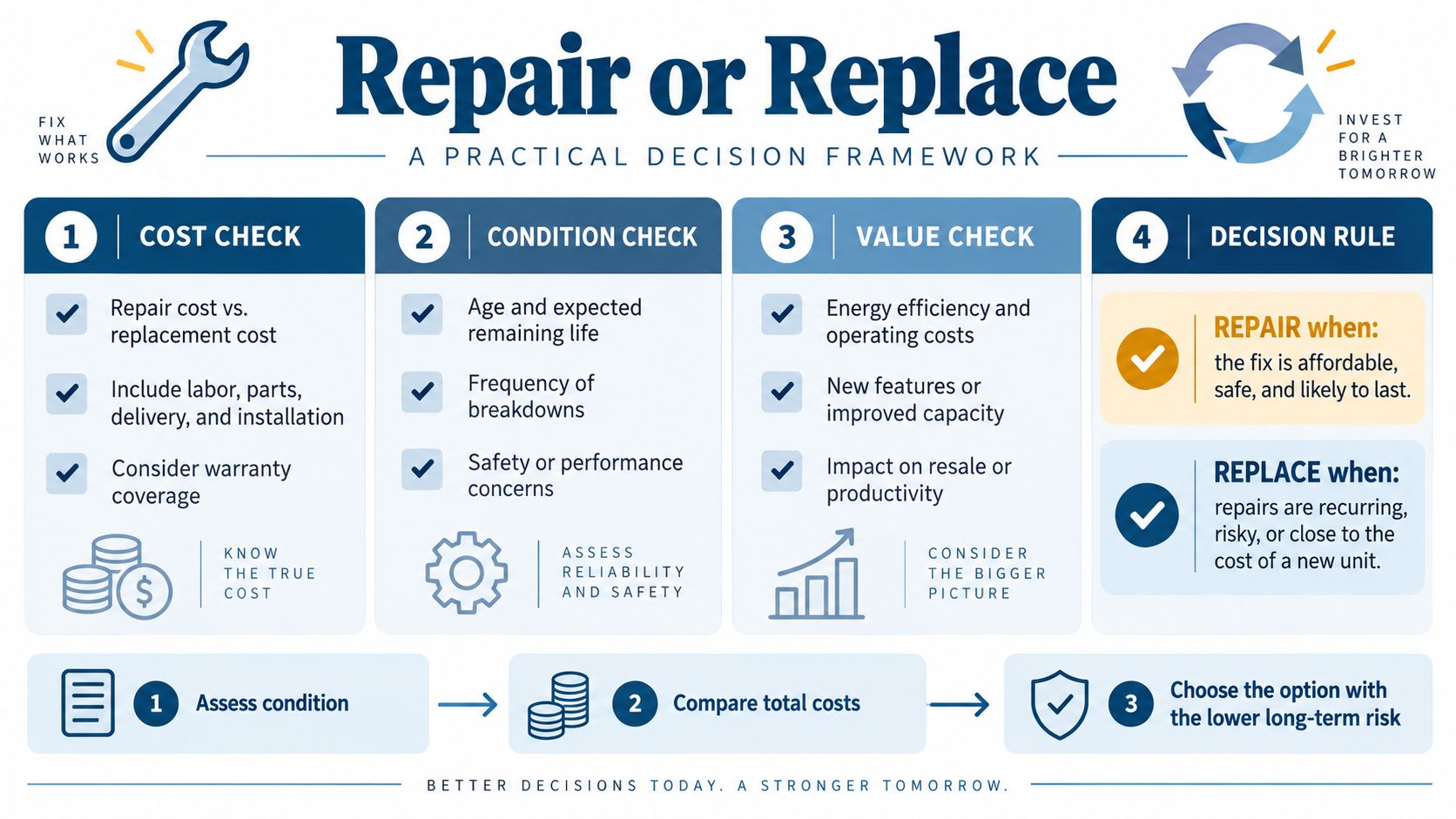
Consider a hypothetical nine-year-old single-door underbench fridge with a compressor failure, a quoted $1,400 repair, two previous service visits, and a refrigerant phase-out concern. If the compressor cost approaches half the price of a suitable new unit, parts support is uncertain, and another failure would disrupt food storage, replacement may be the more responsible commercial choice. That example is not a prediction of outcome for every appliance. It demonstrates why the invoice alone doesn't settle the question.
A different result applies to a three-year-old combi oven requiring a $220 door-seal replacement, with no previous faults and strong parts support. If the chamber, controls, and heating systems remain sound, repairing the seal preserves a valuable asset and avoids an unnecessary replacement.
The distinction between those examples is not the dollar amount by itself. It is the relationship between age, failure history, supportability, operational risk, and remaining service life. The discussion in buying cheap versus buying once reinforces why purchase price should be considered alongside ownership conditions.
Common Faults and Warning Signs by Equipment Type
Warning signs help an operator brief the technician accurately. They don't authorise a staff member to open a panel, adjust a gas train, handle refrigerant, or bypass a safety control.
| Equipment Category | Warning Sign | Likely Fault Area |
|---|---|---|
| Refrigeration | Temperature creep, heavy ice, short cycling, water pooling, or unusual fan noise | Door seals, defrost system, airflow, refrigerant circuit, or controls |
| Ovens and cooking equipment | Uneven heat, slow recovery, inconsistent ignition, or repeated error messages | Heating elements, burners, probes, controls, ignition, or airflow |
| Fryers | Slow oil recovery, foaming, irregular burner behaviour, or unstable temperature | Heating system, thermostat, filtration, oil condition, or gas controls |
| Dishwashers | Lower wash temperature, film on glassware, poor rinsing, or slow return | Wash arms, booster heater, dosing, filters, pumps, or water supply |
| Ice machines | Small harvest, hollow or cloudy cubes, reduced production, or leaks | Water filtration, inlet valve, scale, harvest system, or refrigeration |
| Food-preparation equipment | Blade drag, mixer overheating, vibration, or coupling wear | Blade, motor, bearings, drive components, or overload protection |
Refrigeration faults deserve a disciplined response because door-seal damage, airflow restriction, defrost problems, and control drift can look similar from the outside. The operator should record actual symptoms, product temperature observations, alarm history, and whether the unit recovers after loading changes.
Cooking faults show up in food before they appear in a service report. Uneven oven colour, longer cooking times, fryer recovery problems, and griddle hot spots indicate that output has changed. A chef who records which programme, load, or menu item exposes the issue gives the technician better information.
Warewashing symptoms often appear as operational complaints. Glassware may retain film, wash results may deteriorate, or the machine may struggle to keep pace with the dish return. Ventilation and extraction also affect kitchen performance, so operators reviewing broader air-quality or duct issues may find commercial kitchen ventilation guidance useful alongside the equipment assessment.
Food-preparation equipment needs the same approach. A slicer that drags, a mixer that overheats, or a blender that loses drive should be removed from service if it presents a safety risk, then referred to an appropriate technician or manufacturer pathway.
Preventative Maintenance Schedules That Reduce Downtime
Preventative maintenance reduces downtime only when one person owns the schedule. Assign routine cleaning and observations to the closing team, then reserve inspection, testing, calibration, refrigeration, gas, and electrical work for qualified technicians. Manufacturer requirements take priority over any generic calendar.
Daily controls
At close, staff should clean cooking surfaces, inspect door seals, check filters where the manual permits operator cleaning, and record unusual sounds or performance changes. Follow the approved procedure for dishwasher detergent and rinse-aid levels. Clean ice machines and food-preparation equipment according to their manuals.
A refrigeration door seal that fails to close properly is an operating fault, not a cosmetic issue. EECA states that fixing door seals can reduce refrigeration costs by 1% to 5% and usually pays back in under a year (EECA hospitality energy guidance). Arrange a qualified assessment rather than reshaping or replacing the seal with an incorrect part.
Weekly and monthly controls
Weekly checks should cover refrigeration and oven gasket condition, ice-machine filter status, fryer cleaning routines, and dishwasher spray-arm cleanliness. Monthly technical work can include condenser cleaning, thermostat calibration, water-pressure verification, and inspection of electrical leads or controls by appropriately qualified personnel.
Condenser coils need access and regular cleaning. Keep that task in the maintenance plan, record the work completed, and compare refrigeration performance over time instead of assuming a standard saving applies to every site. For a deeper routine, see our guide to commercial refrigeration maintenance.
Quarterly records
Quarterly reviews should examine temperature recovery, recurring alarms, door-seal condition, energy performance, water quality, and repair history. Record the date, equipment, task, person or technician involved, and parts used. These records turn repeated faults into a procurement question: repair again, or replace equipment that is consuming labour and service capacity.
The Consumer Guarantees Act requires a remedy for faulty goods within a reasonable time. Consumer Protection says spare parts and repair facilities should remain available for a reasonable time after supply (Consumer Protection repair rights). The proposed Right to Repair Amendment Bill would introduce a latest response period of 20 working days, but it is not current law (Right to Repair Amendment Bill). Maintenance records do not guarantee a claim, but they provide a clearer evidence trail for the supplier, technician, or replacement decision.
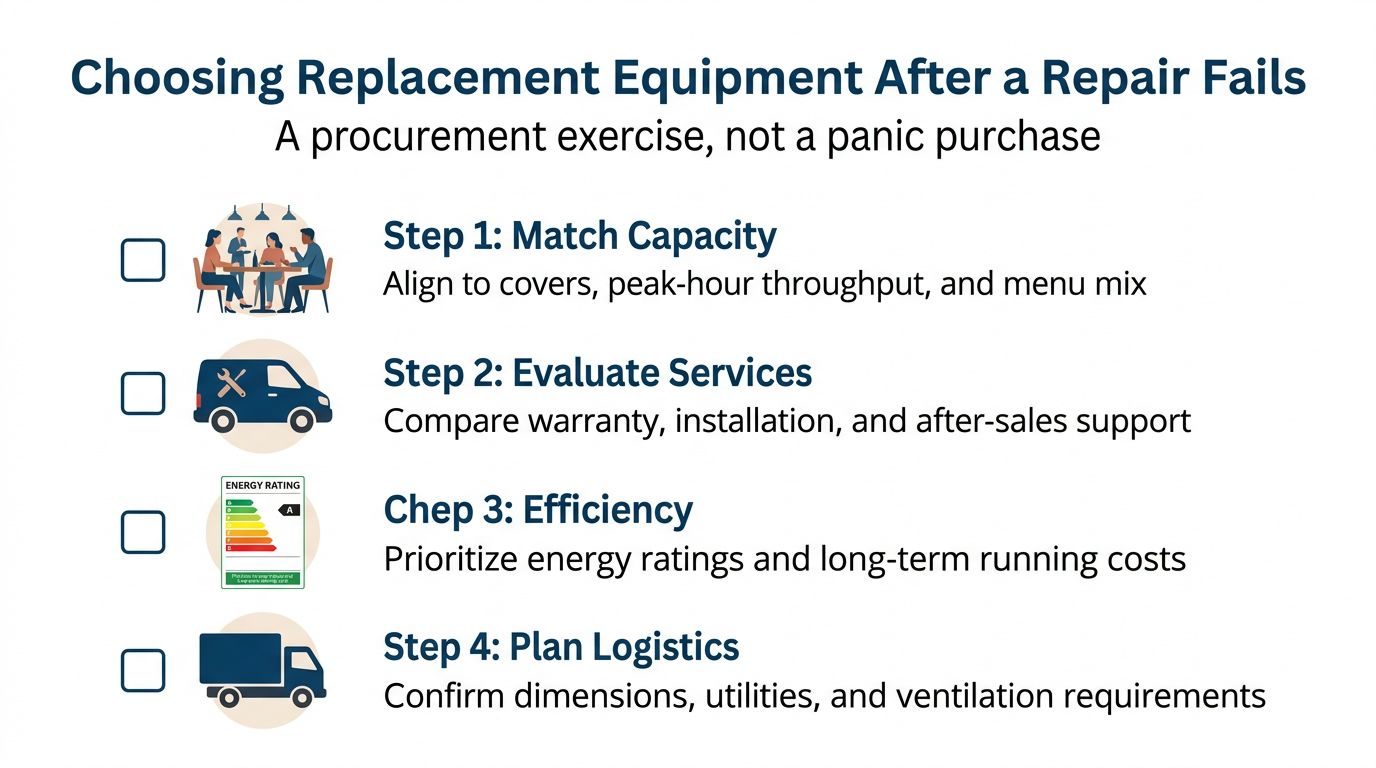
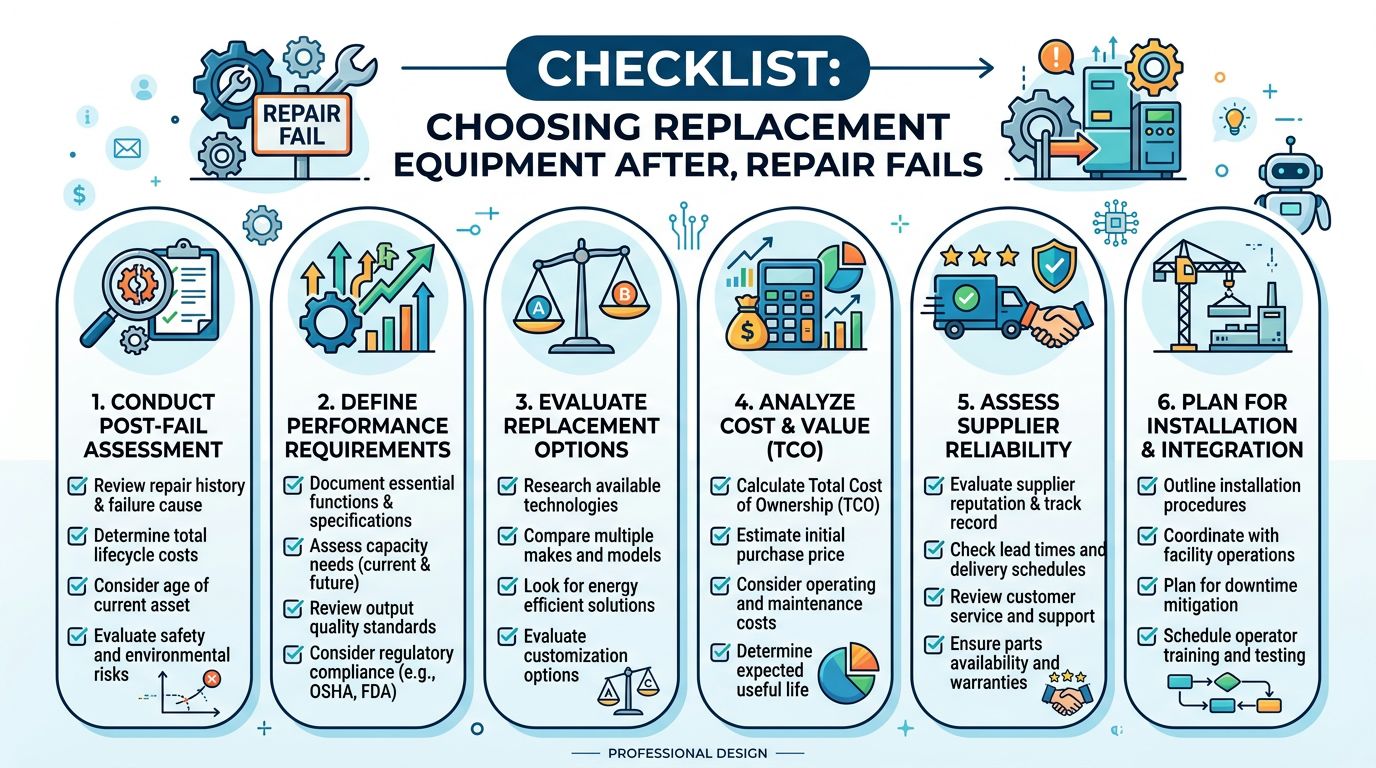
Choosing Replacement Equipment After a Repair Fails
A failed repair should trigger a procurement review, not a panic purchase. The replacement has to fit the kitchen's capacity, services, layout, workflow, and support pathway.
Start with the work the equipment must perform. A café with a compact cookline may need fast access and tight footprint control, while a hotel or institutional kitchen may prioritise batch capacity, service continuity, and predictable cleaning. Oversizing a combi oven for occasional banquet demand can consume space and utilities unnecessarily. Under-specifying refrigeration can create constant loading pressure and poor stock organisation.
Build the shortlist around the site
The operator and supplier should confirm:
- Capacity: Covers, peak-hour throughput, menu mix, batch size, and storage requirements.
- Services: Gas, power, water, drainage, ventilation, clearance, floor loading, and delivery access.
- Support: Warranty terms, parts availability, manufacturer service coverage, and installation requirements.
- Ownership: Cleaning access, energy use, maintenance requirements, controls, and expected duty cycle.
- Budget: Equipment, delivery, installation, compliance work, commissioning, and any required kitchen alterations.
Two or three suitable models can then be compared against those criteria. Sticker price should not decide the purchase if the machine has weak parts support or doesn't suit the venue's workload.
Hospitality can help customers identify an appropriate replacement based on the existing equipment, required capacity, available services, and budget. It doesn't repair the failed unit or maintain service-call records. Its practical value at this stage is helping the operator understand the equipment choice and manufacturer support route before committing to a replacement.
A commercial buyer should also consider the duty environment. Consumer Protection says the CGA has no fixed time limit for how long a product must last. Reasonableness depends on factors including price, use, and what the business was told the equipment could do (Consumer Protection appliance rights). A high-use fryer or dishwasher should be specified for commercial duty, not selected as though it were domestic equipment.
Bringing It All Together, Your Next Step
A breakdown leaves the operator with three decisions. Triage the failure according to food safety, service capacity, and operational risk. Choose the right repair or replacement pathway based on qualification, warranty, parts access, equipment history, and remaining life. Act before the next breakdown by recording the model, age, last service, and previous faults.
Restaurant equipment repair is therefore more than a technician call-out. It is a signal to review whether the asset still suits the venue and whether the original purchasing decision provided enough support for its working life.
Hospitality can help hospitality operators compare replacement equipment against capacity, services, workflow, budget, and manufacturer support, while suitable qualified technicians handle repair work where repair remains the right choice.
Contact Simply Hospitality when a failed appliance raises the question of what should happen next. The team can help identify replacement options across refrigeration, cooking, warewashing, ice-making, and food-preparation categories, then guide the purchase towards equipment that fits the kitchen's actual requirements.