


Automatic Rinse Aid Dishwasher Choices for NZ Venues
Dishwasher rinse aid is a final-rinse surfactant that helps water sheet off dishes and glassware, improving drainage and drying. It isn't detergent, and it isn't a sanitiser.
If glasses still look spotted after a wash, is the rinse-aid dose the problem? For a busy café, restaurant or institutional kitchen, that distinction matters. Increasing chemical concentration won't fix hard water, poor washing or a dirty machine, and it can increase consumption without improving the finish.
What Dishwasher Rinse Aid Does
A café turns its glassware around ahead of lunch service. The glasses come out free of food and drink residue, but droplets still cling to bowls and bases after the cycle. As those droplets dry, they leave marks that make otherwise clean glassware look poorly washed.
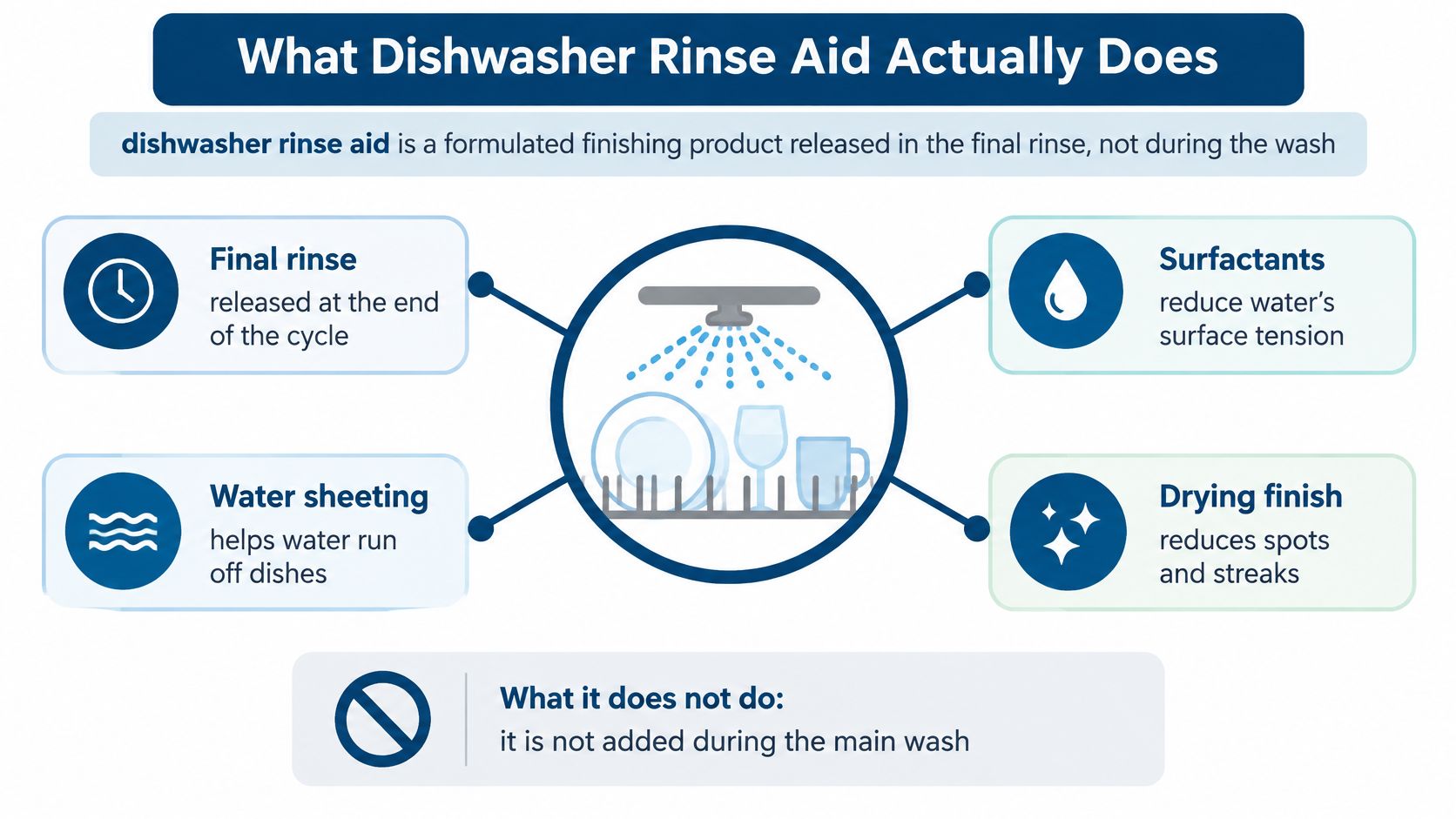
Rinse aid is a formulated finishing product for that stage. Its surfactants release during the final rinse and lower water's surface tension, so rinse water spreads thin and drains off plates, glasses and cutlery with less left behind. On a correctly dosed machine, that shows up as:
- Fewer water spots, particularly where droplets previously dried in place.
- Less streaking, provided detergent and rinse-aid dosing are balanced.
- Clearer glassware, without an obvious surface film.
- Better drainage, with less residual water on surfaces that can shed it.
Where rinse aid sits in the cycle
The dose goes into the final rinse only, so the wash stage still does the soil removal. Two racks can run the same programme and dry differently, because water beads on one surface and sheets off another. The chemical shifts the odds toward sheeting.
The infographic shows the dosing point in that final-rinse sequence.
New Zealand food-safety guidance requires a dishwasher used for sanitising to achieve the necessary sanitising result, with operation guided by the manufacturer's instructions.
Rinse aid plays no part in that outcome.
For operators, the value is a more consistent finish when clean ware returns to service. Recessed bases, pooled water and unsuitable rack positions can still leave moisture behind, regardless of the product used. I judge a rinse aid on the sheeting and spot count it delivers and what it costs per cycle, the same way I'd judge any chemical on the machine.
How Rinse Aid Changes the Final Rinse
The final rinse is where rinse aid earns its keep. Water's surface tension pulls it into droplets, and on a glass fresh from the machine those droplets can hold on the bowl, rim or base instead of running off.
When a droplet evaporates, dissolved minerals can stay behind as a mark. The glass may be clean, yet still look finished poorly. Extra detergent does not solve that mark because the problem starts in how the last water leaves the surface.
Water sheeting is the useful change: a thinner, more continuous layer that drains across the surface instead of separating into isolated drops. Less water left in patches means less left to dry in place.
Drainage needs a suitable rack
The chemistry only helps where water has somewhere to go. Glasses at an unsuitable angle, closely nested utensils or overlapping plates can retain water even when the final-rinse chemical is correctly dosed.
Rack selection and loading belong in the same conversation as chemical selection. A practical assessment looks at:
- Water movement, whether water drains freely or collects in pockets.
- Surface finish, whether marks appear as individual spots or a continuous film.
- Load consistency, whether the same glass type repeatedly produces the same result.
- Drainage path, whether rims, feet and recessed bases give water a clear route off the item.
A Modular Stainless Dishwasher Basket Cassette sits on the rack-organisation side of the wash-up area, so judge it by spacing and drainage rather than chemical treatment.
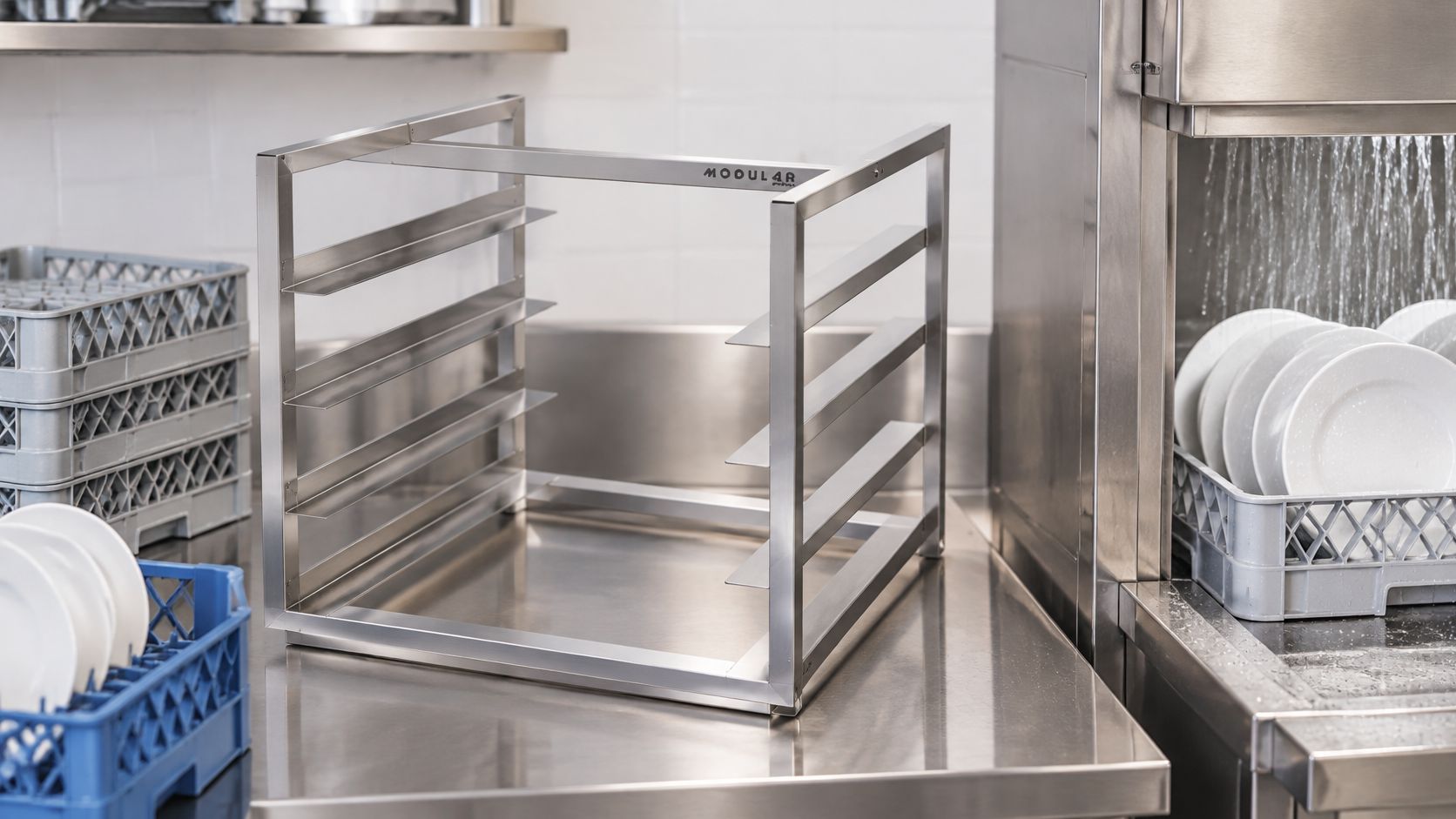
In hospitality, short turnaround makes drainage important. A rack of wine glasses needs a consistent finish across the load, not one service-ready glass beside others still carrying water.
If the result changes from site to site or after a supply change, use how water quality affects dishwasher performance as the check before changing the dispenser setting. Within the machine itself, judge rinse aid by sheeting and drainage at the rack.
When a Dishwasher Needs Separate Rinse Aid
Separate rinse aid is useful when the machine, detergent, water conditions and required drying result call for it. It isn't automatically necessary in every household dishwasher, and an all-in-one tablet doesn't automatically make it unnecessary either.
Consumer NZ's dishwasher-care advice explains that most tablets and capsules already contain rinse aid, making additional dosing optional, while powder detergents generally require a separately filled dispenser because rinse aid must be released at a particular stage.
The machine manual remains the deciding reference. A tablet's ingredients don't establish how a particular dishwasher manages its final rinse or drying settings.
Situations that justify checking the separate supply
- Spotted glassware, particularly when presentation matters at the table.
- Excessively wet dishes, after loading and drainage have been checked.
- Frequent glasswashing, with little time between washing and reuse.
- High-volume warewashing, where consistent rack results matter throughout service.
- Hard-water conditions, alongside a review of mineral treatment.
- Short turnaround, when ware needs to drain reliably before storage or reuse.
Many commercial machines use separate detergent and rinse-aid dosing systems. Their chemical setup should be treated as a coordinated process, not replaced with household tablets because the packaging promises several functions.
Hard water contains more calcium and magnesium. Those minerals can contribute to chalky deposits and spotting, so persistent scale warrants a water-softening or filtration review rather than an indefinite increase in rinse aid.
Controlled test: Keep the glass type, loading, detergent and operating conditions steady. Adjust only the permitted rinse-aid control, then compare the finish on a consistent rack.
That approach avoids wasting chemical while several settings change at once. Product selection also needs to account for the wash chemistry, as explained in the guide to choosing commercial dishwasher detergent.
Blocked jets, unsuitable detergent and poor loading require their own corrective action. None becomes acceptable because the rinse-aid reservoir is full.
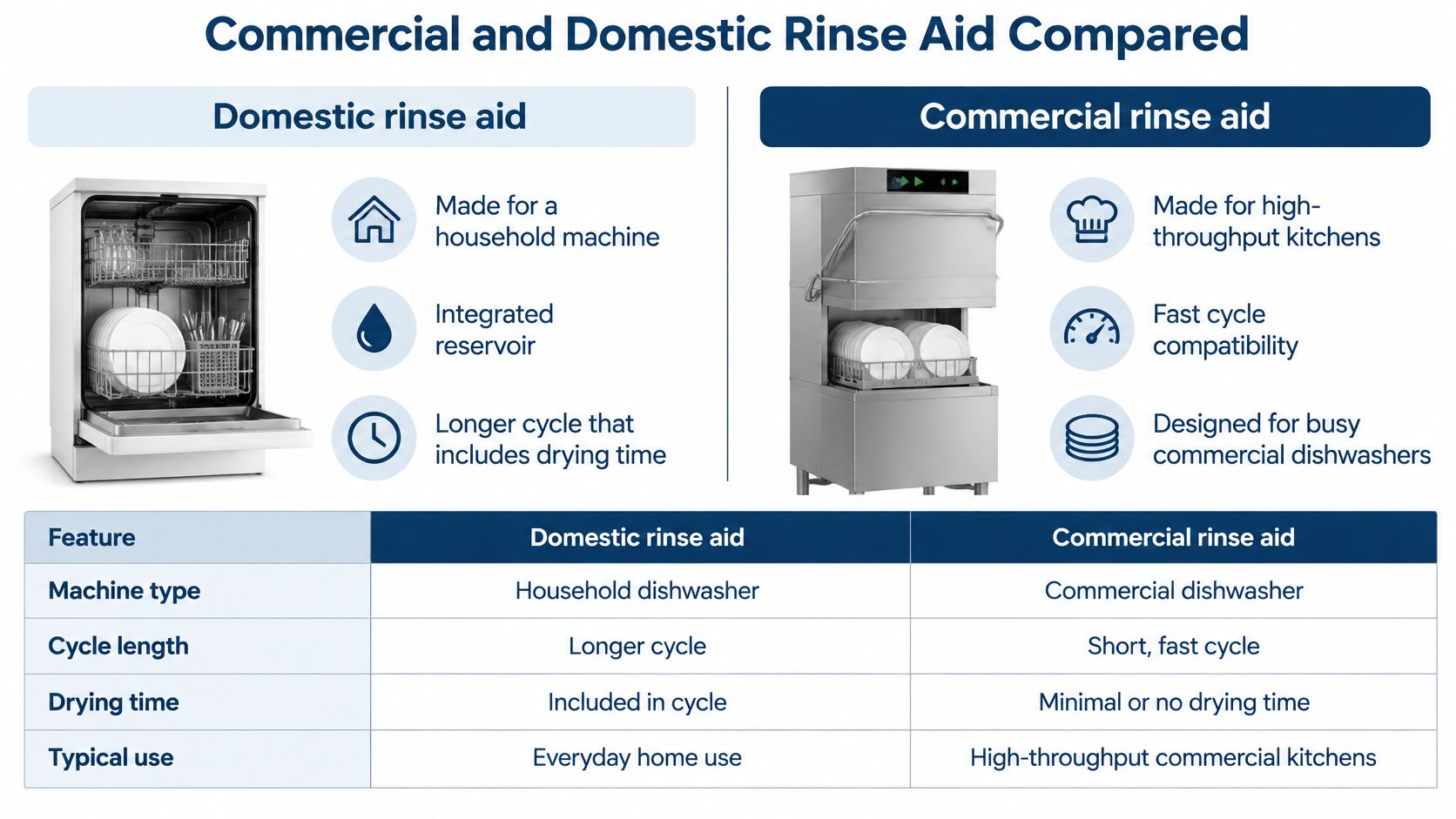
Commercial and Domestic Rinse Aid Compared
| Feature | Domestic rinse aid | Commercial rinse aid |
|---|---|---|
| Typical application | Household dishwashers and home drying results | Restaurants, cafés, hotels, marae, aged care and other food-service warewashing |
| Packaging | Small bottles suited to a door reservoir | Larger packs or drums for chemical lines and higher cycle counts |
| Dispensing | Operator fills an integrated compartment | Automatic doser or pump meters the final rinse |
| Cycle demands | Longer cycles with a drying phase | Short cycles and fast glass or crockery turnaround |
| Compatibility | Match the domestic machine instructions | Match the machine, doser and a food-service rinse-aid product |
| Concentration and dose | Dispenser setting where the machine allows it | Supplier specification for that formulation and site water |
| Buying focus | Drying result in one household machine | A food-service product in a pack size matched to turnover |
Commercial and domestic formulations aren't automatically interchangeable, and neither category carries a single standard concentration. A household product is blended for an integrated door reservoir, not for a pump pulling chemical through a line. A commercial concentrate needs written confirmation that the machine and chemical instructions allow it before it goes into a domestic reservoir.
Judge the difference the same way you judge any other controlled step: sheeting on the glass, spots left after drainage, and what each cycle costs in chemical.
Match the whole chemical setup
For food businesses, product purpose matters. The MPI maintenance-compounds procedure lists dishwash rinse aid under the DA2 dishwashing-compound category, supporting selection of a product intended for that application rather than a general-purpose cleaning chemical.
Operators running Classeq, Winterhalter, Rhima or Starline equipment should confirm the actual model and dosing arrangement before changing chemicals. Brand alone doesn't establish that a particular rinse aid suits the machine; the product's dosing specification and the doser setup need to agree.
The same practical approach applies to the wash-up station. Hospitality's Modular Stainless Dishwasher Basket Cassette is a stainless cassette sized to hold commercial dishwasher baskets; it stores baskets and won't fix a chemical or rinse-performance problem.
Pack handling also deserves attention. A larger container may suit a hotel's consumption but sit awkwardly in a small café with limited chemical storage. The useful purchase is the product and pack that fit the machine, staff handling arrangements and actual workload.
How to Dose Rinse Aid Correctly
There's no universal rinse-aid dose. Settings must match the product, machine, dosing equipment and site water, with adjustments made within the relevant instructions.
Domestic dishwasher procedure
- Locate the compartment. It's commonly in the door near the detergent dispenser, but the manual confirms the correct opening.
- Fill to the specified marker without overfilling.
- Wipe away spills before closing the dispenser, so excess product doesn't enter the wrong stage.
- Check the adjustment control. Some machines allow a dispenser setting or menu adjustment.
- Run a representative load and inspect drainage and drying.
- Make a controlled adjustment only where the instructions permit it, then assess another comparable load.
A wet plastic container and a spotted wine glass aren't necessarily evidence of the same fault. Results should be assessed across suitable items rather than judged from a recessed container base holding pooled water.
Commercial dishwasher procedure
- Confirm the product identity. Use the chemical specified for the existing machine and dosing setup.
- Check that the rinse-aid suction line enters the rinse-aid container, not the detergent container.
- Follow the chemical supplier's dosing specification for that formulation and site conditions.
- Record container changes and workload. Unexpected consumption needs investigation against racks or cycles washed.
- Inspect a standard load for drainage, film and residual moisture.
- Refer suspected pump, injector, probe or dosing-line faults to a qualified technician.
Never manually add rinse aid to the wash tank unless the manufacturer specifically instructs it. Detergent and glasswasher chemicals are companion consumables with distinct purposes, not substitutes for one another.
Include wastewater in commissioning
Palmerston North City Council's trade-waste guidance recommends cleaning products with a working-concentration pH of 6–10. That's local guidance, not a universal product specification for every New Zealand venue.
A commissioning record should identify the product, dispenser setting, operating temperatures, incoming-water conditions and observed finish. Obtain technical information for the diluted product rather than assuming the concentrate's SDS alone describes the discharge.
Temperature verification belongs with the machine technician and the venue's food-safety process. Hospitality's purchasing advice shouldn't be treated as dosing calibration or a machine repair service.
Rinse Aid Problems and What to Check
Water spots are a common reason to increase rinse aid, but their appearance alone doesn't establish underdosing. The useful first response is to identify the pattern and check the machine systematically.
| Problem | Possible cause | What to check |
|---|---|---|
| Water spots on glasses | Hard-water minerals or underdosing | Local hardness, final-rinse temperature, dose against the supplier specification and a consistent glass load |
| Streaky glassware | Overdosing or detergent film | Controlled dose test, detergent type and rinse jets |
| Dishes remaining wet | Short cycle, poor drainage, low dose or overloaded racks | Gaps between items, filters, sheeting and rinse temperature |
| Excessive foaming | Rinse aid in the wash tank or the wrong product | Chemical connections; no wash-tank addition unless instructed |
| Chemical residue | Overdose or unsuitable chemical | Dose setting, product identity and complete final rinse |
| Cloudy glasses | Removable scale or permanent etching | Appropriate scale treatment and water review; stop polishing etched glass |
| Rinse aid used too quickly | Leak, high setting or high cycle volume | Lines, pump setting and racks washed daily |
| Rinse aid not dispensing | Empty container, air lock, closed valve or pump fault | Container level and suction line first; technician for dosing faults |
Separate deposits from damaged glass
Mineral deposits sit on the glass; etching is damage to the glass itself. A suitable cleaning or descaling process may remove a deposit, but more rinse aid won't restore an etched surface.
Suspected scale needs an appropriate treatment that follows the equipment and chemical instructions. Permanent cloudiness shouldn't trigger repeated polishing, stronger chemical dosing or improvised acid treatments.
The guide to what causes spotty glassware provides useful context when appearance remains inconsistent.
Restore the process before changing concentration
MPI's maintenance-compound approval codes specify that an approved dishwasher rinse aid must be used for its intended automatic-dishwasher purpose and according to both chemical and machine manufacturers' directions.
Routine checks should include:
- Preparation, scrape excess food before loading.
- Water access, leave surfaces exposed rather than nesting items.
- Machine condition, clean filters and inspect accessible spray jets.
- Cycle selection, use the appropriate sanitising programme.
- Release checks, confirm ware is clean and dry before reuse.
More chemical isn't a corrective action for a machine that isn't washing or rinsing properly.
Staff should record the symptom, operating conditions and any adjustment. Persistent faults, unsafe results or dosing-system problems require professional attention rather than continued trial and error during service.
What Rinse Aid Costs per Cycle
Cost per cycle or rack is more useful than price per litre. Concentration, correct dose and actual workload determine how quickly a container empties.
A larger pack may reduce purchasing frequency, but that doesn't prove a lower operating cost. Leaks, spills, unsuitable connections and an unnecessarily high setting can consume the apparent saving before the product reaches the final rinse.
Illustrative calculation only
The following example uses hypothetical assumptions, not recommended dosing or verified New Zealand product prices.
| Assumption or calculation | Illustrative amount |
|---|---|
| Rinse aid used per cycle | 3 mL |
| Product price | $12 per litre |
| Litres used per cycle | 0.003 L |
| Cost per cycle | $0.036 |
| Cost at 100 cycles daily | $3.60 |
| Cost across 300 operating days | $1,080 |
The arithmetic is straightforward: litres used per cycle multiplied by price per litre gives chemical cost per cycle. Multiplying that result by actual cycle count produces the operating estimate.
These figures are assumptions for arithmetic only. A real comparison needs the product's specified dose, the venue's purchase price and measured consumption.
Why the cheapest litre can cost more
A more concentrated product used at a lower correct dose may cost less per rack than a cheaper, less concentrated alternative. That comparison is valid only when both products suit the machine and achieve an acceptable result.
Workload also needs a consistent measure. A cycle-based estimate shouldn't become a rack-based estimate where the machine's operating arrangement makes those measures different.
For a hotel, aged-care kitchen or busy café, small dosing errors repeat throughout the working day. Consumption records are therefore more useful than judging economy by how large the container looks.
Purchasing rule: Compare compatible products at their correct operating dose, not at an artificially reduced dose that leaves unacceptable results.
Rewashing adds another operational consideration. The discussion of rewashing costs in a commercial kitchen helps frame why chemical economy should be assessed alongside usable output, staff handling and service pressure.
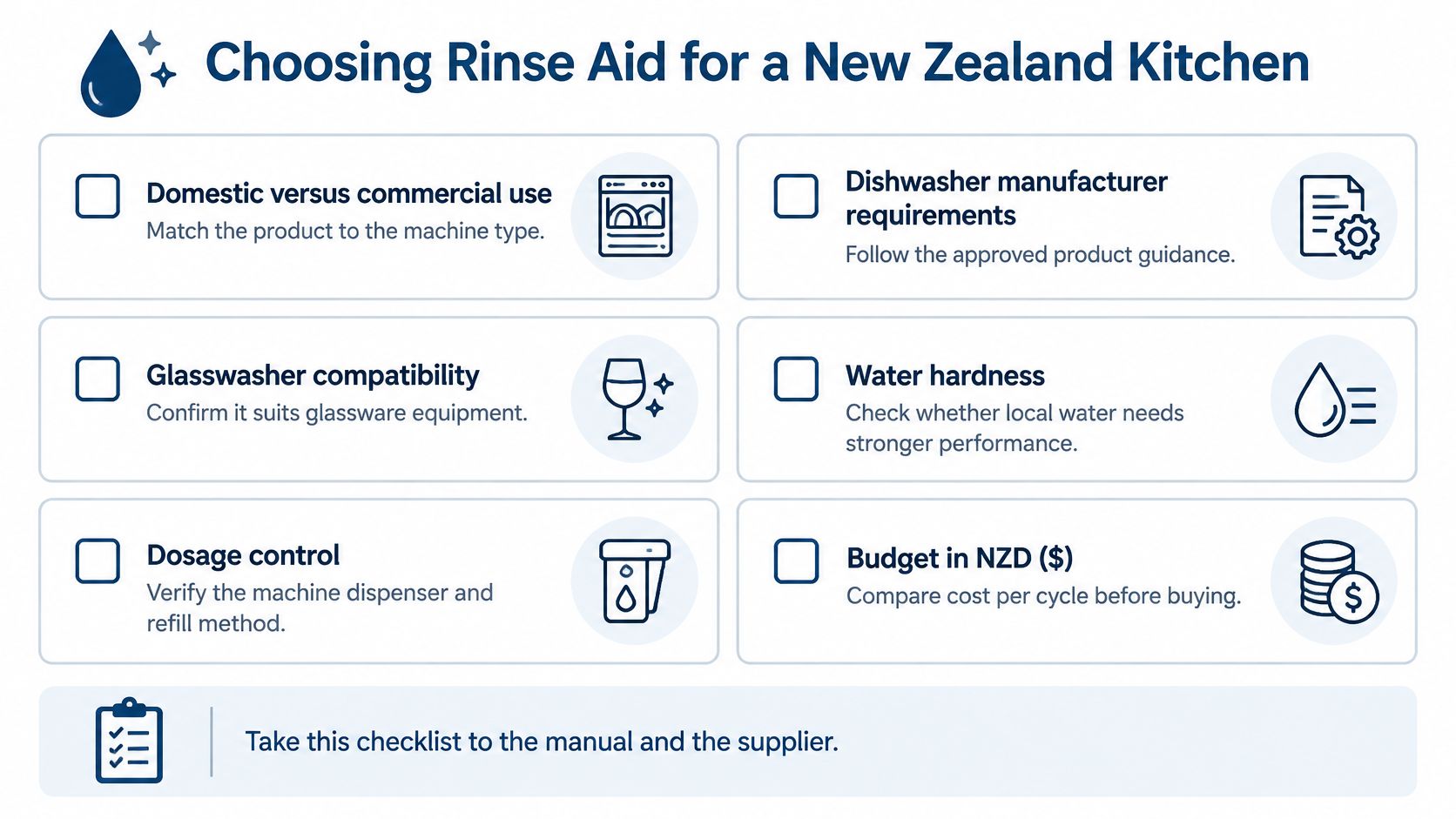
Choosing Rinse Aid for a New Zealand Kitchen
Choose a rinse aid by comparing its finish under a controlled trial, then check that the product suits the machine and its dosing setup. Judge the result by how well water sheets off and whether spots remain on glasses and plates.
| Buying consideration | Why it matters | What to check |
|---|---|---|
| Domestic or commercial use | Products and packs aren't automatically interchangeable | Machine type and maker's chemical instructions |
| Manufacturer requirements | The machine may expect a specified setup | Manual before a product change |
| Glasswasher compatibility | Glass presentation exposes poor results | Intended glasswashing application |
| Drying performance | The required result is effective drainage | Trial on a standard glass or plate rack |
| Pack size | Storage and handling must suit workload | Typical weekly consumption |
| Discharge and disposal | Chemical use affects wastewater | Working pH information and local trade-waste rules |
| Reliable supply | An empty container interrupts the process | Ongoing availability and reorder arrangements |
The checklist below provides a visual reminder of the main selection questions.
Check handling requirements before opening the container
WorkSafe New Zealand's SDS guidance requires a current safety data sheet for every hazardous substance held in a workplace, regardless of quantity. Keep it accessible to workers and emergency services.
Staff need instructions for storage, protective equipment, spills and disposal. Follow the precautions for the specific formulation rather than assuming all rinse aids carry the same risks.
Detergent removes soil, rinse aid assists final-rinse drainage, and descaler treats mineral build-up. If the machine no longer suits the venue's workload, the commercial dishwasher selection guide can help frame equipment choices.
Hospitality offers commercial dishwashing equipment and Cleaning & Chemicals products. Visit Simply Hospitality with the machine model and current chemical details to ask about a compatible rinse aid and related warewashing consumables.