

Commercial Silicone Moulds NZ: A Practical Hospitality Guide
A bakery can have a strong recipe, capable staff, and a good oven, yet still struggle with desserts that look slightly different from batch to batch. One mousse sets a little taller, one petit four leans to one side, one plated element comes out clean while the next tears on release. In a commercial kitchen, those small inconsistencies become bigger problems. They affect plating speed, portion control, prep planning, and how customers judge quality.
That's why commercial silicone moulds matter. In pastry kitchens across New Zealand, they're not just baking accessories. They're production tools that help bakeries, pâtisseries, and hospitality venues standardise output, manage waste, and build a more recognisable dessert style. Anyone comparing silicone moulds in NZ for professional use should focus less on novelty and more on how each mould supports menu consistency, freezer-to-oven flexibility, food safety, and repeatable service. Some of the most useful lessons come from the wider equipment decisions hospitality teams make every day, as discussed in what we've learned from helping hospitality businesses choose equipment.
An Operator's Guide to Silicone Moulds
New bakery owners usually notice the same pressure point early. The menu looks good on paper, but production becomes harder once desserts need to be turned out consistently across busy prep days and service periods.
Commercial silicone moulds help solve that by locking in shape, portion size, and presentation. They also support a broader style of production than many operators expect. A single mould format can often move between frozen desserts, mousses, semifreddo, baked components, chocolates, petit fours, and plated finishes, provided the manufacturer's guidance supports that use.
In hospitality settings, the true value isn't the mould itself. It's what the mould does to the operation. It gives junior staff clearer repetition, helps pastry sections prep ahead with fewer variables, and makes premium presentation easier to repeat. For operators searching for practical advice on silicone moulds in NZ, that's the difference that matters.
The Role of Silicone Moulds in a Modern Kitchen
Modern pastry work relies on consistency, but it also relies on range. Very few kitchens now use moulds only for basic cakes. Many pastry chefs find that the same style of moulding tool supports multiple menu categories, which is why silicone has become so useful in commercial settings.
Where moulds earn their space
Silicone moulds are now commonly used for:
- Mousses and set desserts where clean release matters for finish
- Semifreddo and frozen inserts that need uniform sizing
- Chocolates and petit fours where shape precision affects presentation
- Mini cakes and tart-style portions for cabinet and banquet production
- Savoury components such as herb butters, canapé bases, and portioned accompaniments
That breadth matters because storage space and bench space are always under pressure. A mould that works across frozen and baked applications can justify its footprint more easily than a single-use novelty item.
A common issue seen in new pastry programmes is buying shapes before deciding how they fit the menu. That usually leads to trays that look interesting but rarely leave the shelf. The stronger approach is to choose moulds around what the venue wants to be known for.
Practical rule: Buy for repeat production first, visual impact second. A mould only adds value when the kitchen uses it often enough to improve workflow.
Popular shapes and why they keep selling
In commercial kitchens, the most frequently chosen shapes tend to be individual desserts, domes, mini cakes, and tart formats. They work because they support neat portioning and clean visual repetition. Contemporary geometric designs are also increasingly popular when a venue wants a more premium or modern plated look.
Many operators choose these formats because they help bridge production and branding. A clean dome can suit a mousse, frozen dessert, glaze finish, or plated petit gâteau. A geometric cavity can make a signature dessert look distinct without adding extra garnish or plating steps.
That same thinking applies outside pastry. Teams planning cold beverage service or front counter presentation sometimes also look at adjacent tools such as stackable freezer ice molds when they want repeatable frozen shapes with better storage efficiency. It's the same operational principle. Uniform moulded output reduces variability.
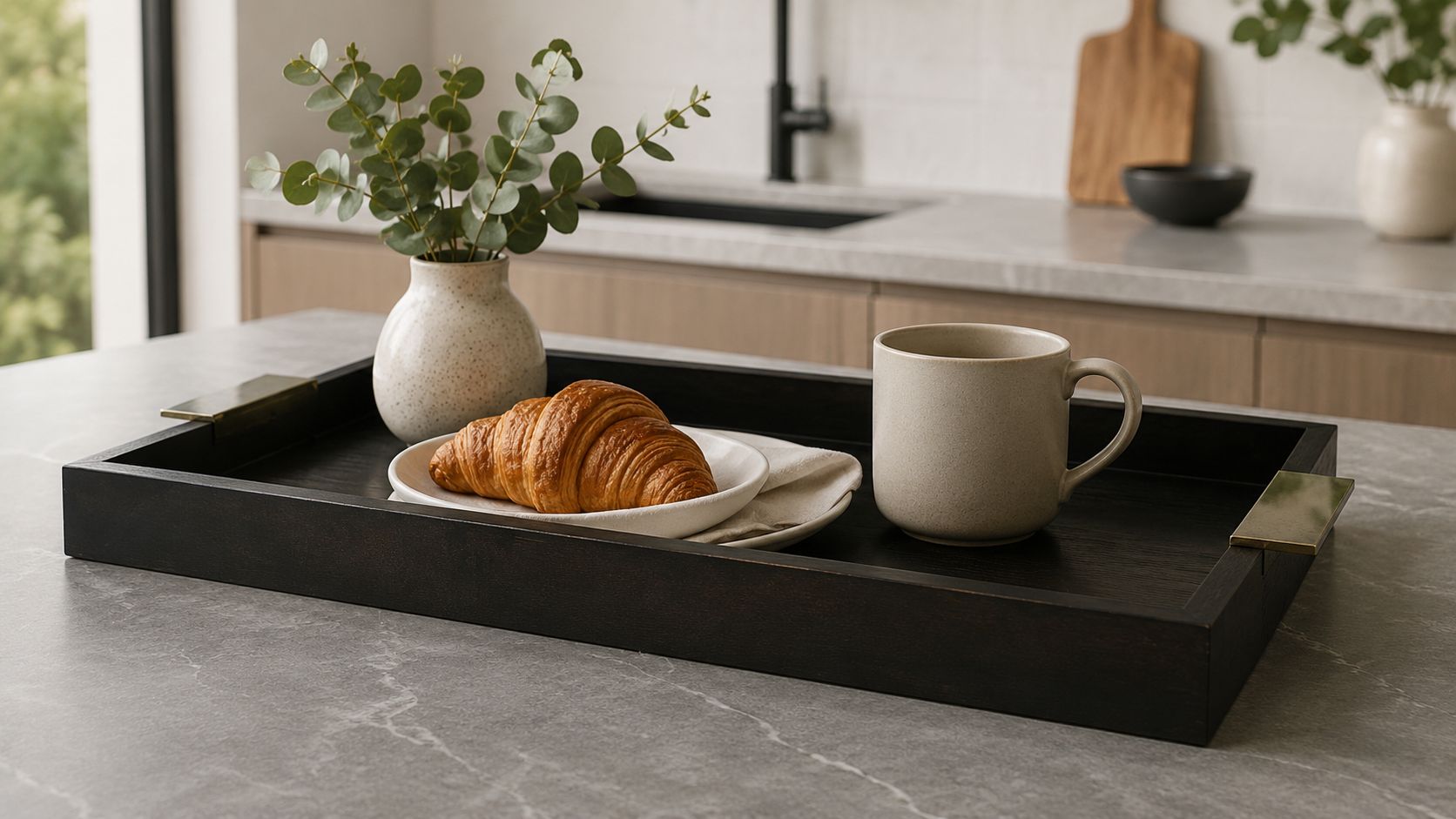
Presentation still matters, of course. A finished dessert, petit four selection, or amenity item may eventually be carried or displayed on serviceware such as the Chef Inox Room Service Tray Dark Mangowood with Aluminium Handles 620x400x50mm, which is crafted from dark mangowood and includes aluminium handles. The mould shape should work with that final presentation context, not fight it.
Selecting Moulds for Production and Profit
Friday service is full, the pastry fridge is packed, and one dessert is suddenly slowing the whole pass. In that moment, the mould is no longer a styling choice. It is either helping production run cleanly or adding labour, waste, and inconsistency.
Portion control shapes the whole section
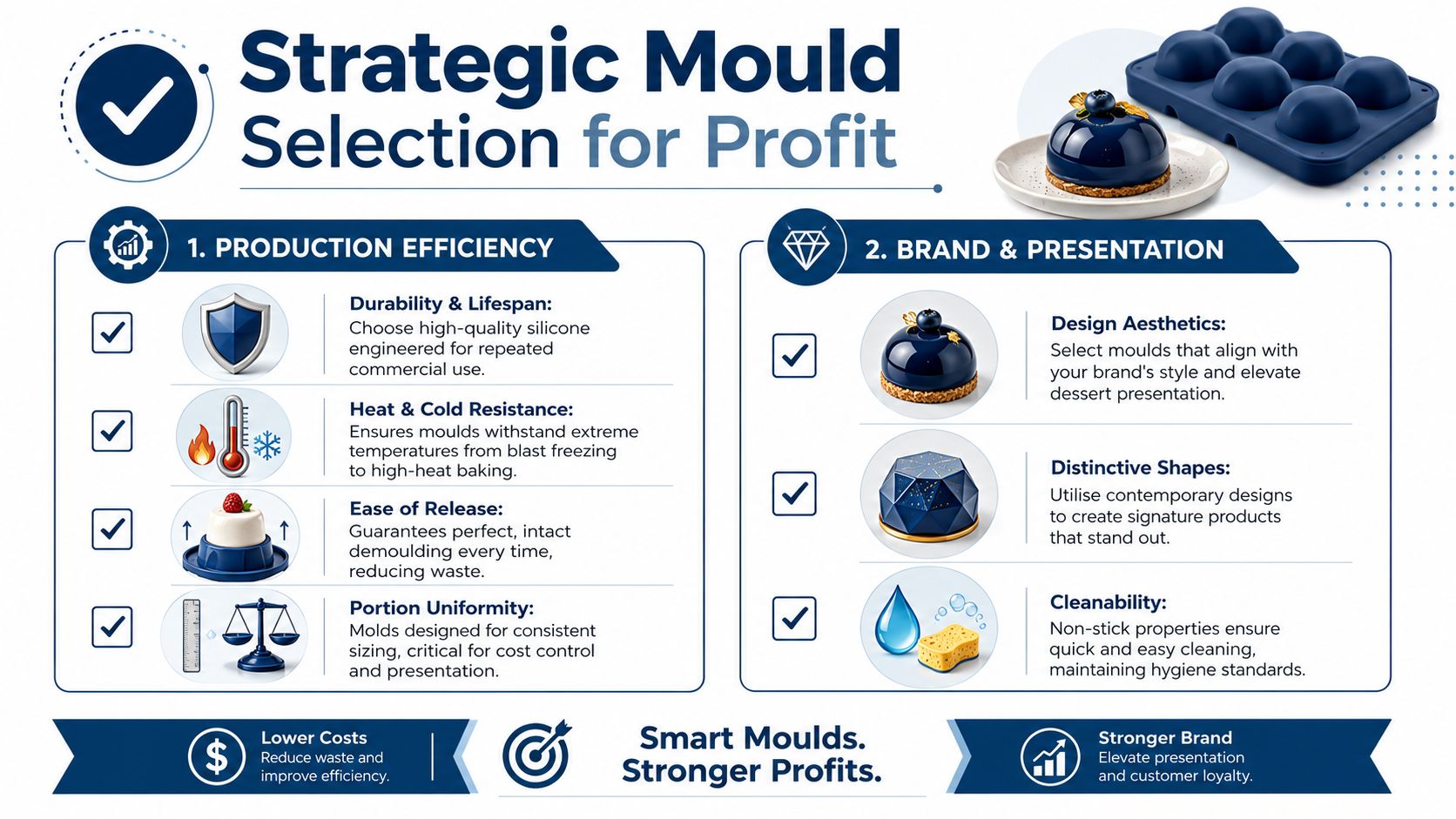
A mould affects food cost before the item ever reaches the customer. If every cavity holds a true, repeatable volume, the team can batch fillings accurately, order ingredients with less guesswork, and price the finished item with more confidence. That matters in bakeries and dessert programs where margin often disappears through over-portioning, trimming, and remake rates.
It also affects speed. Staff work faster when each unit is filled to the same level, freezes at the same rate, and plates with the same garnish plan. A mould that supports this kind of repetition gives the menu more selling power because the dessert stays consistent across busy shifts, handovers, and new staff training.
Good mould selection is really menu engineering.
What to check before buying
Start with the saleable item, not the mould pattern. A shape might look strong in a catalogue and still be wrong for your kitchen if it needs careful hand-finishing, awkward glazing angles, or too much freezer space per batch.
Use this buying filter:
- Menu fit. Choose cavities that suit products you expect to keep on the menu long enough to recover the cost through volume.
- Serve size. Match the cavity to the portion customers typically buy, not the portion that only looks impressive in photos.
- Batch output. Count how many finished units one tray gives you and how many trays fit in your blast chiller, freezer, or speed rack.
- Labour at each stage. Check how fast the team can fill, level, freeze, demould, and finish the product during normal prep.
- Waste control. Favour shapes that reduce trimming, broken edges, stuck product, and uneven topping or glaze coverage.
- Storage footprint. Deep or oversized trays can tie up expensive cold storage space for very little return.
A useful rule is simple. If a mould creates a dessert that sells well, holds margin, and can be produced by more than one skilled staff member, it deserves space in the kitchen.
Choose shapes that can earn in more than one role
The highest-return moulds are often the least theatrical. Domes, bars, rounds, and clean tart formats can work across mousse desserts, frozen inserts, mini gateaux, buffet items, and retail cabinet lines. That gives one mould more earning power and lowers the risk of buying for a single short-term idea.
This matters when a bakery is trying to grow output without adding pressure to the roster. Standardised shapes are easier to teach, easier to portion, and easier to repeat at scale, which is part of the broader discipline of scaling a menu without adding staff.
Novelty still has a place. It works best when it supports a premium price, a seasonal launch, or a signature item that helps customers remember your brand. If the shape is complex but the customer will not pay more for it, the mould is adding cost without adding enough return.
Before committing, test the finished portion in the actual service context. Put it on the plate, in the display, or in the takeaway packaging you already use. The right mould should strengthen the menu, protect margin, and make the product recognisable as yours.
Understanding Technical Specs for Commercial Use
A silicone mould can look fine on day one and still become an expensive mistake by week six. In a commercial kitchen, the spec sheet matters because it tells you how the mould is likely to behave under repeated production pressure, not just whether it looks good in the product photo.
Why vague food-safe claims cause problems in service
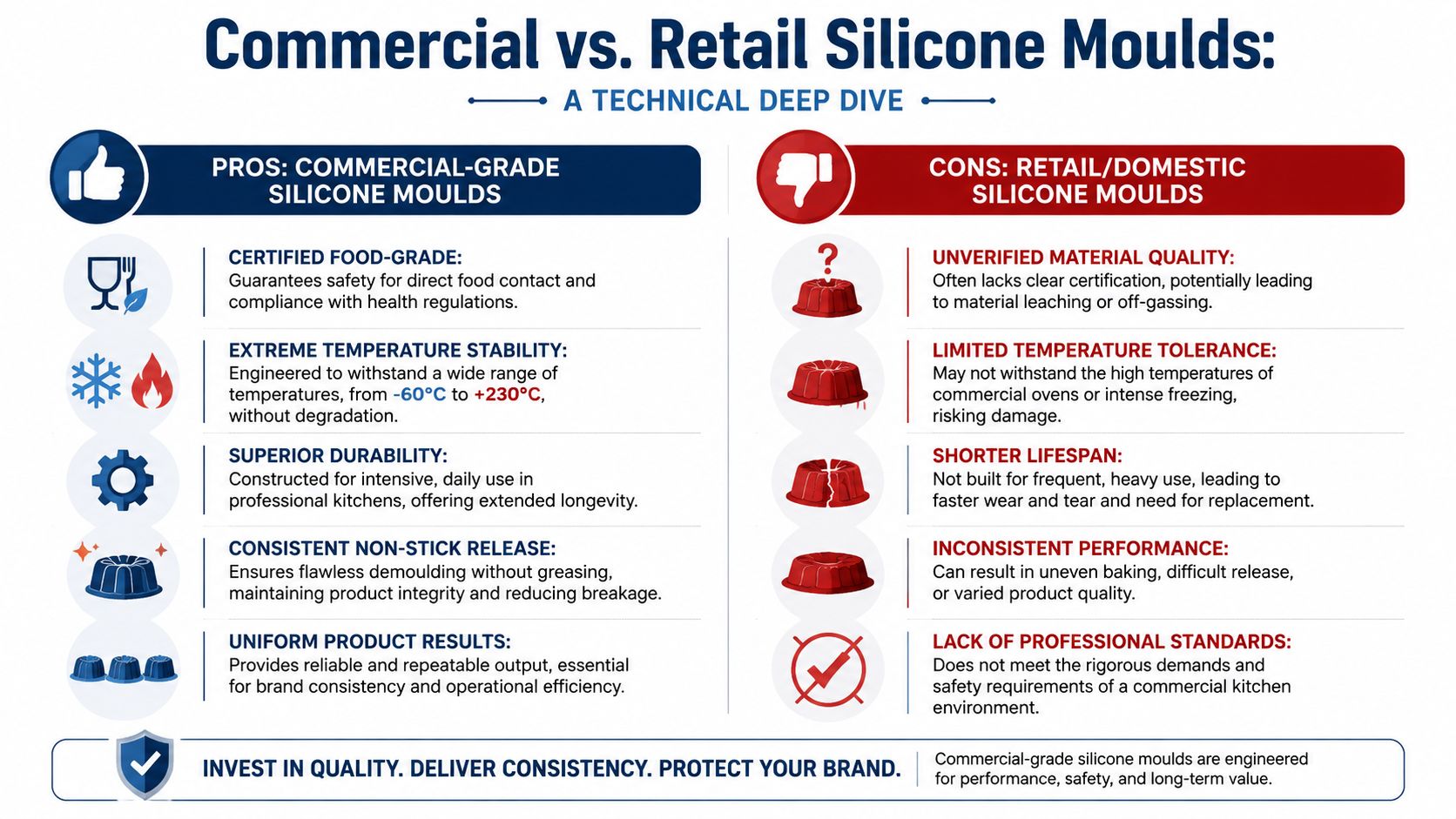
“Food safe” on its own does not tell an operator much. What matters is whether the mould is made for repeated commercial use across the temperatures and handling conditions your kitchen operates.
Look for platinum-cure silicone, clear temperature ratings, and product information that states the mould is suitable for professional production. If those details are missing, the risk shifts to your kitchen. That usually shows up later as poor release, warped cavities, surface wear, or inconsistent finish across batches.
The practical issue is consistency. A bakery may freeze inserts, fill moulds quickly on a busy prep day, move trays in and out of chillers, then wash and reset them for the next run. That cycle puts stress on the material. A mould built for occasional home baking often loses shape or performance much faster under that routine.
What to read on the spec sheet
Read the specifications with service in mind, not just product fit. The goal is to know whether the mould will protect output, portion control, and presentation over time.
Check for:
- Platinum-cure silicone rather than generic food-safe wording
- Clear temperature guidance for the intended use, whether baked, chilled, frozen, or mixed production
- Commercial-use suitability for repeated cycles, not light domestic use
- Consistent wall thickness and cavity definition so the finished item holds its shape batch after batch
- Surface quality that supports clean release and reduces waste from damaged products
Missing information is a buying signal too. If a supplier cannot tell you what the mould is designed to handle, you are left testing durability with your labour, ingredients, and service time.
A good spec sheet saves money before the first order goes live.
Operators comparing moulds with other production tools can also review broader bakeware options for NZ hospitality kitchens. The same rule applies across trays, tins, and mould systems. Clear specifications usually lead to fewer surprises on the bench and more reliable results on the menu.
Silicone vs Traditional Metal Moulds
Silicone isn't a replacement for every mould in a pastry kitchen. Metal still has an important role. The better question isn't which material is better overall. It's which material suits the product being made.
A practical kitchen comparison
| Feature | Silicone Moulds | Traditional Metal Moulds (e.g., Aluminium, Stainless Steel) |
|---|---|---|
| Release | Flexible release helps with delicate mousses, semifreddo, chocolates, and plated dessert components | Rigid structure can make release less forgiving, especially for fragile items |
| Shape handling | Best for intricate cavities and modern dessert forms | Best for classic rigid shapes and products that benefit from structure during baking |
| Heat response | Useful across chilled, frozen, and some baked applications depending on specifications | Strong heat conductivity suits products where browning and crust development matter |
| Storage | Often lighter and easier to stack or store flat | More rigid and durable in storage, but usually takes up more fixed space |
| Use case | Excellent for inserts, entremets, petit fours, moulded savoury items, and premium plated desserts | Excellent for puddings, baked pastries, cakes, and applications where metal contact helps the finish |
When silicone makes more sense
Silicone is usually the better fit when the product is delicate, highly detailed, or frozen before service. Flexibility helps preserve sharp edges and smooth surfaces when demoulding. That matters for mousse domes, layered inserts, glazed individual desserts, and small premium formats.
Many operators also prefer silicone for menu development because it allows experimentation with texture and finish without relying on heavy greasing or excessive handling.
When metal still earns its place
Metal moulds still suit kitchens that prioritise classic baking performance. Aluminium and stainless options provide rigidity and direct heat transfer, which can be valuable for products where exterior finish matters as much as shape.
This is why many pastry sections keep both systems in rotation. One mould type supports the baked base. The other supports the insert, mousse, or final plated form. That combination is often more efficient than trying to force one material into every task.
Cleaning and handling by material
The maintenance routine should also reflect the material.
For silicone:
- Wash after each use so grease doesn't build up on the surface.
- Avoid knives, offset spatulas with sharp edges, or abrasive scourers.
- Dry thoroughly before storage.
- Store flat so cavities keep their intended shape.
For metal:
- Remove baked residue promptly before it hardens.
- Dry completely to reduce spotting or corrosion risk where relevant.
- Protect edges from dents that affect shape and nesting.
- Check coatings and seams regularly if the mould has them.
For venues using flexible bakeware regularly, silicone muffin trays offer another useful reference point because the same care principles apply across many silicone formats.
Best Practices for Cleaning Storage and Longevity
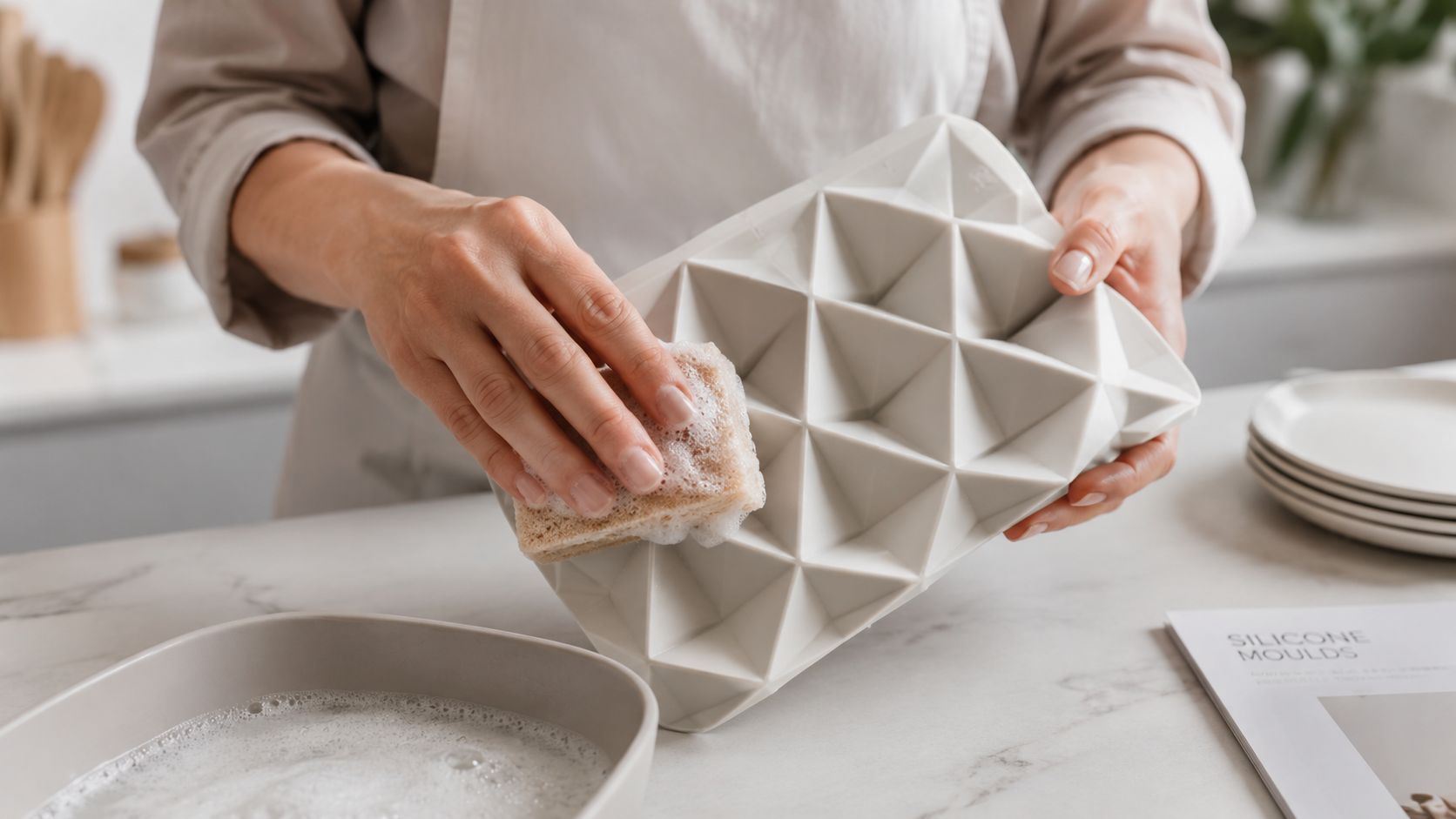
Even good moulds perform poorly when they're cleaned carelessly or stored badly. In pastry sections, that usually shows up as greasy residue, weaker release, distorted cavities, or a finish that no longer looks crisp on the plate.
The routine that prevents most problems
A reliable maintenance routine is straightforward:
- Wash thoroughly after each batch so butter, oil, chocolate, or sugar residue doesn't accumulate
- Use non-abrasive tools rather than harsh scourers
- Keep sharp utensils away from the silicone surface
- Dry completely before returning moulds to shelves or tubs
- Store flat rather than folded or crushed under heavier items
That last point is often overlooked. Folded storage saves space in the moment, but it can affect how the cavity holds shape later. In production, that means inconsistent fill lines and less even presentation.
Grease build-up changes performance
A common issue seen in busy kitchens is assuming that silicone stays naturally non-stick forever. It doesn't if grease film builds up over time. Residue can dull the finish of the product and make release less predictable.
When moulds begin to feel tacky or look cloudy after normal washing, some operators look for extra recovery methods. For teams wanting general background reading on that problem, how to revive silicone bakeware outlines a practical approach to deeper cleaning. It shouldn't replace the manufacturer's instructions, but it can help explain why residue affects release.
Clean silicone performs more consistently than dirty silicone, even when the mould itself still looks serviceable at a glance.
Match cleaning chemistry to the task
Not every cleaning product suits every food-contact surface. Hospitality businesses often find that harsh chemical choices create as many problems as they solve, especially around residue, rinsing, and staff handling.
That's why it helps to align mould care with broader kitchen hygiene practices such as those covered in cleaning chemicals NZ. The right solution depends on what the mould has been used for, how heavily soiled it is, and what the manufacturer recommends. In most cases, gentle but thorough cleaning is the better long-term approach than aggressive scrubbing.
Finding the Right Moulds for Your Business
The best silicone moulds aren't the most complicated ones. They're the ones that help the kitchen produce the same result, batch after batch, without adding friction to prep or service.
For bakeries, pâtisseries, and hospitality venues, that usually means choosing moulds around portion consistency, menu fit, release quality, technical specifications, and storage practicality. Silicone moulds in NZ can support far more than cakes alone. They're now part of how many kitchens build signature desserts, standardise plating, and expand into frozen, savoury, and premium pastry formats without sacrificing control.
The right solution depends on the menu, the team, and the production style. Operators who choose with those factors in mind usually get far more value than those chasing novelty shapes.
If your business needs help choosing silicone moulds, bakeware, or related pastry tools, contact Simply Hospitality. The team works with New Zealand hospitality operators on practical product selection based on menu style, production needs, and day-to-day kitchen use.