


Toilet Cleaner NZ: How to Choose for Commercial Washrooms
The strongest toilet cleaner on the shelf is rarely the right answer for a busy New Zealand washroom. The right product, applied correctly and often enough, usually prevents the scale, staining and organic soil that force operators into aggressive restorative cleaning. For restaurants, cafés, hotels, schools, aged-care facilities, offices and public facilities, the purchasing decision should start with the cleaning problem, surface and schedule, not with the most dramatic hazard label.
A practical toilet cleaner NZ programme separates routine maintenance from heavy build-up, matches chemistry to the soil, controls dosing and contact time, and protects fixtures, plumbing, staff and wastewater systems. The following approach helps operators choose a product that works within the actual washroom workflow, whether the venue needs convenient ready-to-use chemistry or a controlled concentrate for higher-volume cleaning.
Why the Strongest Toilet Cleaner Is Rarely the Best Choice
A common purchasing mistake is waiting until a toilet bowl has visible scale, dark staining or a persistent rim deposit, then searching for the most powerful chemical available. That approach can create a difficult cycle. Staff apply a stronger product irregularly, encounter surface or odour concerns, and still face the same build-up because the underlying cleaning schedule hasn't changed.
Routine cleaning is preventative maintenance. It removes fresh soil before it bonds to the bowl, catches staining while it is manageable, and reduces the amount of restorative work required later. In a high-traffic café or public facility, a suitable cleaner used consistently may achieve a more dependable result than an aggressive product used only after the bowl has deteriorated.
Practical rule: Choose chemistry for the deposit being removed, then choose a frequency that stops that deposit becoming a restoration job.
Start with the actual soil
Mineral scale and hard-water deposits aren't the same problem as everyday organic soiling. A product designed for general bowl cleaning may be suitable for routine work but poorly matched to established mineral deposits. Conversely, a descaling formula used unnecessarily can add handling complexity and increase the chance of damage to sensitive surfaces or components.
Operators should ask:
- What is visible? Mineral crust, yellowing, organic soil, odour or general loss of freshness each points to a different cleaning response.
- How often is the washroom used? A hotel ensuite, school block and stadium-style public facility won't need identical schedules.
- Is the problem recurring? Recurring deposits may indicate insufficient frequency, poor application, hard water or a fixture issue.
- What does the manufacturer allow? Label directions determine suitable surfaces, dilution, contact time and rinsing requirements.
A cleaning programme also needs more than bowl chemistry. Handwashing supplies, touchpoints, dispensers, brushes, floors and ventilation all affect how customers experience the washroom. Practical guidance on cleaning chemicals in NZ can help operators build a wider system instead of treating toilet cleaner as an isolated purchase.
The central decision is simple: is the venue maintaining a clean surface, or trying to recover one that has been neglected? Routine maintenance should be the default. Restorative cleaning has a place, but it shouldn't become the everyday operating model.
Understanding Toilet Cleaner Types for Commercial Use
Commercial toilet cleaners are formulated for different soils and operating conditions. A product's perceived strength doesn't tell an operator whether it will remove the deposit in front of them. Chemistry needs to match the soil and the surface.
Acid and descaler formulations
Acid-based cleaners and dedicated descalers are generally considered when mineral scale, hard-water deposits or uric staining has accumulated. These products can be useful for restorative work, particularly where ordinary routine chemistry leaves a hard ring or rough deposit behind.
The trade-off is compatibility. Acidic products may be unsuitable for some metals, seals, finishes, stone-like materials or plumbing arrangements, and the label must define where they can be used. More aggressive chemistry also demands tighter staff training, storage and emergency procedures.
Bleach-based products
Bleach-based products are commonly associated with whitening, odour control and disinfection applications. They aren't a universal answer to mineral scale. A bowl can look discoloured because of deposits that bleach won't remove effectively, so repeated use may leave the underlying problem in place.
Bleach also creates a critical safety rule: it must never be mixed with acidic toilet cleaners or other chemicals. Staff should follow the product label and safety information exactly, including ventilation and contact requirements.
Enzyme and routine-maintenance options
Enzyme-based or lower-impact formulations may suit ongoing maintenance where the main objective is managing fresh organic soil and keeping the washroom in an organised daily programme. They can be useful when operators want a gentler routine approach, but they shouldn't be assumed to replace a specialist descaler when scale has already formed.
Eco-positioned products also need careful assessment. Environmental performance depends on the full formulation, packaging, dosing method and disposal pathway, not just a front-label phrase. The commercial cleaning chemicals guide provides useful context for comparing product roles and handling requirements.
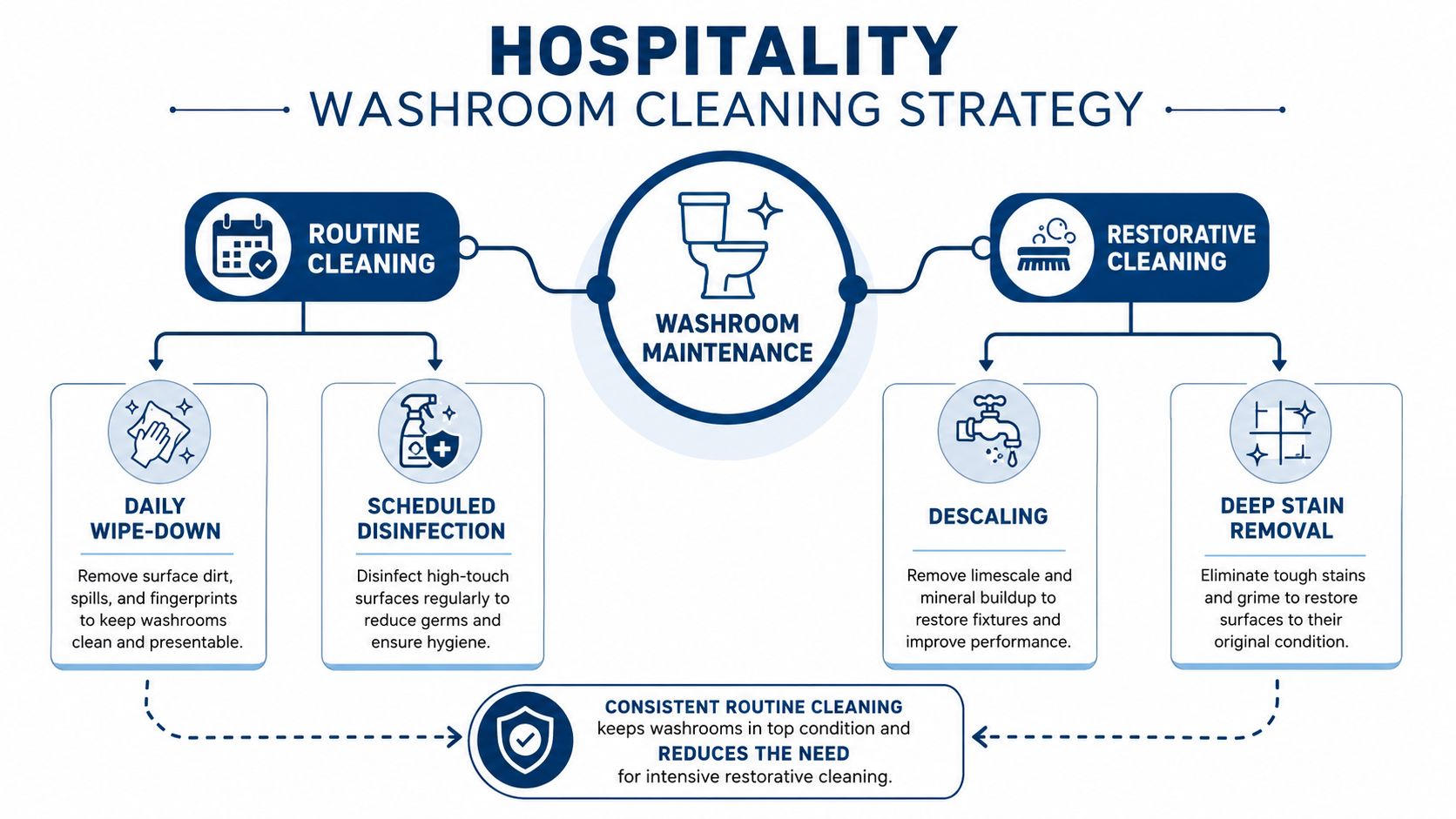
Match the product to the job
A useful operational split is:
- Routine bowl cleaning: Fresh soil, light staining and ordinary daily maintenance.
- Descaling: Mineral deposits and hard-water build-up that routine chemistry can't shift.
- Restorative stain removal: Established discolouration requiring a targeted product and controlled process.
- Targeted disinfection: A risk-based response, not an automatic substitute for cleaning.
A business using digital task control may also benefit from a commercial cleaning workforce platform to assign washroom checks, record completion and identify missed tasks. The platform doesn't replace correct chemistry, but consistent execution is often what prevents a manageable cleaning job becoming a difficult one.
For equipment rather than toilet bowls, compatibility matters just as much. UNOX D&CAL SPRAY is formulated for the stated UNOX cleaning or maintenance process and is model-specific for compatible UNOX equipment, including listed SPEED-X™, BAKERTOP MIND.Maps™ COUNTERTOP, CHEFTOP MIND.Maps™ COUNTERTOP and CHEFTOP MIND.Maps™ COMPACT lines. It shouldn't be treated as a general toilet cleaner or substituted across unrelated surfaces.
Routine Cleaning Versus Restorative Cleaning in Hospitality Washrooms
Routine and restorative cleaning serve different purposes. Routine cleaning protects the condition of the fixture. Restorative cleaning attempts to recover a surface after soil, scale or staining has become established.
A practical diagnostic starts with the bowl and the cleaning record. If the surface feels rough, shows a persistent ring or develops discolouration shortly after cleaning, the operator should identify whether the deposit is mineral, organic or a combination. Water hardness, flushing performance, frequency of use and the time available for each service all influence the result.
A simple decision process
- Inspect the deposit. A hard, crusted ring suggests a different response from loose organic soil or a general odour issue.
- Check the schedule. If staff are cleaning only after visible deterioration, the venue is operating reactively.
- Review the application. Confirm that the product reaches the intended surface and that staff follow the label's contact instructions.
- Assess the fixture. Porcelain, stainless steel, plastic components, seals and adjacent finishes may require different treatment.
- Escalate only when needed. Use a targeted restorative product for established build-up, then return to a preventative schedule.
New Zealand's public-toilet conditions show why washroom maintenance deserves operational attention. A national and multi-regional survey covering 1,864 public toilet complexes estimated about 3.7 facilities per 10,000 people nationwide. The same survey found 14.8% of toilets had no soap, 2.5% had no water for handwashing, 18.5% had no-touch bowl flushing, and 32.8% had no toilet bowl lids, demonstrating that toilet-cleaning and washroom maintenance standards remain a measurable public-health issue in NZ. The figures are reported in the New Zealand public-toilet survey.
Operators can use bathroom cleaning tips as supplementary general guidance, but commercial sites still need product-specific instructions and a documented schedule. A specialist cleaning supplies range can support a more targeted approach when routine and restorative products need to be separated.
High-traffic washrooms usually benefit from consistency more than from increasing chemical strength alone. A venue should set service points around actual use, assign responsibility clearly and inspect the result. That system prevents fresh deposits from becoming a recurring restoration problem.
How Dosing Format and Contact Time Affect Cost and Results
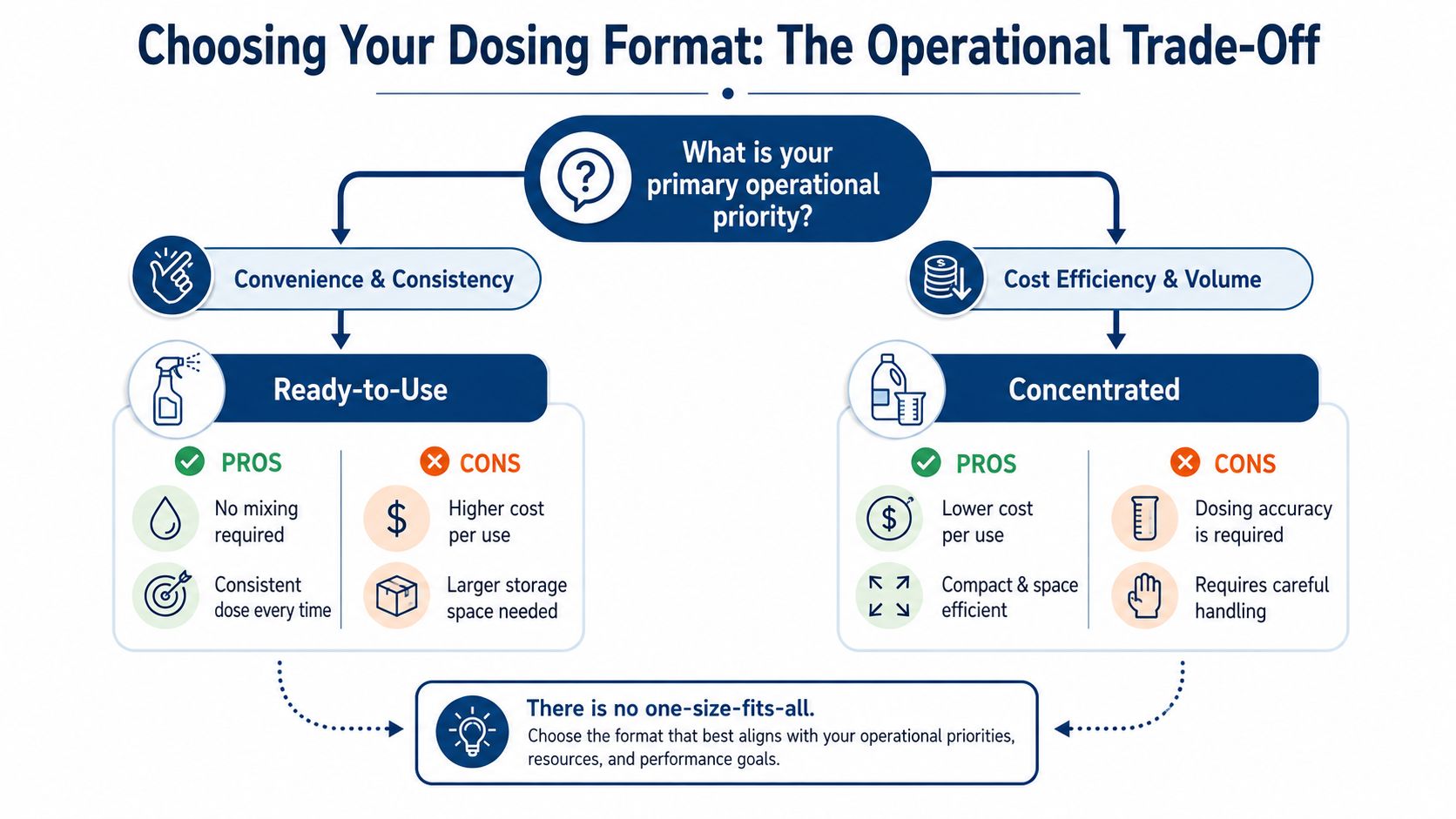
Ready-to-use and concentrated toilet cleaners solve different operational problems. Ready-to-use products reduce preparation decisions. Concentrates can reduce packaging and support higher-volume workflows, but only when staff dose them accurately.
A ready-to-use product may suit a café, small office or venue where different staff members clean at different times and consistency matters more than storage efficiency. It removes the mixing step, but operators still need to control spray use, storage, stock rotation and safe handling.
A concentrate may suit a hotel, school, aged-care facility or multi-site operation with a defined cleaning team. The bottle price alone doesn't show whether it represents good value. The meaningful comparison is cost per correctly diluted litre or cost per use, based on the manufacturer's stated dilution and the quantity applied.
Why over-dosing doesn't solve a weak process
Adding extra chemical can increase cost without improving the result. It may also leave residue, create stronger fumes, damage a surface or increase wastewater loading. Leaving a product on for longer than the label allows isn't a safe shortcut either. Formulations differ, so there isn't one universal dilution ratio or contact time for heavy commercial use.
Staff should have access to:
- The original label: It identifies the intended application, surfaces, warnings and directions.
- A defined dosing method: Measured dispensers or controlled systems are more reliable than guessing into a bucket.
- A practical task sheet: The sheet should state which product is used for which soil and where it must not be applied.
- Time to work: Contact time should follow the manufacturer's instructions, not an improvised assumption.
Build dosing into the workflow
A product may perform well in testing but fail in operation if staff can't use it correctly during a busy service period. Managers should check whether bottles are being refilled safely, whether trigger sprayers remain labelled, whether concentrates are stored away from incompatible products and whether the cleaning team can complete the required contact time without immediately flushing or wiping.
For larger operations, a central chemical station can improve control, provided staff understand the equipment and emergency procedure. Smaller venues may prefer ready-to-use bottles to reduce training complexity. Neither format is automatically superior.
New Zealand workplaces also need to treat safety documentation as part of the purchasing decision. Commercial cleaning products in NZ should be evaluated alongside the label, SDS, storage needs and staff capability, not just the visible cleaning result.
Surface Compatibility and When Cleaning Is Enough
A toilet cleaner must suit both the deposit and the fixture. Glazed porcelain is common in commercial washrooms, but the surrounding area may include stainless steel, plastic hinges, rubber seals, chrome finishes, painted surfaces and flooring. A product that works on the bowl may be unsuitable for the seat, flush plate or nearby metalwork.
Staff should apply the product only where the label permits, control splashes and rinse or wipe as directed. Acidic or strongly reactive products deserve particular care around plumbing and fixtures, especially where the cleaner could remain trapped under rims, around seals or in poorly flushed areas.
Cleaning and disinfecting aren't interchangeable
Cleaning removes soil. Disinfection is a separate risk-control step that may be justified in an outbreak, a high-risk setting or where a documented infection-control procedure requires it. Routine use of an antibacterial product shouldn't automatically replace ordinary soap-and-water hygiene or proper cleaning.
NZ coverage has highlighted guidance from health experts and the Health Ministry that soap and water are recommended for everyday use, and that antibacterial products are often no better at killing germs. The Royal Society has also described New Zealand as having relatively low antimicrobial resistance rates. Those points support a measured approach, targeted disinfecting where needed rather than routine overuse.
Decision point: If the bowl is dirty, clean it first. If a specific risk calls for disinfection, follow the approved disinfectant process after cleaning.
The Ministry of Education guidance described in the supplied NZ material says bleach can be suitable for toilets and sinks during outbreak scenarios, using a 0.1% solution and longer contact time. That is a specific outbreak use case, not a recommendation to use bleach as the default daily toilet cleaner.
Venue type affects the decision. An ordinary restaurant washroom may need dependable cleaning and touchpoint control, while aged care, schools or institutional settings may have additional procedures set by management, public-health advice or an infection-control plan. Operators should document when disinfection is required, which product is approved and how staff verify contact time.
Safe Handling Disposal and What NZ Labels Tell You
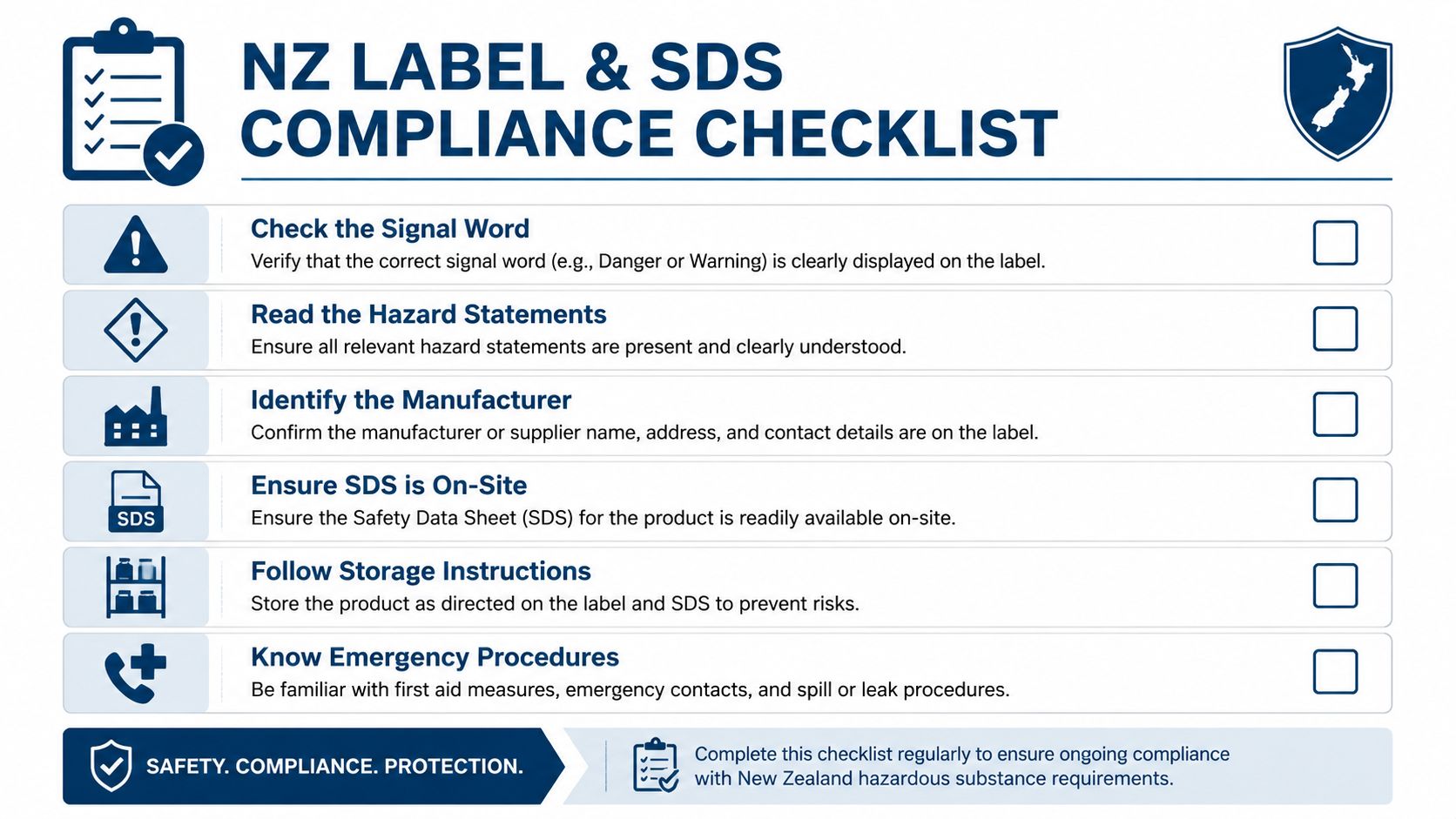
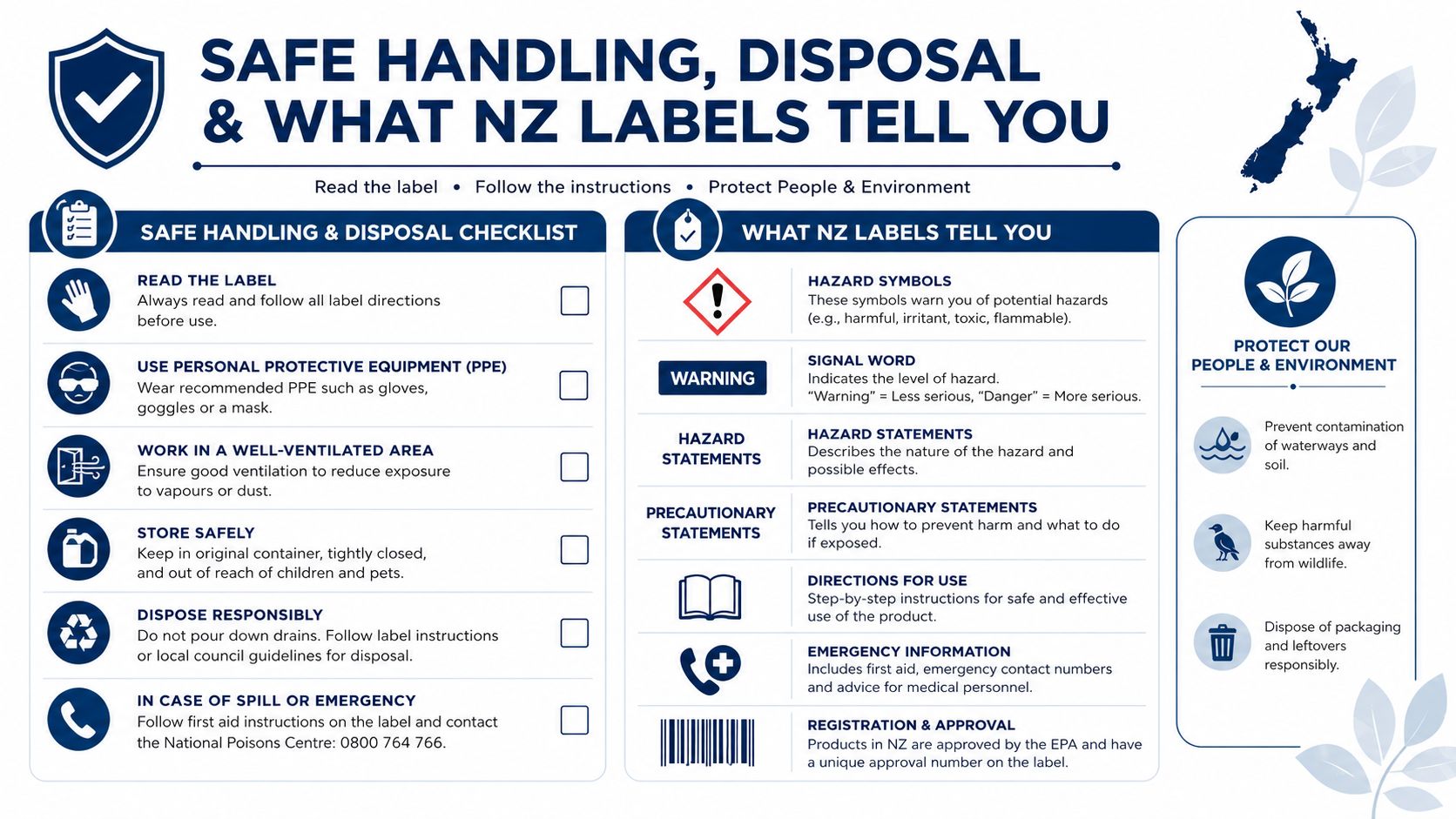
A toilet cleaner's label is an operating document, not just packaging. It tells staff where the product can be used, what protective equipment may be required, whether dilution is permitted, how long it should remain in contact and what to do after application. Never mix cleaning chemicals, even when a stronger result seems desirable.
Hazard classes vary between products. NZ toilet-cleaner SDS examples include risks such as flammable liquid, serious eye irritation, narcosis, corrosive effects and aquatic harm. Operators should check the exact product classification rather than assuming all toilet cleaners behave alike. A label that says “bathroom” doesn't make a chemical suitable for every bathroom surface or disposal route.
SDS and HSNO responsibilities
WorkSafe NZ states that a current Safety Data Sheet is mandatory for each hazardous substance in a workplace. The supplier must provide a HSNO-compliant SDS, and the document must be available to workers and emergency services. It needs to be obtained when the substance is first supplied, or first supplied again after five years or after an amendment, as set out in WorkSafe NZ SDS guidance.
Under NZ hazardous-substances rules, every hazardous substance imported into or manufactured in New Zealand must be approved under the HSNO Act and have an approval number. The cleaning-products group standard applies to solid or liquid substances imported or manufactured for use as a cleaning product, according to the relevant hazardous-substances practical guide.
Staff need to know where the SDS is kept, how to respond to a splash, what protective equipment applies and which products must be segregated. Managers should also ensure labels remain attached when products are decanted.
Disposal and environmental selection
Wastewater systems are sensitive to contamination and blockages, and regional rules can restrict discharges that introduce prohibited characteristics into sewer systems. Acidic or strongly reactive toilet cleaners should therefore be selected and diluted according to the label, with rinse water handled in line with site procedures and applicable trade-waste requirements. National wastewater guidance describes these practical risks in wastewater and hazardous-substance advice.
NZ ecolabelling criteria for detergents and cleaning products prohibit formulation or manufacture with phosphorus, including phosphates and phosphonates, and require surfactants to be readily biodegradable and anaerobically degradable. Where applicable, the standard also caps fluorinated surfactants at 0.025% by weight and silicone surfactants at 0.25% by weight, as specified in the Eco Choice Aotearoa cleaning-products criteria.
Sustainability should be assessed across the complete system. Concentrates may reduce packaging and transport, refillable dispensing can reduce waste, accurate dosing prevents unnecessary discharge, and relevant environmental certifications may support institutional procurement. The eco-friendly cleaning products discussion provides a useful starting point, but each organisation should check its own procurement policy.
Choosing and Stocking the Right Toilet Cleaner for Your Venue
The right toilet cleaner NZ purchase starts with a short operational audit. Before adding another bottle to the chemical cupboard, the venue should answer:
- What needs removing? General soil, mineral scale, hard-water deposits and staining need different approaches.
- Is this routine or restorative? A daily product should maintain the bowl, while a specialist product should address established build-up.
- Does it suit the surface? Check porcelain, stainless steel, plastics, seals, finishes and plumbing.
- Is it ready to use or concentrated? Select the format staff can apply accurately during the actual cleaning shift.
- Are staff dosing correctly? Measure concentrates and keep every decanted container labelled.
- Is the schedule frequent enough? Consistency often prevents the need for aggressive recovery work.
- What is the cost per use? Compare correctly diluted product, application quantity and waste, not bottle price alone.
Single-site venues may value simplicity and clear staff instructions. Multi-site operators may prioritise standardised products, controlled dispensing, SDS access and reliable replenishment. Schools, aged-care facilities and public facilities should also align product selection with their internal risk assessments and cleaning policies.
For teams that need additional guidance on professional cleaning product selection, the same principle applies: identify the soil, surface and workflow before selecting chemistry. Hospitality can help operators compare cleaning chemicals and related hospitality supplies according to the washroom, staff process and venue requirements.
Hospitality supplies commercial cleaning chemicals and hospitality equipment for New Zealand operators, with product guidance focused on practical use, compatibility and safe handling. Visit Simply Hospitality to review suitable cleaning categories or contact the team for help choosing a toilet cleaner that fits the venue's surfaces, traffic levels and cleaning schedule.