


Upright Commercial Fridge: New Zealand's Top Picks
Choosing an upright commercial fridge by litres alone is one of the quickest ways to buy the wrong cabinet. A unit can look generous on a specification sheet yet waste valuable space because the shelves don't suit the kitchen's trays, containers or bottles. The better decision considers usable capacity, door configuration, operating environment, airflow, food-safety control and 24-hour electricity use. For New Zealand hospitality businesses, SKOPE and Atosa represent two different purchasing propositions, so the right choice depends on the venue's workflow, support expectations and budget rather than a simple premium-versus-cheap comparison.
Why Litres Alone Won't Pick the Right Upright Commercial Fridge
The litre figure is useful, but it's only a starting point. Gross capacity can include space occupied by interior walls, evaporator housings, corners, shelf supports and areas that staff can't use efficiently. Two upright commercial fridges with a similar headline capacity may hold very different quantities of half-pans, sauce bottles, prep containers or trays once the internal layout is considered.
Vertical refrigeration is significant in storage-heavy kitchens because it uses height rather than spreading chilled storage across the floor. EECA's commercial product insights report records average 2024 capacities of 599 litres for vertical refrigerators and freezers, compared with 267 litres for horizontal refrigerators and freezers. The same report shows that New Zealand's annual sales of fridges, fridge-freezers and freezers increased from 181,845 units in the year ended March 2002 to 266,298 units in the year ended March 2024, about 46.4% growth over 22 years. EECA's commercial product insights report provides useful context for why upright formats remain important in busy kitchens.
Three filters matter more than the headline figure
A practical buying assessment starts with three questions:
- What must fit? Check the actual containers, trays, ingredients and packaging used during a busy service, not an idealised empty shelf.
- Where will it operate? A cool café preparation room puts different demands on a cabinet from a hot restaurant kitchen beside cooking equipment.
- What will it cost to run? An upright cabinet operates continuously, so efficiency, ventilation and door-opening behaviour affect ownership well beyond the invoice.
A large cabinet can still be a poor choice if staff must move stock between shelves, leave airflow blocked or open several doors to find commonly used ingredients. A smaller unit with sensible shelf spacing may support faster access and better organisation.
Practical rule: Choose the cabinet that stores the kitchen's real stock in an organised way, not the cabinet with the most impressive number on the brochure.
SKOPE and Atosa can both be appropriate. SKOPE suits operators placing greater weight on premium commercial refrigeration, New Zealand support and serviceability. Atosa offers genuine commercial refrigeration with a more accessible purchase position. Neither should be judged without considering the venue's operating conditions and tolerance for downtime.
What an Upright Commercial Fridge Actually Does in a Working Kitchen
An upright commercial fridge is a vertical cabinet built for continuous foodservice use, not occasional household storage. Its value shows in how it handles frequent door openings, heavy loading, repeated cleaning and long operating hours. Door count, solid or glass fronts, adjustable shelves and commercial refrigeration components all affect how well it fits the job.
The cabinet should make routine work easier. Stainless-steel exteriors support regular wipe-down cleaning, while food-safe interiors, removable shelves and rounded internal corners make sanitation less awkward. Castors can assist with repositioning and floor cleaning, although the fridge still needs a stable, level location with suitable clearance and power.
Temperature control is a working responsibility, not just a thermostat setting. New Zealand food-storage guidance generally advises holding chilled food below 4°C, while particular foods and storage situations may require additional controls. Temperature can vary between shelves and cabinet zones, so check more than the display or dial with a thermometer. The New Zealand food-storage guidance explains why checks should cover the appliance rather than one convenient point.
The cabinet must suit the station
An upright is useful for consolidated chilled stock, but its height does not automatically make it the right format. An undercounter cabinet keeps frequently used ingredients beside the prep bench. Bench or prep refrigeration adds chilled storage beneath a working surface, reducing movement during assembly. Chest formats can hold stock differently, though staff must manage access and rotation carefully. Display cabinets are aimed more at front-of-house drinks or ready-to-eat presentation than back-of-house ingredient control.
The practical test is the work path. How often will staff open the cabinet? Which ingredients need immediate access? Will the door obstruct an aisle or make staff cross the cooking line? A vertical cabinet can provide strong storage density, yet poor placement can slow service and create avoidable handling.
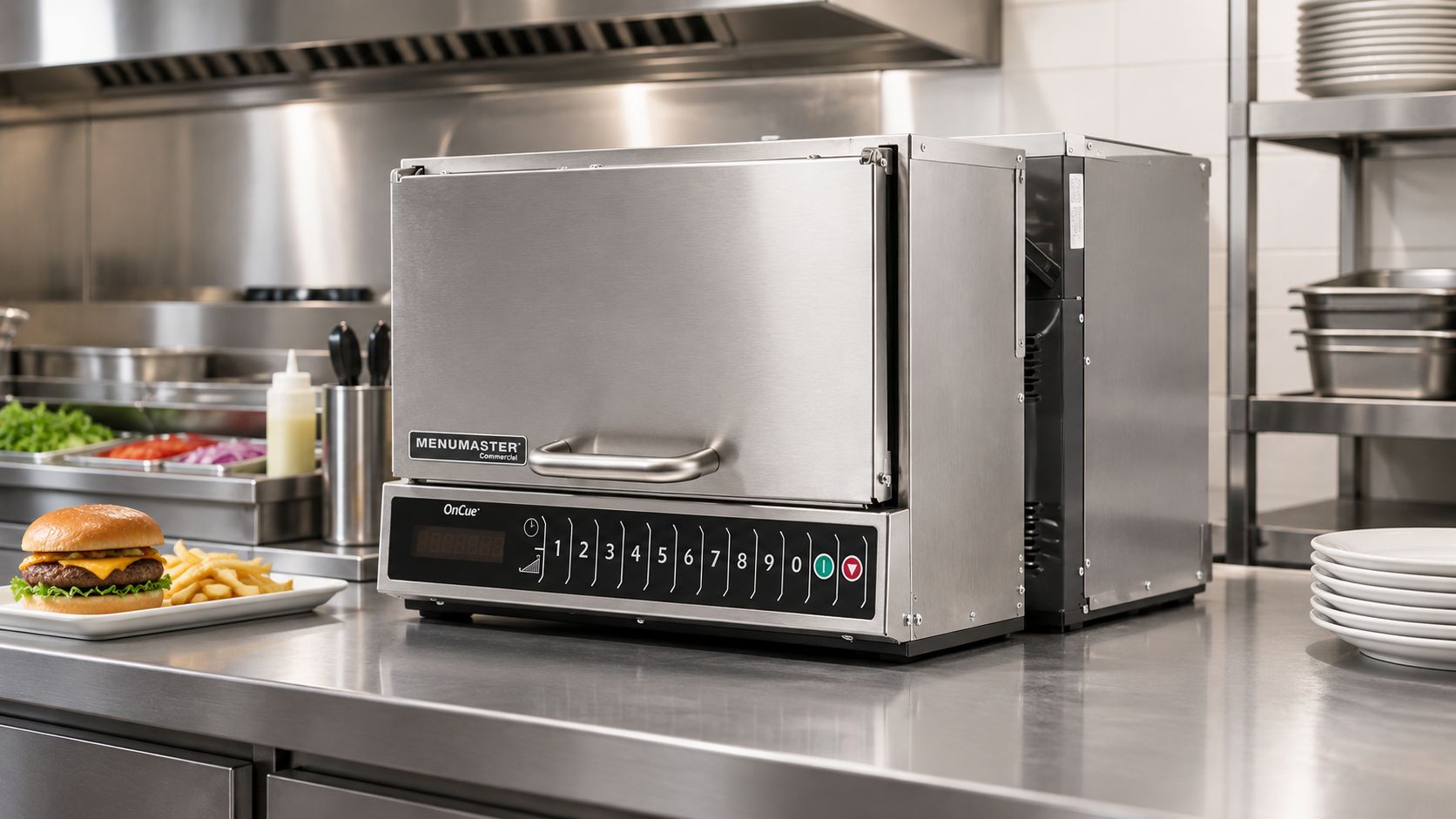
The Menumaster MOC5241 2400W Heavy-Duty Microwave shows the same task-first approach in another equipment category. Its compact 9-litre cavity and 2400W output suit quick-service work such as single-portion regeneration, burger finishing and sauce heating, rather than large-batch cooking. The buying lesson applies to refrigeration too: match the equipment to the task, workflow and operating environment, not one headline specification.
Door and Shelf Configurations That Match Your Workflow
Door count changes how staff access stock, how much wall or aisle space the cabinet needs, and how the unit fits into a service rhythm. It shouldn't be treated as a simple capacity ladder.
A one-door upright can suit a narrow galley, bar, pastry station or dedicated garnish area. It's useful when the cabinet serves one work group and the available footprint is restricted. The limitation is access width. Staff may need to open the full cabinet to reach a single ingredient, and a crowded interior can turn routine retrieval into searching.
A two-door cabinet often works as a general prep-line or back-of-house workhorse. It gives staff more organised zones and can make stock rotation easier, particularly when one side is allocated to pre-prepared ingredients and the other to incoming stock. Door swings, handle positions and nearby benches still need to be checked before installation.
A three-door unit suits high-volume production, shared storage or venues that need several clear stock zones. It can reduce the need for multiple separate cabinets, but the increased footprint may be difficult in a tight kitchen. More doors also mean more seals and hardware to keep clean and inspect.
Solid doors or glass doors
Solid doors generally suit back-of-house ingredients where visibility isn't required. They reduce visual clutter and can be a sensible choice for stored proteins, sauces, produce and prepared components. Glass doors make stock easier to see and can suit beverages, grab-and-go products or customer-facing service, but the door frame, shelving arrangement and cleaning workload deserve attention.
Adjustable shelving is often more valuable than an extra nominal capacity claim. Shelves should be strong enough for the products stored, easy to remove, and positioned so staff can reach common ingredients without repeatedly unpacking the cabinet.
Workflow check: The most frequently accessed ingredients should sit where staff can reach them quickly, without opening several doors or searching behind slower-moving stock.
Door swing arcs matter as much as cabinet width. Measure the open-door position, nearby benches, corners and staff paths. Operators should also check whether the model offers a door arrangement that suits the site, rather than assuming the standard configuration will work.
For a wider discussion of how storage supports kitchen flow, see commercial kitchen shelving considerations. The same discipline applies inside refrigeration, every shelf should earn its space.
Usable Capacity and Why Shelf Spacing Beats Headline Litres
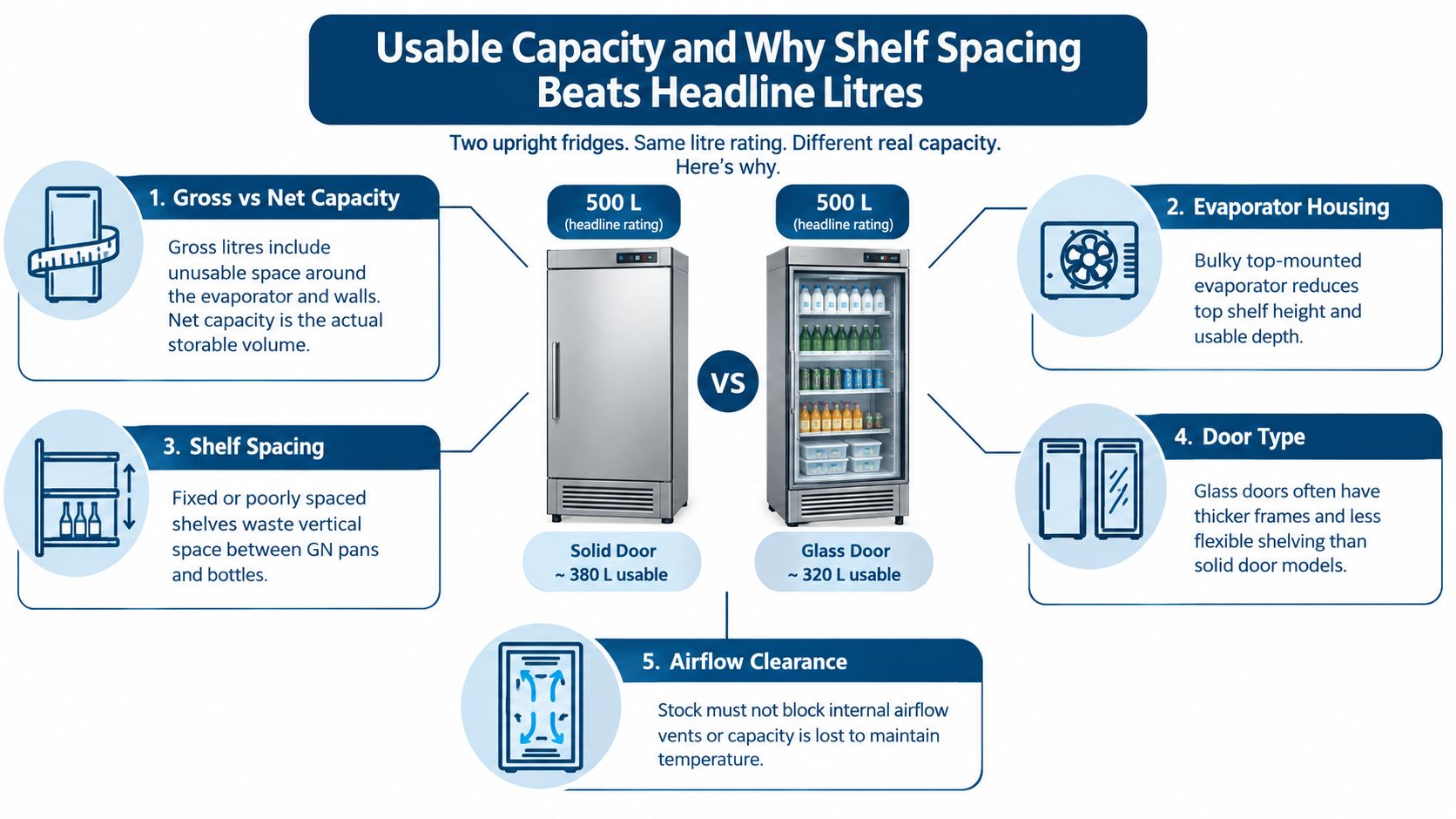
Headline litres do not tell staff how much stock they can store, reach and rotate safely. Usable capacity is reduced by evaporator housings, fans, shelf supports, door rails and insulation, so the internal working space can differ substantially from the gross figure.
Shelf spacing often matters more than extra nominal volume. Fixed shelves may leave wasted gaps above short containers while blocking taller bottles, pans or trays. Adjustable shelves let the cabinet follow changing menus, delivery patterns and prep routines.
Measure the stock, then test the cabinet
Take the kitchen's actual containers into the buying decision.
- Containers and pans: Check internal width, depth and shelf clearance against the pans used during prep.
- Bottle height: Confirm that sauces, milk containers and beverage bottles stand upright without removing a shelf.
- Tray access: Leave enough clearance to slide trays in and out without catching shelf edges or door rails.
- Airflow space: Keep vents and circulation paths clear. Packing a cabinet to its physical limit can lead to uneven cooling.
- Rotation zones: Reserve space for new deliveries, older stock and frequently used ingredients.
Door-mounted rails can restrict access to deep shelves even when the shelf dimensions look generous. Glass-door models may also have thicker framing or an interior arranged for display, leaving less flexibility for back-of-house storage.
A cabinet drawing or specification sheet is only useful when compared with real containers. Standardised pans should be measured before selection. Kitchens with changing menus will usually gain more from adjustable shelving than from a rigid internal layout.
The right arrangement also affects daily labour. Staff can find ingredients faster, keep delivery rotation clearer and avoid placing containers directly in front of vents. That protects the intended airflow pattern while making the advertised capacity more useful in practice.
SKOPE and Atosa as Two Different Buying Propositions
SKOPE and Atosa shouldn't be reduced to a premium brand versus a cheaper alternative. They represent different approaches to purchasing commercial refrigeration.
SKOPE is associated with premium commercial refrigeration, strong New Zealand support and established serviceability considerations. That proposition can suit venues where access to parts, technical support and a familiar local support network carry significant weight. Multi-site operators, accommodation businesses and kitchens with limited tolerance for disruption may place a higher value on support continuity and whole-of-life ownership.
Atosa provides genuine commercial refrigeration with a more accessible purchase position. That can appeal to start-ups, operators fitting out several locations, or businesses managing a tightly controlled capital budget while still needing equipment designed for foodservice rather than domestic use. The decision should still include the model's ambient specification, warranty conditions, parts pathway and service arrangements.
| Factor | SKOPE | Atosa |
|---|---|---|
| Purchasing proposition | Premium commercial refrigeration with strong New Zealand support | Commercial refrigeration at a more accessible purchase position |
| Service consideration | Useful where established support and parts access are important | Suitable where value and commercial specification are central |
| Venue fit | Businesses prioritising support continuity and whole-of-life planning | Start-ups, multi-site fit-outs and budget-conscious commercial kitchens |
| Selection priority | Confirm model capacity, conditions, configuration and service pathway | Confirm model capacity, conditions, configuration and service pathway |
| Ownership view | Higher initial spend may be assessed against support and serviceability | Lower entry barrier should still be assessed against long-term support |
Specific model selection still matters more than brand familiarity. Operators should compare door count, shelving, cabinet dimensions, temperature controls, ambient operating conditions, warranty terms and local servicing before committing.
The discussion of SKOPE's popularity in New Zealand hospitality provides additional context for operators assessing the brand's support proposition. Atosa should be considered on its own merits, not as a substitute chosen without checking the individual cabinet.
Ownership question: If the cabinet stopped during a busy week, which support arrangement would give the business the clearest path to resolution?
That question often clarifies whether the purchasing decision should prioritise upfront affordability, support infrastructure, or a balance of both.
Temperature Performance, Energy Use, and 24-Hour Running Cost
The setpoint on the controller is only one part of temperature performance. In a working kitchen, ambient heat, door-opening frequency, loading pattern, internal airflow, ventilation and door seals determine how hard the cabinet runs and how consistently it holds food.
For potentially hazardous chilled food, New Zealand guidance supports keeping product at 5°C or below. Holding between 2°C and 4°C provides more operating margin during busy service, loading and warmer conditions. Food kept in the 5°C to 60°C danger zone for more than 4 hours must be discarded, according to the compliance guidance used for this topic. The New Zealand commercial refrigeration compliance guidance explains the practical implications.
Performance under service conditions
Check the specified ambient operating conditions for the exact model. A cabinet that performs well in a cool preparation room may struggle when positioned beside ovens, grills or fryers. Claims that one model automatically performs best in New Zealand humidity require controlled comparative data, so they should be treated cautiously.
Use the cabinet's real duty cycle to assess it:
- Measure different areas: Temperatures can vary across the cabinet, so one controller reading is not enough.
- Observe recovery: Check how quickly the cabinet returns to its intended range after loading and repeated service access.
- Protect airflow: Keep stock away from vents and leave enough space for cold air to circulate.
- Inspect seals: A damaged or poorly closing seal allows warm air inside and increases refrigeration load.
- Check ventilation: Restricted airflow around the cabinet makes the refrigeration system work harder.
A fridge that recovers well in an empty showroom may behave differently during a crowded lunch service.
Electricity use needs the same practical assessment. EECA identifies refrigeration as New Zealand's third largest electricity user in 2023, behind hot water cylinders and electric furnaces. Its workplace refrigeration guidance explains why equipment selection and daily operating behaviour both affect energy use. Advice on energy-efficient appliances can also help when comparing equipment across a wider kitchen fit-out.
New Zealand's commercial refrigeration efficiency requirements came into force on 1 July 2021. EECA states that fridge and freezer labels use star ratings, with each additional star representing an 18% reduction in energy consumption. Its fridge and freezer energy-rating information connects the label with annual kWh use under standardised test conditions.
EECA's measured commercial cabinet data ranges from about 5.2 to 11.6 kWh/day/m² of TDA, demonstrating that cabinet types can differ materially in efficiency. The commercial refrigeration product data is more useful than a generic running-cost estimate because electricity tariffs, loading and kitchen conditions vary.
The supplied performance graphic lists figures such as a 2.8 kWh daily average and a £0.85 daily cost. Those values are not New Zealand-verified results for a particular upright commercial fridge, so they should not be used for a venue budget. Compare the model's stated annual or daily consumption with the site's electricity rate and duty cycle. That gives a more realistic view of its 24-hour running cost than litres or purchase price alone.
Installation, Ventilation, and Day-to-Day Maintenance Habits
Installation decisions affect how reliably an upright commercial fridge runs. Before delivery, confirm the available width, height, depth, floor level, power supply, door swing and the manufacturer's clearance requirements. Leave enough space for air movement around grilles and the condenser, while allowing staff to open the doors without blocking a service path.
The floor deserves attention too. An uneven surface can affect levelling, door closure and cleaning access. During a fit-out, these commercial flooring contractor tips may help the team prepare a suitable position before the cabinet arrives.
Routine checks should fit into normal cleaning work:
- Door seals: Wipe them clean and look for damage or gaps when the door closes.
- Interior airflow: Keep vents clear and avoid packing stock tightly against circulation points.
- Exterior ventilation: Maintain the specified clearance around grilles and the condenser area.
- Ice and frost: Investigate unusual build-up rather than treating it as a cosmetic issue.
- Temperature logs: Record cabinet temperatures under the venue's food-safety procedures.
- Cleanliness: Remove spills promptly, then clean shelves, the cabinet floor and door interiors with suitable products.
Keep stock organised so cleaning does not become a rare deep-cleaning task. A crowded cabinet restricts airflow and makes it harder to spot spills, damaged seals or frost early.
Operators should observe, clean and report problems. Refrigerant loss, unusual compressor noise, persistent icing, repeated temperature issues and defrost faults require a qualified commercial refrigeration technician. DIY repairs can worsen the fault and create food-safety risk.
Hospitality does not provide refrigeration servicing or publish failure-frequency data. Its commercial refrigeration maintenance guidance supports routine care, while technical faults belong with an appropriately qualified technician. A small change in cabinet behaviour is easier to address early than after repeated resets or prolonged temperature problems.
Matching the Cabinet to Your Kitchen and Getting the Right Advice
The right upright commercial fridge is the one that matches the kitchen's stock, access pattern and environment. A single-door model may suit a bar, pastry station or compact prep area. A two-door cabinet often supports general restaurant storage, while three-door refrigeration can suit high-volume production where separate zones and larger access are justified.
The final assessment should cover:
- Stock profile: Measure the pans, trays, containers and bottles the venue uses.
- Workflow: Place frequently accessed ingredients where staff can reach them without crossing busy paths.
- Environment: Check the manufacturer's ambient operating specification for the installation area.
- Configuration: Select solid or glass doors, door count and shelving around the work being done.
- Ownership: Compare energy information, warranty terms, parts access and service support.
- Installation: Confirm clearances, ventilation, power, floor level and door-swing space before ordering.
The cabinet shouldn't be chosen in isolation from the rest of the kitchen. Operators planning a new venue or reviewing an established site may find refrigeration advice based on business stage useful when deciding whether to add one cabinet, use several specialised units or plan a broader refrigeration layout.
Hospitality can help hospitality businesses compare SKOPE and Atosa upright fridges, review usable capacity, assess site constraints and coordinate equipment choices with wider kitchen planning. The useful conversation starts with menu, stock, workflow and operating conditions, not just a requested litre figure.
Hospitality supplies commercial refrigeration and can help operators compare SKOPE and Atosa configurations, shelving, door options and whole-of-life considerations for their venue. Visit Simply Hospitality to discuss the right upright commercial fridge for the kitchen's stock, layout and daily workload.