


Washtech Dishwashers and What to Compare Before You Buy
A Washtech dishwasher is a sensible starting point for New Zealand buyers, but familiarity is not a buying strategy. Operators often end up with the brand they already know because it has been seen on previous sites, stocked by the local tech, or recommended by the installer. That shortcut can be costly when the machine is expected to run thousands of cycles over its life, because the decision is not the badge on the front, it is whether the machine fits the work, the power supply, the water system, the workflow, and the service network behind it.
Washtech matters in New Zealand because it has deep local roots. The company says it was founded in Auckland in 1981 as Wash Systems Limited by Des and Gary Brent, that its first Starline undercounter dishwasher was assembled in Des Brent's single-car garage, and that it later became the largest manufacturer of professional dishwashing equipment in New Zealand before joining Ali Group in 1999 about Washtech. That history explains why the brand gets talked about so often. It does not explain whether it is the right machine for a café, a bar, a school kitchen, or a high-turnover restaurant.
The smarter approach is simple. Compare equivalent Washtech, Starline, Classeq, Winterhalter, and Rhima models on cycle time, water use, rack capacity, electrical requirements, chemical systems, parts support, and whole-of-life ownership. If the machine is going to anchor your wash-up area for years, that comparison is the decision that matters.
Why the Familiar Name Isn't Always the Right Choice
A familiar name feels safe because it reduces decision friction. Many operators have seen a Washtech dishwasher in the wild, watched staff use one, or heard a service agent speak positively about the brand. That comfort is real, but it's not the same as proof that the machine is the best fit for a specific site.
The better question is whether the machine matches the job. A compact café, a pub dish-up area, and a banquet kitchen all need different things, even if they all want a reliable undercounter or passthrough unit. A machine that looks “standard” on paper can still be the wrong choice if the cycle is too slow, the water demand is too high, or the support structure is thin once the warranty ends.
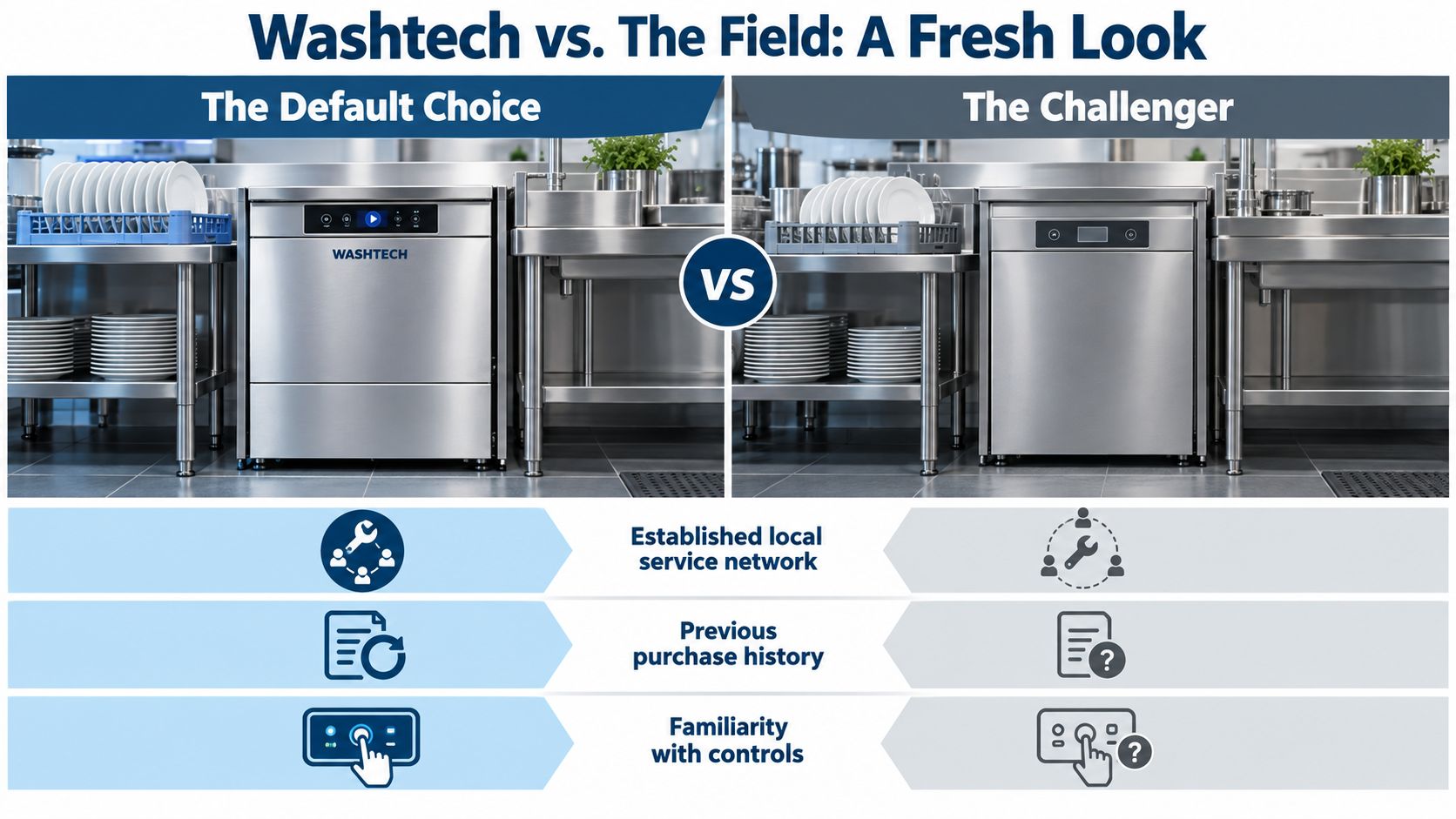
What brand familiarity really comes from
Brand familiarity is usually built by a few practical forces, not by neutral comparison.
- Established local service network. If techs already know the machine, it gets recommended more often.
- Previous purchase history. Once a venue has bought one, the next purchase often follows the same pattern.
- Familiarity with controls. Staff and managers tend to trust what they already know how to operate.
That's why a like-for-like comparison matters. A buyer should not ask only whether Washtech is well known in New Zealand, because it is. The stronger question is whether a comparable Starline, Classeq, Winterhalter, or Rhima unit offers a better balance of throughput, water use, and support for the same site.
Practical rule: if two machines can both wash the load, compare the one that is easier to support, cheaper to run, and simpler to keep compliant in the real kitchen.
The wrong habit is choosing the machine first and the operating model later. The right habit is to define the wash load, then select the machine that suits it. That avoids locking a venue into a ten-year compromise because the first quote felt familiar.
What Washtech Actually Offers in the NZ Market
Washtech's New Zealand range is broad enough that buyers should never talk about it as if it were one single machine. The company's local heritage includes the Starline range, but Washtech also sells GM and UC undercounter models, LP passthrough machines, and larger SP rack-conveyor options where fitted. That matters because the buying conversation changes completely once the machine class changes.
What the main Washtech tiers are trying to do
The undercounter lines are aimed at smaller wash-up areas where footprint matters and the staff need a straightforward cycle workflow. The passthrough range is built for higher volume and heavier service pressure, where a hood-style opening and more serious rack handling make more sense. The conveyor class is for sites where warewashing becomes a production line rather than a side task.
Washtech says the Starline range has been made in New Zealand since 1981 and engineered for New Zealand conditions and regulations, and that the Starline GLV is the latest in a series refined since 1981. Washtech also claims the GLV became New Zealand's most popular undercounter dishwasher, and says the brand supports customers with the most extensive service network and spare parts inventory in the region Starline M2 product information. Those are useful markers of local support and product maturity, but they still need to be tested against the exact model the buyer is considering.
| Washtech range | Typical use case | Headline features |
|---|---|---|
| GM and UC undercounter | Smaller cafés, bars, compact kitchens | 500 × 500 mm class footprint, simple operator workflow, suited to rack-by-rack washing |
| LP passthrough | Restaurants and venues with steady turnover | Hood-style access, higher throughput, designed for staff who need faster rack movement |
| SP rack-conveyor | High-volume kitchens and institutional sites | Continuous wash flow, larger-system planning, best suited to peak load rather than average demand |
For buyers comparing alternatives, this is the useful reference point. It helps anchor the conversation around size, wash style, and workflow rather than logo preference. For a broader supplier perspective on how these ranges are often positioned against each other, the comparison article on Winterhalter and Washtech Starline dishwasher ranges is a sensible companion read.
If the kitchen is being planned alongside other equipment, the same logic applies across the cookline. A module like the Waldorf 800 Series INL8410ECF - 900mm Induction Range Convection Oven Low Back Version shows how much site planning matters when electrical load, clearance, and service access are all part of the purchase. Dishwashing should be treated with the same discipline.
Comparing 500x500mm Undercounter Machines
A 500 × 500 mm undercounter dishwasher is where most operators begin, and it's also where brand loyalty causes the most lazy buying. The machine looks modest, but the details still matter because a small difference in cycle time or water use becomes significant when staff are clearing racks all service long. That's why equivalent models from Washtech, Starline, Classeq, Winterhalter, and Rhima should be lined up side by side before anyone signs.
What to compare first
The essentials are the same across brands. Look at cycle time, water per cycle, racks per hour, power supply, and whether the machine includes built-in dosing or expects external chemical gear. If the site is front-of-house or semi-visible, noise and operator friendliness also belong in the comparison.
The Commerce Commission says dishwashers sold in New Zealand carry WELS water-efficiency labels and must comply with AS/NZS 6400:2016 rating and labelling rules Commerce Commission water efficiency labels. That means buyers should look at certified water-use values, not vague “low water” language. The same framework is also relevant to the consumer-facing product category description WELS dishwasher labels.
| Model | Cycle time | Water per cycle (L) | Racks/hour | Power supply | Dosing |
|---|---|---|---|---|---|
| Washtech undercounter equivalent | Model-specific, varies by range | Model-specific | Model-specific | Single or three phase, depending on model | Built-in or external, depending on model |
| Starline undercounter equivalent | Model-specific, varies by range | Model-specific | Model-specific | Single or three phase, depending on model | Built-in or external, depending on model |
| Classeq undercounter equivalent | Model-specific, varies by range | Model-specific | Model-specific | Single or three phase, depending on model | Built-in or external, depending on model |
| Winterhalter UC series | Model-specific, varies by configuration | Model-specific | Model-specific | Single or three phase, depending on model | Integrated dosing options are a common consideration |
| Rhima undercounter equivalent | Model-specific, varies by range | Model-specific | Model-specific | Single or three phase, depending on model | Model-specific |
That table is deliberately cautious because the right comparison is model-to-model, not brand-to-brand in the abstract. One Washtech undercounter might suit a bar perfectly, while a Winterhalter UC model may make more sense for a site that values more advanced control logic or a tighter chemical setup. Classeq often appeals to operators who want straightforward serviceability and a clean, no-fuss operating experience.
Short version: choose the machine that matches your rack rhythm, not the one with the most familiar badge.
A useful next step for buyers is to compare the exact quote line by line. The internal guide on commercial dishwasher NZ buying considerations is worth using as a checklist so the quote doesn't hide important differences in supply, dosing, or install scope.
Passthrough Dishwashers and Higher Throughput Options
Once a kitchen starts pushing beyond simple rack-by-rack washing, the question changes. A passthrough machine is not just a bigger undercounter, it changes the entire rhythm of the wash-up area. Staff need space to sort, load, unload, and stack clean ware without blocking the door swing or creating a bottleneck at the bench.
Where the throughput jump actually matters
Restaurants with continuous turnover, banqueting venues, and institutional kitchens all feel the difference. A properly sized passthrough can keep pace without forcing staff into a stop-start workflow. That's the point where rack capacity, chamber height, and hood operation matter more than brand familiarity.
Winterhalter's PT Series deserves attention because premium buyers often care less about the cheapest entry price and more about how the system behaves under pressure. That is especially true for operators who want stronger support around ergonomics, wash quality consistency, and better planning around the warewashing line. The product page for the Winterhalter PT Series pass-through dishwasher is a natural benchmark when that is the sort of buying conversation underway.
Practical takeaway: passthrough decisions usually fail when the kitchen layout is ignored, not when the machine badge is wrong.
Classeq also belongs in the comparison set because its larger hood-lift machines give buyers another sensible reference point for mid-volume work. Starline front-loading passthroughs suit some New Zealand kitchens well when the install is tight and the operation values a simpler service footprint. Rhima should sit on the list too, particularly for operators who want to compare a different service structure and equipment philosophy.
The key is not to compare a passthrough against an undercounter and call the larger one “better”. The comparison is whether the venue needs a hood-style machine, a single-tank setup, a more advanced system, or a conveyor path. If the daily load is still modest, oversizing only adds cost and complexity.
Water, Energy and Chemical Systems Compared
Running cost hides in small differences. A wash cycle that looks similar on paper can behave differently once it is repeated all day, every day, in a real kitchen with staff pressure, mixed soil loads, and variable water quality. That is why the cheapest quote is not the same thing as the cheapest machine to own.
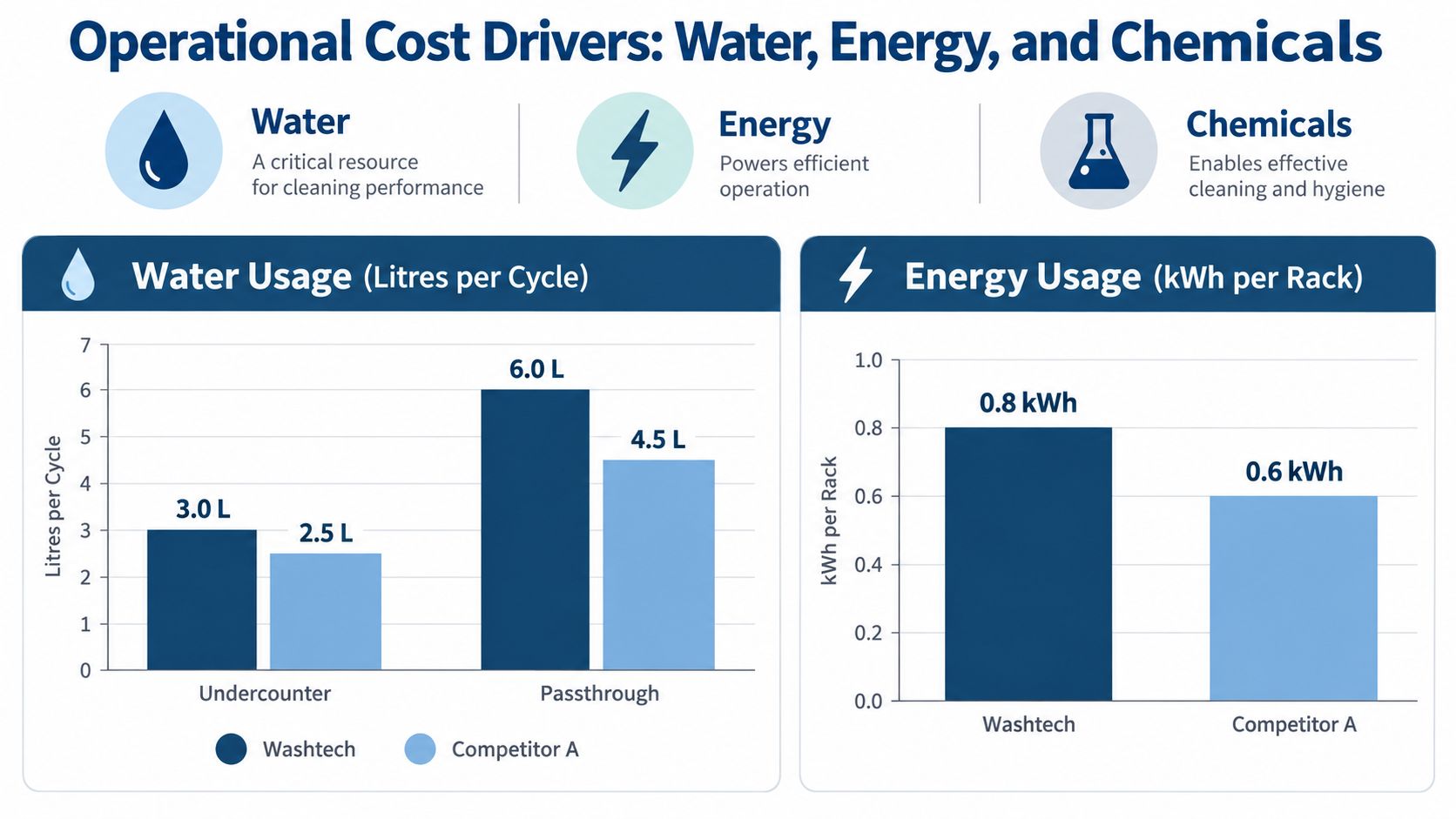
Why the operating mix matters more than the brochure
Water use and rinse temperature influence how hard the chemicals have to work. New Zealand food hygiene rules require utensils to be scraped clean, washed in water at not less than 60°C, then rinsed for not less than 10 seconds in clean water at not less than 77°C Food Hygiene Regulations 1974. That's not just a compliance note, it's a buying filter. If the machine can't reliably support the wash-and-rinse process, it isn't the right machine.
Auckland Council's service guidance also says commercial dishwashers must be supplied with water at suitable volume, pressure, and temperature Auckland Council service guidance referenced in dishwasher water calculator. That makes hot-water capacity and plumbing design part of the ownership conversation, not an afterthought. A machine with a smart spec sheet can still underperform if the site can't feed it properly.
The comparison should include these points:
- Water per cycle. Lower consumption is useful only if wash quality stays consistent.
- Chemical dosing. Integrated systems are easier to manage when staff turnover is high.
- Temperature recovery. Final-rinse performance depends on the machine and the site together.
- Programme discipline. The operating programme has to match the same testing logic used for water-efficiency comparison.
For a broader explanation of how site water conditions affect real dishwasher behaviour, the internal note on how water quality affects dishwasher performance is worth a look.
There's also a good consumer analogy here. People trying to understand appliance load often check household electricity use guidance, but a commercial dishwasher is not a home appliance with a neat, fixed pattern. In hospitality, every cycle is tied to a workflow, a sanitation target, and a chemical regime. That's why total cost per rack matters more than a tidy brochure number.
Service Support, Parts and Total Cost of Ownership
A dishwasher's real test starts after the install. The warranty period is only the opening chapter, and the expensive failures usually come later, when a site needs parts quickly and a tech who knows the machine. Buyers should treat support structure as part of the product, not a bonus.
What to ask before signing
The first question is who services the equipment locally. The second is whether parts are available in a timeframe that won't wreck the service run. The third is what support looks like once the warranty ends, because that is where many venues get caught out.
Washtech says it backs its dishwashers with a 15-year parts availability guarantee and that the range is engineered for New Zealand conditions Washtech home page. That is a useful reassurance for long-life planning, but it should still be tested against the exact machine and the local service path. Starline and Classeq often sit in overlapping dealer networks, while Winterhalter's support model is more premium and specialist in feel, and Rhima tends to rely on specialist distributors.
Good buying question: if a pump, wash arm, or dosing component fails in year six, who carries the part, who fits it, and how quickly can service get the site running again?
The internal note on commercial dishwasher maintenance is useful because maintenance discipline changes the ownership cost as much as the model choice does. A machine that gets cleaned, descaled, and checked properly will generally create fewer surprises than one that is left to drift.
Total cost of ownership should include:
- Purchase price.
- Water, power, and chemical consumption.
- Service visits and callouts.
- Parts replacement over time.
- Labour impact when the machine is down.
That last item is often the most expensive, because a wash-up bottleneck affects the whole kitchen. A lower-priced unit can become the costlier choice if it is harder to service or if parts are slow to obtain.
Installation and Kitchen Integration Considerations
A dishwasher only performs well if the site is ready for it. That sounds obvious, but many installations fail because the machine was chosen before the plumbing, power, and ventilation were checked. The brand matters less than the infrastructure when the install is incomplete.
The site checks that should happen first
Power is the starting point. Some undercounter machines use single-phase power, while larger units may need three-phase supply, so the switchboard and circuit capacity have to be confirmed early. Hot water is the next issue, because passthrough machines often need a dedicated supply at about 55 to 65°C, and the system has to recover quickly enough during service.
Drainage and ventilation are just as important. Undercounter machines often sit into existing sink runs, while passthrough models usually need a floor waste, a proper drain line, and enough extraction nearby to deal with steam. Clearances matter too, because door swing, chemical storage, and service access can all be compromised by a tight corner.
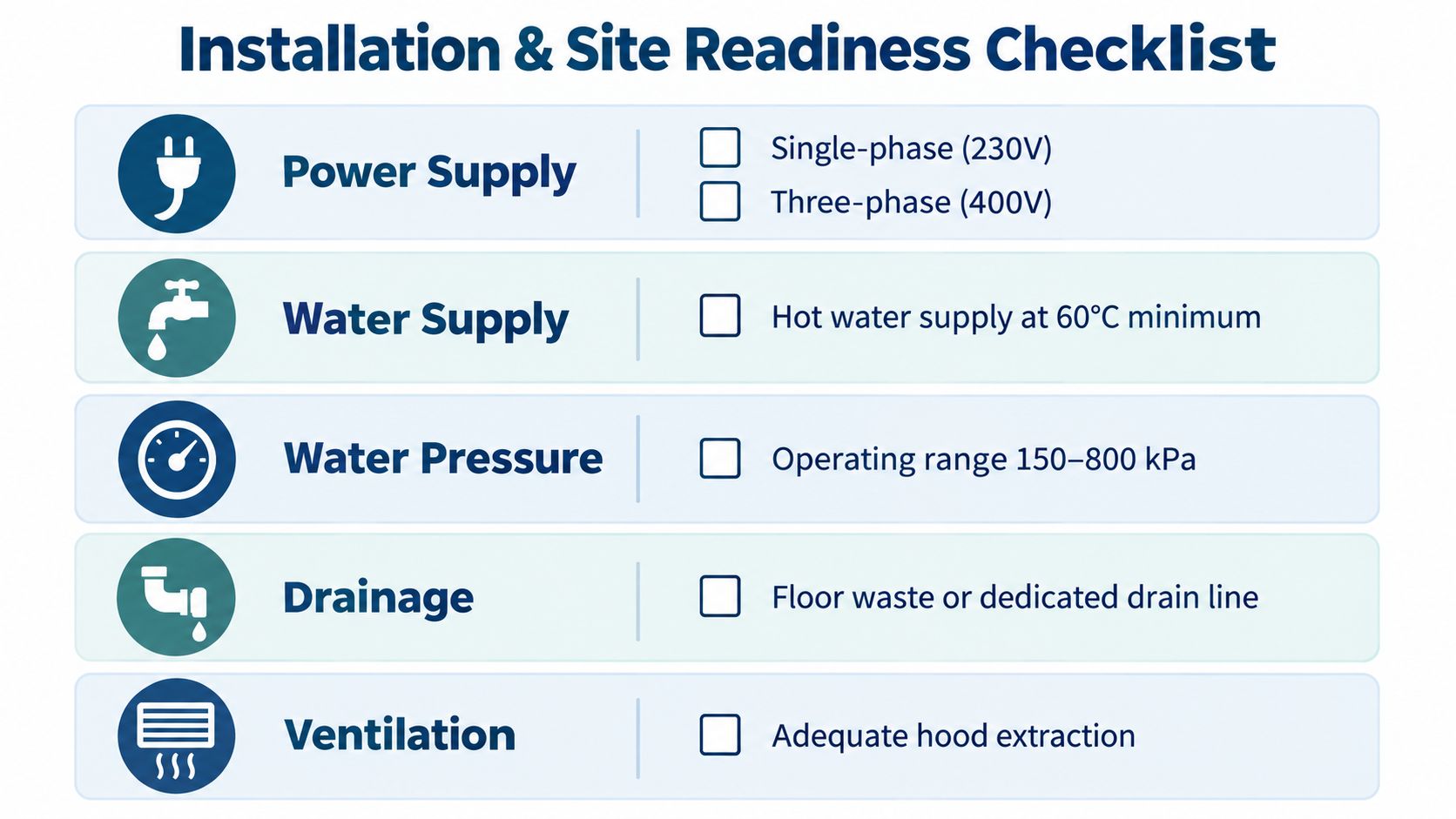
Site details that get missed
A few small things cause repeated problems in live kitchens.
- Bench depth. If the machine overhangs the run, loading becomes awkward and unsafe.
- Door and rack travel. Corner placement can block movement and slow the room down.
- Isolation access. Staff need to reach shut-off points quickly during a fault.
- Water quality protection. Water hammer arrestors and softeners help protect equipment in hard-water areas.
For operators planning a broader kitchen refit, it helps to think in terms of workflow rather than just equipment replacement. A site with a machine upgrade often also needs plumbing changes, bench adjustment, or extraction work, which is why practical bathroom and kitchen remodeling guidance like bath and kitchen remodeling help can be useful when the physical space needs attention as well.
The cleanest install is the one that looks almost boring after commissioning. That's usually because the machine, the plumbing, the power, and the room layout were matched before the order was placed.
Matching the Right Machine to Your Venue
The right machine class depends on how the venue works, not on what seems standard in the industry. A quiet café, a busy restaurant, and a high-volume institutional kitchen are not buying the same tool, even if they all wash plates. That is why the machine should be matched to covers, service shape, and staffing, not to brand comfort.
Venue type is the fastest way to narrow the field
A 60-seat café running around 80 to 120 covers per service usually needs a single 500 × 500 mm undercounter machine, possibly with a glasswasher beside it. A 150-cover restaurant with continuous turnover tends to benefit more from a passthrough machine, especially when the dish-up area needs clean rack flow. Bars and boutique accommodation often suit compact glasswashers or undercounters with short cycles, while institutional kitchens, conference centres, and high-volume accommodation should look at conveyor or rack-transport systems sized for peak demand.
| Venue Type | Typical Covers/Service | Recommended Class | Key Consideration |
|---|---|---|---|
| Small café | Moderate daily covers | 500 × 500 mm undercounter | Footprint and speed at peak |
| Mid-size restaurant | Continuous service turnover | Passthrough dishwasher | Rack flow and operator space |
| Bar or boutique accommodation | Lower food load, higher glassware focus | Compact glasswasher or undercounter | Glass handling and quiet operation |
| Institutional kitchen | High and sustained volume | Conveyor or rack-transport system | Peak demand, not average demand |
One factor to keep in mind is change. Menus shift. Glassware use changes. Bakeware load increases. A machine that feels adequate now can become awkward if service grows or if the dish mix becomes heavier. That is why a 60-second option can matter in one venue, while another can live comfortably with a longer programme if the staffing and bench flow are well designed.
Rule of thumb: buy for the work the kitchen does at peak, not for the quietest hour of the day.
Service proximity and chemical supply reliability should weigh heavily too. A machine is only as useful as the support behind it, and that is where the comparison between Washtech, Starline, Classeq, Winterhalter, and Rhima becomes practical rather than theoretical.
If a venue is comparing a Washtech dishwasher against Starline, Classeq, Winterhalter, or Rhima, Simply Hospitality can help line up the specifications and narrow the choice to what suits the kitchen. Visit Simply Hospitality to compare models, check support options, and get a recommendation based on the way the machine will be used.