


What Makes Award Appliances Popular in Semi-Commercial Environments?
A lot of operators are in the same position. The kitchen isn't domestic, but it also isn't running like a restaurant line all day. It might be a staff room serving lunch rushes, a church hall used hard on weekends, a sports club kitchen before and after games, or a small accommodation property handling breakfast service and occasional functions.
That's where the question of what makes Award Appliances popular in semi-commercial environments becomes practical rather than theoretical. The appeal usually isn't about buying “less commercial” equipment. It's about matching each appliance to the workload it handles, the available space, the electrical setup, and the people who'll use it.
Not every non-residential site needs heavy-duty commercial equipment. New Zealand hospitality sales reached NZ$15.7 billion in the year ending March 2024, up 5.8%, while venue numbers rose only 0.1%, which helps explain why smaller, high-usage kitchens are looking for dependable and flexible equipment choices in the first place, as noted in the Restaurant Association hospitality report. In lower-demand workplaces and community settings, selected Award appliances can make sense when the duty is right. The key is to assess each appliance on its own merits, not label the whole kitchen domestic or commercial and hope for the best.
How Award Appliances Fit Semi-Commercial Environments
A semi-commercial kitchen usually sits in the middle ground between home use and full restaurant production. It may be in an office, school staffroom, marae, sports club, community hall, motel unit block, or function space. The volume can be modest most of the day, then spike sharply when everyone wants service at once.
That pattern is why Award often comes up in buying discussions. The brand can suit environments where operators need practical kitchen capability without automatically stepping into larger, heavier, fully commercial equipment with bigger service and infrastructure demands.
Where the fit is strongest
The strongest fit is usually in sites with light to moderate duty, such as:
- Office and workplace kitchens where food prep is simple and the users change frequently
- Staff rooms that need cooking capacity beyond a basic household setup
- Sports clubs with concentrated pre-game and post-game use
- Churches and community facilities that host periodic meals, events, and fundraisers
- Smaller accommodation properties handling breakfast, reheating, or light meal preparation
- Meeting and function spaces where equipment may sit quiet for hours, then work hard for a short window
A common issue seen in these sites is buying by room type instead of workload. A “commercial kitchen” in a low-demand facility might not need full restaurant-duty ovens or cooktops. At the same time, a modest-looking space can still need a proper commercial dishwasher if crockery arrives in one concentrated rush.
Practical rule: The important distinction is lower duty, not smaller premises.
Why popularity often comes down to practicality
Award appliances are often popular in these environments because they can offer a workable middle ground. Many operators want equipment that feels familiar to use, fits conventional spaces, and doesn't force the site into unnecessary upgrades or oversized capacity.
The better buying sequence is simple:
application → peak usage → consecutive use → appliance specification → warranty suitability
That approach avoids two common mistakes. One is underbuying with household equipment that won't tolerate repeated workplace use. The other is overbuying with full commercial equipment that costs more, takes more room, and may ask for services the site doesn't have.
For readers weighing that middle ground more broadly, the article on domestic, semi-commercial and commercial equipment differences is a useful companion.
Understanding Semi-Commercial Duty Levels
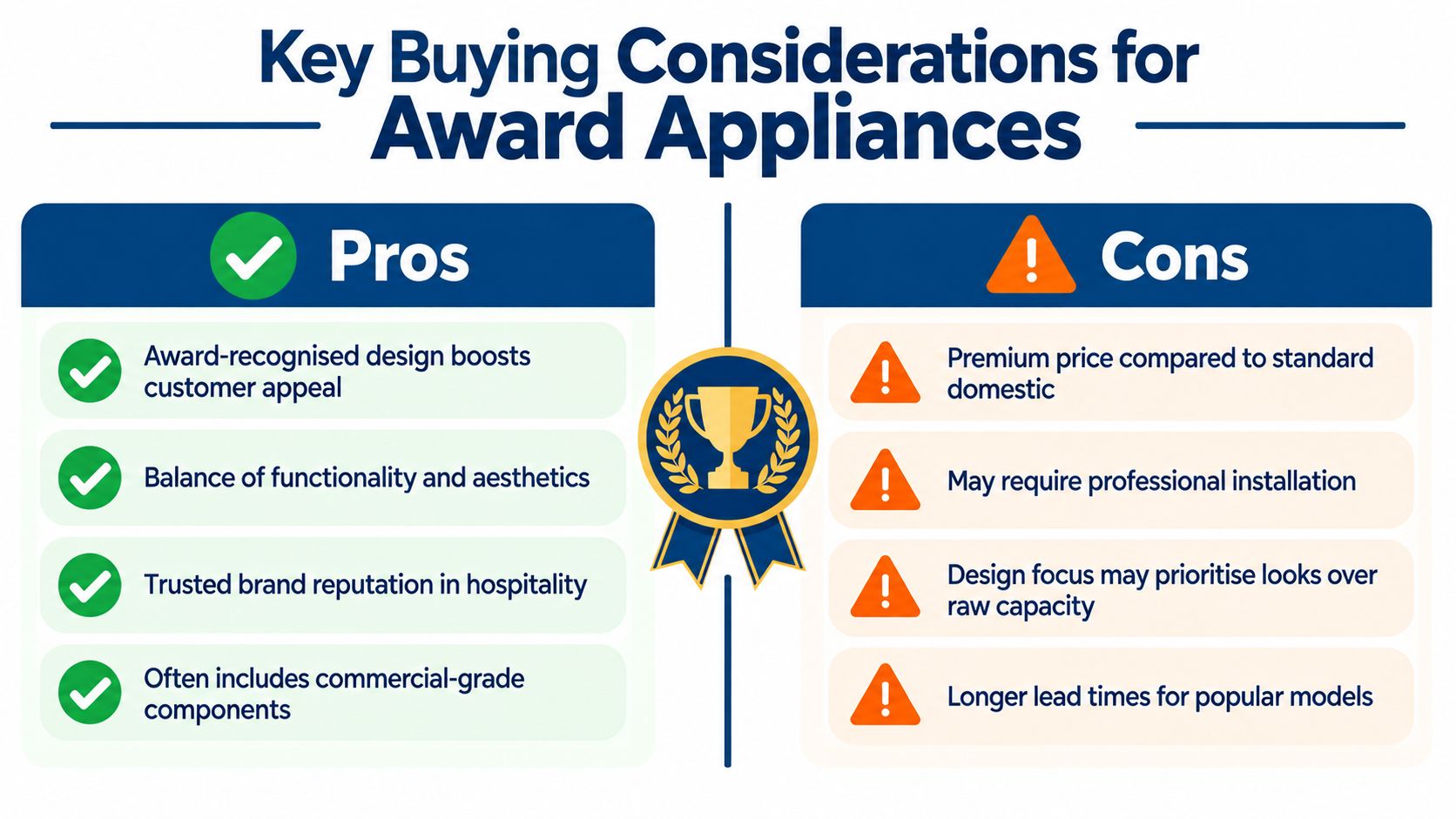
“Semi-commercial” sounds clear until it's tested against an actual service pattern. In practice, it isn't a universal technical classification. The more useful question is whether a specific appliance is suitable for the intended duty, installation conditions, and warranty terms.
Duty isn't about daily averages
A kitchen can look quiet on paper and still overload an appliance. What matters is the busiest period, not the calmest one.
An office kitchen may only use an oven for a short lunch window. A church kitchen may sit idle during the week and then handle back-to-back trays during an event. A motel breakfast room may use refrigeration steadily but only need light cooking. Those are different duty profiles, even if the room size looks similar.
A practical assessment should cover:
- User numbers during the busiest period
- Consecutive runs without long cooling or recovery breaks
- Event frequency if functions create irregular spikes
- Food type because reheating, baking, and batch cooking place different demands on equipment
- Failure consequences if service stops at the wrong time
Appliance by appliance is the right method
One consideration regularly discussed with customers is that a kitchen doesn't need to be all one thing. It's often a mix.
| Appliance type | Lower-duty site question |
|---|---|
| Oven or cooktop | Will it handle the busiest hour without constant recovery issues? |
| Dishwasher | Will one rush of dishes overwhelm the machine? |
| Refrigeration | Can it maintain stable temperature with repeated door openings? |
| Rangehood | Is ventilation suitable for the actual cooking load? |
That's why the most useful habit is to specify the duty level of each appliance independently. An Award oven or cooktop may be suitable for light workplace cooking, while dishwashing demand, extraction, or refrigeration stability may justify stepping into a fully commercial option.
The wrong choice usually happens when buyers classify the room once and stop thinking.
Key Buying Considerations for Award Appliances
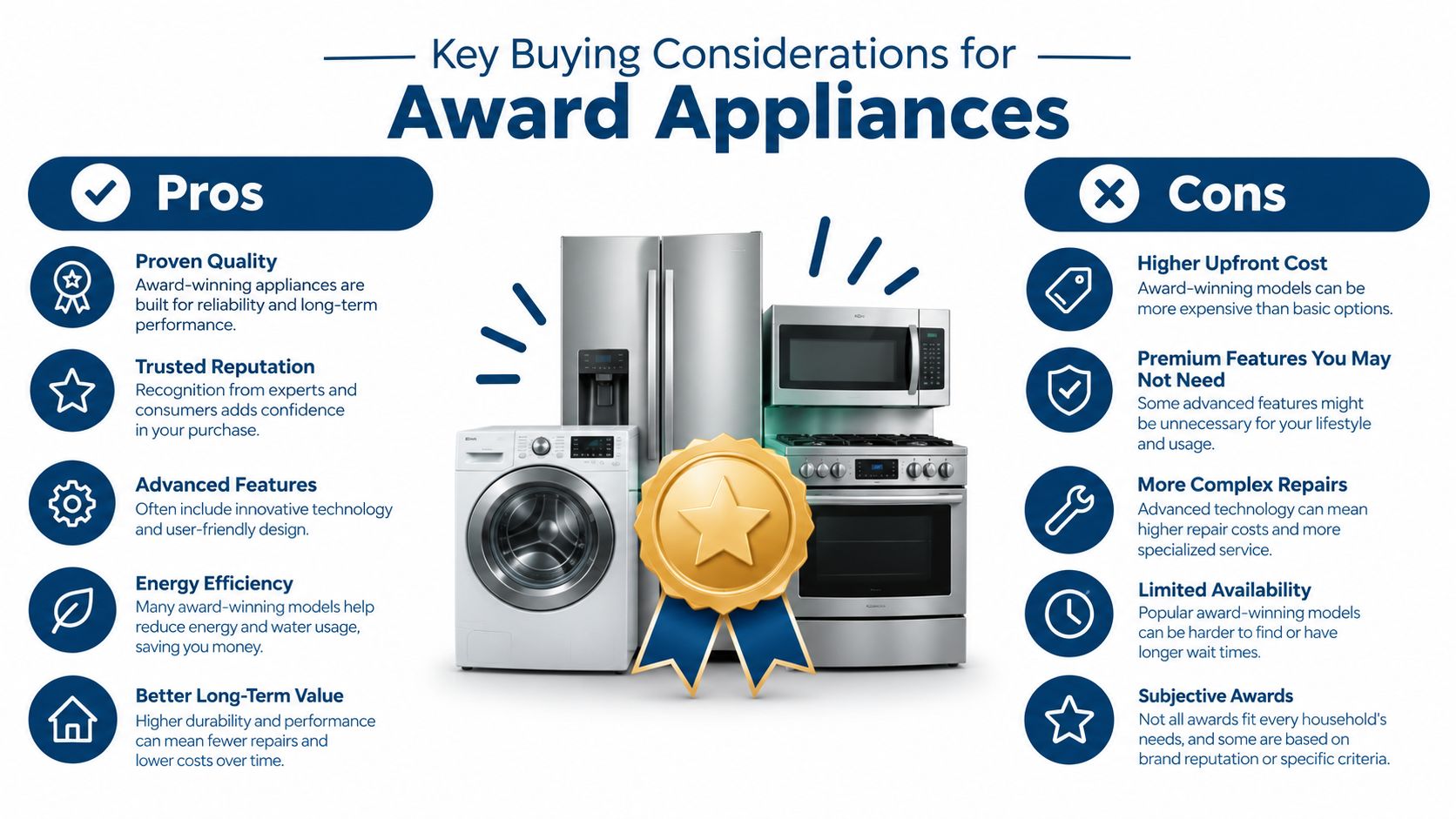
Popularity isn't created by an award badge on its own. In semi-commercial settings, operators usually choose an appliance because it solves practical operating problems without adding unnecessary complexity.
Usability matters when many people touch the equipment
MBIE reports that hospitality employment in New Zealand grew 7.3% in 2023 while venue numbers barely moved, which helps explain why operators place real value on intuitive, labour-efficient equipment that needs less specialised training, as outlined in the MBIE hospitality and tourism employment report.
That matters in semi-commercial spaces even more. Staff rooms, clubs, and community facilities often have mixed users, changing volunteers, or general staff rather than trained kitchen teams.
The useful features are usually straightforward ones:
- Clear controls that don't rely on specialist knowledge
- Conventional dimensions that fit existing joinery or benches more easily
- Simple cleaning access for day-to-day upkeep
- Practical functions that cover common tasks without unnecessary complexity
The buying filters that actually matter
Many operators choose Award because the balance can work well, but the buying decision still needs discipline. A common issue seen is focusing on headline capacity and ignoring how the appliance will behave on site.
Key checks include:
- Footprint and clearance because compact units often work better in lower-demand sites with limited bench space
- Energy performance because operating cost matters long after purchase
- Cleaning time because awkward interiors, seals, or trays increase labour exposure
- Recovery and consistency because occasional heavy bursts can be more punishing than steady light use
- Workflow fit because simple operation matters when many different people are involved
For operators reviewing common buying errors across all equipment types, the guide to the biggest equipment buying mistakes is worth reading.
A compact appliance that's easy to train, clean, and reset often delivers better value than a larger model whose extra capacity never gets used properly.
Matching Award Models to Low Demand Kitchens
The most practical way to assess Award is by venue example, not by broad category labels. Semi-commercial sites rarely need every appliance at the same duty level.
Workplace and staff room setups
A workplace kitchen may reasonably use an Award oven or cooktop where the actual demand is light cooking, reheating, or simple meal service. In that setting, familiar controls and everyday usability are often more important than the feature depth expected in a restaurant line.
A staff room can also suit compact refrigeration or smaller cooking appliances where the load is predictable and spread across the day. What matters is whether the appliance can handle the busiest lunch window without recovery problems or poor temperature control.
Clubs, churches, and community facilities
Sports clubs and churches often have the opposite pattern. They can be quiet for long periods, then very busy around events, gatherings, and service peaks. That makes concentrated demand the true test.
An Award cooking appliance may still be a sensible fit if the cooking programme is modest. The dishwasher may not be. If plates, cups, and servingware arrive all at once, that station often needs a more purpose-built commercial answer than the cooking side does.
The broader planning issues for these venues are covered well in the article on appliance considerations for sports clubs and community organisations.
Small accommodation and function spaces
Smaller accommodation properties often need dependable refrigeration and light cooking rather than production kitchen output. The right solution depends on whether the kitchen is supporting guest self-catering, breakfast preparation, or occasional functions.
Meeting spaces and function rooms also need careful separation of duties. A low-demand room may justify selected Award appliances for periodic use, but if event turnover is tight and service continuity matters, buyers should move quickly to fully commercial equipment where throughput, durability, or downtime risk demands it.
One practical option operators can review is the Award Appliances collection. The useful approach is to assess each model against workload, intended use information, and installation requirements rather than assuming the whole range suits every non-residential kitchen.
Ensuring Compliance and Infrastructure Readiness
A good semi-commercial fit is not decided by the spec sheet alone. Many buying decisions go wrong at installation stage, once operators discover the room, services, or access path do not suit the appliance they chose.
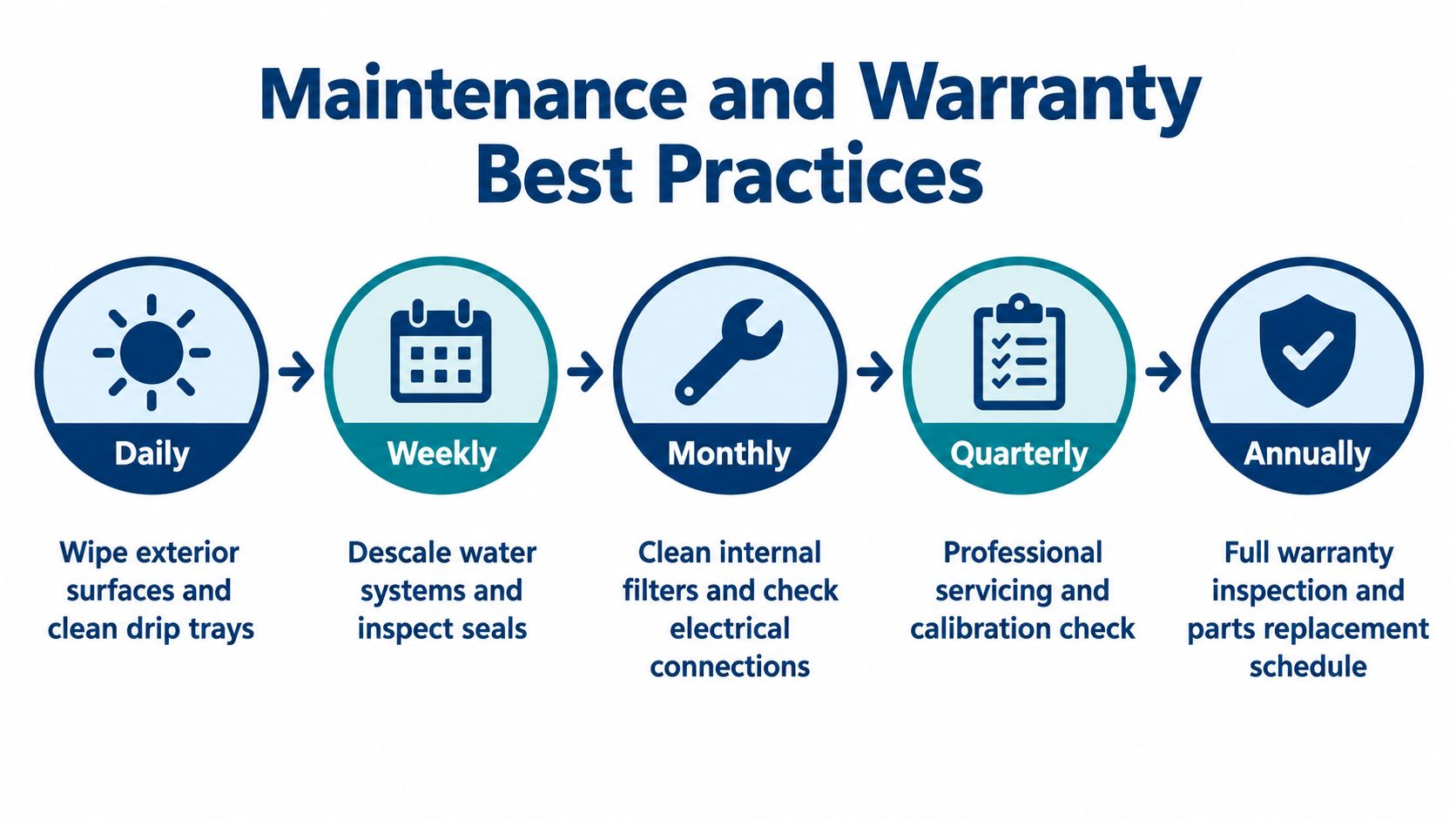
In semi-commercial venues, Award appliances often appeal because they can work within lighter infrastructure than full commercial equipment. That advantage only holds if the actual duty and site conditions line up. A staff kitchenette, club servery, small lodge breakfast room, or function prep area can all look similar on paper, but power supply, ventilation, drainage, and bench capacity often differ in ways that matter once service starts.
The checks that should happen before ordering
WorkSafe New Zealand states that certain appliances require a Supplier Declaration of Conformity before sale, which makes compliance checks part of the buying process for semi-commercial equipment, as set out in the WorkSafe high and medium risk product guidance.
Before ordering, confirm:
- Electrical requirements for the exact model, including load and connection type
- Plug and socket suitability rather than assuming a standard wall outlet will do
- Installation instructions and whether a qualified electrician or plumber is required
- Ventilation and clearance needs around cooking appliances and rangehoods
- Plumbing or drainage requirements where relevant
- New Zealand compliance documentation before purchase
The practical risk is straightforward. A light-duty kitchen may have limited circuits, older switchboards, or shared power loads with urns, fridges, and dishwashers. I regularly see sites choose an appliance that suits the menu but not the available supply, then spend more on electrical upgrades than they expected. Operators comparing imported or commercial-looking units should also review the broader principles in electrical equipment safety standards explained in Australia, especially where local installation assumptions are unclear.
Layout and safe handling are part of the decision
Semi-commercial rooms are often multi-use spaces. The same bench may handle prep in the morning, service at lunch, and cleaning stock in the afternoon. That changes what matters.
Ask a few blunt questions early:
- Can one person move it safely, or is a trolley needed?
- Is bench height suitable for loading and unloading?
- Are cleaning points easy to reach without awkward lifting or twisting?
- Can the appliance be isolated safely for cleaning or maintenance?
- Will door swings, lids, or trays interfere with adjacent equipment or walkways?
Manual-handling issues are easy to overlook with smaller appliances, especially in venues where volunteers, casual staff, or mixed-experience teams use the kitchen. Weight, grip points, and cleaning access all affect whether the unit will be used properly over time. A model that is fine for occasional supervised use can become a poor choice if staff need to shift it for every service or store it off-bench between functions.
Ventilation is another common miss. Even modest cooking loads can create heat and grease that the room was never designed to manage. Anyone assessing extraction should compare the appliance output with hood position, make-up air, and cleaning access, then review what to know about a kitchen exhaust hood before signing off the layout.
Maintenance and Warranty Best Practices
The difference between a reliable semi-commercial appliance and a frustrating one is often maintenance discipline. Lower-demand sites sometimes neglect this because the equipment doesn't look like “serious” kitchen machinery. That's a mistake.
What should happen routinely
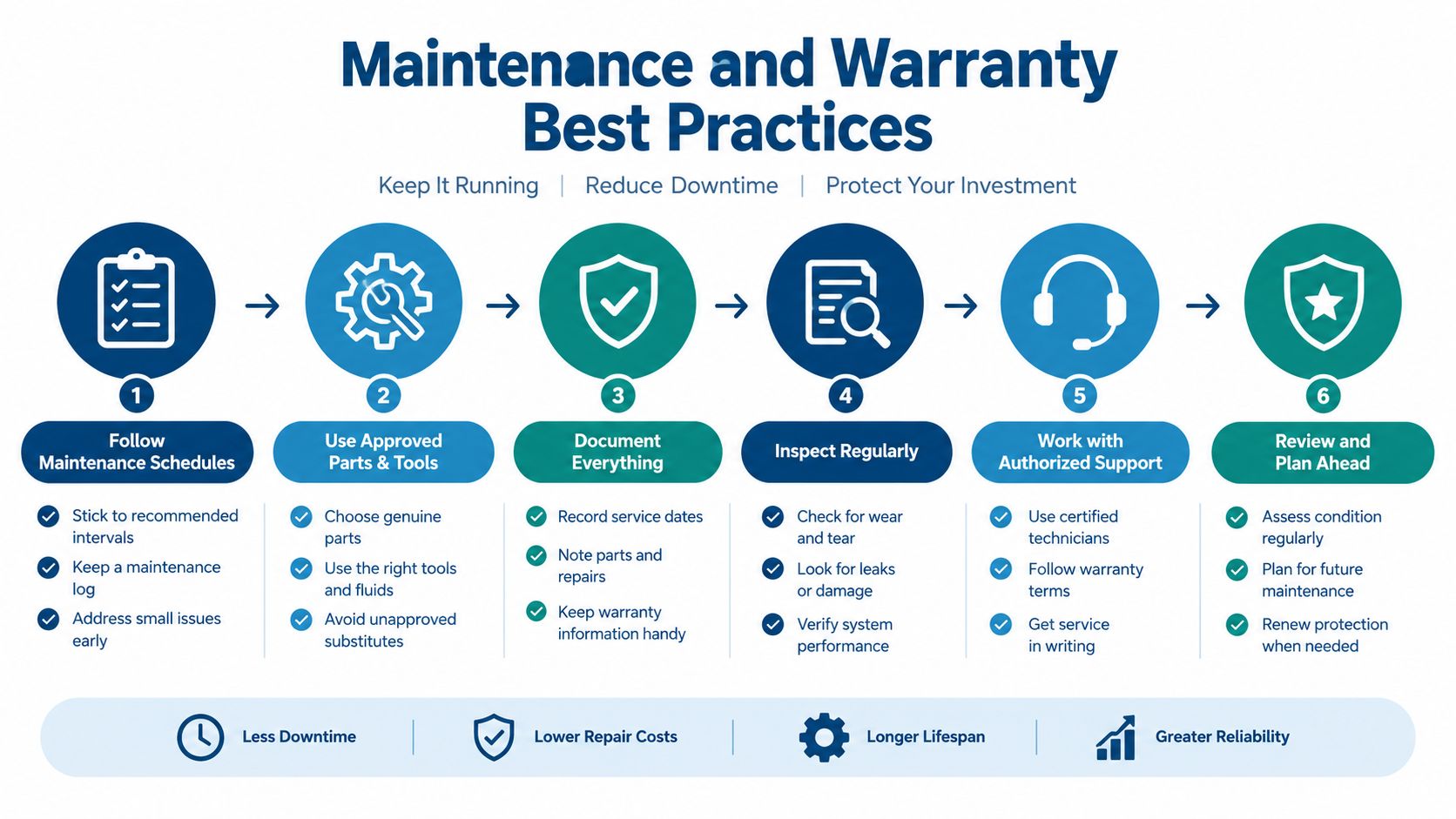
New Zealand's hospitality energy-efficiency checklist recommends annual thermostat calibration and seal inspections to maintain temperature stability and reduce food safety risk, as outlined in the hospitality energy efficiency checklist.
A practical routine includes:
- Daily cleaning of contact surfaces, trays, and spills before residues harden
- Weekly checks of seals, hinges, filters, and removable components
- Monthly review of temperature accuracy, unusual noise, and visible wear
- Scheduled servicing based on manufacturer guidance and actual use conditions
Warranty only helps when the appliance is used correctly
A common issue seen with semi-commercial equipment is buyers assuming the whole range shares identical warranty conditions. It doesn't. Warranty coverage, exclusions, intended use, and installation expectations can vary by product.
That's why operators should keep:
- Proof of correct installation
- Service records
- Cleaning records for high-use appliances
- Model and serial information in an asset register
Good maintenance protects more than the appliance. It protects service continuity.
Where a site also depends on heating, cooling, or related building systems, facility teams sometimes find it useful to compare their kitchen maintenance mindset with broader building upkeep practices such as commercial AC maintenance. The categories differ, but the principle is the same. Preventive care is easier to manage than unexpected failure.
Balancing Cost Benefit and Long Term Ownership
The cheapest appliance on day one isn't always the lowest-cost choice over time. In semi-commercial settings, the true cost sits across purchase price, running cost, usability, downtime risk, maintenance effort, and whether the appliance is being pushed beyond its intended duty.
Purchase price is only one part of the equation
Award can represent a useful middle ground when the application is a good fit for the appliance. The buying comparison should look like this:
purchase price + required performance + workload suitability + warranty + installation + expected operational needs
That's a better framework than just asking whether one option is cheaper than full commercial equipment. An inexpensive model used beyond its intended duty can create more disruption than value.
Energy and downtime have to be part of the discussion
EECA reports that refrigeration and cooking account for 37% of energy use in New Zealand food-service, which is why accurate efficiency information matters when comparing total cost of ownership, as shown in the EECA food and beverage service sector pathway.
That matters most when comparing:
- A slightly better-specified model that may hold temperature more consistently
- A larger appliance that's underused most of the time
- A cheaper unit that may create more labour through slower operation or harder cleaning
- A fully commercial model whose extra capacity may never be needed
Many operators choose equipment that's slightly above average demand but still close to the actual workload. That can make sense. Oversizing too far often wastes space, utilities, and purchase budget.
For a broader discussion of long-term ownership thinking, the article on buying cheap versus buying once is a helpful reference.
Next Steps for Choosing Award Appliances
The strongest reason Award appliances become popular in semi-commercial environments is simple. They can fit a workload that's too demanding for ordinary household use, but not demanding enough to justify full restaurant-grade equipment everywhere.
The practical shortlist
Before choosing any model, operators should confirm:
- Actual application rather than the label on the room
- Peak demand during the busiest hour
- Consecutive use expectations during events or rushes
- Electrical, ventilation, and installation requirements
- Intended use and warranty suitability for that specific appliance
- Whether another station in the same kitchen needs a higher-duty commercial option
When to move to full commercial equipment
Award won't be right for every project. A fully commercial solution is usually the better fit where there is continuous cooking, high dishwasher throughput, large batch production, heavy consecutive use, or where downtime during service would create major disruption.
That balanced approach is what usually leads to better outcomes. The right solution depends on matching each appliance to the actual duty cycle, not buying by assumption or appearance alone.
If a workplace kitchen, club, staff room, church facility, accommodation site, or function space is being planned or upgraded, a proper appliance-by-appliance review will usually save more trouble than a blanket domestic-versus-commercial decision.
Hospitality helps New Zealand operators compare equipment by workload, installation requirements, and day-to-day practicality, including situations where selected Award appliances may suit a semi-commercial environment and where a full commercial step-up is the safer option. For advice on ovens, cooktops, dishwashing, refrigeration, ventilation, and fit-for-duty equipment selection, visit Simply Hospitality.