

Wholesale Glassware NZ: A Buyer's Guide for Hospitality
The most common advice on wholesale glassware NZ is to compare the price per glass and choose the cheapest carton that looks acceptable. That approach misses the commercial decision. Hospitality operators need to judge replacement availability, range continuity, warewashing suitability, storage, breakage exposure and customer impact before committing to a large order.
In practice, New Zealand buyers need to think beyond the opening order. Many hospitality glassware ranges are imported, so lead times, freight costs and local stock depth can all affect how quickly a venue can replace breakages or top up a popular line. That matters far more than saving a small amount on the first carton if the range becomes hard to reorder later.
That is especially relevant in hospitality, where glassware moves constantly through service, clearing and warewashing. Restaurants, bars, cafés, hotels and event operators all need ranges that can handle daily use while staying consistent enough to support presentation across wine, beer, water and cocktails. Hospitality New Zealand's State of the Nation report
Why Wholesale Glassware Is More Than a Per-Glass Price
A cheaper glass isn't automatically a cheaper glassware decision. A venue that saves on the initial carton but struggles to replace missing pieces, loses matching stems or removes fragile items from service may spend more across the working life of the range.
The commercial question is simple: what will this glass cost the venue each time it passes through service? That includes the purchase price, freight, storage, washing, polishing, handling, breakage and the time required to source replacements. A premium glass can be poor value in a high-impact application if it doesn't suit the venue's racks or wash process. An everyday tumbler can be the right answer for fast, repetitive service if it remains readily available.
Evaluate the operating cycle
A glass passes through more hands and systems than most operators first consider. It is selected behind the bar, filled, carried to a table, cleared, scraped, washed, dried, stored and returned to service. Each stage creates a different requirement.
Commercial buyers should assess:
- Range continuity: Can matching pieces be reordered later, or will the venue be forced into a mixed set?
- Replacement availability: Can a carton be sourced when breakages occur during a busy period?
- Warewashing fit: Does the height, bowl shape and rim tolerate the venue's racks and commercial dishwasher?
- Storage efficiency: Can the range be stored safely without overcrowding shelves or creating unstable stacks?
- Service role: Does the glass justify its specification for the beverage it carries?
Practical rule: The real wholesale advantage isn't getting a lower price on a large opening order. It's knowing the venue can still replace the glasses that eventually disappear or break.
Freight and minimum order quantities matter particularly in New Zealand, where supply routes and regional delivery arrangements can affect the economics of a reorder. Operators comparing purchasing formats can also review wholesale portable kits when broader event or mobile-service requirements sit alongside glassware planning.
For a practical local overview of selection, handling and commercial use, the commercial glassware NZ guide provides useful context. The key decision remains the same: glassware is an operating cost line, not a one-off décor purchase.
Matching Glassware Types to the Drinks You Actually Serve
A glassware package should begin with the beverage list, not a catalogue. Operators should identify what the venue pours, where it is served and how quickly it moves before selecting shapes and quantities.
A restaurant with a serious wine list needs a different stemware mix from a pub focused on beer and spirits. A cocktail bar needs shapes that support presentation and garnish clearance, while a café may need dependable tumblers that survive constant washing and quick handling.
| Glassware Type | Beverage / Use | Service Setting |
|---|---|---|
| Red wine bowl | Fuller reds, aromatic service and table presentation | Restaurants, wine bars and tasting rooms |
| White wine stem | Cooler white and sparkling wine service | Restaurants, cafés and functions |
| Flute | Sparkling wine and celebratory pours | Events, hotels and cocktail service |
| Universal stem | Mixed wine lists where one versatile shape is preferred | Restaurants, cafés and accommodation |
| Water tumbler | Still or sparkling water, with stemmed or stemless formats | Table service and casual dining |
| Highball | Spirits with mixers, soft drinks and long cocktails | Bars, restaurants and event service |
| Lowball | Neat spirits, short cocktails and smaller mixed drinks | Bars, lounges and premium service |
| Beer glass | Pint, schooner, tulip, weizen or pilsner service | Pubs, bars, restaurants and beer venues |
| Carafe or decanter | Table-side water, wine service or decanting | Restaurants, hotels and functions |
| Cocktail glass | Signature cocktails and presentation-led drinks | Cocktail bars and premium beverage menus |
Map the menu before the range
Red wine generally benefits from a larger bowl that gives fuller styles room, while white wine stems usually use a more restrained aperture for cooler service. Flutes suit sparkling wine, but a venue with a varied list may prefer universal stems to reduce storage complexity.
Highballs and lowballs should reflect the actual spirit-and-mixer programme. Beer glasses need to match the venue's pour style and brand presentation, not just fill a shelf. Carafes and decanters also need a clear service purpose because their slower turnover and larger footprints affect washing and storage.
Specialty cocktail glasses deserve scrutiny. A dramatic shape can support a signature serve, but it shouldn't be introduced if the venue lacks a safe storage location or can't wash it reliably. A useful adjacent storage option is the Mepal Cirqula Rectangle 1000ml Nordic White, a 1000 ml BPA-free polypropylene bowl with a flexible TPE-sealed window lid designed for storing, reheating and serving meal preparation or a standard leftover portion in a rectangular format.
For event operations, bottle handling and service logistics can also be considered alongside the venue's glassware workflow through resources such as Forever Party Rentals bottle knockdown. Operators looking for broader selection guidance can refer to drinking glasses and glassware advice.
Premium Versus Everyday Ranges Across the Hospitality Catalogue
Premium and everyday glassware shouldn't be treated as competing answers for the whole venue. They solve different operating problems.
Stölzle deserves serious consideration when a venue wants premium presentation, a refined rim and a balanced feel for wine or cocktails. Its ranges, including the increasingly popular Kyoto collection, suit operators who want contemporary presentation without specifying the same premium tier for every service position. Zwiesel, Luigi Bormioli, Pasabahçe and Ocean also give buyers room to build a package across different price points and beverage applications.
Put premium where guests notice it
Premium specification earns its place when the glass is part of the customer's perception of the drink. Wine stems, cocktail glasses, champagne glasses and selected spirits glassware sit directly in that zone. Bowl shape, optical clarity, rim finish and balance can all contribute to how a beverage is presented and handled.
Everyday commercial glassware is usually more sensible for high-volume water service, house beer, soft drinks, busy bar work and outdoor settings. The priority there is consistent availability, practical durability and easy warewashing. Premium glassware can be wasted when it is used for a drink that turns quickly and receives little customer attention.
A venue should also separate premium presentation from fragility. A thin rim may look and feel elegant, but the range still needs to suit the dishwashing process, storage method and staff handling routine. The wine glasses NZ selection guide is useful when the beverage programme requires more deliberate stemware choices.
The strongest package often combines ranges. A restaurant might choose Stölzle Kyoto for selected wine and cocktail service, a practical tumbler for water and a durable beer glass for the bar. That layered approach protects the budget while giving premium beverages the presentation they deserve.
Planning Quantities, Replacements and Reorder Cycles
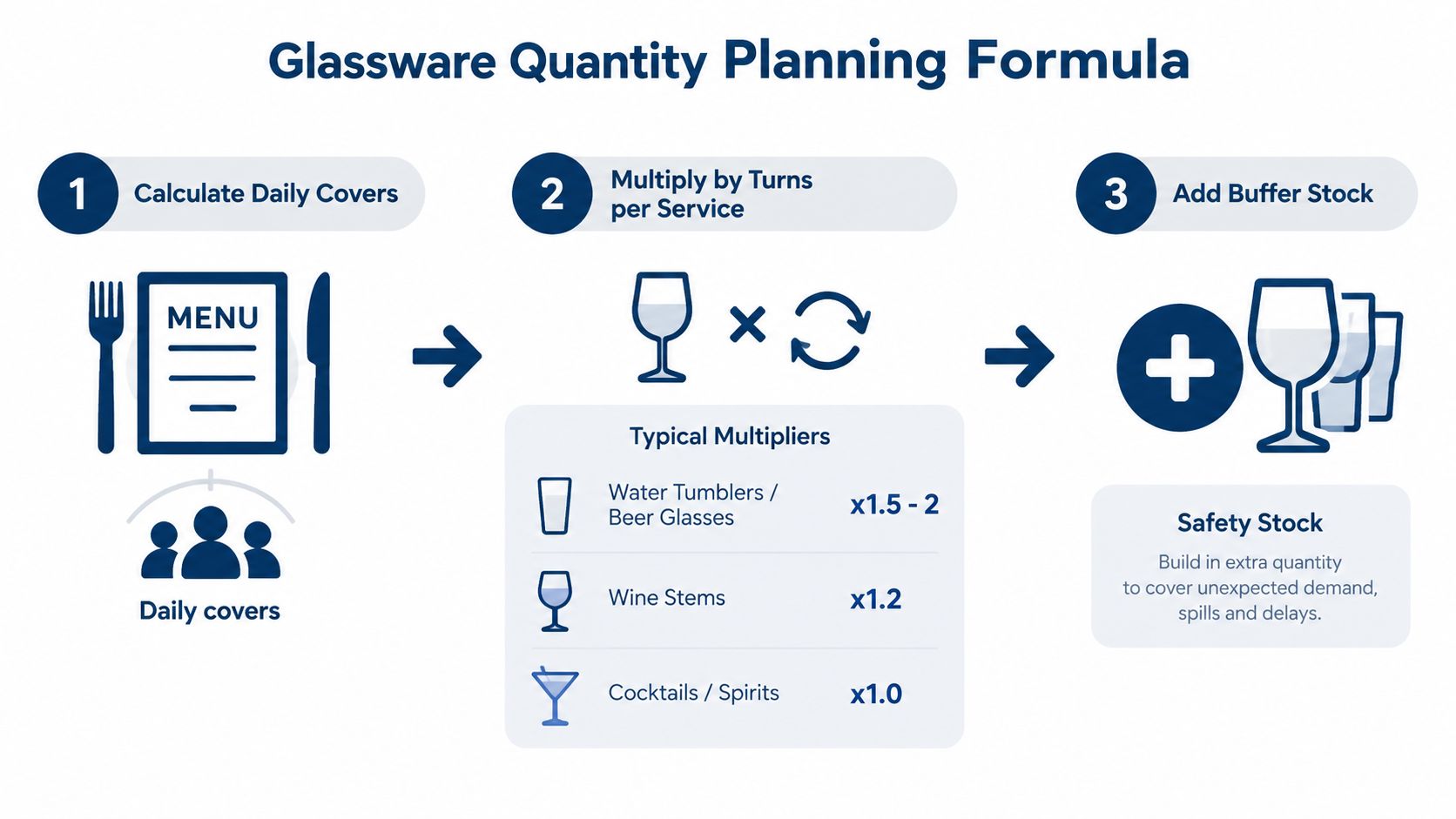
Quantity planning starts with service patterns. Operators should calculate the number of covers or expected guests, identify how many times each glass can turn through a service and then set aside replacement stock. Every category needs its own calculation because a wine stem, carafe and water tumbler don't move through the operation at the same rate.
The planning formula below provides a useful starting framework.
Separate opening stock from replacement stock
An opening package needs to support normal service while the wash cycle is still running and reserve pieces are held back. The exact requirement depends on covers, menu mix, storage capacity, event patterns and how quickly the venue can wash and return glassware.
Operators should ask:
- How many glasses are needed initially? Count each type against the beverage list and service plan.
- How many need to remain available as replacement stock? Reserve stock shouldn't be treated as available service stock.
- Which glasses turn over fastest? Water tumblers, beer glasses and popular wine stems often need closer monitoring than occasional-use carafes.
- What happens if another carton is needed next year? Reorder confidence matters as much as the initial carton quantity.
The demand environment also varies by region. Hospitality sales reached $15.99 billion in the year ended June 2025, but national growth was only 1.4%, with four of 18 regions above 5% growth and six regions declining. Restaurant Association regional hospitality reporting shows why a Queenstown-Lakes venue shouldn't automatically use the same purchasing calendar as a slower market.
Seasonal planning should reflect the venue's location and customer mix. Tourism hubs, event businesses and ski-market operators may need stock staged ahead of their busiest periods, while other venues can reorder more evenly. The hand-polishing cost discussion also helps operators account for the labour attached to presentation, not only the carton count.
Total Cost of Ownership Beyond the Invoice
The invoice price is only the first line in a glassware cost review. A proper comparison includes how often the range is replaced, how it fits the wash process, how much shelf space it consumes and how much staff time goes into handling and polishing.
New Zealand buyers should also account for import exposure. Glass and glassware imports were about NZD 366.8 million in 2024, compared with NZD 183.2 million in 2000, and major origins include China, Australia, Malaysia and Indonesia. New Zealand glass and glassware import history indicates why landed cost, supply continuity and regional availability deserve attention before a buyer commits to a large package.
Compare the costs that affect service
| Cost Factor | Everyday Tumbler | Premium Tumbler |
|---|---|---|
| Initial purchase | Usually lower and easier to deploy across high-volume positions | Usually higher and more selective |
| Customer presentation | Practical and consistent | More refined where presentation matters |
| Replacement planning | Often suited to frequent replenishment | Requires stronger continuity checks |
| Warewashing | Must match the venue's daily wash routine | Requires equal attention to racks, handling and thermal shock |
| Storage | Typically simple for standard shapes | Shape and height may require dedicated planning |
| Best application | Water, soft drinks and busy everyday service | Premium beverages and customer-facing moments |
A lower-priced glass can make sound commercial sense in a high-volume setting, but only if the range remains available and handles the operation appropriately. A premium glass can also be poor value if staff stack it incorrectly, overfill racks or use it in a service position where guests won't notice the difference.
Most hospitality buyers do not need to spend much time on tariff classifications. The more useful commercial question is whether the final landed cost, reorder timing and local stock support make the range practical for ongoing service. New Zealand Customs tariff guidance is still worth checking where needed, and HS 7013.37 tariff information can provide a reference point, but most venues will get better purchasing outcomes by focusing on replacement continuity, freight and dependable supplier support.
The premium glassware cost analysis is a useful prompt to calculate cost per service rather than comparing shelf prices alone.
Allocating Your Glassware Budget for Maximum Customer Impact
Most venues shouldn't divide the glassware budget evenly across every category. That spreads money across low-impact items and leaves too little for the glasses that shape the customer's impression of wine, cocktails and premium spirits.
A better method is to assign each beverage category a role:
- Wine glasses: Prioritise presentation, bowl shape, rim quality and balance where wine is a visible part of the offer.
- Cocktail glasses: Spend where signature serves, garnish and visual identity matter.
- Champagne glasses: Choose a format that supports celebratory service and event presentation.
- Water tumblers: Favour practical commercial options that handle constant use and repeated washing.
- Soft-drink glasses: Select shapes that suit the menu, ice service and high turnover without unnecessary specification.
- Beer glasses: Match the venue's pour style, storage system and bar workflow.
Use the beverage list as the budget map
A premium wine list may justify premium stems, while a casual café may get better value from a reliable universal glass. A cocktail bar should assess whether its signature drinks need dedicated shapes or whether a smaller set of versatile formats can cover the menu without creating storage pressure.
This isn't only a presentation decision. Glass shape affects how the drink is held, how it reaches the table and how staff manage the service. A wider bowl may suit some fuller wines, while a narrower shape can be more practical for cooler white wine service. The venue should choose based on its actual list rather than copying a specification designed for another operation.
Budget principle: Premium glassware belongs where customers notice the difference. Everyday glassware belongs where turnover, washing and replacement dominate the decision.
Stölzle, Zwiesel, Luigi Bormioli, Pasabahçe and Ocean allow operators to build a mixed package across premium and practical applications. Hospitality offers these glassware brands and related hospitality supplies, allowing businesses to discuss a package rather than forcing every beverage into one collection.
The strongest specification may therefore use premium wine and cocktail glasses alongside durable everyday tumblers and beer glasses. That approach creates premium moments without asking the venue to fund premium presentation for drinks that don't benefit from it.
Questions to Ask Before Committing to a Range
A polished catalogue image doesn't prove that a glassware range will work in a busy venue. The supplier conversation should focus on operational fit, future replacement and the details that create problems after installation.
Check the range before ordering cartons
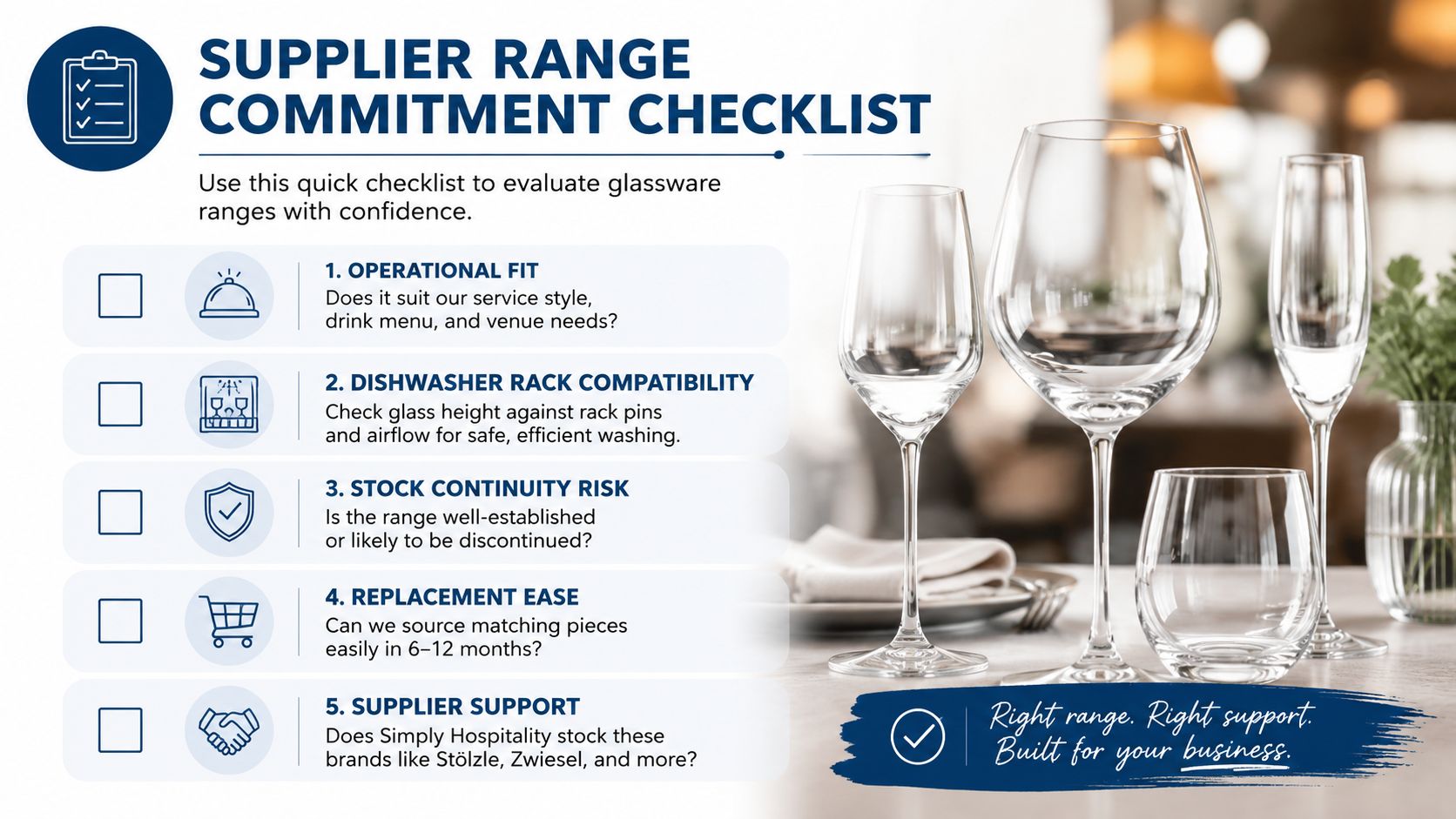
Operational fit comes first. The glass needs to suit the beverage, service style, staff workflow and storage location. A venue shouldn't buy a tall stem that won't fit its dishwasher rack or shelf.
Dishwasher compatibility needs a physical check. Glass height, bowl width and rack pins should be assessed together, especially where a venue already owns a fixed warewashing system. Glasses should also reach room temperature before and after washing to reduce thermal shock, according to commercial glass handling guidance.
Replacement continuity is a commercial requirement. Operators should ask whether the range is regularly stocked in New Zealand, whether individual cartons can be reordered and what happens if another 100 glasses are needed later.
Trial quantities can help a venue test washing, stacking, storage and staff handling before committing to a full package. Only glassware designed for stacking should be stacked, and damaged or abraded glasses should be removed from service.
Ask about sustainability and disposal
Glass recovery isn't uniform across New Zealand. There is no single nationwide commercial glass recycling process, so hospitality operators should check requirements with their contractor or local council. Colour-sorting generally produces the best recycling outcome. New Zealand hospitality glass recovery guidance
The Glass Packaging Forum reports that only about 10% to 15% of single-use glass containers are consumed in hospitality venues and that this segment is usually sent to landfill because it is the cheapest and easiest disposal route, while broader container-glass recovery is around 75%. Glass Packaging Forum product stewardship analysis For buyers, durability, reuse and a practical collection system matter more than packaging claims alone.
Written quotes should separate unit price, carton quantity, freight and GST. The final questions should be direct:
- Can the range be reordered? Confirm the likely supply path for matching replacements.
- Will the supplier support the range? Ask about stock depth and normal ordering arrangements.
- Does it suit commercial warewashing? Check rack fit, handling and temperature requirements.
- Which beverages justify the premium? Allocate budget according to customer impact and turnover.
- What happens after the opening order? Plan replacement stock before the first service.
Hospitality supplies commercial glassware across Stölzle, Zwiesel, Luigi Bormioli, Pasabahçe and Ocean, alongside broader front-of-house and hospitality equipment categories. Operators can visit Simply Hospitality to discuss a glassware package based on beverage mix, carton quantities, warewashing, storage and dependable replacement planning.