

Why Emile Henry Continues to Inspire Professional and Home Chefs in NZ
The popular advice is to buy bakeware for its colour, shape, or French styling. That misses the reason Emile Henry continues to inspire professional and home chefs. The useful question isn't whether a ceramic dish looks good on an open shelf. It's whether the vessel earns repeated use through reliable cooking, practical handling, and presentation that removes a step between the oven and the guest.
For New Zealand cafés, restaurants, caterers, accommodation kitchens, and serious home cooks, Emile Henry sits in an unusual category. It's ceramic cooking equipment that can also function as servingware, supporting baking, roasting, gratins, pies, tarts, desserts, and sharing dishes without requiring a transfer into another vessel. The brand's products are described as being made in Burgundy, France, and its ceramic craft traces back to 1850, giving it roughly 175 years of continuous specialisation by 2026.
That heritage matters, but it shouldn't make the buying decision. The stronger case comes from use. If a dish supports mise en place, moves safely from preparation to oven to pass, holds its presentation, and survives the care routine a kitchen can deliver, it deserves consideration as working equipment.
The Case for Treating Emile Henry as Equipment, Not Decor
Emile Henry is often marketed like lifestyle tableware. In a working kitchen, that's the least interesting part of the purchase. A chef doesn't need another attractive object in storage. A chef needs a vessel that earns a place in the mise en place system, survives replenishment cycles, and contributes to service without creating extra handling.
A bistro running a gratin special three nights each week might use a Flame ceramic dish repeatedly for preparation, baking, holding, and service. That dish may be pulled from storage and sent to the pass more often than several metal pans reserved for occasional menu items. Its value comes from the number of useful jobs it performs, not from the fact that its glaze photographs well.
The right comparison with stainless steel isn't just material against material. It's operational.
- Use frequency: A versatile dish used repeatedly has a stronger case than a specialist piece that rarely leaves the shelf.
- Menu fit: Gratins, baked pasta, pies, roasted vegetables, and desserts suit ceramic particularly well because the cooking vessel can remain part of the presentation.
- Handling: Fewer transfers can mean fewer opportunities for a dish to lose structure or require extra plate-up work.
- Storage discipline: A beautiful range still becomes expensive clutter if the sizes don't match the venue's portions and shelving.
- Cleaning workload: One vessel may reduce transfer-related washing, but the team still needs a realistic process for ceramic handling and storage.
Operational rule: Judge premium bakeware by repeatable service use, not by shelf appeal.
A commercial kitchen should also separate domestic, semi-commercial, and commercial equipment expectations before ordering. The practical distinctions are outlined in this guide to domestic, semi-commercial and commercial equipment.
Home cooks can use the same logic. One excellent rectangular dish used for lasagne, baked pasta, and seasonal crumbles may deliver more value than a coordinated collection that spends most of its life in a cupboard. Professional chefs and home cooks differ in volume, but both benefit when cookware is bought around actual dishes and repeatable habits.
How the Ceramic Body Actually Performs in a Working Oven
Emile Henry says its products are made in France using Burgundy clay and a proprietary High-Resistance, or HR, ceramic process. The manufacturer also describes laboratory-led testing for thermal and mechanical shock resistance (Emile Henry manufacturing information). Local NZ listings describe pieces fired at 1180°C and engineered to be heat-resistant, thermal-shock-resistant, oven-proof, freezer-safe, and coated with a scratchproof glaze.
Those specifications matter, but they don't make ceramic indestructible. Operators still need to distinguish between the material's rated performance and the conditions of a busy kitchen. A product page should be checked for the individual piece, its temperature limit, heat-source suitability, and care requirements.
Several Emile Henry product pages state a maximum usable temperature of 290°C, including products such as the tagine, pizza stone, and pizza station (Emile Henry tagine specifications). Flame cookware has a separately stated freezer-to-oven tolerance, moving from -20°C/0°F into a hot oven up to 500°C/930°F (Emile Henry Flame Dutch oven specifications). Those figures apply to the specified product range, not automatically to every ceramic item.
Heat retention is useful, but it changes the workflow
Independent review evidence describes Emile Henry's thick clay body as slower to heat but effective at retaining heat and supporting even browning. In practical terms, that can help gratins, focaccia, casseroles, and baked desserts cook with fewer hot-spot problems while remaining warm at the pass or table.
The trade-off is speed. Ceramic generally needs a considered preheat, and a team that loads a cold vessel into a rushed oven cycle may not get the same result as a thin metal pan. Ceramic also loses to aluminium when rapid heat response and light handling are the priority. Stainless steel offers strength and broad commercial familiarity, but it isn't chosen for the same heat-retention and presentation role.
| Property | Emile Henry HR Ceramic | Aluminium | Stainless Steel |
|---|---|---|---|
| Heat behaviour | Slower uptake, strong heat retention, even cooking characteristics | Fast response and lightweight handling | Durable, but heat behaviour depends heavily on construction |
| Oven-to-table use | Strong, with presentation built into the vessel | Usually requires separate servingware | Usually requires separate servingware |
| Temperature handling | Product-specific limits apply, with stated thermal-shock performance on relevant ranges | Product and coating limits apply | Product and construction limits apply |
| Surface and appearance | Glazed finish designed for repeated use, but still needs careful handling | May stain, mark, or require protective coatings | Practical and durable, less presentation-led |
| Best fit | Gratins, baked pasta, roasts, pies, desserts, sharing dishes | Fast baking and lightweight batch handling | General-purpose commercial cooking and robust back-of-house use |
For operators planning the wider cooking line, oven choice still matters. Advice on selecting a commercial oven for a New Zealand kitchen should sit alongside bakeware selection, because the oven, rack spacing, loading pattern, and vessel material all affect service.
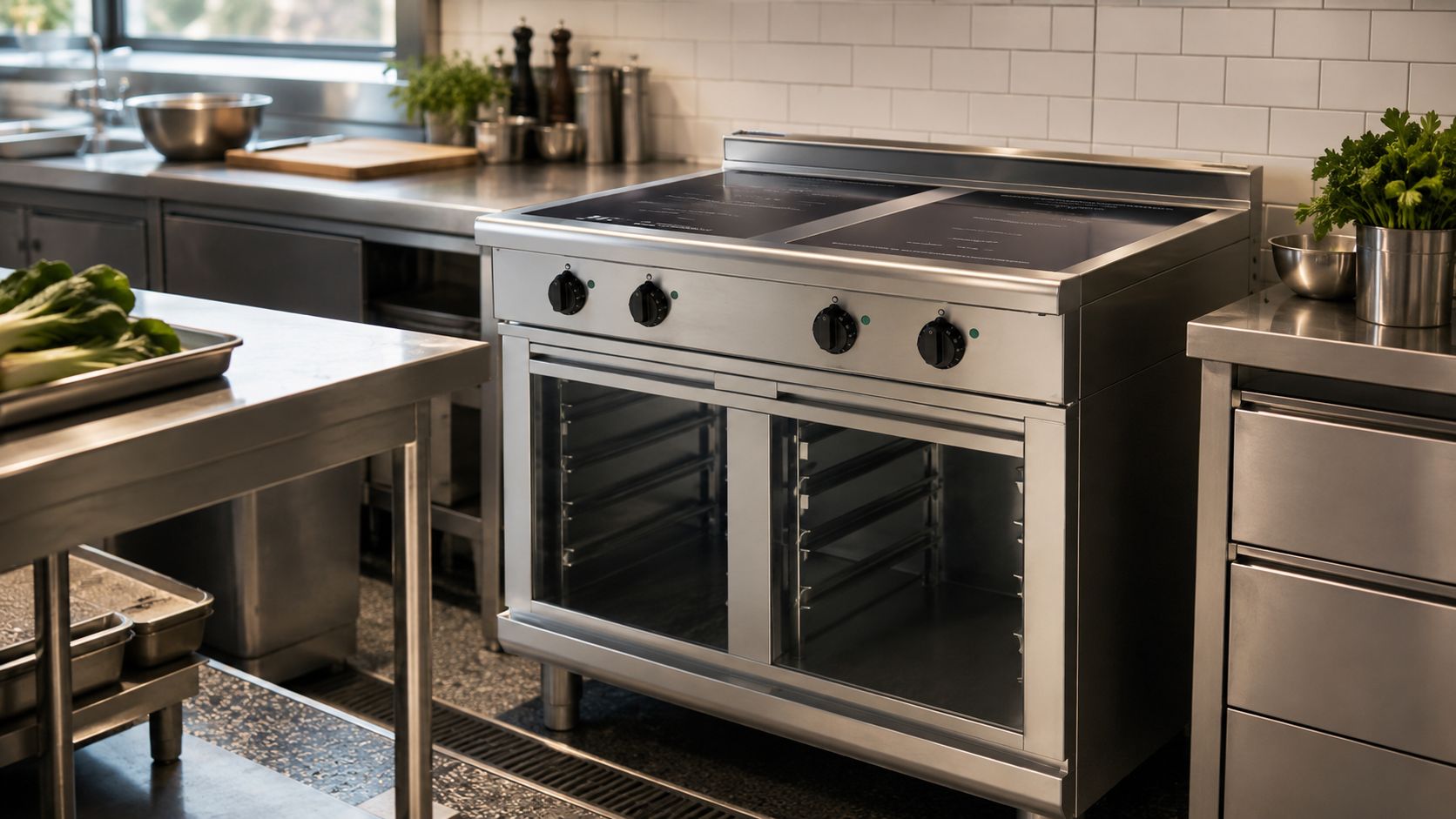
A separate consideration is induction. The Waldorf 800 Series INL8400R5F-CB, 900mm Electric Induction Cooktop Low Back Version with Cabinet Base is a four-zone cooktop with a 6mm ceramic glass cooking surface, automatic pan detection, and a cabinet base. It's relevant to the cookline, but Emile Henry ovenware shouldn't be assumed to be suitable for direct induction merely because the cooktop surface is ceramic. The product's instructions and intended heat source remain decisive.
Oven-to-Table Dishes That Earn Their Place on the Menu
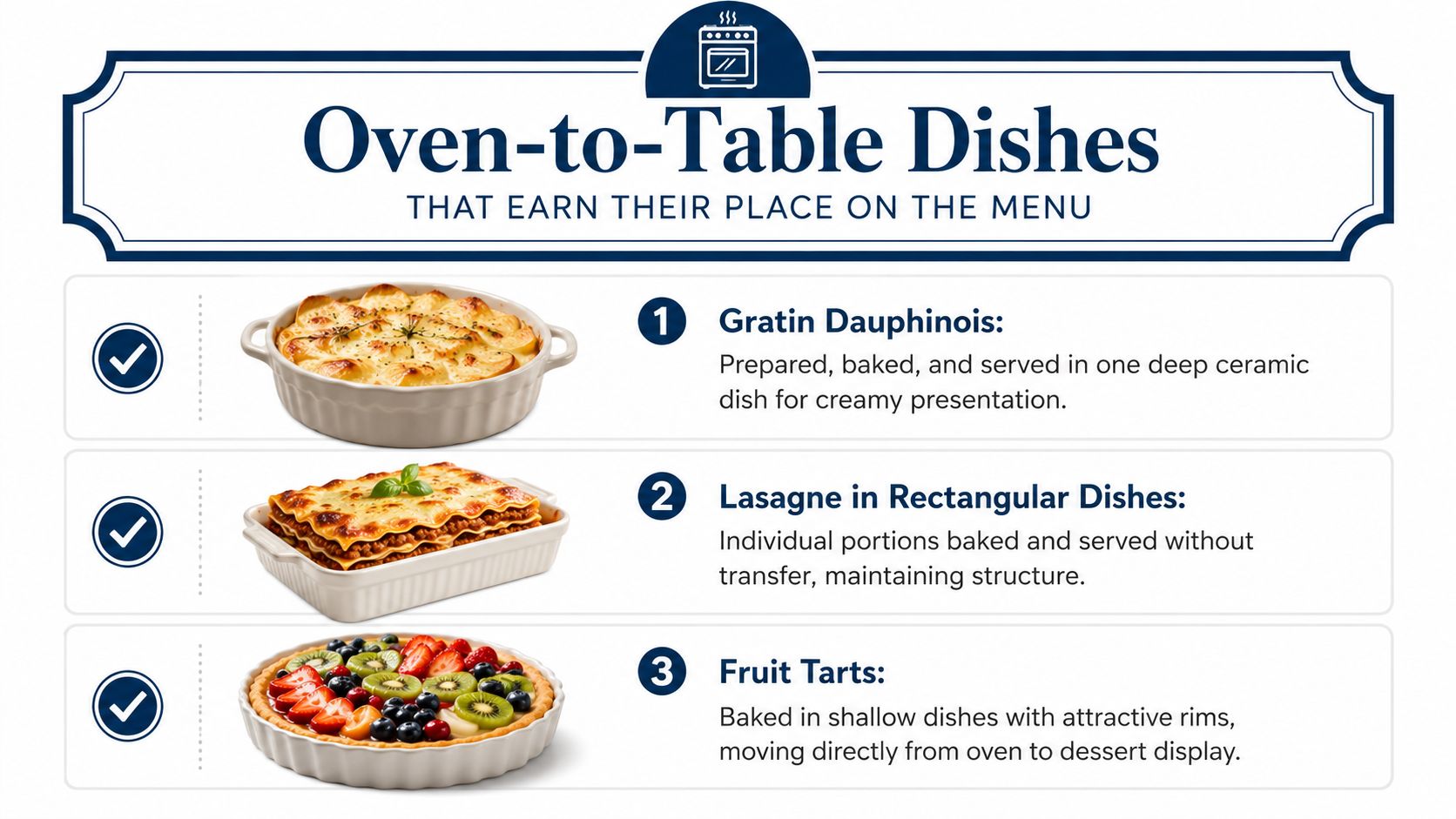
The strongest Emile Henry application starts before the oven and ends at the table. A gratin can be assembled in the same deep dish, baked until bubbling, carried to the pass, and served without being scraped into a separate platter. That preserves the visible crust and gives the guest the dish as it was cooked.
A bistro set menu can use this approach for gratin dauphinois. A winery lunch can use a ceramic dish for roasted seasonal vegetables or a baked side designed for sharing. A café can prepare fruit tarts or clafoutis in shallow dishes that move directly to the cabinet or service counter once cooled, provided the shape and display requirements match.
The menu applications are specific
Lasagne and baked pasta benefit from rectangular dishes with enough depth for controlled layers. Individual portions can be baked and served in their own vessels, while a larger format suits family-style service. The operator should match the dish to the planned portion rather than choosing a shape because it looks generous on a shelf.
Pies and tarts suit ceramic because the rim contributes to the finished presentation. A fruit tart can move from oven to dessert display, while savoury pies can go directly to the table in a format that looks deliberate rather than transferred.
Roasted vegetables and whole roasts need a vessel with usable depth and enough surface area for the food to sit without crowding. Oval roasters can suit whole birds, joints, or sharing vegetables, but the oven rack and storage footprint must be checked first.
Desserts such as crème brûlée and clafoutis work when the vessel supports portion control and front-of-house presentation. The same principle applies to baked puddings and seasonal fruit dishes.
The New Zealand bakeware selection should be assessed by the dishes it supports, not by the number of pieces in a range.
A useful menu checklist asks:
- Does the dish require a crisp or bubbling surface that should remain visible?
- Can preparation, baking, holding, and service happen in one vessel?
- Would transfer damage the portion, crust, or sauce?
- Does the ceramic format suit the venue's portion size?
- Will the piece be used often enough to justify its storage space?
- Does the colour and finish support the food rather than distract from it?
The best oven-to-table choice is the one that removes a transfer without creating a new handling problem.
What Chefs and Home Cooks Can Learn From Each Other
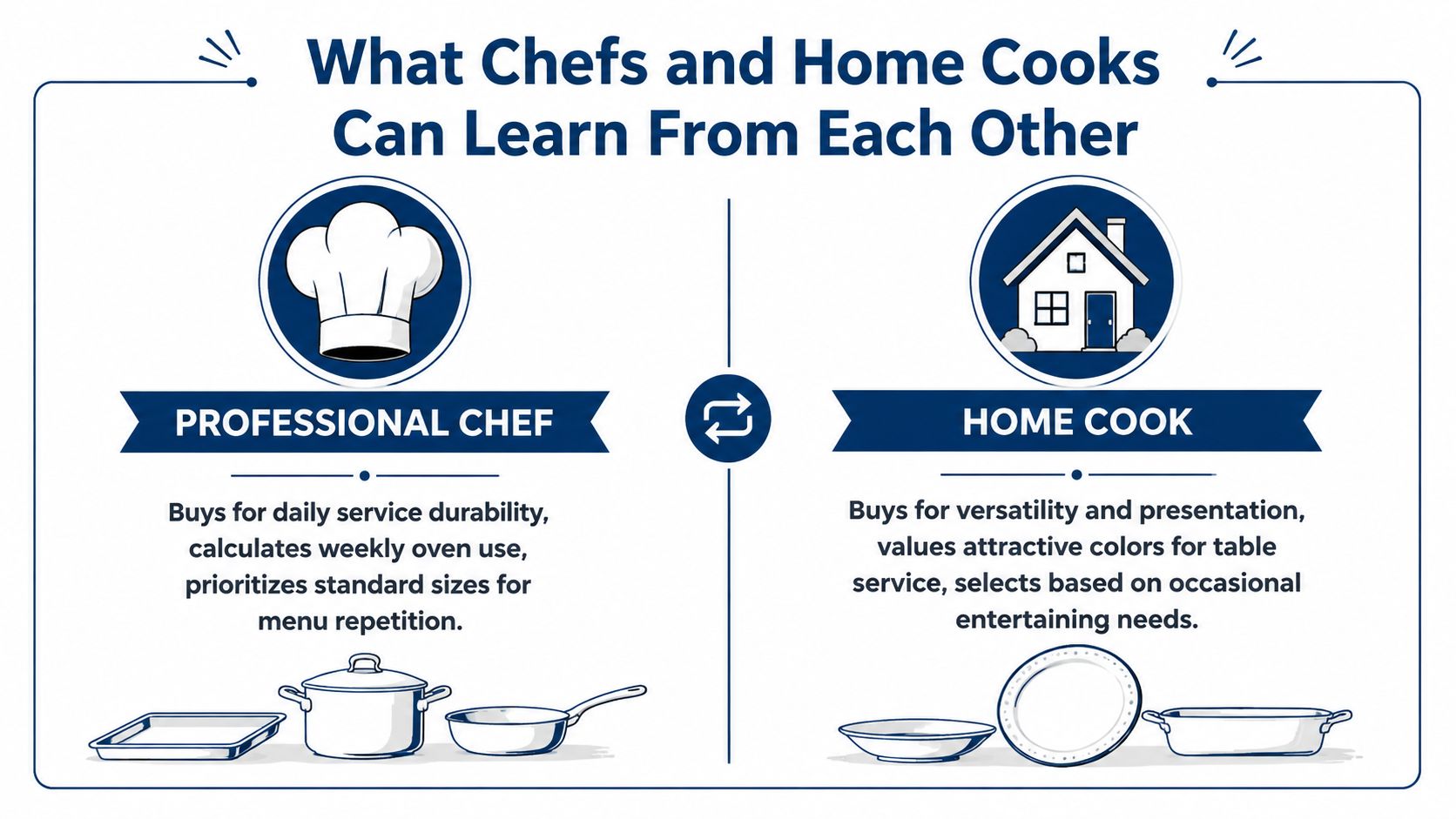
Professional chefs usually buy bakeware around repetition. They consider how often a dish appears on the menu, how many oven loads it needs, how long it must hold at the pass, and whether the dishwashing area can process the volume. A home cook may begin with colour, shape, or a matching collection, but the more useful question is the same one used in a commercial kitchen: what will this piece cook?
A chef planning ceramic for a new menu should test the exact format before ordering broadly. The trial should include a real preparation cycle, oven loading, holding, pass handling, washing, drying, and storage. It should also test whether the vessel's weight and dimensions suit the staff who will handle it.
Frequency beats collection size
A professional kitchen can learn from the home cook's attention to presentation. Colour, glaze, and shape matter when the vessel reaches the guest, especially for sharing dishes and open-kitchen service. A home cook can learn from the chef's discipline by choosing one versatile dish for recipes prepared regularly instead of buying a set that completes a visual theme.
The useful buying test is straightforward:
| Professional chef priority | Home cook priority |
|---|---|
| Menu repetition and service frequency | Recipes prepared regularly |
| Standardised portions and oven capacity | Normal household portions |
| Rapid replenishment and pass handling | Ease of moving from oven to table |
| Dishwashing and storage workflow | Available cupboard and dishwasher space |
| Consistent presentation across service | Colour, finish, and entertaining style |
Professional buyers should also consider simultaneous oven loads and whether different shapes compete for the same rack space. Home cooks should consider freezer space, cupboard access, handle weight, and whether the vessel is practical to wash after a large meal.
The shared lesson is simple. Buy for repeatable performance, not appearance or quantity alone.
A versatile dish used week after week can justify premium ownership more convincingly than several specialised pieces that rarely see heat. That principle applies equally to a café kitchen and a home kitchen.
Cleaning, Storage and Day-to-Day Handling
Ceramic bakeware can support repeated use, but the finish remains part of the equipment's value. A chipped or poorly stored dish may still look functional to a staff member under pressure, yet it no longer meets the same presentation standard. The team should treat each piece as both cooking equipment and serviceware.
The manufacturer's current instructions for the specific product should take priority, especially for dishwasher use. Collection requirements can differ, and a commercial dishwasher's heat, detergent, and handling cycle may be more demanding than domestic washing.
A practical care routine
- Cool before washing: Very hot ceramic shouldn't be immersed in cold water or placed against a cold, wet surface. Gradual temperature changes reduce avoidable thermal shock.
- Use gentle cleaning tools: Mild detergent and non-abrasive pads protect the glazed surface. Metal scourers and aggressive cleaners can mark or damage the finish.
- Check dishwasher guidance: Confirm that the individual piece is dishwasher-safe before placing it in a commercial machine.
- Store with space: Tight stacking increases the risk of knocks and chips. Protective liners or suitable separation can help where the manufacturer permits them.
- Handle with heat protection: The body, handles, and lid can remain hot after cooking. Staff need suitable oven gloves and a clear route from oven to pass.
- Inspect before service: Remove pieces with chips, cracks, or crazing from use immediately and record the issue.
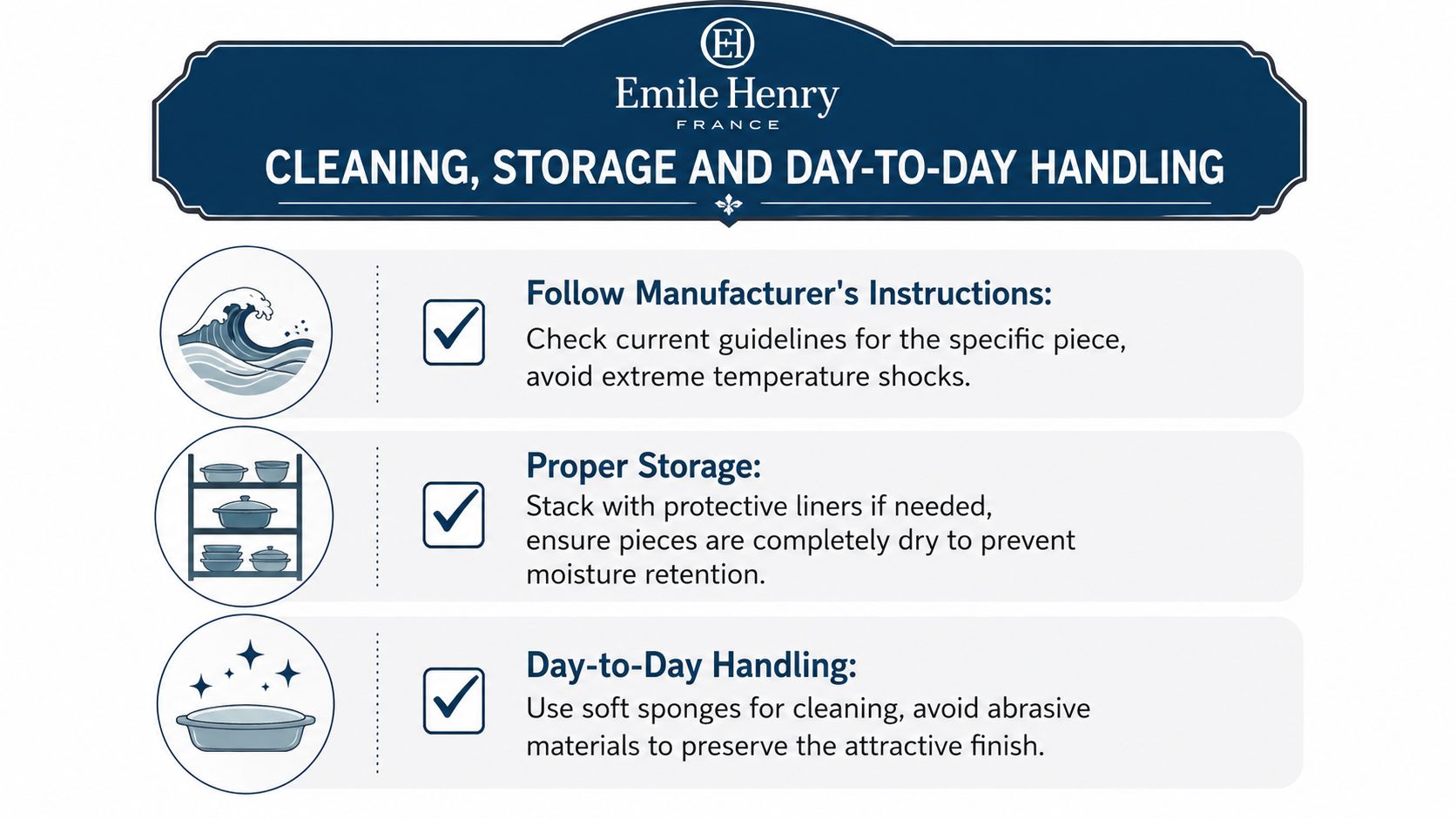
A short staff induction prevents inconsistent treatment. The cleaning team should know which pieces can enter the dishwasher, where they dry, how they stack, and what damage requires removal. The kitchen manager should also ensure lids and dishes are fully dry before storage where moisture could remain trapped.
The same discipline applies at home, although the handling volume is lower. Guidance on cleaning chemicals for New Zealand hospitality can help operators review whether their detergent and cleaning process suit the surfaces in use.
Cost, Warranty and Long-Term Ownership Considerations
The business case for Emile Henry starts with cost per use, not the ticket price alone. A premium dish that supports regular baking, holding, and presentation can earn its place if it replaces separate cooking and serving steps. A cheaper dish may be the better choice when the application is fast, rough, high-volume production where light handling and rapid heat response matter more than oven-to-table service.
Operators should record the full ownership picture:
- purchase cost
- realistic service frequency
- portion yield
- oven and storage footprint
- cleaning method
- handling requirements
- replacement pattern
- suitability for front-of-house presentation
A venue trial should use the exact menu item and service conditions. It should test whether staff can load the dish safely, whether it fits the oven without disrupting other production, whether the portion presents well, and whether the washing process protects the finish. Breakages should be recorded with the likely cause, because a failure may relate to a product defect, unsuitable use, thermal shock, or poor handling.
Emile Henry states that all products carry a limited household 10-year warranty against breakage caused by defective workmanship (Emile Henry warranty and brand information). That wording matters. It refers to household coverage, so commercial operators shouldn't assume that the same terms apply to business use. Warranty terms, exclusions, and local requirements should be confirmed before purchase, and proof of purchase should be retained.
| Ownership factor | Professional kitchen | Home kitchen |
|---|---|---|
| Use test | Menu repetition, service volume, oven loading | Regular recipes and entertaining needs |
| Cost logic | Cost per service and replacement cycle | Cost per meal or recurring use |
| Presentation value | Reduced transfer and service-ready vessel | Direct oven-to-table presentation |
| Risk control | Staff training, inspection, storage separation | Care instructions and safe handling |
| Warranty review | Confirm commercial applicability | Review household terms and exclusions |
Operators assessing the wider principle can also consider buying cheap versus buying once. Premium ceramic is long-life equipment only when it remains safe, presentable, and productive in the environment where it's used.
Choosing the Right Pieces for Your Venue or Kitchen
Shape selection should begin with the menu, then move to the oven, portion, and service style. A rectangular dish suits layered lasagne and baked pasta because it supports consistent cutting and predictable plating. A round or shallow flan dish suits tarts and quiches, while an oval roaster gives whole birds, joints, and roasted vegetables a service-ready format.
Oven compatibility needs a direct check. Convection, combi, and conventional ovens move heat differently, and rack spacing can limit the practical size of a dish even when the oven cavity appears large. Operators should confirm the piece's stated temperature and heat-source suitability, then test a loaded vessel rather than relying on an empty-rack measurement.
Match the shape to the work
| Dish type | Recommended shape | Portion / service style | Oven compatibility |
|---|---|---|---|
| Gratins | Deep rectangular or oval dish | Sharing, family-style, or side-dish service | Confirm oven dimensions and stated product limits |
| Lasagne and baked pasta | Rectangular dish | Individual, small-group, or larger shared portions | Suitable only where the specific product is oven-rated |
| Pies and tarts | Round or shallow flan-style dish | Café display, dessert service, or plated sharing | Check rack clearance and product instructions |
| Roasts and vegetables | Deep oval roaster | Whole-table presentation or shared service | Confirm cavity space, rack load, and thermal guidance |
| Bread and baking | Purpose-designed baking vessel | Counter service, breakfast, or home use | Match product temperature rating to the recipe |
| Small desserts | Ramekins or small ceramic dishes | À la carte portions | Check spacing, handling, and washing process |
Colour and finish should follow service style. A front-of-house sharing dish may benefit from a finish that complements the food and dining room, while a back-of-house workhorse should be chosen primarily for size, handling, and repeat use. Attractive colours can support presentation, but they shouldn't override oven fit or storage practicality.
Before ordering, a hospitality buyer should answer five questions:
- Which menu item will use the piece most often?
- What portion does the dish need to produce?
- How many pieces fit in the oven at once?
- Where will clean pieces be stored?
- Can the team wash and handle them without avoidable damage?
The right Emile Henry range is the one that matches the venue's actual production rhythm.
Getting Practical Advice for Your Menu and Service Style
This article is a starting point, not a substitute for testing the actual dish in the actual kitchen. Menu rotation, service volume, oven configuration, dishwashing capacity, storage footprint, and front-of-house presentation all affect whether ceramic earns its space.
A chef, head cook, owner, or home cook should have the intended recipes and normal portions ready before choosing sizes. The selection process becomes more useful when it includes the oven type, expected holding time, preferred service style, cleaning method, and any limits on shelving or dishwasher access.
Hospitality works with New Zealand hospitality operators across cooking equipment, bakeware, cookware, tableware, cleaning, refrigeration, and kitchen planning. Its team can help compare ceramic bakeware with other options around a specific menu and service workflow, rather than treating a catalogue image as the final decision.
The central test remains practical: what dishes will be cooked in the vessel, and can that vessel stay with the food all the way to the table? When the answer is yes and the piece will be used regularly, Emile Henry makes a credible case for both professional kitchens and serious home cooks.
For help matching Emile Henry ceramic bakeware to menu items, oven capacity, portion sizes, storage, and service style, contact Simply Hospitality's hospitality equipment team. Visit Simply Hospitality to discuss a practical bakeware selection before ordering.