

Why Friginox Blast Chillers Have Become Essential in Modern Commercial Kitchens
Peak service exposes every weakness in a kitchen. Prep runs late, hot food waits for space in the cool room, chefs try to stay ahead of dockets, and quality starts slipping at the exact time consistency matters most. That's why Friginox blast chillers have become essential in modern commercial kitchens. They don't just cool food quickly. They give operators control over production, timing, food safety, and service pressure.
For many hospitality businesses, the true value of a blast chiller sits between the stove and the fridge. It changes when food can be produced, how batches are managed, and how safely cooked items move into storage for later service. In demanding kitchens, that shift matters far more than owning “another refrigeration unit”.
Moving Beyond the Pressures of Peak Service
A common issue seen in commercial kitchens is that too much of the day's production still happens too close to service. Staff are reducing sauces, finishing braises, portioning proteins, cooling components, and trying to hold standards while orders keep building. That approach works until the kitchen gets busy. Then every delay affects quality, labour pressure, and food safety at the same time.

Many operators already know they need better flow during service. The bigger opportunity is changing what happens before service starts. Practical changes such as stronger mise en place systems, clearer prep zones, and better production timing all help. So does reviewing ways to improve kitchen efficiency during peak service. But for batch production, none of those changes goes far enough without a reliable way to chill food safely and predictably.
Why the blast chiller changes the conversation
A standard fridge stores cold product. A blast chiller helps create a different production model.
That difference matters because modern kitchens aren't only cooking for immediate service. They're also:
- Producing ahead: sauces, proteins, fillings, desserts, stocks, and prepared components
- Managing multiple channels: dine-in, takeaway, catering, retail packs, and functions
- Trying to smooth labour demand: using quieter periods for prep rather than overloading service windows
A blast chiller becomes most valuable when the kitchen uses it to spread production across the day, not when it's treated as a single-purpose cooling box.
In practice, Friginox units often become central production tools. They let teams cook when labour and bench space are available, then move food through chilling and into storage in a controlled way. That's a very different outcome from hoping service prep can carry the whole operation.
The Uncompromising Role of a Blast Chiller in Food Safety
A Tuesday prep shift often looks under control right up until the cooling starts. Stocks are finished, trays are coming off the line, rice is cooked, braised proteins are ready, and the fridge is already tight on space. That is the point where food safety stops being a paper requirement and becomes an operational test.
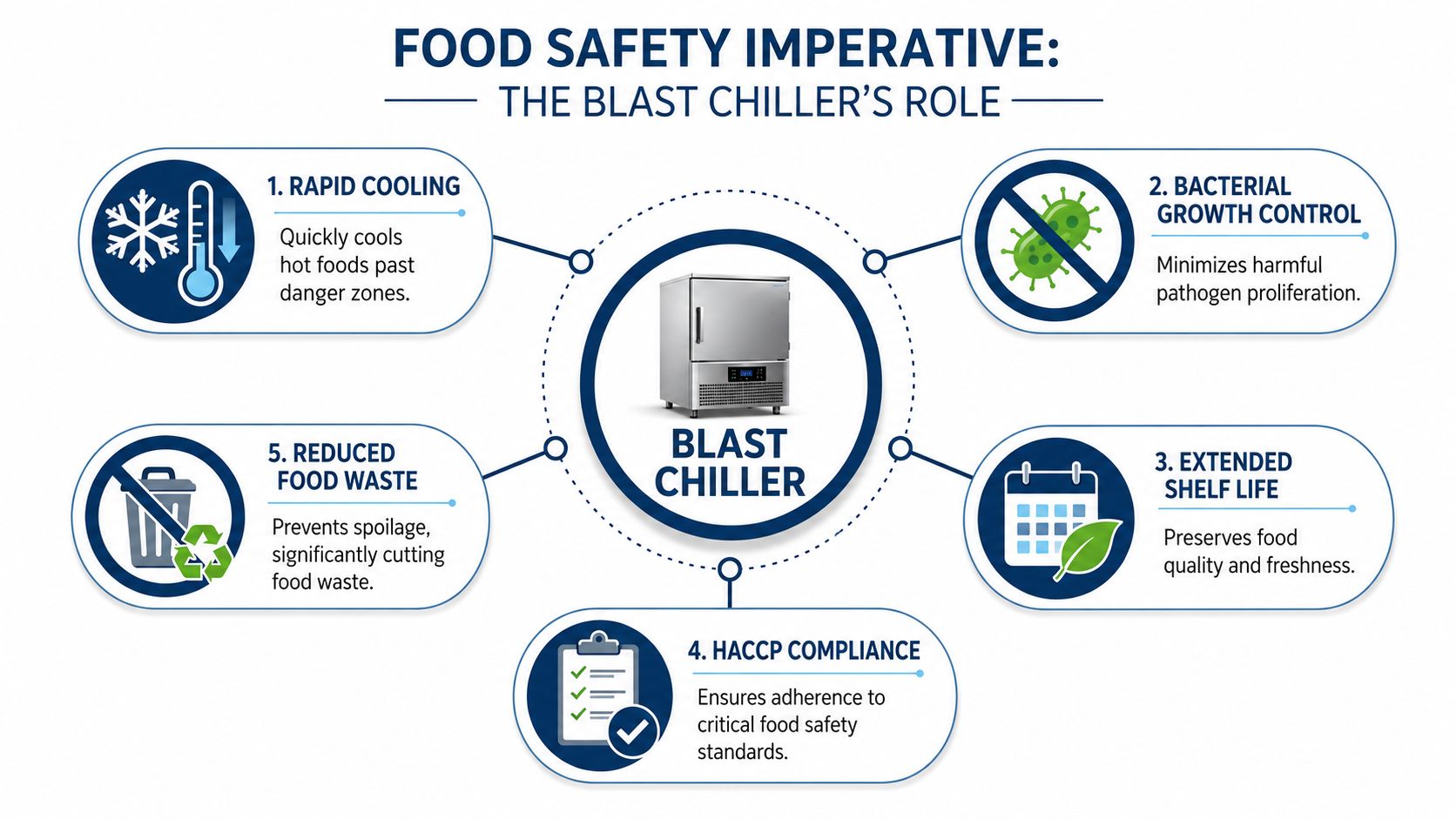
New Zealand kitchens handling high-risk food need a cooling process that stands up in real service conditions, not just in theory. The Ministry for Primary Industries requires high-risk food to cool from 60°C to 20°C within two hours and then to 5°C within the next four hours. If a kitchen is still relying on benches, ambient cooling, or an overloaded fridge, the process is exposed. Operators weighing up the practical case can review this guide to whether blast chillers and shock freezers are worth the investment.
What the danger zone means in real kitchens
The risk usually sits in the middle of the product, not on the surface. A deep pan of lasagne, a heavy batch of soup, cooked rice, braised beef, or a tub of filling can feel cooler on top while the core is still holding heat in the 5°C to 60°C range where bacteria multiply quickly.
That creates two problems at once. The product cools too slowly, and the fridge has to absorb heat it was never designed to pull down quickly.
Friginox blast chillers are built for that production step. According to the Friginox user manual, Friginox units can reduce food temperatures from 70°C to 3°C within 90 minutes. That speed matters because it gives chefs a controlled, repeatable way to move cooked food out of the danger zone instead of hoping standard refrigeration can catch up.
This is also where workflow and compliance meet. A blast chiller is not just protecting one tray of food. It is protecting the whole production plan for the day by letting the kitchen batch-cook, chill properly, and store product without compromising safety.
Practical rule: If hot bulk product is regularly being left to stand before refrigeration, the cooling process needs fixing before the next inspection, complaint, or wastage review.
Good process still matters
A blast chiller gives the kitchen the right tool, but the result still depends on discipline around the machine.
The habits that make the biggest difference are straightforward:
- Use shallow pans and sensible batch sizes. Dense product cools more evenly when depth is controlled.
- Check core temperature, not surface temperature. Staff need proof that the centre of the product has reached target temperature.
- Move product fast. Food should go from cook line to blast chill cycle without unnecessary waiting.
- Transfer chilled product into the correct storage promptly. The blast chiller is part of the chain, not the final storage point.
- Keep surrounding services up to standard. Clean drainage, waste handling, and grease trap and plumbing solutions support a safer back-of-house environment.
For accurate core checks, the Hygiplas T Shaped Digital Probe Thermometer, priced at $39.30 and currently in stock, is designed for tough meats, frozen food, liquids, and semi-solids, with a temperature range of -50°C to 150°C shown on an LCD display.
That matters because food safety in a busy kitchen is rarely lost through one dramatic mistake. It usually slips through small delays, oversized containers, poor temperature checks, and cooling methods that do not match production volume. A Friginox blast chiller closes that gap and turns safe cooling into a planned production step rather than a rushed end-of-shift task.
How Friginox Transforms Kitchen Workflow and Productivity
A blast chiller earns its keep when it changes how the kitchen plans production, not just how fast it cools food.
The practical gain is control. Cooking no longer has to sit so close to service, which gives chefs more choice over when prep happens, how labour is used, and how much pressure lands on the pass at the worst point of the day. In busy commercial kitchens, that shift usually matters more than the cooling cycle itself.
From reactive prep to planned production
Reactive kitchens tend to spend too much labour at the wrong time. Staff prep under pressure, tie up equipment close to service, and leave little room when bookings shift, a function order lands late, or a key team member is missing. Food can still go out well, but the workflow is fragile.
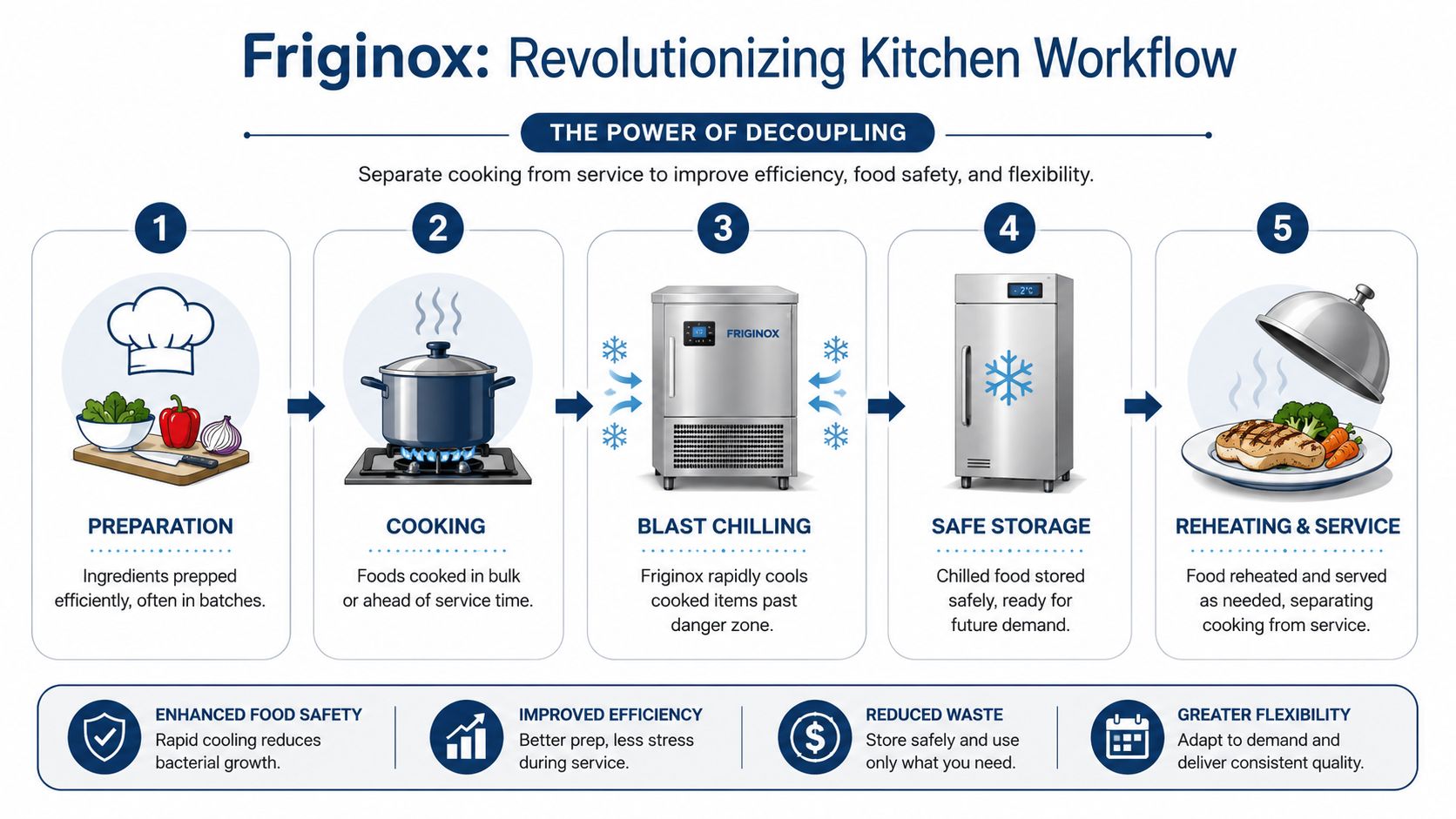
A Friginox blast chiller supports a steadier production model:
- Cook larger or repeat batches when the kitchen has capacity
- Chill product as part of the production plan
- Move finished batches into labelled cold storage
- Bring items back for service, finishing, or assembly as required
That approach suits central production, events, grab-and-go ranges, cabinet food, banqueting, and menu lines with regular demand. It also helps kitchens protect margin. Better planning reduces duplicated prep, lowers service-time waste, and makes staffing more productive across the whole shift.
Placement matters as much as capacity
I regularly see operators focus on tray count and overlook positioning. A well-specified machine still creates friction if staff have to carry hot pans too far, cross traffic with pot wash, or queue for bench space before loading.
The best results come from placing the unit within the production route. Product should leave the cook line, be portioned or trayed promptly, go into the Friginox cycle, then move into storage with minimal backtracking.
That creates a clear path:
| Stage | What should happen |
|---|---|
| Cooking | Product comes off the line as soon as it is ready |
| Transfer | Staff portion or tray it without delay |
| Blast chilling | Food moves straight into the Friginox cycle |
| Cold storage | Chilled product is stored safely and clearly labelled |
| Service | Teams reheat, plate, or finish as needed |
Operators reviewing broader kitchen flow often benefit from looking at how to design a kitchen that saves time on every service, because a blast chiller works best as part of the production route, not as a stand-alone piece of equipment.
Good workflow reduces handoffs, walking, waiting, and last-minute decisions.
Throughput depends on the whole setup
A blast chiller improves output, but surrounding systems still decide how well the kitchen runs day to day. Drainage, waste handling, wash-down access, storage space, and traffic flow all affect whether cook-chill production feels controlled or awkward. Operators reviewing infrastructure around prep and cook-chill systems can also assess grease trap and plumbing solutions when checking whether the wider kitchen setup is ready for heavier production volumes.
For venues with takeaway or retail service, small operational items also shape the bench layout. The BioPak Plant Fibre Flat Cold Paper BioCup Lid, priced at $109.30 with availability unknown, comes in 80 mm and 90 mm options and is made from a mix of plant fibres, with home compostable certification to Australian standards AS5810 and no added PFAs. It is a different product category, but the lesson is the same. Efficient kitchens are built from connected systems that support the production plan.
A Real-World Example of Gaining Kitchen Efficiency
The value of a blast chiller becomes clearer when it's built into the day-to-day production rhythm rather than judged on cooling speed alone. That was the outcome in the work done with The Knot Food Lab.
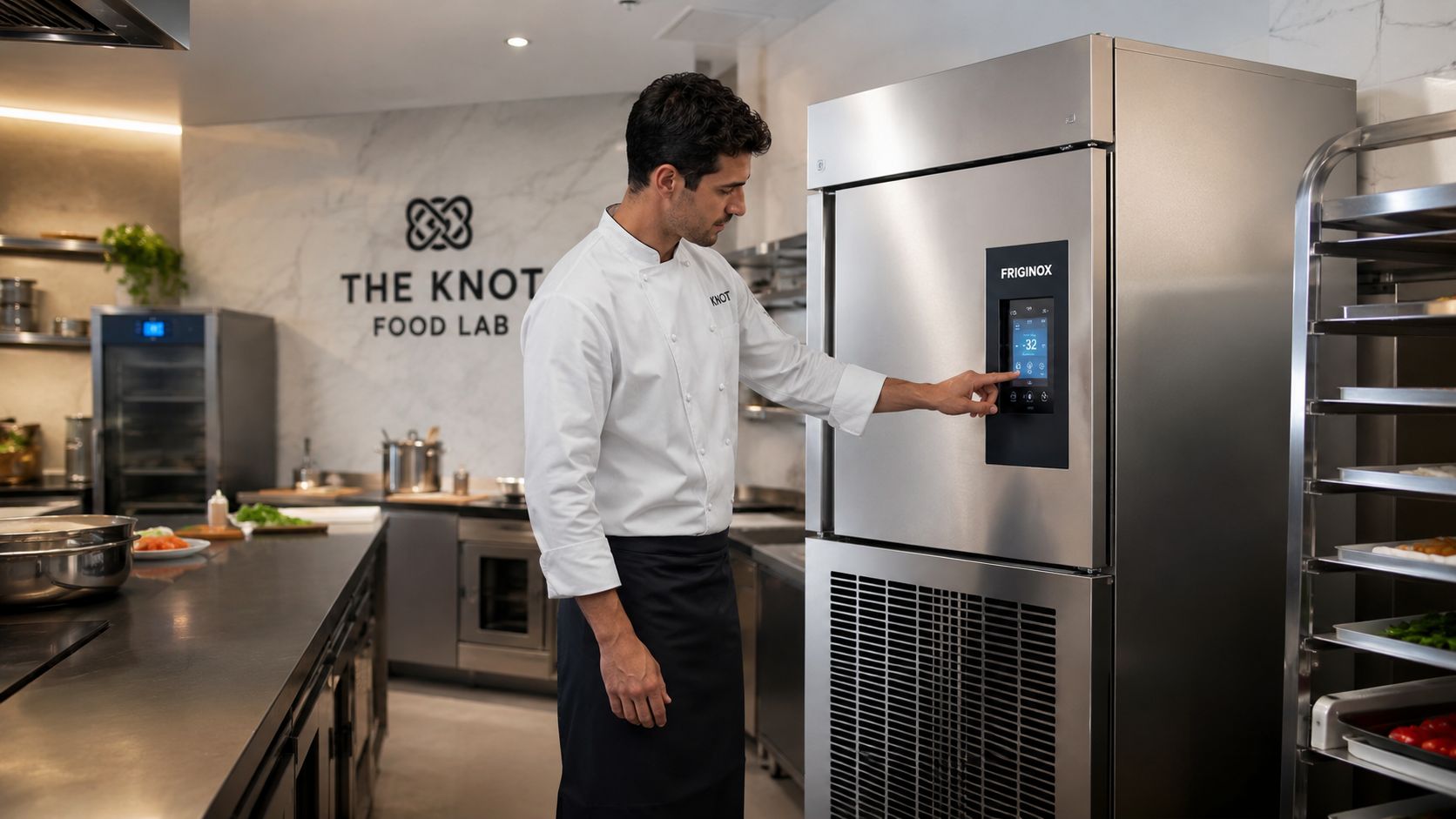
Before the Friginox unit was integrated, production pressure sat more heavily around active service and immediate prep windows. That's common in kitchens producing fresh food for later sale. Teams can make good food this way, but consistency becomes harder to protect when preparation, cooling, storage, and service all compete for the same narrow time frame.
What changed in practice
At The Knot Food Lab, the improvement wasn't merely that food chilled faster. The bigger gains came from the way the kitchen could be organised around the unit.
The Friginox blast chiller helped the team:
- Improve kitchen efficiency by moving more production into quieter periods
- Maintain food quality on items prepared ahead for later resale
- Protect consistency instead of relying on rushed service-time prep
- Reduce pressure during busy periods by spreading production across the day
That's the pattern many commercial kitchens find once a blast chiller is treated as a production tool rather than a compliance box.
Why this example matters
The lesson from The Knot Food Lab is practical. A blast chiller doesn't solve poor systems on its own. What it does do is make a better system possible.
When teams can cook, chill, store, and reintroduce product in a planned sequence, they get more control over labour, less congestion around service, and a more reliable result on the plate. For kitchens balancing fresh production with future demand, that control is often the key reason Friginox becomes part of the core equipment lineup.
Better kitchen efficiency usually comes from changing the sequence of work, not just increasing the speed of one task.
Key Friginox Features That Matter in a Busy Kitchen
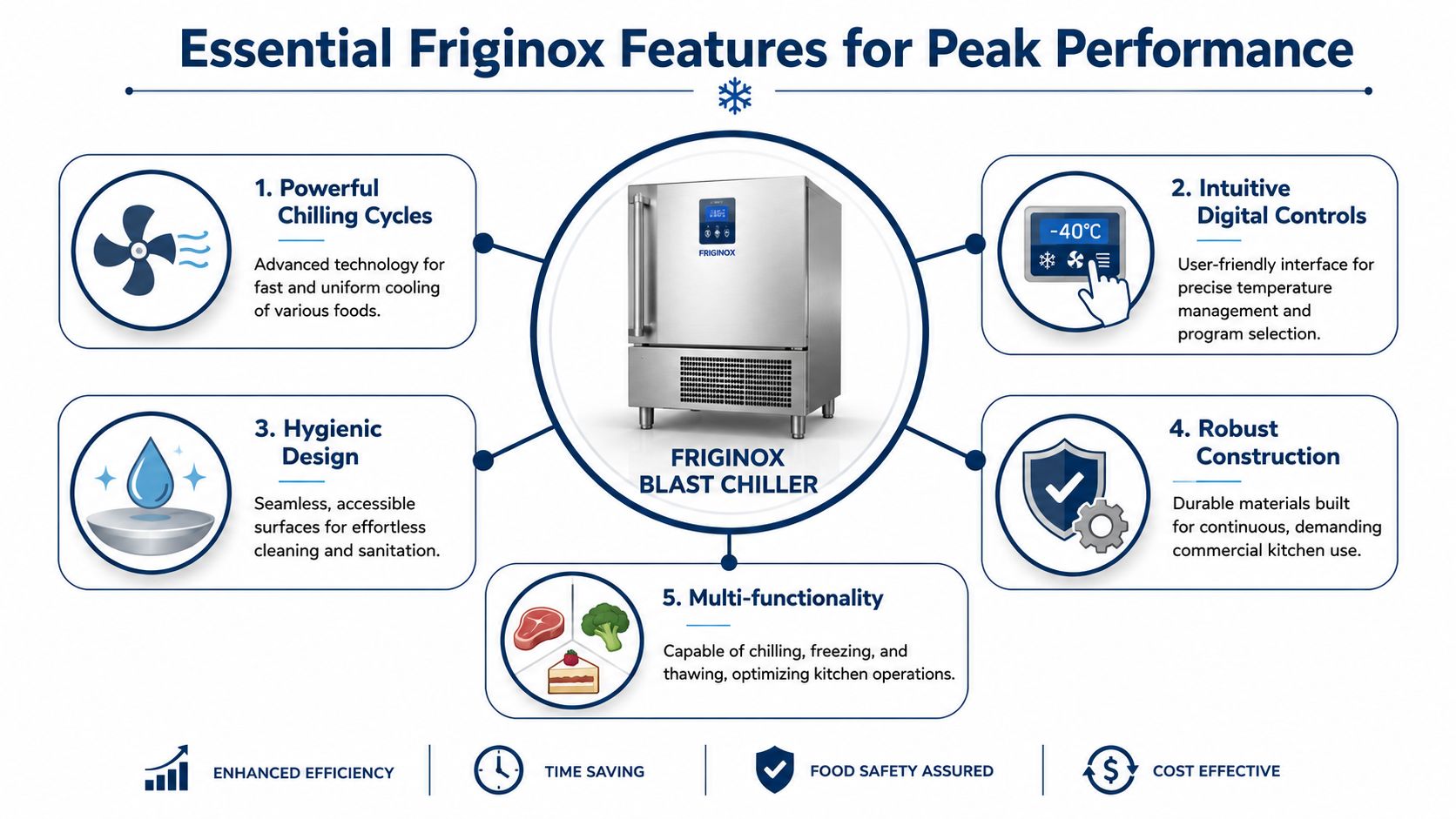
Operators don't usually choose a Friginox unit because of a brochure phrase. They choose it because specific features solve specific production problems. In busy kitchens, the most useful Friginox strengths tend to be programmable cycles, consistent temperature performance, and the ability to handle multiple trays at once.
Programmable cycles support consistency
A common consideration is staff variability. Not every shift has the same senior chef on hand, and not every prep period has time for trial and error. Programmable blast chilling and shock freezing cycles matter because they help standardise the process.
That's useful when kitchens are handling different products with different needs. Dense foods, delicate components, prepared meals, pastry items, and proteins don't all respond the same way to aggressive cooling. A programmable unit gives the team a repeatable method instead of relying on guesswork.
Consistent temperature control protects the product
Reliable temperature performance matters for two reasons. The first is obvious. Food safety. The second is product quality.
Many operators choose Friginox because the unit gives them confidence that the same process will deliver the same result across repeated batches. That consistency helps when the kitchen needs to produce ahead without compromising finish quality later on.
Useful applications include:
- Prepared meals: where even chilling supports portion consistency before storage
- Sauces and braises: where large-volume batches need controlled cooling
- Pastry and dessert components: where product structure can suffer if handling is rough
- Protein prep: where batch planning needs dependable cold-chain control
Multi-tray capacity matters more than many buyers expect
Tray capacity isn't just a size question. It's a labour and timing question.
A blast chiller that can handle multiple trays gives staff more flexibility to run sensible batch sizes and clear production benches faster. In kitchens producing for functions, cabinet stock, aged care, accommodation, or café service, this can make day planning much easier.
One factor often discussed is whether the kitchen needs a blast chiller for occasional cooling or as an everyday part of batch production. That answer should drive capacity decisions.
Shock freezing has a different use case
Blast chilling and shock freezing often get grouped together, but they solve different operational needs. Blast chilling is about pulling cooked food down rapidly for refrigerated storage. Shock freezing suits kitchens that need to preserve product for frozen holding as part of a wider production system.
The right choice depends on menu style, storage strategy, and how often the venue produces in volume. For operators comparing equipment types, the SKOPE MultiFresh Next S blast chiller and shock freezer is one example of a unit designed around both blast chilling and shock freezing functions.
Planning Your Investment in a Friginox Blast Chiller
Friday service ends, the prep team is tired, and a trolley of hot pans still needs to be cooled, labelled, and stored properly before anyone can leave. That is usually the point where operators stop looking at a blast chiller as another refrigeration purchase and start seeing it for what it is. A production tool that protects tomorrow's service as much as tonight's close-down.
A Friginox blast chiller earns its place when it removes pressure from the whole kitchen system. The primary return sits in better batch planning, steadier labour use, fewer cooling hold-ups, and less risk around high-risk food handling. Purchase price matters, but so does what the unit lets the team do every day.
Cost matters. Fit matters more.
A low upfront figure can still be an expensive decision if the cabinet is too small, badly positioned, or underused because it does not match the menu. I have seen kitchens buy on price, then keep cooling product in ways that slow the team down because the workflow never changed.
A better approach is to assess the unit against production reality:
- Which menu items create repeat cooling pressure
- How often batches are produced across the week
- Whether the unit is supporting prep for one service period or several
- How much bench, trolley, and storage space sits around it
- Who is responsible for checking, labelling, and transferring product
That last point gets missed. A blast chiller improves output only when staff ownership is clear.
Plan the installation around the route food takes
The best position is usually close enough to the cooking line that staff can load fast, but not so close that it blocks pass traffic or prep benches. Food should move in one direction. Cook, chill, store. If trays are crossing back through active work zones, the cabinet is in the wrong place or the handling process needs work.
A straightforward planning checklist helps:
- Identify the dishes that regularly finish cooking in volume
- Map the path from stove, oven, or combi to blast chilling to cold storage
- Check tray format and batch size against actual production, not estimates
- Allow room for door swing, trolley access, unloading, and cleaning
- Set a routine for core temperature checks, labelling, and transfer times
Operators reviewing the wider cold-side setup should also read guidance on choosing refrigeration based on your business stage, particularly if the blast chiller is part of a new fit-out, a menu expansion, or a correction to an existing bottleneck.
Premium equipment still needs disciplined use
Friginox sits in the premium end of the market for a reason. Kitchens buy it for repeatability, control, and reliability under heavy use. That value shows up only when the unit becomes part of the production routine, not a piece of equipment the team uses only when things get busy.
In practice, that means:
- Training staff to choose the right cycle for the product
- Avoiding overloaded trays and poor airflow
- Cleaning internal surfaces and condensers to schedule
- Verifying core temperatures instead of assuming the cycle did the job
- Keeping storage, dating, and labelling organised after chilling
Finance can still be part of the decision. For some operators, staged funding through a provider such as SilverChef makes sense when the cabinet is solving an immediate workflow or compliance problem. The stronger question is not whether the kitchen can buy a Friginox blast chiller. It is whether the kitchen can keep running the same production pressure without one.
Your Partner in Building a More Efficient Kitchen
Friginox blast chillers have become essential because modern kitchens need more than cold storage. They need a safe, repeatable way to manage batch cooking, protect food quality, reduce service pressure, and keep production organised. When a blast chiller is integrated properly, it becomes part of the kitchen's operating system.
For many venues, that's the answer to why Friginox blast chillers have become essential in modern commercial kitchens. They help teams work with more control, not more stress.
If your kitchen is weighing up a Friginox blast chiller, planning a fit-out, or trying to improve production flow, Simply Hospitality can help assess what suits your menu, space, and service model.