

Why Hospitality Businesses Go Back to SKOPE Reflex Time and Time Again
The popular view is that operators go back to SKOPE ReFlex because they trust the brand. That's part of it, but it misses the bigger reason. In hospitality, refrigeration is a 24/7 operational system, so repeated purchase decisions are often less about taste and more about risk control, staff familiarity, service access, and what the cabinet will cost to live with over time. SKOPE's Christchurch roots, long manufacturing history, and deep place in New Zealand hospitality help explain why the brand keeps coming up when venues replace, expand, or standardise their cold storage (SKOPE about us).
Commercial fridges don't get judged on purchase day alone. They get judged during Friday dinner, when the prep bench is full, the bar is moving fast, and nobody wants a door fault, a temperature drift, or a service call that drags into the next shift. That's why familiarity can be a feature, not a weakness, and why why hospitality businesses go back to SKOPE Reflex time and time again is really a question about whole-of-life reliability, not brand romance.
Familiarity as a Feature in NZ Hospitality Kitchens
A lot of people assume repeat buying is just habit. In practice, it's often a sensible response to how busy kitchens run. When refrigeration is part of the daily rhythm, a known platform reduces uncertainty for duty managers, shortens induction, and helps staff work faster without stopping to learn a new layout every time a cabinet is replaced.
Why repeat purchase is really about operational confidence
A kitchen team doesn't just need a fridge that holds temperature. It needs a fridge that the next duty manager can understand quickly, that the chef on the pass already knows how to load, and that the night cleaner can wipe down without wondering where grime will collect. That matters in venues where staff turnover is real, training windows are tight, and the equipment has to be serviceable by technicians who may be called in long after the warranty has faded.
Practical rule: if a cabinet already fits the team's cleaning routine, service pattern, and loading habit, replacing it with the same platform often lowers the hidden cost of change.
There's also a planning benefit. SKOPE's history in Christchurch since 1942, its long run under the SKOPE brand since 1965, and its family-owned manufacturing base in Christchurch give buyers a level of continuity that's uncommon in commercial refrigeration (SKOPE about us). For operators, that continuity can matter just as much as specification sheets, because equipment decisions in hospitality are rarely isolated. They sit inside fit-outs, staffing, compliance, and replacement cycles.
In the NZ market, the practical case for repeated buying is made stronger by the way refrigeration sits inside energy and compliance expectations. Hospitality guidance already tells operators to keep fridge and freezer doors shut, service refrigeration regularly, and replace old or broken units with more efficient ones over time, while New Zealand's commercial refrigeration energy performance and labelling settings were updated under the Energy Efficiency regulations and took effect on 1 July 2021 (Hospitality Energy Efficiency Checklist). That makes consistency a management choice, not just a comfort choice.
The result is simple. When the next replacement comes around, many operators reach for the platform they already know, because the key question isn't whether a fridge looks good on install day. It's whether it still fits the team, the workflow, and the service burden years later.
What SKOPE ReFlex Is and Why Configuration Matters
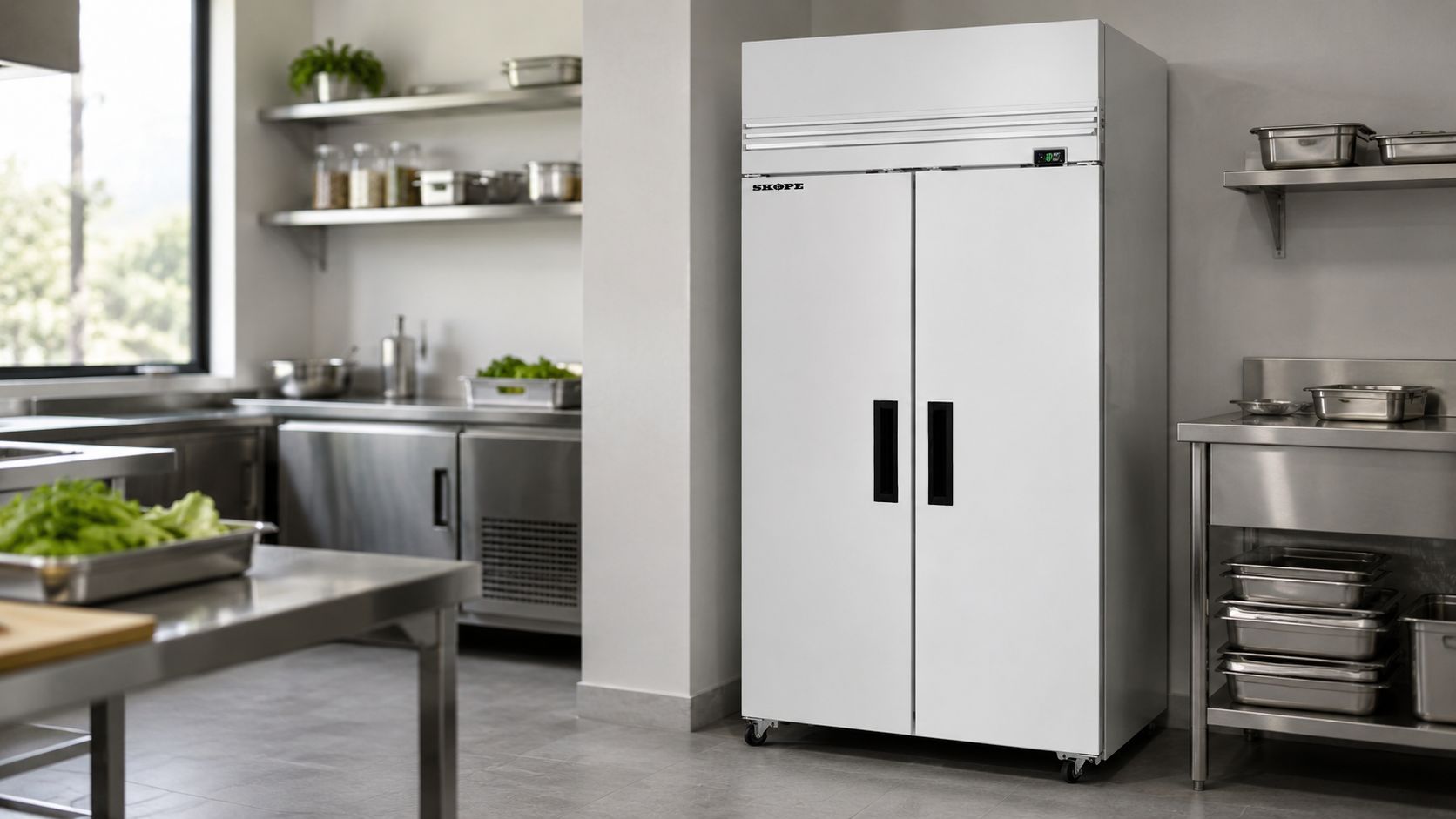
SKOPE ReFlex is a configurable refrigeration platform, and that flexibility is the point. Operators can match the cabinet to the job instead of forcing the kitchen around a generic box. In venues where one unit may shift between prep, pass, bar back, and back-of-house storage, that matters day to day.
The cabinet is the starting point, not the whole decision
ReFlex is built around choices such as solid or glass doors, single, double, or triple-door formats, and interiors suited to gastro and GN-style storage. The value is easy to miss until service starts. A cabinet with the wrong door type slows the pace, and the wrong door count can create more staff movement than it saves in footprint.
Quoting discipline matters here. If the door hand, lock, castors, and shelving arrangement are not set early, retrofits can turn into avoidable cost and avoidable downtime. During fit-out work, that is one of the common traps. A team signs off on capacity alone, then finds the service side does not suit the line, the door swing clashes with another station, or stock is awkward to reach in the rush.
The same thinking applies to freezer selection, even when the spec looks straightforward. The SKOPE ActiveCore 2 Door Storage Freezer - White - SKFT1000NS-A shows the kind of cabinet choice operators are making in the same family of equipment, with a 2 door configuration, solid swing doors, operation at -21°C to -18°C, and ambient tolerance up to 40°C. Those are the hard details that matter when a cabinet has to live in a hot, demanding professional kitchen.
The service side matters too. SKOPE's product material also highlights R290 refrigerant, removable refrigeration modules on ActiveCore platforms, and cabinet designs intended to simplify future servicing and reduce disruption when faults happen. That links directly back to risk management. A fridge that can be maintained without tearing the whole kitchen apart is the one operators are far more likely to keep in service.
For a broader comparison of how SKOPE builds different cabinet families, see understanding the SKOPE ProSpec range.
A useful way to view ReFlex is simple. The spec sheet tells part of the story, but the value sits in how well the cabinet can be shaped around service flow, staff habits, and the venue's storage pattern. That is why the question is rarely “Is ReFlex good?” It is “Which ReFlex configuration fits this kitchen?”
Designing Refrigeration Around Workflow Rather Than the Other Way Around
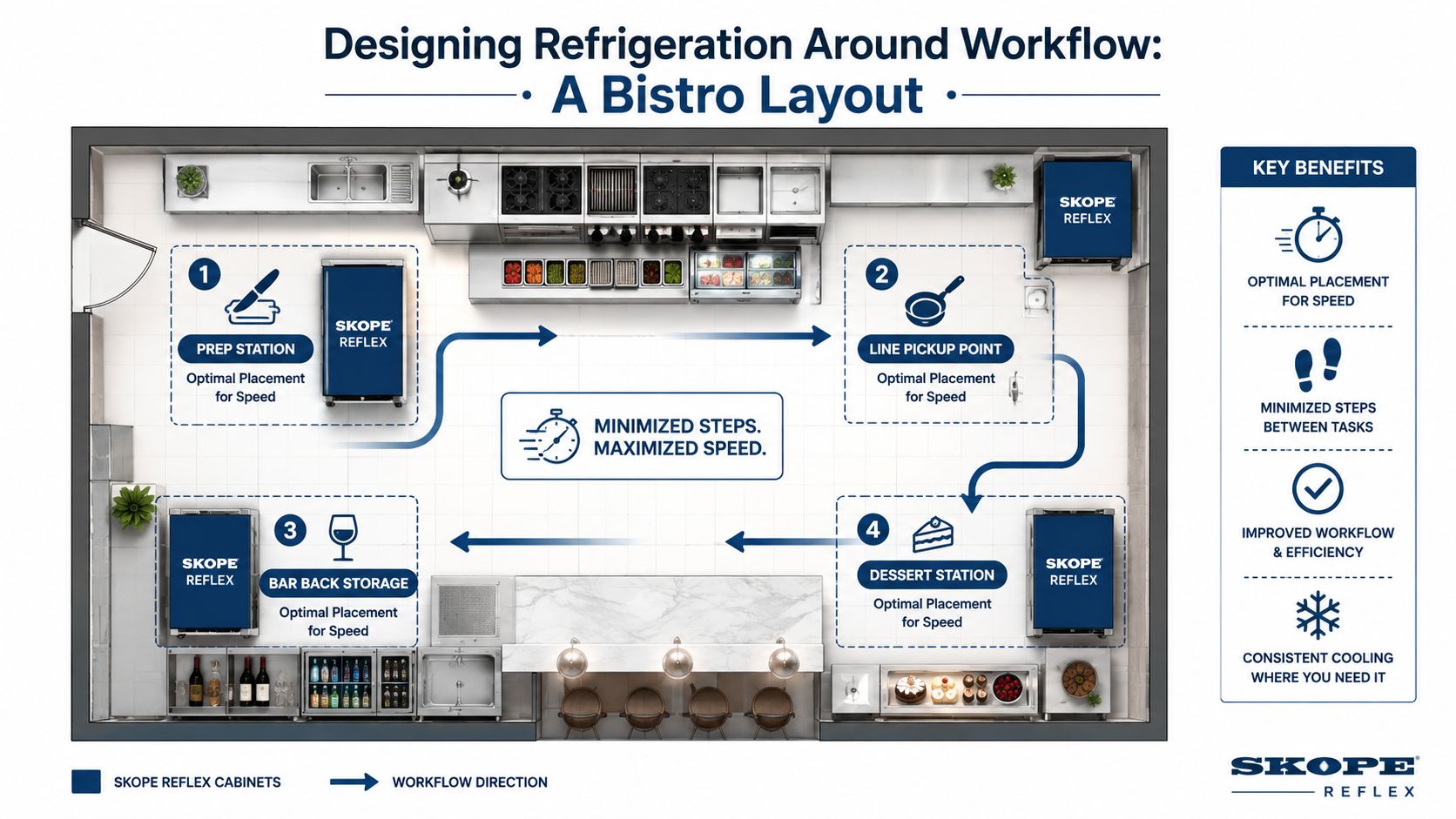
A small bistro can hide a poor fridge layout for a while. Service exposes it fast. Cabinet placement changes how far staff walk, how often doors swing open, and whether product reaches the right station in one move or gets carried across the kitchen in trays and hands.
A bistro layout tells the story better than a brochure
Take a straightforward NZ bistro with a prep station, a line pickup point, a bar back, and a dessert bench. The prep cook needs chilled herbs, sauces, and proteins close to the chopping area. The line needs fast access without cross-traffic. The bar team needs glass-front visibility for drinks, not a solid-door box that adds extra opening and closing. Dessert plating works better when the cabinet sits near the pass, so staff are not walking back through a tight galley for one more garnish.
ReFlex configuration earns its keep in those details. Pass-through storage can remove crossover in a narrow kitchen. Glass doors suit front-of-house or bar use where sightlines matter. Right-hinged and left-hinged choices matter too, because the wrong swing can block a service lane or force staff to step around a door during load-in and service. If you want a fuller look at how cabinet families are configured, see what makes the SKOPE EziCore range so popular.
Refrigeration layout is a workflow decision first, and an equipment spec second.
Walking is the hidden cost. Every awkward cabinet placement adds a little more movement to each shift, and hospitality teams feel that by the end of service even when they cannot easily measure it. A fridge that sits one station too far from the pass can slow pace, add coordination problems, and make the room feel tighter than it should.
A good internal check is simple. If the line cook, bar person, and duty manager would each describe the cabinet differently, the layout probably has not been built around the way the kitchen works. Refrigeration should be planned alongside prep zones, cooking lines, and wash-up paths, not after the kitchen drawing is already fixed.
The best installations do not look clever. They just feel natural on service day, because the fridge is exactly where the team expects it to be.
Build Quality, Hygiene and Temperature Control in Busy Venues
Commercial refrigeration doesn't fail in glamorous ways. It fails when a gasket loosens, a door starts sweating, ice builds up where airflow should be, or temperature drifts gradually enough that the problem only shows up on the log. That's why repeat buying tends to follow cabinets that make the day-to-day less annoying, not just the spec sheet look strong.
The mechanical details are what keep the cabinet useful
SKOPE's Reflex and related commercial cabinets are built around features that matter in high-use kitchens, including stainless steel construction, rounded corners that are easier to wipe down, magnetic gasket sealing, and digital control systems that support temperature management and defrost behaviour. SKOPE also specifies food-safe storage ranges such as 1°C to 4°C on one commercial fridge sheet, alongside a 9-star energy rating and measured energy use of 4.50 kWh per 24 hours on that specification. Those numbers matter because they connect the cabinet to compliance, power cost, and practical installation planning.
The same engineering logic appears in higher-capacity units. One SKOPE three-door vertical chiller is specified with a gross volume of 1497 litres, operating at +1°C to +4°C in 43°C ambient, and measured at 4.95 MEPS (kWh/24h/m²) with a standard 230V single-phase 10amp cordset. For operators, those are the sorts of details that help a cabinet survive a hot back-of-house without becoming a constant maintenance problem.
Why hygiene and control drive repeat decisions
Busy venues care about cleanability because time is short and inspection standards are real. Stainless surfaces and rounded internal corners cut the effort needed to keep the cabinet presentable. Magnetic seals matter because a poor door seal doesn't just waste energy, it invites condensation, then icing, then airflow problems. Once that starts, the fridge becomes harder to trust.
SKOPE also uses design features such as natural R290 refrigerant and self-contained or removable refrigeration modules on some ActiveCore and ReFlex-related platforms, which helps with modern refrigerant expectations and can simplify servicing when faults occur. In environments where cabinets are opened all day, that serviceability is part of food safety too, because a unit that can be returned to stable operation faster is a unit that's less likely to sit on the edge of trouble.
For operators, the value of build quality is not luxury. It's consistency. A cabinet that holds its performance in year eight the way it did in year one saves the team from managing avoidable friction, and that's one of the strongest reasons hospitality businesses keep choosing the same platform again.
Service, Parts and the Long Tail of Ownership
The purchase decision is the easy part. The test comes later, when the cabinet has already lived through years of service, staff turnover and hard trading. That's when it either stays familiar and manageable, or turns into the fridge everyone hesitates to call about.
What usually happens after the warranty window
On a busy commercial fridge, the service work is usually ordinary, not dramatic. Hinges drift out of alignment, sensors need recalibration, fan motors wear, and controllers eventually need attention. None of that is unusual. The difference between a straightforward repair and a costly one usually comes down to parts access and technician familiarity.
That is where a local base matters. SKOPE's long-standing presence in Christchurch, and its wide use across hospitality, means technicians and operators are often working with equipment they already know. That can shorten diagnosis, keep service conversations clearer, and make it easier to run the same maintenance approach across multiple sites.
Ownership rule: a refrigerator becomes cheaper to live with when the person fixing it already understands the platform.
The same point applies inside the kitchen. If chefs and duty managers already know how the cabinet behaves, fault reports are clearer and training on a replacement unit is faster because the layout feels familiar. Cleaning routines also stay more consistent when the team is not relearning the basics every time a unit is swapped.
Good support is part of the purchase decision, not an afterthought. A venue that wants to limit downtime should ask about parts supply, technician access, and the shape of commercial fridge service options before it signs off on a cabinet. If a repair drags because a simple part is hard to source, the equipment cost grows well beyond the sticker price.
There is also a practical link between ownership and cash flow. Some operators want refrigeration costs to be predictable rather than lumpy, especially when they are balancing replacement cycles across several venues. That is one reason SKOPE Funding deserves attention, because eligible SKOPE refrigeration can be financed and scheduled maintenance can be folded into the funding arrangement. It gives operators a cleaner way to plan for ongoing equipment care instead of treating service as a surprise expense.
For broader context on equipment finance, how Capital Express helps restaurants is a useful example of how operators often think about spreading capital cost while keeping maintenance on the radar. The structure can change, but the aim is the same, keep the equipment predictable.
Repeat buying is partly a bet on the future. It is a decision about who will service the cabinet, whether the parts will still be available, and how easily the team will keep it in step with the shift.
Questions Worth Asking Before You Specify a ReFlex Cabinet
A good quote should be interrogated the way a duty manager interrogates a prep list. If the answers are vague, the cabinet probably isn't specified tightly enough. The cost of getting it wrong shows up later, usually when the kitchen is already busy and nobody has time for regret.
Ask the workflow questions first
Start with the obvious but often skipped details.
- Door style: Does the venue need solid doors for storage, or glass doors for visibility and faster selection?
- Format: Is underbench the right fit for the prep line, or will an upright cabinet work better without stealing floor space?
- Access: Will the door hand, hinge position, and opening arc suit the service side, not just the drawing?
- Storage pattern: Does the kitchen need GN compatibility, mixed shelving, or a layout built around frequent restocking?
These questions matter because refrigeration should support the movement of ingredients, not interrupt it. If product has to travel too far from cold storage to prep or pass, the layout is working against the team.
Then pressure-test service and support
The second layer is less visible but just as important.
- Common spares: Are parts readily available for hinges, gaskets, sensors, and controllers?
- Technician access: Is there a service path that makes sense for the venue's location and trading hours?
- Warranty scope: What's covered on the compressor, control system, and cabinet body?
- Failure response: What happens if the controller fails on a Saturday night?
Those are not theoretical questions. They're the ones that determine whether the kitchen stays operational or spends a service window waiting for the next available fix.
A useful reminder is that refrigeration is a whole-of-life decision. Operators who ask only about cabinet size can end up paying later through awkward placement, avoidable servicing, or a replacement that doesn't match the way the kitchen works. The right unit on paper isn't always the right unit on the line.
Planning the Whole Life of Your Refrigeration with SKOPE Funding
The smartest refrigeration purchase is the one the venue can still live with years later. That means looking at repayment, maintenance, replacement timing, and service continuity as one decision rather than four separate headaches. SKOPE Funding fits that thinking because it lets eligible SKOPE refrigeration be financed, with scheduled maintenance able to sit inside the arrangement so the cabinet is managed across its operating life, not just bought and forgotten.
Why predictable ownership matters more than a cheap start
Commercial refrigeration doesn't stop working after the invoice is paid. It runs constantly, and that means energy use, maintenance, and eventual replacement all belong in the same conversation. For many venues, especially those with multiple cabinets or multiple sites, spreading the cost across a longer term can make more sense than trying to absorb a lump sum and then hoping the repair budget behaves.
A useful way to think about it is simple. A two-door cabinet might suit a smaller prep or storage zone, while a four-door arrangement makes more sense where volume and segregation matter. The finance question isn't just which cabinet costs more to buy, it's which setup will be easier to support, service, and standardise across the next few years of trading.
Operators who are already running older SKOPE units can also think about SKOPE-on-SKOPE finance as a way to keep the platform familiar while upgrading the parts that matter most. That can reduce training friction and help the replacement land without disrupting the whole kitchen flow.
There's a broader benefit here too. When maintenance is planned instead of reactive, refrigeration is less likely to become a crisis item at the worst possible moment. The venue gets better visibility on what it owns, what it owes, and what it needs to keep trading smoothly.
For operators comparing finance paths, the practical takeaway is straightforward. The cabinet should be chosen for workflow, but the ownership model should be chosen for the full life of the equipment. That's where the recurring appeal of SKOPE ReFlex sits, not in novelty, but in the way familiarity, serviceability, and planned care lower the pressure on the people running the venue.
If you're weighing up SKOPE ReFlex, or trying to decide whether to repair, finance, or replace a commercial fridge, Hospitality can help you work through the cabinet options, the workflow layout, and the long-term ownership questions. Visit Simply Hospitality to request a quote or get practical advice on the right refrigeration setup for your venue.