

Why Woodson Is a Trusted Name in Countertop Foodservice Equipment
The popular advice is to spend first on the biggest kitchen equipment. That approach misses where many compact venues produce and serve food. A toaster, contact grill, hot display or bain-marie may occupy little space, yet it can sit at the centre of a breakfast, lunch or takeaway workflow throughout service. Why Woodson is a trusted name in countertop foodservice equipment comes down to that practical fit: a broad commercial range, compact formats, durable construction, and equipment designed for repeated foodservice work rather than occasional domestic use.
In practice, most buyers are not comparing countertop equipment by industry sales figures. They want to know whether a unit will fit the space, handle consistent daily use, stay easy to clean, and keep service moving when the kitchen is busy. That is where countertop equipment earns its place. In many venues, these smaller units support core menu items and have a direct effect on workflow, food safety and day to day efficiency.
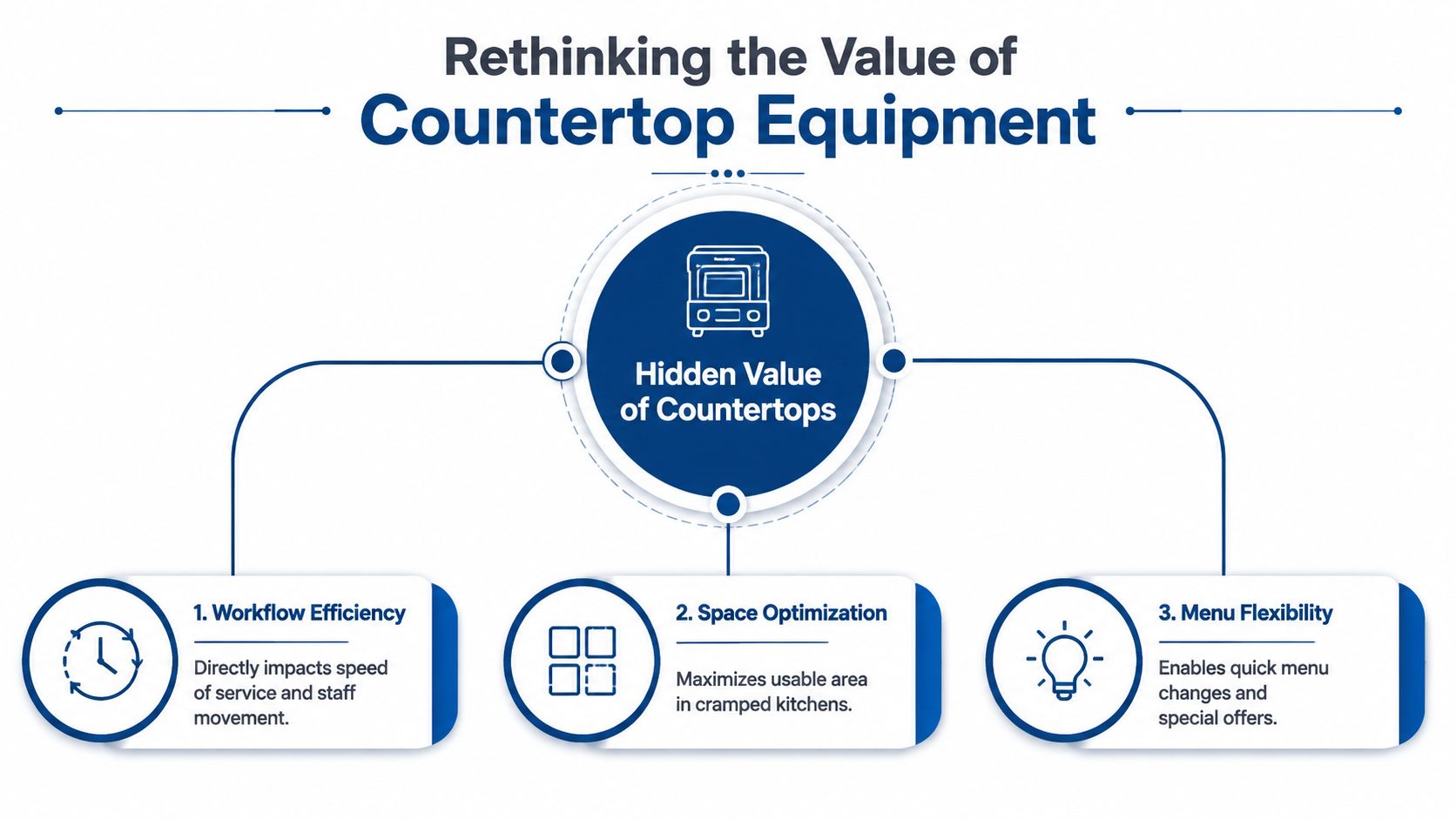
Rethinking the Value of Countertop Equipment
Large equipment attracts attention because it looks important. Combi ovens, cooklines, refrigeration and dishwashers often dominate a fit-out budget, but physical size doesn't determine operational value. A small appliance that prepares a popular menu item repeatedly can matter more to a venue's daily workflow than a larger machine used only occasionally.
A compact café, takeaway, food truck or satellite servery may rely on benchtop equipment for much of its menu. A toaster can handle breakfast production, a contact grill can finish sandwiches and proteins, and a heated display can keep prepared food visible and ready for service. The right question isn't, “What fits in the leftover space?” It's, “What earns its place on the bench?”
Bench space is a production asset
Every centimetre of working surface competes with preparation, plating, storage and cleaning access. A countertop appliance should therefore perform a meaningful job repeatedly, sit in the right position, and avoid creating extra movement for staff.
Good placement can be more valuable than adding equipment. If a grill sits close to assembly and a hot-holding unit sits close to the pass, staff don't need to carry partially finished food across the kitchen. That reduces unnecessary movement and makes the sequence easier to organise during busy periods.
Operators should assess revenue or production per centimetre of bench space as a principle, not as an invented financial calculation. Equipment that occupies valuable surface area without supporting a regular menu task is taking space away from prep and service. Equipment that handles a high-frequency task can justify a compact footprint even when its purchase price appears modest.
A useful purchasing comparison is the discussion of buying cheaply versus buying once. The cheapest unit isn't automatically the economical choice if it cleans poorly, lacks suitable capacity, or can't be supported when a fault interrupts a key menu item.
Practical rule: Judge countertop equipment by the value of the work it performs, not by its dimensions or price alone.
The Woodson Countertop Range Explained
Woodson's countertop range covers the tasks that frequently create pressure in compact commercial kitchens. Its listed categories include countertop fryers, contact grills, griddle toasters, salamanders, induction hobs, conveyor toasters and ovens, bain-maries or hot food wells, and ductless filter hoods through the Woodson range available from Simply Hospitality's Woodson countertop fryer collection.
The value is in how those categories can form practical workstations. A café may place a toaster beside sandwich assembly. A takeaway may position frying and hot holding close to the dispatch area. A deli may need visible food holding rather than a larger cookline hidden behind the service counter.
Matching categories to workflow
| Category | Primary function | Ideal venue type | Key models |
|---|---|---|---|
| Toasters and conveyor ovens | Toasting, finishing and continuous heating | Cafés, bakeries, takeaway venues | Conveyor toasters, griddle toasters and ovens |
| Contact grills and griddles | Pressing, grilling and surface cooking | Cafés, delis and quick-service venues | Contact grills and countertop griddles |
| Fryers and cooking equipment | Fried-food production and compact cooking | Takeaways and convenience operations | Countertop fryers and induction hobs |
| Hot food displays and bain-maries | Holding and presenting prepared food | Delis, caterers and institutional kitchens | Bain-maries, hot food wells and displays |
| Salamanders and finishing equipment | Browning, melting and finishing | Restaurants, bars and compact prep areas | Salamanders and related countertop cooking units |
| Ductless filter hoods | Recirculating filtration for suitable cooking loads | Retrofit sites and space-constrained kitchens | Countertop ductless filter hoods |
The range also supports modular planning. Rather than forcing every task onto one main line, operators can build stations around toasting, grilling, holding, display or finishing. That approach can preserve a clear preparation surface and put equipment nearer to the person using it.
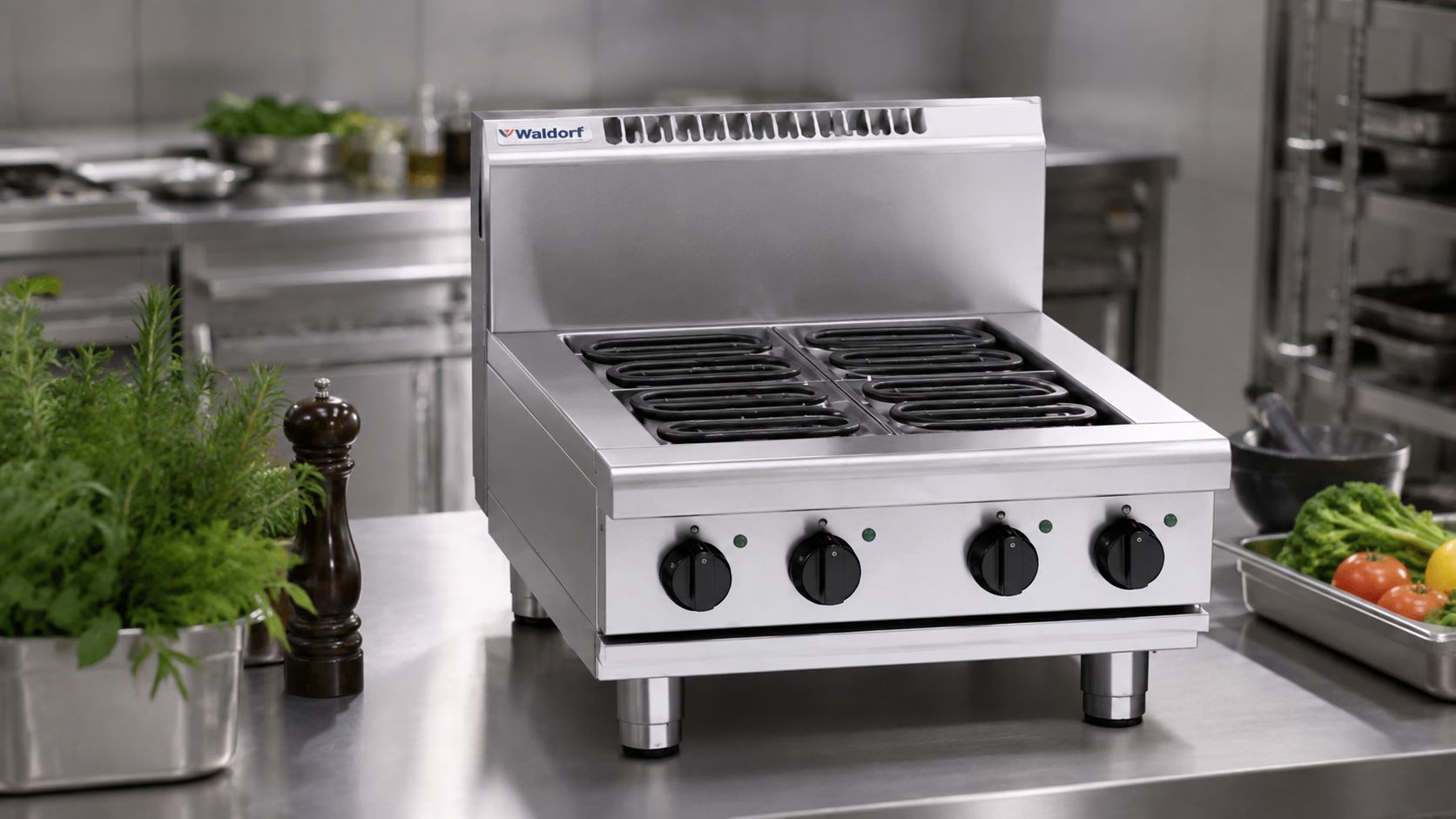
For a different type of cookline planning, the Waldorf 800 Series RN8400E-B 600mm Electric Cooktop Bench Model provides four 2.4kW radiant elements, six temperature settings including a simmer setting, a heavy-duty stainless steel finish, reinforced control knobs, adjustable feet and additional rollers. Its 600mm bench width allows it to operate as one module with a selected base, but the pan count, oven energy, pot sizes and extraction still need to be confirmed as one package.
A broad range doesn't remove the need for planning. It makes planning more useful because operators can select equipment around the actual menu, service position and available utilities rather than buying isolated appliances that compete for space.
How to Evaluate Countertop Equipment for Your Venue
A countertop appliance should pass a practical test before it reaches the purchasing list. The key questions concern frequency of use, footprint, production capacity, power requirements, workflow position, cleanability, commercial durability, parts support and servicing.
Start with the menu. List the tasks that happen during each service and identify which appliances perform them. A unit used for one occasional special has a different justification from a toaster, grill or hot display used throughout breakfast or lunch service.
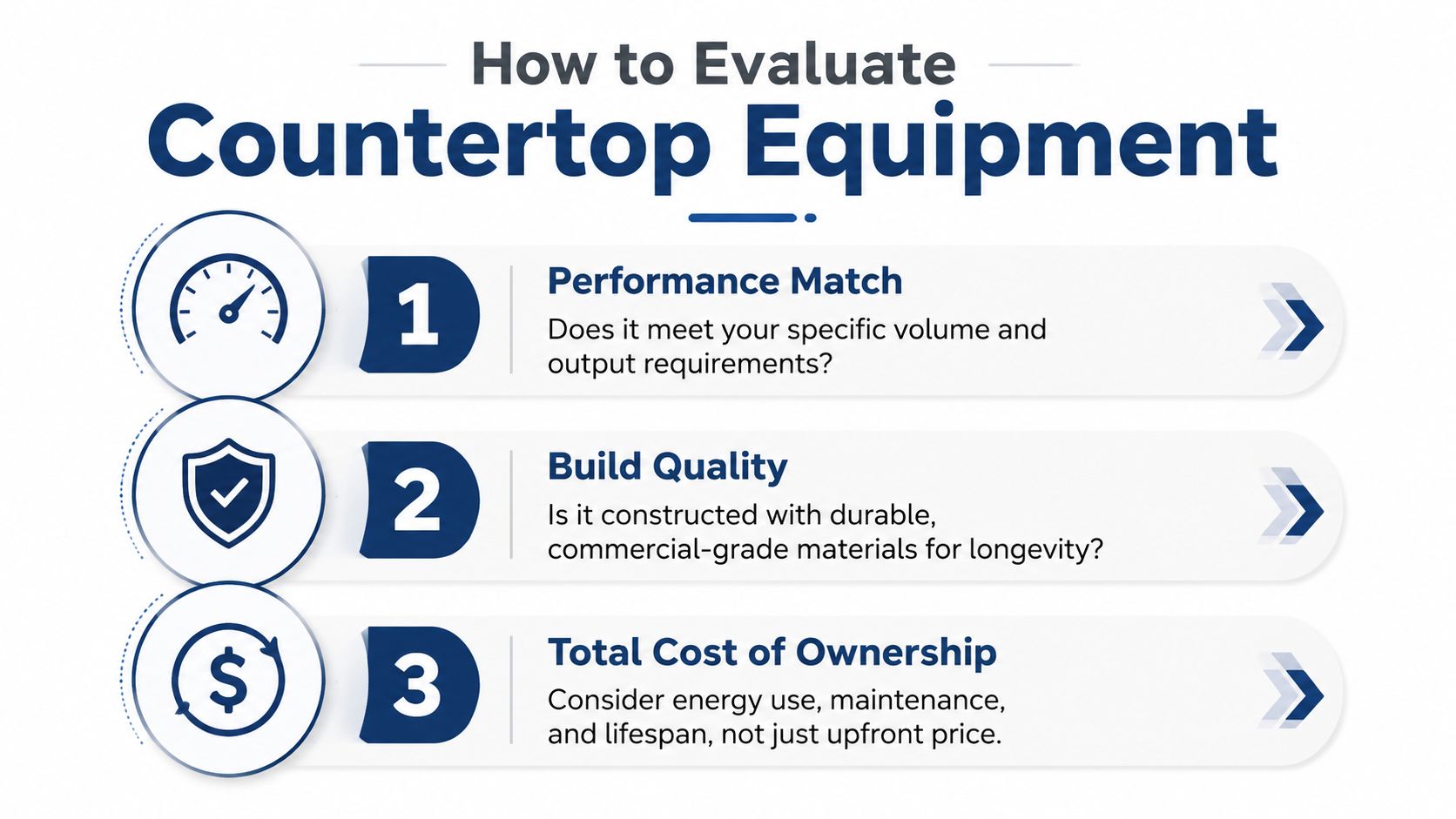
A practical selection check
- Frequency of use: How often will staff operate the appliance, and does it support a core menu item or an occasional task?
- Capacity at peak demand: Can the unit maintain the required output when orders arrive together, or will staff queue around it?
- Footprint efficiency: Does the appliance justify the bench area it occupies, including clearance for controls, loading and cleaning?
- Electrical requirements: Can the venue provide the required connection without overloading the circuit or compromising other equipment?
- Workflow position: Does it need to sit beside assembly, the pass, prep, dispatch or a customer-facing display?
- Cleaning access: Can staff reach underneath, around and inside the unit without dismantling half the station?
- Supportability: Are parts, warranty assistance and service arrangements available for the model in New Zealand?
Capacity needs careful judgement. A larger appliance isn't always better if demand doesn't justify its footprint, while a smaller unit can become a bottleneck if it can't keep pace with the menu. The correct choice depends on peak workload, not a quiet trading period.
Operators should also measure what the current setup prevents. A redundant appliance may consume the bench space needed for plating, packaging or a second production task. Replacing it with a better-matched unit can improve the station without adding more equipment.
Understanding the differences between domestic, semi-commercial and commercial equipment helps clarify why appearance alone isn't enough. Commercial construction, intended duty, cleaning requirements and serviceability all affect ownership.
Commercial Construction and Food Safety Compliance
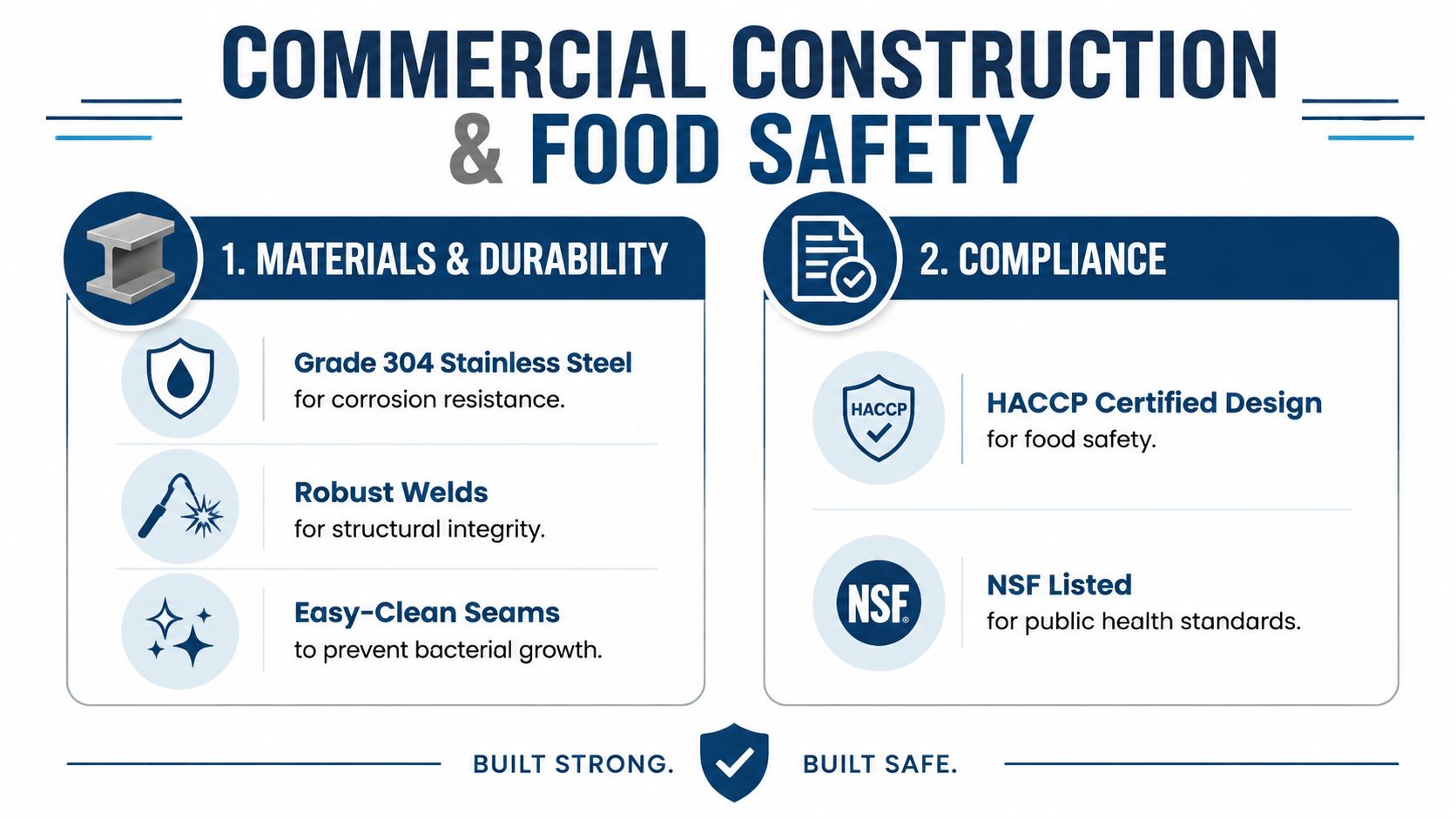
Countertop equipment works in an unforgiving environment. Heat, moisture, grease, repeated washing, spills and constant handling expose weak finishes quickly. Stainless steel construction, sound welds, accessible seams and serviceable components matter because the unit must remain usable and cleanable after repeated commercial work.
New Zealand food-premises guidance requires counters, bars, food displays, window displays and bain-maries to have surfaces that are smooth, durable, impervious and free from cracks, crevices and cavities, including internal surfaces, as set out in the New Zealand food-premises guidance. That requirement affects how buyers inspect equipment. A low price doesn't compensate for joins that trap residue or finishes that become difficult to sanitise.
Construction choices that affect ownership
Commercial kitchen guidance emphasises stainless steel plant and equipment, while hygienic food-processing tube standards specify welded austenitic stainless steel for food and other hygienic applications, as described in the NZ stainless steel fabrication guidance. The practical benefit is a material approach suited to heat, moisture, cleaning chemicals and heavy handling.
Food businesses must also keep premises, fixtures, fittings and equipment in good repair and working order. Equipment must be clean and sanitary for its intended use, and damaged items such as chipped, broken or cracked utensils must not be used for handling food under the food safety standard.
Operators should inspect:
- Welds and edges: Smooth joins are easier to clean than rough or open seams.
- Seals and gaskets: Worn seals can allow residue and moisture into areas staff can't clean properly.
- Controls and handles: These should withstand repeated use and routine cleaning.
- Removable components: Parts that can be removed safely are easier to inspect and sanitise.
- Clearance: Equipment should be movable or installed with enough access for cleaning beneath and around it.
A unit that still turns on but can no longer be cleaned effectively isn't performing its intended job. That makes construction quality part of food-safety management, not merely a durability preference.
Ventilation Solutions for Compact Kitchens
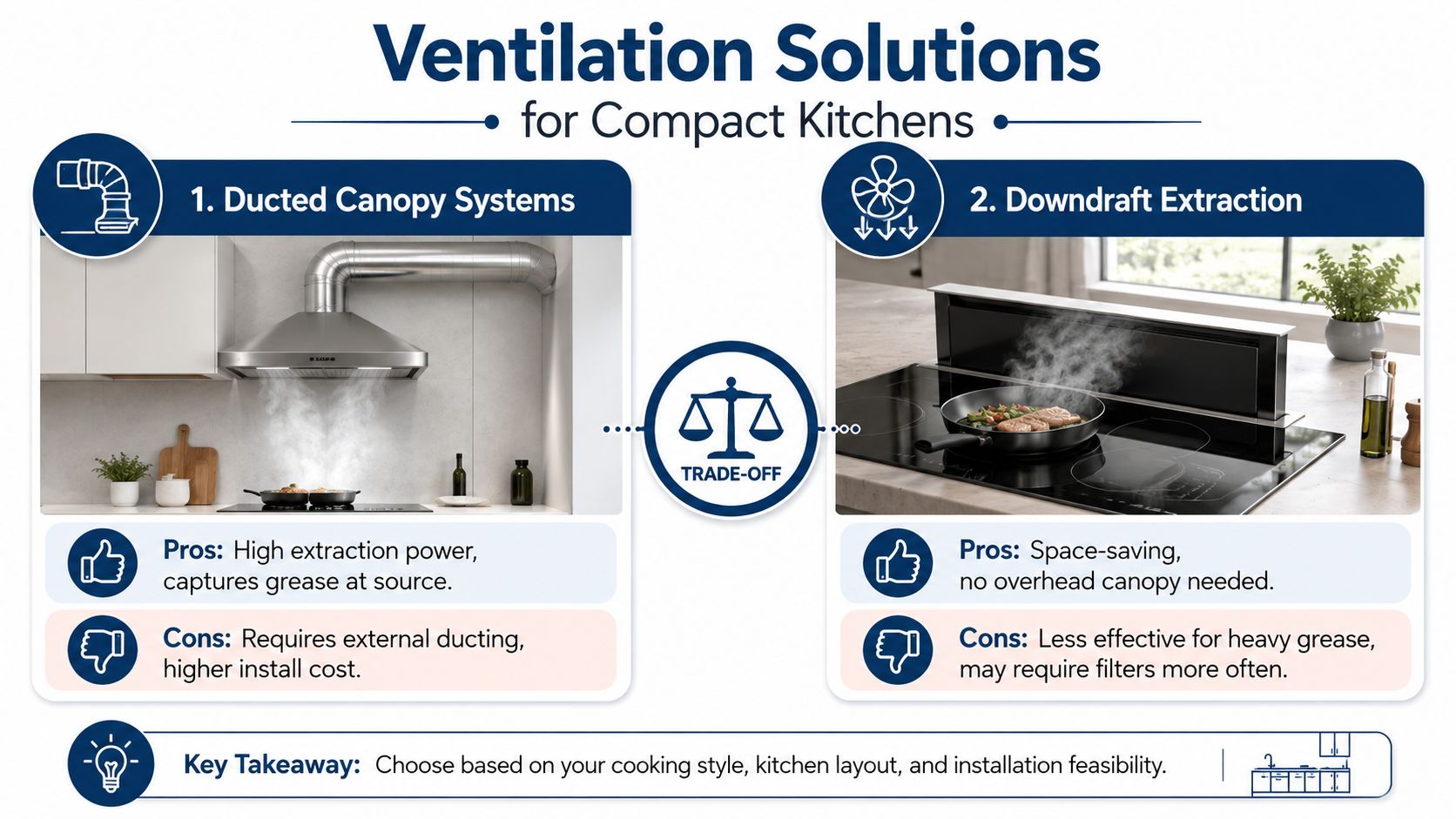
Cooking on the benchtop can add heat, grease and vapour to a small room quickly. Ducted extraction and ductless filtration solve different site problems, so selecting between them requires an honest assessment of the menu, cooking load, building constraints and approval requirements.
A ducted canopy generally provides a direct path for contaminated air to leave the premises, but it can require structural work, external discharge planning and more complicated installation. A ductless hood recirculates air through filtration. That can suit a retrofit or compact site where ductwork isn't practical, but it doesn't make every cooking process suitable for a non-ducted setup.
Ducted and ductless trade-offs
Woodson's countertop filtration systems include models tested and certified for Australia and New Zealand against NCC-2022 performance requirements, with multi-stage filtration intended to reduce contaminants when adequate background ventilation is available, according to the Woodson countertop ductless exhaust hood information. Certification is important, but it isn't a substitute for site assessment.
A ductless system may be worth investigating for:
- Retrofit premises: Existing buildings may not allow practical duct routing.
- Compact service areas: A suitable unit can avoid the overhead bulk of a full canopy.
- Moderate cooking loads: The menu must match what the filtration system is designed to handle.
- Front-of-house cooking: Filtration can help manage vapour and heat where cooking happens close to customers.
Heavy grease production, high smoke loads or cooking that creates substantial airborne contamination may require a different extraction approach. Operators should confirm the appliance combination, filtration requirements, make-up air, fire safety implications and territorial authority expectations before installation. The commercial kitchen exhaust hood planning guide is a useful starting point, but a qualified assessment remains necessary.
The hood's placement matters as much as its specification. It should capture the source effectively, leave staff enough working clearance, and remain accessible for filter cleaning. A ductless solution that is undersized, poorly positioned or maintained irregularly won't deliver the intended result.
Service Support and Total Cost of Ownership
A countertop appliance can be inexpensive to buy and expensive to own. If it supports a popular menu item, a fault can force staff to change production, remove an item from sale or move work to an already crowded station. The purchase price is only one part of the decision.
Support should be checked before purchase. Operators should ask who handles warranty matters, where replacement parts are sourced, whether technicians understand the equipment, and how maintenance access has been designed. A supported commercial brand gives the operator a clearer path when a component needs attention.
| Cost factor | Woodson, NZ supported | Imported or unsupported |
|---|---|---|
| Parts access | Confirm local availability and ordering pathways | Parts may require overseas sourcing |
| Warranty assistance | Confirm the applicable commercial warranty process | Warranty responsibility may be unclear |
| Electrical suitability | Confirm New Zealand requirements before installation | Compatibility must be checked carefully |
| Service planning | Ask about local support arrangements | Repairs may depend on specialist availability |
| Downtime exposure | Reduce uncertainty through support planning | Delays can be harder to predict |
| Maintenance | Check access to serviceable components | Access and documentation may vary |
Questions that protect the operation
The equipment should be evaluated across its expected working life, energy requirements, cleaning routine, maintenance needs and potential disruption if it fails. No unsupported failure-rate comparison should be assumed. The sensible approach is to identify the menu item at risk and plan for parts, servicing and backup procedures.
Operators should also avoid treating warranty as a complete service plan. Warranty terms need to be read alongside installation requirements, cleaning responsibilities and the availability of consumable or wear components. A unit that is simple to access and maintain can be easier to keep in service than one with a lower purchase price but limited documentation.
The ageing equipment cost review provides a useful prompt for assessing whether an existing unit is still earning its bench space. If cleaning takes longer, performance no longer matches demand, or parts are difficult to obtain, replacement may be more practical than continued improvisation.
Real-World Applications in Hospitality Venues
A café running breakfast and lunch from a restricted kitchen might place a Woodson toaster or contact grill beside sandwich assembly, with hot holding close to the service side. That arrangement keeps preparation, cooking and handover connected. The operator still needs to check power, clearance and peak demand, but the station can avoid sending staff back to a distant main line for every toasted or grilled item.
A takeaway may combine a countertop fryer with a heated display or bain-marie. The fryer handles production, while the holding equipment supports organised dispatch and visible service. Hot-holding equipment must maintain at least 60 degrees Celsius, and freezers must remain below minus 18 degrees Celsius, according to New Zealand food-premises design guidance. The operator should test the equipment under service conditions, not only when empty.
A hotel bar, accommodation servery or institutional satellite kitchen may use a compact salamander, induction hob or hot food well for finishing and holding. The equipment can support a focused menu without requiring every task to happen in a full cookline. Placement beside the pass is useful when staff need to finish and serve quickly, while cleaning access and safe electrical loading remain essential.
These examples share one principle. Small equipment becomes valuable when it sits exactly where a repeated task happens. The right solution depends on the menu, staffing, premises, utilities and service pattern, not on the appliance's size alone.
Hospitality supplies commercial countertop equipment and related kitchen categories for cafés, takeaways, restaurants, accommodation venues and institutional kitchens. Operators can visit Simply Hospitality to discuss Woodson options, bench-space planning, installation considerations and support requirements before choosing equipment.