


Why Zwiesel Glass Has Become a Favourite for Premium Hospitality
The strongest glass isn't automatically the right glass for a premium venue. A thick tumbler may tolerate rough handling, yet still look cloudy, feel clumsy and lose its rim before a properly specified crystal glass reaches the end of its useful service. Zwiesel Glass has become a favourite for premium hospitality because it treats refinement and commercial practicality as connected requirements, not competing ideas.
That distinction matters in New Zealand. International arrivals rose 14% year on year in the year to June 2025, but remained 13% below 2019, while hotel supply was 13% above 2019 and occupancy was 14% below pre-COVID levels (CBRE New Zealand hotel figures). Operators are competing harder on the guest experience, but they still need glassware that survives repeated service, commercial washing and storage.
Zwiesel's appeal sits at that intersection. Its glassware is designed to present wine, Champagne, cocktails and other beverages with the finish expected in fine dining, premium hotels, wine bars, cellar doors, cocktail bars, function venues and premium catering. The commercial decision, however, reaches beyond the shape of the bowl. It includes material, wash compatibility, rack fit, handling, replacement planning and the complete journey from service to storage.
Refinement and Survival Can Coexist
A venue shouldn't choose the heaviest glass just because it appears difficult to break. Strength without refinement creates its own operational problems. Chunky glass can scratch, cloud or chip at the rim, while its weight affects carrying, polishing, storage and the way a guest experiences the drink.
Premium hospitality asks more of stemware. A fine wine glass needs a rim that feels clean against the lip, a bowl that suits the beverage programme and a stem that sits comfortably in the hand. It also needs enough structural resilience for commercial service, where staff clear tables quickly, racks move through a glasswasher and clean stock is returned to service repeatedly.
Zwiesel's history supports that premium positioning. The company was founded in 1872, construction began in April, and the first table glass was produced on 25 November 1872, according to the brand's published history. That longevity doesn't prove that every range suits every operation, but it gives procurement teams a supplier history built around consistency and professional use.
Practical rule: The best glass is the one that survives the venue's service loop while still delivering the required presentation.
A luxury restaurant may accept a more delicate profile if staff are trained, the beverage list justifies specialist shapes and storage is controlled. A high-volume bar may reasonably prioritise a shorter stem, stronger base and simpler range. Neither venue needs the same answer.
The useful question is therefore not, “Which glass is strongest?” It is, “Which glass delivers the right sensory experience without becoming impractical in this operation?” That framing prevents a common mistake, buying a visually impressive set that doesn't fit the glasswasher, the racks or the pace of service.
The Material Behind Tritan Crystal
Tritan crystal is a lead-free crystal formulation associated with Zwiesel's premium glassware, developed around titanium and zirconium oxide rather than traditional lead content. In practical terms, the material is intended to provide clarity, a refined feel and commercial durability without relying on leaded crystal.
The distinction matters in hospitality because glassware is used around food and beverages, handled by staff and washed repeatedly. A lead-free formulation aligns with contemporary expectations for food-contact serviceware, while the crystal composition supports the visual qualities operators want from premium stemware.
What the formulation changes
Manufacturing consistency matters as much as the material name. Glass is melted, formed and finished through controlled production steps, and those steps influence the consistency of bowls, stems, bases and rims across a purchase. A venue that orders a complete programme needs pieces that look coherent on the table and behave predictably in racks and washers.
The published Zwiesel material information describes Tritan crystal as engineered for repeated commercial dishwashing. It also identifies the formulation as lead-free, which is relevant for venues that want premium presentation without traditional leaded crystal.
For operators, the benefits are practical rather than abstract:
- Clarity: Clear glass lets colour, brightness and effervescence remain visible.
- Handling: A well-balanced piece can feel refined without being awkward during service.
- Wash tolerance: Commercial dishwasher suitability reduces reliance on slower, less controlled hand washing.
- Consistency: Controlled manufacturing supports a uniform appearance across a glassware programme.
The history also helps explain why Zwiesel is specified in professional environments. The brand states that sommeliers, winemakers, internationally acclaimed chefs and top hotels in over 120 countries value it as a reliable partner (Schott Zwiesel and professional gastronomy). That statement should be read as brand positioning, not as a guarantee that every product fits every venue.
The sensible approach is to verify the specification for the selected collection. Operators should check the manufacturer's care guidance, confirm commercial dishwasher suitability and test the actual glass in the existing rack system before committing to a large programme.
How Glass Design Shapes the Drink
Glass design changes both presentation and service behaviour. Bowl width, taper, rim aperture, stem length and base balance affect how a guest holds the glass, how the beverage is presented and how confidently staff can move it through a busy room.
A broad bowl can give fuller-bodied red wine room to open, while a narrower bowl can help keep chilled white wine focused and contained. Sparkling wine generally benefits from a shape that supports aroma without allowing carbonation to disappear too quickly. Those are design principles, not universal rules, so the beverage list should lead the decision.
For operators wanting a useful explanation of the relationship between shape and perception, how glassware transforms wine taste provides helpful context. Manufacturer information should still be used for claims about a specific Zwiesel collection or beverage shape.
Design details that matter in service
A thin, well-finished rim usually feels more refined than a thick rolled edge. A long stem can create a formal silhouette, but it also needs suitable rack clearance and storage. Stemless glassware removes the stem as a breakage point and can be comfortable for casual service, although hands transfer warmth more readily to chilled drinks and the format may not suit a formal dining room.
| Design Element | Bowl Width | Rim Aperture | Stem Proportion | Typical Beverage Match |
|---|---|---|---|---|
| Broad bowl | Wide | Moderate to wide | Longer, balanced stem | Fuller-bodied red wine |
| Tapered white-wine bowl | Medium | Narrower | Medium stem | Aromatic white wine |
| Sparkling shape | Narrow to medium | Controlled opening | Stable stem and foot | Champagne and sparkling wine |
| Universal bowl | Medium | Moderate taper | Compact to medium stem | Mixed wine programmes |
| Stemless tumbler | Varies by range | Tapered or open | No stem | Casual wine, cocktails and mocktails |
A premium glassware programme should reflect the menu, not catalogue photography. The Schott Zwiesel Wine Glasses collection can be assessed alongside the venue's red, white and sparkling service requirements, while the Schott Zwiesel Champagne Glasses collection addresses venues that need a dedicated sparkling presentation.
Operators should also consider the practical relationship between glass design and the rest of the table setting. A slim, dark safety-glass platform such as the Soehnle Bathroom Scales Style Sense Compact 300 Slate belongs to accommodation bathroom equipment rather than beverage service, but it illustrates the same design principle: appearance matters, yet the product still has to perform its everyday job.
For a broader comparison of premium stemware decisions, why Stolzle Lausitz has become a favourite in premium hospitality offers a useful adjacent reference without replacing the need to specify glassware around the actual beverage programme.
Dishwasher Cycles and Clarity Retention
A glass that looks exceptional on its first shift but becomes cloudy under commercial washing is a liability. Premium buyers should ask how the glass behaves after repeated cycles, not only how it looks when unpacked.
Published information for Zwiesel Tritan crystal states that the material was tested through 1,000 commercial-grade dishwasher cycles at 150°F, with less than 0.3% reduction in light transmission (Zwiesel Tritan crystal information). That is a specific material-performance claim, and it gives operators a useful benchmark for discussing clarity retention.
The test result doesn't guarantee that a venue's glasses will remain spotless. Water chemistry, detergent concentration, rinse aid, rack loading, temperature control and handling all influence the result. Mineral deposits can create spots, while incorrect chemical dosing can etch surfaces or leave residue. Overcrowded racks can also create contact damage even when the glass itself is dishwasher suitable.
What the benchmark does and doesn't tell buyers
The published cycle figure describes repeated commercial washing under stated test conditions. It doesn't provide a universal service-life promise, a breakage rate or a replacement forecast for every New Zealand venue.
| Glass Type | Rated Wash Cycles | Clarity Retention at 500 Cycles | Rim-Chipping Resistance |
|---|---|---|---|
| Zwiesel Tritan crystal | 1,000 tested cycles | Less than 0.3% light-transmission reduction after 1,000 cycles | Designed for commercial use, subject to correct handling |
| Standard crystal | Varies by product | Confirm with the manufacturer | Depends on construction and handling |
| Soda-lime glass | Varies by product | Confirm with the manufacturer | Depends on construction and handling |
The table deliberately avoids unsupported ratings for other glass types. There isn't one universal cycle figure for all standard crystal or soda-lime products.
A venue should investigate spotting rather than blaming the glass immediately. The practical causes are covered in what causes spotty glassware, including the interaction between wash chemistry, water quality and drying. Correct rack selection and routine washer checks matter just as much as the glass specification.
Commercial glasswashers can also run rapid cycles of 60, 120 or 180 seconds, with one New Zealand listing describing capacity of up to 960 glasses per hour (commercial glasswasher information). That throughput makes compatibility important. Premium glassware must fit the venue's wash process without forcing staff to overload racks or handle hot, wet glasses unnecessarily.
Matching Glassware to Venue Type
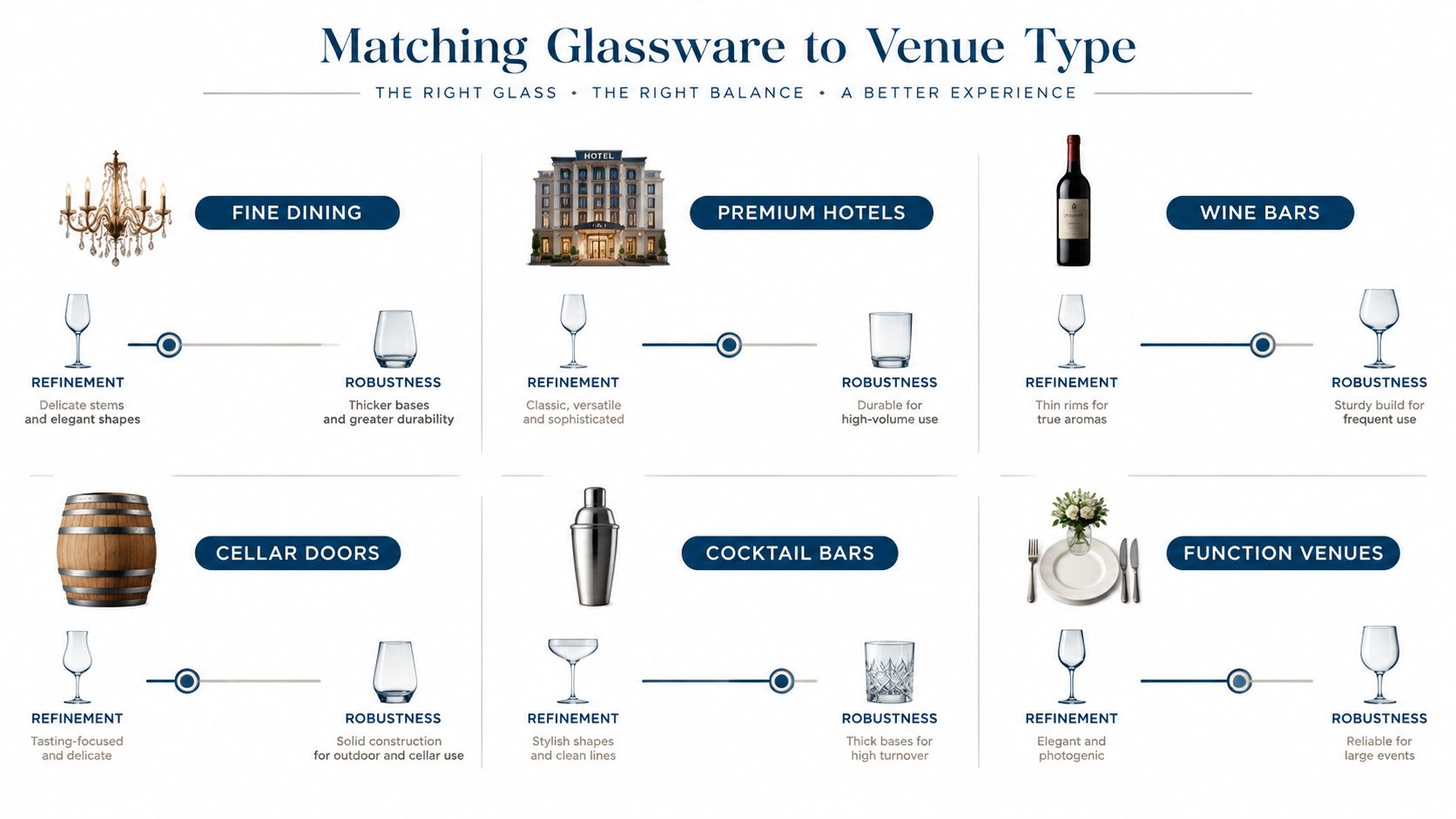
There isn't one correct Zwiesel programme for every premium venue. The right balance depends on beverage mix, service tempo, storage, wash equipment and guest expectation.
Fine dining restaurants usually place greater emphasis on bowl geometry, rim quality, stem balance and the visual relationship between glass and plate. The glass becomes part of the beverage narrative, particularly where sommeliers guide guests through varietals, regions and pairings. A restaurant with a broad wine list may choose several specialist shapes, but it should avoid adding forms that staff rarely use.
Premium hotels need a wider operating range. The signature restaurant may require refined wine and Champagne glasses, while banquets, room service and conferences need consistent handling and straightforward replacement. A coordinated programme often works better than selecting a different glass for every outlet.
Wine bars and cellar doors use glassware as a tasting instrument. Clarity, aroma access and a comfortable stem can support a more attentive tasting experience. Cocktail bars have a different priority. They may need tumblers, coupes, Nick and Nora styles, larger bowls and stable bases that suit shaken, stirred and built drinks.
Function venues and premium caterers tend to prioritise uniform optics, rack compatibility, stackability where appropriate and a clear replacement pathway. A beautiful specialist glass that creates sorting problems after an event can cost more operationally than a simpler, well-matched alternative.
A practical venue comparison
Zwiesel's range structure, including Pure, Enoteca, Classico, Banquet and Hommage, gives buyers categories to evaluate rather than a single visual style to accept or reject. The final choice should come from the operating brief.
- Fine dining: Prioritise refined rims, balanced stems and beverage-specific bowls.
- Premium hotels: Build a suite that works across restaurants, lounges, banquets and room service.
- Wine bars: Match shapes to the main varietals and tasting style.
- Cellar doors: Select glasses that support repeated tastings, clear presentation and easy replenishment.
- Cocktail bars: Consider bases, bowl capacity, stem stability and fast service handling.
- Function venues: Favour consistent sizing, rack fit and simple replacement planning.
Hygiene planning also deserves attention beyond glassware. Guidance on disinfectant wipes in hospitality can help teams think about touchpoints and cleaning responsibilities, although wipes don't replace a validated glasswashing process.
A broader overview of drinking glasses and glassware can help operators compare formats before narrowing the specification to Zwiesel collections.
The Service to Storage Glassware Loop
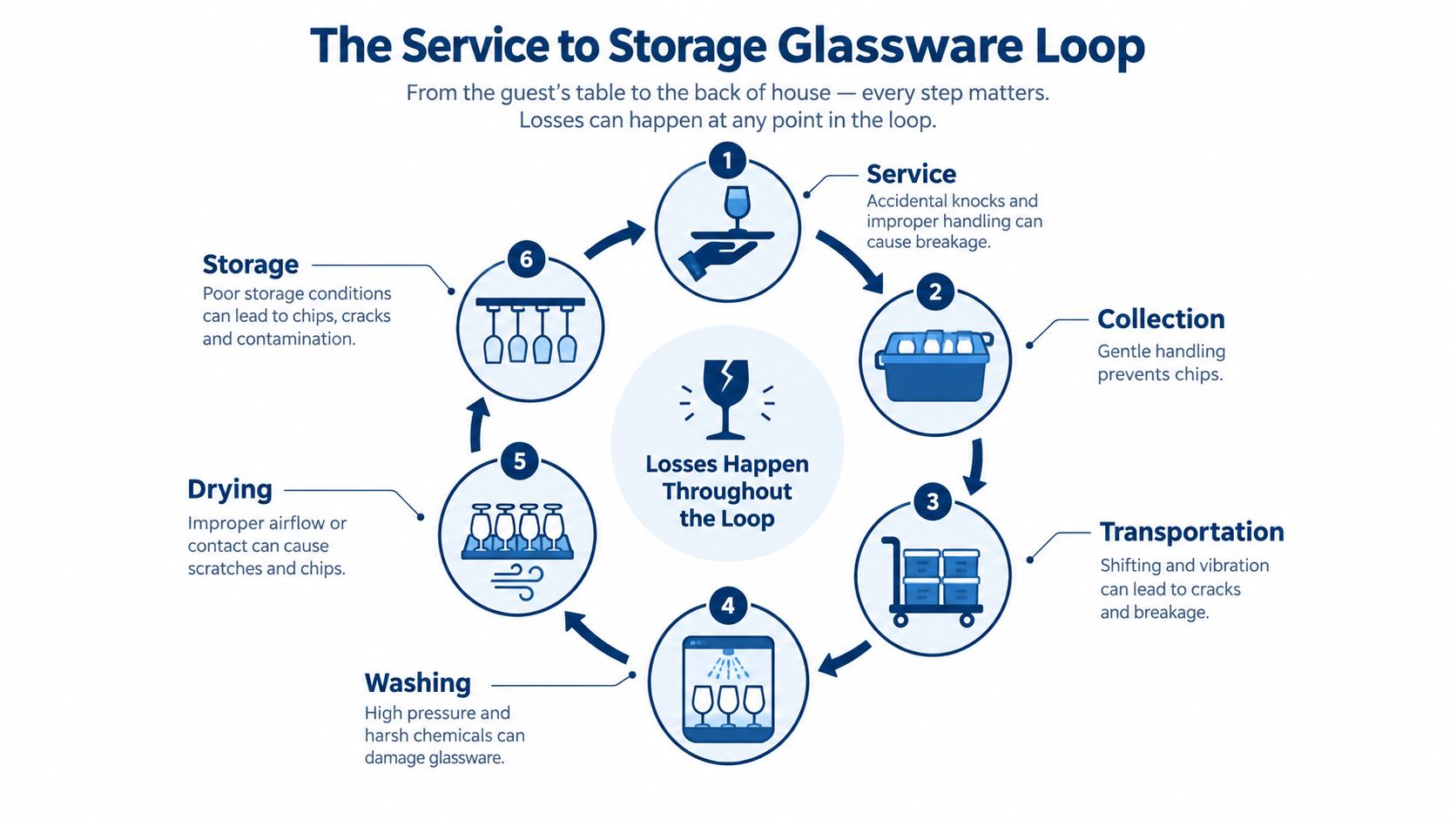
Glass construction matters, but breakage rarely begins and ends with the product itself. A premium glass travels through several handling points, and each one can introduce chips, cracks, scratches or thermal stress.
The sequence is straightforward:
Service → collection → transportation → washing → drying → storage
During service, staff can knock a rim against a tap, bench or table edge. During collection, bowls can scrape against bus tubs or cutlery. Transportation adds risk when trays are overloaded or carts move over uneven surfaces.
Where the process loses glass
Racking deserves particular attention. A compartment that's too narrow forces contact between bowls and stems, while a compartment that's too large allows movement during the wash. The rack should support the glass without trapping pressure around the rim.
The washer also needs disciplined management. Excess detergent, excess rinse aid, poor water quality or unsuitable temperatures can affect clarity and surface condition. Operators should follow the equipment manufacturer's settings rather than increasing chemical dosing to chase a faster result.
Operational insight: A premium glass can't compensate for a rack that holds it incorrectly or a storage shelf that allows rims to collide.
Drying and polishing create their own risks. Staff can twist a towel inside a bowl, grip the rim too firmly or move a hot glass into a cold environment. Storage should protect the rim and keep clean glasses in a position that prevents dust, moisture and contact damage.
A venue can improve the loop without changing brands:
- Train collection staff to keep glassware separate from cutlery and heavy crockery.
- Match racks to the actual glass dimensions, including bowl diameter, stem length and base size.
- Check washer settings and record chemical or water-quality issues rather than guessing.
- Inspect rims and bowls during polishing, removing damaged pieces before service.
- Store clean glasses securely, with enough clearance to prevent contact.
A commercial glasswasher can be the right choice where the volume and workflow justify it, while a dishwasher may suit a different operation. The comparison in glasswasher versus dishwasher helps frame that equipment decision around throughput, space and service pattern.
The important point is measurement. Operators should record breakage by location and stage, such as service, collection, racking, washing or storage, rather than assuming every loss reflects the glass material.
Procurement and Specification Guidance
The procurement process should begin with the beverage programme and end with the service loop. Buying from a photograph or choosing the same stemware for every outlet often creates unnecessary complexity.
A useful specification brief should record:
- Venue profile: Fine dining, hotel, wine bar, cellar door, cocktail bar, function venue or mixed service.
- Beverage mix: Main wine styles, sparkling service, cocktails, beer, water and non-alcoholic drinks.
- Service tempo: Table service, counter service, room service, banquets or event turnover.
- Wash system: Glasswasher or dishwasher, rack dimensions, cycle settings and chemical programme.
- Storage: Shelving height, hanging rails, cupboard depth and separation from other equipment.
- Replacement plan: Preferred range, supplier availability, care instructions and internal approval process.
Order planning should start with par stock, expected usage and a realistic replacement buffer. The exact buffer depends on the venue and shouldn't be treated as a universal percentage. A small wine bar with controlled handling may need a different reserve from a hotel operating restaurants, banquets and room service.
Reduce unnecessary range complexity
Range consolidation can simplify rack loading, staff training and stock counts. That doesn't mean every glass should be identical. It means each specialist shape should have a clear job.
A venue should check:
- Whether bowl and base dimensions fit existing racks.
- Whether stems can be stored without pressure on the rim.
- Whether the glasswasher can handle the height.
- Whether staff can identify each glass quickly during a busy service.
- Whether the selected range has a practical replacement pathway.
A written care guide is useful, especially when different outlets share stock. The guide should cover rack loading, chemical settings, drying, polishing and storage. Staff need to know that dishwasher suitability doesn't remove the need for correct handling.
Operators can also brief a supplier more effectively by sharing the service style, wash system, storage limitations and expected usage. A supplier such as Simply Hospitality can discuss commercial glassware categories and related hospitality equipment, but the recommendation should still be tested against the venue's actual process.
The premium glassware range provides a starting point for comparing presentation, material and operational considerations. Buyers should then request the specific manufacturer information for the selected Zwiesel collection rather than applying a general assumption to every product.
Buying discipline: Consolidate where it simplifies operations, but keep specialist shapes where they serve a clear beverage or presentation purpose.
Choosing the Right Range for Your Venue
A fine-dining restaurant may prioritise a delicate rim, balanced stem and varietal-specific bowl. A premium hotel usually needs a broader suite that can move between the restaurant, lounge, banqueting and room service. A wine bar or cellar door may put more weight on aroma, clarity and tasting consistency.
A cocktail-led venue may need tumblers and stable specialist stems that suit rapid service, while a high-volume function space may value uniformity, rack compatibility and straightforward replenishment above intricate bowl design.
The right Zwiesel range depends on the wash system, service speed, storage conditions and beverage mix already in place. Marketing imagery can't answer those questions, and neither can a generic claim about durability.
Operators should compare the shortlisted glasses in the actual rack, run them through the venue's wash process and ask staff to handle them during a realistic service simulation. That process reveals whether the glass feels appropriate at the table and practical behind the scenes.
For specification support, contact Simply Hospitality with the venue's beverage list, glasswasher details, rack dimensions and storage constraints. The team can help compare Schott Zwiesel glassware options against the operating requirements rather than treating premium glassware as a beauty contest.
Hospitality supplies commercial glassware and hospitality equipment for New Zealand restaurants, hotels, bars, caterers and event venues. Visit Simply Hospitality with the venue's beverage programme and wash-system details to discuss a Zwiesel specification that fits both the table and the service loop.