


Wood Fired Ovens Pizza for Hospitality Venues
A wood-fired pizza oven isn't a hotter version of a conventional oven. It combines fire management, thermal mass, cooking-floor recovery, insulation and operator skill into one production system. That combination can create distinctive pizza and genuine customer-facing theatre, but it can also introduce smoke, installation, fuel, training and service challenges that a standard oven may avoid.
For hospitality businesses, the important question isn't only whether wood-fired pizza tastes different. It's whether the oven suits the menu, expected peak-hour production, available space, installation conditions, local rules and the team operating it. Commercial wood fired ovens pizza should be assessed as part of the whole kitchen, not as an isolated equipment purchase.
Introduction Why Wood Fired Pizza Is a Concept Decision
A wood-fired oven should not be chosen because it reaches an impressive temperature. The operational test is whether it can maintain a useful cooking floor during continuous service while pizzas are launched, rotated and removed.
New Zealand guidance commonly places wood-fired pizza oven operation in the 400-500°C range, with Consumer NZ noting a claim of up to 500°C in 15 minutes, while local operator guidance describes around 400°C as a working temperature for rapid pizza baking. These figures are outlined in New Zealand pizza oven guidance, but they are not a guarantee of service performance. The floor still needs sufficient heat soak, the fire needs active management, and the operator must adjust as the load changes.
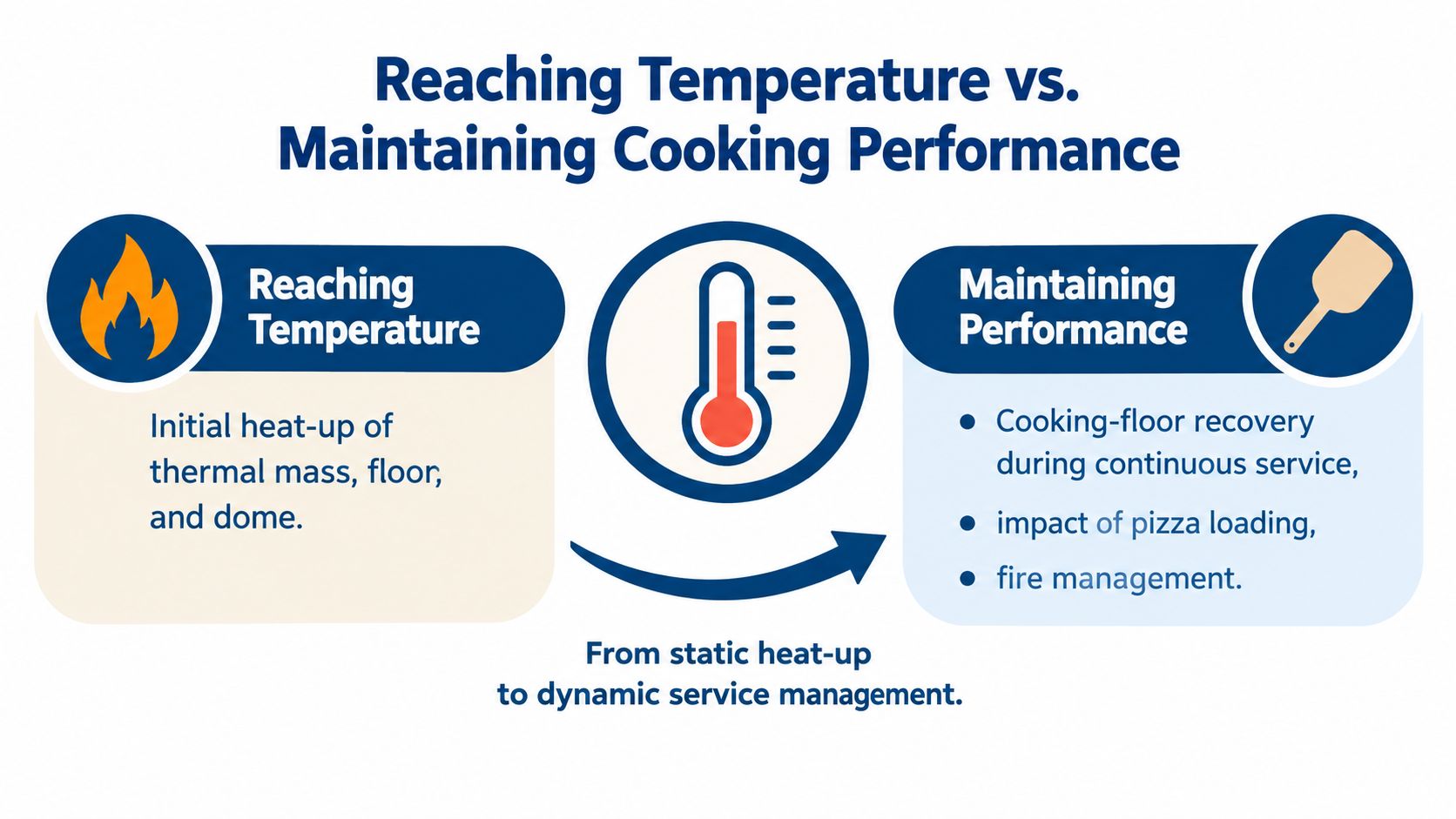
Reaching temperature is only the beginning. During a busy service, fire, thermal mass and operator decisions work as one production system. Adding wood too quickly can create excess flame or smoke. Holding the fire too low can leave the floor struggling to recover between pizzas. Those responses affect consistency, pace and the team's workload.
The fire also becomes part of the menu concept. In an open or visible kitchen, customers may see logs being added, flames moving across the dome and pizzas turned by hand. That theatre can support a venue's positioning, but it doesn't automatically increase restaurant sales. The commercial case still depends on the pizza style, production requirements, labour, fuel, installation and the audience the venue serves.
A traditional wood-fired oven can suit a pizzeria built around craft, visual cooking and a focused menu. A café with limited staff, or an accommodation provider needing predictable operation across changing shifts, may prefer gas-assisted or other commercial pizza-oven technology. Installation conditions, ventilation, fire controls and local compliance also belong in the decision before equipment is ordered.
Hospitality operators can review a breakdown of the customer-experience return on a wood-fired pizza oven alongside the wider equipment assessment. Confirm capacity, consistency, site suitability, compliance and total ownership demands before committing to the fire itself.
Understanding Wood Fired Pizza Oven Types for Hospitality
Commercial wood-fired ovens usually fall into a few practical groups. Traditional refractory ovens use dense, heat-resistant construction to absorb energy from the fire and release it gradually through the cooking chamber and floor. Insulated designs add layers intended to reduce heat loss, helping the oven retain useful cooking conditions between pizzas.
For commercial buyers, Valoriani is the range to examine closely through Simply Hospitality. The Valoriani IGLOO range is relevant where a venue wants a recognisable refractory oven format and customer-facing presence, but the exact construction, dimensions, weight, cooking-floor size and capacity must be confirmed against the selected manufacturer specification. Those details affect delivery, foundations, operator space and production planning.
Comparing the main configurations
| Configuration | Where it can fit | Main operational consideration |
|---|---|---|
| Traditional refractory oven | Dedicated pizzerias and venues making the oven part of the concept | Requires disciplined fire management and adequate heat soak |
| Insulated commercial wood-fired oven | Operators prioritising heat retention and repeatable service | Insulation supports stability, but it doesn't remove the need for skilled operation |
| Wood-fired oven with Spitfire gas integration | Venues wanting wood-fired character with additional control options | Gas integration changes the operating model and must be assessed against the selected configuration |
| Other commercial pizza technologies | High-volume or labour-constrained kitchens | May offer simpler temperature management, though without the same fire-led theatre |
The Spitfire gas integration or related gas options can be useful where a venue wants assistance with temperature control or operational flexibility. That doesn't make the appliance a conventional gas oven. The wood-fired operating method, ventilation design, fuel arrangements and staff responsibilities still need to be planned around the actual equipment.
Pizza capacity also needs careful interpretation. A larger cooking floor can accommodate more pizzas, but loading more product at once affects floor recovery, access and rotation. A compact oven may suit a café menu with modest output, while a dedicated pizzeria needs enough room for the expected peak workflow without forcing operators to crowd the hearth.
The practical comparison is not just wood versus gas. It's thermal behaviour, footprint, capacity, service control and concept fit. Guidance on wood-fired versus gas pizza ovens for hospitality businesses should be considered alongside the venue's menu and staffing model.
Reaching Temperature Versus Maintaining Performance During Service
An oven can reach its target temperature and still underperform during a busy service. Preheating charges the refractory floor, dome and surrounding thermal mass. Production then removes heat with every pizza, especially when cooler dough, sauce and toppings enter the oven. The buying decision should therefore focus on maintaining the cooking floor, not only on the time needed to reach a headline temperature.
Thermal mass provides stored energy. The floor needs suitable refractory construction and enough depth to absorb heat without developing an unstable cooking surface. Insulation keeps that energy inside the oven rather than allowing it to transfer into the surrounding structure. The two features must work together. A heavily built oven with poor insulation can waste fuel, while a well-insulated oven with an undersized floor may still struggle under load.
A practical service benchmark is a 380-450°C stone surface during service, after the stone or hearth has been fully heated. The exact result depends on the oven, fuel, fire position, pizza load and operating method. Maintaining that condition requires the fire, thermal mass and operator to function as one production system. Faster heating may support throughput, but the operational trade-off is recovery, labour and fuel use, as discussed in this guide to whether a faster pizza oven can increase restaurant revenue.
What recovery looks like in practice
During a quiet period, the operator can move the fire, check the floor and launch pizzas with space around each one. Peak service removes that margin:
- Loading reduces floor temperature: Every pizza draws energy from the hearth, with the effect increasing when several are loaded close together.
- Fire position affects balance: A fire pushed too far across the floor can scorch one side. A fire left too distant may not restore the cooking surface quickly enough.
- Rotation protects consistency: Rapid baking depends on reading crust and topping colour, not relying on a timer alone.
- Capacity changes the rhythm: Stated capacity matters less if the team cannot safely load, turn and remove that number during the busiest period.
An oven that appears technically efficient can become expensive when operators overfire it to compensate for weak recovery or poor heat retention. A peer-reviewed oven-modelling study measured efficiency near 12.2% during a water-heating test while burning 3 kg/h of oak logs, releasing 966.4 kJ over 80 seconds. The result illustrates why usable cooking energy depends on combustion control, fuel, preheat and insulation, rather than flame size alone.
Service rule: Maximum temperature describes an oven. Cooking-floor recovery determines whether it earns its place in a busy pizzeria.
Ask practical questions before choosing a model. How many pizzas must the floor hold? How quickly does it recover between loads? Can the team position the fire without blocking the working area? Does the insulation support stable operation without constant overfiring? Those answers matter more than a brochure's peak figure.
Installation and Site Planning for Commercial Wood Fired Ovens
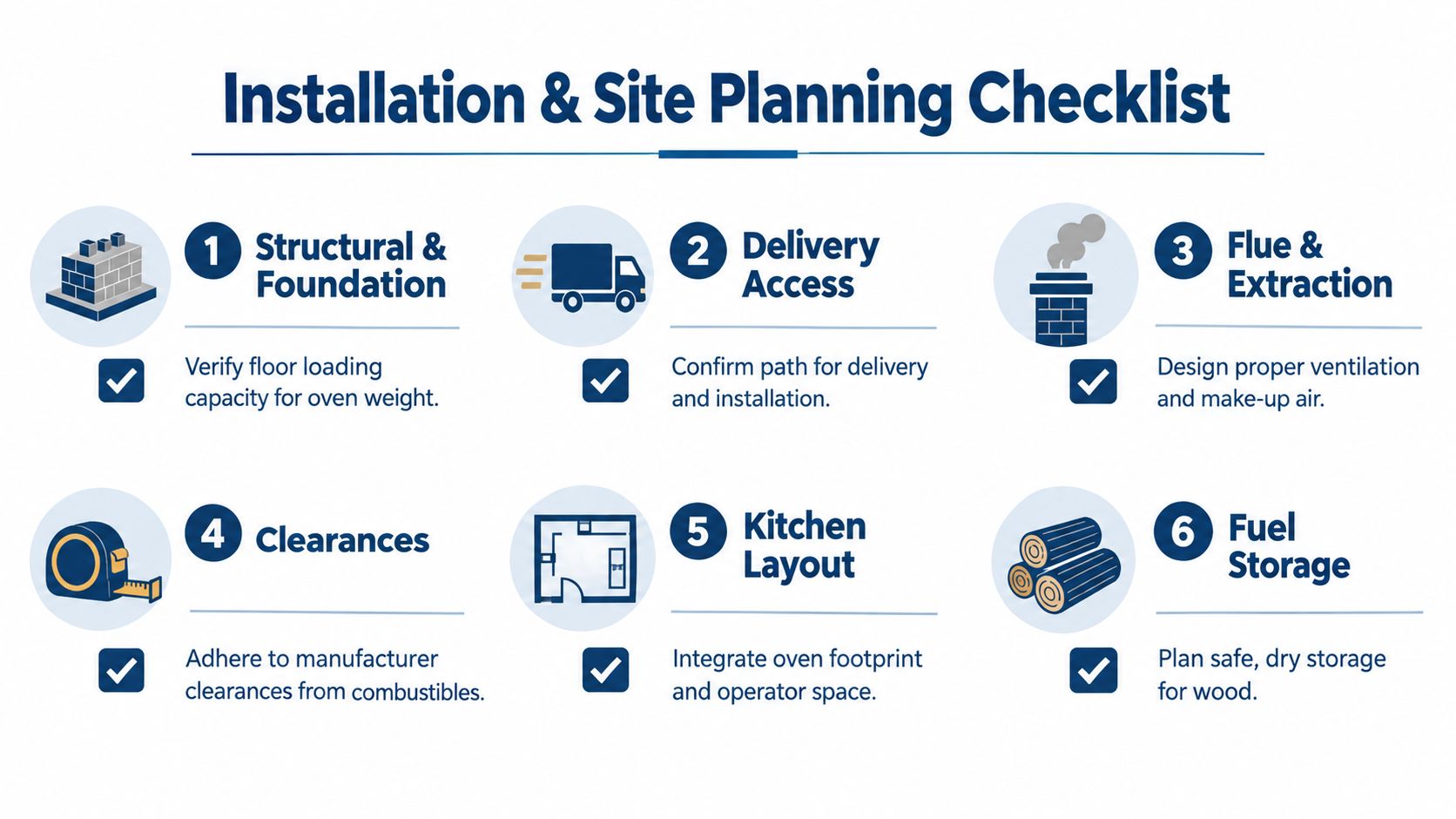
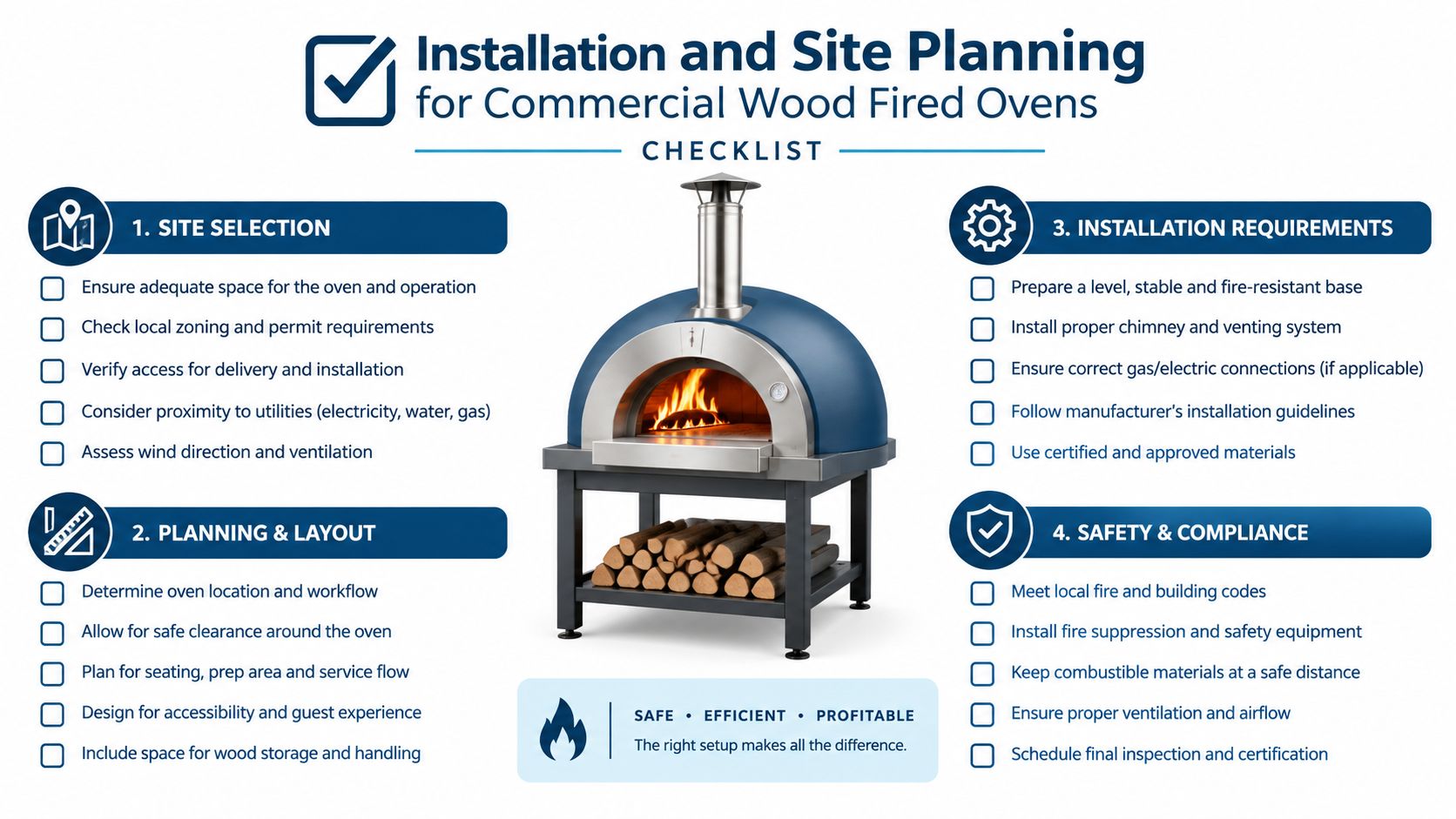
Installation shouldn't begin with a delivery date. It should begin with the building, the access route and the services required to operate the oven safely. Commercial wood-fired ovens can be substantial, and the selected model may affect the floor, foundations, flue, extraction, fire controls and kitchen layout.
Plan the site before choosing the oven
A project team should confirm the following with the manufacturer's documentation and appropriate qualified professionals:
- Structure and foundation: Check the oven weight, floor loading and any platform or foundation requirements. No universal structural specification is suitable for every building or model.
- Delivery access: Measure the route from unloading point to final position. Doorways, corners, stairs and lifting equipment can determine whether an installation is practical.
- Flue and extraction: Design the flue, ventilation and make-up air around the actual appliance and building. Guidance on commercial kitchen exhaust hoods is relevant, but the final design belongs with qualified specialists.
- Clearances: Follow the manufacturer's stated clearances from combustible materials. These depend on the oven, enclosure and installation arrangement.
- Kitchen workflow: Allow room for peel handling, fire tending, pizza assembly, landing space and cleaning. A large oven placed in a narrow cookline can create bottlenecks.
- Fuel storage: Keep suitable wood dry, accessible and safely separated from heat sources. Storage needs to support service without turning the kitchen into a wood-handling area.
Refrigeration and dry storage should also be planned around the pizza station. For example, the SKOPE ActiveCore 3 Door Storage Freezer - Stainless - SKFT1500NS-A has three solid swing doors, an operating range of -21°C to -18°C, adjustable from -26°C to -12°C, and is rated for ambient temperatures up to 40°C. Its storage position should be selected alongside the oven so frozen ingredients, packaging and service movement don't interfere with hot-side access.
Understand New Zealand consent and smoke obligations
For a permanent outdoor fireplace or oven, including a wood-fired pizza oven, New Zealand building guidance allows construction without building consent only where specific conditions are met. The oven must be on the ground, uncovered by a roof or wall, no more than 2.5 metres high, have a cooking surface of no more than 1 square metre, sit at least 1 metre from any legal boundary or building, and dispose of smoke without creating a nuisance or hazard. These conditions are set out in the New Zealand guidance for permanent outdoor fireplaces and ovens.
Fire safety adds further installation detail. The Fire and Emergency New Zealand guidance specifies a non-combustible hearth or base extending at least 500 mm either side of the fire box and at least 1 metre in front, plus a purpose-built cap or 5 mm steel mesh at the top of the vent or chimney to help prevent hot ash and embers escaping.
Local rules still matter. Palmerston North City Council states that a permanent outside fireplace or oven can be built without building consent if its smoke doesn't create a nuisance to another person or property, as described in its fireplace consent guidance. Operators should also check the relevant council and airshed before committing to an outdoor installation.
Operating the Oven During Service From Fire to Finished Pizza
A wood-fired service starts before the first order. Staff need to build the fire with suitable dry hardwood, allow the refractory mass to absorb heat and establish a working fire position. The aim isn't a large flame for its own sake. The fire should create the required balance between floor heat, radiant top heat and recovery.
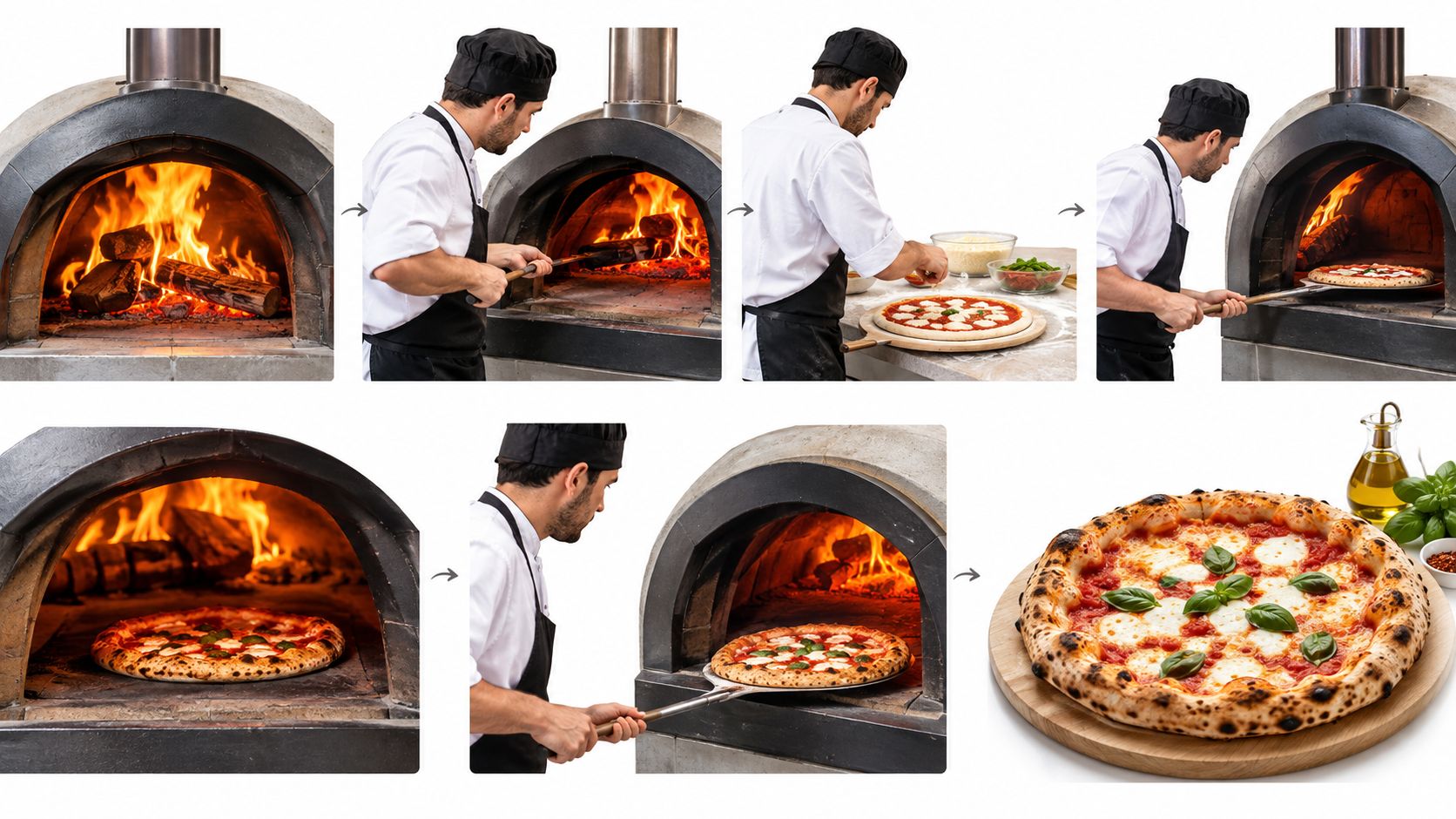
Once service begins, the operator manages several moving parts. A pizza may need to be positioned away from the strongest flame, rotated as the crust colours, then moved closer to or farther from the fire as the toppings finish. The next pizza might require a different position because the floor has recovered unevenly.
The service sequence matters
- Prepare fuel early: Wood should be dry, correctly sized for the appliance and stored where staff can reach it without crossing unsafe paths.
- Read the oven, not only the thermometer: Dome colour, floor response, flame behaviour and pizza movement all provide operating information.
- Load with recovery in mind: A full floor may look efficient, but excessive loading can lengthen cooking and create uneven results.
- Rotate deliberately: Staff should use the appropriate peel technique and keep the pizza moving when the flame requires it.
- Clear ash methodically: Ash and embers need controlled removal so they don't contaminate food, obstruct the hearth or create a fire risk.
Wood selection affects combustion, smoke and usable heat. Operators should follow the manufacturer's fuel recommendations and avoid treating any available timber as suitable cooking fuel. Consistent, dry fuel gives the team a more predictable fire than damp or variable wood, which can produce excessive smoke and uneven heat.
Wood-fired cooking also carries a greater operator component than setting a conventional oven and walking away. Manufacturer guidance should establish the operating method, while staff need practical experience with fire building, fuel loading, fire positioning, pizza rotation and recovery during busy periods. Any training or commissioning support should be confirmed as part of the specific project rather than assumed.
The customer-facing fire can add theatre where the layout allows it. A visible oven may help a venue communicate its style and craft, but it won't compensate for slow ticket times, inconsistent bases or poor kitchen flow. The operator still needs a service plan that works when the oven is busy and the audience is watching.
Cleaning Maintenance Safety and Emissions Considerations
Wood-fired ovens need a routine that protects both the hearth and the surrounding workplace. Ash should be removed using suitable tools once it is safe to do so, with embers placed in an appropriate metal container and managed according to the venue's fire procedures. Staff should keep the cooking floor clear of excess ash because residue can affect flavour, surface contact and the operator's ability to judge the hearth.
The chimney or flue requires attention as part of the site's maintenance programme. Creosote, soot and other deposits can accumulate when fuel burns poorly or the oven is operated with excessive smoke. Cleaning frequency depends on the appliance, fuel, usage and manufacturer requirements, so the service plan should follow the specific documentation rather than a universal timetable.
Smoke is a compliance issue
Regional air-quality rules don't treat every outdoor cooking installation identically. Environment Canterbury allows outdoor cooking, including pizza ovens, only where smoke doesn't cross the operator's boundary, while local rules can vary between airsheds and councils. The outdoor burning rules for Canterbury are a useful reminder that an apparently permitted activity can still create a problem if smoke affects neighbours.
New Zealand regional reporting also shows that air-quality rules may explicitly treat pizza ovens, outdoor fireplaces, braziers and other outdoor food-burning activities as permitted activities in some plans. At the same time, some regional plans set a 1.5 g/kg emissions limit for small solid-fuel burners tested to AS/NZS 4013 and an efficiency threshold of 65% when tested to AS/NZS 4012. The same Otago reporting estimated real-life emissions around 2.03 g/kg in Nelson testing for traditional single-chamber burners and around 2.05 g/kg in Arrowtown testing for upgraded burner designs, as recorded in the Air Quality Management in Otago report.
Ignition deserves particular attention. A 2026 ENEA study reported that wood-fired pizza ovens produced their highest pollutant levels during ignition, measuring emissions across NOx, CO, PM10, PM2.5 and PAHs, according to the ENEA report on pizza oven pollutants. Dry fuel, controlled starts, adequate preheat and good insulation can reduce the temptation to overfire or smoulder through the start-up phase.
Choosing the Right Wood Fired Oven and Planning Your Next Steps
The right commercial oven emerges from the production system, not from the highest temperature on a specification sheet. Restaurants should assess cooking-floor size, pizza capacity, thermal mass, insulation, recovery, footprint and expected peak output together.
A dedicated pizzeria may place greater value on floor area and recovery during continuous loading. A café or accommodation provider may prioritise compact installation, simpler staffing and flexible operating hours. A visible oven can support a distinctive concept, while a back-of-house oven may be judged more heavily on predictable workflow and labour requirements.
Before requesting a final quote, the project team should answer:
- What pizza format and menu will the oven produce?
- How many pizzas need to move through the oven during the busiest service?
- How much operator skill can the venue support across all shifts?
- Where will wood be stored, handled and disposed of?
- Can the building accommodate the oven, flue, clearances and access requirements?
- Would Spitfire gas integration or another commercial pizza technology provide a better balance of control and theatre?
Valoriani, including the IGLOO range, deserves particular consideration for commercial wood-fired pizza applications, but the exact model must be matched to the site and output rather than selected by brand familiarity. The practical buying framework in what to consider before buying a commercial wood-fired pizza oven is strongest when used alongside the manufacturer's technical information and advice from qualified installation professionals.
A wood-fired oven is a deliberate concept choice. It can produce distinctive results and a memorable cooking environment, but the fire, oven, thermal mass and operator must work together every service.
Hospitality operators can compare commercial wood-fired oven configurations, assess workflow and installation considerations, and coordinate related kitchen equipment requirements with support. Visit Simply Hospitality to discuss the venue's menu, capacity and site before choosing the right pizza-oven solution.