


How to Build an Aged Care Equipment Spec from Scratch
An aged care manager rarely chooses equipment based on features alone. The decision usually sits somewhere between meal service deadlines, infection control, staff fatigue, resident comfort, cleaning demands, and a budget that has to keep working long after installation day. That's why what aged care facilities prioritise when choosing equipment looks different from a standard hospitality fit-out.
In aged care, equipment has to support people first. It needs to be reliable enough for daily service, safe enough for vulnerable residents, simple enough for rotating teams to use properly, and durable enough to justify its place in a long-term operating plan.
Many operators also benefit from stepping back and looking at the full operational picture, not just the product sheet. That broader planning mindset is reflected in what we've learned from helping hospitality businesses choose equipment, where the recurring lesson is simple. The best equipment choice is usually the one that keeps service steady, staff supported, and the environment calm for residents.
Choosing Equipment for Aged Care Is About More Than Products
Aged care kitchens, laundries, dining spaces, and care areas don't run on specifications alone. They run on routine. Breakfast still needs to go out on time. Drinks service still needs to be safe and organised. Cleaning still needs to happen properly between one task and the next. If a piece of equipment disrupts that rhythm, it becomes a problem even if it looked fine in a catalogue.
That's why aged care operators usually weigh equipment in terms of operational fit. Reliability matters because breakdowns affect residents immediately. Hygiene matters because surfaces, storage, and food handling standards can't be an afterthought. Ease of operation matters because multiple staff members across different shifts need to get consistent results without unnecessary complexity.
The decision is usually human before it is technical
A fast machine that's awkward to clean often creates more work than it saves. A premium unit with a difficult interface can slow staff down during busy periods. A visually impressive serving solution can still fail if it doesn't hold food safely or fit the room properly.
A common issue seen in aged care projects is treating procurement like a simple replacement exercise. Old unit out, new unit in. That approach often misses the bigger question. Does the new equipment support safer handling, better presentation, easier cleaning, and more dependable service for the people using the space every day?
Aged care equipment works best when it reduces friction in the day, not when it adds another thing staff have to manage.
The right choice usually balances several pressures at once
Most facilities are juggling the same set of trade-offs:
- Resident wellbeing: Equipment should support comfort, dignity, food quality, and accessibility.
- Staff workflow: Teams need equipment that's intuitive, stable, and practical across changing shifts.
- Compliance and safety: Electrical safety, infection control, and handling requirements all shape what's suitable.
- Longevity: Replacement cycles, servicing, and day-to-day wear matter more than glossy features.
Many aged care operators find that the strongest purchasing decisions come from asking one simple question early. What will this item make easier every day for staff and residents?
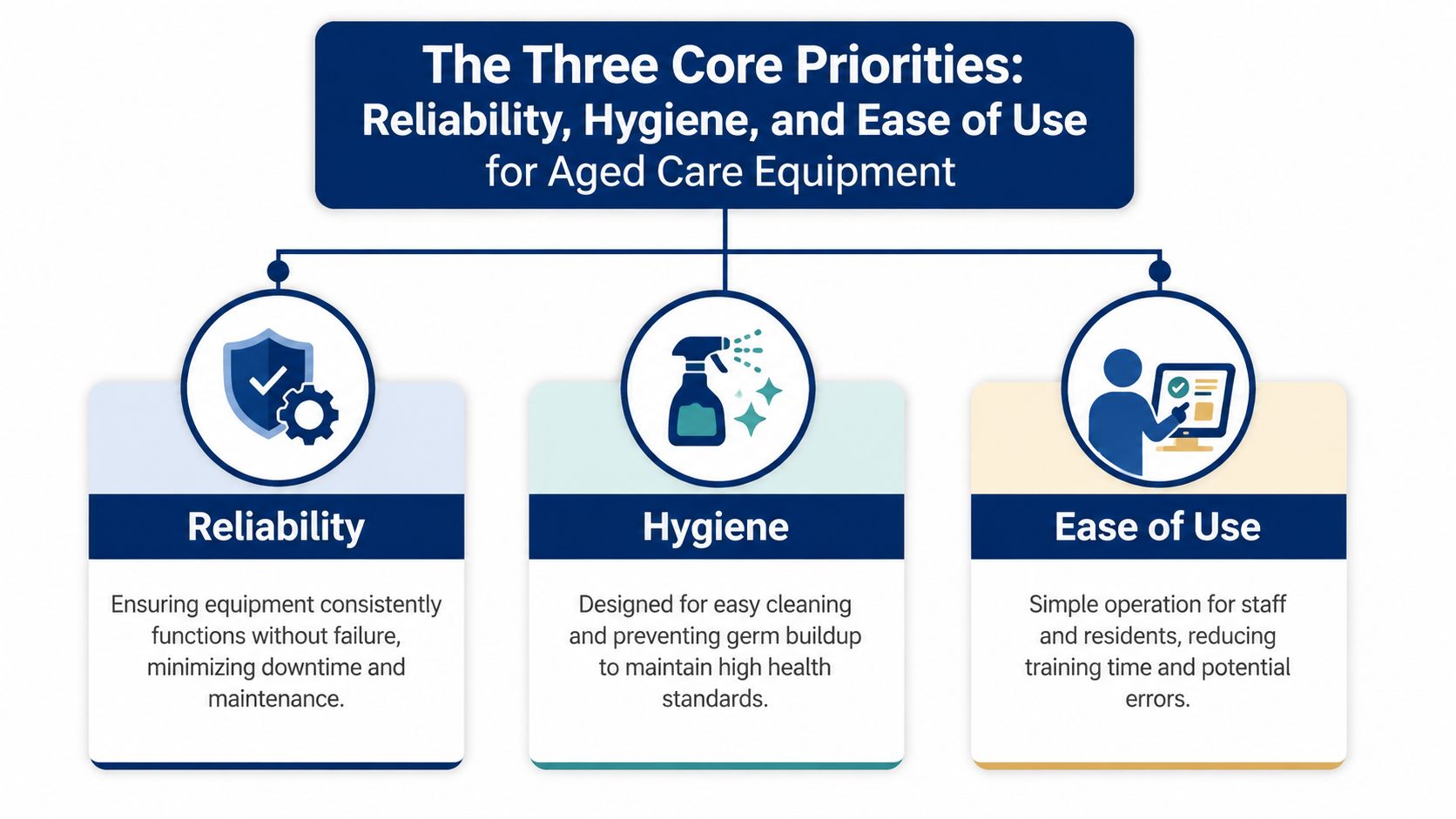
The Three Core Priorities Reliability Hygiene and Ease of Use
In most aged care fit-outs, three priorities rise to the top very quickly. Reliability, hygiene, and ease of use. Everything else tends to sit underneath those.
The staffing context makes those priorities even sharper. The 2023 Grant Thornton Aged Residential Care Service Review found that 71% of NZ facilities operate in the 26–50 bed range, below the optimal efficiency threshold. This compels smaller operators to select equipment that maximises labour productivity, as staffing shortages are a primary barrier to providing timely care for 64% of facilities (NZNO evidence summary reference).
Reliability keeps the day on schedule
Reliability in aged care isn't just about avoiding repair bills. It's about protecting routine. If a dishwasher fails before lunch service, or a display cabinet can't hold temperature consistently, staff don't just lose time. They lose certainty.
That's one reason operators often focus on proven equipment categories and service support rather than chasing extra features. The daily workload is already demanding. Equipment should remove variables, not introduce them. A related operational view appears in how reliable equipment protects your busiest trading days, and the same logic applies strongly in aged care.
Hygiene has to be built into the equipment
Cleanability shouldn't depend on staff having spare time. It needs to be part of the design. Smooth surfaces, accessible seals, removable components, and dependable warewashing all matter because hygiene standards in aged care are high and constant.
A common mistake is choosing equipment that looks durable but has too many awkward joins, hard-to-reach corners, or finishes that show wear quickly. In practice, those details affect whether a unit stays easy to sanitise after months of use.
Practical rule: If a team can't clean it properly during a normal shift, it's not the right equipment for that environment.
Ease of use matters more than people expect
Aged care teams often work across changing rosters, mixed experience levels, and time-sensitive service periods. Equipment with a clear interface, predictable controls, and straightforward loading or handling usually delivers better consistency than equipment that requires too much interpretation.
This matters in both kitchen and support areas. The right solution depends on who will use it, how often they'll use it, and whether the process needs to stay consistent from one shift to the next.
Even products outside aged care show why ergonomic setup and consistency matter. For example, the Moretti Forni Amalfi Single Deck Pizza Oven on Stand is designed with even heat distribution and an ergonomic working height on its stand. It's a pizza oven rather than an aged care staple, but it illustrates a broader procurement principle. Thoughtful design supports repeatable results and easier operation in busy professional environments.
Supporting Resident Wellbeing with Safe and Accessible Design
Safe equipment selection in aged care starts with one basic idea. The equipment has to work for the resident, the carer, and the room at the same time. If one of those elements is overlooked, the setup usually becomes harder to use and riskier to manage.
Space is a practical part of that conversation, not just a design issue. Aged care facilities in New Zealand often work to a benchmark of one square metre of storage per resident, and selections such as height-adjustable beds need at least 150 mm under-bed clearance to accommodate mobile hoists and support correct working posture for carers (aged care equipment requirements).
Good ergonomics protect both carers and residents
When a bed, trolley, bench, or chair is awkward to position, staff compensate with body movement. Over time, that creates strain. In aged care, repeated strain matters because handling tasks happen every day and often under time pressure.
Many aged care operators find that a well-planned layout does more for safety than a long list of features. Clear movement paths, adequate storage, adjustable heights, and room for mobility aids all help carers work with better posture and fewer awkward lifts.
Useful selection questions include:
- Can staff access the item without twisting or overreaching?
- Does it leave enough room for hoists, wheelchairs, and assistance during transfers?
- Will it still work safely when the room is busy, not just when it's empty?
Electrical safety is a baseline, not a bonus
Electrical compliance often gets discussed late, but it should sit near the beginning of the buying process. In New Zealand, aged care facilities commonly prioritise equipment that aligns with AS/NZS 3760 for in-service testing and tagging, which WorkSafe recognises under Regulation 26 as a safe method for meeting general safety requirements for plug-in appliances. Facilities also avoid unnecessary testing to AS/NZS 3551 unless the equipment is part of a treatment environment requiring that higher level of protection (WorkSafe guidance for electrical equipment safety in aged care and similar facilities).
That's an important distinction. Over-specifying every item can distort the budget. Under-specifying can create risk. The better approach is to match the equipment to the actual care setting and use case.
A common floor-level issue is staff fatigue during repetitive standing tasks. Products used in preparation, service, and wash-up zones need to support safer posture over the course of a shift, which is why some operators also look at workflow support items such as anti-fatigue mat solutions when reviewing staff wellbeing in back-of-house spaces.
Safe design isn't only about preventing incidents. It also helps preserve calm, dignity, and confidence for residents during ordinary daily routines.
Meeting Modern Standards for Infection Control and Cleanability
Infection control has changed equipment conversations across aged care. Cleanability used to be one criterion among many. Now it shapes layout, materials, mobility, and even how equipment is assigned to different areas.
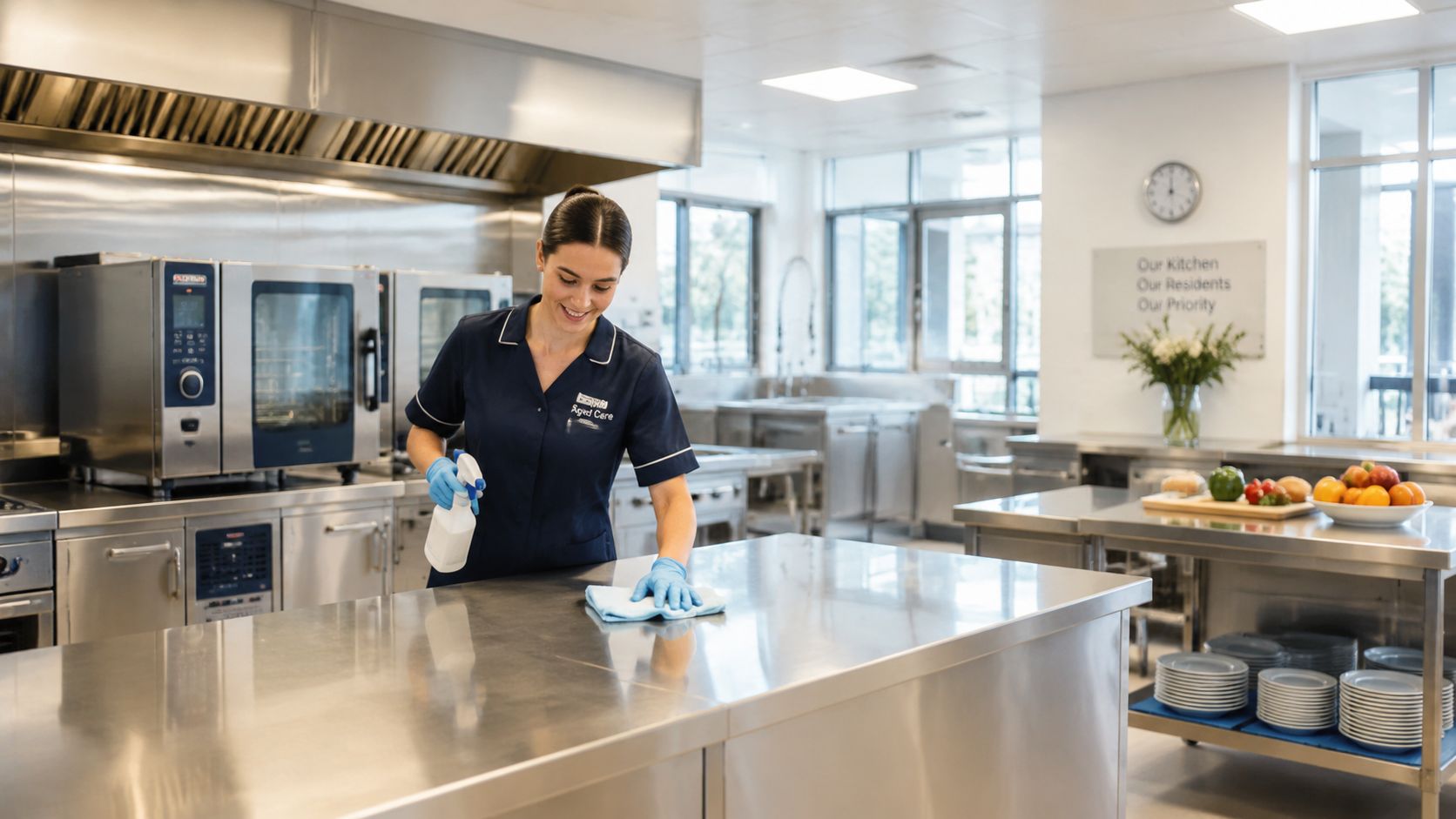
Material choice affects cleaning quality
Stainless steel remains a practical choice in many food service and support areas because it's non-porous, durable, and usually straightforward to sanitise. Just as important is how the equipment is built. Deep lips, exposed fasteners, poorly placed seals, and inaccessible undersides can all turn routine cleaning into a compromise.
Many operators choose equipment with removable shelves, accessible interiors, and simple external profiles because those details reduce the chance of missed spots during busy shifts.
Modular equipment supports isolation and separation
Portable and modular equipment has become more relevant because facilities often need to separate functions quickly. That can include dedicated service items for a room, trolley-based setups, or small equipment that can be cleaned and reassigned without disrupting wider operations.
Practical features worth checking include:
- Smooth contact surfaces: Easier daily sanitising and less grime retention.
- Simple disassembly: Faster deep cleaning when a full clean-down is required.
- Dedicated use options: Easier separation between rooms or wings when protocols change.
- Compact footprints: Better fit in tighter private-room or support spaces.
Food safety sits closely alongside infection control. Holding, transporting, and presenting food safely matters in any institutional setting, but aged care places extra weight on consistency because residents may be more vulnerable to poor food handling outcomes. That's why many operators review both equipment selection and process design together, including practical hygiene habits such as those covered in how to prevent cross-contamination.
A Real-World Example Improving Service in an Auckland Village
One project that shows how these priorities come together involved a Festivé refrigerated display cabinet installed in a large Auckland retirement village. The issue wasn't only that an older unit needed replacing. The wider problem was that the serving setup limited food choice and didn't support the level of temperature consistency and presentation the facility wanted during service.
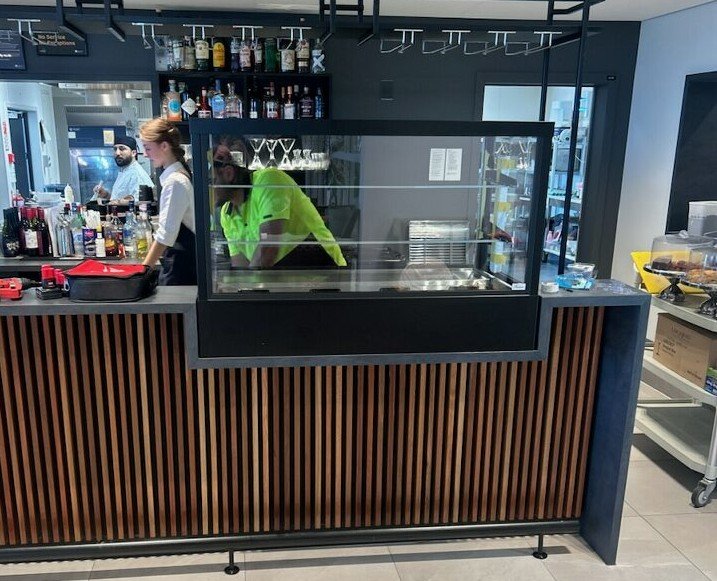
The larger Festivé cabinet gave staff more room to present a broader range of food while helping maintain more consistent food temperatures throughout service. That mattered for two reasons. Residents had better visible choice at the point of service, and the facility could hold food at appropriate temperatures more confidently until it reached residents.
The project depended on integration, not just supply
This kind of installation often succeeds or fails before the equipment even arrives. A cabinet can be technically suitable and still create problems if the bench height, sightlines, circulation space, or finish quality aren't handled properly.
In this project, collaboration with CI Projects was a major part of the result. The existing stone benchtop was modified and part of the serving area was redesigned so the larger cabinet could be integrated cleanly while preserving an attractive finish suited to the resident dining environment.
That's a good example of how aged care projects usually work in practice. The strongest outcomes tend to come from coordination between equipment suppliers, designers, and trades, rather than a handoff from one party to the next.
Presentation and compliance often need to coexist
Residents don't experience equipment as a specification. They experience it as part of the room. If a serving area looks clinical, awkward, or visually disconnected from the rest of the space, it can change how welcoming that environment feels.
At the same time, the service area still needs to support hygiene and food safety. For operators reviewing sanitisation processes more broadly, this overview of heat, chemical, and radiation methods is a useful general reference for understanding how different sterilisation approaches are applied in different contexts.
Aged care fit-outs work best when compliance, function, and presentation are treated as part of the same job.
The Auckland village project is a practical reminder that a successful equipment decision isn't always the one with the longest feature list. It's the one that fits the workflow, protects food quality, supports the people serving it, and still feels right in the resident environment.
The Financial Equation Durability Lifecycle Costs and Procurement
Aged care procurement can go wrong when the conversation stops at purchase price. The cheaper unit may look easier to approve, but if it wears quickly, breaks at inconvenient times, or creates more labour in cleaning and handling, the full cost shows up later.
One factor often missed is the tension between equipment lifespan and subsidy structures. Many procurement guides ignore how long-term depreciation can conflict with New Zealand's regional subsidy caps. For example, a $15,000 blast chiller's 10-year payback might exceed the 3–5 year subsidy window, creating financial gaps that an estimated 68% of facilities fail to anticipate.
Upfront cost is only one part of the decision
A durable unit usually earns its place through steadier performance, lower disruption, and a more manageable maintenance pattern. That doesn't mean every facility should buy the most expensive option. It means the buying process should reflect real use conditions.
A practical review usually includes:
- Expected lifespan: Will the unit hold up under daily use in this environment?
- Cleaning burden: Does it save time or create more of it?
- Serviceability: Are spare parts and technical support realistic to access?
- Workflow value: Does it reduce friction for staff, or does it add another task?
Procurement should reflect operational reality
Many aged care operators find that the strongest value comes from equipment that's appropriately specified, not overbuilt and not underdone. A unit that's perfect for a high-volume restaurant may not be the right fit for a smaller care environment. In the same way, a cheaper domestic-style option often won't cope with the demands of institutional use.
Total cost of ownership becomes more useful than simple price comparison. Purchase cost matters. So do maintenance planning, downtime risk, installation requirements, and whether the equipment still suits the facility if staffing or care needs shift.
A common purchasing lesson appears in buying cheap vs buying once when equipment actually saves money. The same principle applies strongly in aged care, where reliability and service continuity are tied directly to resident routines.
The cheapest item on quote day can become the most expensive item in the room once labour, disruption, and replacement timing are taken seriously.
A Practical Checklist for Choosing Aged Care Equipment
Aged care managers usually make better equipment decisions when they pressure-test each option against daily use, not just brochure language. The checklist below helps keep that review practical.
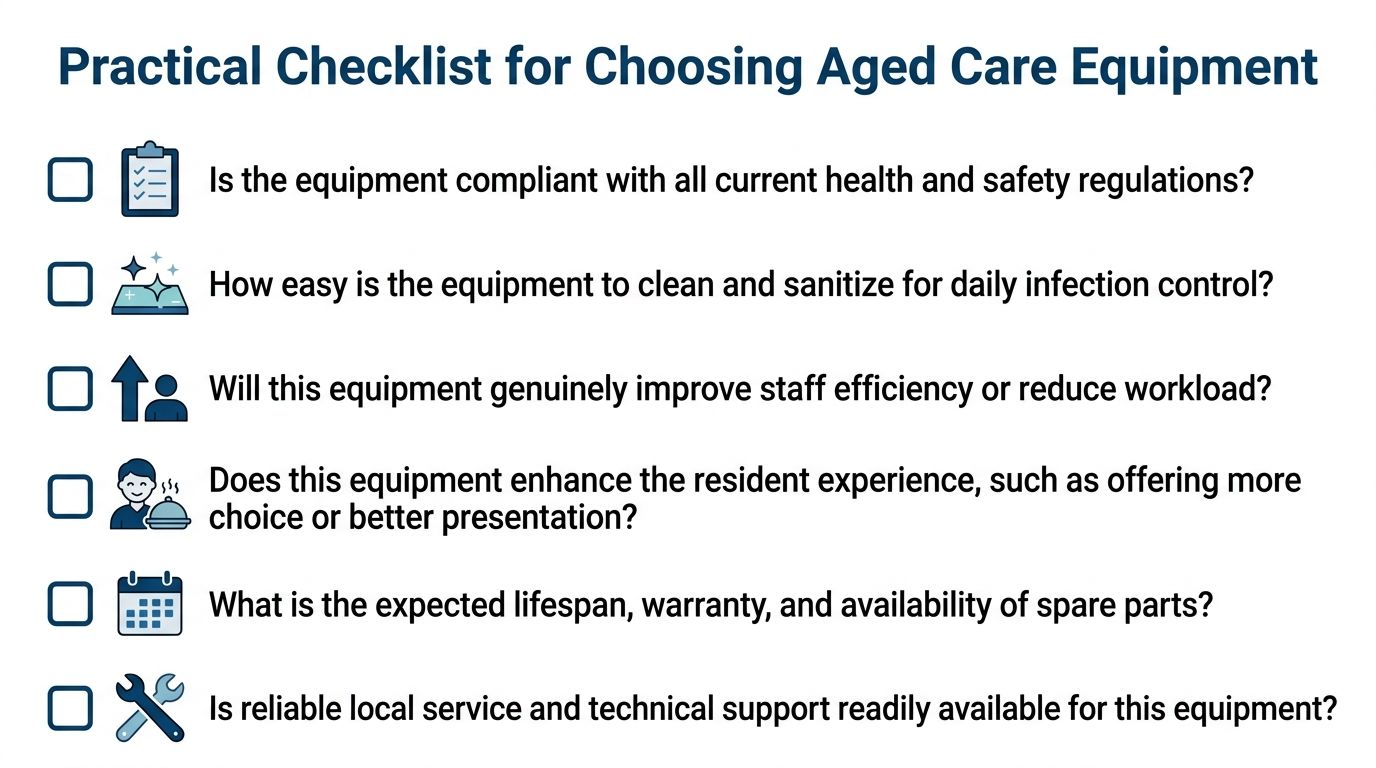
Questions worth asking before approval
- Compliance and safety: Is the equipment suitable for the environment where it will be used, including electrical and handling requirements?
- Cleaning routine: Can staff clean it thoroughly during normal shifts without awkward workarounds?
- Workflow impact: Will it make service, preparation, storage, or transport simpler for the team using it every day?
- Resident experience: Does it improve comfort, accessibility, food presentation, or choice in a meaningful way?
- Support and lifespan: What does the warranty cover, and how realistic is access to spare parts and service?
- Fit within the space: Will it work with existing benches, clearances, circulation areas, and storage constraints?
Look at systems, not isolated products
Facilities often get better outcomes when they review equipment alongside wider operating systems. For example, digital records and process visibility can affect how smoothly teams manage care, cleaning, and handovers. For operators thinking beyond hardware alone, these EkagraHealth AI's EMR system insights are a useful prompt to consider how physical equipment and information systems can support the same workflow.
A common consideration is whether the equipment still makes sense six months after installation. If staff avoid using it, if cleaning takes too long, or if it creates bottlenecks, the decision probably wasn't right even if the product itself is technically sound.
The right solution depends on the facility's layout, staffing pattern, service model, and resident needs. The strongest choices usually support all four.
If your team is reviewing kitchen, service, hygiene, or support equipment for an aged care facility, Simply Hospitality can help assess options with a practical focus on reliability, cleanability, workflow, and long-term fit for your environment.