
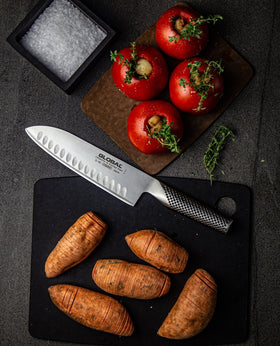

Best Chef Knife NZ: Your 2026 Buying Guide
A lot of new café owners reach the same point at once. The espresso machine is sorted, the fridge is in, the menu is nearly ready, and then someone asks which knives the kitchen should order.
That decision often gets treated as minor because a chef knife seems simple. It isn't. In a working kitchen, the wrong knife slows prep, tires staff, makes portioning less consistent, and gets replaced far sooner than expected.
When considering Chef Knife NZ options for a commercial kitchen, the question isn't just what feels sharp on day one. It's what keeps performing through constant prep, cleaning, handovers between staff, and the realities of a busy New Zealand service.
Why Your Chef Knife Is Your Most Important Tool
Friday service exposes weak gear fast. A dull, badly balanced knife won't just make chopping feel harder. It affects the whole prep chain.
A prep cook trimming herbs with a tired edge presses harder. Sliced tomatoes come out uneven. Onion dice gets rough instead of clean. Portions drift. Another staff member picks up the same knife and avoids using it because the handle feels awkward or the blade drags through product. Small delays stack up.
That's why a chef knife isn't just a utensil. It's part of kitchen output, food consistency, safety, and morale.
What a good knife changes in daily service
A properly chosen chef knife helps with more than cutting speed.
- Cleaner prep work means vegetables, herbs, and proteins are processed more consistently.
- Lower operator fatigue matters over a long shift, especially when one knife handles most prep.
- Better control usually reduces the rough, forcing motion that leads to slips and poor cuts.
- More willingness to maintain the tool often follows when staff like using it.
Practical rule: If the kitchen's main knife feels like a compromise to everyone, it usually ends up being cared for by no one.
Many customers focus first on blade sharpness. In practice, sharpness is only one part of the buying decision. The knife also has to suit the venue's prep style, staff experience, and maintenance habits. That's where long-term value starts.
Decoding Chef Knife Anatomy
Product pages throw around terms like bolster, tang, forged, and stamped as if everyone already knows what matters. Most buyers don't need collector-level knowledge, but they do need to know which features affect daily use in a commercial kitchen.

The parts that affect performance
The tip handles detail work. It's useful for fine trimming, scoring, and controlled cuts.
The blade edge does the heavy lifting. Shape matters here. A curved belly supports rocking cuts, while a flatter profile suits push cutting and fine slicing.
The spine is the non-cutting top of the blade. A thicker spine usually gives a knife more stiffness and a sturdier feel.
The heel is the rear part of the edge, close to the handle. This section often handles harder product and more forceful chopping.
The handle needs to stay secure in wet, fast-moving conditions. Comfort matters, but grip and control matter more.
Why the tang matters
The tang is the part of the blade that continues into the handle. Much of the knife's durability originates here.
A simple way to think about it is the chassis in a vehicle. If the external finish looks good but the structure underneath is weak, the whole tool suffers once real work starts.
- Full tang means the steel runs the full length of the handle. This usually gives better balance and strength.
- Partial tang can still be serviceable, but it often won't feel as planted in the hand.
- Rat-tail tang is narrower through the handle. It can suit some knife designs, but it's not usually what most operators want for hard daily commercial use.
A common issue seen in busy kitchens is buying knives based on the blade alone while ignoring construction. A blade can look impressive in a product photo and still feel unstable after weeks of repetitive prep.
Forged and stamped knives
This is another area where labels can confuse buyers.
| Construction type | What it usually means in practice |
|---|---|
| Forged | Often heavier, with a more substantial feel and stronger balance through the hand |
| Stamped | Usually lighter and more agile, often preferred by staff who want less fatigue over long prep sessions |
Neither is automatically right or wrong. The better choice depends on who's using the knife and how the kitchen works. A small café doing all-day vegetable prep may prefer something lighter. A broader production kitchen may want a more substantial knife that feels sturdy under constant use.
The best knife anatomy on paper still fails if the balance point feels wrong in the hand.
Choosing Your Blade Material and Style
Steel choice affects how the knife behaves long after the unboxing. That includes edge retention, sharpening feel, resistance to damage, and how much tolerance the knife has for rough handling.

German style and Japanese style
Most commercial buyers end up weighing two broad styles.
German-style knives tend to be more forgiving. They're usually chosen by kitchens that want toughness, versatility, and easier recovery from hard use. They suit teams where multiple staff share tools and not everyone has polished knife technique.
Japanese-style knives usually prioritise finer cutting performance. They're often lighter, harder, and capable of a keener edge. That makes them excellent for precision work, but also less tolerant of misuse such as twisting through firm product, scraping the board with the edge, or rough sink handling.
Here's the practical trade-off:
| Style | Strengths | Watch-outs |
|---|---|---|
| German style | Tougher feel, broad versatility, generally better suited to rougher handling | Can feel heavier and less nimble for fine prep |
| Japanese style | Finer edge feel, lower cutting resistance, strong precision | Needs more disciplined handling and maintenance |
New Zealand-listed premium knives show how far this has gone at the higher end. They support very sharp edges, but they also demand better maintenance in humid or wash-heavy commercial environments.
For operators considering a Japanese-style option, Yaxell Zen Damascus VG-10 Japanese Chef's Knife 200mm is the kind of knife that suits kitchens willing to protect edge quality with proper handling and sharpening discipline.
Matching style to venue reality
Many customers make the wrong choice by buying aspirationally. They buy for the knife they admire, not the kitchen they run.
A practical guide:
- Choose tougher construction if the knife will be shared across junior and senior staff.
- Choose finer edge geometry if prep quality, presentation, and slicing accuracy matter more than abuse resistance.
- Choose lower-maintenance steel if the kitchen already struggles with drying, storage, and handwashing discipline.
Building a useful knife kit
One chef knife can carry most prep, but it shouldn't be expected to do everything.
A well-rounded commercial setup often includes:
- Chef knife for all-round prep, herbs, onions, general slicing and chopping
- Paring knife for trimming, turning, garnishes, and in-hand work
- Bread knife for crusty loaves, cakes, and delicate items with soft centres
- Santoku for operators who prefer a flatter profile and efficient up-and-down chopping
A common mistake is using the chef knife for jobs that should go to a serrated or smaller blade. That shortens edge life and increases the chance of misuse.
Finding the Right Size and Fit for Your Team
The knife that looks right in a catalogue isn't always the knife staff will use well. Fit matters more than many buyers expect.
Local guidance in New Zealand identifies the 8-inch blade, about 20 cm, as the most popular all-round size because it balances control and efficiency for everyday prep work in professional kitchens, with a curved belly that supports practical cutting flow.
Why 20 cm works for most kitchens
A 20 cm chef knife usually gives enough blade length for meaningful prep volume without feeling oversized for tighter benches or less experienced staff.
It tends to suit:
- General café prep such as onions, tomatoes, herbs, citrus, and proteins
- Shared team use where one knife size needs to work across several hand sizes
- Mixed prep loads rather than highly specialised station work
Longer blades can be excellent in experienced hands. They move more product in a single stroke and often feel smoother on large prep tasks. But they also ask more from the user in terms of control, board space, and confidence.
Handle shape and balance
Handle comfort is not a luxury detail. It affects grip security over an entire shift.
A common issue seen in first-time fit-outs is buying a set because it looks tidy and uniform, only to discover that half the team finds the handles slippery, too bulky, or awkward at the pinch grip.
Points worth checking before committing:
- Synthetic handles are usually the safer commercial option because they're durable, easy to clean, and less demanding to maintain.
- Wooden handles can feel excellent, but they need more disciplined care.
- Balance point matters as much as handle shape. If the knife feels blade-heavy or handle-heavy, fatigue builds quickly.
A knife that fits the hand properly usually gets used more confidently and maintained more consistently.
One simple tip is to test with more than one staff member. The head chef's preference shouldn't be the only one that decides a kitchen-wide purchase.
For operators wanting a larger all-purpose option, Furi Pro Chef's Knife 23cm suits teams that prefer a bit more blade length for throughput, provided the handle and balance feel right in use.
One-size-fits-all usually costs more later
The cheapest bulk purchase often creates hidden friction.
Staff compensate in ways buyers don't always see. They choke up too hard on the handle. They switch tasks to avoid the knife. They use the wrong knife for the job because the main one feels clumsy. None of that shows up on the invoice, but it shows up in prep speed, edge damage, and replacement frequency.
Sharpening and Maintenance Best Practices
A lot of kitchens say they sharpen their knives regularly when what they really mean is that someone runs the blade over a steel now and then. That's not the same thing.
The first maintenance decision is understanding honing versus sharpening. Honing realigns the edge. Sharpening removes metal to create a fresh edge. If staff treat those as interchangeable, the knife usually ends up dull for long stretches and then over-ground when someone finally tries to fix it.

Choosing the right edge strategy
General NZ guidance places chef's knives in the 15° to 20° sharpening range, but the bigger operational question is which method best balances labour, durability, and speed for the kitchen's workflow.
That matters because the ideal angle on paper isn't always the ideal angle in service.
- A finer angle usually cuts with less resistance and feels sharper.
- A more durable angle usually stands up better to hard use, shared handling, and rushed prep.
- An inconsistent angle ruins both advantages.
What works and what doesn't
Different kitchens need different systems.
Whetstones
Whetstones can produce excellent results. They give control and can suit premium knives very well.
They also depend heavily on skill and consistency. In kitchens where only one staff member can sharpen properly, the system falls apart as soon as that person is off shift or leaves.
Manual sharpeners
Manual sharpeners are fast, accessible, and easier for general staff to use with less technique.
They aren't perfect for every knife, but they often make sense where consistency matters more than achieving a highly refined edge. A practical example is the Furi Diamond Fingers™ Knife Sharpener, which gives operators a straightforward maintenance option for routine edge upkeep.
Professional sharpening services
Professional services can be the right call when the kitchen runs premium knives but doesn't have in-house sharpening confidence.
The trade-off is downtime, logistics, and making sure service intervals happen before performance drops too far.
Operational insight: The best sharpening method is the one the kitchen can repeat reliably without damaging the blade.
A sensible maintenance routine
For most commercial kitchens, a workable system looks like this:
- Hone routinely to keep the edge aligned during normal service use.
- Sharpen on a planned basis rather than waiting until the knife becomes frustrating.
- Assign responsibility so maintenance doesn't become nobody's job.
- Match the method to the knife. Premium Japanese-style blades shouldn't be treated the same way as tougher utility workhorses.
A common issue seen across shared kitchens is edge damage caused by enthusiastic but poor sharpening. Too much pressure, bad angle control, and inconsistent tool choice can turn a good knife into a thick, tired cutter surprisingly quickly.
Hygiene Safety and Storage in a Commercial Kitchen
A new cafe opens on Monday. By Friday, one chef knife has gone through the dishwasher twice, spent a lunch shift sitting in a sink, and picked up a small chip from rattling around in a drawer. The purchase price has not changed, but the operating cost already has.
This part of knife ownership is where many kitchens lose money. Poor cleaning and storage shorten blade life, create avoidable injury risk, and cause hygiene problems that are hard to defend during a busy service. A good knife system protects the edge, protects staff, and keeps the wash-up area compliant.
Cleaning rules that hold up in service
Hand washing is the safer standard in a commercial kitchen. Dishwashers expose knives to heat, harsh detergents, and repeated contact with other items, which can damage edges and handles over time. Victorinox's care guidance for kitchen knives advises against dishwashing for that reason (Victorinox knife care instructions).
The routine needs to be simple enough that staff will follow it during a rushed close:
- Wash by hand after use with mild detergent and warm water.
- Dry immediately so moisture does not sit around the handle, rivets, or edge.
- Keep knives out of sinks and soak tubs where they can be hidden, knocked, or grabbed blindly.
- Take damaged knives out of service until they are repaired or replaced.
Shared kitchens often get caught by the same bad habit. Someone puts a knife down "for a minute," it disappears under utensils, and the next person finds it by hand instead of by sight. That is a safety failure first, and a knife replacement cost soon after.
Storage that reduces damage and keeps audits cleaner
Storage should match how the kitchen works, not how it looks on opening day.
Magnetic strips work well on the line or in prep areas where knives need to stay visible, but only if they are mounted away from splash zones and spaced so blades do not strike each other. Knife blocks protect edges, though they need regular cleaning because crumbs and moisture build up inside. Blade guards are practical for transport, off-site catering, or individually assigned knives. Loose drawer storage usually creates edge damage, slows staff down, and makes cleaning around tools harder than it needs to be.
For wider prep-area organisation, especially separating sharp tools from general bench clutter and wash-up overflow, this guide to commercial kitchen storage containers and organisation is useful when setting up safer storage zones.
Clean storage supports hygiene, but it also improves labour efficiency. Staff waste less time looking for the right knife, there are fewer edge repairs, and fewer blades get retired early because of careless handling. In a New Zealand commercial kitchen, that is the kind of small operational discipline that keeps total ownership cost under control.
Making a Smart Investment for Your Business
A new cafe opens, the prep list grows, and the first knife order gets treated like a minor line item. Six months later, the cheap chef knife has lost its edge, staff are pressing harder through tomatoes and herbs, and the kitchen is paying in slower prep, extra sharpening, and early replacement.

A chef knife should be bought like any other hard-working piece of commercial equipment. Judge it on service life, edge retention, how it handles repeated washing, and how well it survives being shared across a team. Purchase price matters, but labour time, sharpening frequency, misuse, and replacement cycles usually cost more over the life of the knife.
The right choice depends on the kitchen, not the catalogue.
Before ordering, ask a few practical questions:
- Who is using the knife every day
- Will one person own it, or will the whole team share it
- Can the kitchen maintain harder steel properly
- Who will handle sharpening, and how often
- What usually damages equipment in this kitchen, poor storage, rough washing, or rushed handling
In mixed-skill kitchens, a tougher, easier-to-maintain knife often gives better value than a finer, harder blade that performs well only when staff treat it properly. In more disciplined teams, paying more for edge performance can make sense because the knife stays sharp longer and suffers less abuse. That is the trade-off. Better cutting feel versus lower risk and lower upkeep.
Start with coverage of daily jobs, then add specialty knives only when the menu and volume justify them. One dependable chef knife, used correctly, usually delivers more value than a drawer full of underused blades. The same buying logic applies across the kitchen, which is why this guide on buying cheap versus buying once when equipment actually saves money is worth reading before placing a larger opening order.
A smart knife purchase reduces prep friction, keeps training simpler, and avoids the hidden costs that show up after opening day.
If help is needed selecting the right commercial chef knife, sharpening tools, or a practical starter kit for the team, Simply Hospitality can help match the option to the kitchen's workflow, budget, and maintenance reality.