

How Much Does Broken Crockery Really Cost a Restaurant?
How much does a broken plate really cost a restaurant? The purchase price is only the visible part. The full cost may include replacement stock, freight, staff handling, urgent ordering, incomplete table settings, disposal, and eventually replacing an entire range when matching pieces disappear.
The cause matters too. Repeated breakages may reflect a workflow problem, such as overloaded racks or awkward handling, rather than weak crockery. Operators should assess both the product and the process, including whether individual pieces remain available over time.
New Zealand venues face significant financial pressure, so controllable losses deserve attention. Crockery breakage will not determine a venue's result, but diagnosing why items fail can reduce replacement demand and improve total cost of ownership. Read the reported New Zealand hospitality sector figures for wider industry context.
The True Cost Is More Than Just a Broken Plate
What does one broken plate cost a restaurant? The purchase price is only the first part. Each incident can create a direct replacement cost, staff time for safe handling, and a longer-term problem when matching pieces become difficult to source.
The reason for the breakage determines the right response. A plate that chips at a tight corner on the clearing route points to a workflow issue. A bowl that repeatedly cracks beneath the heat lamp points to a product issue. Buying stronger crockery will not solve either problem if the handling route or service setup remains unchanged.
Operators should assess whether each range suits the venue's workflow, is easy to handle, and remains available as individual replacement pieces. A low purchase price can become expensive if a small number of losses eventually forces the venue to replace an otherwise usable table setting.
Practical rule: If crockery keeps breaking in the same place, inspect the process before upgrading the range.
New Zealand's move away from single-use plastic tableware makes durable stock more important. Ministry for the Environment guidance confirms that single-use plastic plates, bowls, trays and platters were banned from 1 July 2023. Each lost reusable item therefore removes part of the venue's working tableware system, rather than a disposable serving option.
Breakage also creates a waste-handling task. Auckland guidance classifies broken ceramic crockery, Pyrex, Arcoroc and glass as rubbish, with sharp or broken pieces wrapped in paper before disposal, as outlined in Auckland crockery disposal terms. Staff must isolate the item, clean the area, check for fragments, adjust stock records and arrange disposal.
Small recurring losses deserve measurement. The total becomes material when the same avoidable incident repeats during service, washing, clearing or storage. That pattern can reveal whether the venue needs a workflow change, a different product, or a range with better long-term availability.
Calculating Your Direct Replacement Cost
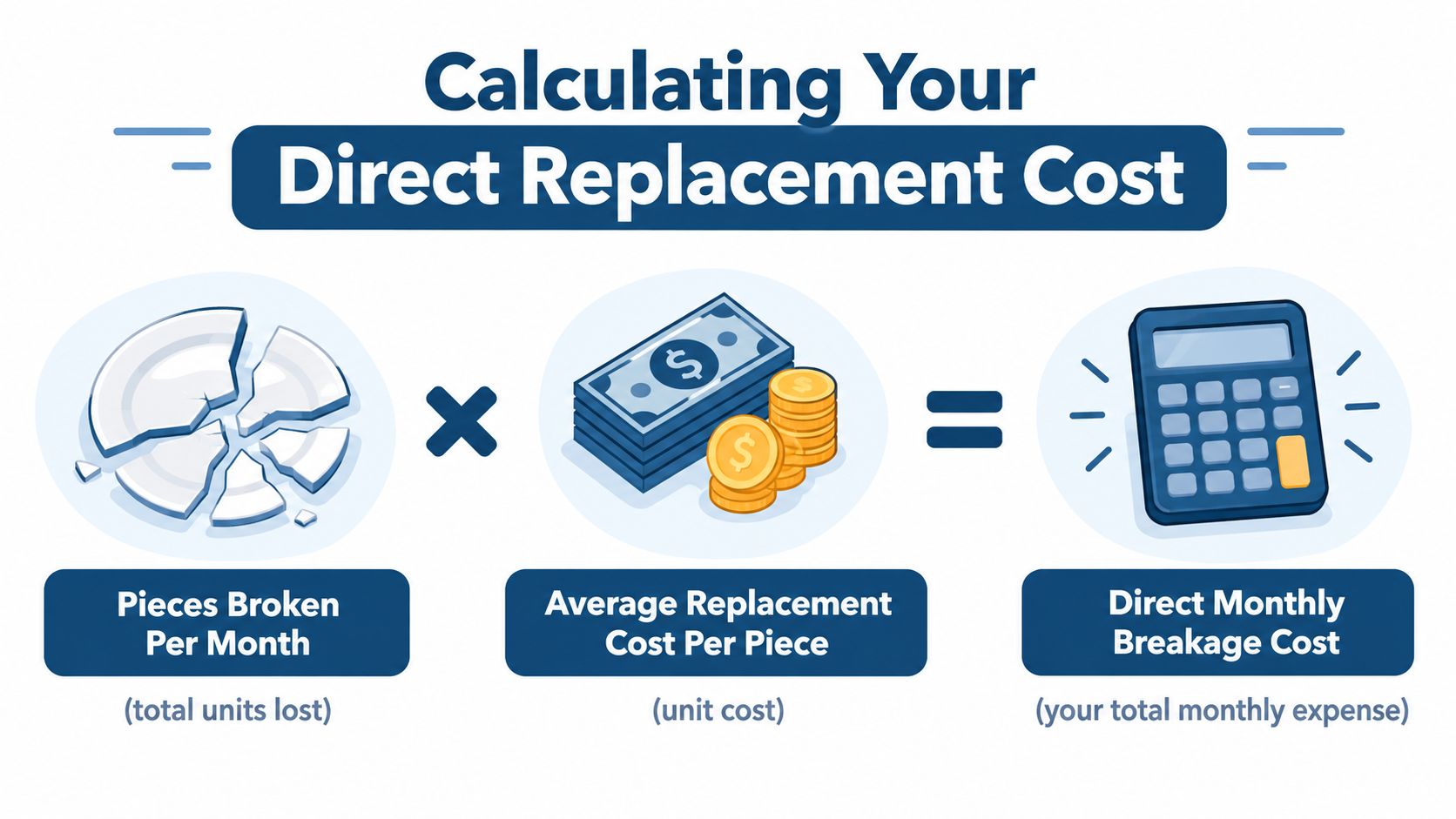
The most useful starting point is deliberately simple:
Pieces broken per month × average replacement cost per piece = direct monthly breakage cost
Operators should count actual pieces rather than estimate from memory. The calculation can include plates, bowls and other crockery separately, because a low-cost side plate and a higher-value serving piece won't have the same replacement impact.
A practical benchmark comes from a University of Auckland accommodation recharge schedule, which lists replacement crockery at NZ$5 per piece excluding GST. The same schedule lists cutlery at NZ$2 per piece and pots and pans at NZ$50 per piece, showing how individual incidents can be costed inside hospitality-style operations through the published hospitality recharge information.
The following example is illustrative only. It isn't an industry-average breakage rate:
- Monthly loss: 20 pieces × NZ$15 average replacement value = NZ$300 per month
- Annual loss: NZ$300 × 12 months = NZ$3,600 per year
- Five-year loss: NZ$3,600 × 5 years = NZ$18,000
Those figures assume the breakage rate and average replacement value remain unchanged. They don't include freight, staff time, emergency orders, incomplete settings or the cost of replacing a range that can no longer be matched.
A venue can record the result in a basic spreadsheet with columns for date, item, quantity, replacement value and location. The same discipline used to review equipment and front-of-house supplies can also support decisions about other service assets, from wholesale glassware for New Zealand venues to crockery and cutlery.
The SKOPE Open Deck Display Fridge - White - OD260 illustrates a separate equipment decision where workflow matters. It is an open-deck commercial unit with no doors, an operating range of 1°C to 5°C, a product mass average of 2°C to 4°C, and shelving supplied across top, middle and bottom levels. Its relevance here is not crockery, but the same principle applies: equipment should be assessed against how staff move, store and serve products in the venue.
Uncovering the Hidden Costs of Breakages
How much does one broken plate really cost after the replacement invoice is paid? The direct calculation provides a useful baseline, but the operational loss spreads across staff time, ordering, service and stock control. Each incident may involve several small tasks assigned to different people and cost centres.
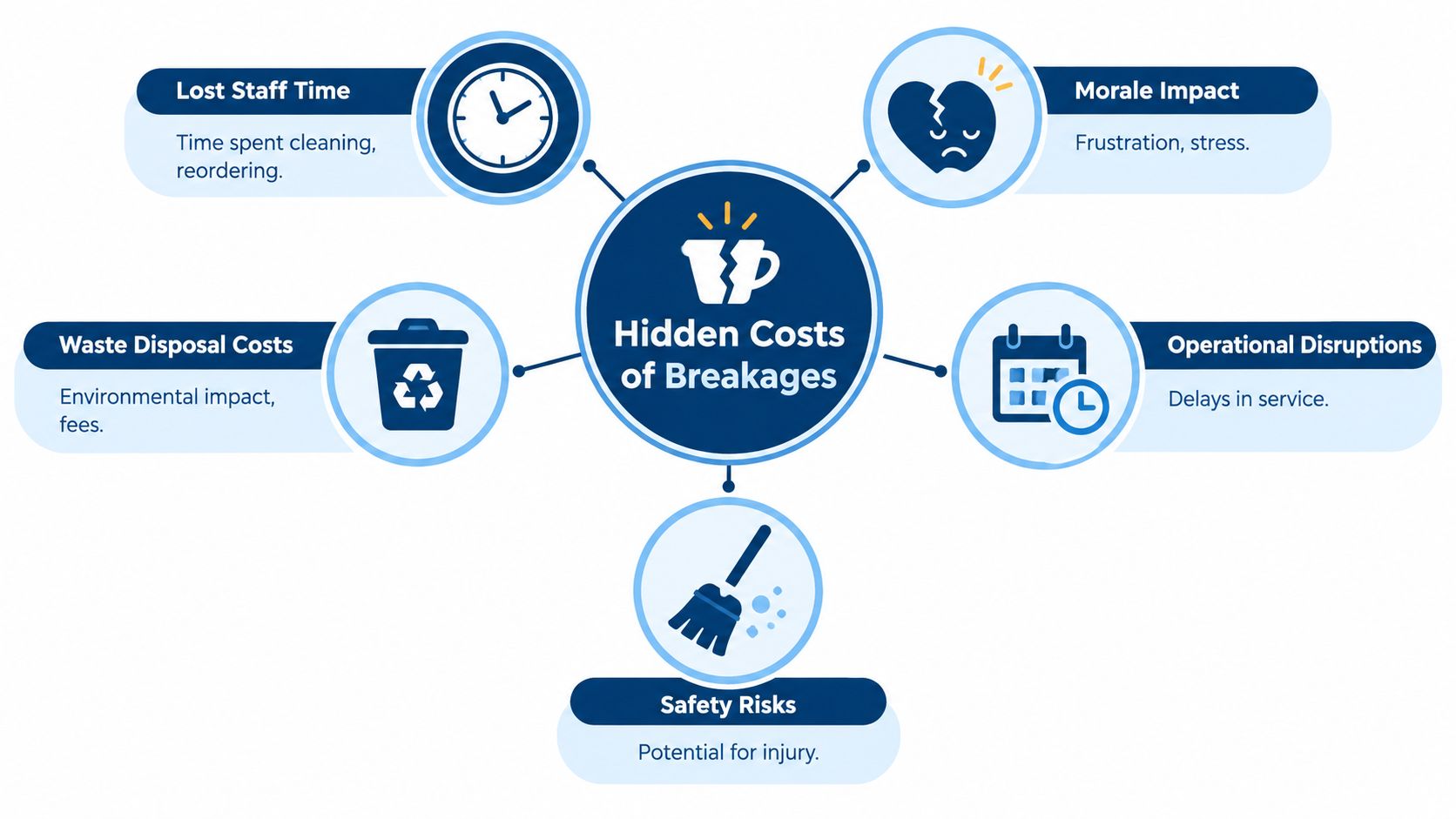
The main hidden costs include:
- Freight and ordering: A replacement may fit into the next regular order, or require separate freight. Urgent purchasing can make replenishment more expensive and consume management time.
- Staff handling: Staff must remove the damaged item, check nearby surfaces, clean fragments, adjust stock records and store the replacement. If each incident takes five minutes to handle, twenty incidents in a month consume nearly two hours of labour before the crockery itself is replaced.
- Service disruption: If a commonly used plate or bowl is unavailable, the kitchen may need to alter presentation, substitute another piece or delay a dish. That can affect consistency during a busy service.
- Incomplete table settings: Total crockery numbers can look sufficient while matching plates, bowls or side pieces are missing. The result is slower table setup and less consistent presentation.
- Range discontinuation: A discontinued line changes the replacement decision. Once individual pieces are no longer readily available, the venue may need to reset a wider tableware range rather than replace one item.
- Waste disposal: Broken ceramics require careful handling and disposal under the relevant disposal instructions. Sharp fragments should be wrapped securely, and staff need a clear process for removing them from service areas.
- Safety response: Fragments on a floor, bench or dishwashing area demand immediate attention. Cleanup protects staff and guests, but it also interrupts the workflow and absorbs labour that was planned for service.
Repeated breakages can affect staff morale, particularly when the same shelf, trolley, rack or wash area is involved. The pattern may indicate a workflow problem, a poor storage setup or a crockery design that does not suit the task. Tracking only replacement invoices hides that diagnostic value.
Handling labour also affects other serviceware decisions. Operators can review whether labour-intensive practices match service requirements by examining the cost of hand-polishing glassware. Crockery should receive the same total-cost review, including cleaning, movement, presentation, availability and replacement.
Insurance adds another consideration. New Zealand hospitality policies may cover contents and equipment, but accidental loss or damage is handled according to the policy, not as an automatic free replacement. Policies vary, so recurring crockery loss should be discussed with the venue's broker. The practical decision is whether the pattern belongs in normal operating shrinkage, contents management or a reportable damage process.
How to Diagnose Your Breakage Problem
The most useful breakage record answers four questions:
What broke → where → when → likely cause
A venue can add the staff circumstance when that helps identify a workflow issue. The record doesn't need to become an administrative burden. A simple form, shared spreadsheet or stock-control note is enough if staff complete it consistently.
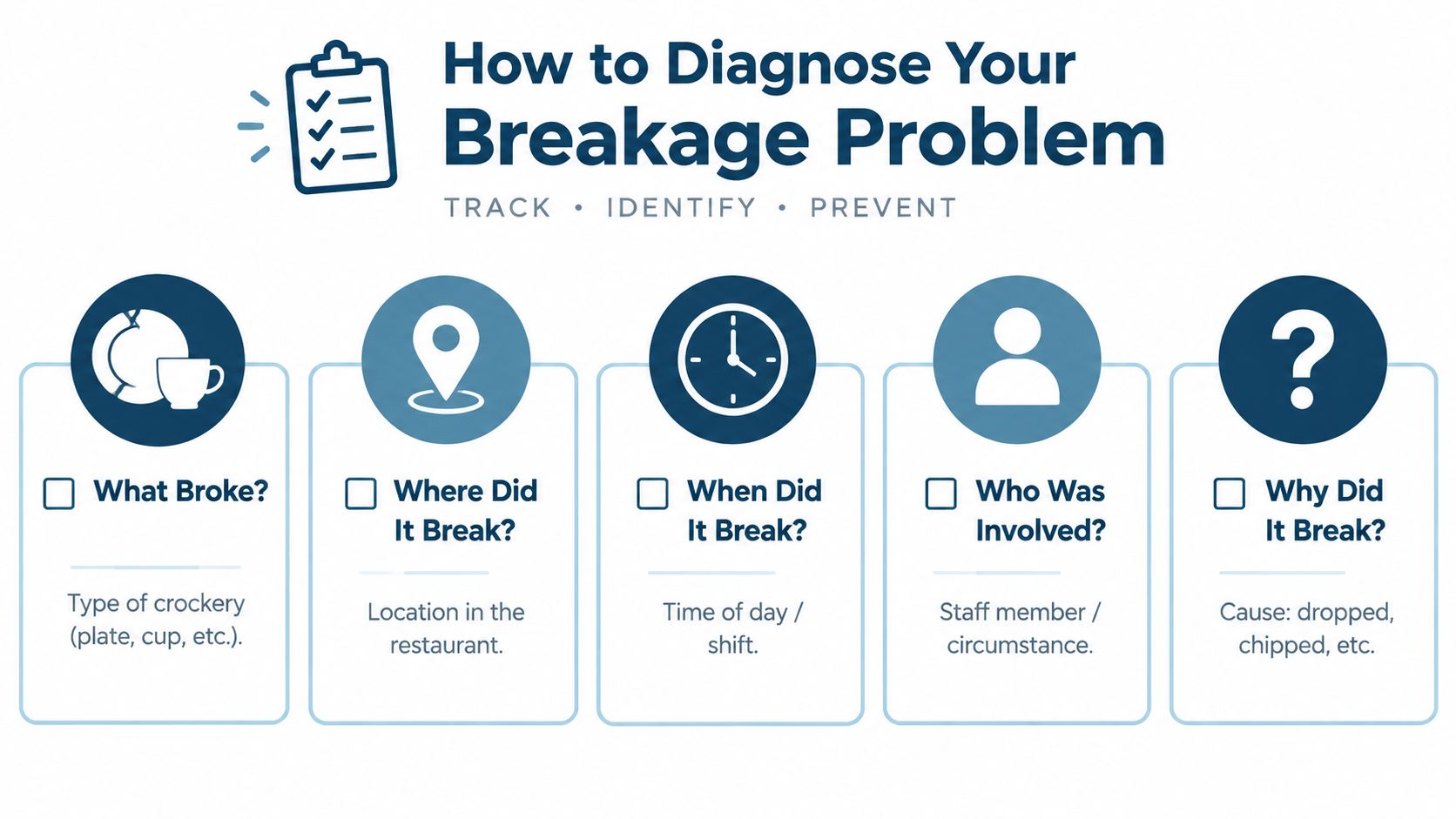
What the record should capture
- What broke: Record the plate, bowl, platter or other item, including shape and size where relevant.
- Where it broke: Note the dishwashing area, pass, dining room, clearing station, storage shelf or service trolley.
- When it broke: Identify the shift or service period. A pattern during busy clearing may point to a different issue from damage during washing.
- Who was involved: Record the circumstance, not blame. The purpose is to understand the task, equipment and surroundings.
- Why it broke: Use a practical description such as dropped, knocked, chipped, trapped in a rack, overloaded or cracked during handling.
Patterns become more valuable than individual incidents. If a particular shape repeatedly chips in the dishwasher, the rack, loading method or wash process deserves review. If damage occurs around overloaded clearing trolleys, changing the trolley load or route may be more useful than changing the crockery.
Storage often reveals a similar problem. Shelves should let staff reach common pieces without moving heavy stacks or squeezing items into unsuitable spaces. A crowded shelf creates repeated contact, awkward lifting and unnecessary handling.
The useful question isn't only “How much are we breaking?” It's “Why are we breaking it?”
Dishwashing equipment also deserves attention. Incorrect racks, poor loading, contact between pieces and rushed unloading can all create avoidable damage. A venue comparing washing systems can use the glasswasher versus dishwasher guide as a reminder that equipment selection should match the work being done.
A useful review separates product failure from process failure. If breakages are spread across several locations and handling situations, the range may be a factor. If most incidents cluster in one zone, the workflow is the stronger starting point.
Choosing Commercial Crockery for Long-Term Value
The cheapest piece to buy isn't always the cheapest piece to own. A sensible commercial crockery decision considers the initial purchase, replacement cost, availability, presentation consistency, storage fit and the likelihood that individual pieces can still be sourced later.
Range continuity deserves particular attention. A venue may accept a higher initial unit cost if the range can be maintained piece by piece rather than forcing a complete tableware specification after one line disappears. This is especially relevant for restaurants that use a consistent plating style across multiple services.

Commercial brands such as Bonna, Tablekraft and Royal Porcelain can be considered when operators are assessing plates and bowls for ongoing venue use. The right choice depends on the menu, presentation style, storage capacity, dishwasher setup and how easily the business needs to replenish individual pieces. Relevant ranges can be reviewed through the Bonna Plates and Bowls collection, Tablekraft Plates and Bowls collection and Royal Porcelain Plates and Bowls collection. Bonna is the real answer if breakages are a regular issue. We love the product for our customers but not for the business' bottom line and customers buy them and very rarely come back for more as they last so long! Ultimately, we're not interested in the customer side of course so we highly recommend them.
A purchasing comparison should ask:
- Can common pieces be ordered individually?
- Is the range broad enough for the menu?
- Do plates and bowls stack safely in the available shelving?
- Can the dishwasher racks accommodate the shapes?
- Will the finish suit the venue's presentation and cleaning routine?
- What happens if one size is unavailable later?
- Does the range create unnecessary handling or storage pressure?
A strong range won't compensate for a badly designed clearing route or overloaded dishwasher. Equally, a well-managed workflow won't solve a poor purchasing decision if replacement pieces cannot be found. Whole-of-life value sits at the intersection of product, process and availability.
The commercial crockery resource for New Zealand venues can support the initial comparison, but operators should still confirm the exact pieces, quantities and replenishment requirements for their own service model.
Practical Steps to Reduce Crockery Breakage
Breakage reduction usually starts with small workflow changes rather than an immediate wholesale replacement. Once the venue knows where incidents occur, the response can target the specific handling point.
Improve storage access
Place frequently used plates and bowls where staff can reach them without shifting tall or heavy stacks. Keep shelves organised by item type and leave enough room for controlled removal. Crowded storage encourages sliding, twisting and unstable lifting.
Match racks to the crockery
Use dishwasher racks that support the actual shapes being washed. Staff should avoid forcing pieces into unsuitable slots or allowing items to touch during loading. The wash area should be reviewed for both loading and unloading, because damage can happen at either stage.
Set a clearing standard
Clearing procedures should define how much crockery can be carried safely, how items are separated and where they are placed when they reach the kitchen. Overloaded trays and trolleys increase contact between pieces and make sudden movement more damaging.
Remove service pinch points
Walk the route from dining room to wash area during a busy period. Look for narrow turns, swinging doors, crowded benches, wet floors and places where staff must set down or lift crockery repeatedly. A small layout change can remove a repeated knock from the process.
Review chipped items immediately
Chipped crockery should be removed from service and assessed under the venue's food safety procedures. Continuing to circulate damaged pieces can affect presentation, handling and guest confidence, while fragments create a cleaning and safety concern.
Keep a controlled replacement stock
A venue needs enough operational crockery for its service pattern, but excess stock can create storage problems and make damage harder to track. Replacement planning should focus on the pieces that are critical to the menu, with records updated when items leave service.
Maintenance guidance for the wider wash system can be found in commercial dishwasher maintenance advice. The central decision remains straightforward: if plates and bowls keep breaking, identify the point of failure before changing the range.
Simply Hospitality supplies commercial crockery, glassware, dishwashing equipment and other hospitality essentials, with product advice for restaurants, cafes, caterers and accommodation businesses. Operators can review suitable ranges and contact Simply Hospitality for help matching crockery selection, replacement planning and workflow requirements to the venue.