


How Much Does Preventative Equipment Cleaning Really Save?
A fridge that struggled overnight, a dishwasher that started backing up at lunch, or a fryer that's gunked up faster than expected all create the same question for an operator, how much money is being left on the table by skipping proper cleaning? The honest answer is that preventative equipment cleaning saves money by reducing risk, not by promising a fixed repair reduction. In hospitality, the value sits in avoided downtime, protected stock, lower energy waste, and delayed replacement, and that logic depends heavily on how critical the equipment is to service.
Hospitality supplies commercial equipment and cleaning-related products, but it doesn't perform equipment servicing or keep service-call statistics. That matters, because any credible answer has to be built on the economics of cost of prevention versus potential cost of neglect, not on invented averages. For operators weighing their own programme, the right comparison is usually staff cleaning time, cleaning products, and scheduled maintenance against repairs, emergency call-outs, downtime, spoiled stock, lost production, and premature replacement.
If the cleaning product side is part of the decision, it's worth choosing products that fit the equipment and the task, not just the cheapest bottle on the shelf. A practical place to start is Simply Hospitality's own article on eco-friendly cleaning products in NZ, because the cleaning chemistry still needs to be safe for food environments, surfaces, and staff workflows.
Introduction Why Cleaning Is a Commercial Decision
A lot of venues only see the cost of neglect once service is already under pressure. A coolroom door seal starts leaking, the compressor works harder than it should, and stock sits at risk. A dishwasher filter clogs, the cycle slows, and the pass starts backing up with dirty ware because no one has time to stop and clear it.
That is why preventative cleaning belongs in commercial decision-making, not just housekeeping. In New Zealand, preventive maintenance is defined as systematic inspection, detection, and correction of early failures before they become major defects, and NZQA includes cleaning and lubrication as part of routine preventive maintenance on machinery and equipment (NZQA preventive maintenance standard). For hospitality operators, cleaning schedules are part of asset care.
Practical rule: if the task protects function, safety, or uptime, it belongs in the maintenance programme, not in an “if there's time” bucket.
That matters in restaurants, hotels, marae, hospitals, and aged-care kitchens where a dirty component can become a service issue fast. A proper clean-down keeps equipment within the conditions it was designed to work in. It also shifts the question from “does cleaning save money?” to “which cleaning tasks save money, on which machines, and at what frequency?”
That is the question operators should ask before choosing cleaning products, setting schedules, or buying equipment that is easier to maintain. The right product still has to suit the job and the food environment, which is why practical buying decisions often start with guidance like Simply Hospitality's article on eco-friendly cleaning products in NZ.
A sensible programme starts with the equipment that cannot fail without immediately hurting trading. The next step is defining what preventative cleaning covers in a commercial kitchen.
What Preventative Cleaning Means in a Hospitality Context
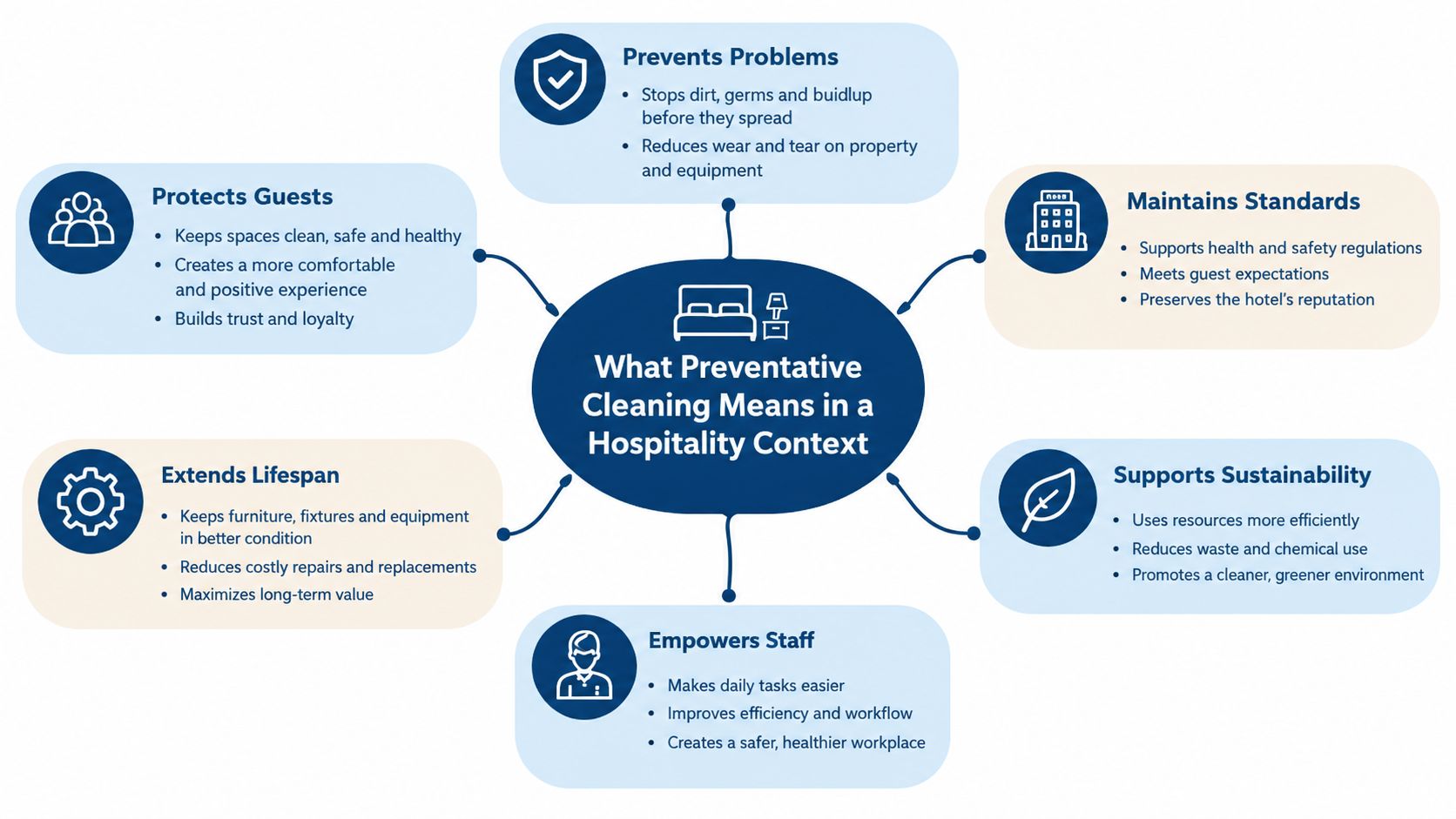
A dirty machine is only part of the problem. Preventative cleaning is the scheduled work that keeps equipment within the condition it was designed to operate in, while also picking up early signs of wear before they turn into breakdowns. Under the NZQA definition introduced earlier, cleaning and lubrication sit inside routine maintenance, so they belong in the asset plan, not in an “if there's time” job list.
That distinction matters on a busy site. Heat, steam, grease, vibration, constant opening and closing, and heavy use all create wear points that may not show from the outside. A clean machine can still be developing a fault internally, but regular cleaning gives staff a chance to spot residue, leaks, loose seals, blocked filters, or other early warning signs before they interrupt service.
What that looks like on the kitchen floor
In practical terms, preventative cleaning turns “wipe it down” into a set task with an outcome. That can include removing residue from food-contact surfaces, clearing accessible filters, wiping seals, and checking for deterioration around high-wear parts. The aim is not cosmetic polish, it is keeping the equipment close to the condition the manufacturer expects.
The trade-off is simple. A rushed clean may save minutes now, but it can leave grime in places that shorten component life or hide a fault. That is why operators need clear task ownership and a schedule that matches how hard the equipment is being worked.
Restaurants and hotels feel the impact through uptime and hygiene. Marae, hospitals, and aged-care kitchens often have even less tolerance for equipment failure, because one fault can disrupt a service run rather than a single meal.
The same preventive logic applies outside kitchens, as this rug care basics in Birmingham resource shows, regular care is about preventing avoidable deterioration, not waiting for visible damage.
Why the definition matters commercially
A clear maintenance definition gives operators a defensible way to write cleaning into asset care systems. It also stops the schedule from becoming vague. “Clean regularly” sounds fine, but it does not tell staff what needs cleaning, when it needs cleaning, or who is responsible.
A proper programme treats cleaning as one part of a wider maintenance system. That is where the economics start to show, because the cost of a missed clean is rarely the clean itself, it is the repair, downtime, or lost stock that follows.
The Cost Equation Behind Preventative Cleaning
A clean schedule makes sense once you price both sides of the ledger.
Cost of prevention is staff cleaning time, cleaning products, and planned maintenance. Potential cost of neglect is repairs, emergency call-outs, downtime, lost production, spoiled stock, and early replacement. That is a better way to judge the spend than chasing a fake “average saving per machine”, because the numbers shift by venue, duty cycle, and asset type.
Commercial truth: a cleaning task only looks expensive until it prevents a much more expensive interruption.
New Zealand business cost data still show repair and maintenance as a real operating burden. Figure.NZ tracks annual price movement for repair and maintenance of machinery and equipment, including a rounded 1.37% year-on-year increase in 2015 Q2 and a 0.27% quarter-on-quarter increase in the same period (Figure.NZ cost series discussed in this NZ hospitality maintenance article). That does not prove a cleaning saving on its own, but it shows why operators work to keep maintenance pressure from compounding.
Equipment criticality changes the maths
A fridge failure is not the same as a food processor failure. One can put stock and food safety at risk straight away, while the other may mainly add labour and slow prep. The same cleaning programme will not return the same value across both.
| Equipment Type | If It Fails | Dominant Cost Risk |
|---|---|---|
| Refrigerator | Stock risk, temperature control loss | Spoiled stock and urgent response |
| Dishwasher | Warewashing flow stops | Service disruption and labour pressure |
| Oven | Menu capacity drops | Lost production and trading limits |
| Fryer | Production bottleneck | Slower output and menu constraint |
| Food processor | Prep slows or shifts to hand work | Extra labour and workflow drag |
That is why local content often stays qualitative when talking about savings, while the clearest NZ figure found in non-hospitality industrial cleaning was a case study showing over $280,000 in annual savings from water, chemical, and labour reductions, plus lower equipment maintenance costs and less downtime (Biogiene red meat case study). The point for hospitality is not to copy that number. It is to see that cleaning can change the full cost stack, not just the repair bill.
Rewashing is one of the clearest neglect costs, as covered in how much is rewashing costing your commercial kitchen. If staff have to repeat a job because the first pass missed soil, the business pays twice, once in labour and again in service flow.
A second useful point is that different venues carry different risk. A facilities provider may talk about preventive maintenance as a way to reduce costly downtime and repair bills, but it still will not give a one-size break-even point for every appliance class (HMS maintenance services). That depends on what failure costs your operation.
The same prevention logic applies outside kitchens, where seasonal exterior cleaning prevents bigger repairs. Water, grime, and blocked surfaces do their own damage if they are left alone.
If the machine protects stock, service, or compliance, cleaning is a risk-control cost, not an overhead to trim.
Equipment Specific Cleaning That Protects Performance
Good cleaning only works when it matches the machine. The right task on the wrong component can do nothing, and the wrong task on a sensitive component can create damage. That's why manufacturer instructions matter, especially when cleaning touches moving parts, sealed cavities, sensors, or safety systems.
Refrigeration
For commercial refrigeration, operator cleaning usually means accessible filters where applicable, door seals, internal surfaces, and keeping airflow paths clear. Dirty condenser coils and poor sealing make compressors work harder, and EECA's hotel and motel guidance says cleaning condenser coils can save 2–3% of refrigeration costs for every 1°C reduction in condenser temperature because dirty coils raise temperature and pressure and force the compressor to work harder (EECA hotel and motel guidance). EECA also notes those savings usually cover cleaning costs within a few months.
A practical example is a SKOPE ProSpec 9 Drawer Underbench Fridge - PG11.UBR.3.D9, which is built for organised cookline access and dependable food-safe cold storage, with a 9-drawer configuration, stainless steel 304 AISI cabinet construction, an operating range of 1°C to 4°C, ambient rating to 40°C, and an SCS Connect controller. On a cabinet like that, good cleaning is part of protecting the airflow, seals, and food-safety visibility the design depends on.
Dishwashers, ovens, fryers, and food prep gear
Dishwashers need filters and strainers cleared, wash and rinse arms checked, food debris removed, and the interior cleaned so spray patterns stay open. Ovens need manufacturer-prescribed cleaning, and where automatic cleaning systems exist, those still need the correct cycle and the right chemicals. Fryers need oil management, filtration, and removal of food debris according to the manufacturer's procedure. Food-preparation equipment needs food-contact components cleaned correctly, with disassembly done only where the manual allows it.
The business value is partly hidden in the inspection step. A staff member wiping a door seal or clearing a filter can spot a damaged gasket, a leak, unusual build-up, or a change in sound or heat output before the machine fails. That observation step is often where the money is saved.
Don't cross the line into servicing
Many operators already understand that clean equipment is easier to service, but they don't always separate the tasks cleanly. A useful internal reference is this commercial refrigeration maintenance article, which sits alongside the principle here, cleaning supports performance, it doesn't replace technical repair.
For restoration and maintenance teams, a similar mindset appears in this maintenance guide for restoration gear, where access, condition checks, and routine care matter as much as the final finish. In kitchens, the same rule applies, clean what staff are trained and authorised to clean, and leave internal systems to qualified technicians.
Operator Cleaning Versus Technical Maintenance
A lot of trouble starts when cleaning and servicing get blurred together. Staff see poor performance, assume something needs dismantling, and go too far. That's where equipment damage, safety risk, and warranty problems start to stack up.
What staff can do
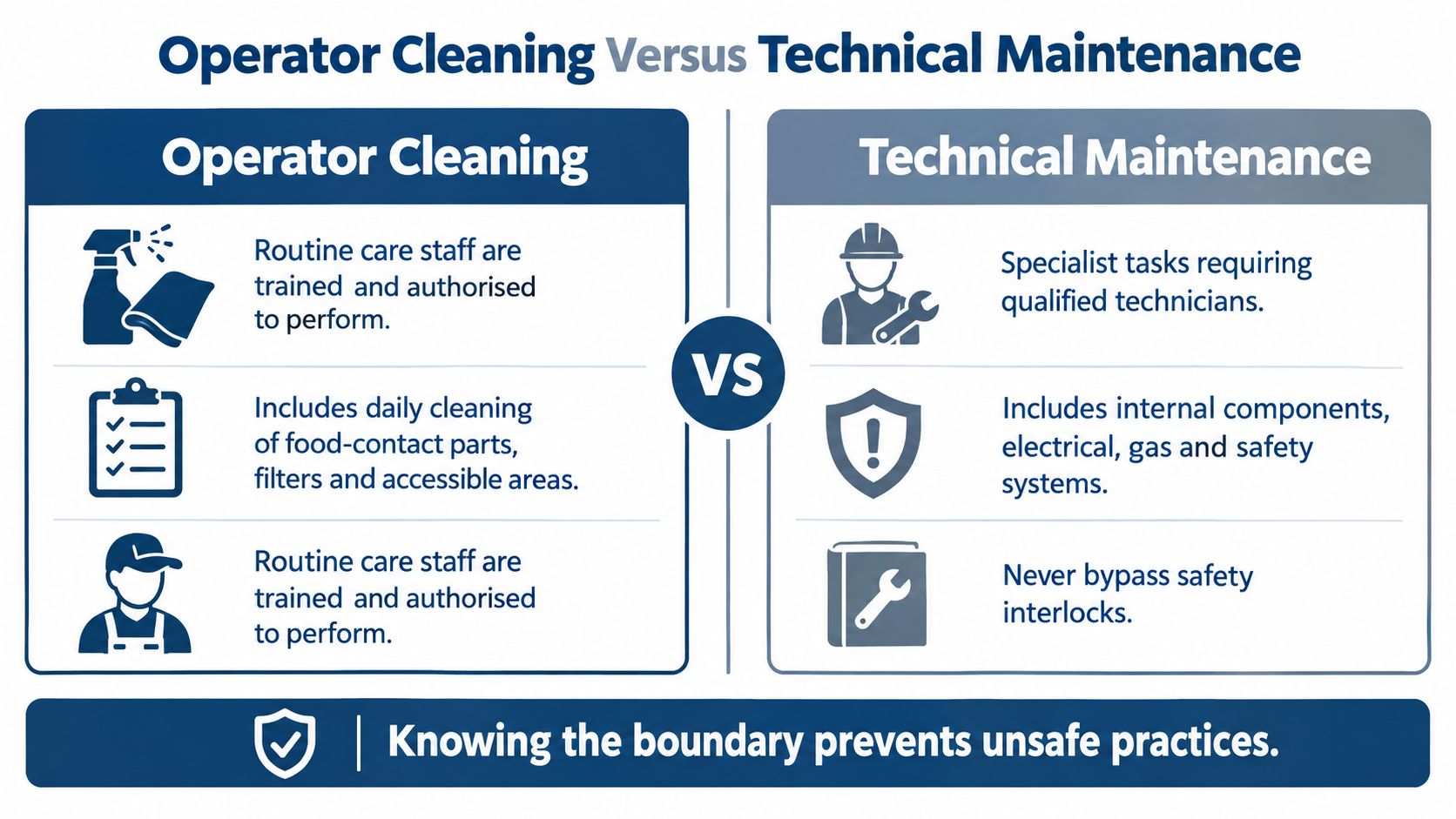
Operator cleaning is the routine care staff are trained and authorised to perform. That usually includes wiping food-contact parts, emptying debris, clearing accessible filters, checking seals, and cleaning visible build-up that's part of the manufacturer's maintenance instructions. It's the kind of work that protects hygiene and helps the machine operate as intended.
What technicians should handle
Technical maintenance is different. Electrical, gas, refrigeration, and other internal systems need appropriately qualified service technicians. Staff shouldn't bypass safety interlocks, dismantle systems beyond their training, or try to “clean” components they don't understand. Cleaning can remove stress from equipment, but it won't prevent every mechanical or electrical failure.
The practical value of routine cleaning is that it often catches simple faults early. A blocked dishwasher filter can be cleared by staff. A refrigeration filter that's dirty according to the manufacturer's instructions can be cleaned before it creates a larger problem. Once performance continues to deteriorate after proper cleaning, that's the point to escalate.
Boundary to remember: if the task involves safety systems or sealed components, it isn't a cleaning job, it's a service job.
That distinction matters for warranty too, because much of the required cleaning and servicing sits inside manufacturer conditions. A machine that hasn't been maintained according to the manual can be expensive in ways that don't show up on the first invoice. Hospitality's own article on commercial dishwasher maintenance is useful background for operators trying to keep that boundary clear.
Building a Cleaning Schedule and KPIs That Actually Work
Ad hoc cleaning always looks cheaper right up until the first avoidable failure. The fix is not more enthusiasm, it's ownership. A schedule only works when someone is responsible for each task and each frequency.
A practical structure
A simple kitchen system usually breaks down like this:
- After use: food-contact components and immediate residues.
- Daily: routine operational cleaning, emptying debris, wiping seals, checking visible condition.
- Weekly or monthly: deeper accessible cleaning and inspection, based on the manufacturer's instructions.
- Scheduled professional maintenance: work that requires qualified technicians.
That structure makes the job accountable. It also makes it easier to train staff, because everyone can see what belongs to the shift, what belongs to the weekly close, and what sits outside operator responsibilities.
KPIs that are actually worth tracking
Hospitality New Zealand's energy efficiency checklist recommends monitoring and tracking electricity, gas, petrol, and water usage monthly, comparing each month with the same month a year earlier and on a rolling 12-month basis, and setting a reduction target (Hospitality New Zealand energy efficiency checklist). It also explicitly advises implementing a schedule so equipment is cleaned and serviced regularly.
Those measures are practical because they show whether cleaning and maintenance are holding the line on waste. Other useful indicators include rewashing rates, refrigeration temperature monitoring, and the number of issues spotted during cleaning. A rise in missed cleans or recurring debris usually signals a scheduling problem, not just a labour problem.
Hospitality's cleaning programmes for cafes fits neatly into that approach, because café operators often need simple task ownership more than elaborate systems. The point is to make cleaning visible enough that management can see whether it's happening and whether it's preventing repeat issues.
Useful habit: if a cleaning task doesn't have an owner, a frequency, and a check point, it isn't a programme.
Making the Right Call for Your Venue
The saving from preventative equipment cleaning isn't just the repair bill you might avoid. It's the service you don't lose, the stock you don't throw away, and the equipment you don't have to replace earlier than necessary. That's why the right answer depends on your equipment mix, volume, and how critical each asset is to trading.
In practice, operators get the best result when they match the cleaning task to the machine, keep operator cleaning separate from technical maintenance, and track the few KPIs that show whether the programme is working. In our experience, that approach is especially useful in kitchens where refrigeration, dishwashing, and hot-line equipment all carry different risk profiles.
If the goal is to reduce avoidable stress on commercial kitchen equipment, Hospitality can help with equipment selection, cleaning products, and maintenance-aware planning across refrigeration, dishwashing, cooking, and food-prep categories. For venues building a cleaner, more reliable operation, the next step is to look at the machines that matter most and decide which ones deserve a tighter cleaning and inspection routine.
If you want help choosing equipment and cleaning products that suit your kitchen's workload, visit Simply Hospitality and talk through the equipment mix, cleaning routine, and maintenance priorities for your venue.